Showing posts with label A Touch of Zen. Show all posts

Monday, February 25, 2013

Film #95: Legend of Drunken Master (1994)


Original Chinese Title: Jui kuen II

Directors: Chia-Liang Liu, Jackie Chan

Original Release Country: Hong Kong (China)

Times Previously Seen: once (about 14 years ago)

Kung-fu Quick Summary:

China, approximately the 1930s or 1940s. Young man Wong Fei-hung (Jackie Chan) is returning by train with his father from a business trip. His father is a respected herbalist, and they have been on a buying expedition. The impetuous Fei-hung gets caught up in trying to smuggle some ginseng onto the train, to avoid paying a tax, and his plant gets swapped with an antique stone. After a few fights and further confusion, Fei-hung, his father, and their assistant arrive home safely.

After arriving back at his father’s shop, Fei-hung and his clownish step-mother cover up their father’s missing ginseng through various tricks. Amidst all of this, Fei-hung gets caught up in a street fight in which he utilizes his “drunken boxing” style – a form of kung-fu that is virtually unbeatable but requires the practitioner to consume ever-increasing amounts of alcohol. For this reason, Fei-hung’s father forbids it.

Fei-hung, getting loaded in the middle of just one of many ass-whippings that he delivers in the movie. Sure, the idea of alcohol-fueled martial arts invincibility is ridiculous. But it's fun.

Fei-hung and his family are eventually visited by Master Fu Wen-Chi, China’s top counter-intelligence officer, and a man whom Fei-hung had fought during the train ride that set all of his trouble in motion. Wen-Chi explains that the antique stone that Fei-hung had found is one of an entire hoard of Chinese historical treasures that are being stolen and smuggled out of China by a corrupt British diplomat and his regional Chinese cronies.

With the help of miners abused by the diplomat’s henchman and Master Fu Wen-Chi, Fei-hung leads an assault on the thieves headquarters – the mines from which they are excavating and stealing the national treasures. Fei-hung fights his way through a gauntlet of ever-more skilled adversaries and, by embracing his drunken boxing skills, defeats them all. The treasures are returned to their rightful owners, the Chinese people, and the fiendish British diplomat is banished.

My Gut Reaction to the Film (Done after this most recent re-viewing)

I assume that this film was put on the “All-TIME 100 list” because it is considered the absolute pinnacle of what kung-fu movies can offer.

If this is the case, then I can now say that kung-fu is simply not a genre that holds my attention.

In an odd way, my feelings towards the kung-fu genre are similar to the way I feel about the musical or even dance film genres. I can appreciate the planning, skills, and execution that they all require, and I can even marvel at these things for a while. Eventually, though, I’m always left wanting more narrative and emotional substance. Legend of Drunken Master is no exception.

Whether you're a fan of martial arts flicks or not, you have to marvel, even if only for a few moments, at the physical skill exhibited throughout the movie.

Story-wise, you have a nationalistic tale that is threadbare and so simple that it almost insults your intelligence. While the thievery of Chinese treasures of antiquity has been and is a real problem, this film’s treatment of it makes it clear that it is only meant to imbue the goofy Fei-hung with some sort of heroic purpose. I guess even Hong Kong kung-fu movies need their McGuffin.

In reality, the nefarious thievery acts more like whatever throw-away premise would get used in a W.C. Fields movie – it’s simply something that serves as an excuse for the star to do what he is best known for. In Fields’ case, it was begin a drunken, wise-cracking buffoon. In Jackie Chan’s case, it is being a lightning-quick contortionist/martial artist who dispatches hordes of enemies. The reason is completely inconsequential, so long as the star gets to do his thing. This keeps things rather simple, which can be both good and bad.

Interestingly, this film’s connections to the movies of long ago do not lie in its simplistic plot alone. One can easily see a very heavy dose of silent-film era shenanigans in Legend of Drunken Master. Between Chan and his step-mother, played by Anita Mui, the goofy slapstick is never very far. Chan himself often channels the great Buster Keaton, as far as pulling off effortless acrobatic and gymnastic moves, even when doing what would otherwise be routine movements. At times, I was also reminded of a quote I once heard about Fred Astaire – that he was “always dancing,” even during non-dancing scenes. Chan doesn’t “always” dance through his scenes, but when he does, it is to excellent effect. However, I must say that the slapstick eventually became more sophomoric than amusing to me.

The thing that makes this movie stand out is, of course, the action sequences. Jackie Chan and co-director Chia-Liang Liu (also a long-time stuntman in Hong Kong martial arts flicks) concocted and executed some phenomenal sequences in this movie. The speed and precision of the movements create a ballet of violence that will mesmerize any viewer. At least, for a little while. This was my problem. Like the slapstick elements of the movie, what begins as magnetic eventually became tiresome to me. The latter half of the film, with Chan facing down dozens and dozens of generic thugs and henchman, had lost its luster. I realize that not everyone feels this way. There are plenty of kung-fu movie fans who live for this stuff, and those fans would surely love every minute of every fight scene in this movie. I, however, grew weary of them.

One other gripe I have regarding the action sequences is their authenticity. One legitimate claim to fame that Chan has always had is that he and everyone in his movies perform all of their own stunts. However, in Legend of Drunken Master, it is quite clear that suspension wires are used during several of the fights and stunts. This is a bit disappointing since part of the intrigue of these movies is seeing just how far the stuntmen and women can push the limits of the human body, in terms of agility, flexibility, and coordination. Some of this wonder is diminished, though, when I can tell that they are “cheating” somewhat by using tools that any old “action” star could use. It would be like seeing Swan Lake when you know that the ballerina is using support wires. Not nearly as impressive.

One of the most obvious of several scenes that used wires to hold the actors up, allowing them to preform stunts and moves that seemingly defied gravity. Rather cheap, in my view. 

So I’m pretty much done with kung-fu movies. Perhaps there are still some out there that show the depth and development that I’ve always found lacking in them. Unless I hear of an unusually thoughtful or meditative film like the previously reviewed classic, A Touch of Zen, or the much more recent Crouching Tiger, Hidden Dragon, I’ll be staying away from this brand of film.

That’s a wrap. 95 shows down, 10 to go.

Coming Soon: Pulp Fiction (1994)


“Bring out the gimp.”

Please be sure to pick up all empties on the way out.

Saturday, November 26, 2011

Film #67: Xia Nu (1971)


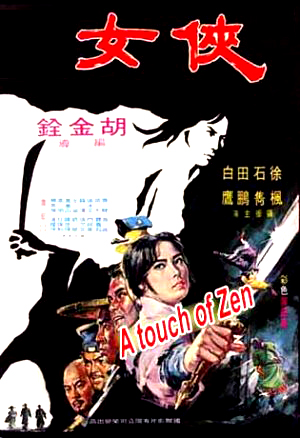
Title for us English-Types: The Dignified Lady, a.k.a. A Touch of Zen

Director: King Hu

Initial Release Country: Taiwan

Times Previously Seen: none

Teaser Summary (No spoilers)

Chinese scholar helps a young woman deal with corrupt government officials who pursue her. Many people brandish swords and jump really high.

Extended Summary (Slightly longer plot synopsis. Spoilers included.)

In a small village in Ming Dynasty China, a young man named Ku lives a humble life. He is an artist and a scholar who ekes out a living doing portraits and scribing. The only seeming worry is his mother, who constantly badgers him about his bachelorhood and apparent lack of ambition for more prominent work within the government.

Within a short span, several strangers appear in the town: Doctor Lu, the blind fortune-teller Shih, a government official named Ouyang, and the young woman Ying. The very private and rarely-seen Ying actually moves into the supposedly haunted fort next to Ku's ramshackle home, which is part of a larger dilapidated and disused castle.

Over the next several days, it becomes clear to Ku that each of the newcomers is hiding something beneath their simple public personas. After a few moments of mystery and suspense, Ku learns that Ying, whose real name is Yang, is the daughter of a former magistrate who was going to inform the emperor of massive corruption. The primary figure involved in the corruption is someone known as “Eunuch Wei”, who intercepted Yang's father and had him tortured to death. Yang flees with two trusted generals – Shih and Lu – until they find refuge in the monastery of fighting Buddhist monks and remain there for two years.

Back in the present, Ku and Yang share an evening in each other's arms. Shortly after, Ku helps Yang and her two general protectors to lure Eunuch Wei's forces into a trap. Using local superstition and his own mechanical contrivances, Ku entices hundreds of Wei's forces, led by corrupt local officials, into the “haunted” fort and methodically lays waste to them with various traps. His plan is executed brilliantly, but he finds that Yang has fled the morning after their night-time victory.


Yang, Ku, and the generals trek through the jungle. You can bet that bodies and blades will be soaring through the air, shortly.

Ku, over several months, tracks Yang back to the monastery where she previously was sheltered. Before he can ascend the monastery mountain and find her, though, a monk brings down a newborn child – the result of his single night with Yang. With the child is a note from Yang asking that she not be disturbed, for she seeks permanent solitude in the monastery. Ku, dejected, begins to take the child home.

Ku and his infant son do not get far when he is accosted by a small band of soldiers, headed by Hsu Hsen-Chen, the brutal and powerful leader of Eunuch Wei's forces. Before Hsu can take Ku, however, Yang and the monastery's master, Abbot Hui, intercede. The immensely powerful yet impassive Hui uses his remarkable martial skills to eventually subdue and dispatch the considerable might of Hsu, though not before receiving a mortal wound at his hands.

In the end, the wounded but living Ku and Yang look on as Abbot Hui struggles to ascend a nearby rock formation. Hui sits in a lotus pose and becomes one with Buddha.

Take 1: My Gut Reaction (Done after this one viewing, before any research on the movie.)

This movie is as good as I can imagine a kung-fu movie getting, which tells me that kung-fu movies just are not my thing.

A Touch of Zen has a ton going for it, which is good since it clocks in at over three full hours. There are plenty of compelling things that will enthrall a viewer, as they did me. The movie blends several strong components with a style that, though familiar, takes on a different feel due to the unique setting. However, after a certain point, the genre elements of the movie became rather dull.

The movie is divided into two parts, as most 180-plus-minute movies are, and the division is not just temporal. The very style of the movie changes drastically between the first and second parts. When dwelling on the first part of the movie, I can't help but think of the previous movie that I reviewed for this blog, Once Upon a Time In the West. Like that and other Leone films, A Touch of Zen begins with very deliberate, quiet pacing. It allows the viewer to passively drink in the scenery, the characters, and everything about the setting. I found this enjoyable since the director, King Hu (yes, that was his name – your sophomoric joke here), had a real eye for camera placement. I don't know if he was a student of Sergio Leone's films, but the parallels are hard to miss. Plenty of wide-angle shots cut with close-ups, featuring the vibrant faces and varying landscapes catch the eye throughout the film.


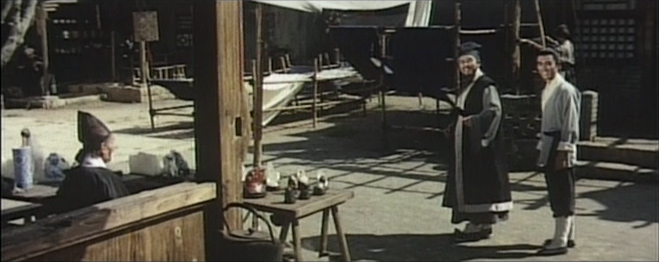
Many of these earlier scenes in the village create a great feel for the little place, not unlike Sergio Leone's Westerns.

Another great strength of the first half of the film is revelations about the various mysterious characters. It takes well over an hour to get the whole story of Uoyang, Ying and the generals, but until you do, the intrigue makes for great theater. I also found it great that a lot of the suspicions and enigmas are, initially, merely hinted at through looks and gestures rather than superfluous dialogue.

Hu definitely took a slow-burn approach to this, and I loved the way that it inched its way into the movie. It starts with a small attack between two people. To this point, there has been nothing outlandish in the film. Suddenly, in the midst of a fight, two fellows are deflecting daggers with their bare hands and leaping ten to twenty feet in the air off of tree branches. These initial dashes of the supernatural work well within the movie early on, and they lend an entertaining sense of adventure.

However, the second part of the film defines the phrase “too much of a good thing” to me. Whereas the first 90 minutes mostly comprise still moments punctuated by gradually-extended action sequences, the second half of the film is almost all action, with very few quieter moments. It's pretty neat to see a few people flying around like trapezists and dueling with swords for a bit, but after an hour, I found it tedious. I can certainly appreciate the acrobatic, choreographic, cinematic, and editing skill that all of these scenes took, but come on. Once the point is made that the characters are possessed of these Buddha-granted fighting powers of extraordinary magnitude, it morphs into pure stylization. And I can only handle so much style when there's no substance being added.


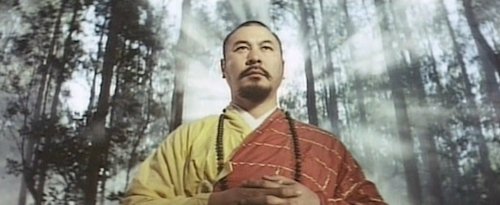
Abbot Hui, whose Enlightenment will kick your ass off.

A saving grace did come at the end for me. While roughly 45 minutes of the final hour of the film consists of extended fighting sequences, the finale is one of very interesting imagery. Abbot Hui, who was brilliantly played by the quietly imposing Roy Chiao, sitting in the lotus pose with the setting sun forming a halo behind him puts a wonderfully ambiguous and iconic stamp on the tale. Perhaps the implication is clearer to viewers more familiar with Buddhism, but a novitiate Westerner like myself is left to marvel and ponder exactly what this all means, especially in light of the fact the never-seen arch enemy, Eunuch Wei, is never conquered.

Despite this satisfying and metaphysical moment of closure, it takes a long time to get there. It also highlights one of the things that I wanted to see more of – the monks. Perhaps restraint was the best course here for the filmmakers, as too much of these orange-robed warriors as salt might have spoiled the broth. Still, I felt that there were plenty of questions left unanswered about this key component to the story. What is their philosophy, that it leads them to train themselves into nigh-unbeatable unarmed combatants? How do they do it? What is the synthesis between the pacifist Buddhist mindset and the ability to throw trained soldiers around like rag dolls? The lack of exploration of these questions left me wanting.

The only other thing that bothered me is something that the filmmakers possibly had no control over. Maybe due to a shoddy DVD transfer, some of the night scenes are impossibly dark. Typified most by the long midnight ambush of Ku and Yang's followers on Eunuch Wei's forces near the end of Part 1, there are times when the viewer can barely tell what's happening on screen. It's only emphasized by how well the rest of the movie is shot, with its masterfully composed sets and framing. The night sequences often blur into random shadows rushing around amidst the screams. The impenetrable murk did little to enhance these moments. Again, though, this may just be an age and DVD quality issue.

The ultimate question for me with any of these movies is, “Why did the fellows who did the TIME list put it on with the other 99 shows?” Whereas it is totally obvious with many of the movies on the list, with A Touch of Zen, I can only speculate. My guess is that it was probably one of the first films to have the high-flying, effects-enhanced martial arts action sequences that have become renowned the world over, thanks to films such as Crouching Tiger, Hidden Dragon and Hero. Beyond this, it combines pathos with a polished, epic feel that many action films aspire to, but rarely achieve.

Would I watch it again? No. Not in its entirety, at least. Oddly, I would watch the slow first hour for its gradual and soothing pacing. More though, I would watch the final ten minutes again, as the final scenes offer some food for philosophical thought. You can keep the 90-plus minutes of over-the-top sword fights.

Take 2: Or, Why Film Geeks Love This Movie (Done after some further research on the movie.)

When it comes to this movie, there's really not a wealth of material to dog through on the Internet. Within what I did find, there was nothing surprising. Critics, both past and present, hailed A Touch of Zen as an excellent film, in terms of technique (It won the 1975 Cannes Film Festival Technical Grand Prize, and was nominated for the Palm d'Or.). No shocker there, as the visuals still hold up exceptionally well, even here in 2011.

The theme of Buddhism comes up quite a lot. Apparently, King Hu was lauded for his blending of the philosophy with the flash and style of the fighting sequences.

The only other common thread running through any materials I found was how A Touch of Zen has continued to be emulated. Virtually every site I found mentions either Crouching Tiger, Hidden Dragon; House of Flying Daggers, or both. All you have to do is watch a ten-minute clip of the 1971 original movie to see exactly why.

Would I recommend it? Only to people who know they like kung-fu movies, as A Touch of Zen is to kung-fu movies what the Godfather is to mafia flicks. It set standards that have and will persist through the decades. If, like me, the genre is not your thing, I highly doubt you'll be willing to hand over the three hours it takes to watch. Maybe just youtube the final ten minutes or so.

That's a wrap. 67 shows down. 38 to go.


Coming Soon: The Godfather (1972):


Yes!! I'm as excited about this one as I was about Casablanca. I don't care what kind of film snob you might be, you lose credibility if you don't enjoy this classic. I haven't watched it in several years, so I'm due. Come on back and see how I put my admiration to words.

Please be sure to pick up all empties on the way out.