Showing posts with label Dominic Cooper. Show all posts

Monday, March 16, 2020

Idiot Boxing: Preacher, season 3 (2018); GLOW, season 3 (2019)

The wild and deranged crew of season 3. A good number of
them are done justice, in terms of the spirits of their renditions
in the source comic. Others are slight misfires.
Preacher, season 3 (2018)

As the fourth season of AMC's Preacher was just kicking off this August, I finally caught up and worked through the third season. Like the two before it, it's been just good enough and shown just enough creativity relative to the source material to keep me watching. It's never been a sure thing, though.

As I've explained in my reviews of season 1 and season 2, my history with Preacher runs pretty deep. The short version is that I was an absolutely rabid fan of the comic book series through the mid- and late-1990s, not only buying and reading each of the 70-plus monthly issues the moment they came out, but even writing fan letters and going to comic book conventions to see and listen to the creator and writer, Garth Ennis. So it's always been impossible for me to come to the TV adaptation with any sort of unbiased views. I must admit, though, that the series, despite some obvious weaknesses, has done a nice job in some surprising areas.

This season is almost exclusively in Louisiana, mostly in the fictional Annville, a family compound where Jesse grew up. In order to save Tulip, who was killed at the end of the previous season, Jesse makes a deal with his grandmother, Marie L'Angelle. "Miss Marie" is a powerful but ultimately evil witch who bargains for and consumes souls of desperate people, using them to prolong her life. While she does resurrect Tulip for Jesse, it comes at a great cost which Jesse wrestles with through the season. All the while, Herr Starr continues to keep his sights on Jesse as the "Messiah" whom he hopes to use to kick off an apocalypse. And the vampire Cassidy is also around, though at odds with Jesse for various reasons, so finds himself in New Orleans and making a rather surprising friend.

While there were no grand improvements for me this season compared to the first two, I did find the plotting to be a bit tighter. Not great, mind you, but a bit more streamlined than the looseness of the previous ones. Keeping things mostly focused on Jesse's place of origin and the bizarre and dangerous characters within it allowed a bit more coherence to the tale, allowing for more impact once Starr and his Grail goons show up towards the end of the season. The acting is as good as ever, and the casting of characters newly introduced to the TV series - primarily Jodie and T.C. - was spot-on. Actually, the T.C. character was a perfect example of what, for me, is a great strength of the TV adaptation. Since the very beginning, it has been very clear than the show-runners would not be doing a totally faithful retelling of Garth Ennis's and Steve Dillon's graphic novel. They have made many changes, omissions, and additions - some minor and some major - which gives the show a feeling quite its own. This is most apparent in the narrative, but it is also evident with characters like T.C., played brilliantly by Colin Cunningham. In the comics, T.C. is merely a nasty little redneck with a propensity for bestiality. In the TV series, though, there is more to him, as twisted as it all is. The result is a far more entertaining character than the comic offered, memorable as he was. While I may not have loved all of the changes, I tip my cap to the creators for trying plenty of different things, rather than simply leaning on the popular source material.

My primary issue with the show still remains, however, and that is the lack of a fully logical mythology. I'm all on board with the horror and the wild flights of fancy that are part-and-parcel to the entire story. Vampires? Cool. God, the Devil, and a Saint of Killers? Count me in. A doomsday shadow organization conspiring to trigger the Apocalypse? Right on. But I still need to see some consistent logic behind what these amazing and fantastic characters can and cannot do. Whether it is Jesse's "Voice of God" powers, Cassidy's vampirism, or the supernatural voo-doo of Miss Marie, the writers seem to play very fast and loose with the parameters put in place. One moment, the Saint of Killers is an unstoppable killing machine; the other, he gets knocked over by a car. One moment, Jodie can literally walk bare-handed into a compound guarded by two dozen armed killers and murder them all, and later he loses a relatively simpler fist-fight to a lone, smaller Jesse. The show is bananas anyway, so these things don't hurt the proceedings all that much, but they are little details that irk me a bit.

Word is that the fourth season - about halfway through airing as I write this - will be the final season, as planned by the creators. It's good to see another solid show have the guts to call it quits in the name of the narrative, rather than drag it out. I may or may not ever go back to watch the entire series again, but as a tremendous fan of the comic series, I feel that the show has done it a fair amount of justice.
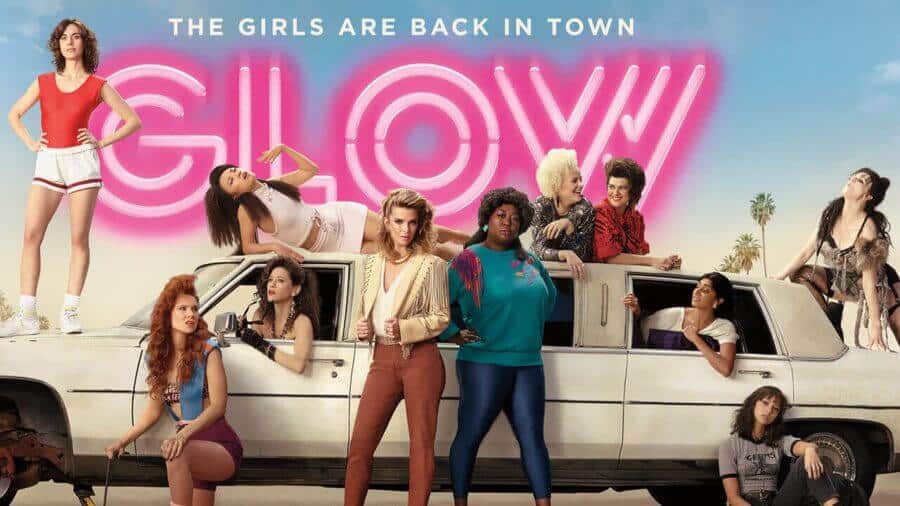

The Gorgeous Ladies bring their act to Vegas. Some handle
the temptations well. Others? Not so much.
GLOW, season 3 (2019)

This show started off strong two years ago, and it just keeps getting better.

At the end of season 2, the Gorgeous Ladies Of Wrestling (GLOW), along with producer Bash and show director Sam, head to Las Vegas. After being cancelled by their network in Los Angeles, they seek to keep their jobs and the show alive with a limited engagement of performances at an old-school casino in Sin City.

Season 3 of GLOW picks up shortly after these events, and we see the gang immerse themselves in Vegas. The show, while not a massive success, certainly does well enough to entertain Vegas tourists, and continues to be a decent gig for everyone involved. Of course, it doesn’t take long before various wrestlers, Bash, and Sam begin to experience tensions and issues of varying types. Some are relationship-related, others professional, and others business-related.

As good as the previous two season were, the third is the best thus far. I suppose that viewers who are more interested in the pro wrestling aspects of the show will disagree, as this season focuses far less on what happens in the ring. That was very much a strength of the show’s first season. That was only ever going to take this show so far, however, and the writers seem to have realized that very early on. The personal struggles and drama feel very real in this season, and we get to dig into several minor characters’ personalities and deeper motivations. Some of these are tackled with humor, while others are more dramatic. In nearly every case, the time spent looking past the garish costumed and into the characters’ inner-workings only adds richness to the series.

There were several engaging individual character developments in this season, including Tamme “Welfare Queen” Dawson’s fight against physical injury and Cherry’s break up with her man Frank. For my part, I was most impressed by the development of Shiela the She-Wolf, as she tries to expand into doing serious dramatic acting. From the very first episodes of the show’s first season, Shiela was immediately the most eccentric and enigmatic character, but this season ensures that she isn’t relegated to simply “humorous weirdo” status. Far from it. Hers and others’ stories are given some serious attention, and the show is all the better for it.

And lest you think that the show has become far more dramatic, rest assured that there is still plenty of humor to go around.  Perhaps not as much as the wilder, unpredictable first season, but my wife and I still had plenty of great laughs throughout the season. All of the actors have excellent comic timing, and once again comedy veteran Marc Maron stands out. His character Sam Silvia doesn’t have as much screen time as in previous seasons, but he makes the most of it.

A fourth and final season has already been confirmed and will release later in 2020, which is great since the show has really hit an amazing stride.

Sunday, May 13, 2018

Idiot Boxing: Preacher, season 2 (2017); Jessica Jones, season 2 (2018)

Tulip, Jesse, and Cassidy make New Orleans their home base
for most of season 2. You can never see where the show is
going, which is often fun, though tight plotting is sometimes
sacrificed for the "gonzo" unpredictability.
Preacher, season 2 (2017)

A wild comic book, adapted into an even wilder TV series, grows even more insane in its second season.

The first season saw the introduction of the three primary characters - Jesse, Tulip, and Cassidy - as they fled the tiny town of Annville, Texas, after it was laid to waste in a Biblical-style smiting. Armed with the power to literally compel others to do whatever he says, Jesse and his companions set out to find God, who they have learned has abandoned Heaven. The quest leads them to Las Vegas and eventually New Orleans, with the narrative taking several trips back in time to see Tulip and Jesse's back stories. On their trail much of the time is the invincible Saint of Killers, a towering, undead cowboy from the 19th century who has been tasked with finding and killing Jesse so that the power within him can be recaptured and returned to Heaven.

To echo my review of the first season, it is impossible for me to have an unvarnished opinion about this show. I was a tremendous fan of the source comic book back when it was originally released through the 1990s, reading and re-reading it more times than I can remember. Thankfully, I am not a purist when it comes to adapatations of even previously-treasured books. The first season of Preacher showed that, while they were going to use much of the tone and even many details from the original stories, the show runners were going to tell the story very much their own way. I respect this, as a shot-for-shot telling of the original graphic novel would be rather uninspired and quite boring for those of us familiar with the source material. This second season continues that trend, with the story reworking some of the graphic novels' characters and plotlines, while adding some completely orginal ideas. It works quite well, most of the time,

A wonderful highlight of season two is
Pip Torrins's portrayal of the ruthless
Herr Starr. He pefectly captures the
comic version's balance of stone-cold
intensity and sarcasm.
That said, this show still hasn't quite found its footing as much as I had hoped after the first season. Yes, the wild irreverence and anything-goes spirit is fully intact, to be sure. And the gonzo action and thoroughly bizarre characters and scenarios abound, which is also as it should be. But I can't help but feel that the show runners and writers haven't fully discovered a unified, cohesive through-line for certain aspects of the series. There are a few ways that this manifests itself, but the primary one is exactly who Jesse Custer is as a person. In the comics, it is quite clear from early on that he is an old school, John Wayne "tough guy" at his core. Thanks to a brutally tough upbringing and a religious adoration for said movie Western hero, Custer has a backbone of steel and a punk-rock, "screw you" attitude that leads him on his hyper-focused quest for God. In the show, however, there is still a fair bit of hemming, hawing, and a few too many side-plots that get in the way of Jesse's goal, which wasn't even formed until the end of season one, and is consistently blurred or muddled into other plot elements in this second season. It is still there, to be sure, and it does all come back around by the season's final few episodes. But minor plot threads like Tulip's secret marriage and her PTSD after a horrible run-in with the Saint of Killers, along with the little story around Cassidy's son, Dennis, mostly seem to act as minor speed bumps in the greater tale, even if they do provide some decent entertainment. There is also an entire chunk of season two dedicated to Eugene "Arseface" Root attempting to escape Hell, where Jesse accidentally sent him in the previous season. This storyline is interesting for a while, as we figure out just how this particular version of Hell is constructed, but I felt weary of it about halfway through the 13-episode season.

On the whole, though, I still enjoy the show. One big reason is that the casting is excellent. I already lauded the main trio of actors - Cooper, Negga, and Gilgun, all still phenomenal - but this season introduces the primary villain from the comic series: Herr Starr, and he could not have been cast or played any better than Pip Torrens has done thus far. Starr is an icy-cold devotee of calculated order. In the comics, he is ruthless, murderous, and highly capable of seeing his goals through, while at the same time being a sort of running joke, as he is intermittently victimized in various bizarre ways. The TV show continued in this tradition, and Torrens plays the role with a spot-on, no-nonsense air that sells both the character's viciousness and the many darkly humorous moments that unfold around and to him. And though the Featherstone character was not quite as prominent in the comic series, she is given a larger, more varied role and played exceptionally well by Julie Ann Emery. And there are plenty of other lesser parts conceived, written, and performed to perfection throughout this sophomore season.

Despite its logical inconsistencies and some lack of attention to smaller details, I'm still on board with this show. There really isn't anything else quite like it that I've seen on TV, which is a valuable commodity in this "Platinum Age" of television. For one like me, who usually turns to TV for wild, imaginative escapism rather than pseudo-realistic drama, Preacher still fits the bill quite well.


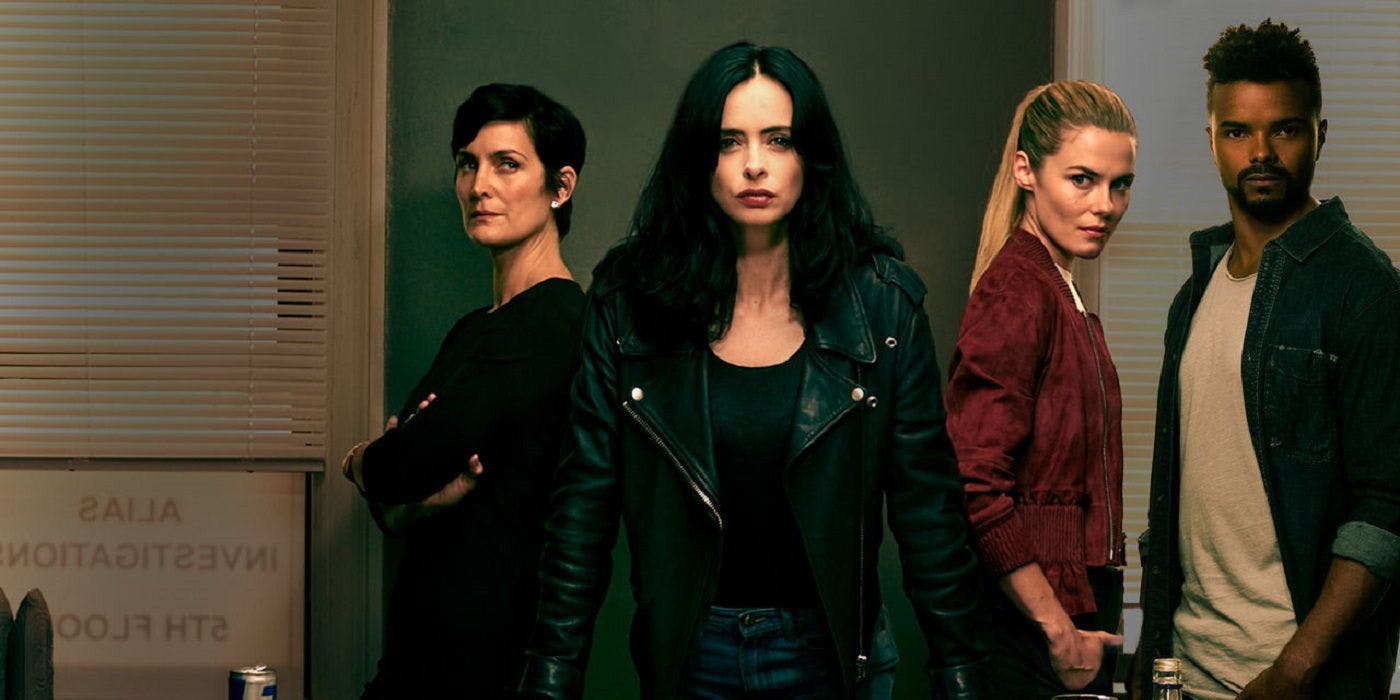
Much of the main characters from season 1 return, though it
can sometimes feel as if the sub-plots focusing on a few of
them can water down the main narrative around Jessica and
the history behind her family and her powers.
Jessica Jones, season 2 (2018)

Another solid season of the Netflix series, if not exactly a masterpiece.

At the end of season one, which was released over two years ago, troubled private eye Jessica Jones had survived the immensely trying ordeal of tracking down and killing Kevin Kilgrave. The sociopathic and morally bankrupt Kilgrave, who possessed the power to force people to do his bidding by merely speaking to them, had focused his sights on Jessica but was ultimately laid low by his previous victim. We next saw Jones in the Netflix mini-series, The Defenders, in which she teamed up with Luke Cage, Danny Rand (a.k.a. "Iron Fist") and Matt Murdock (a.k.a. Daredevil), as the quartet fended off the shadowy group "The Hand" from plunging New York City into a realm of chaos and darkness.

Now, nearly a year after the events in The Defenders, Jones is back at her office working as a P.I. and trying to keep herself together. The trauma of having killed a man - even one as murderous and deserving as Kilgrave - haunts Jessica. Her plight isn't helped when other superpowered people begin turning up and dying around Jessica. She soon learns that these deaths are connected to her acquisition of her super strength when she was a young teenager. As she digs deeper into this, she begins to learn some shocking truths about her past. some of which she would clearly like to ignore.

This season was fairly strong and held my interest throughout, though I felt it was just a tad weaker than season one. Kristen Ritter is still excellent at playing the sneering, sarcastic, ultra-cynical Jones, and there is still great satisfaction in seeing her deal with the scum of Hell's Kitchen. And the show still does a great job in making her multi-dimensional. She may be the most obviously flawed "hero" in the Marvel Cinematic Universe (MCU), and the show is all the more unique and engaging for it. And seeing the character have to face certain facts about herself - some within her control and several well beyond her control - only offers us more opportunity to see how she deals with various dilemma, as well as how those dilemmas further impact her search for meaning in her own life.

Janet Taylor does an excellent job as the imposing figure who
plays a major part in this season. While the season can drag
a bit, her story goes a long way towards keeping it engaging.
As with the first season, a decent amount of time is given over to the many secondary characters: Jessica's neighbor and now-aspiring business partner Malcolm, foster-sister and mid-level celebrity Trish Walker, power lawyer Jeri Hogarth, and several others have their own arcs that play out through the thirteen episodes of the season. Some are certainly more interesting than others, but most of them are engaging enough. It certainly helps that these characters are more grounded and complex than what one finds in the MCU's big screen fare. Still, this season does not break the streak of Netflix MCU shows not having enough good material to fill out all 13 episodes. This leads to a bit of watering down of what could be some excellent, shorter seasons.

When I rewatched the first season of Jessica Jones last year, I found that I still enjoyed it quite a lot. I'm currently not sure how excited I'll be to take in this second season again, but I'm certain that I will give it another go.