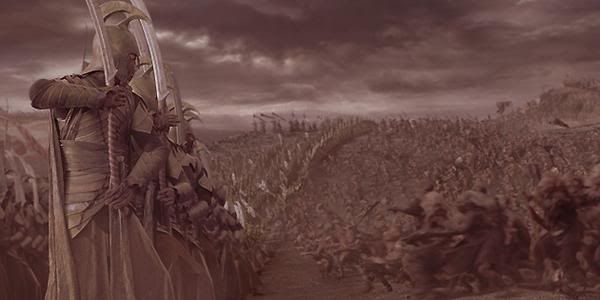
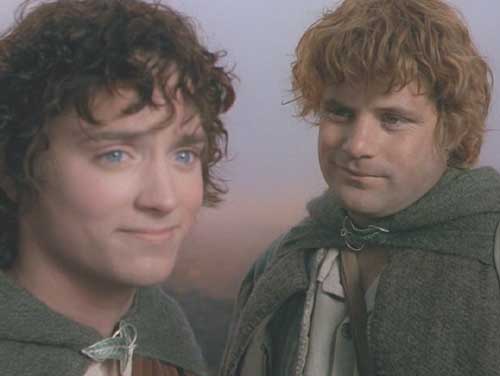
Showing posts with label Lord of the Rings. Show all posts

Saturday, October 12, 2013

Film #105: Lord of the Rings: The Return of the King (2003)


Director: Peter Jackson

Original Release Country: United States

Times Previously Seen: six or seven

*Note: The Lord of the Rings (LotR) trilogy was considered a single film by the list compilers at TIME, but I have reviewed each film separately. Here was my review for the first installment, The Fellowship of theRing; my review of The Two Towers is here.

Legolas Quick-Draw-and-Fire Summary

The hobbits are still little, but the stakes and fights are way, way, way bigger. “End of Middle Earth” bigger.

Extended Summary

*If you’d really like to dork out, you can check out thiseven-more detailed summary at imdb.

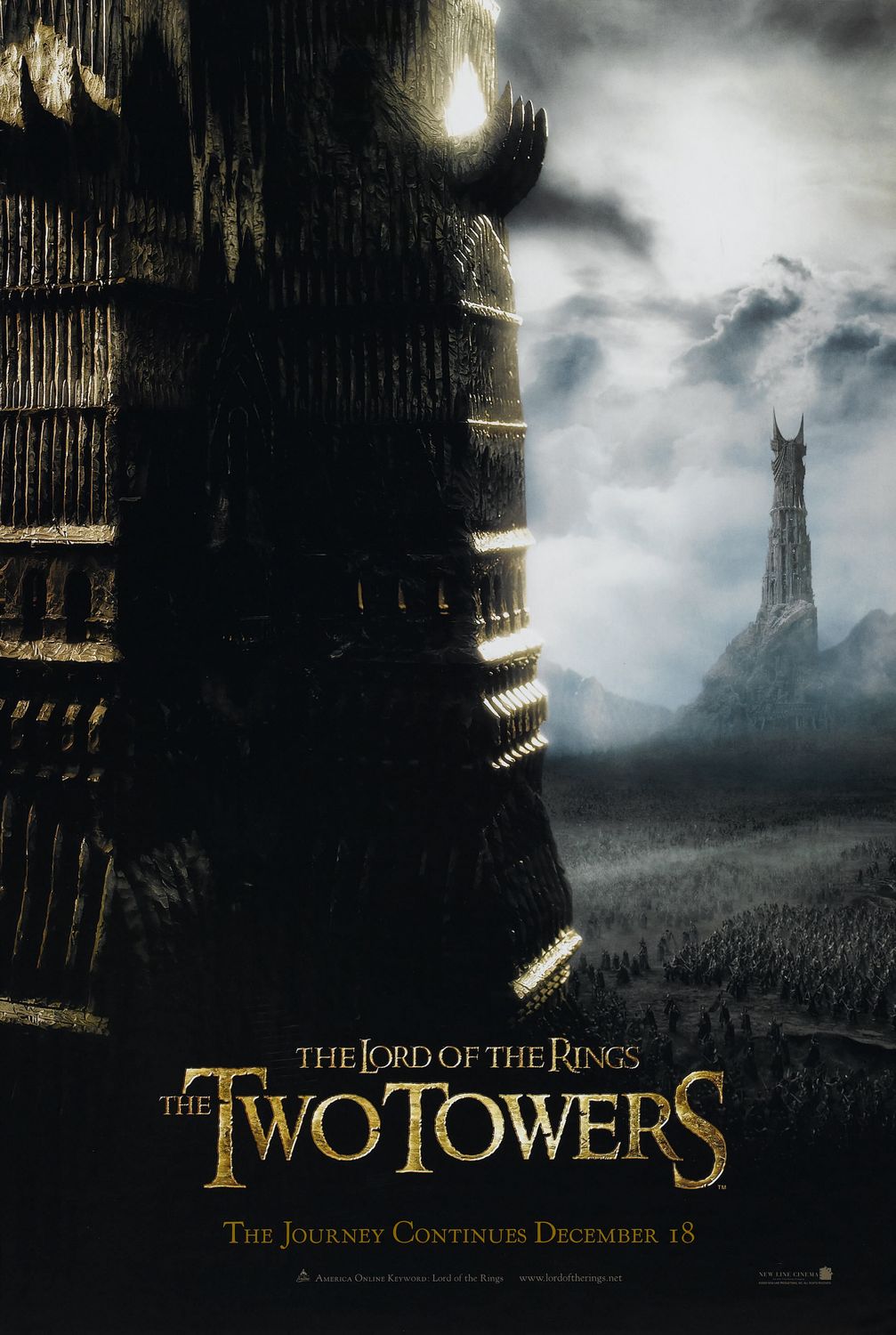
Following the defeat of Saruman’s army at Helm’s Deep, Gandalf, Aragorn, Gimli, Legolas, and King Theodrin make their way to the evil sorcerer’s tower, where the wizard is trapped and surrounded. The companions reunite with Merry and Pippin, who have been awaiting their friends. Aragorn and Theodrin attempt to convince Saruman to assist them by telling them of the Dark Lord Sauron’s plans, but the wizard is slain by a vengeful Wormtongue before he can provide any information. The group leaves the White Tower and heads back to Edoras.

Not far from Osgiliath, where Faramir freed them, Sam, Frodo, and Gollum continue their way towards Gollum’s promised “alternative path” to Mount Doom. Sam, overhearing Gollum telling himself about luring the hobbits into a trap, is convinced that the shifty creature is leading them to their deaths. Frodo, however, sees no choice but to trust their guide.

Frodo, Gollum, and Sam prepare for their incursion into Mordor. Of course, the scuzzy critter in the middle doesn't exactly help their cause.

Back in Edoras, Pippin makes the foolish decision to take hold of a “Seeing Stone” which they had discovered back at Saruman’s tower. The stone allows the user to peer into Sauron’s mind to an extent, but it also allows the Dark Lord to see back. Pippin is freed from the stone by Aragorn, and whisked away from Edoras by Gandalf, who knows that the hobbit’s location will now be known to Sauron. He decides that they must make towards Minas Tirith, where he can begin to muster the city’s defenses against the imminent attack which Pippin saw in Sauron’s mind.

When Pippin and Gandalf arrive in Minas Tirith, they find that the grand city’s steward, Denethor, is wracked with grief and despair due to learning of his favored son, Boromir’s, death. Denethor is too absorbed in his own self importance and pain to heed Gandalf’s pleas that he prepare the city for an oncoming attack from nearby Mordor. Gandalf and Pippin then take the initiative and slyly ignite the city’s beacon system.

When the beacon arrives far off in Edoras, King Theodrin subdues his displeasure at Gondor’s past lack of assistance to his own people and musters his men to head for Minas Tirith. His daughter, Eowhin, disguises herself as a male warrior and joins the hurried march.

Back in Mordor, Sam, Frodo, and Gollum have entered and lain eyes on the imposing Minas Morgul, the massive black fortress that is home to the Witch King Angmar, the most powerful of all of the ring wraiths. The hobbits and Gollum witness the pouring out of a massive army of Sauron’s forces, just before they begin to ascend a massive staircase up the side of a mountain – this is Gollum’s secret path into Mordor.

The hobbits and Gollum ascend the path around Minas Morgul, with a massive force of monsters marching below.

Back in Minas Tirith, Faramir, son of Denethor and brother of the departed Boromir, attempts to head off Sauron’s forces in Osgiliath, but he meets defeat after a pitched nighttime battle.

In the middle of the march to Minas Tirith, Aragorn and his companions begin to doubt their chances of victory. However, help arrives in the form of the elf king Elrond. Elrond gives him the newly re-forged sword of Aragorn’s ancestor king. The sword gives them new hope, but more will be needed. At Elrond’s urging, Aragorn makes into a nearby mountain pass which is haunted by an army of ghosts who had betrayed Aragorn’s ancestor two millennia earlier. Accompanied by Legolas and Gimli, Aragorn braves the spectral mountain, faces off with the ghostly leader of the traitors, and convinces them to follow him. Aragorn vows that, should the ghost army fight with him, he will release them from their cursed existence.

Back in Minas Tirith, the final battle has now begun. From their newly captured center at Osgiliath, Sauron’s forces attack The White City. The massive horde of all manner of creatures – including, orcs, trolls, Uruk-hai, goblins, and others – bombard the city’s defenses relentlessly. However, every time Sauron’s army seems to be on the verge of taking the city, help arrives. First, it is from King Theodrin, who leads his Rohirrim into the flank of the attacking army. For a while, the forces of good seem to be gaining the upper hand. However, the Witch King Angmar joins the fray and takes out Theodrin. Just when the tide of battle seems to be swinging back to Sauron’s side, Aragorn, Legolas, and Gimli attack from Osgiliath with their ghost army. With their forces bolstered, the defenders of Minas Tirith wipe out the attackers. Among the slain is the powerful Witch King, whom Eowhin herself has dispatched.
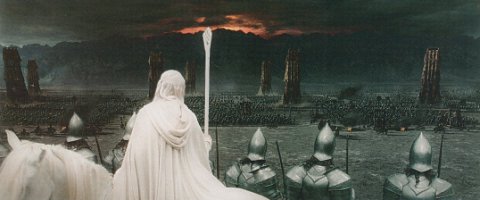
Gandalf looks on from Minas Tirith, the tremendous forces of the Witch King Angmar approaching to topple the glorious city.

Inside Mordor, Gollum finally makes his move. As Sam had feared, he leads Frodo into a deadly trap. Leading Frodo into a dark cave and then abandoning him, he leaves the hobbit to be attacked by Shelob – a massive carnivorous spider. Frodo is initially poisoned into paralysis by Shelob, but Sam comes to the rescue and fights off the vicious creature. Frodo is initially taken by some nearby orcs to a stronghold, but is freed once again when Sam capitalizes on infighting and manages to pull his friend away.

In Minas Tirith, the champions of the city take little time to celebrate. They realize that, despite their victory, Sauron has more forces that he can send after them. They also realize that, as long as the Ring of Power still exists, Sauron will never be defeated. Aragorn realizes that their only hope of true victory is to give Frodo enough time to reach Mount Doom and destroy the ring. To do so, Aragorn and the remaining forces of good decide to bring the fight to Sauron at Mordor. When they arrive at the Black Gate of Mordor, Aragorn, who has now fully accepted the mantel of “King,” goads Sauron’s forces into emerging from behind their walls. This pulls the attention of the Dark Lord away from inside Mordor.

Deep within Mordor, Sam and Frodo have been struggling their way towards Mount Doom. Frodo can barely walk, so weighed down is he by the power and burden of the ring. He and Sam are unsure of how to approach Mount Doom without being noticed by Sauron’s ever-searching massive eye. That is, until all of the forces make for the Black Gate to confront Aragorn’s army. The way is now clear for them.

At the Black Gates, Aragorn's army (center) are surrounded by Sauron's remaining hordes. This provides the distraction that Sam and Frodo need inside Mordor to dispatch the ring.

Sam physically carries Frodo up towards the entrance of Mount Doom, only to be waylaid by Gollum, who goes after the ring. Amid the scuffle, Frodo breaks free and enters Mount Doom. He at first makes as if to drop the ring into the pit of fire, thus destroying it, but at the last moment, he refuses. The ever-corrupting power of the ring has finally corrupted even Frodo, who puts the ring on and becomes invisible, which also alerts Sauron to the ring’s presence. Before Frodo can escape, though, Gollum reemerges and finds him, literally biting the ring off his finger. The two struggle over the ring, with it and Gollum eventually falling over the edge and into the pit of fire. Both Gollum and the ring are destroyed, and the Dark Lord Sauron is finally defeated.

The forces of good have finally and completely triumphed. Aragorn is officially recognized as the first true king of mankind in over two millennia, and Arwhen decides to forsake her elfish immortality and join him at his side. The remaining elves embark on their ships for “The Undying Lands,” taking the now very-aged Bilbo with them. Surprisingly, Frodo takes the elves invitation to join them in their journey away from Middle Earth. Frodo’s tribulations have left scars, physical and otherwise, that prevent him from ever living a normal life in Middle Earth again. And so, he bids his friends farewell and sails away.

In the end, Sam, Merry and Pippin all return to Hobbiton, where Sam re-assumes his life as a humble gardener, marries his sweetheart, and has a family.

My Take on the Film (Done after this most recent viewing)

Still the best film of the three, though one that has, like its predecessors, lost just a bit of its magic to me. The reasons are similar.

So much of LoTR: Return of the King is still an absolute blast to watch. So much so that I wished that I’d been able to see it on the big screen again, though I don’t know if my backside could have taken the endless sitting (the extended edition clocks it at nearly four hours).

True to its epic form, the entire third act of LoTR brings things to a massive and mostly satisfying conclusion. It probably would have been easy for any filmmaker to let a few plot threads dangle or try to inject too many of the countless minutiae from the source novels. Peter Jackson and his co-writers did no such thing, though. As massive as the plot and cast of characters are, it never feels too bloated, and virtually every scene and interaction either is central to the story or deepens our view of the battle for Middle Earth.

The inclusion of the Dead Men of Dunharrow may at first seem self-indulgent to Peter Jackson's horror whims, but it ties perfectly well into the larger plot. Not to mention it provides some of the most awesome scenes in the film, such as this one when they storm Osgiliath.

When taken with the first two installments, Return of the King completes the tale magnificently. Everything that is hinted at or brought up in the first two films finds its closure by the end. Aragorn’s place as the unwilling king; Theodrin’s ill will towards the Gondorians; Gandalf’s descent into death and rebirth as the new White Wizard; the hobbits’ noble attempts to be a part of something far greater than their humble selves; all of it comes together in the epic battle at Minas Tirith.

The fight at Minas Tirith is, as one would hope, the grandest of all in the series. As entertaining as the battle of Helm’s Deep is in The Two Towers, Minas Tirith cranks everything up to tremendous levels. From the initial assault, featuring wicked black dragons snatching defenders off the parapets and hurling them back into the city, to the nearly endless waves of monsters and beasts of war charging the forces of man, it’s simply eye-popping to behold. Again, it does lose something on anything smaller than the true big screen, but I still found myself captivated taking it all again for the umpteenth time.

Return of the King also adds in some new elements and players, which only enhance the film’s strengths. The inclusion of the ghastly Dead Men of Dunharrow is a great touch of the truly supernatural into the fantasy setting. Tapping into his horror roots, Jackson makes this ghoulish army as terrifying as it is awesome. There’s no small amount of satisfaction in seeing their spectral green forms wash over Sauron’s forces first at Osgiliath and then on the field of battle outside of Minas Tirith.

With all the fun that Return of the King provides, it still has lost a bit of luster, in similar fashion to, and for the same reasons that the previous two films have: Frodo and Sam’s part of the story. I completely understand that, actually, Frodo’s mission is by far the most crucial to the entire plot. And I understand that the relationship between him and Sam is the quiet heart and soul of the entire epic tale. Still, their trek through treacherous Mordor is painstakingly long, especially at the end. By the time Sam utters the words, “I can’t carry the ring for you, Mister Frodo, BUT I CAN CARRY YOU!!” I’m worn out with their love-fest.

Sam carries Frodo. The first time you see this scene, in the edited version of the film, it may carry an emotional punch. After that, though, it strikes as tiresome and sentimental.

On top of that is what may be the most dragged out, laborious ending in film history. I get it – this is an eight-hour-plus film trilogy (ten-plus if you watch the director’s cuts), so it’s going to take longer to provide closure for everything that has transpired. But really, it’s hard not to feel that the end of the story should be shortly after the victory at Minas Tirith, or at the very least, after Sam and Frodo finally destroy the ring. And yet, the movie keeps going for nearly thirty minutes AFTER that. The first or even second time I watched them, I didn’t notice it. But after you’ve seen the films several times, the ending can feel rather glacial.

The Lord of the Rings trilogy is still a monumental achievement in film. It’s bound to be many years, and even decades, before a film series translates the true spirit of fantasy storytelling with such outstanding visual effects, action, and adventure as Peter Jackson did. He’s trying to replicate it with The Hobbit as I write this, but even if the prequel tale’s three films are as good, they will still be in the shadow of their earlier, grander cinematic translations. I may not be as enamored of the series as I was for several years after their release, but they truly set a standard that I don’t see being matched for a very long time.

And that is, truly and completely, a wrap. 105 shows down. And that is all.

Coming Soon: Wrap Party!! - Where I do a recap of my last three-and-a-half years of working through this entire list and revisit my favorite and most despised films from the 105 that I watched. 


Please be sure to pick up all empties on the way out.

Friday, September 20, 2013

Film #103: Lord of the Rings: The Two Towers (2002)


Director: Peter Jackson

Original Release Country: United States

Times Previously Seen: six or seven

*Note: The Lord of the Rings (LotR) trilogy was considered a single film by the list compilers at TIME, but I am reviewing each film separately. Here was my review for the first installment, The Fellowship of the Ring.

Legolas Quick-Draw-and-Fire Summary:

The eight remaining fellows of the fellowship of the ring are scattered about the lands. Many a fight ensues, while Sam and Frodo make more puppy-dog eyes at each other.

Extended Summary (with spoilers. Lots of them.)

*If you’d really like to dork out, you can check out this even-more detailed summary at imdb.

Sam and Frodo, having left behind the rest of the fellowship, continue to make their way towards Mordor. As they make the arduous trek across the craggy, sheer cliffs, they are attacked by Gollum, the previous owner of the Ring of Power. Gollum is monomaniacally obsessed with repossessing the ring. Sam and Frodo manage to capture and subdue Gollum, forcing the wretched creature to guide them safely to Mordor.

Far away, on the open plains of Rohan, Merry and Pippin are being carted along by the band of Uruk-hai that captured them. This band of vicious creatures are eventually joined by an equally repulsive force of orcs. The entire group is being hunted and hounded by Aragorn, Legolas, and Gimli, who are relentlessly chasing after their hobbit companions. However, before the trio can catch up to the Uruk-hai, the band of monsters are set upon by the Roherrim – a force of horse lords led by their Prince Eomir, who has been banished from his own lands by a possessed King Theodrin. Despite this, the Roherrim kill all of the Uruk-hai and orcs. Merry and Pippin manage to escape the carnage, fleeing into the nearby Fangorn Forest.


Legolas, Gimli (obscured by horse head), and Aragorn are met by a wary Eomir and his Rohirrim.

In the Forest, Merry and Pippin are saved by a massive, animated tree – a creature known as an “Ent.” This ent, which gives his name as Treebeard, brings the hobbits to a man he refers to as “the White Wizard.” Though the hobbits at first assume that Treebeard is referring to the now-evil Saruman, it is actually a reincarnated Gandalf. We come to find out that Gandalf, after defeating the Balrog beneath the Mines of Moria, was resurrected and brought back to Middle Earth in order to assume the role vacated by the twisted Saruman – that of “The White Wizard.” Eventually, Aragorn, Legolas, and Gimli find all three of their old friends in Fangorn, and the six are happily reunited. The reunion, however, is short, as Merry and Pippin are taken with Treebeard to a muster of other Ents, while the other four make their way to Edoras, the capital of Rohan.

Meanwhile, Sam, Frodo, and Gollum have traversed the Dead Marshes outside of Mordor’s Black Gate, though not without some serious risk. As the trio arrive at the gate, it becomes clear that entering Mordor this way is virtual suicide. Gollum convinces them that there is another way in, though it will take some time to reach it. Though Sam is highly skeptical of the skulking Gollum, Frodo puts his trust in the shifty guide, and the three begin their retreat from the Black Gate.

Back in Edoras, Gandalf and company arrive to find King Theodin in a vicious mental trap laid by his own “advisor,” Wormtongue, and maintained by the sorcerer Saruman. The newly empowered Gandalf exorcises Theodin, restoring his mind and youth; then, the wizard leaves in order to find Prince Eomir and the Roherrim. Gimli, Legolas, and Aragorn stay behind to assist Theodin, as his lands are being overrun by Saruman’s ever-growing hordes of bloodthirsty creatures and feral human tribes. Theodin decides to gather all of the people in his city and bring them all to Helm’s Deep, a massive fortress built into a mountain. From there, he hopes to repel and crush any oncoming army. En route to Helm’s Deep, the caravan is set upon by a group of vicious, lupine wargs. The humans fend them off, but they seemingly lose Aragorn in the defense, the ranger having been sent over a cliff while fighting one of the warg riders.


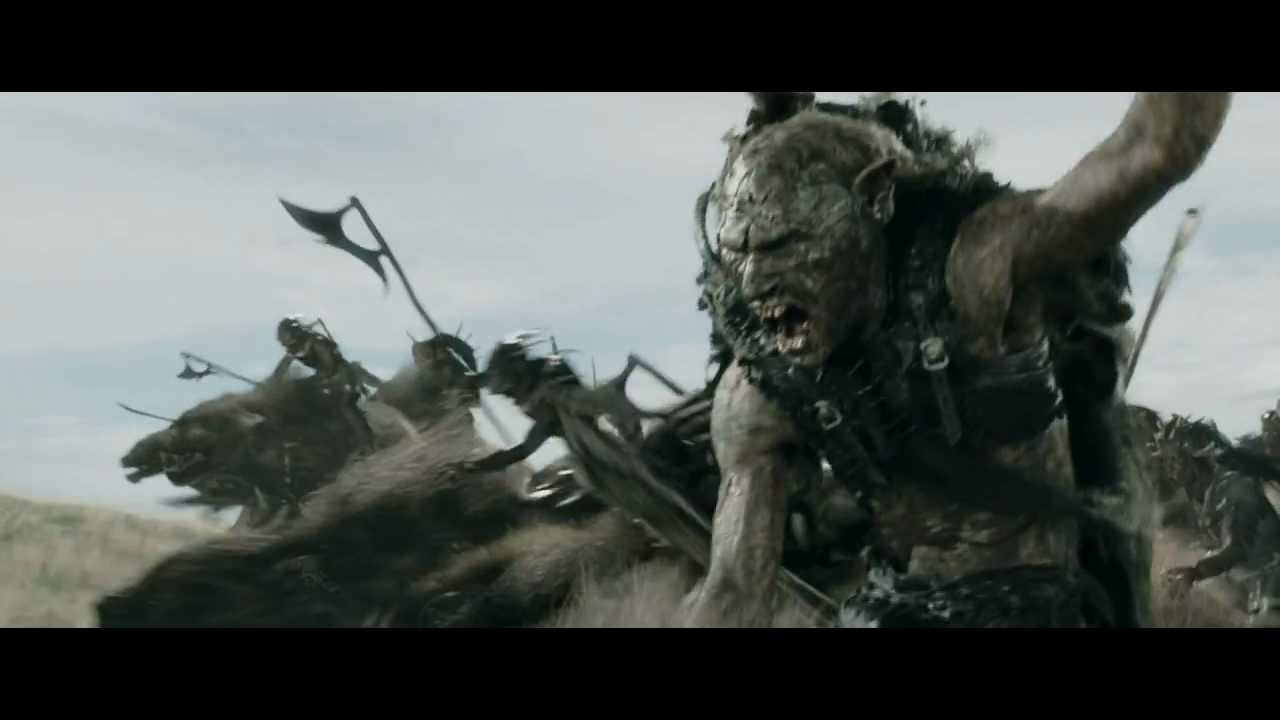
The vicious wargs and their riders. Our heroes have to fend off a whole mess of these nasty critters, en route to the safety of Helm's Deep.

Far off, within the borders of Gondor, Sam, Frodo, and Gollum continue to make their way towards Gollum’s alternate path into Mordor. However, they are taken by a band of humans led by Faromir, a young Prince of the region. Sam and Frodo are taken captive as assumed spies, but the cunning Gollum eludes capture.

Back in Helm’s Deep, King Theodin readies the small group of humans remaining for their grand defense. Though the Deep is an amazing defensive structure, their number of actual warriors is very few. Their hopes are bolstered, however, when first Aragorn turns up very much alive, and then even more when a force of elven archers arrives.

In Gondor, Faromir begins to interrogate Sam and Frodo about their purpose in his lands. He also manages to capture Gollum. Faromir eventually learns from Gollum that Frodo carries the Ring of Power, and Sam and Frodo learn that Faromir is the younger brother of Boromir, their fallen comrade from the fellowship of the ring.  Despite the hobbits’ warning to Faromir not to try and take or use the ring, the young prince decides to take them all to his father at Minas Tirith, the capitol of Gondor.

At Helm’s Deep, night has grown completely dark, and Saruman’s massive army has arrived at the gates. The battle ensues. After hours of bloody fighting, the humans and elves have exacted a mighty toll on the numbers of the attacking hordes. Still, the sheer numbers of the monsters is near to overwhelming them all. Just when Theodrin’s forces are down to their final few, the dawn breaks, and reinforcements arrive. In the east, Gandalf, Eomir, and the Roherriam charge into the flank of Saruman’s remaining army, routing them all and saving the remaining human forces nestled within Helm’s Deep.


It's all-out siege warfare when Saruman's army attacks Helm's Deep.

All the while, Merry and Pippin have been waiting for the excruciatingly deliberate Ents to decide whether to involve themselves in the war. Though the tree creatures decide that they will not fight, they change their minds after Treebeard sees how Saruman has razed huge swaths of forest surrounding his tower. An army of ents storms and overtakes the tower, wiping out the monstrous forces within and trapping Saruman in his own lair.

Within Gondor, Faromir and his captives arrive in Osgiliath, a blasted city close to Minas Tirith. Their entire party is assaulted by forces from nearby Mordor, including a Ring Wraith riding a vicious black dragon. Frodo barely escapes the Wraith, and Faromir finally decides to allow Frodo, Sam, and Gollum to continue their way into Mordor. The Gondorian prince does, however, warn then that the path that Gollum is taking them to is fraught with horrible dangers.

The road, it seems, is only going to get harder…

My Take on the Film (Done after this most recent viewing)

While my recent re-watching of Fellowship of the Ring found me a little more restless than I had ever been when watching it before, I did not find the same problem with The Two Towers. Though I might not be quite as enchanted by it as I was ten, five, or even three years ago, I still really enjoy it.

Compared to Fellowship, there’s simply more meat to it. Yes, there are some of the lighter, more melodramatic moments, especially in the extended edition (which is the one that I watched this time). The teased romance between Aragorn and Eowhin, the antics of Merry and Pippin, and the wistful recollections and musings of Aragorn and Arwen, are all little moments that become a bit stale once you’ve seen them as many times as I have. They’re not bad, but they provoke some watch-gazing for me.

The real draw of The Two Towers is the action. While Fellowship certainly has a few good action scenes and small-scale battles, the second chapter steps it all up in a serious way. The smaller skirmishes with the wargs, orcs, and Uruk-hai are cool enough. But they all pale in comparison to the battle of Helm’s Deep. At this point in the story, Peter Jackson began to throw it all out there. In scenes that would do Braveheart proud, the fighting intensity and action are simply a blast to watch. The entire battle takes up over 30 minutes of the film, but it has never, any of the times that I’ve watched it, felt overly long to me. There are simply so many eye-catching things happening in nearly every shot that the entire Helm’s Deep sequence demands multiple viewings. Of course, if you simply can’t stand battle scenes, then you’re out of luck. For the rest of us, it’s unadulterated popcorn entertainment.


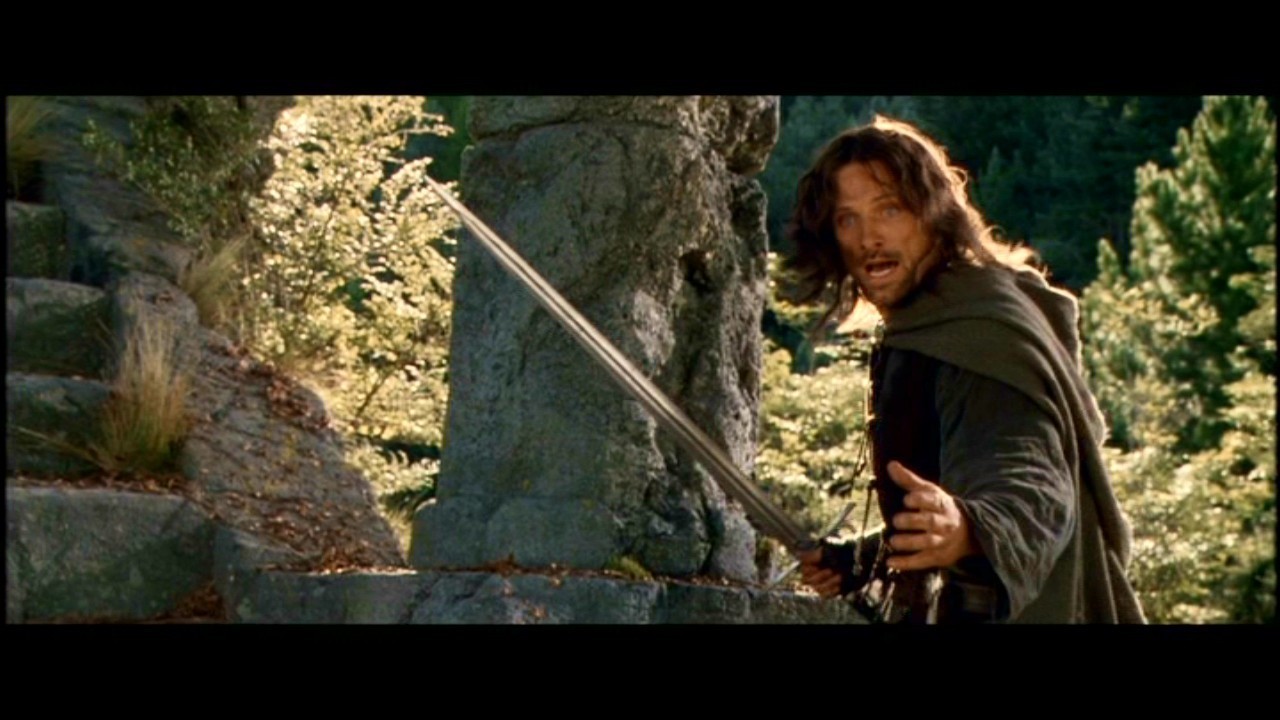
The battle of Helm's Deep is so rousing and entertaining, that I'm usually ready to pick up a sword, put on a snarl, and charge into the fray, right behind ol' Aragorn here.

Nearly all of the same strengths of the first film carry over into this second. The acting and casting remain incredibly strong, and there are some nice additions. The characters Arwin and Faromir have some intriguing depth and back stories. The Ents seem to be a bit divisive – some viewers really love them, while others find them boring as, well, watching a tree grow. I’ve always thought they were fine, and I especially love their attack on Saruman’s tower.

My overall sense of The Two Towers is that of expansion. While Fellowship introduced us to the main characters and kept things relatively tight in terms of the players, the second story starts to give us much larger groups, new lands and peoples, and a much greater sense of the entire land that the Dark Lord Sauron seeks to dominate. To me, Peter Jackson pulled off a rather amazing feat in that, though many readers of the source novel will say that The Two Towers is the least interesting of the three parts, the film version is no such weak link. It builds perfectly into the third and final chapter when, as Gandalf puts it at the end of this chapter, “The Battle for Middle Earth begins.”

That’s a wrap. 103 shows down; 2 to go.

Coming Soon: Finding Nemo (2003):


“Whaddaya mean I’m funny?! Funny how?! Like a clownfish??!!”

(Seriously. Just say that to yourself in Joe Pesci’s voice. It’s hilarious.)

Please be sure to pick up all empties on the way out.

Sunday, August 4, 2013

FIlm #100: Lord of the Rings: The Fellowship of the Ring (2001)


*The Fellowship of the Rings is the first part of the Lord of the Rings trilogy. The list-compilers at TIME magazine consider them all “one film,” but I will review each one separately.

Director: Peter Jackson

Initial Release Country: United States

Times Previously Seen: at least eight

Rapid-Fire Summary (No spoilers)

Tiny, cheery little fellow ends up with the most powerful and evil trinket in the land. A few other tiny, cheery little fellows and a few larger fellows join up to help him bring the trinket to a raging volcano and destroy it. Some silliness and swordplay carry them through.

Extended Summary (Spoilers included. Fair Warning)

*As many of you know, a truly geeked-out Tolkien and/or LoTR film fan could write a 200-page summary of this film. I’m not, and I won’t. However, if you want something more detailed, you can check out this synopsis at imdb. And if you want something MUCH more detailed, just read the novels.

In the mythical world of Middle Earth, a variety of beings dwell. In a setting that resembles the Middle Ages of our world, humans share Middle Earth with other races, including elves, dwarfs, orcs, goblins, and many others. One of the more peaceful and communal races is that of the hobbits – smallish beings that resemble humans, though around half the size and bearing hairy feet and slightly pointed ears.

One evening, in Hobbiton, the elderly hobbit Bilbo Baggins pulls an incredible vanishing act in front of a full crowd on his 111th birthday. To pull off this feat, he uses a ring of invisibility that he had obtained many decades prior in a game of riddles from a wretched creature that called itself Gollum. In addition to the other witnesses to Frodo’s disappearance are his nephew Frodo and their human wizard friend, Gandalf. What Gandalf knows that Frodo doesn’t is that Bilbo had planned this disappearance, in order to leave behind the daily headaches caused by his relatives in Hobbiton. Bilbo leaves behind the ring of invisibility, which Gandalf carefully passes along to Frodo. Gandalf, however, suspects something more sinister about the ring.

Bilbo and Gandalf share a smoke before Bilbo's grand vanishing act in the shire of Hobbiton.

After much travel and research, Gandalf returns to Hobbiton and tells Frodo that the ring is, in fact, the lost “One True Ring” of Sauron, “The Dark Lord” from ages past. The ring is a physical manifestation of Sauron’s evil soul and his will to dominate, and it corrupts all those who come into contact with it. Hobbits, though, seem to have a much stronger resistance to the ring’s corrupting powers than nearly all other races. Gandalf has also discovered that Sauron has been gradually reforming and building a massive army in the blasted lands of Mordor. The Dark Lord has also learned that his ring of power is in the hands of a hobbit called “Baggins.” Because of all of these things, Gandalf forces Frodo and his friend, Samwise (Sam), to leave the shire and get to the nearby town of Bree, where he will meet them after he consults with the head of his wizarding order, Saruman the White.

When he meets with Saruman, Gandalf soon discovers that his elder and superior has already been turned by the powerful will of Sauron. Saruman captures Gandalf for a time, but Gandalf eventually escapes. Meanwhile, Frodo and Sam, who have been joined on their journey by fellow hobbits Merry and Pippin, reach Bree, only to find that Gandalf is not yet there. After some trouble nearly erupts, the hobbits are befriended by a man called “Strider,” a ranger who seems to have their interests at heart. He saves them from the “ring wraiths,” powerful minions of Sauron whose only goal is to retrieve his ring of power.

The hobbits and Strider spend several days evading the ring wraiths, and they eventually reach the elven city Rivendell, where they reunite with Gandalf. After a counsel between representatives of the races of elves, dwarfs, and humans, it is decided that the ring must be taken to and destroyed in the only place where it is possible – Mount Doom in the middle of Mordor, where the ring was originally forged millenia earlier. Frodo elects to bear the ring, and eight others accompany him: his three fellow hobbits, Gandalf, Strider (whose real identity we learn is Aragorn – the heir to the throne of humans), the human nobleman Boromir, the dwarf Gimli, and the elf Legolas. The fellowship of the ring is formed.

The nine members of the fellowship of the ring in Rivendell, before they embark on their treacherous (and for some, fatal) journey to Mordor.

The fellowship fight through and past many dangers in an attempt to reach Mordor. They are harried by crows, pursued by orcs, and turned back by massive snowstorms created by Saruman. With no other options, they take Gimli’s suggestion to go under the mountains, through his cousin Bali’s cave city, The Mines of Moria. However, upon entering Moria, they find nothing but dwarf corpses. Moria has been overrun by goblins. The fellowship forges ahead, cautiously, but after a few days they are attacked. After fending off several dozen goblins and a cave troll, the must flee when a powerful fire demon appears. Gandalf stands against the creature, allowing his companions to escape; however, the kindly wizard is pulled down into a seemingly bottomless chasm with the beast.

Once free of Moria and after a brief respite in a wooded elvish city, the eight companions move on. Eventually, though, Frodo begins to realize that he will have to continue the journey alone, as the ring’s power threatens to overcome and twist each of his companions. To confirm his suspicions, Boromir attempts to take the ring from Frodo. Frodo flees him just as the fellowship is attacked by a band of orcs. The companions turn back the orcs, but not before Boromir is killed and Merry and Pippin are taken prisoner (Saruman has commanded his orcs to take any hobbits prisoner, so that he can find the ring of power).

The fellowship of the ring, once composed of nine companions with common purpose, is now broken. However, they are not defeated. Sam willfully joins Frodo on his quest to bring the ring to Mount Doom and destroy it. Now parted from the ring bearer and his closest friend, Aragorn rallies Gimli and Legolas, as they agree to stalk the orcs who have Merry and Pippin and free their little companions.

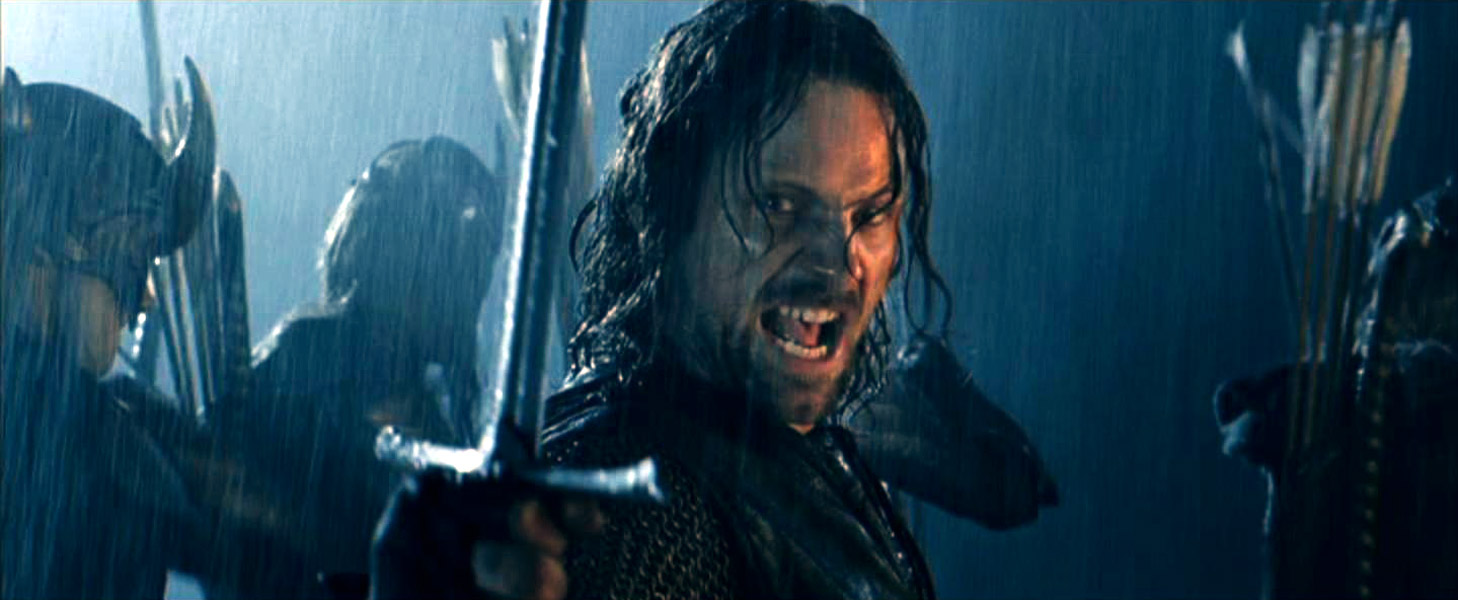
Aragorn, imploring Frodo to flee on his own and leave the fellowship behind. Aragorn then goes on to display his swordsmanship by mowing down waves of orcs.

My Take on the Film (Done after this most recent viewing)

To my slight sadness, the Fellowship of the Ring has lost a bit of its magic for me in the past few years. It’s still a great film, and I can’t see anyone ever attempting to adapt Tolkien’s seminal work onto the big screen again, so successful was Jackson. Still, this recent viewing didn’t hold my attention the way that it had before.

A little history: I LOVED these movies when they came out. When Fellowship hit the theaters, I saw it three times. When it was released on DVD, I watched it another two or three times. When they released the extended DVD version (which brought the film’s length to nearly three-and-a-half hours), I bought it right away and watched it three more times. About four years ago, my local theater did a marathon of the full trilogy, extended editions (nearly 11 hours of film in one day), and I went to it and enjoyed them all, immensely.

So why has my adoration for the movie faded? I can’t say that I’m completely sure. It could be that I just wasn’t in the right mood to watch it upon this recent viewing. I also suspect that, by viewing the 200-minute-long extended edition, I asked too much of myself at that particular time. However, I have other suspicions…

Upon this umpteenth viewing, I experienced some of the same dazed, stupefied disconnection as ol' Boromir here. Mainly, it was during the the sappier Frodo/Sam exchanges.

Once you’ve seen the films a few times, or maybe if you’re really familiar with the books, you may have less patience for the slower moments of the film. And Fellowship does have plenty of what could be called “slow moments.” This is not to be confused with “unnecessary scenes,” as all of the quieter moments do have their purposes: they add depth to certain characters, they reveal relationships or lore about the very rich world of Middle Earth, or they allow the viewer to take in the visual majesty that the film presents. Still, for some reason, these things weren’t enough to keep hold on my attention like they had in the past.

Lest I get too deeply into what I was not as enamored of, I need to spend time on the many positives of this movie. Now, one needs to be aware that this is the ultimate “fantasy” film, based on the “fantasy” story that basically birthed a massive genre of novels, films, cartoons, role-playing games, and so forth. If you haven’t seen these films and you have no interest in medieval-setting mythical tales, then don’t bother. I understand that some people find such things silly and pointless, and those people should stay well away from this film trilogy. I, on the other hand, love this kind of stuff, and Peter Jackson constructed what will probably remain the greatest fantasy film(s) for many, many decades.

Tackling J.R.R. Tolkien’s incredibly rich world of Middle Earth had been attempted before, but only in cartoons. For the many decades that followed the book’s release, there was simply no way that any movie could capture the imagination the way that the books always had. Finally, though, by the late 1990s, the financial and technological means existed for bringing Tolkien’s Middle Earth to live-action life. And right from the first scenes of this first installment, it was clear that Jackson was the man for the job. The prologue in Fellowship, which depicts the background tale of the Dark Lord Sauron’s One Ring of Power and his defeat at the hands of elves and humans, is packed with the visual magic and rousing action that define the film series.

The first, historic battle scene is relatively short, but conveys all of the grandeur and intensity that is intended. After this, though, it takes quite a while for the film to get back to these breathtaking, blood-pumping melees. 

The attention and respect that Jackson constantly pays to the source material is very impressive. Of course, hardcore Tolkien fanatics will nitpick at plenty of little things – “No, Boromir didn’t inherit that sword from that person…,” or “No, it wasn’t Pippin who stole the carrots, it was Merry...” and blah, blah, blah. Those who get caught up in such minor details completely miss the point – Jackson was brilliant at staying as true as he could to the novels while putting together a very entertaining film. The story conveys every bit of wonder and richness embedded within Middle Earth, and the tale of Frodo and the ring are given the epic treatment that they require.

The story itself is the classic, age-old story of a quest undertaken in order to prevent evil forces from dominating the lands. The fellowship formed by the four races certainly presents a compelling mix of mythical history, characters, and archetypes. The various races represent simplicity, power, honor, grace, courage, stodginess, and many other characteristics, in different turns. The ultimate presence of magic, represented by Gandalf and Saruman, adds the mystic and mysterious aspects of the story. To people like me, it can be truly enchanting.

Of course, all of the things explained in the previous paragraph were present in the books. What Jackson did was successfully translate them onto the big screen. Using his native country of New Zealand was a convenient and perfect choice. The small island country’s rolling, verdant hills; craggy, snow-capped peaks; and lush forests provide all of the scenery that Tolkien’s Middle Earth contained. Even someone who has no interest in the story of little hobbits, dwarfs, and elves can watch many of the sweeping shots over the landscape and marvel at it.

Jackson also put New Line Cinema’s massive budget to good work as well, with the end result being phenomenal costumes and visuals. The set pieces are great, and they build up the world all the more. Perhaps my favorite decision of his was to use human actors as much as possible. While there are clearly moments when CGI was used (particularly to create some of the especially enormous buildings, statues, or armies), Jackson opted to use make-up and creature effects as often as he could. Hence, you have many of the orcs, goblins, and other nefarious beings being played by human actors. The effects is that they all seem much more tangible and horrifying. I guess this latter adjective should come as no surprise, seeing as how Jackson got his cinematic start doing extremely graphic and effects-heavy horror films like Dead Alive.

Even when scenes involved dozens of individuals, Jackson didn't cop out with computer graphics - the use of real actors done over in top-notch make up and costumes was an invaluable asset to the film series.

The cast is excellent. From the impish and humble hobbits to the gruff and belligerent dwarves, all of the players nailed their parts right from the start in this first installment of the trilogy. The standouts to me are Ian McKellan as the kindly, paternal Gandalf the Grey and Viggo Mortensen as the mysterious, internally conflicted Strider/Aragorn. Some people might find the dialogue and deliveries to be overly theatrical and dramatic, but I’ve always felt that it fit the setting well. We’re dealing with imaginary myths here, so the speech and deliveries should be delivered with a polished and almost aristocratic air. It all fits perfectly well in this film series.

This does, however, bring me to something that I now find a bit tedious in Fellowship – the relationship between Frodo and Sam. I do understand perfectly well that this relationship is the true heart of the story. The fraternal bond between the two friends is the very type of goodness that is supposed to carry us through dark times, and it is this notion that creates the connection between us the viewers and these completely imaginary characters. Still, once you’ve seen the film a few times (or a half dozen times, like myself and other nerds), the moments that Sam and Frodo share start to drag. Granted, it isn’t a massive focus in Fellowship, but it’s already starting to wear on my attention. Instead of enjoying the moments between the two hobbit pals, I find myself anticipating other scenes. Namely, the action sequences.

Just a small, early sample of what will be many, many, MANY doe-eyed gazes between Sam and Frodo. It doesn't get terribly annoying until the third film, but it begins in the first film.

In Fellowship, we get several fantastic action sequences, and these serve as great hints of what is to come in the subsequent films. The opening prologue features a rousing depiction of the historic defeat of Sauron at the hands of Isildur. Other fight and battle scenes are equally entertaining, though they take a while to arrive at. The standouts are the trek through the Mines of Moria, including Gandalf’s facing off against the towering Balrog, and the battle in the woods between the fellowship and a patrol of orcs. For a man who had never directed extended action scenes in any of his previous major films (maybe you could include The Frighteners), Jackson proved himself quite astute at directing these scenes. Of course, he would continue to outdo himself in each of the sequels, with battles becoming grander and more spectacular.

*I will be reviewing the other two films in the Lord of the Rings trilogy in the next few weeks, after watching the few other films remaining on the TIME list.

That’s a wrap (sort of). 100 shows down; 5 to go.

Coming Soon: Talk to Her (2002):


My hunch is that this is a thoughtful, artful drama that has nothing to do with elves and dwarfs cracking wise and killing monsters. It should be an interesting change of pace.