Showing posts with label Luke Wilson. Show all posts

Monday, May 18, 2020

The Royal Tenenbaums (2001)

Director: Wes Anderson

The wife and I have found ourselves unintentionally revisiting Wes Anderson's film catalog. It started with watching The Darjeeling Limited a couple weeks back, then continued with Rushmore last week. Having enjoyed those two, we kept it up with his follow-up to that latter film, and enjoyed it plenty.

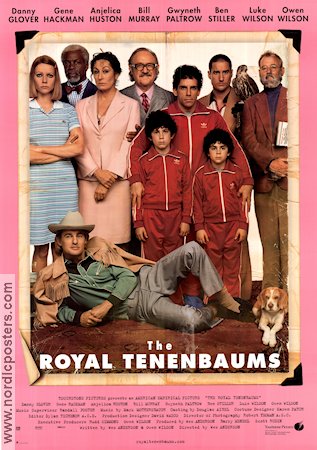
The Royal Tenenbaums uses an impressive ensemble cast to follow the Tenenbaum family, a New York City-based clan which includes Royal, the self-involved, insensitive father; Etheline, a loving mother, and three budding genius children: Chas, Margot, and Richie. While the Tenenbaum kids all seem to be headed for greatness in their respective fields of interest - finance, playwrighting, and tennis - the dysfunction within the family (mostly due to their father) eventually derails nearly everyone's chance at great success. We mostly follow the children a little over two decades after they were all between roughly eight and eleven years old and still showed limitless promise. At this point, Royal, now completely broke and desperate but no better a human being, concocts a scheme to work his way back into his wife and children's lives.

This is the Wes Anderson movie I know best, having watched it every few years since it came out, and I still think it's pretty great.

The Royal Tenenbaums was the first film of Wes Anderson's to expand to the large-group ensemble approach. After his smaller-scale (and smaller-budgeted) films Bottle Rocket and Rushmore, we now got a story that juggles no less than a half-dozen major characters and their bizarre and dysfunctional relationships with each other. If there is any primary character, it is the titular Royal, played hilariously by Gene Hackman. His gruff, unforgiving turn as the thoughtless, selfish, destructive patriarch of the Tenenbaum family sets and keeps much of the rest of the story in motion. It's not always easy - not even in comedy - to create a character who's mostly despicable, but whom you ultimately empathize with. At least a little bit, anyway.

But the movie is more than just Hackman as the unfit, previously-absentee father. The all-star cast all live up the reputations that had either previously created and/or have since maintained. Anjelica Huston is as good as she's ever been, which is saying something. No surprise there. But the younger players - Ben Stiller, Gwyneth Paltrow, Luke and Owen Wilson, Danny Glover, Bill Murray, and others - are inhabit their quirky and damaged characters splendidly.
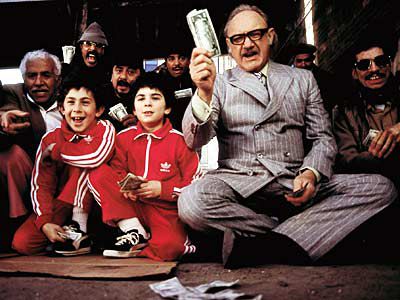
In an attempt to bond, Royal brings his newly-acquainted
grandsons to a dog-fighting circle. Perfect example his
insanely misguided (but hilarious) attempts to reconnect with
a family whom he himself drove off with this type of thing.
This movie was also the one which I consider the first of what the movie-going world would come to know as "the Wes Anderson movie." While we saw it almost fully formed in Rushmore, it is with The Royal Tenenbaums that we get the hyper-detailed, meticulously-crafted, super vibrant visuals and ultra-sharp cinematography in each and every shot and movement. It's not to everyone's taste, as it shatters any illusion that you're watching reality, and it can have a cartoonish feel to it. But for those who appreciate an eye for visual details, it's hard not to be impressed. The impeccable quality has been a part of every single film - both live action and animated - that he's done since, and this was really the one which set his own bar.

All technical merits aside, the movie is still just plain funny. Hackman delivers Royal's brutally insensitive lines and needling to perfection. The Wilson brothers bring their penchant for playing zoned out, sensitive types fully into Eli Nash and Richie Tenenbaum. The rest of the cast is just as good, and they're all given plenty of hilariously odd situations that actually don't seem too far off the detached, near-aristocratic pursuits of New York elite types. As with nearly every Anderson movie, it does take a brief, dark turn that's difficult to anticipate, but the proceedings never get overly bleak. There is heart and dysfunction aplenty, but this is, overall, a comedy.

I still rank this one among my favorite Wes Anderson films. I've generally liked them all to varying degrees, but The Royal Tenenbaums is in my top two or three. Along with Rushmore, it's the Anderson movie I would recommend to someone who hasn't seen any of his. From either one of those, you'll know if he's to your liking. 

Saturday, October 21, 2017

Retro Duo: Idiocracy (2006); The Babadook (2014)

Idiocracy (2006)

Director: Mike Judge

Flawed but still funny, semi-forgotten work by one of the great comic minds of our generation.

Mike Judge has a rather singular place in American humor. As the creative mind behind Beavis and Butthead, King of the Hill, and the more modern Silicon Valley, he has shown to be a distinctive voice by tapping into elements endemic to recent generations of the denizens of the U.S. and mining them for comic gold again and again. He also gave us Office Space, the cult hit that to this day, nearly two decades after its release, is perhaps the defining parody of cubicle culture.

Back in 2006, Judge wrote and directed Idiocracy, which was something of a departure from his comfort zones. Instead of lampooning dumbed-down pop culture or office hell, he went for a full-on satire in the form of future dystopia. The story follows Joe Bauers (Luke Wilson), a completely average guy (yes, this makes him an "Average Joe." Get it?) who happily does his meaningless job as an army librarian. Joe is selected for a military experiment in suspended animation, along with a prostitute, Rita (Maya Rudolph), which goes awry and leads to Joe and Rita emerging from their cocoons 500 years into the future. When they awake, they find that the world has been overrun by all of the worst elements of human nature, turning earth into a nightmare of corporate ubiquity and a population too stupid to deal with even the simplest problems. The previously-average Joe, however, is now literally the smartest man in the world, leading the population to turn to him to solve all of their many massive problems.

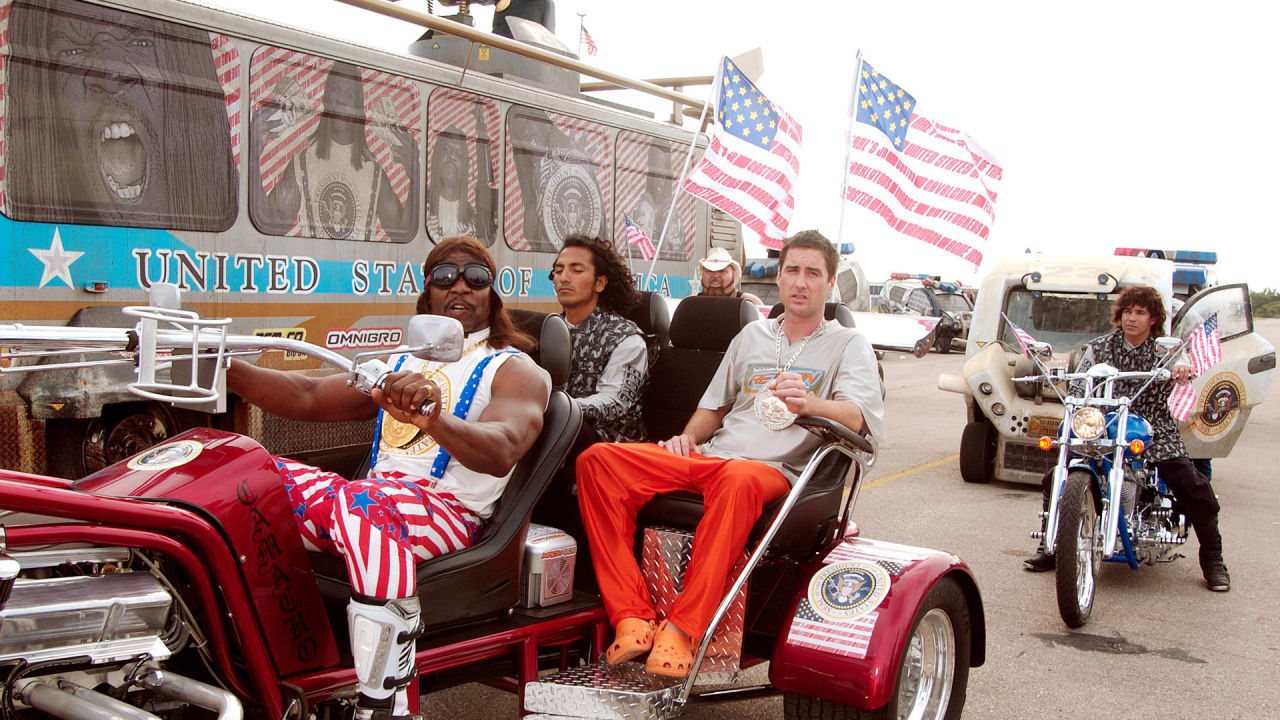
Joe rides along with President Camacho's cabinet/entourage.
The notion that the highest position in the land is held by the
brashest, most ultra-macho trash-talker isn't such a stretch.
The movie is a fun watch, despite the fact that it noticeably loses steam in its second and third acts. The first ten or fifteen minutes feature some great comic dialogue and typically hilarious Mike Judge-type gags. Once Joe awakes in the hellishly dysfunctional future, there is still plenty of hilarious commentary on the more negative trends towards homogenization, oversexualization, and commercialization that we see today. Hospital nurses who are using a fast-food style picture board to admit patients. An entire TV channel dedicated to watching a guy get his testicles pummeled in various ways. A foul-mouthed, trash-talking president who was a famous porn star and professional wrestler. These bits are as hilarious as they are the logical conclusions of certain disturbing trends in our popular culture.

What takes some wind out of the movie's sails towards the end for me is that the future depicted on the screen is simply ugly. Much of this is by design, as Judge envisioned a world where basic services like garbage disposal and environmental protection have long since been abandoned. That, and the fact that nearly every person and object has been branded by large corporations, create a visually unappealing world. It also doesn't help that the film didn't seem to have enough funding to bring the vision fully alive. In doing a touch of research, it doesn't seem like any funding was pulled from the film, but the effects, sets, and costumed have a rather cheap look to them. The movie is much more about the humor and social commentary, to be sure, but the B-grade aesthetics bring the experience down a notch.

Despite its flaws, I recommend this one to just about everybody. It's fun and silly, with a healthy amount of clever, old-school satire. While its overall scope outstripped its resources, but the ideas and gags are still well worth a look.


The Babadook (2014)

Director: Jennifer Kent

Now that is how a horror movie should be. Subtle when necessary. Profound and thoughtful. And creepy enough to make you soil your underpants.

For those who haven't seen it but plan to, I'll keep this spoiler-free, at least in terms of key plot points in the second and third acts of the movie. The tale follows Amelia, a widow whose son, Samuel, shows some concerning behavioral problems. His active imagination has him afraid of monsters to the point that he creates weapons to fend them off and sometimes acts out his violent defenses. One night, Samuel pulls a pop-up book previously unseen by Amelia off of his reading shelf. The book is titled "Mister Babadook." Amelia begins to read the book, despite its extremely creepy images and haunting narrative, and too late glances ahead to see that the story takes a horribly grim turn. She tries to hide the book, but the damage seems to be done. Samuel is so scared now that after a night of little sleep, he claims to be able to see the Babadook in many other places. As Samuel's behavior concerns and frightens other children, parents, and other adults around him, Amelia grows more and more concerned.

While I could nitpick a few things in terms of the imagery and a few of the connections from one point to another in this story, I found it to be astounding. It's not often that I'm riveted to a screen the way that I was during this picture. I can't call myself a devotee of the horror genre, but I do enjoy a well-crafted and well-executed scary movie that makes my skin crawl, and The Babadook delivers. It does rely on a few conventions, such as the odd squeaky door or shadow-shrouded closet, but the emotional and psychological context I found to be highly original. There is something of a "twist" in the story, I suppose, but it's not of the M. Night Shyamalan variety. Figuring it out early (for me it was about halfway through the picture) doesn't diminish the effect, and the film is subtle enough to not offer a grand "reveal" at any point, trusting us viewers to piece it all together on our own. And just when I was afraid that the resolution was going to be way too tidy, we get an ending that is far from completely comforting.

Little Samuel is creepy at hell much of the time, but you
learn that this impression is a bit of a red herring. This is one
of several clever wrinkles the movie offers the horror genre.
I would love to dig deeper into the psychological elements explored in the movie, as it comprises what I feel elevates this movie above just a genre picture. In the name of staying spoiler-free, though, I cannot write too much. I will only say that this was a brilliant use of the visual medium to convey the terror and confusion that I imagine people might feel when certain foundations of reality begin to crumble around them.

I will point out that this is a grim story. There are no beautiful people involved, and there is nary a joke cracked through the whole film. It is intense, and when one realizes what lies at the movie's heart, one can see why it needs to be intense. For those looking for one of those "fun" horror movies with jump-scares and maybe even a little sexual titillation, this is absolutely not the movie for you.

I'll be keeping my eye out for what the writer/director Jennifer Kent comes up with next, as The Babadook was good enough to make me regret not getting out to see it in theaters a few years ago.