Sunday, October 1, 2017

Before I Die #614: Blackmail

This is the 614th movie I've now seen out of the 1,199 movies on the "Before You Die" list that I've gradually working my way through.


Director: Alfred Hitchcock

A pretty curious early work from suspense master Alfred Hitchcock. It clearly displays some of his early mastery of the visual aspects of the medium, though the actual story itself drags more than it ought to, especially for a film only 85 minutes long.

The story follows Alice White, a young woman in 1920s London, who is "playing the field" a bit in terms of dating. Although seemingly attached to Scotland Yard detective Frank Webber, Frank pays far more attention to his work than to Alice. Perhaps for this reason she has begun to show interest in a new suitor - an artist named Mr. Crewe. One evening, after Alice deceptively blows off Frank, she meets Crewe and eventually is enticed up to his apartment. Crewe makes unwanted advances and eventually tries to rape Alice, who defends herself and ends up killing Crewe with a knife. Alice flees the scene. The next day, Frank and his fellow detectives arrive on the murder scene, where Frank secretly finds evidence that Alice is the killer in the form of a forgotten glove. He spirits it away and returns to her, but the two are soon confronted and blackmailed by a man, Tracy, who had quietly seen Alice entering Crewe's apartment. Tracy's blackmail attempts work for a short while, in small ways, but he is eventually suspected of murder himself. He is ultimately pursued and dies while trying to escape capture. Despite being off the hook, Alice seems to still be troubled by her conscience.

This was a fairly fascinating movie for a few reasons. This is the earliest Hitchcock movie I've seen, and one can certainly see many elements that are familiar in his pictures. There is a daring use of dark subject matter, such as attempted rape and successful murder, at the heart of the story. It also goes beyond merely being a crime procedural, offering gray areas in terms of who the guilty and innocent are. And then there is the psychological aspect, seen mostly obviously in Alice, who was clearly justified in defending herself against the aggressive advances of Crewe, but still feels the conflict of one who has killed a person. While I've seen some other contemporary films that utilized one or two of these themes, Blackmail is the earliest one I've seen that brings them all together through such a small-scale, personal story. For this, it certainly stands out.

Alice tries on a dress at the behest of Crewe. This little idea
is one that Hitchcock would later really run with in his more
classic movie
Vertigo.
The aesthetic elements of the movie are a mixed bag. The set designs are good for the era, with many of them creating a distinctive sense of place. This is especially true in the dastardly Crewe's apartment, which I can still picture very easily in my mind, even these couple of weeks after I watched the movie. Staging certain scenes (or even whole movies) in a single, confined location is something that Hitchcock would do later with even greater success in films like Rope or Rear Window, and we get a preview of it here. The acting is fair enough, though still a tad too rooted in the physical showmanship more suited for stage acting. Strangely, the audio doesn't truly kick in until nearly 10 minutes into the movie. I've read that this is because Hitchcock had already begun filming when the British Film Institute (who was providing funding) decided to make the movie a sound picture. This shift doesn't exactly ruin anything, but it is rather noticeable.

Blackmail is a movie that has a clear place in the history of great cinema, even if it's not likely to become any person's favorite movie, or even anyone's favorite Hitchcock movie. While the brilliant director would go on to make many better films, this one clearly shows his talent when he was still relatively young. For this, it is worth a look for fans of the early sound era and Hitchcock's overall body of work.

That's 615 movies down. Only 584 to go before I can die. 

Friday, September 29, 2017

Idiot Boxing (2017): Ballers, season 3; Insecure season 2

Ballers, season 3 (2017)

Striking out in a somewhat bolder direction, the show feels similar to the plight that its protagonist, Spencer Strasmore, undergoes during this third season - perhaps reaching for more than it can handle but ultimately staying within its lane.

At the end of the second season, NFL star-turned aspiring financial advisor Strasmore had to rely on a last-ditch safety line from some of his own clients in the form of a multi-million dollar loan. The loan was so that he could buy the company that hired him, run it his own way, and avoid certain other obligations. He was also outed as having played an unknowing part in several fellow players' losing millions of dollars through misguided investments. This third season sees Spencer getting some of his footing back, though he is still under the pressure of debt to his own clients. Despite this, he decides to swing for the fences and try to orchestrate a deal that will move an NFL team to Las Vegas, a move certain to upset many owners of other NFL teams. This invloves juggling even larger egos than the ones he is accustomed to dealing with, and some of his own demons and skeletons threaten to torpedo the deal throughout the process.

I enjoyed this season, and would even say that it's the best of the series so far. I was skeptical at first, when the first few episodes features some shaky scripting and even a few cheap-looking visuals. And Steve Guttenburg (yes, he's still around) shows up to completely overplay his role as an unctuous and smug Las Vegas casino owner. But the second and final thirds of the season hummed along nicely, with some enjoyably tense moments to go along with the several good laughs that each episode provided. Dwayne "The Rock" Johnson has found himself a nearly perfect role, which can showcase his not inconsiderable acting abilities. And there were some new supporting cast members, such as Steven Weber, who turned in some solid little performances.

One thing that seems a bit odd about this season is that the stories of the secondary characters have become rather fragmented from Spencer's. That wouldn't necessarily be terrible if they were a bit more interesting. As it is, though, Ricky Jarett's romantic life isn't nearly as compelling as his battles with possible CTE; and Charles's attempts to find a life in football after this retirement can feel a bit forced and oversimplified at times. I hope future seasons either integrate these guys' stories better with the main one, make them more engaging, or just abandon them altogether. There is also the odd little question of what, exactly, happened to the hot young prospect Travis Mack, who was a significat part of season two's story arc? A strange omission from this season.

The ultimate test of whether I enjoyed a show is simply whether I will be tuning in for the next season. With Ballers, it's a definite "yes." It has its flaws, to be sure, but it's still a fun sports show that focuses on the equally fascinating world behind what happens between the lines.


Insecure, season 2 (2017)
Just one of a several awkward run-ins that Issa has with her
ex, Lawrence. Both of them have some exciting and bumpy
experiences back in the world of singles dating.

An impressive sophomore effort for this dramedy, made stronger with a greater emphasis on the "comedy" component.

I mostly enjoyed the first season of Insecure, though as I stated in my review, my enthusiasm waned a bit by season's end. That first season saw a shift in tone, with it starting off around 80/20 skewing towards comedy over drama, but being more like 50/50 by the latter half of the season. By the end, the laughs were far fewer, as we were simply watching Issa's personal life with her longtime boyfriend Lawrence come crashing down.

The second season picks up not long after the first ended. Issa is still struggling to find her place and fulfilment at her job as a social worker, but she has now officially declared herself a free, single woman. As such, she throws herself back into the current-stricken waters of millenial dating, complete with its many pitfalls. This of course leads to plenty of awkward and hilarious hook ups and near-misses, making for great comedy fodder. At work, she and her closest co-worker, Frieda, face the challenge of bringing their after-school program to a high school where the African-American vice principal is all too happy to exclude non-African Americans from the extra help. Not to be out-dysfunctioned, Issa's best friend Molly is experiencing plenty of occupational and romantic difficulties of her own.

For my money, the strength of the show is almost completely in the comedic elements. Show creator Issa Rae and her fellow writers have a great sense of comic set-ups and dialogue, and Rae herself is an outstanding comedic actress, both in her delivery and her physical humor. A bit of an issue that I had with the first season was how the comedy/drama balance went from being around 80/20 in the favor of comedy in the beginning to being about 50/50 by the final few episodes. This second season, however, struck a balance that was more consistent and satisfying throughout, with the trend generally skewing towards the humorous from season's beginning to end. I will admit that, as a guy who is about to turn 42 years old, my frustration with the dramatic elements are quite possibly due to my age. When one looks back at twenty-somethings bungling their personal lives by making short-
Issa with her closest girl friends. A particularly fun standout
was Kelli (second from the right). She's mostly a comic
presence, but her attitude and lack of filter are hilarious.
sighted and selfish decisions, it can be a bit tedious. However, were I watching this show while I was myself the age of the characters, I would probably be more riveted and curious. As it is, though, I sometimes just shake my head at the predictably negative outcomes of the their decisions. There are also a few reactions and decisions that simply come off as strange or inexplicable (to both me and my wife, with whom I've watched every episode). My hunch is that these little enigmas are either due to the age difference, cultural differences between my white, Texan self and the Los Angeles African-Americans whom the show focuses on, or likely a combination of both. Whatever the case, there was nothing so puzzling that it affected my enjoyment of the show.

It would seem that HBO has once again done the smart thing by keeping this show limited to an efficient season of a tidy 8 episodes, each being between 25 and 30 minutes. The lack of extraneous plot or weak jokes is evident in the brisk story pacing and the crisp jokes and dialogue, where they were clearly able to avoid any lame filler. Issa Rae, her writers, and cast members seem to have more places to go with these characters, and I'm looking forward to future seasons.

Wednesday, September 27, 2017

New Release! mother! (2017)

No spoilers. Rest easy.

One of the official movie posters, which
more than hints at the visceral scenes
which you can expect in the picture.
Director: Darren Aronofsky

This movie is one trippy, nightmarish horror show of unrelenting tension. And I was fascinated.

The movie follows a young woman (Jennifer Lawrence) who is married to a middle-aged poet (Javier Bardem) who is struggling with writer's block. The woman (her name is never given, but referred to as "Mother" in the credits) leaves her husband (name also never given, credited as "Him") to seek inspiration in solitude, while she meticulously repairs and refurbishes their entire house, which is a grand old country home that apparently suffered some sort of damage in the past. A visitor arrives (Ed Harris), and he very quickly imposes on the couple. While Mother is none too pleased with the unexpected guest's intrusion, Him seems oddly welcoming to this stranger. Soon, the stranger's obnoxious wife (Michelle Pfeiffer) arrives, adding Mother's concerns. After this point, the situation steadily spirals out of control for Mother over the course of time. The entire home eventually becomes a whirlwind of bizarre and aggressive behaviors which Mother tries to reckon with.

Darren Aronofsky, who wrote and directed the movie, has shown in past films that he is more than willing to offer commentary on grand themes, while using hallucinogenic visuals to convey discomfort. He did this in his first two features, Pi and Requiem for a Dream, which dealt with paranoia and addiction, respectively. mother! does an equally commendable job building a sense of claustrophobia at the hands of encroaching guests and ever-multiplying hordes of unwanted visitors. When you add in the hallucinogenic, sometimes surrealist visions which Mother experiences, the movie certainly creates a mood. It's not likely to be a mood which pleases you, but I have to think that Aronofsky's point was to make us squirm more than a little. Mission accomplished.

Lest you think that the movie is simply about freaking out us viewers, rest assured that there is far more to it than that. Aronofsky has never been one to shy away from swinging for the fences in terms of grand themes, and mother! is no exception. It becomes clear fairly early on that we are not meant to see the characters on screen as "real" people, but rather archetypes. The character names in the credits certainly confirm this, giving credence to the idea that we are watching an allegory for several notions, some much more obvious than others. Such relatively abstract forms of film are likely to annoy or frustrate many viewers, but I found them mostly fascinating.

If you have seen the cast list, you will probably not be surprised that the acting is outstanding. Curiously, as purely cinematic as much of this movie is, there are certain elements that put me in mind of a stage play. This is something that can require a certain extra grandiosity in actors' performances, and will rarely work in films. In mother!, however, it actually works, given the allegorical nature of the tale. Enhancing the performances are the framing, camerawork, and set designs, which certainly create a memorable setting and sense of ever-increasing chaos.

One of several scenes which depict how Mother is (or at least
feels) completely out of place and sync with everything and
everyone around her, including her husband.
If one has looked at reviews for this movie, you'll notice very mixed reactions (something Aronofsky movies have inspired in the past). I think that this is for a couple of reasons. If one is able to see this movie as a piece of art, not unlike bizarre or even grotesque works by masters like Picasso or Gustave Dore, then one is likely to appreciate much of what it has to offer. If, on the other hand, one is expecting a traditional horror tale or human drama, then one is likely to be disappointed at the least and outright offended at worst. So it helps to know what you're in for here.

This is one of those movies that I can't say that I "enjoyed" but that certainly held my interest and which I found to be a quality piece of art. Some of the social commentary can come off a bit obvious or heavy-handed here and there, but I was always curious about what the next scene would bring. At times, I found it was actually predictable, but there were enough surprises and oddly vague suggestions that I remained engaged for the film's full two hours. I may never watch it again, but I was glad to catch it on the big screen. 

Monday, September 25, 2017

Retro Duo, anime edition: Akira (1988); Ninja Scroll (1993)

Akira (1988)

Director: Katsuhiro Otomo

One of the granddaddies of modern anime, and this one still holds up quite well.

Like Fist of the North Star and Vampire Hunter D, Akira was one of the titans of anime film that I watched many times back in the early 1990s. Not having seen it in over two decades, though, I wasn't sure how it would feel. I needn't have worried.

Based on director Katsuhiro's Otomo's equally-lauded, massive manga work of the same name, the story is a science-fiction action tale that takes place in Tokyo in 2030, now "Neo-Tokyo," nearly four decades after a mysterious and immensely powerful weapon had destroyed much of 1992 Tokyo and triggered World War III. The main story follows a few adolescent biker gang members, led by Kaneda, who become enmeshed in a bizarre and terrifying confluence of events and powerful figures. At its center is a long-buried, secretive science program that had, several decades earlier, been experimenting on children in order to harness energies no less powerful than the Big Bang itself. Kaneda's best friend, Tetsuo, is accidentally imbued with similar powers, but he has no training or assistance in controlling them. The result is a devastating variety of psychokinetic abilities which, though at first granting Tetsuo immense power, eventually overwhelm and threaten to consume not only him, but also the entire city of Neo-Tokyo.

At its heart, Akira is a cautionary tale about mankind meddling with the forces of nature. The way that it tells this story, though, is truly a sight to behold. The film melds several conventions of speculative fiction, horror, and action extremely well, and it does it on as epic a scale as one could imagine. When Tetsuo is first afflicted by the side effects on his newly-acquired powers, we get several nightmarish hallucination scenes that are as creepy as some of the best shows in the horror genre. As his abilities rapidly crescendo, the military and science groups who try to rein in Tetsuo find themselves hopelessly outmatched. But as they try ever-more powerful methods of stopping the young man, the scenes of destruction grow larger, more devastating, and more captivating for us viewers. What starts as a few soldiers and doctors being carelessly dismembered eventually escalates into Tetsuo destroying entire tank regiments, city blocks, and even a massive laser satellite in space, all with mental powers that have been unleashed.

Freaky, handsy teddy bears are just the beginning of Tetsuo's
problems. The eerie music that accompanies these scenes just
makes them that much more horrifying.
Scale is one thing, but it isn't everything (I site every Michael Bay Transformers movie as evidence). What makes the movie enthralling much of the time is the aesthetic. Katsuhiro Otomo was actually trained as an architect, and it shows in both in manga and animation. He had an excellent sense of how to use negative space and scale to create sequences which, even if chaotic and packed with action, make an impression beyond objects and people simply flying around the screen. To put it simply, there are a ton of gripping action scenes that are a blast to watch.

The story has always felt rushed, even if mostly compelling. This isn't really a big surprise, given that Otomo's original, serialized manga was a sprawling, 2,000-plus page tale that delved into multiple storylines involving Tokyo society, political corruption, and several other grand themes, along with the gradual erosion of Tetsuo's sanity and his friendship with anti-hero Kaneda. Otomo did a commendable job in condensing many of the main points of his larger story into a 2-hour movie, but the pace can often seem too brisk, not offering us enough time to know or care much about the main characters.

I would be remiss if I did not mention one of the movie's greatest strengths - the soundtrack. I had forgotten just how haunting and evocative it is. This movie is very nearly three decades old, but the score has not aged a day. It is still an amazingly slick fusion of electronica and traditional Japanese sounds, including driving taiko drums and even deep-throat Buddhist chanting. Like any great soundtrack does, it immensely enhances every scene during which it is played, from the motorcycle street races, to Tetsuo's earliest nightmares about the toys, to the finale during which the titular Akira emerges to try and stop the seemingly unstoppable, cosmic and destructive forces exploding from within Tetsuo. The music always hits just the right notes and tones demanded.

I was glad to fire this one up again. Far more than just bringing me back in time nearly three decades, it proved to still be an impressive work of film making.


Ninja Scroll (1993)

Original Japanese Title: Jubei Ninpucho

Director: Yoshiaki Kawajiri

Back in the mid-1990s, MTV would occasionally air brief, one- to two-minute clips of animation from fringe artists or foreign countries. I recall being stricken by a phenomenal clip of a quiet samurai crossing a bridge, only to be assaulted by a trio of thieves whom he dispatches with lightning-fast sword work and a few slick one-liners. I was dazzled, but also frustrated by not knowing what it was or where I could get more of it. Luckily, not long after that initial exposure, I discovered the source to be Ninja Scroll, a feature-length samurai/fantasy film. After watching the full movie, I was borderline obsessed. I bought the VHS tape and watched it at least once every year through the rest of the decade. My viewing rate slowed down after that, so familiar was I with the film, but this recent viewing renewed my appreciation for this anime masterpiece.

The story follows Jubei Kibagami, a drifter samurai/ninja for hire in the mold of classic lone gunmen/samurai in the films of Sergio Leone or Akira Kurosawa. Jubei is a master swordsman with a keen wit and a soft spot for the little guy. Through little fault of his own, Jubei becomes embroiled in a sinister power play to overthrow the local government by the "Eight Devils of Kimon," an octet of villains possessed of bizarre, supernatural powers. Jubei teams up with a female ninja, Kagero, and a crafty old government spy, Dakuan. As the trio try to fend off the lethal Devils and their otherworldly abilities, Jubei discovers that their leader is an old nemesis whom he had thought dead. This turns a mission of survival into one of revenge.

Jubei's duel in a quiet bamboo forest with the blind sword
master Mujuro is my favorite stand-off against one of the
lesser Eight Devils. It's relatively short, but has a fantastic
atmosphere and one of several clever turns in the film. 
To this day, this is my favorite anime film. As a viewer in his early forties now, I still appreciate the clever little turns in the plot and the overall tight storytelling. In my experience, most anime puts more emphasis on aesthetic, at the expense of thoughtful or mature plotting or character development. Ninja Scroll is a rare exception. I won't suggest that it can stand up to high-quality live-action movies, but there is still something genuinely moving and engaging to be found in this period tale. Jubei is well-constructed character, and when he finally loses his cool in the final sequences, his rage is fully palpable.

Of course, great ninja/samurai anime shouldn't just be solid story and characters. We came to see some sword-swinging action striking visuals, right? Right. Well, Ninja Scroll is tough to top in this department. The concept of having a set of villains with abilities like rock-hard skin, being able to literally melt into shadows, or unleash a horde of deadly wasps from a hive built into one's back is a great start. Couple such bizarre attributes with hyper-slick, dynamic animation, and you have an action movie that is simply a blast to watch. The duels and fights are thrilling, and there are even some trippy visual sequences that make for a nice change of tone. Director (and chief animator) Kawajiri's semi-rough style may not be for those who enjoy the more pleasing, smoother animation of legends like Hayao Miyazaki or Katsuhiro Otomo, but I think his style is the perfect representation for his brand of adult-oriented violence and action.

Speaking of violence, Ninja Scroll has it in spades. Without going into detail, this one is absolutely not for kids. On top of that, there are a couple of sexual assault scenes that unfortunately bear the stamp of misogyny all-too often found in anime. It is only this latter blemish that I can criticize in this movie. Fortunately, the scenes do pass rather quickly, minimizing the discomfort they are likely to cause any thoughtful viewer.

If you enjoy any form of mature anime but haven't yet seen this movie, you owe it to yourself to give it a shot. It is simply tough to top. 

Saturday, September 23, 2017

Before I Die #613*: A Storm over Asia (1928)

*It's that time again. The fine people at the "1,001...Before You Die" headquarters have issued a new edition of their list, including 12 new movies from the last year or so. I'd already seen five of them, but this all requires an adjustment to my overall numbers. Hence the jump from film #607 to #613. With that out of the way...

This is the 613th movie that I've now seen out of the 1,199 movies on the "Before You Die" list that I'm gradually working my way through.

Original Russian Title: Potomok Chingis-Khana

Director: Vsevolod Pudovkin

Bair, the Mongol fur trader, offers his wares for sale. The
insulting price given sets into motion an ever-expanding chain
of events that lead to an massive outright revolt.
A curious old silent movie that, while overly long by today's standards, offered some social and political commentary that was novel for its day.

The movie mostly follows Bair, a Mongol fur trader who runs afoul of a chiseling, white supremacist English trader. After a scuffle during which an Englishman is killed, Bair goes on the run and joins a group of Russian partisans for a time, as they fight against English forces in the region. He is eventually captured and sentenced to death by the British; however, it is discovered that he is likely the only living descendant of Genghis Khan, the powerful ruler from centuries past whose legend still has a firm grip on the Mongolian people. Knowing this, the British enact plan to raise Bair to the status of ruler of the Mongols, hoping to use him as a puppet ruler through whom they can control the Mongolian people. Unfortunately for the scheming British, Bair ultimately erupts into fury at his and his people's being used and manipulated, and he rallies his fellow Mongols to war against the British.

The version I watched of this is apparently the "full" two-hour-and-change version, as opposed to the 74-minute version that is referred to on several database websites. Well, I could really feel those extra 45 minutes at times. The movie features more than a few slow-moving segments during which I presume the audience was meant to simply take in the scenery, as opposed to seeing the plot move along. This is especially true during the first half hour or so, when little happens beyond Bair bringing a rare, high-quality fur into town for sale. Things do get more engaging once he goes on the run from the infuriated British, but often the pace slows while scenes linger on repetitive sequences or mundane activities such as men smiling at each other. It also doesn't help that there are absolutely no well-rounded or fully explored characters in the picture. This is not completely uncommon for stories which tackle large socio-political and military themes, but it can be rather dull when all but one character acts in completely predictable ways.

There is one fascinating (if overly long) sequence where we
get some documentary-style footage of authentic Buddhist
ceremonies being performed. The precision and pageantry
of these ceremonies is curiously juxtaposed with English
military leaders donning their garb. Such commentary was
relatively sophisticated, based on other silent films I've seen.
All that said, A Storm over Asia does stand out from most other silent films that I've seen, including its contemporaries. It's the earliest film I've seen that offers a fairly straightforward tale of social manipulation, whereby one group - the British in this case - seeks to use religious belief and historical capital to create a shadow regime over a region. This shows a deeper and darker vision of international politics than what one would see in the films of D.W. Griffiths or a movies like Battleship Potemkin and October, two Russian revolution films which had a very obvious bias. This movie does the same, but expands its scope to outside of Russia's borders.

The end of the tale is quite unusual as well. Whereas many directors would have built an entire third (and even perhaps a second) act around a Mongol horde erupting with fury against their oppressors, it is this outburst of anger that serves as a foreboding exclamation point at the end of A Storm over Asia. It certainly has a very particular effect of leaving one with a sense that one overly arrogant group has just grabbed the tiger by the tail, and we viewers are left with the image of the snarling tiger just turning around and starting to take its first vicious swipe at its aggressor. I can appreciate how the story is much more about the causes behind a revolution rather than the actual fighting which eventually break out.

Overall and interesting film for its day, and one that does show why it is still considered important, nearly a century after its release.

That's 613 films down. Only 586 to go before I can die. 

Thursday, September 21, 2017

New Release! Logan Lucky (2017)

Some vague spoilers ahead. Fair warning.

The Logan siblings - they comprise half of the sextet that
attempts a heist of rather massive proportions.
Director: Steven Soderbergh

A fun heist movie, with a unique flavor and an attempt at something just a tad more complex than Soderbergh's "Ocean's" films, even if it doesn't quite succeed at everything it attempts.

The tale is mostly that of Jimmy Logan (Channing Tatum), a proud West Virginian who gets laid off from his construction job on account of his having a chronic knee problem. Jimmy needs money to help support his daughter, so he convinces his brother Clyde (Adam Driver), sister Mellie (Riley Keough) and a few others of dubious character to pull off a robbery at the nearby NASCAR racetrack during a competition.

As a heist movie, Logan Lucky hits the necessary marks. The setup is nothing new, and it doesn't hold up terribly well under scrutiny, but it serves well enough as an excuse to see if a band of  misfits can actually pull off a challenging robbery. More important is that the movie, much like the "Ocean's" movies, offers clever and entertaining forms of problem solving. There's a cunning jailbreak (both out and back in), stealth, disguises, and meticulous planning all along the way. This is what any good movie of this type needs, and Logan Lucky delivers.

Much like Soderberg's "Ocean's" series, this one also has a very breezy, fun tone. This is especially evident with the characters. While there is a cursory human interest story at work between Jimmy and his cute little daughter, the proceedings never come close to getting grim or overly intense. Jimmy, his siblings, and their partners are all comic characters of one degree or another, with the most purely humorous being the demolitions expert Joe Bang (Daniel Craig) and his uber redneck brothers. I must admit that, were I from West Virginia or the deep south, I might take exception to how people from those regions are depicted, seeing as how nearly every main character seems to be intellectually challenged in one way or another. As it was, though, there are plenty of good laughs to be had.

On the topic of mental capabilities, however, is one bone I have to pick with the movie. At nearly every step of the picture, we are shown how everyone involved in the heist, from the two goofy, younger Bang brothers up to the "mastermind" Jimmy Logan, seems to be rather slow or inept in certain ways. And yet, the entire crew does actually manage to plan and execute a rather sophisticated robbery to near-perfection. This would have been easier to accept had we been given some slight suggestion as to Jimmy's mental acuity, but this never really happens. I very much appreciate seeing a heist movie that uses a different character type, setting everything in the South, but I still need to believe that the characters actually have the skills required.

And the Bang family makes up the other half. While Daniel
Craig's West Virginian drawl slips every so often, he makes up
for it with a fun turn as the quirky demolitionist, Joe Bang.
Another odd little blemish came from an extremely unexpected source - Oscar winner Hilary Swank. Swank plays F.B.I. Agent Sarah Grayson, who shows up in the last parts of the movie to try and piece together the facts of the robbery. For some strange reason, Swank's performance stood out as completely unnatural and overdone, coming off as a poor imitation of Sandra Bullock's comedically stern Agent Ashburn in The Heat. This stands out all the more when everyone else in the picture, very much including pretty boy Channing Tatum, does an excellent job. Swank is a great actress, but for whatever reason, she missed the mark on this one. It happens to the best of them, I suppose.

So this was an entertaining flick, being exactly what I had expected. It's not going to change the genre or anything quite so historic, but it is a well-made, entertaining tale that can offer some truly PG-13 fun for a couple of hours. 

Tuesday, September 19, 2017

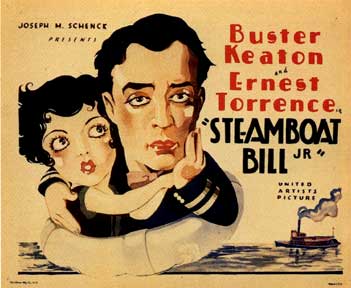
Before I Die #607: Steamboat Bill, Jr. (1928)

This is the 607th movie I've seen out of the 1,187 movies on the "Before You Die" list that I'm working my way through.


Directors: Charles Reisner, Buster Keaton

A solid Keaton flick, with some of his more memorable set piece stunts, though it doesn't top my two other favorite Keaton movies.

The setup and story are not wildly innovative for silent era comedies: the only son of a crusty old steamboat captain, William Canfield, Jr. (Keaton) returns home from college to see his father for the first time in many, many years. Much to his burly, working-class father's chagrin, Junior is a diminutive dandy, looking wildly different from his old man in both his tiny frame and his foppish style. Senior attempts to teach junior his trade, with little success. This creates bigger problems since their family business - their steamboat - is about to be put out of business by a brand new, larger, and more luxurious steam liner that has just moved into their river town. The rivalry with this other company is put on hold, though, when a massive storm blows through the town, endangering everyone in it. Junior, despite his many goofs up to this point, manages to save his father and several other prominent people in the town.

"Old Stoneface" Keaton's remarkable skills as a
physical comedian are on display throughout the
film, but perhaps never moreso than as he
fumbles his way around the steamships.
As with any Keaton flick, the story is hardly what matters here. It's all about the visual stunts and gags, and this film has plenty of them. The most notable is the grande finale windstorm, when entire buildings are literally crumbling around Keaton's character, as he dodges the debris coming at him from all directions. Although there were some impressive stunts in this very long sequence, I was actually more amused by a few of the simpler physical gags. What's always impressed me about Keaton were his uncanny agility and grace, and the massive eyes on his hilariously deadpan face. In this movie, there is more than one moment where he'll take a spill that could seriously cripple him, somehow catch himself, and never once change his facial expression. It dawned on me that he truly is the original Jackie Chan, in terms of putting his safety at risk for the sake of a movie. Only I find his impassive non-reactions far funnier than Chan's highly expressive face.

I've now seen about a half dozen of Keaton's movies, and my two favorites are still Our Hospitality and The General. Steamboat Bill, Jr. may have the more memorable final act in the eyes of historians, and it may have inspired the very first Mickey Mouse cartoon, but it wasn't quite as entertaining as those earlier movies of his.

That's 607 movies down. Only 580 to go before I can die.