Showing posts with label crime films. Show all posts

Tuesday, July 28, 2020

Blue Velvet (1986)

Director: David Lynch

Pretty riveting, dark neo-noir type film which is the most accessible film I've seen from noted surrealist David Lynch.

I recall watching this one once before, about 20 years ago, though I had zero recollection of the second half of the movie. This means that I either fell asleep, or that I left the friend's house where we were watching it before it was over. Whatever the case, I'm happy that I finally went back to it.

The movie follows Jeffrey Beaumont (Kyle MacLachlan), a young man who returns to his cozy American town from college after his father is hospitalized after falling ill. While walking in a field near his neighborhood, Jeffrey makes the grisly discovery of a human ear lying on the ground. He takes the ear to the police, but can't seem to leave it at that. With the help of a police detective's daughter, Sandy (Laura Dern), he employs some amateur sleuthing techniques to dig deeper into the mystery. Before long, he is wrapped up with the sultry lounge singer Dorothy (Isabella Rosalini) and a maniac criminal, Frank (Dennis Hopper). Jeffrey is inexorably pulled into a dark, underground criminal world filled with drugs, violence, and depravity of a level that belies the otherwise peaceful-seeming town.

Blue Velvet is still pretty hypnotic, even after nearly 35 years, and certain elements almost seem like a practice run for some of what we would see in the original Twin Peaks  TV show 4 years later. The most obvious one is the notion of dark, twisted forces lurking beneath the tranquil, All-American, white picket fence veneer of the setting. You have the attractive young couple in Jeffrey and Sandy, who seem to be falling in love, and we see more than a few nods to the idealist view of relationship from American suburbia from the 1950s and early '60s. It doesn't take long, though, before things get weird. Like, really weird. No sooner does Jeffrey sneak into the lounge singer Dorothy's house for some intel on a possible murder than he finds himself in a closet, peeping on her undressing, then seeing her brutally victimized by the unhinged, sexually warped madman, Frank. This dizzying dichotomy of light and dark has long been a part of David Lynch's works, and Blue Velvet was his earliest and probably still his most accessible example of it.

Then there are the technical merits of Blue Velvet. The movie just looks so good. And I don't mean to say that it's easy or always pleasing to watch. It's not. There are just too many disturbing and violent behaviors going on to say that you "enjoy" watching it. Still, it doesn't take an expert to see that the costumes, lighting, sets, and cinematography are masterfully designed and executed. There's such a rawness to most of the scenes involving Frank that most films won't employ. When Frank is terrorizing then raping Dorothy, there are no edits or camera maneuvers to spare the viewers of just how horrific he is. Similarly, when Jeffrey is basically abducted to the apartment where Dorothy's child is being held captive, there is such a skeevy, dangerous vibe that one can't help but feel like Jeffrey has ended up in some deceptively drab-looking circle of Hell. An easily overlooked part of these disturbing sequences is the lack of music, creating a silence that intensifies the horror. On the flip side, there are other scenes and moments that are very lush and stylized, showing off Lynch's range of techniques.

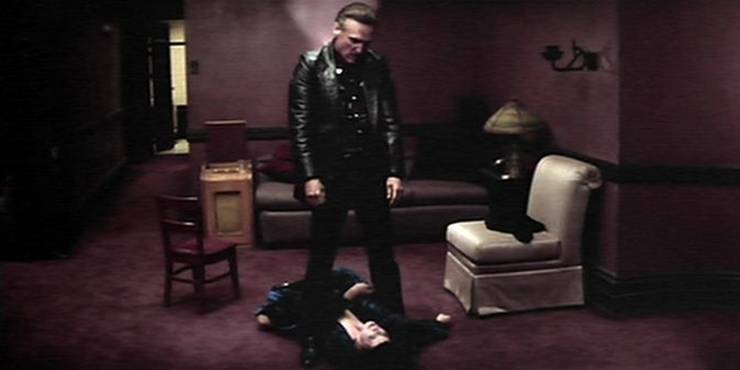
Frank, menacing over a terrified Dorothy. Frank is one of
the most frighteningly raw psychotics you'll ever see in film.
And Lynch doesn't let you off the hook by stylizing him in
any way - he's just a mad dog nutbag, on unflinching display.
I always find it hard to explain my feelings on the acting in David Lynch's movies, since there's such a range. There's almost always some campiness to be found in his works, which inherently requires some overacting and scene-chewing from the actors. And sometimes camp filmmakers just put bad actors in their movies, either because they find the amateur acting funny or because they just like the way an actor looks on film, despite a lack of acting ability. I think David Lynch has always done all of these things, and Blue Velvet is no exception. All that said, the four main performers - all rock-solid professionals - are perfect. And there's also a great, smaller turn we get from Dean Stockwell, the bizarre, perverted "ringmaster" at the aforementioned apartment scene (I must admit that this character can accurately be branded as a classic example of homophobia).

Like every David Lynch movie I've seen, I can only recommend it to people who are ready for something that's more than a little odd, twisted, and challenging in some respects. While the over-arcing story follows your typical crime thriller, the telling is much grittier, bizarre, and in your face than more popular fare in the genre. The best starting place for those who haven't seen Lynch's work is the original Twin Peaks TV show. If the darker elements of that program don't freak you out, check out Blue Velvet. From there, Lynch's work mostly gets darker and more surreal, so it's a logical next step. 

Monday, July 20, 2020

Twin Peaks (2017)

Spoilers Ahead! Fair Warning. 

Director: David Lynch

It's simple: if you enjoy David Lynch, you'll enjoy this show. If not? This one is highly unlikely to win you over.

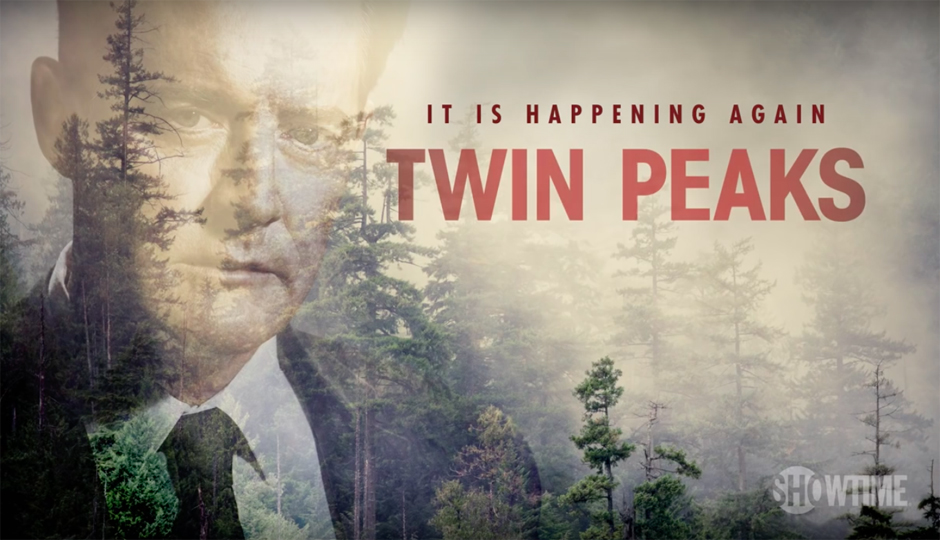
I recently posted my reviews of the original Twin Peaks show and its prequel movie, Fire Walk with Me, as my wife and I worked through them. The original program was canceled after only two seasons and 30 episodes, then left in the ether for well over two decades. Then, lo and behold, it was resurrected by Showtime.

Sometimes referred to as Twin Peaks: The Return, this long-awaited continuation of the quirky, dark TV series does actually pick up roughly 25 years after the final episode of the original, which aired back in 1991. That final episode ended with a wild ride of surrealistic madness, capped off with buoyant, boy scout FBI Agent Dale Cooper seemingly getting trapped in another realm while an evil doppelganger had taken his place in our world. The 2017 resurrection series jumps ahead in time the same 25 years that had passed between the airing of the two series. In the strange "Red Room" limbo where Cooper was stranded in 1991, he is finally sent back out to reclaim his place in our world. The problem is that the evil version of Cooper has been there, long building and overseeing a criminal enterprise and planning how he will avoid being pulled back into the Red Room. In our world, a series of new, bizarre murders starts to bring back together many of the people in Twin Peaks and within the FBI who had previously known and worked with Cooper, especially dealing with the Laura Palmer murder.

Unless I wanted that summary to stretch into a 20-page exposition, I had to keep it laughably short and simple. Twin Peaks: The Return consisted of 18 episodes, all between 50 minutes and an hour, and it takes no end of strange, surreal twists, and is told in typically David Lynch, non-linear style. This makes any concise, clear summary all but impossible. At least, not one that conveys the show's distinguishing characteristics. This is a long, all-David Lynch production, and it contains pretty much all of the "Lynchian" elements that one might expect.

In short, my wife and I enjoyed watching it.

Andy and Lucy are among the many original characters 
to return. They're also part of several of the stranger,
stilted, and seemingly disconnected scenes and sequences
that we get over the course of the 18 episodes.
If you ever saw the original show, or a few of Lynch's more surreal films like Eraserhead, Lost Highway, and Mulholland Drive, among others, then you have a sense of what to expect. So many scenes and moments will leave you questioning what, exactly, is going on, especially in terms of the plot. Thanks to shifting perspectives, unclear identities, multiple identities, non-linear narrative, and outright surreality, Twin Peaks is far from a traditional narrative. Sure, it contains more than a few familiar mainstream elements of crime dramas - mysteries surrounding murders, some tense confrontations between hardened criminals, narrow escapes from death - but the precise combination and presentation of them in all uniquely David Lynch. Characters act and speak in strange, often stilted ways. The pacing of many sequences is bafflingly drawn out at times. Many of the odder elements are never clearly explained. Such non-traditional spinning of a story can be enjoyed, tolerated, or rejected. I actually enjoyed much of it, and was able to tolerate the rest. But I also understand why some people would reject the show.

Probably the most obviously bizarre elements are the supernatural/surreal ones. In Twin Peaks, David Lynch has created his own cosmology - one which we viewers are not meant to completely understand, in my view. It involves industrial machinery, electricity, deep space, atomic science, and several immortal beings that are able to move between alternate dimensions and planes of existence. I won't pretend to understand it all, but I greatly enjoyed the mental exercise of stitching together the images and implications presented in the show. While there are plenty of these supernatural elements to be found through the entire 18-episode series, the most mind-blowing and dazzling episode was Part 8, which is almost completely done in black and white, with sparing dialogue, and is a parade of images and settings which can only be understood as "not of this world." That is, except for some scenes at the beginning of the atomic bomb detonation in 1945, and some bizarre, ash-covered demon-like figures who appear later, in 1956. The rest is a hypnotic, dreamlike tour through alien landscapes and perception-altering imagery. Honestly, watching it was not unlike taking hallucinogenics, and I was transfixed.

One of the many striking and puzzling images from the
markedly surreal eighth episode. Some viewers would be
turned off by the strangeness of it, but I was dazzled by the
imagery and dreamlike nature of this chapter.
But what about the more grounded elements? What about Dale Cooper and the crime stories? This is where, I suspect, some viewers lost their patience with the show, which I can understand. During many of the periods on "our world," David Lynch often chose to draw scenes out to frustrating lengths. A ten-minute sequence of a few people trying to find a key to an apartment. Two full minutes of a guy sweeping up a bar floor. An interminable argument between Audrey and her husband that stretches out, piecemeal, over four or five episodes and ends up going seemingly nowhere. And there are plenty of other examples. For me, these were things that I tolerated, but I totally understand how some people found them infuriating. In my case, I found that they did somewhat fit into the overall off-beat vibe of the entire series. Or at least, they fit just enough that they didn't get on my nerves too much.

A significant part of the fun here is seeing which characters and actors return from the original show, and what their characters are up to. Amazingly, the overwhelming majority of the original actors were around and signed on for it. Some of them don't show up until much later in the season, and very few of them have any great roles. In fact, almost none of them have any more than maybe 30 minutes of total screen time, across all 18 episodes. I have to think that this was much more about David Lynch just wanting to show faithful fans of the original show that these characters are still around, even if most of them no longer have any real connection to the greater events swirling around Agent Cooper. Whatever the case, my wife and I certainly perked up when seeing an original cast member turn up, however inconsequential their presence may have been.

The alienness of the Red Room serves as a microcosm for how
a viewer might feel while watching this show. Familiar elements
mixed in jarring, inexplicable ways can both attract and baffle.
I do have to point out something which my wife initially noticed about the entire show, and which is hard to ignore once perceived, and that is the role of women. David Lynch is clearly an artist who has a deep passion for the styles and character archetypes of popular Americana from the 1950s and 1960s. This has long been a huge part of his style: blending those classic, romanticized elements of U.S. culture with the twisted, pitch-dark demons lurking beneath their surface. Unfortunately, he also seems to keep his female characters almost always restricted to the old, limited roles of popular stories from those bygone decades. With very few exceptions, the women in Twin Peaks are either victims, objects of lust, mentally unstable, or various combinations of those three. A few others may only be attractive window dressing, such as Agent Tammy Preston in The Return, who does little more than pose like a model for David Lynch's Gordon Cole character to gaze at from time to time. As our culture changes in its attitudes towards representation here in the 21st century, it becomes harder and harder not to notice such a clear imbalance in gender roles in TV and films like this.

As implied, this show is a tough one to recommend. I certainly can't suggest that anyone start with this revival of the show, before watching the original. The original program will give you a beginning sense of whether you care for David Lynch's general style or not. More than that, though, I would recommend also seeing one or two of Lynch's relatively more accessible films, like his neo-noir thriller Blue Velvet or even the aforementioned Lost Highway. Those two contain some of the challenging, surreal elements that the director uses more in Twin Peaks: The Return. If you dig those earlier movies, then you'll probably like the resurrection of Twin Peaks

Sunday, October 1, 2017

Before I Die #614: Blackmail

This is the 614th movie I've now seen out of the 1,199 movies on the "Before You Die" list that I've gradually working my way through.


Director: Alfred Hitchcock

A pretty curious early work from suspense master Alfred Hitchcock. It clearly displays some of his early mastery of the visual aspects of the medium, though the actual story itself drags more than it ought to, especially for a film only 85 minutes long.

The story follows Alice White, a young woman in 1920s London, who is "playing the field" a bit in terms of dating. Although seemingly attached to Scotland Yard detective Frank Webber, Frank pays far more attention to his work than to Alice. Perhaps for this reason she has begun to show interest in a new suitor - an artist named Mr. Crewe. One evening, after Alice deceptively blows off Frank, she meets Crewe and eventually is enticed up to his apartment. Crewe makes unwanted advances and eventually tries to rape Alice, who defends herself and ends up killing Crewe with a knife. Alice flees the scene. The next day, Frank and his fellow detectives arrive on the murder scene, where Frank secretly finds evidence that Alice is the killer in the form of a forgotten glove. He spirits it away and returns to her, but the two are soon confronted and blackmailed by a man, Tracy, who had quietly seen Alice entering Crewe's apartment. Tracy's blackmail attempts work for a short while, in small ways, but he is eventually suspected of murder himself. He is ultimately pursued and dies while trying to escape capture. Despite being off the hook, Alice seems to still be troubled by her conscience.

This was a fairly fascinating movie for a few reasons. This is the earliest Hitchcock movie I've seen, and one can certainly see many elements that are familiar in his pictures. There is a daring use of dark subject matter, such as attempted rape and successful murder, at the heart of the story. It also goes beyond merely being a crime procedural, offering gray areas in terms of who the guilty and innocent are. And then there is the psychological aspect, seen mostly obviously in Alice, who was clearly justified in defending herself against the aggressive advances of Crewe, but still feels the conflict of one who has killed a person. While I've seen some other contemporary films that utilized one or two of these themes, Blackmail is the earliest one I've seen that brings them all together through such a small-scale, personal story. For this, it certainly stands out.

Alice tries on a dress at the behest of Crewe. This little idea
is one that Hitchcock would later really run with in his more
classic movie
Vertigo.
The aesthetic elements of the movie are a mixed bag. The set designs are good for the era, with many of them creating a distinctive sense of place. This is especially true in the dastardly Crewe's apartment, which I can still picture very easily in my mind, even these couple of weeks after I watched the movie. Staging certain scenes (or even whole movies) in a single, confined location is something that Hitchcock would do later with even greater success in films like Rope or Rear Window, and we get a preview of it here. The acting is fair enough, though still a tad too rooted in the physical showmanship more suited for stage acting. Strangely, the audio doesn't truly kick in until nearly 10 minutes into the movie. I've read that this is because Hitchcock had already begun filming when the British Film Institute (who was providing funding) decided to make the movie a sound picture. This shift doesn't exactly ruin anything, but it is rather noticeable.

Blackmail is a movie that has a clear place in the history of great cinema, even if it's not likely to become any person's favorite movie, or even anyone's favorite Hitchcock movie. While the brilliant director would go on to make many better films, this one clearly shows his talent when he was still relatively young. For this, it is worth a look for fans of the early sound era and Hitchcock's overall body of work.

That's 615 movies down. Only 584 to go before I can die. 

Wednesday, August 9, 2017

Retro Duo: Zodiac (2007); Dawn of the Planet of the Apes (2014)

Zodiac (2007)

Director: David Fincher

I actually saw this movie back in 2007 in the theaters and thought it was excellent. That was, however, the only time I had seen it until it popped up as streamable on Netflix about a month ago. After the mood struck me to fire it up, I was reminded of why I had such a high opinion of it a decade ago.

The movie tracks the investigation into the very real series of murders which took place in San Fransisco and other coastal California cities between the late 1960s and early 1970s. The killer infamously taunted the San Fransisco police department and media by sending letters to the major newspapers, daring them to try and discover his identity. Zodiac studies the years-long manhunt mostly through an unlikely vessel - San Fransisco Chronicle political cartoonist Robert Graysmith. As the Zodiac killer's letters arrive, Graysmith becomes more and more engaged in piecing the clues together to uncover his identity. Despite his many efforts, along with those of several dedicated and skilled police officers, the killer is never actually discovered or captured.

Zodiac is a highly unusual true crime movie, in that is offers none of the tidy satisfaction that many such movies serve up. Firstly, the murders are shown in a completely non-gratuitous way that truly chills one's bones. I greatly admire this approach, which prevents any sort of glamour from being placed on such vicious acts. Secondly, and perhaps most impressively, we do not get the satisfying, step-by-step detective tale that ends with the killer getting his just desserts. The road to identifying and arresting the man responsible is long, leads down many dead ends, and frustrates several good cops and earnest journalists into fits of near-insanity. By the middle of the movie, you can already feel these people's rage and feelings of impotence in the face of a murderer who not only brutally killed innocent people but also took pleasure out of taunting what he saw as the San Francisco establishment.

Telling such a tale in a way that is compelling cannot be an easy task, yet David Fincher pulled it off brilliantly. When I saw it in the theaters, I had a sense that the movie was overly long, though I did find it outstanding. During this second viewing, though, my sense of the movie being long-winded was completely gone. I could now see how each scene has its purpose and serves as its own small chapter in the greater tale. This is thanks to some strong writing and directing, as well as excellent performances all around by reliable actors like Jake Gyllenhall, Robert Downey Jr., Mark Ruffalo, and plenty of others. It should also come as no surprise that the cinematography and overall visuals are excellent - aspects of filming which Fincher never gives short shrift.

It's not a happy crime procedural in the vein of modern "Law and Order" shows, to be sure. But this is arguably one of the very best movies about a serial killer that has ever been made. If the topic itself is not too disturbing for you, I highly recommend setting aside the two-and-a-half hours to take this one in.


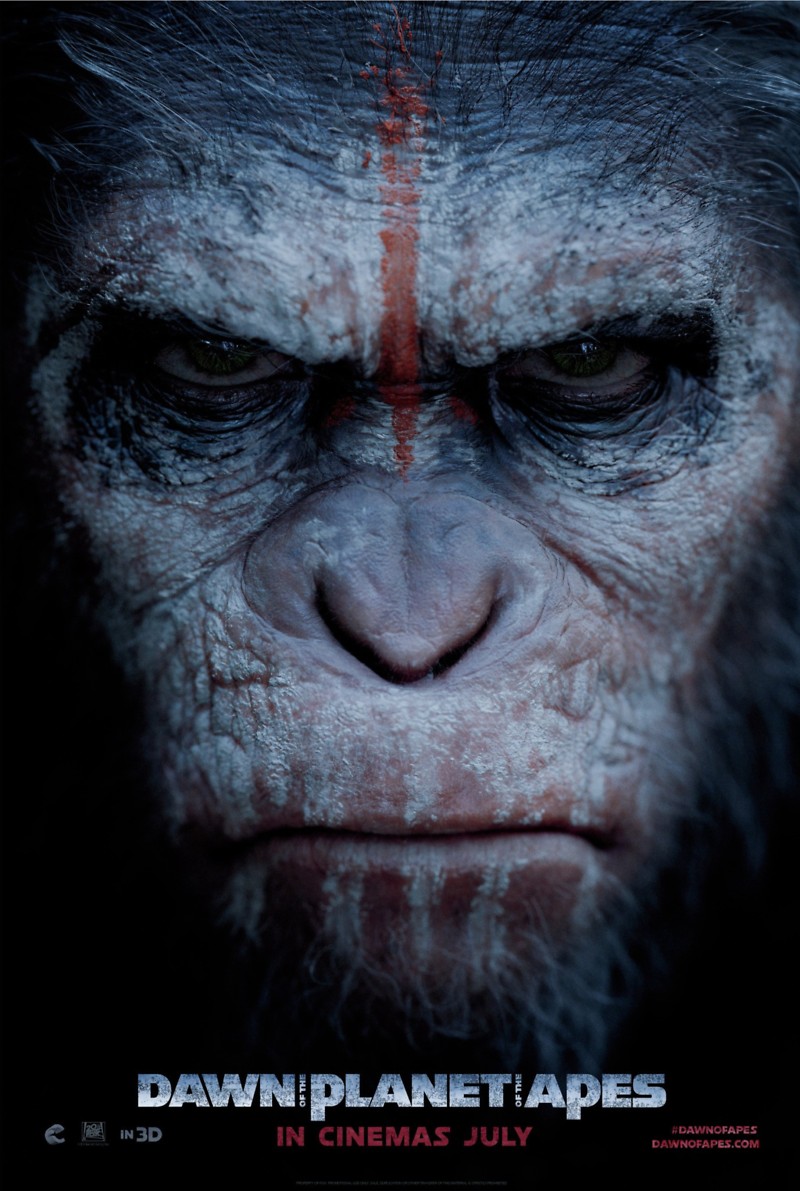
Cute little Caesar from the first movie
has learned a few hard lessons from life,
and he wears them in his gaze.
Dawn of the Planet of the Apes (2014)

Director: Matt Reeves

The second in the modern "Apes" trilogy, this was another surprisingly well-done follow-up to the equally solid Rise of the Planet of the Apes, released in 2011.

At the end of Rise, the exceptionally intelligent (thanks to genetic engineering) ape Caesar had led a large-scale escape of dozens of apes whom had been subjected to experiments and torture. Unbeknownst to Caesar, he and his brethren were also carrying a virus, known to humans as simian flu, which then began infecting the human population.

Dawn of the Planet of the Apes picks up ten years after the end of Rise. Most of humanity has been killed by the simian virus. Caesar is the head of a large clan of apes living in an organically-constructed town in the forests outside of San Francisco. Still with him are several of the apes which he initially set free, before the outbreak of simian flu. Most notable are the massive and quiet orangutan Maurice and the still-bitter, tortured, and pugnacious Koba. The apes all live in relative peace, and they haven't even seen a human in two years. That is, until they come across a small group of them nosing around the apes' forests. One human gets spooked and accidentally shoots Caesar's son, Blue Eyes. This sets off a chain of events leading to a fight between an angry contingent of the apes and an enclave of human survivors who have been scraping out a meager existence in the husk of old San Francisco.

As silly as I found the original 1968 Planet of the Apes in many ways, it is extremely difficult to find much that is silly about Dawn. Yes, there are apes running around, riding horses and using guns. On the surface, it can seem completely ridiculous. But the themes of warfare, vengeance, xenophobia, and superiority are all thoroughly relevant, and they are handled with surprising skill here. Thanks in no small part to the stunning visual effects of Weta studios and some amazing motion-capture performances by Andy Serkis and others, even the apes evoke genuine feeling that is often missing from all-human cast, struggle-for-survival dramas. The apes like Caesar and Koba speak in short, simple sentences, but many of their words carry immense weight, given the context, and show thought and emotion with which we can empathize. And since the context is a more primitive world, with very little electricity or advanced technology, the prominence of questions about existence and survival feel completely natural. The resolution blends its action with its drama quite well, with the stakes feeling quite high on both a material and emotional level; this is impressive, given just how much of it involved computer-generated primates.

While I may not feel the need to rewatch Rise or Dawn of the Planet of the Apes again any time soon, I found them both pleasant surprises and very solid films, especially the latter. Perhaps the best praise I can offer is that, while I didn't bother to catch either of the first two in the theaters despite positive reviews, I plan to catch the final installment of the trilogy on the big screen. 

Saturday, May 28, 2016

Before I Die #565: Pepe le Moko

This is the 565th of the 1,172 movies on the "Before You Die" list which I'm gradually working through.

Director: Julien Duvivier

To an average modern viewer, Pepe le Moko would be a good movie. When taken in the context of its release and the overall history of film, it's an incredible movie.

Taking place roughly around the time it was made in 1936, Pepe le Moko centers on the title character, a thief who is hiding out in the famous Casbah area of Algiers, Algeria. Pepe is, in many ways, the classic romantic rogue - handsome and charming, with just enough integrity to inspire devotion from many who meet him. However, he is also possessed of a deep sadness, and this is where the movie was well ahead of its time. While it is certainly engaging to learn about Pepe's skills as a thief and his powerful charisma, it is the deeper exploration of his psyche which made this movie so groundbreaking.

The film wears the veneer of a chase movie. The police force in Algiers have been unable to catch the elusive Pepe, and the government of France, the colonizers of Algeria, send in officials to oversee a more rigorous pursuit. Despite warnings from local officers familiar with the difficulties of the situation, the French attempt to bulldog their way into finding the notorious thief. Shifting between the center and the periphery of the investigation is Slimane, a seemingly-lazy local officer possessed of deceptive intellect, knowledge, and patience. It is the slow burn of watching Slimane work the problem of apprehending Pepe that makes this movie so far ahead of its time. Whereas nearly all films of that time (and the majority of films even today) rely on the drama of strong characters constantly duelling each other in dynamic and eye-catching ways, Pepe le Moko is more measured and assured. It is this slower pace which allows us to truly think about what motivates Pepe, and it becomes clear that it is more than simply money and women.

This still gives just a taste of how tricky the maze of the
Casbah can be, especially to those unfamiliar with its
twists, turns, and many, many dark shadows. 
Pepe le Moko is also a film about place. The locale of the Casbah is spectacular. Filmed on location, the movie depicts a neighborhood which is a fascinating labyrinth of multi-storied buildings, winding stairways, and bodies packed into the well-worn structures. It's a perfect setting for the tale of a thief who both uses the maze to retain his freedom and feels its constrictive nature. Casablanca, as great as it is, never comes close to creating the sense of locale as Pepe le Moko.

The resolution of the story is just as impressive as anything else about the movie. It avoids all of the tropes and typical cliches of weaker films. This was a great movie that I'm glad to have finally watched, after reading about it for so many years.

That's 565 films seen, only 607 more to go before I can die...

Friday, January 1, 2016

Before I Die #561: The Asphalt Jungle (1950)

This is the 561st that I've watched of the 1,172 films on the "Before You Die" List that I'm gradually working my way through.

Director: John Huston

A decent enough noir flick, but one that I'm a bit surprised is held in such high esteem.

The basic tale focuses on a bank heist, masterminded by a recently paroled master thief, Doc Riedenschneider (Sam Jaffe). Doc arrives in a new city, where he quickly gets to work assembling a small crew who will help him pull off his long-planned score. The gang he gathers includes the safe-cracker Louis Ciavelli, the gunman Dix Handley (Sterling Hayden), and the driver Gus Minissi. Doc has his plot bankrolled by a shady lawyer, Alonzo Emmerich (Louis Calhern). The heist begins well enough, but multiple complication start to arise, between one crew member being shot by police, and the entire gang being double-crossed by Emmerich.

In terms of noir crime plots, The Asphalt Jungle is solid, if not completely novel. It seems a sort of hybrid between 1946's The Killers and 1948's The Killing (noir films weren't noted for originality in their titles). In fact, the latter film also starred Sterling Hayden, who is also the key player in Jungle. The familiarity of the story and tone robbed the movie of some of its edge for me. Still, the suspense as the heist unfolds is on par with some of the very best crime movies.

Dix (far left) and Riedenschneider (far right) display their
spoils to their ostensible patron, the oily Emmerich.
I found the characters varyingly engaging. Doc Riedenschneider is certainly the most unique and entertaining of the lot. A quirky and brilliant old thief with a weakness for young ladies is bound to be entertaining, and he is. The primary character Dix, however, I found rather dull compared to other classic noir protagonists. There is some complexity beneath his gruff exterior, but he's still rather simple. Sterling Hayden is an all-time great stoic, but it robbed the character of some intrigue. Most others in the film are fairly shallow, though acted well enough.

The classic noir era of the 1940s and '50s provided me with some of my absolute favorite movies. I still watch Double Indemnity and Out of the Past every few years with growing love and appreciation. Checking out another touted film from the era like The Asphalt Jungle was enjoyable, but I can't put it in the same class as those other masterpieces. 

Tuesday, May 19, 2015

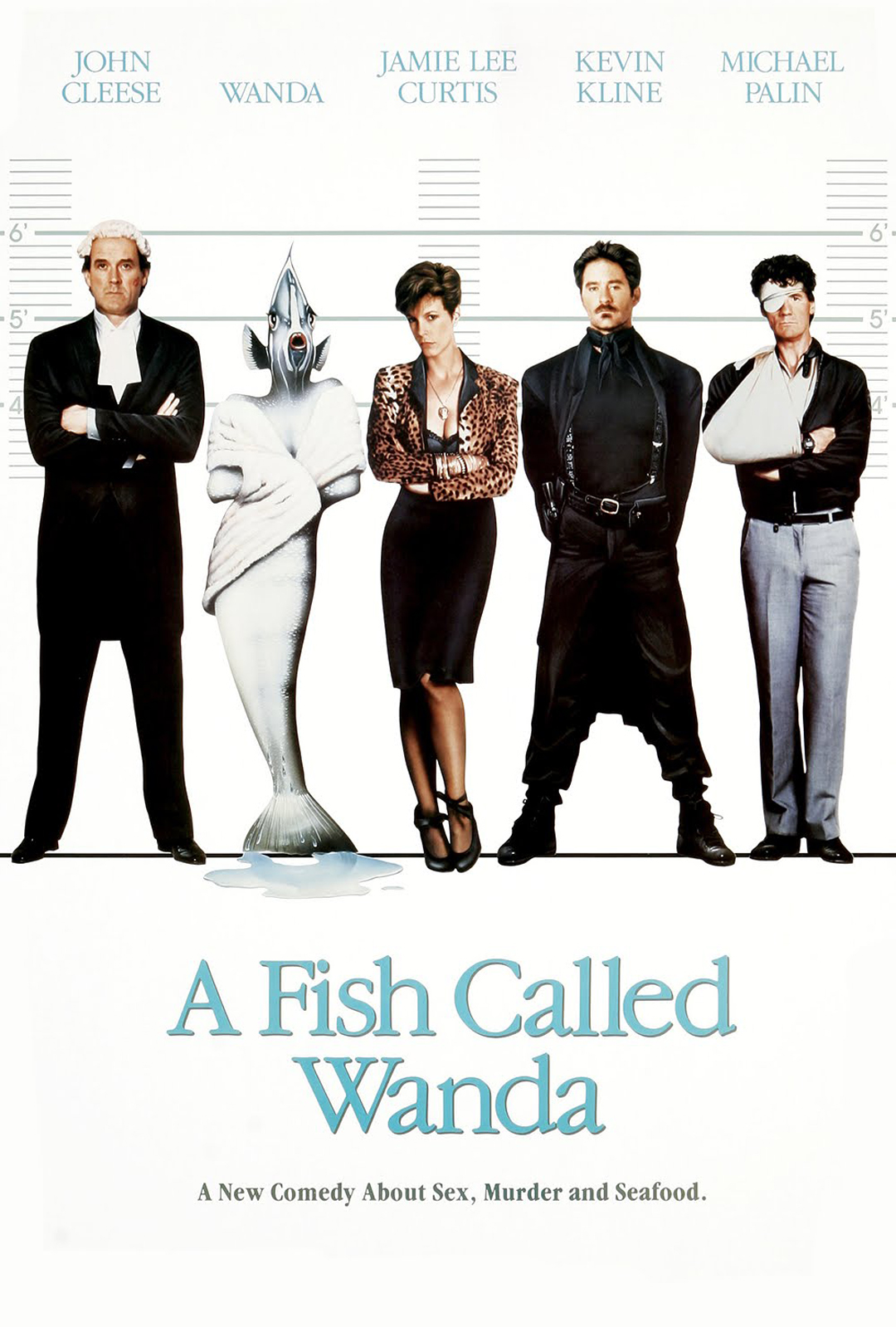
Retro Trio: A Fish Called Wanda (1988); The Man Who Knew Too Little (1997); Killing Them Softly (2012)

A Fish Called Wanda (1988)


Director: Charles Chrichton & John Cleese

A 1980s classic comedy that still has it.

I watched this movie plenty of times as a kid, but it had been at least 10 years since I last saw it. Though there are a few dated elements, in terms of the visuals, the dash of sappiness, and even a bit of the acting, A Fish Called Wanda is still a brilliant blend of British and U.S. humor.

For those who may not have seen it, the story mostly follows Wanda Gershwitz (Jamie Lee Curtis), a con woman who uses her beauty and wiles to horn in on a bank heist, with the intention of stealing the prized diamonds from the primary thieves. Using sex and emotional manipulation, she coldly plays every man involved - the mastermind George, the weapons man Otto (Kevin Kline), the stuttering henchman Ken (Michael Palin), and the repressed and unwitting lawyer Archie (John Cleese).

What allows the movie to stand the test of time rests on the script and the performances. The interactions between the more liberal and maverick Americans - Wanda and Otto - and their British cohorts are hilarious and eminently quotable. The standout scenes are typically between Otto and any of the English characters, whom he despises out of his own small-minded xenophobia and latent inferiority complex. Otto's supremely "ugly American" personifies every laughably obnoxious trait of U.S. travellers that has been the butt of jokes for decades, right up to the present.

Otto may not have been as memorable had it not been for an Academy Award-winning performance by Kevin Kline, which is a rare feat for a comedy film, but completely worthy. He often makes the movie, and his stand-offs with John Cleese's barrister Archie Leach and Michael Palin's Ken are perfection.

Great movie that is still great 25 years later, and will likely be great for decades to come.

The Man Who Knew Too Little (1997)

Director: Jon Amiel

A pretty fun, if not outstanding, little comedy.

I had never seen this one before, and I must admit that I could see why it was never hailed as a "great" comedy, despite having a great cast. The movie is a spoof on the spy thriller genre, following goofy American tourist Wallace Ritchie (Bill Murray) who goes to London and is unwittingly pulled into a plot between English and Russian forces to resurrect the Cold War status quo. Ritchie, however, is sucked into the entire affair, believing that he is the center of a popular television show on which the central "actor" is an average person who must play along with the professional actors around him, ad libbing along the way.

This premise isn't a bad one, as far as spoofs go, though the political elements do seem a few years too late for a film made in 1997. Even still, there was plenty of fodder for better political satire which went unused. That aside, there are plenty of solid setups for the comedic misunderstandings that drive the movie.

Instead of focusing more on the political humor, the film focused almost solely on its star, and one could do far worse than Bill Murray. Even when the dialogue or set-ups fall flat, Murray can carry a scene or an exchange with his hilarious deliveries, reactions, and physical comedy. It's easy to forget, given Murray's strengths with extremely dry and deadpan humor, that he can act the oblivious fool extremely well.

As a whole, though, the humor and goofiness wore thin by the third act. Despite being an obvious parody, the silliness level ramped up a little too high to remain effective. The grand finale scene consists of an overly long dance routine that borders on feeling interminable. And instead of leaving well enough alone and having Wally go on his merry way, we're left with him being recruited by the C.I.A. It was a bit too juvenile for my liking.

Had the script been a bit more clever and abandoned the more slapstick elements, this movie could very well have been a classic. As it is, it offers a few laughs, but doesn't warrant multiple viewings for me.

The social commentary is clumsy, but it
is curious enough to provoke thought.
Killing Them Softly (2012)

Director: Andrew Dominik

I was disappointed, but not necessarily because the movie is bad.

Killing Them Softly was released in 2012 and had a short and quiet run in theaters, despite solid critical acclaim. By the time of its video release, it had attained status as an "underrated film" and "sleeper pick" by critics in many quarters. With all of this "in the know" hype, I had very high hopes. The movie is quite good, but not without its flaws.

I will admit that the movie is fairly original, in terms of its grittiness and willingness to look at the more unglamorous aspects of criminality. The story takes place in a horribly bleak part of Boston, where a couple of dim, low rent street guys rob a high stakes poker game which includes members of the local mob. This sets off a chaotic attempt to assess blame and levy punishment, with noted hitman Jackie Cogan (Brad Pitt) brought in to sort the entire mess out.

The novelty of the story is that it does look at the disorganization and brutality of "organized" crime. The characters come off as extremely authentic, with all of their weaknesses on full display. Whether it's simple base greed, lust, or substance addiction, a viewer gets the sense that the grim and nasty picture painted for us is far closer to the reality than the more palatable portraits given us by more mainstream gangster movies. Instead of the ultra-slick, hyper-intelligent criminals, we see the sad, flawed, and ultimately doomed thugs and lowlifes who stand no real chance at getting what they want. Easily the most poised character is Jackie, who spends far more energy battling his disgust for the stupidity and indecision around him than on actually cleaning up the various messes created by foolish thugs and Jackie's waffling employers.

Jackie spends an awful lot of time in this kind of situation -
explaining a lot of harsh realities to dim or weak wanna-be
criminals. They provide much of the movie's power.
As far as the cleaning up of those messes, they do provide some excellent on-screen suspense and power. There are more than a few scenes that can effectively stun you with their impact. Unfortunately, there are also a few plot lines and scenes that seem to drag endlessly. The main one is the entire character Mickey, played by James Gandolfini in one of his final roles before his death. Mickey is an aging hitman who Jackie brings in to help him, but it soon becomes apparent that Mickey is a broken shell of what he once was. The point of Mickey's descent, though, is belabored so much that it is taxing to watch, and it almost resulted in my completely checking out of the film. Blessedly, it does end, and the main story picks back up in the movie's final 20 minutes.

A greater enigma hanging over the entire movie is the completely unsubtle social commentary. Right from the jump, we see dashes of political posters with Obama and Romney on them, in the throes of the 2008 presidential race. The blatantly obvious message is that the United States is in a state of free-for-all chaos, with our little crime story meant as a microcosm of the entire quagmire. It's not a terrible suggestion, but it could have been handled with far more deftness. It does, however, set up an absolutely classic final line to the movie, which may be one of the most memorable in all of crime cinema.

Killing Them Softly is, despite its weaknesses, a nice addition to the genre of crime films. It does stand apart from most of its ilk, and the performances are more than strong enough to carry a viewer through it. Definitely recommended to any fan of gangster movies. 

Monday, March 30, 2015

Before I Die #544: The Girl with the Dragon Tattoo (2011)

This is the 544th movie I've watched out of the 1,162 films on the "Before You Die" list that I'm gradually working through.

Director: David Fincher

An excellent adaptation/alternative version of a phenomenally successful novel.

Like millions of readers, I got caught up on the "Millenium" trilogy of books by the deceased Swedish author Stieg Larsson several years ago. I found the first book a very engaging and novel look at deep-rooted, institutional xenophobia and misogyny through the lens of a complex murder mystery.

I saw the original Swedish film adaptation that was released in 2009, and I thought it a solid but slightly flawed take on the story. In 2011, we got a rare treat: a U.S. remake that is actually better than the original European version. The improvements can likely be connected to a much larger budget and the direction of David Fincher, a man who is no stranger to telling very dark and complex tales in films.

For those unfamiliar with the story, it mostly follows two unique characters. Mikael Blomqvist is a crusading but embattled journalist who is hired by an incredibly wealthy businessman to potentially solve a 40-year old murder within his large and largely-dislikable family. Also involved is Lisbeth Salander, a tortured and antisocial genius hacker who becomes Blomqvist's research assistant. There are a ton of curious and sordid details that go into explaining how the two become connected, which make for a dark and fascinating story. Fincher's movie ties the many threads together as skillfully as possible, though an unfamiliar viewer will need all of their attention to keep up.

Yes, Lisbeth can be just as wicked as she
dresses. Fortunately, she tends to direct her
scary smart rage towards misogynists. 
Blomqvist and Salander are great characters in their own rights, and they are brought to life by outstanding performances by Daniel Craig and Roony Mara. Not to slight Noomi Rapace, who admirably portrayed Salander in the original Swedish film version, but I found Mara added just a little more bite to the role. The affable Blomqvist and prickly Salander are different in nearly every way but for two important things: their desire to see justice done and their their unwavering energy to see it through. When the two find their causes overlap, we get some extremely satisfying storytelling.

For those unfamiliar with the details of the story, I have to warn you that it goes to many extremely dark places, with graphic detail regarding murder and rape. If you can stomach such things in your fiction, then this movie is well worth watching. While I found the subsequent two novels not as strong as the first, I do hope that the cast and crew of this 2011 adaptation come together for the rest of the series.

So that's 544 films down. Only 618 to go before I can die...

Monday, March 16, 2015

New(ish) Releases: Gone Girl (2014); Horrible Bosses 2 (2014); Robocop (2014)

Gone Girl

Director: David Fincher

A well-constructed, gripping, and bold movie. Gone Girl is also a film that will likely leave you unsure of exactly how to feel when the credits roll.

It is impossible to say much about the plot of the movie without taking away great parts of its strengths. The set-up is thus: Nick and Amy Dunne are in a marriage that has grown painfully stale. What started as a storybook romance has become a dull affair that has revealed each person's worst flaws. On their fifth anniversary, things take a turn for the tragic and strange when Amy disappears, seemingly kidnapped. Nick, though at first not a suspect, increasingly becomes the focus of the investigations for various reasons.

If it seems like this is a fairly standard crime thriller set up, this is because it is. But it is a grave mistake to think that Gone Girl is a typical crime thriller. While it exhibits a number of the tropes typical to the genre, it turns many of them on their heads, while examining several larger, far more interesting and disturbing questions that go well beyond the "Who done it?" force that normally drives such movies.

The technical merits are outstanding, as is true with every Fincher movie that I've seen. The visuals are brilliant, the music enhances the film exceptionally well, and the acting is strong all around (yes, even Ben Affleck is fine). In short, it's a pleasing film to take in, aesthetically.

The movie explores several areas that are grey, dark grey, and eventually pitch black. This is to be expected from director David Fincher, who long ago proved himself unafraid to explore such places, most notably in his early film Se7en. Gone Girl is not for the faint of heart, or those looking for a nice, easily-digestible tale of heroes, villains, and ultimate justice. For that, I commend it, even if I probably never need to watch it again.

Horrible Bosses 2 (2014)

Director: Sean Anders

Just funny enough not to be a waste of time, but it was a tight race.

I really liked the first one. The over-the-top titular "bosses" were cast perfectly, and there was plenty of great banter between them and the trio of likable average Joes played by Jason Bateman, Jason Sudeikis, and Charlie Day. Such can't really be said of the sequel. Chris Pine and Christoph Waltz do just fine, but the script was far weaker than its predecessor. Pine and Waltz make the most of what they were given, but what they were given wasn't much to speak of.

The story, at least, differs from the original in that the three main shmos are attempting to start their own business. This pits them against Waltz's ruthless billionaire venture capitalist, who thinks nothing of crushing them like insects. Through it all, Bateman, Sudeikis, and Day go through the familiar stages of hope, rage, and panic that produced many of the great scenes in the first film. In part two, however, the chemistry is often out of balance. Where the three main players had previously been lovable, if a tad dim occasionally, in this movie Sudeikis's and Day's characters are stupid beyond belief. Stupid to the point that you wonder how they're even able to function. This idiocy results in a handful of good laughs, but many more duds than the first movie.

I knew not to expect anything great from this sequel, so I wasn't terribly disappointed in it. Just don't get your hopes very high - this will give you just enough laughs to make it worth your while, but no more.

Robocop (2014)

Director: Jose Padilha

While not terrible, this reboot of one of my favorite 1980s action flicks does little to recommend itself. This remake had potential, but most of it went unfulfilled.

It took some serious guts to even attempt a reboot of one of the most iconic 1980's tough-guy action movies. Twenty-seven years ago, Director Paul Verhoeven gave us a fun, ultra-violent action flick that constantly winked at us with its satirical advertisements and fantastic one-liners. This 2014 version played it much straighter, while attempting to inject some of the sly social commentary of the original. Unfortunately, the recent version is nowhere near as clever or entertaining.

The shame of the movie is that so many great foundational elements were in place. The tale of mangled police officer Alex Murphy is compelling enough, and witnessing his transformation into a cyborg war machine is a bit of fun. There's even a really stunning scene in which we see what Murphy looks like without the intimidating, prosthetic Robocop suit. The actors are all top-notch as well. It's tough to go wrong with Gary Oldman, Michael Keaton, and Samuel L. Jackson; and Joel Kinnemann was a solid choice for the title role. However, even these talents could only breathe so much life into a rather lukewarm script. The action is merely OK, as it does nothing to stand out from other blockbusters in the genre.

This movie set itself up for failure, really. Had it not been a remake of such a great movie, it might have been more engaging. As it is, though, one has to question whether it even needed to be made. My answer is "No." At least, it didn't need to be remade in such a bland way.

If nothing else, though, the movie did provide this hilarious interview with Kinnemann on The Daily Show with John Stewart. Start it at the 2:00 mark, and listen to the "Uncle Scotty" story. It had me rolling.

Saturday, November 22, 2014

Gangster Flick 3-Pack: Lucky Number Slevin (2006); Gloria (1980); Point Blank (1967)

Lucky Number Slevin (2006)

Director: Paul McGuigan

A fun, stylish, rapid-fire gangster movie that carves out its own niche.

There are a ton of influences at work in Lucky Number Slevin, which can be a dangerous thing in the wrong hands. Fortunately, director Paul McGuigan juggles and balances them all impressively well. While the result may not be an all-time classic, it is still a tight, fun viewing experience.

Without giving too much away, the basic story set up is that a young man named Slevin arrives in New York City to stay with a friend named Nick Fisher. All too soon, Slevin is whisked away by men who think he is Fisher, and Slevin is quickly embroiled in a bizarre gang cold war between two powerful yet reclusive crime lords known as "The Boss" and "The Rabbi," performed with playful menace by Morgan Freeman and Ben Kingsley, respectively.

It might be easy to write this movie off as one of the countless Tarantino Pulp Fiction clones, but this would be a slight injuctice. While the nonlinear narrative and rapid-fire dialogue might suggest that earlier modern crime classic, Slevin is much more in the style of The Boondock Saints. It leaves behind the endless pop culture references and isn't nearly as gritty as a Tarantino picture, but is rather more visually polished and overtly fun. The script has more in common with film noir, with its staccato back-and-forth sarcasm.

Odd scenes like this one are the norm. Some are trying a
little too hard to be quirky, but others are effective enough.
Much of the amusement of the movie comes from the disorientation of the tale. The lead character, Slevin (Josh Hartnett), is often whisked around by and between oddball gangsters, a la Roger Thornhill in North by Northwest (which is openly referenced in Slevin). Slevin's wise-ass reactions to his surroundings and circumstances, along with their inevitable consequences, are often hilarious. And then there's the fun as the viewer of simply trying to piece together all of the seemingly disparate puzzle pieces, not unlike when one first watches The Usual Suspects. Of course, as is usually the case with such breakneck-paced films, the speed masks plot holes that are really only noticed when one has time to look back along the path. Still, it doesn't detract from the immediate experience, as the movie clearly doesn't take itself too seriously.

An interesting observation was how this movie might have the single longest "reveal" of any film I've ever seen. For the first 90 minutes or so, the story hustles along and teases a far more complex and sinister motive behind all of the actions. This motive is explained at the end but takes (no joke) twenty minutes to fully reveal all of the mysteries. This seems ridiculous because it is ridiculous, but the details are engaging enough to prevent boredom.

Gloria (1980)

Director: John Cassavetes

I'm not altogether sure why this movie gets so much acclaim. For my part, I just couldn't see it.

The movie tells the story of the eponymous Gloria, who finds herself protecting a 6-year old boy whose family has been murdered as part of a massive mafia hit. Gloria, though, is no ordinary neighbor. She happens to have been the mistress to the mafia overlord behind the massacre, although she has left that life behind her. As Gloria escorts and protects her charge, Phil, she wrestles with just how far she's willing to go to save him.

That basic premise is not a bad one at all, and it's one that was used in Luc Besson's 1994 film Leon: The Professional. To me, the latter film did a far better job of it, though. Gloria is a good idea completely mucked up by incoherent emotional tone, vague plot points, unimaginative mafia characters, and outright terrible acting and dialogue by child actor John Adames. This last one was the most intolerable for me, as Phil is in the vast majority of scenes, and it is his relationship with Gloria that is meant to be the lifeblood of the film. Alas, the script for Phil often comes off as unnatural, as if written by an adult with a point to make rather than as words of an actual child.

The setting is another bone of contention for me. Perhaps I simply wasn't in the right mood, but the film depicts the same New York City that we usually see in films from the late 70's - the grungy, grimy, scum-laden concrete jungle that seems to ooze depravity and hide menace around every corner. I'm not saying that this can't be effective, but it became tiresome and simply a chore to watch after about an hour.

I was expecting quite a bit more from this one, but hey, they can't all be winners.

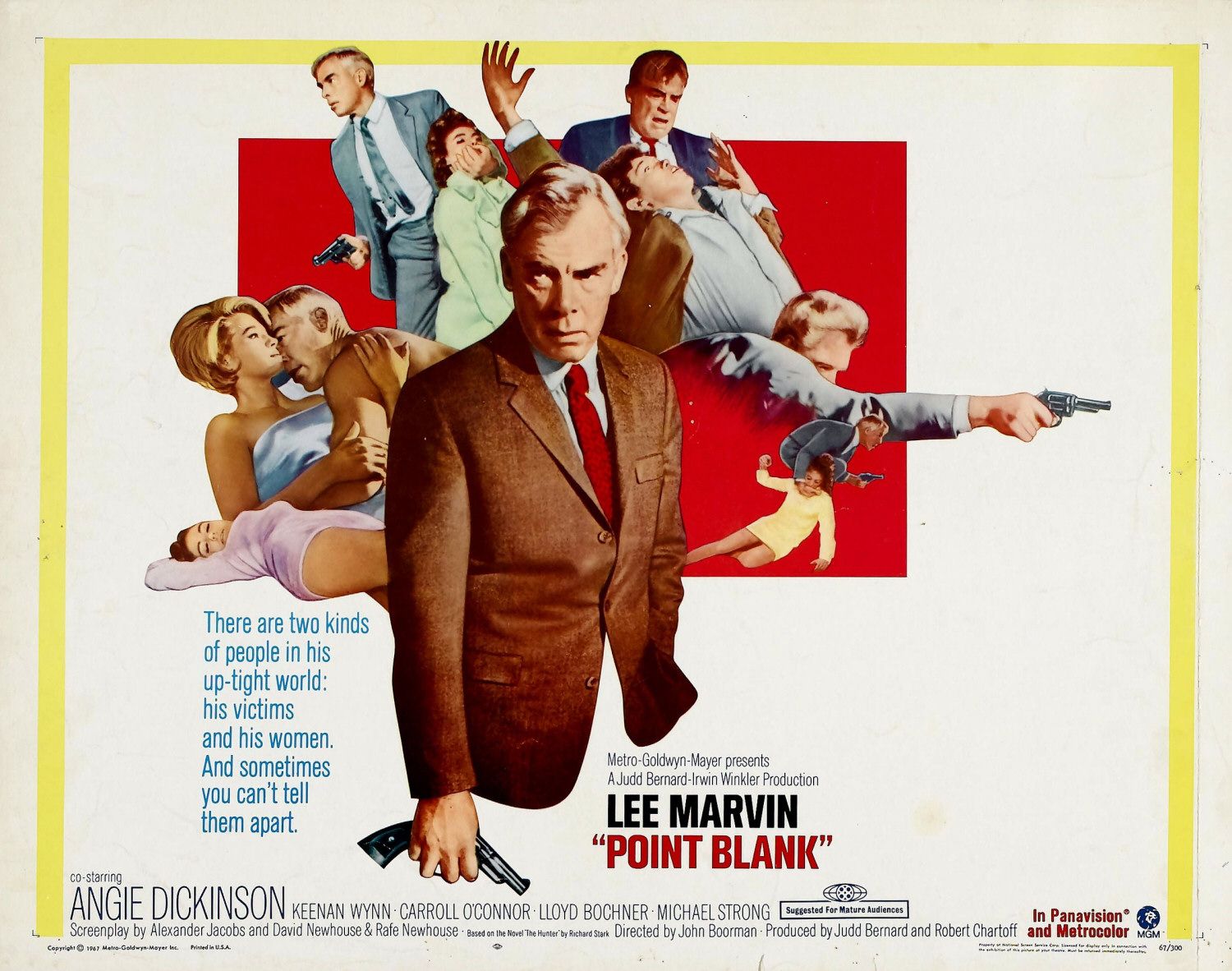
Point Blank (1967)

Director: John Boorman

Not a bad movie, though not quite as strong as I was hoping for.

If you're like me, you pick up this movie because you want to see Lee Marvin (who I once saw referred to as "the toughest-looking son of a bitch who ever was born") wreck some serious shop. Well, you pretty much get that with Point Blank. The big drawback, though, is the aesthetic and settings within which he has to do it.

Marvin plays Walker (who, in classic tough guy fashion, adamantly never reveals his first name), who is out for revenge against a former friend who has double crossed him, shot him, and left him for dead in order to pay back a crime syndicate known as "The Organization." Well, Walker survives and comes back two years later to track down his betrayer between San Francisco and Los Angeles. He starts to target anyone who knows anything about his former friend, Reese (John Vernon), and he essentially kills his way up the criminal food chain to get to him.

Watching Walker go to work is fairly satisfying, though it's a story that's been done better in movies like Get Carter (the original 1971 version), A History of Violence, and others. Sure, the bad guys are scuzzy enough, but Walker doesn't ever have to display overly exceptional wits or physical prowess. He's smart enough to see various double-crosses before they get to him, but his skills are more often implied rather than actually displayed.

If you think these outfits are terrible, they're actually some
of the tamer ones that you'll see in the movie. And the
seediness of this still frame also indicates a pervasive tone.
What weakens the movie and has caused it to fade so much over the years are the look and feel of the film. Filmed in 1967, it hurls every groovy, mod-tastic piece of dated music and fashion that it can manage at you. There are hinky jazz clubs, a bombastic musical score and sound effects, and costumes that might as well smack you in the mouth. These may all have been chic and cool when the movie was released, but they were undoubtedly rather comical a mere decade later. Forty-five years later, they have become an obnoxious distraction.

It also didn't help that, aside from Lee Marvin playing Walker, there aren't any other compelling characters. Reese and everyone in the organization is a one-dimensional egoist who first tries to placate Walker before trying to stab him in the back. Even Angie Dickinson, who is pleasant enough to look at, plays a character who is arguably the work of a obliviously misogynistic mind. Perhaps thinking they were creating a woman of "depth," they have her swing between raging at Walker, punching and cursing him, and then jumping into bed with him. In between these weird bouts, she plays it cool as a cucumber, though we never have any clear idea how or why the transitions are made. What we're left with is a woman who can only be described as a traumatized schizoid. Either that or just poorly conceived and written.

Fortunately, the film is only 93 minutes long, and it's fairly streamlined. There are a few throwaway scenes, but not many. The story clicks along fine, with Walker moving from one punching bag to the next, doling out underworld justice. I've no need to watch it again, but it was fine one-shot viewing. 

Sunday, October 19, 2014

Before I Die #521: Get Carter (1971)

Director: Mike Hodges

Great gangster flick, based on a great book.

The basic story is that Jack Carter, a "fixer" for a London-based crime syndicate, has returned to his home town in the north of England. His brother has died in a way that makes Jack very suspicious. Jack quickly begins to start shaking bushes and soon has multiple criminals swirling around, most of whom wish to do him very serious harm. Jack, not a man easily dissuaded, pursues the mystery to its very end, leaving a trail of bodies in his wake.

How does one adequately describe this film, or even the book upon which it was adapted? The title character, Jack Carter, is not a nice man. He works for a sleazy and extremely powerful organized crime syndicate based in London. He kills people. He barely hesitates to exploit relatively innocent bystanders in the name of reaching his own goals. So why is it so compelling to follow him?

Jack Carter is, to me, a very dark, very English take on the classic noir protagonist of Hammett and Chandler. Jack is fully immersed in the murky waters of the English criminal underworld of the increasingly cynical post-mod era of the early 1970s. And while he's not the biggest fish in those waters, he is easily one of the deadliest. Like the classic noir "hero," he inhabits every scene, and we follow him through a complex maze of depravity and salaciousness that is frighteningly entrenched in Jack's entire world. But Jack is clearly right at home there, and his confidence is mesmerizing.

It is this confidence, along with his lethal capabilities and knack for the occasional snide one-liner, that carry us along. Don't be fooled, though. This is not Sam Spade or Philip Marlowe. He's not even the more jaded Tom Reagan from Miller's Crossing. He is a villain, and there are really only two things that keep him from being too repulsive to be interesting. One is that, in this tale, his targets are even more villainous that he is. The other is that he does exhibit the tiniest shred of compassion for his niece (who may actually be his daughter) as he carries out his quest for revenge. Mostly, though, he is out to avenge his brother's death. A viewer gets the sense that Jack is killing his way through adversaries out of is own pride just as much as a sense of vengeance.

Jack and his trusted weapon - the shotgun that he and his
brother saved up their money to buy as boys. Jack and the
gun get more than a little payback.
So the character and story are strong enough, but they are far from the only worthy qualities of the movie. The direction is tight and focused, and the aesthetic is just as gritty as it ought to be. This is not to say that it has a "dark" or "cheap" look based on some misguided attempt to convey some form of reality. A surprising number of scenes take place in broad daylight, where Jack and his opponents' dastardly deeds can be witnessed openly. The editing and framing are wonderfully done, which makes the viewing experience extremely dynamic during the several action sequences. But nothing feels rushed in any way. The first half of the film features many slower, meditative shots when the camera lingers on Jack's face, or the faces of others who are reacting to Jack's words or actions. There is just as much power in these moments as when the bullets are flying and the bodies are falling.

Do I really need to say anything about Michael Caine? Perhaps you are only familiar with his more recent roles, and you may be wondering if he was as strong an actor in his younger days. If so, you can stop wondering. He's incredible. If you've only seen him in roles of genteel, pleasant, and stately chaps, then you will marvel at how well he plays the coolly brutal Jack Carter.

The main caveat for those who don't know the story should be clear. There is no "good guy" here. Get Carter is about a bad man doing bad things to even worse people. But it sure is entertaining, just as any expertly-presented story about a cool customer plying his trade should be entertaining.

...And What About the Book?

I suppose a touch of disclosure is in order here. The reason I read the source novel for this is that a close friend of mine is responsible for having it published for the first time in the U.S. in four decades. I had already planned to watch the film for some time, so its reintroduction onto U.S. bookstore shelves last month was rather fortuitous for me.

Originally titled Jack's Return Home in the U.K., the book is fantastic. And the movie's director, Mike Hodges, stays extremely true to the spirit of the story and the protagonist. As expected, certain artistic license was taken, but it was done respectfully and with amazing adeptness. It is that rare adaptation that does the source novel more than enough justice while utilizing the elements that make cinema a different art form. Author Ted Lewis used terse, sparse language in this narrative. Hodges took that great narrative and translated into a ripping good film story with great camerawork, editing, and a fantastic actor.

If you have any interest in comparing the book to the film, I highly recommend reading the novel first. It's a modest 200 pages, and they turn very quickly. You can order it from a ton of places, but here's the direct link through Syndicate Books.

Movie or book, you really can't go wrong if you're into hard-boiled crime fiction. 

Sunday, September 28, 2014

Retro Trio: Made (2001), Escape Plan (2013), We Own the Night (2007)

Made (2001)

Director: Jon Favreau

In a word: lame.

The look on Favreau's face here is pretty
much how I felt watching this movie.
This was a surprise for me, since I've generally liked Favreau's writing and direction in his various films. From Swingers to Elf to the first two Iron Man movies, I thought he was solid enough, if not exactly spectacular. I don't put him in any kind of pantheon of great directors, but he's solid. Even films of his that I wasn't terribly enthused about, such as Chef, are well-done, for what they are. 

So it was disappointing to watch this earlier stab of his at spoofing the mafia genre. It's not hard to see what Favreau was trying to do - throw a couple of bickering buddies into the lower levels of the mafia that has been glamorized by countless great movies. But it never gets any real steam. First of all, Vince Vaughn's character is supremely annoying. I'm no Vaughn hater (even though he has absolutely zero range, outside of playing himself), and I actually think he's hilarious when cast in the right movies. But imagine his typical motormouth character firing off line after line, without a single thing actually being funny. Well, that's what he is in Made. I actually wanted him to get whacked after about 15 minutes.

Second off is that the story rambles through a sluggish and vague narrative that seems to have been meant as a mafioso Odyssey of sorts. There are a few mildly amusing scenarios here and there, but most of the scenes simply drag. In the end, the big "reveal" of the plot only made me think that the movie should have been about 45 minutes shorter and saved us viewers the trouble.

This movie had potential, with a decent idea and really good cast, including Favreau, Vaughn, Peter Falk, and about half the cast of The Sopranos. Alas, the whole was far, far less than he sum of its parts. So much so that I was surprised that it made a "Top 100" list of gangster movies compiled by a few Philadelphia area film aficionados. Not sure what they were seeing on this one. 


Escape Plan (2013)

Director: Mikael Haefstrom

This movie fell just slightly on the wrong side of "mediocre." It's not terrible, but there's no way one can call it "good." 

The plot is all but given away by the two-word title. Stallone plays Ray Breslin - a security professional who breaks out of prisons in order to expose any weaknesses, so that they can be corrected. When his services are procured by a a mysterious woman working with the C.I.A., things start to go wrong. All of his safeguards are stripped, and he is truly stuck in a high-tech, ultra-secret, maximum security prison which is completely off of the grid. Inside, he meets a sly German inmate (Schwarzenegger) who takes great interest in his demeanor and skill set. From there, the two try to (you guessed it) escape.

Escape movies' biggest strength is always waiting to see just how the escapee will use his cunning to make his way past all sorts of obstacles to gain his freedom. In that respect, Escape Plan gets it right. The set up is fine, and the super max prison presents a few interesting obstacles that Breslin has to surmount. But none of them are so creative that they become memorable. Breslin's methods for studying and using his environment are just compelling enough to have kept me watching, but they weren't exactly mind-blowing.

One must absolutely NOT think too hard about this movie's story. There are a laughably high number of logical inconsistencies. I was able to shrug them off for the most part, as it didn't take too much away from the escape element of the movie, but they are pretty bad. If the very reason for the prison's existence doesn't hold up to some mild questioning, then the scriptwriters have done a pretty poor job. There are more than a few other massive oversights that are nearly as awful, so a viewer will need to be ready not to analyze things too closely. You'll only be disappointed.

The aesthetic is just hilariously bad. Clearly going for style over any kind of pragmatics, the prison design is unnecessarily silly, and the guard uniforms look like bad Halloween costumes. Style over substance can work, as long as there is actual style. Escape Plan's notion of "style" equated to what an 11-year old boy would find "cool-looking."

There is also one missing element that I had mixed feelings about. When you sit down to watch a movie with Stallone and Schwarzenegger, then you would expect more than a few one-liners, right? Well, this movie is woefully lacking in that department. Yes, there are a few attempts at some zingers here and there, and one or two of them are half-decent. But mostly, the banter is absent, and much of what is there is thoroughly forgettable.

Do I feel like I wasted my time watching this? Not quite, but close. And there's absolutely no need for me to watch it again. It's a barely passable popcorn flick that you can turn your brain off for, and we all need one of those every once in a while. 


We Own the Night (2007)

Director: James Gray

A good crime flick, if not quite an outright "classic."

The movie tells the tale of Bobby Green - a self-absorbed, semi-outcast brother of one cop and son of another. Played by Joaquin Phoenix, his is a story of self-actualization and transformation through suffering. It's a unique story for the crime film genre, in the type of character that serves as the focus, and just how that character evolves throughout. While it does seem a tad extreme and rushed to an all-too tidy ending, it is a rather satisfying arc.

The movie's two greatest strengths are the acting and the fact that it doesn't pull too many punches. The large-scale "crime" conflict is between the local cops and an ever-increasing Russian mob presence, and Bobby is caught between the two. The tightrope that Bobby walks through most of the movie is constantly wavering in the winds of his own indecision, and we viewers know that he will eventually fall off. The suspense comes from waiting to see if Bobby will make the choice of which direction he falls towards, or if the decision will be made for him. The emotional ramifications make for great theater, as Joaquin Phoenix wears the struggle exceptionally well. He has to struggle through several dilemmas that threaten either his body or his peace of mind, without a single easy answer or fully acceptable outcome for himself or his loved ones. The grey areas certainly set this film apart from many others of its ilk.

Though much of the movie focuses on emotional turmoil, there are certainly several highly suspenseful action sequences, which are quite well-done and affecting. More than simply adding some visceral excitement to the proceedings, they often serve to jar Bobby out of his sometimes paralyzing indecision.

The clearest weakness to me is simply that the transformation goes a bit too far, by the end. I won't give anything away, but the end of Bobby's journey went to a place that I thought oversold just how far he had transformed by story's end. It hardly ruins the film by any means, but it wasn't completely to my liking.

A very good movie that I would certainly recommend to anyone who is a fan of more sophisticated crime tales that focus more on individual character study and transformation, rather than the more procedural elements of most crime films. 

Friday, August 29, 2014

A Prophet (2008)


Director: Jacque Audiard

Now this is a little more of what I was hoping for from Gomorrah a few weeks ago.

A Prophet tells the story of a young Arab, Tarik, who gets a 6-year prison sentence in France for refusing to rat out a few other criminals. During those six years, he goes from terrified and abused kid to savvy, educated master criminal.

A young Malik, preparing himself to take a life in order
to save his own. This is just the first of many steps he
takes along an ever-darker road towards first his survival,
and then his dominance.
The story of Malik is completely gripping and uniquely tragic. One could look at it as a much more masterful, thoughtful, realistic, and far less sensational version of Brain de Palma's Scarface. Malik goes into prison as a man on his own: no friends or family to speak of, and no connections to anyone in the criminal world. He is a quiet, reserved young man who merely wants to serve his time and avoid trouble. Of course, prison rarely affords people such luxury. Once the powerful Corsican mob see Malik as a pawn they can use to further their own ends, a cycle begins that completely transforms him in every way.

The movie offers all of the tension that you might expect or hope for from such a story. Malik fights for his life at several turns, avoiding death at the hands of the Muslim and Corsican inmates, none of whom ever fully accepts him into their tightly-cloistered groups. He has to rely on his own observations, cunning, and intellect. This in itself is engaging enough, given how precariously close to death he teeters at several junctures. Some of the life-or-death tension is built slowly and insidiously, as when Malik resignedly marches towards having to assassinate another inmate or be killed himself. Others stem from the constant derision poured on him by the Corsican mobsters who hold Malik's fate in their petty hands.

Malik, after several years in prison, talking with the
Corsican mobster who he initially must obey, but
gradually seeks to overcome. 
As severe as all of this sounds, the movie is not without humor. Granted, it's nothing quite so overt as the interactions you see in The Shawshank Redemption, with the ever-comforting Morgan Freeman there to lighten the mood when necessary, but A Prophet provides earthier, quieter moments of levity. Whether it's Malik getting a hold of porno movies, or his playful talks with the lone friend he makes in prison, there is just enough to lighten up an otherwise extremely intense story.

I can't recommend this movie highly enough to anyone who likes crime and/or prison movies. It may be a little grittier than the most popular examples of the genre, but it's a brilliant story told by expert filmmakers. 

Saturday, March 2, 2013

FIlm #96: Pulp Fiction (1994)


Director: Quentin Tarantino

Initial Release Country: United States

Times Previously Seen: around nine or ten, at least (last seen about five years ago)

(Relatively) Rapid-Fire Plot Synopsis

*For those who haven’t seen it, Pulp Fiction is told in non-linear style, making summation a rather odd task. I will present it in the only way that I can manage to keep it reasonably concise. However, I am aware that events play out in the film in a different order. Bear with me…

Los Angeles, the early- to mid-1990s. Jules Winfield (Samuel L. Jackson) and Vincent Vega (John Travolta) are low-rent hit men for local crime kingpin, Marsellus Wallace (Ving Rhames). The two appear at the apartment of a few younger guys who have a briefcase belonging to Marsellus. Jules and Vincent spend some time intimidating the young men before killing them and taking the case. After they kill two of the young men, a hidden third man nearly kills them, though all six of his shots freakishly miss their targets, from virtually point-blank range. Jules and Vincent kill their assailant, but Jules feels that God had a hand in saving him from death.

Jules and Vincent complete their executions of the unfortunate rubes who tried to rip off Marsellus Wallace, the kingpin of Los Angeles.

Shortly after, in their car with their inside informant, Marvin, Jules and Vincent debate whether their escape from certain death was an act of the Almighty. In the midst of the discussion, Vincent accidentally shoots and kills Marvin – the result of careless handling of his pistol. Jules and Vincent then hurriedly get their car to a friend’s house, where they spend the next hour or so in a race against he clock to clean their car and dispose of the body. With the help of a professional “cleaner,” Winston Wolf (Harvey Keitel) the men are able to dispatch the car and body, though not without a fair amount of tension.

After the ordeal, Jules and Vincent have some breakfast at a diner. They continue their discussion of their avoidance of death earlier, and Jules decides that he is going to give up his life as a hit man and become a wanderer who rights wrongs. Vincent is highly skeptical and all but mocks his colleague. While Vincent is in the restroom, a pair of boyfriend/girlfriend thieves rob the diner. When the man attempts to rob Jules of Marsellus Wallace’s briefcase, Jules turns the tables and pulls his gun on the robber. After several minutes of tense discussion, Jules explains that he has given up killing people, pays off the robber, and lets him and his girlfriend go, all of this to the great chagrin of Vincent.

A day or two after, Vincent has an assignment to be a guard and companion to Marsellus Wallace’s wife, Mia (Uma Thurman). Vincent takes Mia to a retro restaurant, where the two engage in stimulating discussion and even win a dance contest.

The unlikely dancing duo of hit man Vincent and mob wife Mia. This joyous routine will soon be followed by a harrowing drug overdose that puts a serious damper on the evening.

Back at the Wallace residence, as Vincent struggles in the bathroom over his growing attraction to Mia, she discovers a bag of heroin in Vincent’s discarded coat pocket. Thinking it to be cocaine, she snorts it, goes into immediate shock and collapses. Vincent discovers her and rushes her to the house of his drug dealer, Lance (Eric Stoltz). Vince and Lance get through their extreme panic and manage to revive Mia with an adrenaline shot directly to her heart. After these harrowing events, Mia and Vincent amicably agree to keep the entire affair a secret from Marsellus, and they go their separate ways for the evening.

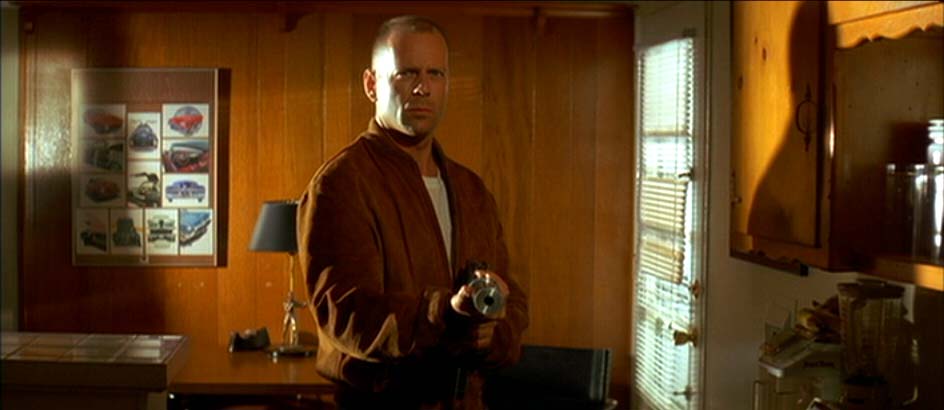
Several days later, a major boxing match takes place. Aging but capable boxer Butch Coolidge (Bruce Willis) shocks Marsellus Wallace by actually winning a fight that the crime boss has bribed him to lose. Butch, in a supremely risky double-cross, took the cash from Wallace, wagered all of it on himself, and won big. The only thing that he needs to do is quietly flee from the country the next morning. This simple plan is foiled, however, when Butch learns that his girlfriend, Fabian, has left his most prized possession - an heirloom watch that his forebears took unspeakable pains to pass down to him. Butch must risk returning to his apartment to retrieve the watch.

Butch carefully returns to his apartment, which at first seems to be empty. He grabs the watch, and then notices a silenced machine gun sitting on the kitchen counter. In an odd turn of luck for Butch, the hit man sent to stake out his apartment is in the bathroom at the exact moment Butch has arrived. When the assassin emerges, it turns out to be Vincent Vega, whom Butch quickly kills with his own weapon.

Butch prepared to take out Vincent, the man who would have killed him had the careless hit man not left his gun outside of the bathroom.

Upon fleeing his apartment in his car, Butch unfortunately runs across Marsellus Wallace himself. Wallace chases Butch into a pawn shop run by a redneck, Maynard. Maynard pulls a shotgun on them both, knocks them out, and brings them to the basement where he and his perverted companion, Zed, make clear that they will take sexual advantage of both men and kill them. While Maynard and Zed have their way with Wallace, Butch quietly manages to free himself. Rather than escaping and leaving his adversary Wallace to a horrible fate, however, Butch decides to save him. After the rescue, Wallace grants Butch a sort of amnesty, telling him to leave L.A. for good. Butch readily accepts, returns to pick up his girlfriend, and leaves.


My Reaction to the Film (Done after this most recent viewing)

I think I could go another 50 years before watching this film again, and I still could not see it with fresh eyes. That is how much of an impact it had on me when I first saw it, and that’s how much impact it’s had on countless films since its release.

Back in 1994, I was 19 years old when I saw Pulp Fiction for the first time. I had no idea who the director was, but the movie blew me away. I had never seen a film so funny, engaging, tense, entertaining, novel, and just plain fun. There were so many different things to soak up that I went back to the theater to watch it three more times, over the course of the next few weeks. Any time I found a friend who hadn’t seen it, I would bring them immediately. It quickly became a mainstay of the pop culture landscape, and references to nearly everything in the film have abounded ever since.

Now that nearly 20 years have passed and Quentin Tarantino has released several other movies, it’s become rather easy to deconstruct his work and view it as overdone and perhaps a bit too heavy on style at times. Still, this doesn’t take away from just how novel a blend it all was back in 1994, and it still shows his style as a brilliant one that is, as the saying goes, “often imitated, never duplicated.”

Of course, the dialogue is the most engaging part of watching Pulp Fiction the first, third, or even tenth time you see it. Basically every line shows a certain amount of wit or unexpected humor. Tarantino’s hallmark of seasoning the dialogue with pop culture references was put on full display in Pulp Fiction. He had done it to a degree in his previous film, Reservoir Dogs, but not to this extreme. In the same way that details and references make a good stand-up comedian funny, the running spoken interplay between characters in Pulp Fiction is as entertaining as it gets. Virtually every line from the film is quotable, and I was just like millions of others in going back to the theater repeatedly in order to soak it all up and commit it to memory.

Vincent and Jules in the diner. Arguably the best of the many great conversations in the film. Samuel L. Jackson's take on Jules's introspection earned him a well-deserved Oscar.

When describing a Tarantino film (especially the earlier ones), fans will never have the word “cool” very far from their vocabulary. The characters themselves are all great archetypes of “cool.” The stony-eyed hit men, the mythically-powerful mob boss, the aging boxer with one last shot to hit it big – these major characters were all drawn from countless noir and pulp stories from the previous several decades. Tarantino cast them into modern settings masterfully and made them fun to watch. Even all of the minor characters – Pumpkin and Honeybunny, Lance the drug dealer, Maynard and Zed the perverted rednecks, Winston Wolf, and all of the others have become almost iconic, based on amazingly composed vignettes. Tarantino is obviously a lover of what he terms “badasses,” and Pulp Fiction probably has the highest badass factor of all of his movies.

Yet another element to the Tarantino film is the music. Never before had I taken in a movie in which the music enhanced the atmosphere so effectively. From the moment that Miserlou relentlessly kicks in during the opening credits, the soundtrack deepens the mood with every song. Once again, the word “cool” finds its way to the forefront.

Though I’ve seen this movie at least ten times, and I know it basically by heart, one thing was more noticeable to me this time around. I had never really taken in just how obviously “cinematic” it all is. Sure, there is a certain amount of realism to some of the settings, and the actors’ deliveries of the dialogue are astoundingly naturalistic. Still, when you focus on the costumes, the set designs, and the composition of the other elements, it’s abundantly clear that the world of Pulp Fiction is just that – fiction. From the eye-popping colors of Jack Rabbit Slims to the minimal yet memorable suits of Jules and Vincent, and even the obviously phony backdrop in the cab that Butch takes from the boxing arena, there are plenty of moments that remind you that you are, indeed, watching a movie. Sure, there are really tense and violent moments (something for which Tarantino has been recognized and criticized for two decades now), but it is quite clear that these are, in many ways, comic book characters. In film, this makes for pure cinema through a concoction that very few directors can manage.
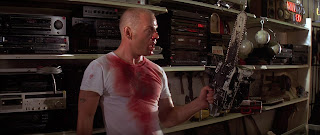
Butch peruses which weapon he will use to kill a couple of deranged hillbillies. This visceral scene is one of several almost cartoonish ones that show off Tarantino's skill with the nearly-lost art of visual storytelling.

I don’t know if Pulp Fiction will be as enjoyable thirty, twenty, or even ten years from now, when the pop culture references lose their sparkle and meaning and more and more filmmakers try to ape its magic. But no critic can ever diminish the effect it had on the cinematic landscape. It’s still a really fun movie to watch, and may be the quintessential “1990s American” movie.

Some Final Thoughts on Tarantino:

As stated, I became a tremendous fan of Quentin Tarantino after Pulp Fiction, and I still go to see every movie that he either directs or for which he writes the screenplay. Here are my quick thoughts on each of his major motion pictures:

Reservoir Dogs (1992): Outstanding crime flick, featuring everything that a Tarantino fan could love. The sharp dialogue, intensity, and non-linear storytelling are all tight, and the acting is absolutely top-notch.

True Romance (1993): Director Tony Scott took Tarantino’s script and fashioned another great movie. It has one of my all-time favorite movie scenes – in which Dennis Hopper and Christopher Walken stare each other down and engage in a captivating exchange.

Natural Born Killers (1994): Director Oliver Stone took Tarantino’s basic story and some of his script and created an uneven mess. Stone can never help himself from making grandiose statements, and he went way over the top in this one, often drowning out the strengths of the Tarantino-penned script.

From Dusk ‘Till Dawn (1996): Directed by Robert Rodriquez, a great vampire movie that combines Tarantino’s strengths with crime writing and vampire lore. Over-the-top fun that I still occasionally watch and enjoy.

Jackie Brown (1997): The sleeper Tarantino movie. It’s actually my second favorite, behind Pulp Fiction. Adapting an Elmore Leonard novel, Tarantino put together his most accessible movie, for those who are put off by the graphic violence in most of his movies. I always recommend this one to people who haven’t seen it.

Tarantino's most underrated film, in my view. Great direction and acting bring a cracking Elmore Leonard tale to life. If you dig crime movies, check it out.

Kill Bill, volumes 1 and 2 (2003, 2004): Tarantino’s homage to kung-fu and spaghetti western movies. They work very well in some places, and they’re quite a bit of fun; however, they became a bit tiresome by the end of the second part. The movie gore hits new heights in these ones.

Grindhouse/Deathproof (2007): This is where my patience with Tarantino started to wear thin. This is his most self-indulgent, tiresome film. There is some great acting and decent verbal exchanges, but Tarantino was clearly in love with his own dialogue just as much as the B-movie exploitation horror films that he was channeling. Not a bad movie, but I’ll never watch it again.

Inglorious Basterds (2009): Still overly enamored of his own dialogue, Tarantino nonetheless made a solid World War II flick. It’s a preposterous re-imagining of history, but still an entertaining watch. Could have been edited down a bit, but I enjoy it. Christoph Waltz and Brad Pitt help with excellent performances.

Django Unchained (2012): Very much like the previous movie, only set in the 1850s old West. Again, Tarantino falls back on his passion for spaghetti Westerns, but does it with his own panache. Also a bit long, but still a solid movie. Like “Basterds,” it’s worth watching just for Christoph Waltz.

As of now, I still consider myself a fan, but I now qualify it a bit more. At this point, I would really like to see Tarantino get away from the same wells that he’s drawn from for years now – exploitation, kung-fu, and spaghetti western films. I understand that these are his strengths and passions, but I think he’s a capable enough filmmaker to try something a bit different. Although, with word coming out that there is a “Kill Bill, part 3” in the works, I probably shouldn’t hold out much hope.

That’s a wrap. 96 shows down. 9 to go.

Coming Soon: Chunking Express (1994)


 I know a few of director Wong Kar-wai’s movies, and I’ve liked them. I’ll see how this early work of his stacks up.

Please be sure to pick up all empties on the way out.