Thursday, June 12, 2014

X-Men: Days of Future Past (2014)


Director: Bryan Singer

If anyone wants the four-alarm, dork-out version of my take on the X-Films, I did a review of all the previous flicks a few weeks back. Here's the link.

Spoiler-Free (i.e. "short," by necessity) Summary

Some time in the decade of the 2020s, Earth has become an absolute hell. Seemingly-indestructible, highly intelligent robots known as "Sentinels" have hunted down an killed nearly all mutants, while humans have splintered into various factions fighting on one side or the other. Concentration camps have been created, and many of the planet's cities have been reduced to little more than charred rubble from all of the devastation.

A handful of the very few remaining mutants, including the iconic Charles Xavier and Eric Lensherr, a.k.a. "Professor X" and "Magneto" devise a last-ditch plan to send their comrade Logan (Wolverine) back in time to prevent the complete annihilation that they are about to face. Having determined that the entire Sentinel war was set into motion by an assassination in 1973, Logan must have his consciousness sent backwards into his 1973 body to muster the younger Xavier, Lensherr, and other useful mutants in order to save their future. The difficulty is compounded by the fact that, once he arrives in 1973, his legendary companions are embroiled in all manner of problems to overcome.

What Did I Think?

Welcome back, Bryan Singer.

It's excellent. In fact, I'm ready to say that Days of Future Past is at least as good as the best two X-Films to date: X-Men United and X-Men: First Class.

Beast, Xavier, and Logan get big chunks of the screen time.
The focus on fewer characters is a welcome change from
the weaker entries into the X-Men movie canon.
This one could have been a mess, given its ambitious plot. Time travel stories can get ridiculously convoluted, and ensemble casts can dilute any sort of character development. Future Past avoids these problems, for the most part, by not losing its main focus. Though dozens of characters appear or are briefly alluded to, the bulk of the screen time is given to Xavier, Magneto, Logan, and Mystique. This was exactly what the vastly inferior X-Men: The Last Stand had failed to do - give us a small group of characters to anchor everything else.

Speaking of characters without giving anything away, one newcomer to the film series (but a mainstay of the comics) is given a nice amount of time in the middle of the tale, and he nearly steals the show. When the main players part ways with him, I was ready for a sequel immediately.

The basic story idea is one that we've seen in film before, most notably in The Terminator - someone must return to the past in order to make one key change that will prevent an apocalyptic future. This movie adds a tiny, intelligent wrinkle in that, instead of the time traveler physically making the journey through the 4th dimension, his consciousness is sent back to inhabit his own past body. This avoids the cliched time travel device of the young self facing off against the older self (though this can be handled well, like in the brilliant Looper). Not to mention that this actually side-steps one of the major, if hypothetical, paradoxes of time travel theory - that of two of the same object occupying the same dimensional planes. This is a detail that a sci-fi geek like myself appreciates.

At the heart of the story is what has always been the soul of the X-Men, ever since their creation by Stan Lee back in the 1960s - the question of how two groups of beings, one with vastly more power, deal with one another. Is the approach one of fear, cynicism and alienation? Or one of hope, optimism, and cooperation? It's these themes that elevate the X-Men mythology beyond mere mutants with cool powers, wearing flashy uniforms. This entry into the series makes sure that its action/adventure elements don't overwhelm the meatier topics at play.

Watching the mutants of the dark future desperately (and
often futilely) attempting to fend off the lethal Sentinels
is eye-popping stuff.
But hey, it's an X-Men movie. We want to see some cool powers and action scenes to go with the heavier subjects, right? Hell yeah! And we do, indeed, get plenty of action. In fact, Future Past may have some of the best action sequences in the entire series. Some of the opening sequences, which take place in the blasted future of the Sentinel war, feature some fast-paced fights that cleverly illustrate some pretty cool mutant powers. In the 1973 era, we've got some nifty one-on-one fights involving Beast, Wolverine, Mystique, and a handful of others. And again, that "new character" I alluded to earlier has arguably the most entertaining sequence that's ever been used in an X-Men film.

I wouldn't have thought that another blockbuster would come out this year that was the caliber of Captain America: The Winter Soldier. Glad I was wrong. I'll be going to catch this one again, and I may even spring for the IMAX treatment. 

Tuesday, June 10, 2014

The Curious Case of Benjamin Button (2008)


(This movie is the 513th out of the 1,149 complete list of 'Films to See Before You Die,' which I am working my way through)

Director: David Fincher

Rapid, Spoiler-Free Summary

In New Orleans in 1919, just as the First World War ends, a young boy named Benjamin is born with a puzzling malady. Though a newborn infant, he has the physical decrepitude of a person well into his eighties. Over the ensuing eight-plus decades, Benjamin not only survives, but ages in reverse.

While undergoing his lifelong age reversal, Benjamin has travels and experiences many of the joys and sorrows of human life. He eventually goes off to faraway lands, becomes involved in World War II, discovers pleasures of the flesh, and falls in love. Though few of these experiences is especially unique, Benjamin's odd condition results in a very singular perspective for both him and those who are closest to him.

What Did I Think?

It's not a bad movie, but I'm not altogether sure what the point of it was. And this isn't what you want viewers of your movie to feel when you offer them two hours and forty-five minutes of story.

The idea of a protagonist who ages in reverse is certainly interesting enough. The mere concept begins to raise certain questions about how such a fantastic person would function and interact with others, and how such a condition would affect the perceptions of the inflicted and those who come to know him for long periods of time. We do, indeed get this in the movie right away, as the grotesquely aged newborn Benjamin is immediately abandoned by his father. As Benjamin advances into and through his childhood years, living at a retirement home under the care of the matronly young African American caretaker, the only people who seem to offer him any understanding are the extremely aged with whom he lives.

The 20-something year old Benjamin. The movie flirts
with some interesting themes as we see how people act
towards him, but it never plumbs the depths as much as
it could.
There's certainly a notion here to chew over - how one's physical appearance has much more influence over how others treat us than our words or even actions. Though Benjamin has the size, mental maturity, and behavior of a very young child, none outside of the home looks at him with anything but disgust. The end of the film offers and interesting counter-point to this, when the elderly-yet-childish-looking Benjamin returns to the very same retirement home. When taken together, these bookends of the film may offer the most profound statement that the story has to offer.

And yet, I felt that such poignant themes were lacking. After all, what is the point of having a character like Benjamin is you're not going to use his most distinguishing feature to do some social exploration? And make no mistake - his singular physical condition is his most distinguishing feature, and this is perhaps the biggest weakness of the movie. There's really not much personality to him. Once you get beyond what makes him "curious," you're just left with a plain old nice guy. Hardly anything to spend nearly three hours watching. Which brings me back to the question: if you're not going to imbue him with any outstanding personality traits, then you'd better use him as a foil to examine some more engaging topics. The movie doesn't either one with much imagination or depth.

Another, lesser, issue that I have with the movie stems from the nerdier part of my personality: the physiological aspect of Benjamin's condition. Many viewers probably wouldn't bother to spend energy on this, but I couldn't help question why, at the end of his life, he would shrink down to child-size. He wasn't born the size of a full-grown adult, so why would the reverse happen? Yes, I know that it's all pure fantasy, but I'm just looking for a little logical consistency.

On a much larger scale, is there any possible way that Benjamin would not have been taken away by military scientists to become a lab rat? He never makes much effort to hide his condition, and it's hard to imagine him just coasting through life without at least a visit from parties interested in a walking miracle who may hold the key to the fountain of youth. This is also never so much as mentioned or explored. Would it have killed someone to at least try and insert a touch of consideration for it?

It all comes out as very mediocre. The cinematography is highly polished, so the film is a pleasure to look at. The acting is solid, and the human emotions are sincere and exhibited well. These help carry along a lengthy movie that resulted in, to me, a subtle shoulder shrug.

(513 films down, 636 to go before I die.)

Sunday, June 8, 2014

My Dinner With Andre (1980)


Director: Louis Malle

Summary

A struggling playwright and stage actor in New York has an engaging dinner with an estranged friend.

Yep. That's it.

What Did I Think?

Apparently, this movie was hailed as a wonderfully novel and fascinating experiment in film - an entire movie composed of almost nothing more than a single conversation presented in real time between a couple of friends. The premise being that the conversation itself will be so fascinating that no other effects, adornments, or "movie tricks" should be necessary.

Straight away, I have a problem with considering this approach "novel". Way back in the earliest days of cinema, one of the common criticisms leveled at the medium was that is was usually comprised of a single camera shot, trained on a single set where there actors played out the story. In other words, it was essentially a stage play. Eventually, certain geniuses like Georges Melies, D.W. Griffith, and others started to make use of the techniques of varied photo perspectives and film editing, which set film apart from other storytelling media. With this bit of history in mind, a film like My Dinner With Andre seems much more like a regression rather than something bold or novel.

Visually, this is all you get in this movie: Andre (right)
absorbed in his own exposition, and Wallace sitting there,
wearing a perpetually dopey look of puzzlement.
So what about the "dinner"? Is the conversation truly that engaging? My short answer is "no." The entire thing revolves around the Andre character telling his estranged friend, Wallace (both of whom play somewhat fictionalized version of themselves), about his whereabouts and thoughts during the past several years, during which he had all but vanished. Andre had been a very successful writer and director in the New York theater scene, but he had turned his back on that success, as well as his wife and children, in order to basically "find himself" and seek out some sort of life purpose. It's a bit of a Gauguin story.

For most of the first 30 to 45 minutes, Andre talks about various experimental workshops and communes in which he has taken part, in order to stoke some sort of creativity or new perspectives on life. These involve strange near-bacchanalia, shared spontaneous experiences, and other quirky and bizarre gatherings and individual characters. During this first half or so of the film, I couldn't shake the feeling that people who are directly involved in the theater and its creative processes would be enthralled. To someone like me, however, it came off as self-absorbed pretension. This is typified by the fact that these two men, who claim to have little to no interest in finery or "bourgeois" trappings, are eating in a 5-star restaurant. I refuse to believe that the writer (Wallace himself) failed to realize this. I'm just not exactly sure what the point of this detail was. Maybe that Andre is blind to his own hypocrisy? Or perhaps that, in the end, he just doesn't care anymore? Either conclusion is unsatisfying.

The conversation does eventually take a turn towards the more universal, not merely restricting itself to an analysis of literary or theatrical creativity. When the conversation turns to more accessible subjects such as where we do or do not derive pleasure in life, or how one engages in a meaningful existence, it does become more engaging. But there wasn't quite enough of it for my liking.

Surprisingly, I found the acting rather poor. Perhaps is was because the two actors are more accustomed to the stage, but they seemed to be overdoing it a bit. The intonation, gestures, and facial expressions all seemed meant for an audience who was sitting 20 to 100 feet away from them. Had they (or maybe more naturalistic film actors) played it with more subtlety, then it would have had exponentially more power. Though I suspect that this is a personal preference of mine, given that I generally dislike any actions or speech that I feel are overly dramatic.

This certainly wasn't a film for me. But I can easily see how those who are deeply into the theater or creative personalities would greatly enjoy it. If you count yourself among this group, you should certainly give it a try.

Forthcoming Reviews:

Top Secret!, Tyson, X-Men: Days of Future Past, Goon, and Coraline. Stay tuned!!

Monday, June 2, 2014

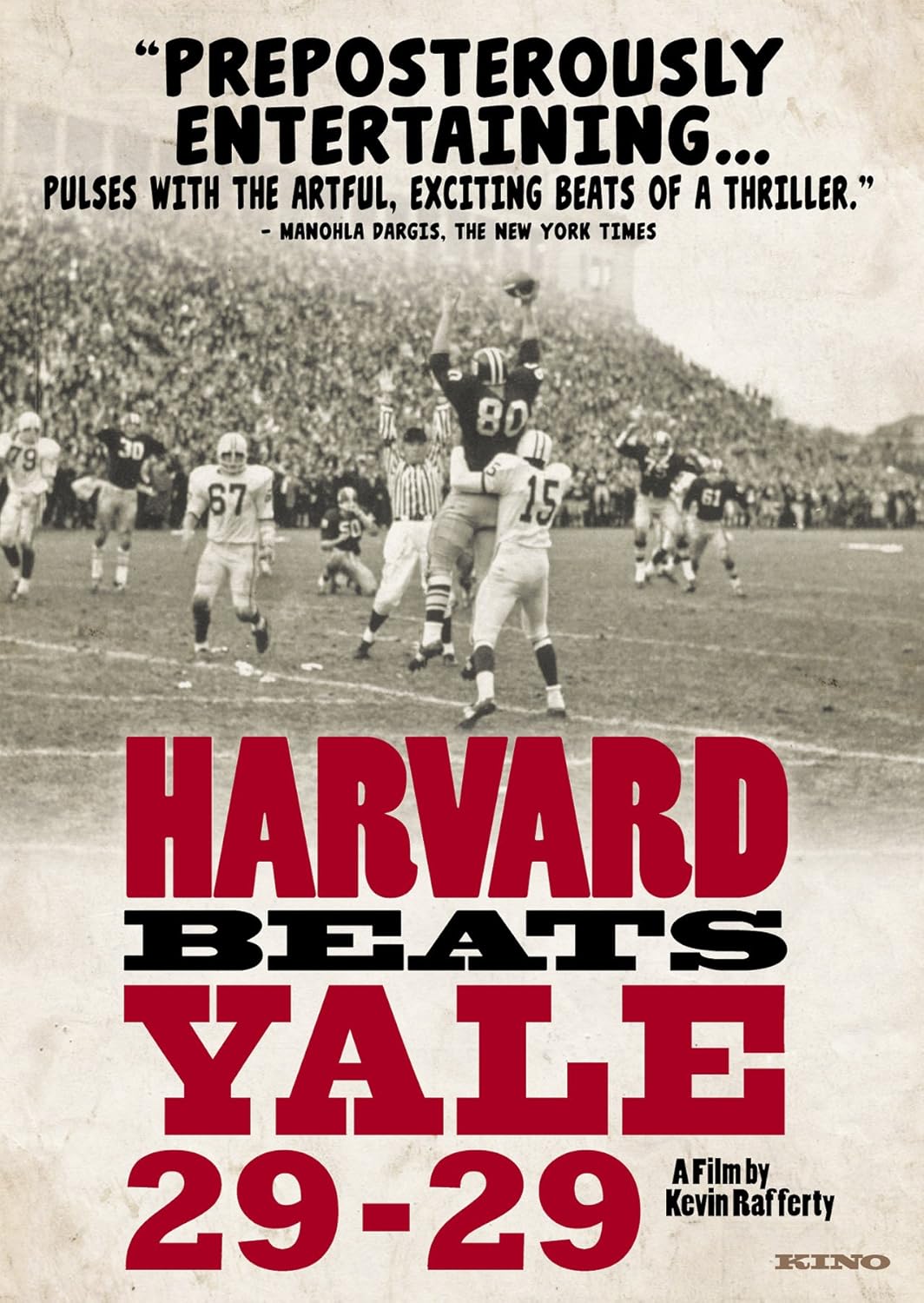
Harvard Beats Yale, 29-29 (2008)

Quotes like that one at the top of this
movie poster are probably what led to
my ultimate feelings about this one...

Director: Kevin Rafferty

This documentary was a tad disappointing.

I'll watch a sports documentary about damn near anything. In watching nearly every one of ESPN's extraordinary 30 for 30 series, I've enjoyed tales about burnt-out football prodigies, trans-gendered tennis players, coked out NASCAR drivers, and plenty of other odd topics related to athletic endeavors. Because of my passion for the general topic, I was excited to see a well-received film on something I knew nothing about - an apparently epic football game played in 1968 between two long-time rivals of the Ivy League - Yale and Harvard. The movie was lauded when it came out in 2008, and I'd had it floating around my Netflix queue since around that time. Maybe 6 years of anticipation did the film a slight disservice.

The story of the game is well told. The contest is presented with chronologically-ordered clips of the pivotal plays, from the kick off to the final gun. Between the plays are interviews with various players from both teams, each giving his recollections and reminiscences about a game that was exceptional to those who cared.

And this is the problem for me. I felt that by the end, I should have cared more. But I didn't.

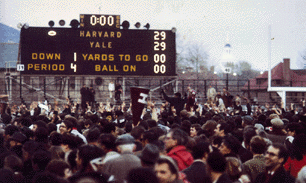
The original TV footage of the game is pretty cool to see.
It reminded me of the pre-HD days of my youth.
Yes, it was an exciting game in which an underdog (in this case, Harvard) came back from a major deficit to upset one of the better football teams in the country. However, Yale was not among the absolute elite in the nation. They were ranked #16 at the time. Nothing to scoff at, to be sure, but they weren't exactly the 1960s Boston Celtics. And Harvard wasn't a team of scrubs. Though they weren't ranked as highly as Yale, they were an undefeated team with some talented players. This sapped the game of a bit of drama for me.

Another expectation I had that went unmet was that the game symbolized some grander commentary about U.S. society at the time. Through the player interviews, we do get some sense of how the contrasting views of the Vietnam war and anti-government sentiment affected some of the players and their interactions with their teammates and classmates, but the game wasn't really the grand analogy for American society that I was expecting.

The men involved in the game, including a very young Tommy Lee Jones (who comes off as the ultimate curmudgeon in his interviews), have some personality. Some are amiable blue collar types, while others are self-important windbags. This certainly helps maintain some magnetism. But there weren't any classically memorable storytellers in the group, which would have helped.

A good sports documentary, but nothing approaching the very best the genre has to offer. I have to feel that there are much more compelling sports tales to be told, with more intriguing personalities and a stronger connection to society as a whole.

Thursday, May 29, 2014

The Devil and Daniel Webster (1941)


Alternate Title: All That Money Can Buy

Director: William Dieterle

Spoiler-Free Summary

In mid-19th century New England, a young farmer named Jabez Stone is down on his luck. As he hits what seems to be rock-bottom, he pronounces that he would sell his soul to the devil for the money he needs to live. Lo and behold, a demonic man calling himself Mr. Scratch arrives, and makes Jabez the very offer for which he asked. Reluctant at first, Jabez eventually succumbs to temptation, accepting untold riches in exchange for giving up his soul in a set number of years.

The years roll by and the money that Jabez accepted changes him in ways that neither he nor his dedicated wife or mother would ever have predicted. When the time nears for him to give his soul in return, he panics and calls on the only man who he thinks can save him - famed local, orator, and federal senator Daniel Webster. Webster takes up Stone's highly unusual case and attempts to defend his soul against Mr. Scratch and his devilish logic.

What Did I Think?

A really good movie, despite my misgivings during the first ten or fifteen minutes.

The Devil and Daniel Webster is, at the heart of its plot, a religious, didactic, cautionary tale not unlike those that you see on those hilariously ridiculous little cartoon pamphlets warning against the temptations of sin. This is the sort of thing that I would generally have zero interest in. And yet, this film was highly engaging.

What grabbed me was how little the movie flinched, especially for a film made in 1941. As annoyingly "gee-shucks" innocent as the Stone family is, it becomes effective when you see the changes that Jabez undergoes as the film progresses. From my experience, it's rare to find a film from that era in which such naive and innocent characters are put through such worldly and mature trials.

...and the deal is made. This is one of many scenes that
expertly used light, shadow, and fog to create the right
atmosphere for dark dealings. 
Probably the best thing about the movie is the use of supernatural elements. The eeriness with which Daniel Webster's character (based on the real person of the same name) is introduced is spellbinding - he works on a speech in the solitude of his office, with the dark shadow of a demon lurking over him, seeking to tempt him into making a deal that would make him president of the United States. Webster is fighting against hell itself, and this scene sets the stage for the rest of the film incredibly well.

One other feature of this movie warrants mentioning - the performance of Walter Huston as the mischievous Mr. Scratch. It's tough to pull off the right fusion of impishness and sleaze that Huston manages, but the character benefits greatly from it. His facial expressions alone are worth the price of admission.

I must say that the resolution of things was a bit too tidy for my liking, but this didn't kill the movie for me. It is, after all, a fable told through the lens of 1940s cinema. It's a fun, classic film that is a rather unique entry.

Thursday, May 22, 2014

X-Men Series Re-Watch

With X-Men: Days of Future's Past approaching in theaters in a short while, I've worked my way through most of the other X-Men films as a refresher. Here are my thoughts:

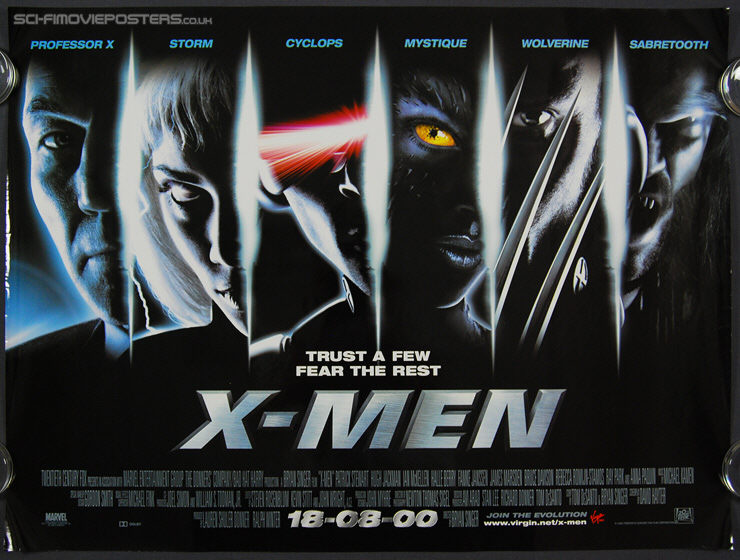
X-Men (2000)


Director: Bryan Singer

This one doesn't hold up as well as I had expected.

I saw this one in the theater 14 years ago, and was pretty blown away. I had been a tremendous fan of the X-Men comic books, amassing an embarrassingly large run of the original series, which I read and re-read countless times. In 2000, though, my 25-year-old cynical self went into the theater expecting the worst. One has to remember that, back then, there really hadn't been a truly successful big-screen adaptation of a superhero movie since Superman II in 1980. At least not on a scale that a mega-popular super-team franchise like the X-Men would demand. I was figuring that something would go wrong - there would be miscasting all over the place. The writers would change up a bunch of the characters, and it would become a hash-job not unlike the wretched League of Extraordinary Gentlemen (don't get me started on that blasphemous piece of excrement.) Or the acting or special effects would be horrendously bad.

Well, I was wrong on all of those counts.

Right from his opening scenes, Jackman
proved himself to be a great casting
move. 
The writers were quite faithful to the spirit of the characters and the grand themes of the comic book. The casting was solid, all around, with Patrick Stewart and Hugh Jackman standing out as nailing the roles of arguably the two most important characters in the whole X-Men mythos - Professor X and Wolverine. The movie had a budget that allowed them to hire actors who didn't just look the parts, but could play them very naturally. And the effects were solid. Just by not being bad, the film was great in my eyes.

Flash forward 14 years. Superhero movies have evolved a bit. With the Sam Raimi Spider-Man films, Christopher Nolan Batman trilogy, and the Avengers Cinematic Universe, the ante has been upped to tremendous proportions. And when compared to some of the best of the genre in the past 7 or 8 years, the original X-Men has lost some of its luster. Upon closer inspection, some of the plot elements are weak, some of the dialogue isn't quite as funny, and some of the humor is simply flat or at least a little goofy.

X-Men is by no means a bad movie. It's still a nice entry into the genre, and one could argue that it did usher in the new wave of very well-done, polished superhero films that can entertain younger and older fans alike. But this recent viewing highlighted the advancements made in the sophistication of this films' successors.

X-Men 2: X-Men United (2003)


Director: Bryan Singer

The second of the series makes some excellent strides and is still a very solid superhero movie.

Nearly all of the weaknesses of the initial installment are smoothed away or eliminated. The plot is tighter, the dialogue is a bit sharper, and the goofiness is almost non-existent.

The story carries on where the first movie left off quite well. Mutant paranoia is growing more rampant, thanks in no small part to the machinations of Colonel Stryker, a soldier and military scientist who frames mutants for an abduction of the president and whips the public into a frenzy of fear. He was also heavily involved in Wolverine's mysterious history. These different elements come together well, without things ever feeling like they're being rushed or simply mashed together. The slower, quieter moments are more carefully done in United, which lends them a little more power.

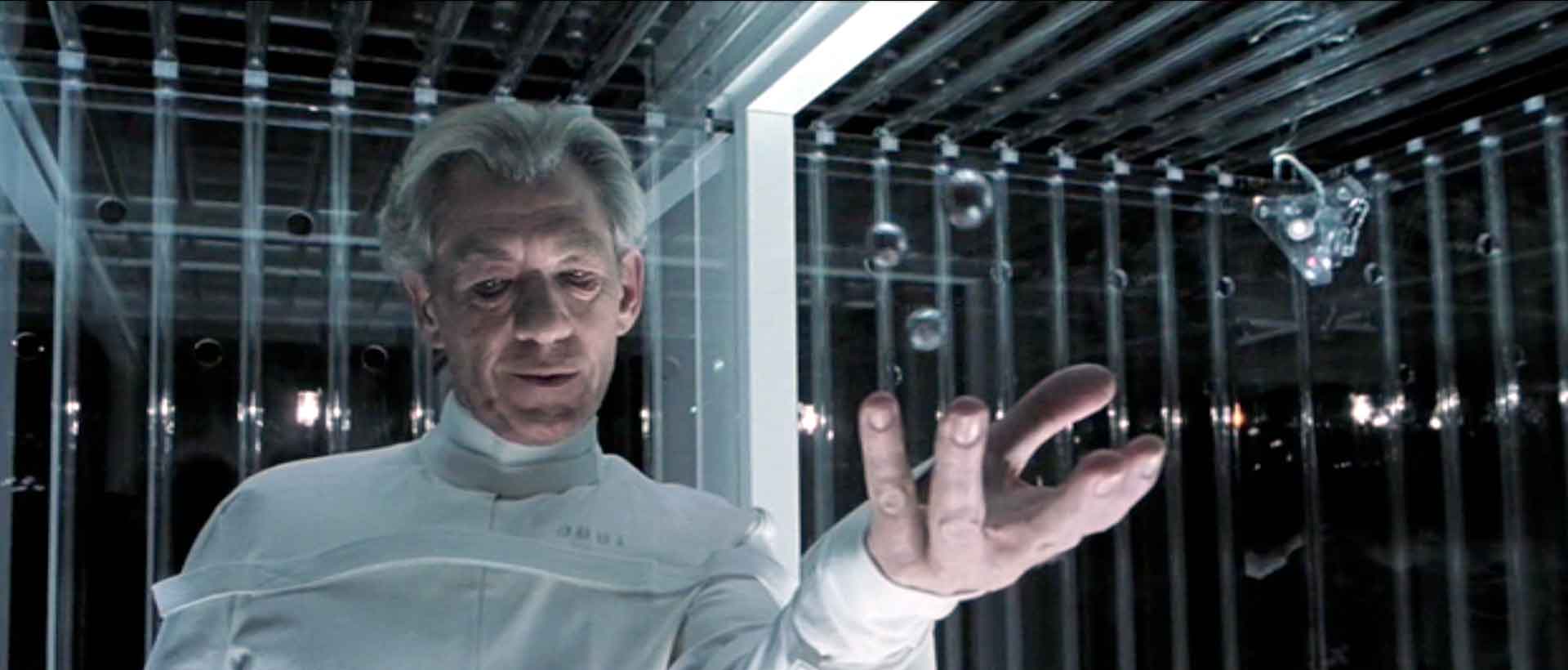
Magneto's escape from his stylish, plastic prison is one
of the several very cool and memorable action sequences.
The action is a great step up from the first. The first film had adequate action scenes, but they looked a little sloppy in places. In United, there are several creative and cool scenes, such as Magneto's escape from his plastic prison, Wolverine going berserk on the soldiers invading the school in New York, and several of Mystique's confrontations with various enemies. I was still plenty entertained by these scenes, these 11 years after the movie came out back in '03.

This one did threaten to commit the common sin of the "add a character" overload. This film brings in a few other mutants known from the comics, such as Proteus, Pyro, Lady Deathstrike, Colossus (in a cameo of sorts), and Nightcrawler. But the film didn't divide its attention among them in ways that resulted in a loss of the overall focus.

There aren't nearly as many attempts at humor as the first movie, and this was a good thing. The general tone of United is darker, so wisecracks would have been far out of place. When a line is dropped, it's in an appropriate place and is typically effective.

X-Men 2: X-Men United is arguably one of the best superhero flicks in the last 15 years. It may not be quite as strong as the best Avengers or Nolan Batman movies, but it's not far below them.

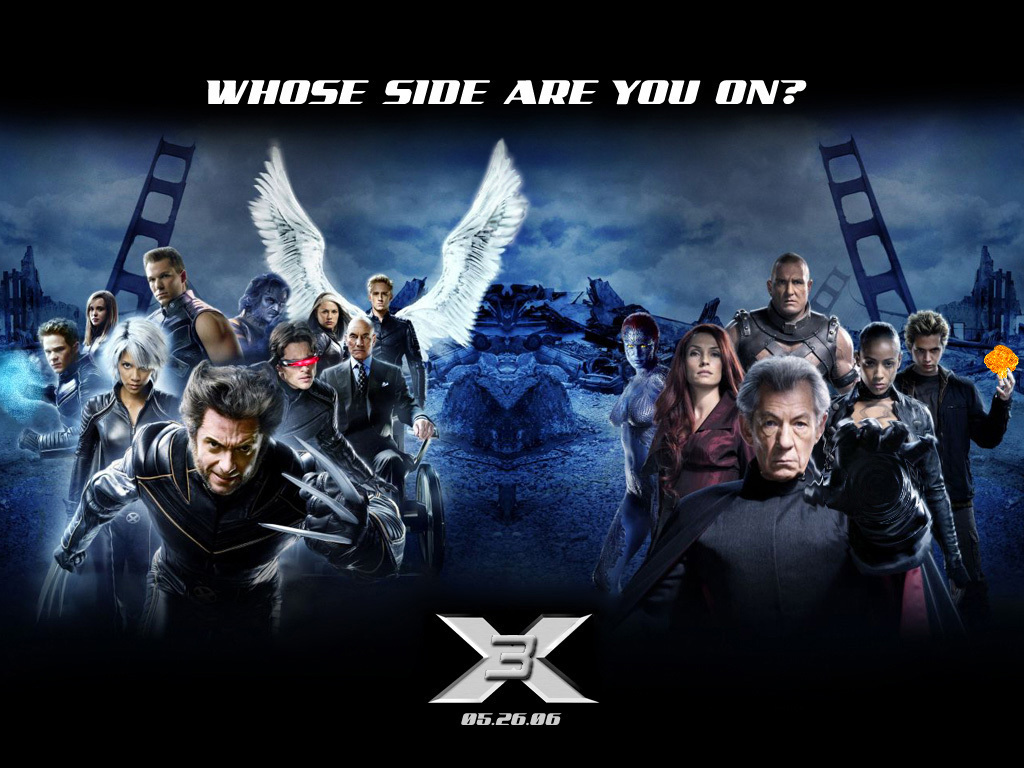
X-Men 3: The Last Stand (2006)


Do I have to pick a side? Can I go "Switzerland" on this one?
Director: Brett Ratner

Until this viewing, I had only seen this movie once - in the theater back when it came out in '06. Back then, I left with the impression of a somewhat flat, paint-by-numbers, "style-over-substance" film that was a letdown after the first two solid films.

That opinion holds, for the most part.

The Last Stand is a near-textbook example of what can go wrong when you try to please an entire fanbase of comic dorks. The departure of Bryan Singer as director and co-writer of the film series is quite apparent. Instead of a giving us a handful of well-chosen team members to focus on, The Last Stand throws every mutant in the book at us. There are literally dozens, if not hundreds, of various mutants thrown into the mix, nearly all of whom showed up in the comic series at one point or another. To me, this is always an extremely weak approach to story writing. It reeks of an inability to write deeper, more meaningful explorations of the characters' human personalities or motivations, instead opting for quantity over quality.

Lest you think I view this film as a total bomb, it's not completely without redeeming qualities. The basic story and plot progression are decent. The story of a medical "cure" for the mutant gene is interesting enough, and it has pretty clear parallels in reality. It follows that such a concept would kick off a mutant uprising, led of course by Magneto. The result is a near-endless barrage of action sequences, mostly of the large-scale variety. Some of them are uninspired, but a few are actually well done.

In some respects, this adaptation was
probably better than the source material.
This entire uprising storyline, though, is where things go off the rails. By necessity, it requires so many mutants with various powers that they cease to even be interesting anymore. Superhero movies' most intriguing element is that the characters' powers and abilities set them apart from normal humans. But when the entire movie is populated almost exclusively with scores upon scores of them, the effect is seriously dulled.

The lead that almost gets buried in this movie is the other primary storyline- that of the "Phoenix," which is Jean Grey's immensely powerful, psychotic alter-ego. This story is, actually, far more interesting than the mutant uprising one, and it could have stood on its own and carried the entire film, truth be told. That is, however, if it had been handled deftly. But very little about The Last Stand speaks to deftness. It's an all-out, full-frontal assault on the viewer, with nary a hint of subtlety or novelty.

The final mark against the movie is that the most glaring attempts at depth were clumsy and wrought with misplaced sentimentality. There were far too many cheesy lines delivered by Wolverine, of all characters. If there's any X-Man who you absolutely can not have delivering hokey lines, it's Wolverine - an absolute icon of cynical cool.

So it's not all bad, but The Last Stand is easily the weakest of the three original X-Men movies.

X-Men Origins: Wolverine (2009)


Director: Gavin Hood

I saw this once, shortly after it came out. Like most, I thought it stunk out loud.

When I fired it up a few days ago, I had an amusing viewing experience. As I watched, I found myself wondering if perhaps we had all been a bit too harsh on the movie. Sure, there are some goofy moments, but there seemed to be some merit, and I was sort of enjoying the re-watch.

For about 45 minutes.

Then, about halfway through the movie, I started to remember the reasons for my initial feelings. And things only got worse as the second and third acts of the film play out. By the end, the movie had sunk right back to the abysmal place my mind had stuffed it.

Actually, some people are likely to enjoy the movie. If you're not one to nitpick over lack of character development, illogical plot devices, action sequences that openly defy every law of physics (without irony), and a fracturing of continuity with the previous X-Men films, then you might be OK with it. Not me, though.

One of the few strengths of the film rests in Liev Schreiber's
portrayal of classic Wolverine antagonist, Sabertooth. The
two tough guys deserved a better movie, really.
The sad thing is that there are some decent ingredients to start with. The goofy 19th century "kiddie Wolverine" opening sequence aside, the idea of Logan and Victor (a.k.a. Sabertooth) as half brothers becoming soldiers of fortune throughout the century is fine. And the notion of having a black ops team of superhumans made for a solid reason to bring in other well-known characters from the comics, such as the Blob, Deadpool, and others. And the sequence of their assault on a Nigerian drug compound is semi-decent. Decent enough that I was mostly willing to ignore things like how poorly everyone's powers were defined or illustrated.

Once those opening plot lines are set up and Logan walks away from the brutality of it all, though, things start to go downhill. Slowly, at first. Then begins the exponential increase in the momentum of suck. Any halfway intelligent casual viewer or self-respecting comic dork can't help but roll his or her eyes at just how silly virtually everything in the second half of the movie is. For the dedicated comic fan of the 1990s, things go from silly to blasphemous. The film completely butchers one of the coolest characters to come from the X-Men mythos in that decade - Deadpool. Being goofy is one thing. Destroying a beloved character is another.

I do have to say that there are a few redeeming qualities of the movie. Hugh Jackman does still play a damn good Wolverine, even if he is given inconsistent dialogue to work with. The standout to me, though, was the casting of Liev Schreiber as Sabertooth. In a way that far surpassed Bryan Singer's vision of Wolverine's classic nemesis in the original X-Men film, Schreiber conveys all of the cunning, brutal menace, and bloodlust that the character demands. Jackman and Schreiber had good chemistry, and each one did have a few decent lines to work with. And yet...

The movie's a dud, overall. It's standard case of a few good ideas being completely flubbed in the execution and the inability of the filmmakers to pare things down and tighten up the weaker elements. I don't ever need to watch it again.

X-Men: First Class (2011)


Director: Matthew Vaughn

Not quite as incredible as some reviewers would have you believe, but still a very good superhero flick, and my second favorite of the six X-Films so far.

In going back in time and adding to the backstories or Erik Lensherr/Magneto and Charles Xavier/Professor X, the writers and director did good work adding some solid depth to the iconic characters. Having Magneto's quest for revenge converge with Xavier's mission to band with humans to stop the nefarious Sebastian Shaw felt fairly organic, as these types of movies go. Seeing the groundwork laid for most of the primary elements of the X-Men is handled deftly, for the most part. Though the younger team members aren't given much time to develop as individuals, this was probably for the best. It's Xavier and Erik, their common short-term goals, and disparate long-term visions for mutants, which carry the movie throughout. Team members like Banshee, Havok, and the others mostly serve to bolster the greater themes at play, and this works well and keeps the plot moving.

The casting and acting is perhaps the best of all X-Films. Not one of the younger actors turns in a bad performance, and Kevin Bacon heads up the great crew of thoroughly evil and self-satisfied villains that make up the Hellfire Club. All of these are outdone, though, by James McAvoy as Xavier and Michael Fassbender as Erik. Fassbender especially nails the enraged sense of righteous vengeance that Lensherr carries with him as he exacts retribution on the former Nazis who terrorized him in his youth.

Though the action sequences are strong, the more personal
scenes shared by Fassbender and McAvoy elevate 
First
Class to higher quality.
The plot isn't anything terribly creative. It's a standard "band together to stop the extermination of humanity" tale that many superhero flicks employ. In First Class, the story does have the added power of serving as the impetus for the eventual conflicting viewpoints of Professor X, Magneto, and all of those mutants who follow each of them. We don't get any psychoanalysis of the villains' hidden motivations, other than their thirst for domination. And for this movie, that's fine.

The action sequences are fairly strong, with a few that standout as highly entertaining. The key is that none of them is as ridiculous as what you get in X-Men Origins: Wolverine, which offered no end of over-the-top fights that might as well have been video game sequences.

One thing that observant fans will notice is that, like Origins: Wolverine, the continuity of the X-Films gets muddled up even further in First Class. In terms of characters' ages, accents, and their interactions with each other in this and the other movies, the writers didn't exactly dot all their "i"s or cross all their "t"s. More casual fans won't notice or care, but dedicated comic book fans do notice and it's an unfortunate weakening of the suspension of disbelief. With just a touch more attention to detail, the writers could have woven this film seamlessly with the others in the canon.

The resolution of the movie is strong enough, with some very satisfying closure on some fronts. A few elements are severely glossed over, though, for the sake of convenience. A little more imagination from the screenwriters could have remedied this.

Very good movie, overall, and I'm looking forward to the imminent follow up, Days of Future Past.

The Wolverine (2013)


Director: James Mangold

Much closer to the mark than it's forgettable predecessor, but still not quite a bull's eye.

Picking up a few years after The Last Stand, The Wolverine finds the eponymous hero living as a wild hermit in the forests of Canada, struggling against nightmares about his violent past and his necessary killing of his beloved Jean Grey. He is found and convinced away from this solitude and taken to Japan. There, he becomes wrapped up in a massive intrigue involving an old Japanese acquaintance from World War II - Yashida. Yashida has become an immensely powerful industrialist who has a suspiciously intense interest in Logan and his supernatural healing and slow aging. Eventually, Logan is beset by yakuza, ninja hordes, a venomous mutant, and other assailants, not necessarily in that order.

The Wolverine gets much right that Origins got horribly wrong. Instead of leaning on a heavy dose of well-known yet watered-down characters from the more modern comic books, the writers focused things more on Logan, with only one other mutant involved in the entire story. This allowed Logan's motivations and actions to take center stage, which is always what the best Wolverine solo stories have done. Keeping Logan's purposes limited to the much more personal goals of survival and protection of Mariko was a great change from the epic-scale plots of earlier films.

The writers and director Mangold handled the location of
Japan extremely well, including many of the visual and
cultural hallmarks. It all worked as a solid setting for
Wolverine's struggles. 
And yet, there are basically two things about this movie that I think could have vaulted it from "pretty good" to "excellent." One is the romance with Mariko. I suspect that this was a Hollywood directive, as superfluous romances in movies usually are. If we take away Logan's bagging Mariko, then he actually becomes much more like the samurai that he is implied to be - one who does the noble thing for its own sake, rather than because the's trying to find a replacement for a lost lover.

The other improvement that I feel was a bit overlooked was Logan's loss of his powers of regeneration. For me, this was one of the best things about the movie. Without his sense of nigh-invulnerability, we get a true glimpse at what Logan is - one who will put himself in real harm's way to do the right thing. Having him regain his power with a good amount of the movie left diluted a bit of the drama for me. Instead of having to rely on his purpose and determination to see his goal through, Logan was able to mostly lean back on his superhuman qualities. While it's fun to see him duke it out in the end, I would have liked to see what he could have done by using his more human characteristics like cunning and resolve. Of course, I guess that would have made it less of a superhero movie.

The Wolverine wasn't a perfect movie, but it got more right than wrong. And for superhero flicks, that puts it in rarer company than you might think.

The Final Analysis

The X-Films franchise has certainly been a mixed bag. Of the six films, I find two of them - X2 and First Class - the be very good. Another two - X-Men and The Wolverine - are solid but not outstanding. And X3 and Origins: Wolverine are fraught with problems.

But there are more to come. I'm quite hopeful that the forthcoming Days of Future Past will be a very solid movie. There's also to be another solo Wolverine film, as well as at least one more team movie - Apocalypse. I don't know that those in charge of the X-Men movie franchise will ever attain the quality, consistency, and cohesion of the Marvel Cinematic Universe, but if they can get anywhere close, we fans of superhero films will have plenty to look forward to. 

Sunday, May 18, 2014

She Done Him Wrong (1933)


Director: Lowell Sherman

Summary (With Spoilers, if that matters):

A popular and self-serving but caring cabaret singer, Lou (Mae West) in 1890s Manhattan Bowery finds herself in between various power-hungry local politicians and criminals who seek to flex their muscles and win Lou's affections. Lou breezily plays them off one another and even manages to help out the charity center next door to the cabaret, but not without the help of an undercover Federal agent known as "The Hawk" (Cary Grant). In the end, The Hawk rounds up all of the crooks, and instead of hauling Lou into prison for her self-defensive murder of another dastardly dame, he puts a ring on her finger and vows to marry her.

How sweet.

Did I Like It?

She Done Him Wrong is fun enough, but not exactly a stunning classic film that with give you much to take with you. The plot is pretty thin, sensational and visceral stuff; the primary characters, aside from Lou, are all either penny dreadful, 1-dimensional bad guys or the knight-in-shining armor; and the dialogue is comprised of mostly pulp-novel cliches and silly colloquialisms. These latter can actually be quite amusing at times, if only for their dated silliness.

No, the attraction has nothing to do with plot, character depth, stunning dialogue, or dazzling acting. It's all about Mae West. She was, truly, a wonder. With a breezy and careless sultriness, West dominates every scene. Despite playing what amounts to a prostitute with extremely loose ideas when it comes to men's affections, West is in complete control in virtually every scene. In films from the 1930s, especially the pre-Hayes Code era, the only other woman who I find as naturally strong and magnetic as West was Barbara Stanwyck.

Not unlike the characters she played in vaudeville and films,
West inspired lust, attraction, and admiration, as well as
derision and jealousy in both men and women. And she
seemed to have a hell of a good time doing it all.
This is, of course, what makes the conclusion of She Done Him Wrong a little disappointing. Having her fat inexplicably pulled out of the fire by a "white knight" like a very young and dashing Cary Grant takes some of the strength out of West's character and the appeal of the movie. But the movie is played in such a playful way, that it's hard to take it too seriously. This is unlike a film like Baby Face, which had much more gravity to it, making the happy "Hollywood" ending much more disappointing. These unsatisfying endings do, however, serve to remind that the 1930s were still very much a part of "a man's world."

She Done Him Wrong is a fun, quick look back at how bawdy and entertaining films could be in the 1930s, before the film industry got scared of the conservative majority and started to censor itself - a constricting force that wouldn't start to loosen its stranglehold for over two decades.