Showing posts with label Andrei Tarkovsky. Show all posts

Saturday, November 9, 2013

Gravity (2013)


Director: Alfonso Cuaron

Spoiler-Free Summary & Reaction:

Gravity tells the tale primarily of Doctor Ryan Stone (Sandra Bullock) as she attempts to avoid and escape an “all Hell breaks loose” scenario in Earth orbital space. Stone is a medical engineer working on installing an updated system to the Hubble Space Telescope. She is being assisted by veteran astronaut Matt Kowalski (George Clooney), who is on his final space mission. While working on the telescope, however, a massive disaster elsewhere in orbit sends massive amounts of debris hurtling towards the astronauts. As the debris slashes through their own equipment at devastating speeds, multiple times, Kowalski tries to help Ryan overcome her terror and personal fears to survive.

This movie is one that I absolutely recommend seeing on the big screen, with the bells and whistles of IMAX and 3D, if possible. I’m not much of a 3D fan, but this one is well worth it. (If you go in the near future, get to the theater early, so you can snatch up a good seat). The visuals are just as amazing as everything you’ve heard or read, and Cuaron and his crew obviously paid extremely close attention to detail in attempting to represent the experience of being in space to the 99.9999% of us humans who will never go. Sure, there’s plenty of action to keep the blood pumping, but there are also chillingly quiet moments that will stoke other phobias that you may not even know you had (agoraphobia being an obvious one).
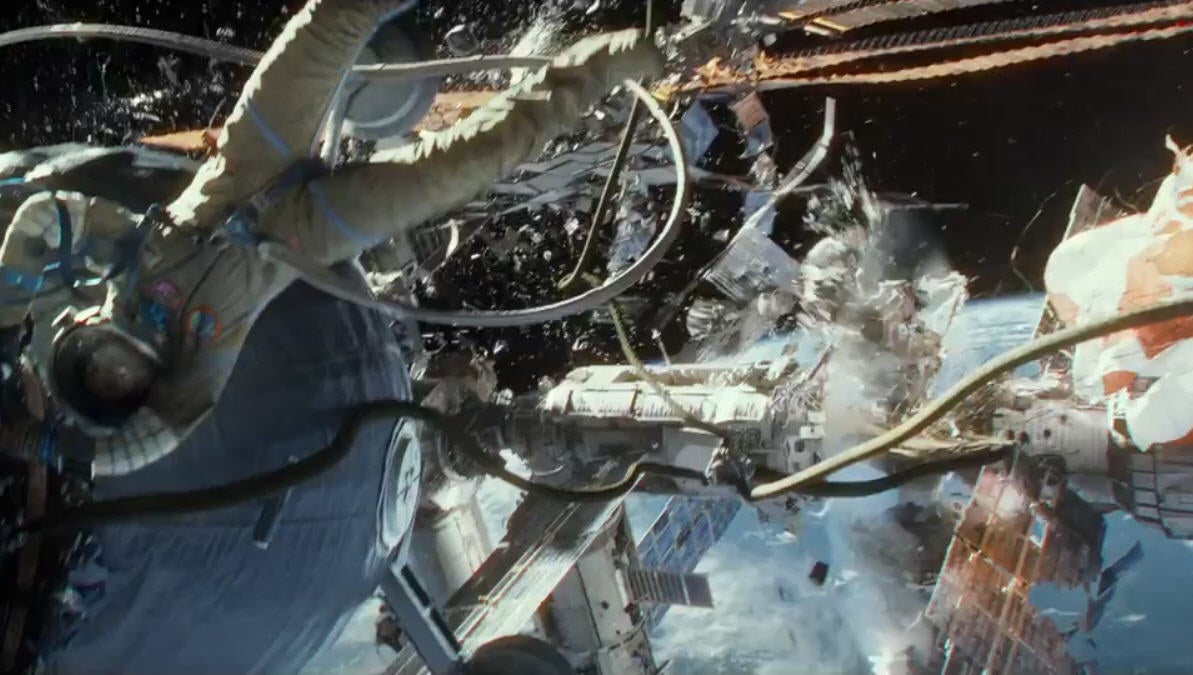
Just one of the seemingly countless shots that will have your eyeballs rubbing their eyeballs.

While the visuals alone make the movie worth shelling out your $15 to $20, the plot is decent enough. No, it’s not groundbreaking or creative, but it provides a plausible premise for the film’s action. Of course, space seems the kind of place where it doesn’t take a lot for humans to get into some very serious trouble, and this is true for Gravity.

The weakest points of the film are the characters and dialogue. The actors do just fine, and Bullock may likely get an Academy nod for her performance as the terrified yet essentially tough Doctor Stone. To be honest, though, I found her character unbelievably sheepish during the first half or so of the movie. From what I know of the N.A.S.A. astronaut program, the men and women who actually make it into space are some of the most unflappable humans who have ever lived. Stone’s demeanor and reactions before and during crisis stretch plausibility at times.

Clooney does well playing, well, George Clooney. They almost could have just called him Danny Ocean or any of the other half dozen cool-as-a-cucumber charmers that he’s played so well over the years. And this is another element that stretches credibility a tad – I had a hard time imagining an astronaut, even a supposed veteran like Kowalski’s character, being so flippant and carefree about much of what transpires. I suppose that he offers the audience the chance to breathe a little bit, given the tension that runs throughout the film, but it’s all a little too smooth for my sensibilities.

The dialogue is probably the weakest part of the entire production. It’s often cheesy and clichéd, especially the messages about bucking up in tough situations. I honestly can barely remember many of the verbal exchanges between any of the characters. When dialogue is used sparingly in a film, as it is in Gravity, it’s preferable to me that it actually be more memorable.

Though flimsy characters and dialogue will often torpedo a film, such is not the case with Gravity. It’s still one hell of an achievement in film-making. This is undoubtedly one that will periodically be brought back to big screens for decades to come, giving people thrills. If you haven’t caught it yet, get out there.

A Few Recommendations of Other “Spacey” Films:

Here are a few other space movies that came to mind as I watched Gravity:

2001: A Space Odyssey (duh) – Stanley Kubrick did, in 1969 and with far more limited technological wizardry, what Cuaron updates and polishes in Gravity. He conveyed the sense of exploring space in visual ways that have blown away audiences ever since its release. Though the characters are mostly forgettable in 2001, the speculative theories about the ramifications of technology and the human desire to expand and explore give 2001 much more intellectual meat for us to sick our mental teeth into.

Almost as expansive as the cosmos themselves, 2001: A Space Odyssey encompasses far more than some of the more dramatic or adventure-oriented space films made.

Solaris (1971) – Russian director Andrei Tarkovsky’s answer to Kubrick’s 2001, Solaris is arguably every bit as transcendent, while adding far more personal humanity to a space exploration tale. While both films feature slick visuals, Solaris pulls viewers’ attention inside the human psyche in ways that the expansive 2001 does not.

The Right Stuff (1980) – Telling a dramatized version of the original United States space program’s earliest years, I’ve always felt that this film portrays astronauts as the always unshakable, often arrogant daredevils that they really were and are. An insanely all-star cast and solid film-making result in a great historical and dramatic epic.


For All Mankind (1989) – A great, concise documentary that compiles some of the best footage that N.A.S.A captured from the inaugural Moon landing, all set to a meditative Brian Eno musical score. A movie that gives you a sense of just how dramatic a feat it was for humans to, in fact, set foot on a different planet. 

That's a wrap. The next film I'll review is The Conjuring, from earlier this year. 

Please be sure to pick up all empties on the way out.

Saturday, June 29, 2013

Film #98: Ulysses' Gaze (1995)


Original Greek Title: To vlemma tou Odyssea

Director: Theo Angelopoulos

Initial Release Country: Greece

Times Previously Seen: none

Rapid-Fire Summary (no spoilers)

Successful, mixed-heritage film director takes a bizarre, dream-like journey through eastern Europe to track down reels of film. Looks awfully confused or pensive throughout.

Extended Summary (Spoilers included)

An American film director, unnamed in the film but credited as “A” (Harvey Keitel), goes to Greece to begin a search for three lost reels of film that were produced by the Manakis brothers in their earliest years as Yugoslavian filmmakers.


The first shot of the film, and the first of many sweeping shots that make effective use of negative space. On the left, "A" looks out over the sea at the beginning of his odyssey.

“A”s journey takes him from Greece to Albania, Macedonia, then Bulgaria, Romania, Belgrade, and finally Sarajevo. Along the way, various couriers’ and companions’ identities meld with “A”’s recollections of his own past in these areas, some of which he had spent time and emigrated from as a child. Relatives and lovers from his past emerge from his memory to interact with him once again. Within these dream-like moments, “A” relives past joys and sorrows, but never gives up his quest for the three Manakis brothers reels.

At the end of his journey, in a war-torn Sarajevo, “A” finds the man who has the reels – a film archivist who has nearly perfected the long-lost chemical formula that will allow him to properly develop the film. Shortly after he does this, though, he and his family are shot and killed in the middle of a firefight on the city streets. “A” sadly returns to the blasted movie theater to watch the films, only to find that they are blank, offering only vacuous white screens.

My Take on the Film (Done before any further research)

More than once while watching this one, the words “inaccessible” came to my mind. Not that I was completely baffled by Ulysses’ Gaze, but there was clearly much more going on than I was able to grasp on this single, first viewing. There are clearly many themes and elements of great depth presented in the movie, and there is a hypnotic quality to its presentation that is compelling enough for me to make the effort for its full three hours. On the whole, though, I’m not sure that I would watch it again, and I certainly cannot recommend it to any but the most patient and avid fans of film.

The story of “A”s quest for the reels of film is interesting enough, as it sets up the traditional “quest” plot device. The film’s title is the first clear indication that Homer’s grand epic, The Odyssey, is a major inspiration. Of course, “A” is not traversing the Aegean Sea and besting monsters or other mythological hazards to return home. “A”s journey is a metaphorical search for his psychological and artistic roots, and he has to move past very real dangers in the highly treacherous Balkan regions in the middle of war-ravaged 1990s. This grand theme is fairly interesting, as it is only revealed in bits and pieces as the film moves along.


"A" rows his "Circe" along the river. His interaction with her is one of the more bizarre among the several time- and person-warping interactions that he has along the way.

The pace and tone of the film are what will tax many a viewer’s patience. In a style that I can best compare to the films I’ve seen of Russian director Andrei Tarkovsky, Angelopoulos uses many slow, measured, and meditative shots to draw in the viewer. I found these quite effective, as it gave me time to ponder the ultimate meaning of “A”s actions and purposes, as well as mull over the stunning compositions placed within the camera’s frames. Like the Tarkovsky films Andrei Rublev, Stalker, and others, Ulysses’ Gaze demands that the viewer embrace the quieter, slower moments in order to allow a certain moody gravity to overcome him or her. Most of the time, it works very well. However, there were a few times when it seemed slightly pretentious or contrived to me. I have to admit to occasionally suspecting being hoodwinked by the notion that just because the filmmaker isn’t spelling it all out for you, you must be missing something. I’ve found that, in my case, this is actually true at times. Sometimes, I am missing something, and maybe that was true when I was watching this film. Whether for this reason or simple impatience on my part, I found myself trying to urge the film forward at times.

From what I could tell, the visuals are fairly amazing. However, there is a caveat here. This film is, oddly enough for the 21st century, extremely difficult to get a hold of. It has not been in print for several years, and there really has not been a well-produced restoration done to my knowledge, which does not allow the film to be seen in all of its majesty. From the mediocre-quality DVD that I was able to procure, it is clearly a film that would be best served by being seen on the big screen. The sweeping shots of the blasted landscapes, meandering rivers, and foggy streets of the Balkan regions convey a bleakness that seems part and parcel of the mental distress that “A” is battling through. Had I been able to watch a higher-quality copy, I might have even more praise for this aspect of the movie.

The acting is rather strange. I love Harvey Keitel, and he often shows a decent amount of range. However, I’m not sure if he was the best choice for this role. Whether through his own interpretation or at the behest of the director, he shows odd shifts in demeanor, posture, and emotion as the story moves on. At many times, it is clear that these shifts represent “A” psychologically shuffling between his present quest and his past memories as son, lover, and brother. During most of the “modern” scenes, though, he delivers his lines as if he were in a trance. I realize that this is probably what the story calls for, as an urge far greater than himself is pulling him towards the Manakis brothers’ film reels, but I found that it almost dehumanized him. This was especially the case when the other modern character around him were acting much more naturally. Added to this is that Keitel, in his many roles in U.S. films, is one of the greatest “naturalistic” actors of the past several decades. A final puzzling thing to me about Keitel’s casting is my question of “Why him?” For much of the film, he’s delivering lines in English or short phrases in Greek, while almost everyone else is speaking the local languages. I suppose that this is likely another layer of the story that I failed to grasp, but it was a bit disorienting.


This is often how Keitel looks in this film - staring off into the distance, while others try to interact with him in more natural, organic ways. It fits the tone of the movie at times, but during some moments, it simply baffled me.

I have to say that, if nothing else, Ulysses' Gaze is a novel film that suggests great depth. I have no doubt that there were more than a few elements and strata that were simply over my head, which led to a bit of frustration and impatience as I viewed it. Still, I enjoyed the process of attempting to piece together the different visual, narrative, and thematic elements in the movie. I certainly was not completely successful, so that I currently have a disjointed impression of the film. I hope that the next section of this review will remedy this…

Upon Further Review (Done after some further research on the film):

I did this portion of the review after reading this very thorough and insightful synopsis at the Internet Movie Database.

Well, it’s quite clear that I missed several key elements that the director implemented. In short, if you plan to watch this movie, there are two things that will help: (1) a general knowledge of Homer’s Odyssey, and (2) patience. When one keeps these in mind, it becomes easier to see why the list-creators at TIME decided to include this film on their “All-TIME Great Films” list.

While I was watching it, I was able to pick up several of the plot points and interactions that mirrored Odysseus’s epic journey to Ithaca. There are many characters who represent the long-archetypal roles of Penelope, Calypso, Telemachus, and many others from the Greek classic tale. However, there are even more that I did not pick up on. One such is how “A”s journey into Sarajevo represents Odysseus’s descent into Hades. Obvious really, when it’s pointed out to you. If a viewer has a rich knowledge and love of the source material, then watching this film would provide a very deep experience.

Another thing that the author of the review points out is some of Angeloupolos’ film style. Beyond just giving a mere synopsis, the writer explains some of the deeper meaning of the long periods of silence in the film, confirming my suspicion that these are meant for the viewer to contemplate far beyond the mere screen action. We are constantly reminded that the region of the Balkans has a rich and often sad history. The long, slow shots give ample time for the mood and weight to settle into our minds. These realizations also give “A”s journey more meaning, as he remains steadfast, despite every sign that tells him to turn back.


A scene from Sarajevo - the "Hades" of "A"s Odyssey. These scenes are obviously and carefully staged, which will put off some viewers. For those who look beyond the unnatural setup and focus on what things represent, the film becomes much more engaging.

As profound as this film is, I still cannot say that I would rush to watch it again. Knowing now much more about the symbolism throughout, I would consider it. However, I would only do so if it were restored to a very high quality. The settings are already dreary enough, without having to watch them on a low-quality print. This one would be a prohibitive recommendation.

That’s a wrap. 98 shows down, 7 to go.

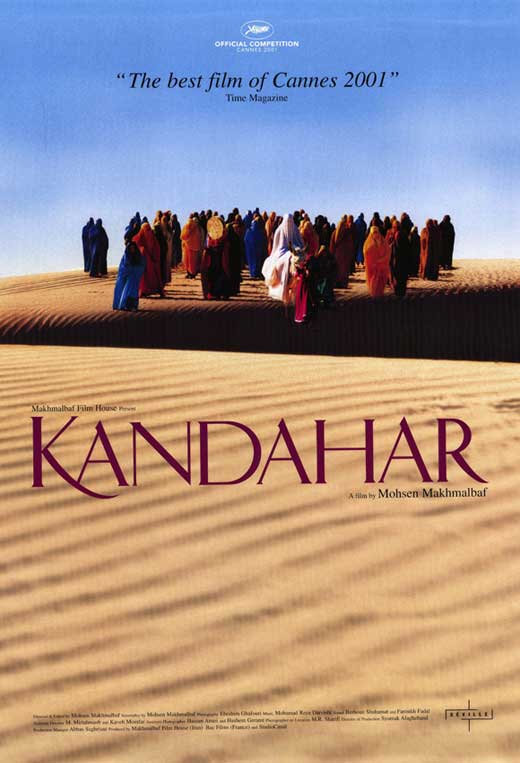
Coming Soon: Kandahar (2001)


Another film that I know almost nothing about. I know it involves Afghanistan and the Taliban, two hot-button topics even today, over a decade after this film was made. We’ll see how it stacks up.

Please be sure to pick up all empties on the way out.