Showing posts with label Federico Fellini. Show all posts

Friday, November 7, 2014

Before I Die #523: The Bird with the Crystal Plumage (1970)

Original Italian Title: L'ucello dalle piume di cristallo

Director: Dario Argento

It's a good movie, to be sure, but one that didn't quite live up to the cultist hype, in my view.

To be fair, my expectations were rather high, given how highly touted this film and director are by some cinephiles and film critics. Perhaps it is due to director Dario Argento's body of work and solid reputation as a solid suspense and horror filmmaker. I can't be sure, as this was the first of his films that I've ever seen. Therefore, I can only give my thoughts on this film based on its own merits, rather than where it fits into Argento's career arc.

The movie is often compared to several of Hitchcock's most famous suspense films, with good reason. There are Hitchcockian elements throughout the film - a bystander witnesses a brutal murder attempt (a la Rear Window), and he then gets wrapped up in a cat-and-mouse game with a psychopathic killer on the loose in Rome. There are plenty of well-executed moments of tension and fear, including a few pursuits through and around the winding streets of the ancient city.

Probably the most obvious strength of the movie is the visual technique. It's amazing to me just how many Italian filmmakers seem to have an innate knack for framing shots. Whenever I see a Da Sica, Leone, Fellini, or other Italian director's film, it's obvious that they have a portraitist's eye for composing a four-sided picture in the most beautiful manner. Dario Argento is another fine example. So many of the scenes are just enjoyable to drink in, thanks to a keen photographer's eye and some vibrant costumes and set designs.

Alas, the film wasn't what I would call a "masterpiece." There are some actions by the main characters that defy logic to a certain extent, and some of the dialogue is stilted and artificial (though I must admit that one line was hilarious - when a police inspector, without a trace of irony, asks for a suspect lineup with the line, "Bring in the perverts."). The acting was also a bit spotty, being what you would expect from a low-budget spaghetti Western. Somehow, I'm used to the amateurish acting in those more mythical Leone Westerns, but it seemed out of place in this more modern, realistic, urban setting.

One of many haunting, visceral, and masterfully framed shots
in the movie. The cinematography is an inarguable strength.
Those criticisms aside, I must confess that the movie did offer me something pleasantly unexpected - an interesting theme on human memory and psychology. In something one might ponder after reading or seeing Rashomon, The Bird with the Crystal Plumage finds its resolution to the mystery in a way that relies very heavily on the mental state of the witness - a mental state that can apply to many of us. It is this ultimate reveal that sets the movie apart from the great Hitchcock movies, though these latter may be superior in terms of coherence and overall execution.

I'll be eager to see some more of Argento, as I've heard some enthusiasts say that they consider a few of his other films even better than this one. If they are, then I expect some very impressive things. 

Tuesday, January 24, 2012

Film #71: La nui americaine (1973)


Title for us English-speaking types: Day for Night

Director: Francois Truffaut

Initial Release Country: France

Times Previously Seen: none

Teaser Summary (No spoilers)

A director deals with the endless technical and emotional chaos on the set of his current picture. 

Extended Summary (A more detailed plot synopsis, including spoilers. Fair warning.) 

France, 1973. Noted film director Ferraud (Francois Truffaut) is trying to get his current project up and running smoothly. Well, as smoothly as possible for a film. The financial backing is imposing stifling deadlines, the script is in constant flux, and the cast and crew have brought all of their emotional baggage with them. The film the Ferraud is attempting to make, May I Introduce Pamela, involves a young man bringing his new bride home to meet his parents, only to have her and his father fall in love and leave the rest of the family.

As emotional as this fictional tale might be, it pales in comparison to more immediate concerns of the cast and crew trying to bring the story to life. Ferraud must deal with almost no end of troubles. Each member of the cast either has gone through, is going through, or is trying to recover from some sort of depression or mental fatigue. The lead actress, Julie (Jacqueline Bisset) is returning from a hiatus to recover her mental health. The young actor Alexandre is an emotional juvenile whose neediness and jealousy knows almost no bounds. The elder supporting actress, Severine (Valentina Cortese), is in the full grip of alcoholism and struggles to so much as remember her lines. Add into this the little quirks and difficulties of the crew, from the script co-writer right down to the lowliest prop man, and Ferraud has his hands both full and tied.

It takes an army. Virtually everyone in this shot either loves, hates, has slept with, and/or will sleep with someone else in this shot. Maybe multiple someones. 

The greatest tests come near the end of filming. First, Alexandre’s girlfriend, the older and more worldly Liliane, leaves him for a British stuntman. This leads to Alexandre sleeping with his co-star Julie, much to the chagrin of Julie’s real husband. Just as all of this gets sorted out, one of the other key actors, Alphonse, dies in a car accident. Despite the insanity and tragedy, Ferraud manages to see the film through to its end. As shooting wraps up, the cast and crew part ways, though many of them clearly expect to see each other on projects. As strange and chaotic as it seems to most, this is the life they choose.

Take 1: My Gut Reaction (Done after this first viewing, before any further research.) 

Day for Night is an enjoyable, extremely well-constructed film that I probably don’t need to watch again. In a style similar to some of Robert Altman’s more renowned movies (M.A.S.H., Nashville, and especially The Player), Francois Truffaut decides to give us a panoramic view of the insanity surrounding a film set. I suppose some people see the subject matter as being self-important and self-aggrandizing, but Day for Night certainly doesn’t come off that way. The interactions between the characters is far often far too playful to be mistaken for pretension on Truffaut's part.

Director Ferraud instructing Julie on exactly how to hold her hands. Day for Night is full of such minutiae of film-making. It's actually fascinating. 

There is no way that I can avoid comparing this movie to its chief forebear: Federico Fellini’s 8 ½ . If looking at a brief treatment, it may seem as if Truffaut pirated Fellini. Both films are about making a film, and both convey the maelstrom surrounding the endeavor. Fellini, though, focused much more on the fantastic inner mental workings of the director-as-artist. Truffaut’s Day for Night takes in the entire scope of the project, not giving too much time to any one person, only delving slightly into a few characters’ minds. The only other clear similarity is that both films expertly achieve what they wish.

As mentioned, there are some graver moments and themes in the movie, such as Severine’s waning ability and waxing alcoholism. But this is tempered by her generally amiable demeanor. There are also Julie’s recovery from depression and her affair with Alexandre, as well as Alphonse’s sudden and tragic death. These, as upsetting as they may be, are quickly resolved and the film, just as the crew in the film, moves on. We viewers are given little more than a few brief moments to feel any lingering pain before being swept away by the inertia of the film-making process and lifestyle. Truly, the show must go on.

Technically, the film is brilliant. While there are no special effects to speak of, the cinematography pulls off plenty of great little maneuvers to draw the eye. To add a layer, you are often getting to look behind the curtain of filming, as we see plenty of the wild and contorted techniques that the May I Introduce Pamela cameramen have to employ to achieve the desired shots. At times, it’s like watching gymnasts do magic tricks in the middle of their routines.

One of the many shots that's not only eye-catching but also pulls back the movie magic curtain a bit. 

On par with the visuals is the acting. Every person plays their part perfectly, from the highly emotional and quixotic actors to the earthier and more practical crew members. Even Truffaut, playing himself in spirit, if not in name, does admirably. The key is that virtually all of the characters are either intriguing, funny, tragic, or a compelling combination of all three. In this, Day for Night taps into the voyeurism that is at the core of the appeal of cinema. We want to watch what all of these people do with and to each other.

All of this being said, I doubt that I will ever watch the movie again. As much as I enjoyed it and can see its strengths, I simply don’t know what I could get out of a second viewing. Hardcore film experts and budding film-makers could probably milk it for endless inspiration and knowledge, but I’m neither. I’d recommend it to anyone who enjoys learning about the filming process and enjoys a healthy dose of oft-light drama and humor. It’s also a great little follow-up to the aforementioned 8 ½ .

Take 2: Why This Movie’s Considered “Great” (Done after a wee bit o’ research.) 

A very wee bit.

It would seem that this movie has gained its praise for the sheer love of film that it conveys. Roger Ebert revisited it in this 1997 review, and he expresses a lot of the enjoyable elements of it well. He points out how the film shows how all of those involved in the film industry, creators, actors and crew alike, are often inebriated on the culture of the filming process. The quirky, high-drama relationships that develop and then dissipate over the course of a few weeks of filming seem as a drug. I suppose it should be no surprise that film critics, almost all of whom must truly love the medium of film, would love such a movie. It taps into their own passions, so a playful, thoughtful, and entertaining movie on the subject is bound to be adored by the professional critics. Day for Night fits the bill.

After this little bit of digging, I feel that Day for Night is a touch overhyped. Compared to nearly all of the other movies on this list, including Truffaut’s own 400 Blows, Day for Night I feel is considered great more because of its subject matter rather than any standout novelty. I do think that viewers who are looking for something a little different and humorous would enjoy it, but perhaps shouldn’t expect the mind-blowing movie that you may expect from an “All-TIME 100 Film”. 

That’s a wrap. 71 shows down. 34 to go.

Coming Soon: Chinatown (1974):

The classic film noir genre gets brought up to date in this slick 1970's Roman Polanski classic. This film kicks off a great streak of 1970s movies in the coming weeks that are some of my absolute favorites. Come on back for my take on it.

 Please be sure to pick up all empties on the way out.

Monday, May 23, 2011

Film #56: 8 1/2 (1963)


Director: Federico Fellini

Initial Release Country: Italy

Times Previously Seen: once (about 5 years ago)

Teaser Summary (No spoilers)

Star film director attempts to balance the manic production process of his current project with his own flights of fancy and real personal problems.

Extended Summary (A more complete plot synopsis, spoilers included. Fair warning)

Star film director Guido Anselmi (Marcelo Mastroianni) is surrounded by chaos. He is in the midst of producing his latest movie – a high-budget monster that has his creative team scrambling to and fro, trying to meet their distracted director's insufferably vague demands. Wannabe actors and actresses constantly badger Guido for parts in the movie, financial backers seek to know more about the mysterious project, and critics, religious figures, and journalists from all over the world nag him for his views on everything from love to politics to religion. In the middle of the maelstrom, Guido, suffering from poor health, goes to a spa, bringing the entire circus with him.

In his mind's eye, Guido dreams himself a balloon about to be brusquely yanked back to earth.

Added to all of the hoopla surrounding the movie itself are Guido's personal problems. He asks his mistress, the pretty but hopelessly dense and materialistic Carla (Sandra Milo), to join him. She offers a bit of escapist comfort, but only for a short while before the pressures of the film start to weigh down on Guido once more.

Throughout the dizzying tap-dance, Guido often finds his only respite in his own fantasies. He recalls past loves and scenarios, painting them with the exceptionally vibrant palette of his revisionist imagination. From floating above the crowd as a balloon, to interactions with past lovers, to conversations with his dead father, Guido loses himself in his own mind as easily as he lights up a fresh cigarette. However, just like the cigarette, each fantasy burns down to its end, leaving him back in reality.

The ever-chic looking Guido, taking in the world around him. What the mind behind the shades does to that world is anyone else's guess.

His reality becomes even more muddled when, after his desperate plea for mature companionship, Guido's wife Luisa (Anouk Aimee) comes to visit him at the spa. The reunion is amiable enough at the start, but soon turns sour as Luisa realizes that her husband is still the same immature dreamer who has cheated on and left her many times in the past. Their 20-year marriage seems completely destroyed when, at a set of screen tests, Luisa sees that her husband has used their most intimate conversations as fodder for his movie script. She storms out of the screen tests, with only marginal protests by Guido.

By this time, the pressures on Guido to become more active in the filming process, respond to critics, and answer to his financial backers finally get to him. At an ill-conceived tea party at one of the movie sites (with scaffolding for a massive rocket ship), Guido is put on a dais and commanded to give answers. In his mind, he escapes by imagining himself crawling under the table, pulling a gun and shooting himself. In reality, he merely cancels the entire picture and sends the entire hoipaloi packing.

In his final waking dream, Guido stares at the now-useless scaffolding and imagines an entire carnival of characters being led about by a little boy in all white, with a flute. The boy directs everyone off of the stage, remains for a few moments more, and is the last to leave.

My Take on the Film

This is a movie that will divide viewers into 2 clear camps: those who find it incomprehensible, Eurotrash nonsense, and those who find it a phenomenally skillful, humorous and entertaining look at the life and mind of an artist. When I first watched this movie about five years ago, I was probably more in the former group, but I am now with the latter.

If you are a movie viewer who demands a plot-driven story that follows the classic hero/heroine overcoming obstacles to prevail for truth and justice, Federico Fellini is not the director for you, and the film 8 ½ is probably the ultimate Fellini film. This is not least of all because it is certainly the most auto-biographical of his many films. I suppose some may say that a film director making a film about a film director making a film is the height of narcissism and self-aggrandizement. This thought did occur to me, but I dismiss it. For any person who has ever attempted any artistic endeavor, it is not hard to understand the character Guido Anselmi's desire to leave behind the trappings of the material world and vanish into any number of fantasy worlds of our own making. Therein lies the emotion of 8 ½ – the desire of escapism. After all, what are most of us looking for in films but to escape?

That attempt at intellectual analysis aside, the most striking thing about 8 ½ is the portrayal of Guido's daydreams. On my past viewing, I simply wasn't paying enough attention to see how they were related to everything else going on in the film. Now, however, I see the very clear connections and why each and every one of his flights of fancy are touching and/or hilarious. This is part of what is captivating about this movie – the viewer is waiting to see just when Guido will warp the world around him into his own vision, and exactly how he will do it. From the very beginning, in which he imagines himself drifting out of his car stuck in traffic and up into the air like a balloon, to the very end in which he sees his role as director symbolized by the little boy leading around thousands of strange characters, it all points to the absurdities that swirl around the world of art.

This is not to equate the absurd with the useless. Absurdity is the ocean in which many comic treasures can be found, and Fellini was the Jacques Cousteau of finding such. He had a such a great eye for the strange, silly, and wonderful moments in life that entertainers can provide. From the little, insensitive comments towards babbling actors to the hilariously ridiculous visions of Guido as the head of his own harem, 8 ½ runs a spectacular gamut of humor.

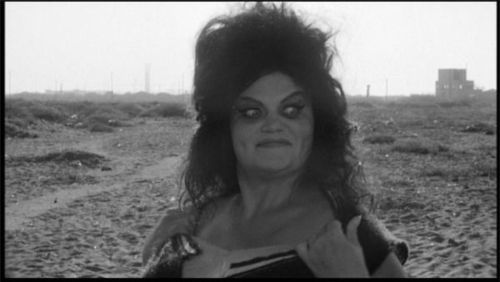
The ocean-side prostitute, Saraghina - One of the countless indelible images in the movie.

Not only could Fellini find this great variety of humor, but he could present it in such an appealing, eye-catching way that his films are often a pleasure to watch. Even someone who has no time for the fanciful nature of 8 ½ has to admit that the film is captivating to look at. From the cast, all striking either for their beautiful or singular looks, to the sets, locales, and shot framing, everything is in its proper place in the movie. It all further reinforces the notion that art can provide the order and pleasure that real life rarely offers.

A final merit to be pointed out is that Fellini cut himself no breaks in this movie. While the character who represents him, Guido, is fairly likable and, but the accounts of the ancillary characters, an artistic genius, his failings as a man are made plain for all to see. Once his wife, Luisa, and his sister show up, it becomes clear that, emotionally, Guido is nothing more than a scared and selfish little child. He lies to cover up his infidelities and uses his and his wife's most intimate moments as little more than fodder for his own movie script. What you get is a man who represents many a great artist – brilliant in his medium but sorely lacking when it comes to the quieter, closer moments of life.

I suppose if I can knock this film at all, it is that it ran out of just a little bit of steam by the end. Coming in at over 2 hours and 15 minutes, I found myself flagging a little bit by the time the end was near. I felt that I had received a near overdose of Guido Anselmi's perpetual mental fluctuations and just wanted the end to come. However, I must say that this may have been because it was late at night, and I was probably just tired. Turn my experience into a cautionary tale – set aside the right time to watch this movie.

The final image of the movie, with the little "band leader" boy symbolizing the director himself.

That's a Wrap. 56 shows down. 49 to go.

Coming Soon:Charade (1963)


This one may be a bit of an effort. Despite having some kick-ass actors in it (Cary Grant and James Coburn, to name a few), it also contains one of my least favorite leads – Audrey Hepburn. Come an back to see if I can stomach it.

Please be sure to pick up all empties on the way out.