Showing posts with label French nouveau. Show all posts

Tuesday, January 24, 2012

Film #71: La nui americaine (1973)


Title for us English-speaking types: Day for Night

Director: Francois Truffaut

Initial Release Country: France

Times Previously Seen: none

Teaser Summary (No spoilers)

A director deals with the endless technical and emotional chaos on the set of his current picture. 

Extended Summary (A more detailed plot synopsis, including spoilers. Fair warning.) 

France, 1973. Noted film director Ferraud (Francois Truffaut) is trying to get his current project up and running smoothly. Well, as smoothly as possible for a film. The financial backing is imposing stifling deadlines, the script is in constant flux, and the cast and crew have brought all of their emotional baggage with them. The film the Ferraud is attempting to make, May I Introduce Pamela, involves a young man bringing his new bride home to meet his parents, only to have her and his father fall in love and leave the rest of the family.

As emotional as this fictional tale might be, it pales in comparison to more immediate concerns of the cast and crew trying to bring the story to life. Ferraud must deal with almost no end of troubles. Each member of the cast either has gone through, is going through, or is trying to recover from some sort of depression or mental fatigue. The lead actress, Julie (Jacqueline Bisset) is returning from a hiatus to recover her mental health. The young actor Alexandre is an emotional juvenile whose neediness and jealousy knows almost no bounds. The elder supporting actress, Severine (Valentina Cortese), is in the full grip of alcoholism and struggles to so much as remember her lines. Add into this the little quirks and difficulties of the crew, from the script co-writer right down to the lowliest prop man, and Ferraud has his hands both full and tied.

It takes an army. Virtually everyone in this shot either loves, hates, has slept with, and/or will sleep with someone else in this shot. Maybe multiple someones. 

The greatest tests come near the end of filming. First, Alexandre’s girlfriend, the older and more worldly Liliane, leaves him for a British stuntman. This leads to Alexandre sleeping with his co-star Julie, much to the chagrin of Julie’s real husband. Just as all of this gets sorted out, one of the other key actors, Alphonse, dies in a car accident. Despite the insanity and tragedy, Ferraud manages to see the film through to its end. As shooting wraps up, the cast and crew part ways, though many of them clearly expect to see each other on projects. As strange and chaotic as it seems to most, this is the life they choose.

Take 1: My Gut Reaction (Done after this first viewing, before any further research.) 

Day for Night is an enjoyable, extremely well-constructed film that I probably don’t need to watch again. In a style similar to some of Robert Altman’s more renowned movies (M.A.S.H., Nashville, and especially The Player), Francois Truffaut decides to give us a panoramic view of the insanity surrounding a film set. I suppose some people see the subject matter as being self-important and self-aggrandizing, but Day for Night certainly doesn’t come off that way. The interactions between the characters is far often far too playful to be mistaken for pretension on Truffaut's part.

Director Ferraud instructing Julie on exactly how to hold her hands. Day for Night is full of such minutiae of film-making. It's actually fascinating. 

There is no way that I can avoid comparing this movie to its chief forebear: Federico Fellini’s 8 ½ . If looking at a brief treatment, it may seem as if Truffaut pirated Fellini. Both films are about making a film, and both convey the maelstrom surrounding the endeavor. Fellini, though, focused much more on the fantastic inner mental workings of the director-as-artist. Truffaut’s Day for Night takes in the entire scope of the project, not giving too much time to any one person, only delving slightly into a few characters’ minds. The only other clear similarity is that both films expertly achieve what they wish.

As mentioned, there are some graver moments and themes in the movie, such as Severine’s waning ability and waxing alcoholism. But this is tempered by her generally amiable demeanor. There are also Julie’s recovery from depression and her affair with Alexandre, as well as Alphonse’s sudden and tragic death. These, as upsetting as they may be, are quickly resolved and the film, just as the crew in the film, moves on. We viewers are given little more than a few brief moments to feel any lingering pain before being swept away by the inertia of the film-making process and lifestyle. Truly, the show must go on.

Technically, the film is brilliant. While there are no special effects to speak of, the cinematography pulls off plenty of great little maneuvers to draw the eye. To add a layer, you are often getting to look behind the curtain of filming, as we see plenty of the wild and contorted techniques that the May I Introduce Pamela cameramen have to employ to achieve the desired shots. At times, it’s like watching gymnasts do magic tricks in the middle of their routines.

One of the many shots that's not only eye-catching but also pulls back the movie magic curtain a bit. 

On par with the visuals is the acting. Every person plays their part perfectly, from the highly emotional and quixotic actors to the earthier and more practical crew members. Even Truffaut, playing himself in spirit, if not in name, does admirably. The key is that virtually all of the characters are either intriguing, funny, tragic, or a compelling combination of all three. In this, Day for Night taps into the voyeurism that is at the core of the appeal of cinema. We want to watch what all of these people do with and to each other.

All of this being said, I doubt that I will ever watch the movie again. As much as I enjoyed it and can see its strengths, I simply don’t know what I could get out of a second viewing. Hardcore film experts and budding film-makers could probably milk it for endless inspiration and knowledge, but I’m neither. I’d recommend it to anyone who enjoys learning about the filming process and enjoys a healthy dose of oft-light drama and humor. It’s also a great little follow-up to the aforementioned 8 ½ .

Take 2: Why This Movie’s Considered “Great” (Done after a wee bit o’ research.) 

A very wee bit.

It would seem that this movie has gained its praise for the sheer love of film that it conveys. Roger Ebert revisited it in this 1997 review, and he expresses a lot of the enjoyable elements of it well. He points out how the film shows how all of those involved in the film industry, creators, actors and crew alike, are often inebriated on the culture of the filming process. The quirky, high-drama relationships that develop and then dissipate over the course of a few weeks of filming seem as a drug. I suppose it should be no surprise that film critics, almost all of whom must truly love the medium of film, would love such a movie. It taps into their own passions, so a playful, thoughtful, and entertaining movie on the subject is bound to be adored by the professional critics. Day for Night fits the bill.

After this little bit of digging, I feel that Day for Night is a touch overhyped. Compared to nearly all of the other movies on this list, including Truffaut’s own 400 Blows, Day for Night I feel is considered great more because of its subject matter rather than any standout novelty. I do think that viewers who are looking for something a little different and humorous would enjoy it, but perhaps shouldn’t expect the mind-blowing movie that you may expect from an “All-TIME 100 Film”. 

That’s a wrap. 71 shows down. 34 to go.

Coming Soon: Chinatown (1974):

The classic film noir genre gets brought up to date in this slick 1970's Roman Polanski classic. This film kicks off a great streak of 1970s movies in the coming weeks that are some of my absolute favorites. Come on back for my take on it.

 Please be sure to pick up all empties on the way out.

Saturday, August 27, 2011

Film #60: Bande a part (1966)


Title for us English-speaking Types: Band of Outsiders

Director: Jean-Luc Godard

Initial Release Country: France

Times Previously Seen: none

Teaser Summary (No spoilers)

Trio of young, restless Parisians attempt a heist, in their own silly, amateurish way.

Extended Summary (A more complete plot synopsis, spoilers included. Fair warning)

In 1960s Paris, buddies Arthur (Claude Brasseur) and Franz (Sami Frey) are in the midst of planning a burglary. The two men are complete novices at thievery, but they seem bored and mildly desperate, and opportunity presents itself. That opportunity has come through Odile (Anna Karina), a pretty young girl whom Franz has met at an English school. Odile lives with her aunt in an impressive home, where she says their current boarder has a stash of millions of francs which he has stolen from the government. Odile tells Arthur and Franz that the money is left in an unlocked cabinet in an unlocked room. The three decide to relieve him of the money and escape their dull lives in Paris.

Over the course of a few days, the three grapple with their impending crime and their own feelings for each other. All three seem friendly enough, in their own flighty ways, but they all face uncertainties. Franz is a bright, well-read man who has genuine feelings for Odile. Odile, the youngest, the most nervous and guilt-ridden of the three, falls for Arthur. Arthur has a quirky yet dark charm, but is somewhat cold and beholden to his heartless and greedy family.

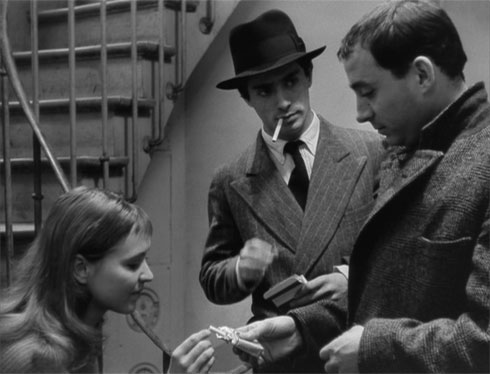
The triangle takes shape: Odile (left), accepts a cigarette from Arthur (right), after coldly refusing Franz (middle).

When the planned date of the robbery approaches, problems start to arise. Odile’s nervousness increases, but the fellows calm her enough to go in and allow them entry to the house. After they “break” in, they soon discover that the previously unlocked room is now firmly locked. They try the outside window, but this too is locked. Odile explains that her aunt and the boarder must have gotten suspicious, based on her own slight disheveling of the room on a previous search through it. Franz and Arthur, frustrated, abandon the job for the day, but pledge to return on the morrow.

The next day, the scene from the prior day repeats itself, to a degree. Odile lets the men in, and Arthur and Franz bully her aunt into giving them the room key, and then they bind her, gag her, and lock her in a massive cabinet. They get into the boarder’s room, but the cabinet is now empty of all but a few thousand francs. When they return to try and get the money’s location out of the aunt, she appears lifeless. They assume she is dead and they flee the house. Just as Arthur, Franz, and Odile are about to drive away, Arthur decides to double back and check to see if the aunt is indeed dead. He promises to meet Franz and Odile a short while later.

During the second robbery attempt, Arthur unleashes his nasty side, while Odile looks on.

Franz and Odile, driving away from the house, spot Arthur’s nefarious uncle, who has known of the planned caper all along, heading towards the house. Franz has a bad feeling about it all, makes a quick U-turn, and tries to catch up. When he and Odile approach the house, their fears are realized: they see Arthur emerge from the house, go into an attached doghouse, and fish the missing money out. As he is carrying the bundles of cash away, his own uncle steps out of the bushes and shoots him several times, the money spilling onto the lawn. Arthur does manage to shoot and kill his uncle in return, but then dies himself. Odile and Franz, watching from afar, then see Odile’s aunt, alive and well, come out of the house just as the boarder arrives on the scene. The two scoop up the money and scramble inside. Franz and Odile leave the bloody scene and drive away.

On the road away from the carnage, Franz and Odile share their feelings for each other and realize that they love one another, even through the attempted crime gone horribly wrong. They decide to board a ship and head to Brazil, where they hope to live happily together and explore a place far removed from their lives in Paris.

Take 1: My Gut Reaction (Done before any further research)

This was a peculiar little movie, but a rather enjoyable one.

Before watching Band of Outsiders, the only other Jean-Luc Godard film I had seen was the influential science fiction film, Alphaville. I found Alphaville interesting and imaginative, but also rather baffling. Band of Outsiders was also a bit baffling, but in different and more amusing ways.

While watching this movie, I couldn't help but think of one of my absolute favorite comedies, The Big Lebowski, that fantastic, bizarro take of the Coen brothers on the noir genre. The Coen's clearly took the premise of “What if a burnt-out stoner were thrown into a 1940s-style noir crime tale set in 1990's Los Angeles?” and ran with it. In Band of Outsiders, Godard seemed to do something similar, asking, “What if three semi-hapless youths tried to pull a heist, and the story were told in noir style?” The results are pretty entertaining and, I imagine, quite novel for 1964.

From the beginning, the film does a good job of establishing the tone. Franz and Arthur drive out and “case” the house they plan to rob, but they can't help lapsing into silly games of “Billy the Kid versus Pat Garrett,” romping and rolling around the street like a couple of 8-year-olds. Master criminals, these are not.

Arthur and Franz, clowning around in the middle of their first recon of the house.

When the young, pretty, uncertain and almost accidentally devious Odile appears, she adds another dimension. Like Franz and Arthur, she knows only that she doesn't like her current life in Paris. Throughout the film, the three flirt with each other and make attempts to reveal their feelings about and to one another, without much success. Franz has a deeper, more thoughtful attraction to Odile, who is infatuated with the more reckless, immature and mysterious Arthur, who lusts for Odile but is more interested in the loot. It's a half-baked love triangle that one would expect from aimless youth.

The style of the film is a comedic take on noir movies. The voice-over narration reveals the inner thoughts of the three main characters. In a standard noir, such as Out of the Past or Double Indemnity, this adds psychological depth, mood and tension through terse, poetic language. In Band of Outsiders, it provides an extra layer of humor by revealing that neither Franz, Arthur, nor Odile is possessed of so much as a fraction of the ability, weariness or resignation of legitimate noir protagonists. They are restless and scattered, and their preoccupations make them horribly suited for lives of crime. But, what else are they going to do?

The plot itself is nothing extraordinary. When I saw “French” and “crime” on the DVD summary, I was ready for something quite different. Having enjoyed several French crime/escape flicks, such as Le Trou and Rififi, I hoped for a similarly tight, fast-paced caper film. Band of Outsiders makes the object of the thieves' desires one that any crime film can utilize – bundles of dirty cash – but makes its obtainment (and failure of) so simple that it's laughable. The money just sits in a cabinet, and the thieves are first thwarted when the cabinet is locked, and later when the money is moved into a nearby doghouse. There's something oddly and hilariously more realistic about all of this.

The "bande" kill some time before the heist by racing through the Louvre. Just one of their sillier adventures.

The acting is all solid. The roles were not extremely demanding, but the three main characters needed to convey uncertainly and antsiness in just the right amounts, and all of them did so. As with any film in a language that one doesn't speak, I'm sure that I even missed some of the subtle humor that can be conveyed by phrasing and tone, but the subtitles seemed to do a good enough job to keep me laughing in appropriate moments.

If a have to knock my viewing experience at all, I would say that it was due to the disorienting nature of the movie. Perhaps this was due to my ignorance of the film going in, but it takes a while to get a full grip on what the movie is trying to do. There are moments of silliness, gravity, dancing, somber soul-searching, deaths by gunshots, and overblown death throes, among others. At times it borders on incoherent, but it never slipped over the edge to me.

Another thing that tried my patience a little was the dialogue. Like many French nouveau movies of the same era, the characters tend to speak in oddly existential epigrams at times. This may have been another element that Godard meant as a mild spoof, but it was hard to be sure. When someone like Odile, who, according to the narrator “wondered if the boys noticed her breasts moving beneath her sweater,” later observes that, "All that is new is, by that fact, automatically traditional." It's hard to tell whether this is supposed to imbue her with a more rounded character, or if we are simply supposed to laugh at her suddenly-found profundity and/or pretension (two things that many French films have in nauseating abundance). Hard for me to say.

Band of Outsiders was a fun, quirky little film to watch. It was far from taxing, length-wise (a mere 93 minutes), and never got mired too deeply in the few elements that I could have found annoying. Would I watch it again? Perhaps, but I wouldn't rush to do so.

Fin. Franz and Odile take a slow boat to Brazil - some place that's not France.

Take 2: Why Film Geeks Love This Movie (Done after some further research)

Not a ton of information out there on this movie, and nothing that surprised me or altered my view of it too much.

In general, it seems that this movie is revered for the blending of its lighthearted tone with its aping of previously-established styles. Several scenes and visuals in the film inspired several later homages in other movies. The one most often mentioned is the “Madison dance” scene. I didn't mention it, but it is a standout scene for its humorous strangeness. One of the more modern and well-known homages of the scene is the Vincent Vega/Mia Wallace dance number in Pulp Fiction.

The famous "Madison dance" scene. Strange? Yup.

A rather heady 2003 essay by Joshua Clover can be found here. Mr. Clover is clearly well-versed in film history, and he draws connections between many elements of Bande A Part, its American root elements, and the relationship to the French New Wave movement of the time. It's an interesting read, though dizzying at times.

That's a wrap. 60 shows down; 45 to go.

Coming Soon: Persona (1966)


Ingmar Bergman has gone all serious, psychological, and disturbing on us! Last time one of his films was in this list, it was the delightful Smiles of a Summer Night. I've seen Persona before, and I know not to expect the easygoing, sly comedy of that earlier film.

Please be sure to pick up all empties on the way out.

Thursday, March 4, 2010

Film #14: Le Crime de Monsieur Lange (1936)


Title That I Can Understand: The Crime of Mister Lange

Director: Jean Renoir

Release Country: France

Times Previously Seen: none

The Story (a summary of the plot; spoilers and all. Fair warning):

In Paris, France, Amedee Lange, a kindly, slightly naive employee for a small publishing company, toils nightly over a series of American western stories featuring a character named Arizona Jim, though the owner of the company simply laughs off any notion of actually publishing them. This owner, one Batala, is a complete scoundrel in a never-ending verbal dance to avoid facing his creditors and past lovers. On the verge of being sued, he gathers the companies funds, packs up and runs, leaving his company to deal with the disaster in his wake. Shortly after Batala hops a train out of town, we hear on the radio that the train has crashed, killing all aboard.

After the publishing company hears the news and panics for a short while, the remaining writers and artists, assisted by Batala's far more humane son, create their own co-operative and decide to publish the Arizona Jim tales. The stories become incredibly successful, and the co-operative find themselves in a new-found state of financial and social well-being, with even the shy Amedee finding love with Valentine, a beautiful and kind-hearted laundress who works nearby.

Just when things are at their height, Batala re-emerges. He had avoided death on the train and slinks back into the publishing office, threatening to reassert control over everything, take all that the co-operative has created, and perhaps even fire everyone out of spite. Upon revealing this dastardly plan to Amedee, the newly successful writer, refusing to allow the wanton destruction of so many people's lives, kills Batala and flees. At the border of France, Amedee and Valentine tell their tale to some local fishermen who have sympathy and help them flee across the border, presumably to safety.

Take 1: My Gut Reaction (done after 1 viewing & before any research):

Excellent movie, and this is saying something. I was exhausted when I started watching this, and the white subtitles were sometimes washed out by the white on the screen. Still, I was happy to fight through my fatigue and the visual barrier and see this film through to the end.

The story is told in classic flashback format. We actually open at an inn on the French border, and Valentine tells the whole tale to a bunch of locals. It works really well, as we immediately learn that this quiet and unassuming guy, Amedee, has killed someone. Great hook, right? It worked for me.

In a tight 80 minutes, you get a great feel for the setting, the characters and all the relevant plot points. It may be a touch rushed at times, but not distractingly so. I quickly developed sympathy for characters like Amedee, Valentine and others, while it took all of two minutes for the bile to rise in my throat at the sight of Batala. The publishing company owner, among a few other ancillary characters, may be a tad 2-dimensional, but he's certainly believable enough as a shifty, sleazy, if semi-charismatic, scumbag. It's another movie like Baby Face where a lot goes down in a concisely-told tale. I presume that this speaks to the director's skill.

The story itself is an interesting with one very deep question at its heart: Would you kill an inveterate leech of a human being to preserve the happiness of dozens of good people? It's one thing to ponder this hypothetical question on your own; it's another to see it play out amongst very believable, if fictional, characters. The murder doesn't come until close to the end. The rest is build-up and serves to create the power of the film.

Here's a clip from the end of the film. The subtitles are in Spanish, but just know that at this point, Batala, bastard extraordinaire, has returned and is explaining his plan to rob and gut the cooperative. Just watch Amedee's face towards the end - you can see the gears turning in his head, doing the math and having it all equal his final decision to murder:


Some may point out that none of the "good" characters is particularly strong. Amedee, the protagonist, is a bit of wimp in some ways, despite his good heart. Valentine is compassionate, but is overcoming past mistakes. The other characters' flaws are more glaring, but I think all of these add the humanistic element to the movie. By the time Amedee is faced with the choice to kill Batala, you completely realize what's at stake - the hard-earned joy of many very real people.

The acting may not be the best I've seen of the early films, but it's strong. A few of the simpler characters don't demand much range, so it's passable. The key roles of Amedee, Batala, and Valentine are played very well by Renee Lefevre, Florentine, and Jules Berry, respectively. This is all that matters.

I'd recommend this to anyone who likes old films and doesn't mind reading subtitles. The only drawback is that, right now, this one's a bit tough to find. It's not available on Netflix, so I had to order a VHS copy and pay $20.00 for it. Maybe it'll come out on DVD in the near-future, or you can find a copy at a video shop specializing in foreign and independent movies. If so, give it a shot if you want to dig into the past of solid cinema.

Take 2: Why Film Geeks Love It (done after some research on the film):

The handful of modern-day reviews of The Crime of Monsieur Lange seem to agree - it may not be absolutely perfect, but it's very unique in its mastery of telling an engaging, thoughtful tale that marries social commentary with genuine compassion, without either one becoming overbearing. Here's the short review by a fellow at TIME.

Apparently, the whole story of the cooperative springs from Jean Renoir's early affiliations with the far left movements in 1930s France. I suppose we're meant to see Batala as representing the thoroughly corrupt heads of industry. It may be a bit of a caricature, but it still works. The critiques I've read point this out as well as how Renoir didn't allow these elements to overwhelm the movie, raising it well above mere propaganda. This critic at Rotten Tomatoes puts it well.

The other lasting element is, as I had noticed, the very human characters. In later films of the French nouveau era that I've seen, like Breathless and Cleo 9 to 5, I feel like these "humanistic flaws" would become so commonplace and numerous that they led to characters who evoked no emotion from me, whatsoever. Decades before these, though, Renoir had the balance just right.

That's a wrap. 14 shows down. 91 to go.

Coming Soon: The Awful Truth (1937):

I've never seen this one, so my march through the unknown continues. Cary Grant's usually awesome, but this one is dubbed a "screwball comedy," which is a genre that I usually can't stand. Maybe this one will surprise me.
Please be sure to pick up all empties on the way out.