Directors: Stanley Donen, Gene Kelly
Initial Release Country: United States
Times Previously Seen: once (about ten years ago)
Teaser Summary (no spoilers)
Cheeseball silent film star stumbles through transition to talkies while finding love and dancing, wearing a shit-eating grin.
Uncut Summary (The full story, including spoilers. Fair warning)
It's 1927 and silent film stars Don Lockwood (Gene Kelly) and Lina LaMont (Jean Hagen) are the toast of Hollywood. They are in the middle of a string of commercially successful, if formulaic romance/adventure movies. Despite their obvious film success, however, the two could not be more different in real life. Don is a happy-go-lucky man who, with his closest friend Cosmo (Donald O'Connor) has worked his way up through the entertainment world by building his singing and dancing chops in all manner of low-brow acts. Lina is a no-talent, dim-witted, high maintenance egomaniac who seems to believe herself a princess simply because she plays them in the movies.
Along comes the landmark film The Jazz Singer – the first talking picture. While most of Hollywood dismisses it as a novelty gimmick, the film's smash success sends all other studios scrambling to follow suit, including Don and Lina's. The transition could not be rougher. Though Don has some trouble, the biggest problem is Lina, whose pretty face is no longer enough. Her high, shrieking New York “city goil” accent cannot be tamed into anything listenable. Not even costly enunciation lessons can can break through her thick skull or provincial, nasal voice.
To the rescue comes Don's new love, Kathy Seldon (Debbie Reynolds), an adorable, spunky little entertainer whose remarkable dancing ability is only outdone by her incredible singing. Cosmo hatches the idea of using Kathy's voice as an unseen proxy for Lina. Since Lina's is the beautiful face that viewers know and love, they'll have her lip synch the dialogue and songs as Kathy sings them.
Initial Release Country: United States
Times Previously Seen: once (about ten years ago)
Teaser Summary (no spoilers)
Cheeseball silent film star stumbles through transition to talkies while finding love and dancing, wearing a shit-eating grin.
Uncut Summary (The full story, including spoilers. Fair warning)
It's 1927 and silent film stars Don Lockwood (Gene Kelly) and Lina LaMont (Jean Hagen) are the toast of Hollywood. They are in the middle of a string of commercially successful, if formulaic romance/adventure movies. Despite their obvious film success, however, the two could not be more different in real life. Don is a happy-go-lucky man who, with his closest friend Cosmo (Donald O'Connor) has worked his way up through the entertainment world by building his singing and dancing chops in all manner of low-brow acts. Lina is a no-talent, dim-witted, high maintenance egomaniac who seems to believe herself a princess simply because she plays them in the movies.
Along comes the landmark film The Jazz Singer – the first talking picture. While most of Hollywood dismisses it as a novelty gimmick, the film's smash success sends all other studios scrambling to follow suit, including Don and Lina's. The transition could not be rougher. Though Don has some trouble, the biggest problem is Lina, whose pretty face is no longer enough. Her high, shrieking New York “city goil” accent cannot be tamed into anything listenable. Not even costly enunciation lessons can can break through her thick skull or provincial, nasal voice.
To the rescue comes Don's new love, Kathy Seldon (Debbie Reynolds), an adorable, spunky little entertainer whose remarkable dancing ability is only outdone by her incredible singing. Cosmo hatches the idea of using Kathy's voice as an unseen proxy for Lina. Since Lina's is the beautiful face that viewers know and love, they'll have her lip synch the dialogue and songs as Kathy sings them.
 Cosmo, Kathy and Don rip through one of their many happy little tunes.
The plan works, and the latest Don Lockwood/Lina LaMont film is made. Once the movie is in the can and awaiting its premier, however, Lina starts to do the one thing that she probably shouldn't: think. Jealous of Don and Kathy's love and Kathy's genuine talent, Lina attempts to legally blackmail the movie studio into making Kathy her permanent voice. The studio head is furious, as he has plans to groom Kathy into their next big star. Flustered, all are left to stew on Lina's selfish machinations.
Everything comes to a head at the movie premier, where the film is shown to an audience who loves it. To roaring applause, Lina decides to really drive her plan home. She attempts to give a speech, but her true voice and condescending comments baffle the crowd. The uncertain viewers demand that she sing, “like in the picture.” Knowing that she has no hope of singing as well as Kathy, Don and Cosmo create the perfect set-up: they tell Lina to lip sync the words as Kathy sings the song just behind Lina and a dividing curtain. In the middle of the song, the curtain is raised, Lina is exposed as a fraud, Kathy's true talent is revealed, and all of the good guys live happily ever after.
Exit, stage right.
Take 1: My Gut Reaction (done after this most recent viewing, before any research)
This musical very often flirted with sliding into the same category as Meet Me In St. Louis, West Side Story, and The Sound of Music: musical films that I simply can't stand. It did, however, manage to fall just on the right side of the line separating amusing viewing from insufferable fluff.
I guess the key ingredient for me was the intentional cheese factor. There is a self-awareness that, while not perfect, was present enough to provide some timeless laughs. From the jump, you get Don Lockwood's shit-eating grin as he shows up at he and Lina's latest premier. While on the red carpet for the pre-show interview, he claims to have always used the word “dignity” as his motto. During this pompous speech, we're treated to a montage of ridiculous and demeaning jobs that he's taken in the past. The scenes are actually pretty funny, and the sarcasm underlying it works well.
This self-effacing tone keeps surfacing occasionally throughout the film, though in fits and starts at times. When its not there, Singin' In the Rain does become rather tiresome. The most obvious moment of this is a bizarre “advertising” sequence during the “Beautiful Girls” number, which seems to be nothing more than an excuse to show off an array of fashion models posing in various costumes. It was a rather bizarre waste of screen time.
It's really the great irony of the film to me: most of the humor is based on ridiculing the superficiality of popular silent films and its stars. And while it's funny to see how talkies exposed this superficiality in the film, the film Singin' In the Rain is, itself, a showcase of superficiality in many ways. You have to acknowledge that Kelly, O'Connor and Reynolds were phenomenally talented singers and dancers. Still, the movie is almost all about flash and show. Sure, it's not as shallow as bad silent films, in which you just needed a few few pretty faces and melodramatic physical acting, but it is still a pretty shallow exercise all the same. If not for the novelty and flash of technicolor cinematography to show off the hyper-colored costumes and sets, I have to wonder if this film would have been such a marvel in its day.
Here's a perfect example of the useless, harmless tone of the film, as seen in the well-known bit, "Good Mornin'":
Despite my skepticism at the depth of the movie, I have to admit to how incredible Kelly, O'Connor and Reynolds were. Even if several of the musical numbers were contrived and hokey, some of them were masterpieces of choreography. Granted, by the end I had pretty much had it with the songs and dances (the 15-minute long 20s number was a test) and just wanted the story, such as it was, resolved, but when I was still engaged in entertainment bits, they were a lot of fun to watch.
The real gem of the movie is the second-billed Donald O'Connor, who may not have had the tanned good looks or raw dancing power of Gene Kelly, but seemed to have more pure athleticism and better comedic timing that his better-known co-star. His “Make 'Em Laugh” routine may be one of the best I've ever seen, being heavily rooted in the physical comedy of Keaton, Chaplin, The Three Stooges, and everything in between.
Here's a link to the astoundingly energetic "Make 'Em Laugh" number.
Singin' In the Rain didn't hold up on this second viewing as well as I had hoped, but it wasn't nearly the exercise in patience that watching other musicals has been. It's a light, fun little movie that I'd recommend to someone who likes musicals in general, and doesn't need an enormous amount of plot depth.
Take 2: Why Film Geeks Love this Movie (done after some further research)
No shockers here, though a few interesting little tidbits after doing some digging.
Like other films that are on TIME's list (It's a Wonderful Life, Detour, and others), this “classic” was not hailed as such immediately. The critics in 1952 seemed to like it, but considered it a touch inferior to the previous year's Kelly dance offering, An American In Paris. Like the other films mentioned, it was only after several years on the shelf and a re-release in 1958 that the masses and critics gave the movie a more special place in their hearts and minds. At this point, it's often praised as the hands-down greatest American musical of all time. I personally don't see it as such, preferring Swing Time or even Cabaret, but I can't knock anyone for the more popular opinion.
Something I didn't realize is that not one of the songs was composed solely for this movie. They were all written years prior, for a number of other shows. This may account for the seeming disconnectedness as far as lyrics and tone go. Not that it mattered much. It's clear that musicals certainly don't need inter-song cohesion to be effective. Each song in Singin' In the Rain, if not my cup of tea, is certainly snappy or catchy.
One better-known tidbit is that during the iconic title song and dance routine, Gene Kelly was operating with a 103 degree fever. I know that when I'm in such a state, I can barely lift my arm to change the channel on my TV, let alone bound and vault around with the reckless abandon that Kelly did during that routine. Incredible. Click this link to see what he did while sick as a dog.
Another curious anecdote is about Debbie Reynolds. At the time of the film, she apparently was a gymnast rather than a trained dancer. Her lack of skills in the latter area enraged Gene Kelly into yelling at her at one point, after which she left the set to have a good cry under a piano on another set. Who should find her there but one Mr. Fred Astaire. Taking pity, Astaire decided to work with Reynolds to get her dancing up to snuff. After reading this story, I can't help but move ol' Fred a few notches further up the “hulluva guy” ladder.
So the research really does nothing to change my opinion of this movie. A good, solid musical that provided me with enough entertainment so that it wasn't a struggle to get through, which his saying something considering my general opinion of the genre.
That's a wrap. 37 down, 68 to go.
Coming Soon: Ikiru (1952):
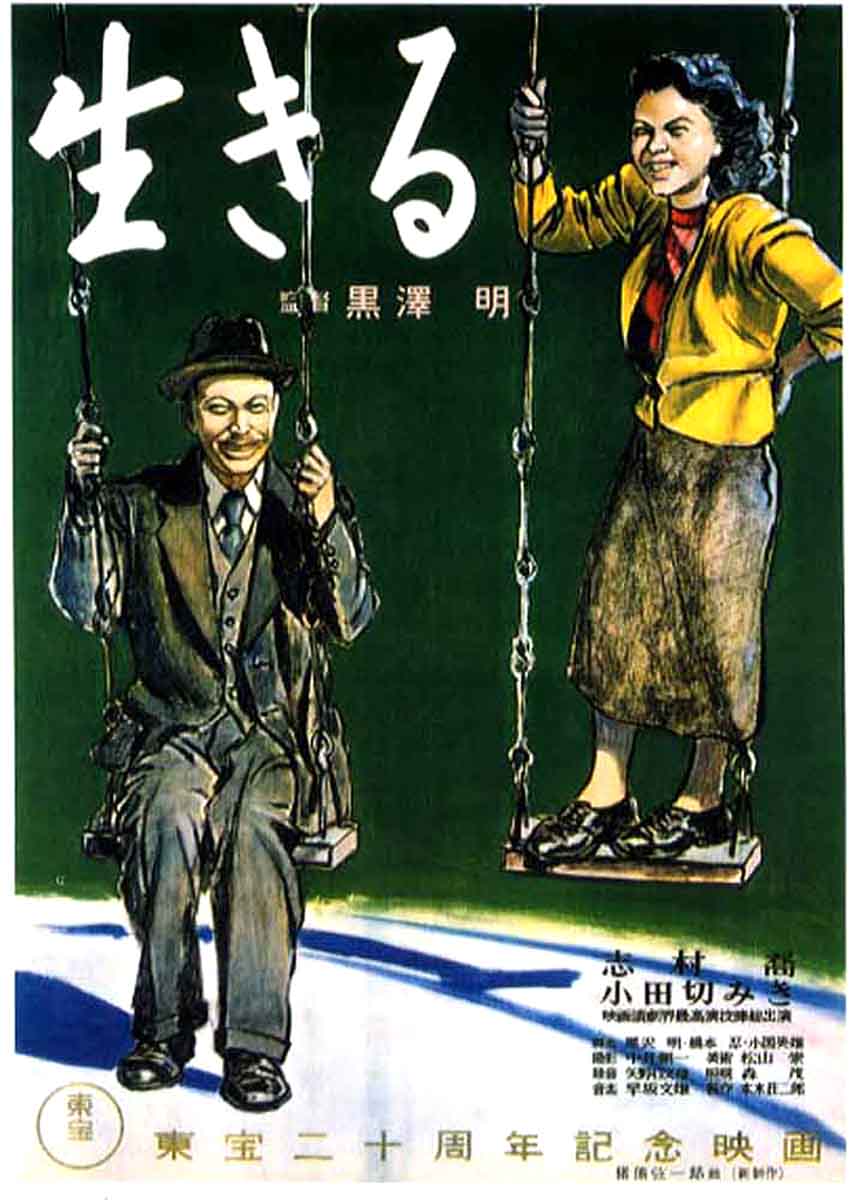 Another film about a sad old man, this one in Japan. We'll see if this poor old bugger makes out better than Umberto D.
Please be sure to pick up all empties on the way out.