Director: Howard Hawks
Release Country: United States
Times Previously Seen: Once (about 5 years ago)
20-Words-or-Fewer Summary (no spoilers)
Machine gun-tongued divorcees & journalists reconnect through hot news story.
The Story (A full blow-by-blow, including spoilers. Fair warning):
Hildegard "Hildy" Johnson (Rosalind Russell), former star journalist, returns to her former newspaper, which is headed by her ex-husband, Walter Burns (Cary Grant). She has come to announce her retirement and fresh engagement to simple nice guy Bruce Baldwin (Ralph Bellamy). Hildy intends to move to Albany with Bruce, an insurance salesman, and become a full-time house wife. Walter, the fast-talking, take-no-prisoners editor of the city's largest paper, is taken aback and immediately pleads with Hildy to stay on the staff and even remarry him. She steadfastly refuses, instead proclaiming her desire to leave behind the high stress life of a beat reporter.
A major story interrupts everyone's plans. A skittish murderer is on death row and is the focal point of some serious local electioneering. Burns sees this as the chance to keep Hildy around, show her that her place is in journalism and as his wife. He uses every chance he can to embarrass Baldwin and guide Hildy towards the story. Eventually, Walter's machinations stoke Hildy's natural journalistic curiosity and she's on the case.

On the left, Walter Burns, master of the shit-eating grin.
Through a dizzying array of arrests, interviews, and lightning-quick dialogue exchanges, Hildy works out all of the kinks: the dead man walking is reprieved as insane, the corrupt local sheriff and mayor are revealed as frauds, and Hildy leaves Bruce to go back to her life with Walter.
Just like that.
Take 1: My Gut Reaction (done after one viewing & before any research):
If Cary Grant were alive, I would cold-cock him.
OK, maybe that's an exaggeration, but there were certainly plenty of moments in this film that I really felt this way. Not unlike his portrayal of Jerry Warriner in The Awful Truth, Grant's Walter Burns is so conniving and self-assured that one can't help but want to deck him. At least in His Girl Friday, he's not posing as a stand-up husband. He's pretty open about how he'll do damn near anything to get a story, including employing known felons as assistants and getting total innocents locked up to suit his professional and romantic aims. Had there not been a long period in the middle of the film when we don't see him, I may have been far more annoyed.
Like The Awful Truth, though, it wasn't necessarily Cary Grant that bugged me - it was the character. Walter Burns was written to be an amusing rogue, I suppose. I just found him bordering on contemptible.
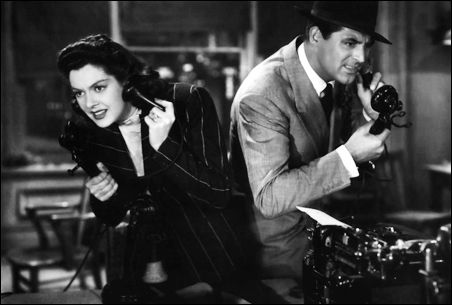
One of the many rapid-fire dialogue scenes. It gets rather dizzying at times, and to me becomes a bit more style over substance/
Since His Girl Friday is by THE screwball comedy director, Howard Hawks, one shouldn't be surprised that it bears an almost hackish similarity to The Awful Truth, which is two years its senior. The romantic part of the story is almost a carbon copy of the earlier film, and the boobish fiance is even played by the same man, Ralph Bellamy. What made this one marginally more tolerable to me was that it wasn't solely about the privileged class. There are far more earthy characters in this film, which made it somewhat more engaging to me.
The crime story, while really just serving as a foil for the love story and verbal exchanges, is intriguing enough to keep things alive. While The Awful Truth had nothing more than the egocentric relationship of the Warriners, His Girl Friday has the inkling of a crime drama running through it. It's not a vast improvement, but an improvement nonetheless, in my view.
The dialogue. Good Lord. This is THE quintessential screwball film in terms of the ear-boggling dialogue that's like a ping-pong game played by two people on PCP. In one sense, it's fascinating since it's the first film I've seen from the list in which things are going so quickly that characters are talking over one another, and there's no way that a viewer can catch everything. The script is very sharp, but I felt like I was watching the film equivalent of an Yngwie Malmsteen guitar solo. Yeah, it's amazingly fast and takes immense skill and technique, yet it's often not very enjoyable, aesthetically.

Like a Malmsteen guitar solo, His Girl Friday is lightning quick, highly skilled, and often not very easy on the ears.
Big-haired, Swedish speed metal aside, I do need to mention the single biggest upgrade in this film from The Awful Truth - Rosalind Russell. She is so much more enjoyable than Irene Dunne that I can hardly describe it. Again, I believe that it came down to the character and the script to a great degree, but Russell exudes much more of an everywoman vibe that Dunne probably couldn't have done had you threatened to take away her diamonds and chiffon scarves.
This film, as much as it had in common with the spirit of The Awful Truth, was different in ways that made me further think about the screwball genre. While there is a slightly more universal appeal to it, there is still an almost mean-spirited ignorance about it. As a mentally imbalanced man's life hangs in the balance (pun intended - he's on his way to the gallows) and even escapes only to have the incompetent cops gun down a bunch of innocent civilians, Walter Burns still has plenty of time to make gags about it all. I'm not sure how I'm supposed to admire, pull for, or even laugh at the jokes of such a self-serving vulture, no matter how suave he may be. This would almost work if the film were meant as a full-on satire or farce, but it isn't. There are too many little moments of legitimate drama in relation to the condemned man for me to ignore, including his emotional girlfriend throwing herself out of a window in a suicide attempt. In my view, it's more upsetting than it is entertaining.
So there it is. Watching His Girl Friday was hardly the struggle that The Awful Truth was, but it's certainly not a film that I'll watch again. Like the latter film, though, lovers of old cinema and Cary Grant will certainly like it. I just couldn't ignore the little things that kept it from being either pure comedy or pure drama.
Take 2; or, Why Film Geeks Love This Movie (done after some further research):
After perusing a few original and modern reviews, it's clear that the dialogue is the pumping heart that keeps this movie alive in the annals of film history. The overlapping dialogue was apparently a major innovation back in '39, and the speed of the exchanges baffled and delighted people from the get-go. Here's the original TIME review upon the film's release.
I felt a little less hyper-critical when I saw Richard Schickel's 2005 review. I especially noted his almost throw-away use of the adjective "heartless" when describing the "hilarity". I guess he found it charming; I found it a tad off-putting.
A few interesting notes. Rosalind Russell was way down the line when it came to casting. Turning down the role were well-established actresses such as Katherine Hepburn (thank God), Irene Dunne (thank Allah), Claudette Colbert, and Ginger Rogers, among others. Russell was non-plussed about it, and secretly hired her own script writer to punch up her lines, which she felt were not as sharp or witty as Cary Grant's, so that she could insert them as "ad libs". Grant caught on and would greet her every morning with "What have you got today?" Man, that guy was either the smoothest cat on the planet or a 5-star asshole.
On final note is that in the original source play, Front Page, Rosalind Russell's character was a man. I suppose Hollywood wasn't yet ready to have a star-studded movie without a love story.
That's a wrap. 19 shows down. 86 to go.
Coming Soon: The Shop Around the Corner (1940):

This is the same director as Ninotchka, which wasn't a bad film, but not my favortie thus far on this little cinematic journey. And yes, by "James Stewart," the poster means "Jimmy Stewart." We'll see just how Mr. All-American does in this one.
Please be sure to pick up all empties on the way out.