Title for We English-speaking Types: Smiles of a Summer Night
Director: Ingmar Bergman
Initial Release Country: Sweden
Times Previously Seen: none
Teaser Summary (no spoilers)
Coy lawyer caught in a love hexagon with young wife, maudlin son, sultry actress, alpha male soldier and his frustrated wife.
Uncut Summary (Full plot synopsis, spoilers included. Fair warning)
In turn-of-the-century Sweden, the well established, 50-something lawyer Fredrik Egerman (Gunnar Bjornstrand) seems to possess several greatly desirable things: a prosperous law firm, a beautiful eighteen-year old wife, Anne (Ulla Jacobson), and an intelligent son, Henrik (Bjorn Bjelfvenstam) who is doing well at university.
Despite these ostensible blessings, some troubles are afoot. Anne, while quite vivacious and loving towards Fredrik, she seems to show at least a mild interest in her step-son, who is actually a few years older than her. Henrik himself is a tormented idealist who cannot find the balance between the lofty tenets of his chosen field of theology and his own earthly, carnal desires. He vacillates between quoting Martin Luther and fondling the pretty young house maid. Added to this is that Fredrik's former mistress, the stunning actress Desiree Armfeldt (Eva Dahlbeck) has returned to town to perform.
A very calm and collected Fredrik brings Anne to see Desiree's performance, not knowing that he had previously been muttering Desiree's name in his sleep. Having heard this and understood what it implies, Anne cannot bear to be at the play for more than five minutes before she begs to leave. Fredrik escorts her home, but returns to the theater to see Desiree.
At the theater, Fredrik confesses to Desiree that, though he has been married to Anne for two years, they have not consummated the marriage out of his sense of propriety. His love for her seems more paternal than matrimonial. Amidst some playful flirting, Desiree offers some comfort to her former lover in the form of advice. She then invites him back to her apartment.
At Desiree's apartment, the two continue their discussion of sex and love. Interrupting the talk is the arrival of Desiree's current lover, Count Carl Magnus Malcolm, who is the very picture of Victorian era masculine achievement. He is highly trained, deadly, aggressive, and unapologetically jealous. He and Fredrik have a stare-down in which Fredrik counters Malcolm's full frontal verbal assault with a more coy, passive-aggressive style. Fredrik leaves of his own accord, returning to his home.
 The initial confrontation between Egerman (left) and the Count, with Desiree as part of the referee.
The next day, at Count Malcolm's estate, we see that his relationship with his own quite young and exceptionally beautiful wife, Charlotte, is far from ideal. She knows of his infidelity, is powerless to stop it, but is still in love with him, overbearing as he is. She decides to attempt a sabotage by visiting Anne Egerman and revealing Fredrik's late-night visit. All she accomplishes, however, is an affirmation that both of their husbands are being unfaithful to them with the same woman.
An interesting twist occurs when Desiree herself orchestrates a dinner for everyone at her mother's palatial estate. She invites the three Egermans and the two Malcolms, in the hopes of using her wiles to untangle everyone's knotted emotions. Through a plan executed in concert with Anne and Charlotte, Desiree accomplishes a few of her goals, if not exactly in the manner devised.
 Most of the key players at the fateful dinner hosted by Desiree's aged but wizened mother.
After a bit of wine during dinner, the tormented young Henrik erupts in a passion and storms off to his room. The concerned Anne faints in his wake and is taken to her room, which neighbors Henrik's. As Henrik laments his fissured mind, he decides on suicide. After tying the rope around his neck and leaping from the high fireplace, however, he accidentally trips a trap mechanism which open a secret side door and sends the bed from the next room into it, and who should be in it but the slumbering Anne? Henrik sees it as fate and the two profess their love for one another. Early the next morning, the two elope while a devastated Fredrik watches from the shadows.
That evening, Charlotte looks to enact her part of Desiree's scheme. She lures Fredrik into a gazebo with the ostensible intention of seducing him. Desiree informs the Count of this, inevitably spurring the headstrong firebrand to charge into the gazebo. He banishes his wife from the gazebo and forces Fredrik to engage with him in a game of Russian roulette. Each man takes his shot, with Fredrik's second shot ringing out, apparently killing him. The shot was, however, merely a load of soot that the Count had used to replace an actual bullet. The Count claims that he would never put himself or his honor at risk for the sake of a “shyster”. Charlotte elicits a comforting promise of fidelity from her husband, and Desiree tends to Fredrik's mild injuries, the two seeming to accept their place with each other.
Take 1: My Gut Reaction (Done after one viewing, before any further research)
No mere plot synopsis can do this movie justice. It's truly comical and its value comes from far more than the storyline.
I've seen around ten of Bergman's 50-plus films, and some of them are a struggle, to say the least. While I enjoyed the more thoughtful, meditative fare like Wild Strawberries or The Seventh Seal, others like the gut-wrenching Cries and Whispers were like being forced to watch a gang of wolverines on cocaine tear each others' throats out. Not fun. With such a wide spectrum of moods and tones, I wasn't sure what to expect from a “comical farce” by the Swedish director. I needn't have worried so much.
With a style that blends the dry wit of Oscar Wilde with a refreshingly modern, earthy sense of humor, Ingmar Bergman constructed quite a film. I can only imagine how bold it seemed upon its release in 1955, but the mature approach to sex and love easily holds its own today. It takes a truly great storyteller to drive a plot using dialogue, and Bergman does it with seeming ease. By shifting the conversations between the various characters, we get a great number of thoughtful perspectives on love, lust and where the two overlap, if anywhere. The feelings conveyed are exceptionally meaty in terms of gravity and circumspection of the human condition.
Lest you think that the whole film is a pack of aristocrats prattling on about love, I need to emphasize the humor, which I think the above quote from Charlotte exemplifies nicely. It takes a little while to really warm up, but once it settles in, it's outstanding. I've already cited Wilde, and I can't help but think specifically of The Importance of Being Earnest; however, Smiles of a Summer Night is much more to my liking. This is because I find Wilde's wit, though razor sharp, to be so rooted in parodying British aristocratic mores that I usually lose interest. In Smiles of a Summer Night, Bergman makes far greater use of wry cynicism and sarcasm. The best examples among the many standouts are the brief tete-a-tetes between Fredrik and Count Malcolm. My only regret is that I don't speak Swedish, and therefore certainly lose some of the effect derived from tones and inflections that are lost in translation. Despite this, the writing more than effectively conveys the humor through the captions.
Here's a clip with the scene between Egerman and the Count. Jump to time 5:00 and give it 3 or 4 minutes of your time:
The characters are brilliantly conceived and translated into the tale. They all are very fully formed and feel thoroughly authentic. Probably the most interesting is Desiree, who seems to me to have a role very similar to the character of Garance in Children of Paradise – the rare female who is completely independent, and in being so, makes herself the object of nearly all men's desires. A key difference is that, while that latter French character is more of a two-dimensional representation of a greater, unattainable ideal of love, Desiree invites much more empathy and respect.
As with all other Bergman films, the technical merits are flawless. Whether you like or dislike a film of his, one cannot dispute that the man knew exactly how to frame his shots, cast his parts, and direct his actors. Smiles is merely a relatively early example of this. It may be in black and white, but the compositions of the settings and costumes is truly effective. While these things are far from the most important elements of the movie, they certainly enhance it for viewers who dig aesthetics.
I imagine that some would probably dub this movie a “chick flick”, and this moniker is probably not unwarranted. However, there is, amid the philosophical musings, plenty here for the thoughtful dude to sink his teeth into: lust, stare-downs, and even a game of Russian roulette. It all adds up to a movie that anyone who doesn't mind foreign films should enjoy. I would also give it a definite go-ahead to any fans of Jane Austen out there.
Take 2: Why Film Geeks Love This Movie (done after some further research)
It's late 1955. Ingmar Bergman is sitting on the toilet, newspaper unfurled on his naked knees. He sees a headline reading, “Swedish film nominated for Grand Prix at Cannes Film Festival.” He thinks to himself, “That's good. A Swedish film will finally get recognition. Good for those peers of mine, whoever they are.” It turned out that “they” was actually him. After making about seven films well-received in his native country, but not outside of it, his break had come, much to his surprise and delight.
Smiles was apparently Bergman's coming out to the international film viewing public. While this 1958 TIME magazine review didn't seem all too impressed, this was apparently a minority opinion. It was regarded as the first time the Swedish film master had blended all of his skills and used them to construct a “nearly perfect work”, as Pauline Kiel puts it in this 1961 essay. It was such a commercial and critical success that Bergman was henceforth given free rein to explore every dark and heady theme that he desired. And explore he did, via such films as The Seventh Seal and Persona.
In reading more on Ingmar Bergman in general, one realizes that, while his many films covered a variety of themes, one of his favorites was calling out pretension. In Smiles of a Summer Night, this is most easily seen through two characters whom I really did not cover in the summary or Take 1: the maid Petra and the coachman Frid. Especially at the end of the movie, after we've watched the ballet of emotions, ideal and carnal, amongst the bourgeoisie main characters, Petra and Frid's lustful frolicking seem far more honest, joyful, and pleasurable. Here it is:
Some critics point to the overwhelming number of epigrams throughout the movie, which is quite clear. The dialogue is ripe with one statement after another about what constitutes masculinity, femininity, love, lust, and so on. Still, I found them though-provoking and woven well into the overall story. With the fantastic balance provided by all of the other aspects of the movie, Smiles of a Summer Night is certainly one that I would watch again.
That's a wrap. 43 shows watched, 62 to go.
Coming Soon: Invasion of the Body Snatchers (1956)

In one of the more radical left turns to be made yet, I go from a turn-of-the-century Swedish farce about love to a McCarthy-era science fiction cult classic. Bring on the pod people!
Please be sure to pick up all empties on the way out.
Director: Ingmar Bergman
Initial Release Country: Sweden
Times Previously Seen: none
Teaser Summary (no spoilers)
Coy lawyer caught in a love hexagon with young wife, maudlin son, sultry actress, alpha male soldier and his frustrated wife.
Uncut Summary (Full plot synopsis, spoilers included. Fair warning)
In turn-of-the-century Sweden, the well established, 50-something lawyer Fredrik Egerman (Gunnar Bjornstrand) seems to possess several greatly desirable things: a prosperous law firm, a beautiful eighteen-year old wife, Anne (Ulla Jacobson), and an intelligent son, Henrik (Bjorn Bjelfvenstam) who is doing well at university.
Despite these ostensible blessings, some troubles are afoot. Anne, while quite vivacious and loving towards Fredrik, she seems to show at least a mild interest in her step-son, who is actually a few years older than her. Henrik himself is a tormented idealist who cannot find the balance between the lofty tenets of his chosen field of theology and his own earthly, carnal desires. He vacillates between quoting Martin Luther and fondling the pretty young house maid. Added to this is that Fredrik's former mistress, the stunning actress Desiree Armfeldt (Eva Dahlbeck) has returned to town to perform.
A very calm and collected Fredrik brings Anne to see Desiree's performance, not knowing that he had previously been muttering Desiree's name in his sleep. Having heard this and understood what it implies, Anne cannot bear to be at the play for more than five minutes before she begs to leave. Fredrik escorts her home, but returns to the theater to see Desiree.
At the theater, Fredrik confesses to Desiree that, though he has been married to Anne for two years, they have not consummated the marriage out of his sense of propriety. His love for her seems more paternal than matrimonial. Amidst some playful flirting, Desiree offers some comfort to her former lover in the form of advice. She then invites him back to her apartment.
At Desiree's apartment, the two continue their discussion of sex and love. Interrupting the talk is the arrival of Desiree's current lover, Count Carl Magnus Malcolm, who is the very picture of Victorian era masculine achievement. He is highly trained, deadly, aggressive, and unapologetically jealous. He and Fredrik have a stare-down in which Fredrik counters Malcolm's full frontal verbal assault with a more coy, passive-aggressive style. Fredrik leaves of his own accord, returning to his home.
 The initial confrontation between Egerman (left) and the Count, with Desiree as part of the referee.
The next day, at Count Malcolm's estate, we see that his relationship with his own quite young and exceptionally beautiful wife, Charlotte, is far from ideal. She knows of his infidelity, is powerless to stop it, but is still in love with him, overbearing as he is. She decides to attempt a sabotage by visiting Anne Egerman and revealing Fredrik's late-night visit. All she accomplishes, however, is an affirmation that both of their husbands are being unfaithful to them with the same woman.
An interesting twist occurs when Desiree herself orchestrates a dinner for everyone at her mother's palatial estate. She invites the three Egermans and the two Malcolms, in the hopes of using her wiles to untangle everyone's knotted emotions. Through a plan executed in concert with Anne and Charlotte, Desiree accomplishes a few of her goals, if not exactly in the manner devised.
 Most of the key players at the fateful dinner hosted by Desiree's aged but wizened mother.
After a bit of wine during dinner, the tormented young Henrik erupts in a passion and storms off to his room. The concerned Anne faints in his wake and is taken to her room, which neighbors Henrik's. As Henrik laments his fissured mind, he decides on suicide. After tying the rope around his neck and leaping from the high fireplace, however, he accidentally trips a trap mechanism which open a secret side door and sends the bed from the next room into it, and who should be in it but the slumbering Anne? Henrik sees it as fate and the two profess their love for one another. Early the next morning, the two elope while a devastated Fredrik watches from the shadows.
That evening, Charlotte looks to enact her part of Desiree's scheme. She lures Fredrik into a gazebo with the ostensible intention of seducing him. Desiree informs the Count of this, inevitably spurring the headstrong firebrand to charge into the gazebo. He banishes his wife from the gazebo and forces Fredrik to engage with him in a game of Russian roulette. Each man takes his shot, with Fredrik's second shot ringing out, apparently killing him. The shot was, however, merely a load of soot that the Count had used to replace an actual bullet. The Count claims that he would never put himself or his honor at risk for the sake of a “shyster”. Charlotte elicits a comforting promise of fidelity from her husband, and Desiree tends to Fredrik's mild injuries, the two seeming to accept their place with each other.
Take 1: My Gut Reaction (Done after one viewing, before any further research)
No mere plot synopsis can do this movie justice. It's truly comical and its value comes from far more than the storyline.
I've seen around ten of Bergman's 50-plus films, and some of them are a struggle, to say the least. While I enjoyed the more thoughtful, meditative fare like Wild Strawberries or The Seventh Seal, others like the gut-wrenching Cries and Whispers were like being forced to watch a gang of wolverines on cocaine tear each others' throats out. Not fun. With such a wide spectrum of moods and tones, I wasn't sure what to expect from a “comical farce” by the Swedish director. I needn't have worried so much.
With a style that blends the dry wit of Oscar Wilde with a refreshingly modern, earthy sense of humor, Ingmar Bergman constructed quite a film. I can only imagine how bold it seemed upon its release in 1955, but the mature approach to sex and love easily holds its own today. It takes a truly great storyteller to drive a plot using dialogue, and Bergman does it with seeming ease. By shifting the conversations between the various characters, we get a great number of thoughtful perspectives on love, lust and where the two overlap, if anywhere. The feelings conveyed are exceptionally meaty in terms of gravity and circumspection of the human condition.
“I hate him. I hate him. I hate him. Men are horrid, vain and conceited. And
they have hair all over their bodies.”
Lest you think that the whole film is a pack of aristocrats prattling on about love, I need to emphasize the humor, which I think the above quote from Charlotte exemplifies nicely. It takes a little while to really warm up, but once it settles in, it's outstanding. I've already cited Wilde, and I can't help but think specifically of The Importance of Being Earnest; however, Smiles of a Summer Night is much more to my liking. This is because I find Wilde's wit, though razor sharp, to be so rooted in parodying British aristocratic mores that I usually lose interest. In Smiles of a Summer Night, Bergman makes far greater use of wry cynicism and sarcasm. The best examples among the many standouts are the brief tete-a-tetes between Fredrik and Count Malcolm. My only regret is that I don't speak Swedish, and therefore certainly lose some of the effect derived from tones and inflections that are lost in translation. Despite this, the writing more than effectively conveys the humor through the captions.
Here's a clip with the scene between Egerman and the Count. Jump to time 5:00 and give it 3 or 4 minutes of your time:
The characters are brilliantly conceived and translated into the tale. They all are very fully formed and feel thoroughly authentic. Probably the most interesting is Desiree, who seems to me to have a role very similar to the character of Garance in Children of Paradise – the rare female who is completely independent, and in being so, makes herself the object of nearly all men's desires. A key difference is that, while that latter French character is more of a two-dimensional representation of a greater, unattainable ideal of love, Desiree invites much more empathy and respect.
As with all other Bergman films, the technical merits are flawless. Whether you like or dislike a film of his, one cannot dispute that the man knew exactly how to frame his shots, cast his parts, and direct his actors. Smiles is merely a relatively early example of this. It may be in black and white, but the compositions of the settings and costumes is truly effective. While these things are far from the most important elements of the movie, they certainly enhance it for viewers who dig aesthetics.
I imagine that some would probably dub this movie a “chick flick”, and this moniker is probably not unwarranted. However, there is, amid the philosophical musings, plenty here for the thoughtful dude to sink his teeth into: lust, stare-downs, and even a game of Russian roulette. It all adds up to a movie that anyone who doesn't mind foreign films should enjoy. I would also give it a definite go-ahead to any fans of Jane Austen out there.
Take 2: Why Film Geeks Love This Movie (done after some further research)
It's late 1955. Ingmar Bergman is sitting on the toilet, newspaper unfurled on his naked knees. He sees a headline reading, “Swedish film nominated for Grand Prix at Cannes Film Festival.” He thinks to himself, “That's good. A Swedish film will finally get recognition. Good for those peers of mine, whoever they are.” It turned out that “they” was actually him. After making about seven films well-received in his native country, but not outside of it, his break had come, much to his surprise and delight.
Smiles was apparently Bergman's coming out to the international film viewing public. While this 1958 TIME magazine review didn't seem all too impressed, this was apparently a minority opinion. It was regarded as the first time the Swedish film master had blended all of his skills and used them to construct a “nearly perfect work”, as Pauline Kiel puts it in this 1961 essay. It was such a commercial and critical success that Bergman was henceforth given free rein to explore every dark and heady theme that he desired. And explore he did, via such films as The Seventh Seal and Persona.
In reading more on Ingmar Bergman in general, one realizes that, while his many films covered a variety of themes, one of his favorites was calling out pretension. In Smiles of a Summer Night, this is most easily seen through two characters whom I really did not cover in the summary or Take 1: the maid Petra and the coachman Frid. Especially at the end of the movie, after we've watched the ballet of emotions, ideal and carnal, amongst the bourgeoisie main characters, Petra and Frid's lustful frolicking seem far more honest, joyful, and pleasurable. Here it is:
Some critics point to the overwhelming number of epigrams throughout the movie, which is quite clear. The dialogue is ripe with one statement after another about what constitutes masculinity, femininity, love, lust, and so on. Still, I found them though-provoking and woven well into the overall story. With the fantastic balance provided by all of the other aspects of the movie, Smiles of a Summer Night is certainly one that I would watch again.
That's a wrap. 43 shows watched, 62 to go.
Coming Soon: Invasion of the Body Snatchers (1956)
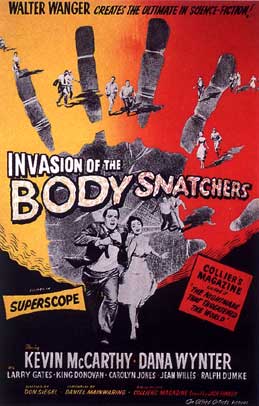
In one of the more radical left turns to be made yet, I go from a turn-of-the-century Swedish farce about love to a McCarthy-era science fiction cult classic. Bring on the pod people!
Please be sure to pick up all empties on the way out.