Showing posts with label Humphrey Bogart. Show all posts

Friday, July 8, 2016

Gangster Flick One-Two Punch: The Petrified Forest (1936); The Pope of Greenwich Village (1984)

The Petrified Forest (1936)

Director: Archie Mayo

An interesting old gangster flick with an novel arc and a few thoughtfully-crafted characters, but one which suffered from the trappings of many of its contemporaries.

The story begins with a drifter wandering through the Arizona desert and happening upon an isolated gas station. The drifter, Alan (Leslie Howard), is an Englishman who has left behind a life of ease and luxury in order to find something profound in the expanse of the American Southwest. At the gas station, he finds Gaby (Bette Davis), the daughter of the station manager and a young woman who seeks to escape the desolation and confinement of the family business. Alan and Gaby quickly find somewhat kindred spirits in each other, and a spark of passion is ignited. While the older Alan eventually leaves Gaby, things are thrown into chaos when a fugutive criminal, Duke Mantee (Humphrey Bogart), arrives in the area with his small crew of bank robbers and killers on the run. Once they take over the gas station and the threat of death becomes palpable, the tone becomes rather existential for several of the captives.

The main story is very solid, and the primary characters are deep enough to be compelling through their interactions. However, the execution is heavily rooted in standard screenwriting of the time. The dialogue can be a bit cliche, especially with the gangsters. A bigger problem for me, though, is the pacing, which seemed very rushed, making the plot points feel more forced and quite implausible. When we consider that the setting is the middle of nowhere, it becomes ridiculous to think that a lone drifter, a quartet of fugitive thugs, and a wealthy couple and their driver all end up at the same spot at the same time. In fact, the wealthy couple hardly seemed essential to the true heart of the plot, and I felt that the movie could have been stronger without them. The movie had a very similar feeling to another Bogart movie - Key Largo - which bore several of the same strengths and weaknesses. Both movies also had the feel of a tale meant for the stage rather than the silver screen (as they both were).

Fortunuately, The Petrified Forest clocks in at a very modest 82 minutes, making it an easy watch. Because of its brevity, it is well worth watching for fans of old-time gangster movies or just Humphrey Bogart. This was an earlier, non-starring role for Bogie, but he could pull off a rather menacing bad guy just as well as anybody ever has.


The Pope of Greenwich Village (1984)

Director: Stuart Rosenberg

I realize that this movie is highly admired by plenty of people, both casual movie-viewers and a fair number of critics. And while it has some clear merit, it really didn't come very close to living up to its reputation for me.

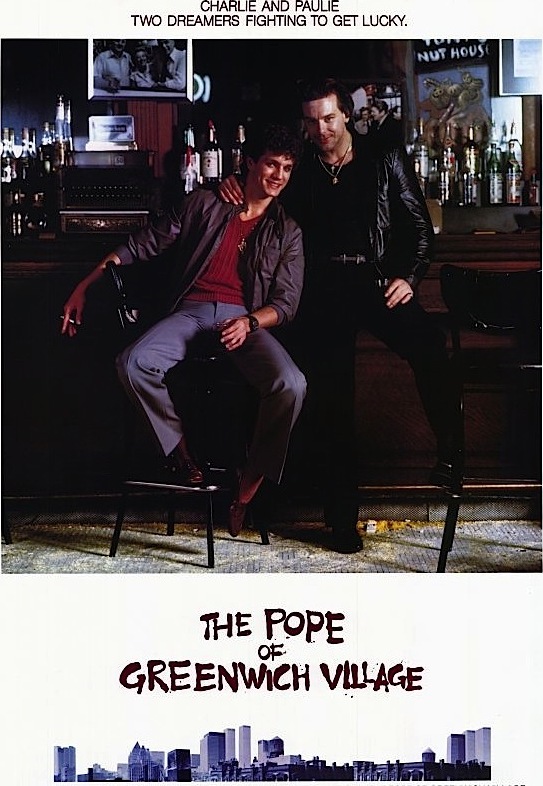
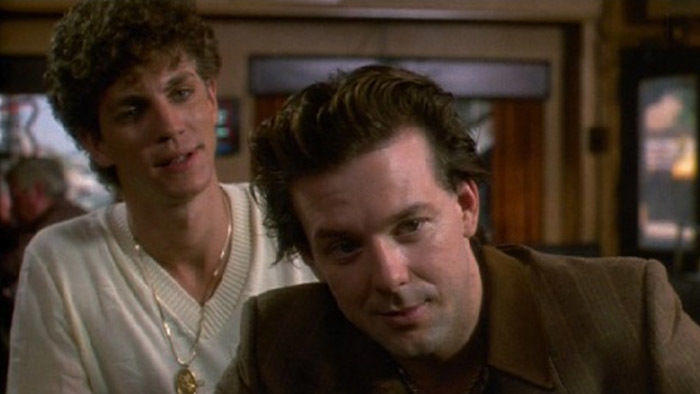
The tale follows Charlie (Mickey Rourke) and his cousin Paulie (Eric Roberts), a pair of local Italian-American boys in Greenwich Village, New York City. Both work in a restaurant but aspire to greater wealth, and neither is above illegal means to obtain it. Their approaches towards life could hardly be more different, though. Charlie, while not exactly a master criminal or life winner, at least has some style and a sense of patience and propriety. Paulie, though, is a complete mess of a human being. Painfully loud and boorishly obnoxious, he can hardly sit still for a second without trying to con someone or get some kind of get-rich-quick scheme underway. His latest is to rob a safe which houses tens of thousands of dollars. He ropes in Charlie and a neighborhood safe-cracker to pull off the job, hoping to split the take. Running along with this scam is Paulie's ill-advised investment in a racehorse.

There are the makings of a good crime tale in the movie. There is a somewhat suspenseful little heist that goes wrong. There are several looming mafiosi. There is the dynamic between the woefully immature Paulie and the less-immature Charlie as they try to navigate some extremely treacherous waters. Still, the movie came off as a patchwork of sometimes-compelling scenes rather than a cohesive whole that had anything particularly interesting to say. While there is some character study involved, it ultimately feels downplayed by the time the final credits roll.

Paulie (left), trying yet again to convince his relatively more
mature cousin Charlie to take a ridiculous risk. I wonder if,
deep down, Mickey Rourke was as irked by Eric Roberts's
performance as I was. 
When I guess about the movie's popularity, I must concede that many of the performances are strong and the fascination with "authentic" New Yorkers can compel. Mickey Rourke was just hitting his early peak at this time, and his turn as Charlie was another example of why he impressed so many viewers at the time. And most of the secondary roles are solid, including the likes of Burt Young, Daryl Hannah, and several other experienced character actors. Eric Roberts, on the other hand, I found almost insufferable. While the Paulie character is supposed to be the kind of twitchy, irresponsible street guy whom we're not meant to like, Roberts went way over the top in many of the scenes. His performance shifts so often and so drastically that the character becomes almost a caricature, or at the very least someone who is far too dumb and far too unstable to function. It didn't help that Roberts's New York accent was spotty at best, which stood out all the more among so many other native New Yorkers. Also stacked against Roberts is the fact that the character type of a fast-talking, irresponsible, selfish, and greedy sleaze has been done too well by others. Robert DeNiro's performance as Johnny Boy in Mean Streets and even Edward Norton's as Worm in Rounders make Roberts's acting look strained.

It also not hard to see why many people have found the movie entertaining. Not unlike The Godfather before it and Goodfellas after, The Pope of Greenwich village gives us more than few amusing verbal exchanges of the distinctly New York Italian-American variety. Plenty of balls are busted and many hands are waved around as the several none-too-bright characters baffle each other with their ineptitude. For those moments, the movie can be fun.

As he did so many times with other movies, Roger Ebert articulated what I felt about this movie far better than I could. He generally liked the movie, but he felt that it was far more about the performances than about any story or message. It is what he dubbed a "Behavior Movie". When I read this, I realized just how right he was. I also realized that, despite many strong performances, I was disappointed in this movie, and I feel no need to see it again. 

Thursday, March 24, 2016

Gangster Flick 3-Pack: The Killing (1956); High Sierra (1941); Mesrine (2008)

The Killing (1956)

Director: Stanley Kubrick

An uneven but fairly compelling early work from a film master, and a rather uniquely dark caper movie.

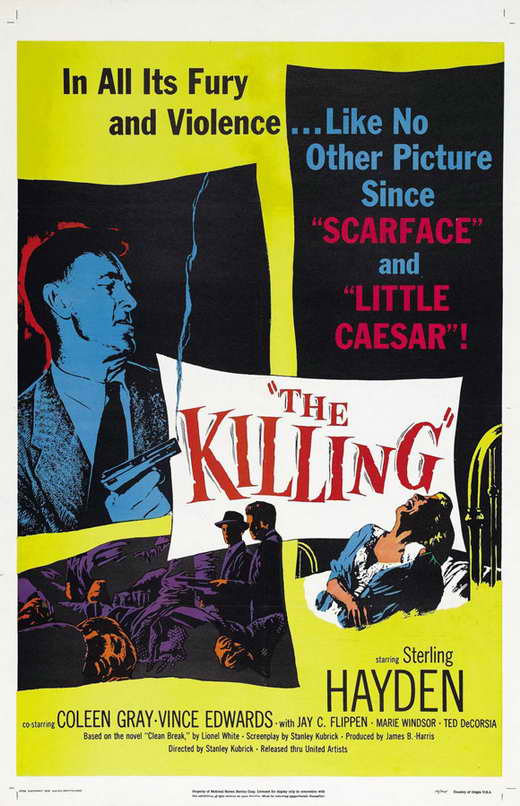
The title of the movie refers to the slang term of making a large amount of money in a short time, as well as the more literal reference to murder. Both meanings are appropriate for this film. The Killing is a caper tale centered on a group who plan to rob a horse track of two million dollars. The head of the group, Johnny Clay (Sterling Hayden), is the only professional thief in the group. The others are racetrack employees who, for various reasons, are looking to make a lot of money quickly. Clay plots out a very thorough and meticulous plan which requires expert timing. Once the plan starts to unfold, various hiccups begin to make things even harder than they already were, with Clay doing everything he can to execute his big score.

The movie takes a hard look at the brutal and dark consequences of crime, as do all of the very best noir  movies. All but one or two of the most minor members of the thieving crew are shown to be rather selfish, callous men whose greed or general weakness leads them into ever-more-foolish decisions. Unlike lesser crime films, The Killing does nothing to glamorize the thieves or their unsavory deeds. There is the compelling nature of the plan and its execution, as with all good caper movies, but this hardly overshadows the crew's dark motivations.

The primary distraction in this movie is the dialogue. Many of the characters are constantly spouting off tough guy lines in a rushed manner that spoke to some weak acting and uninspired scripting. This was especially disappointing considering that legendary crime fiction writer Jim Thompson wrote the script. Despite this, had I been watching this movie with someone else, we almost certainly would have been having plenty of good laughs at the abundance of silly, forced lines.

A lesser but rather obvious merit of the movie is the cinematography. This might not come as a major surprise, given that Stanley Kubrick directed this movie. Still, The Killing was his first major, full-length feature film. The then-only-28-year-old Kubrick was already showing his uncanny eye for striking camera angles, lighting, and using visual grammar to tell stories. This alone makes it worth seeing, as it is a very early but major step along a genius's path towards film mastery.


High Sierra (1941)

Director: Raoul Walsh

A compelling basic story buried within some painfully dated dialogue and acting.

I love Humphrey Bogart. While I haven't seen the majority of the many films he was in, I have seen around a half dozen of his best-known and best-loved movies. From these, it's easy to see why he became and still is a movie legend. With this in mind, I was excited to watch one of his relatively early starring roles in a crime movie. I have to admit some disappointment, however.

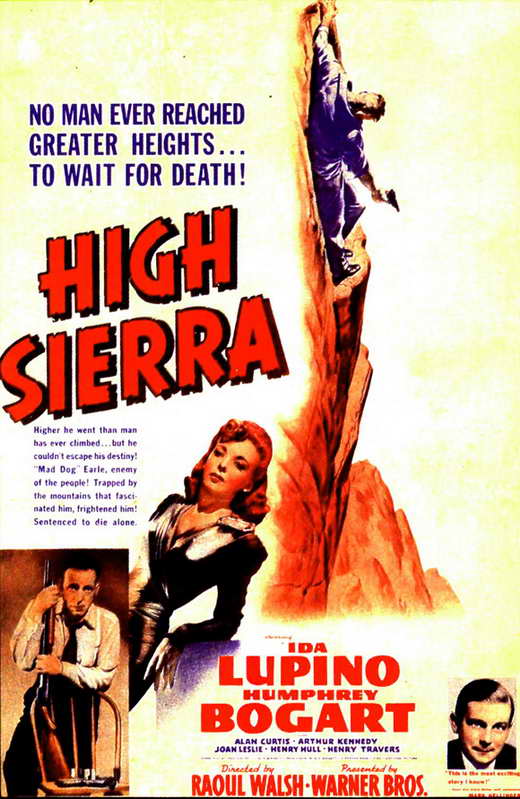
The story is actually the stuff of very strong noir. Bogart plays Roy Earle, a bank robber who has just been released from prison and is already setting up his next major score. The hard-boiled Earle came from a small town in Indiana, and he seems to have a tiny soft spot for small-town folks. This is clear when he comes across a farming family making its way out to California, whom he helps in several ways. Outside of his tender spot for such people, Earle is a rather severe man who does not suffer fools lightly, and will not hesitate to use violence if he feels the need.

One part of the story revolves around Earle's current big score - a jewelry heist arranged through an old associate of his. His partners in the caper are a couple of young, hot-blooded hoods who Earle dislikes but tolerates. The other part of the tale relates to Earle's relationships with two women; one is a young member of the farming family, and the other is a weary and jaded former dance girl. Seeing Earle try to juggle all of these aspects of his life is the real meat of the movie, and the story takes some turns which are intriguing in their unpredictability. I admire how the movie steered clear of a nice, pat, Hollywood ending.

Unfortunately, I had to work rather hard to maintain my appreciation. Even more than the above-reviewed The Killing, the dialogue and much of the acting in High Sierra have aged horribly. While there are some memorable lines, far too much comes right from the cheap, pulp "dime store hood" handbook. Bogart was a great enough actor that he could sell some of the dialogue better than his supporting cast, but even Bogie could only do so much. Also, the storyline involving the farming family is fraught with completely inorganic and illogical jumps. I feel that this movie served as an earlier, less balanced attempt at what director Raoul Walsh would do far better eight years later with the classic White Heat. I'll watch that latter picture again any time. High Sierra, however, is not one I'll ever return to.

Mesrine (2008)

Director: Jean-Francois Richet

Absolutely brilliant, if grim, biopic of a larger-than-life arch criminal.

Mesrine is the story of real-life French criminal Jacque Mesrine (pronounced "may-reen"), one of the most irrepressible, vicious, and public felons in the 20th century. Mesrine took to crime fairly early in the 1960s, after a stint in the French Army. He quickly became a noted burglar, bank robber, and violent thug with an appetite for women and high living. Though he made attempts at leading a "straight" life, they were few and relatively short-lived. For nearly all of his adult life, Mesrine was committing serious and violent crimes, eluding capture, being captured, or escaping from prison. A fair number of his exploits played out in the public eye, thanks to an image he created of himself which appealed to certain sects of the French masses.

Prior to watching this 2-film epic, I had no idea who Mesrine was, but I was fascinated. The movie urged me to look up some facts about the man, and it would seem that the film does not embellish his wild life. His story is told with a vibrance and energy found in some of the best gangster movies, such as Goodfellas or Bonnie and Clyde. The main difference with Mesrine, though, is that there is even less whitewashing of the man's most despicable actions. While it's made clear that Mesrine possessed good looks and charisma enough to seduce women, fellow criminals, and the French public at large, it doesn't balk at showing that he was also a brutal murderer who would torture or even kill anyone who offended his massive ego. The actions which play out on screen can be terrible, but I still found them compelling, given what an outsized persona Mesrine fashioned for himself.

A classic knee-capping, true to the violent nature of the title
character. It's so brutal that you might fail to notice just how
masterful the colors and  lighting of the scene are. This is
typical in these two movies.
The technical aspects of the movie are impressive. The set design and cinematography are first-rate, casting the ugly but oft-exciting world of Jacque Mesrine's life into a palatable light. The acting is also exceptional, with Vincent Cassel turning in a phenomenal performance in the title role. Some of the transitions between time periods can feel a bit rushed, which is surprising for a movie released in two parts and adding up to over four hours. This may just be a function of the sheer quantity of curious activities in which Mesrine invovled himself. The creators could probably have justified adding a tad more to it and making it a mini-series or a trilogy, if they thought anyone could stomach another hour or two of a rather detestable figure like Mesrine.

Mesrine is one of the darker, harder-hitting gangster movies one is likely to see. For those who enjoy well-executed dramatizations of very real and very frightening criminals, though, this movie is difficult to top. 

Monday, August 3, 2015

Gangster Flick 3-Pack: Little Odessa (1995); Key Largo (1948); Dillinger (1973)

Few crime movies feel so authentic. Or so
numbingly grim.
Little Odessa (1995)

Director: James Gray

Hard and real, but faded around the edges.

Little Odessa follows a bleak few days in the bleak life of a young Long Island, New York hitman, Josh (Tim Roth), who is descended from Russian Jewish immigrants. Josh is told by his boss to return to his old neighborhood, Little Odessa, to perform a hit. Though reluctant to return for reasons not totally clear to us viewers, Josh does so all the same. As he hunkers down and prepares for the assassination, Josh attempts to reconnect with a few people, including his younger brother Reuben (Edward Furlong) and his former girlfriend, Alla. These things are not so easy, as he not only needs to keep a low profile, but he must also deal with a mother stricken with a brain tumor, as well as a stern father who has long since disowned him.

The movie has one of the grittiest, nastiest feels of any crime movie I've seen. Any glamor that one finds in most gangster movies is completely stripped away. There are certainly gunfights and killings, but they are presented with cold, disturbing realism. The matter-of-fact manner with which Josh goes about his business is unsettling, to say the least. Yet the juxtaposition with his attempts to rekindle some sort of connection with Reuben and his mother gives depth to this otherwise detached character. He's fiendish and heartless in most ways, but his interactions with these two hints at a person who may just have been redeemable at some time in the past. As the story unfolds, though, it becomes clear that Josh is truly beyond saving.

The film is written and shot with the same starkness as the themes and characters. The Little Odessa where the story takes place is all faded grays and browns, and speckled with urban blight. Everything happens in the cold, bitter wintertime, adding a greater chill to the grim proceedings. There are a few brief moments of gallows levity, but this is not a film that one "enjoys" as much as sees through with determination and a hope for some form of reconciliation.

It is a good movie, no doubt. Director James Gray, who would later do the much glossier We Own the Night, executed a very clear vision, despite having limited resources (this was his very first film). The dialogue feels very authentic, and the performances are excellent. Still, the entire tale is far too tragic and depressing to even border on "entertaining." Rather, it has the feel of a dramatization of all-too real events. It's worth seeing one time, especially for crime movie aficionadoes, but one time should suffice for most people.


A stand-off between Bogart and Robinson should have been
epic. As it was, I found Robinson's cigar-munching,
scenery-chewing Johnny Rocco a rather dull character.
Key Largo (1948)

Director
: John Huston

I can see why this movie has been labeled a classic, though I didn't enjoy it as much as I had hoped.

The story begins with World War II veteran Frank McCloud (Humphrey Bogart) arriving on the titular island, where he hopes to visit the father and sister of one of his fallen comrades. He finds the father James Temple (Lionel Barrymore) and sister Nora (Lauren Bacall) as the proprieters of a little hotel on the island, but not before running into several tough-looking individuals who are staying at the hotel. It isn't long before Frank and the Temples learn that the men are henchmen for Johnny Rocco (Edward G. Robinson), a formerly powerful Chicago ganglord who had fallen from power after the repeal of Prohibition (Al Capone, anyone?). Rocco is staying at the hotel in order to meet with former associates and transact some illegal deal which will give Rocco a foothold back in the criminal world.

Virtually the entire film takes place inside the hotel lobby, where Rocco and his men hold the Temples and McCloud hostage while they wait for Rocco's associates to arrive. To complicate things, a hurricane is bearing down on Key Largo. Things become more and more claustrophic as Rocco repeatedly bullies the Temples, McCloud, and even his own boozy girlfriend, in a effort to demonstrate his strength. McCloud is the biggest enigma, as he seems to be a man of principles and heroism, but he passes up more than one opportunity to stand up to Rocco. Things culminate after the hurricane passes and McCloud is forced to pilot Rocco's boat, with Rocco and goons aboard, to Cuba for their escape.

There is certainly enough in Key Largo to carry a viewer's attention. Bogart is always magnetic, especially when playing a morally ambiguous character such as McCloud. The movie also features great performances by some of the all-time greats such as Bacall and Robinson. Still, I found myself disappointed in much of the dialogue. Rocco and his thugs spout off the same, tired tough guy gangster lines that I've heard in dozens of other such films from the era. I wish I had a dollar for every time someone tagged a statement with "...see?!" These, along with far too many instances of Rocco exclaiming that "Rocco will be back on top!" became dull before very long. It bordered on unintentional self-parody.

Still, the finale was strong enough to redeem most of the weaknesses. The boat ride to Cuba has a nice amount of tension and suspense, making for a memorable finish. It also provides welcome closure to the most intriguing thread to the story - just what kind of man Frank McCloud is.

Key Largo is definitely not your typical gangster movie, as it feels far more like a stage play. With some tighter, more imaginative dialogue, it likely would have become one of my favorite films. As it is, though, it is a great idea somewhat dulled by imperfect execution.


Dillinger (1973)

Director
: George Milius

If there's a movie that should be watched in conjunction with Bonnie and Clyde, this is the one.

Warren Oates is great as the title criminal, but it is Ben
Johnson as "G-Man" Melvin Pruvis (seen here, with
Tommy gun) who steals the show.
Clearly taking his cue from that 1967 Arthur Penn masterpiece, director George Milius decided to meld a polished, Hollywood sheen with a violent, nasty presentation of the other infamous bank robbers of the Depression Era. As the title makes clear, the movie depicts the felonious acts of John Dillinger, the very first "Public Enemy Number One," as he robs and shoots his way across the Mid-West U.S. during the early 1930s. Dillinger was, along with a few others such as Bonnie and Clyde, among the very first "celebrity" criminals the country had seen. He was handsome and charismatic enough to build a rather strong following among many in the public. Like his fellow bank robbers, the support for him stemmed much from the public's emnity towards a banking industry viewed as the culprit of the country's desperate economic situation.

Though the movie does show Dillinger's charisma, it doesn't shy away from showing how brutal, ruthless, and irascible he was. Penn's Bonnie and Clyde conveniently left out several very sordid details about how the pair had killed several innocent people during their crime spree. Milius does not shy away from showing Dillinger for what he was: a greedy, selfish, and self-absorbed punk who cared very little for any collateral victims caught in his wake. Though Dillinger was only ever charged with one murder - that of a police officer - his open gun battles showed little concern for anything but his own escape.

The cast is excellent. Imagine my surprise when seeing Sergeant Hulka from Stripes, Warren Oates, playing the title criminal masterfully. He plays Dillinger's impishness, petulence, and arrogance all with equal skill. The other infamous robbers in his crew - the homicidal "Baby Face" Nelson and charming "Pretty Boy" Floyd - are also done extremely well by a very young Richard Dreyfus and Steve Kanaly, respectively. The most pleasant surprise came from an actor and character I knew nothing of. Ben Johnson plays Melvin Purvis - the stern F.B.I. man in charge of tracking down many of the infamous bank robbers of the day. Johnson's performance is magnetic, as he gives Purvis an icy, calculated toughness that draws the eye in every scene in which he appears.

Dillinger was definitely one of the stronger movies on the list from which I've been pulling these gangster films. Though it was clearly aping much of the style of Bonnie and Clyde, it did include just enough alterations and additions not to be seen as a straight ripoff of that earlier classic.

Sunday, August 8, 2010

Film #34: In A Lonely Place (1950)


Director: Nicholas Ray

Initial Release Country: United States

Times Previously Seen: none

Teaser Summary (no spoilers):

Brilliant but haunted screen-writer with vicious mean streak finds love amidst murder accusation.

Uncut Summary (The full plot, spoilers included. Fair warning)

Dixon Steele (Humphrey Bogart) is a phenomenally talented film writer, but one with demons. He has the love of loyal friends and the respect of the film industry, but has been out of work for some time. This is due to his penchant for getting into fist fights with anyone who he feels slights him. His career lull is also due to his lack of artistic inspiration.

One night in Hollywood, “Dix” meets several acquaintances in a favorite restaurant. He rubs elbows, and convinces the coat-check girl, Mildred, back to his apartment to give him a quick summary of a novel that he is supposed to adapt for the screen. Upon arriving at his apartment, Dix and Mildred catch a brief glimpse of Dix's neighbor, the beautiful Laurel. Inside Dix's apartment, the somewhat shady meeting of Dix and Mildred becomes quite benign as Mildred merely gives Dix a summary of the novel. Dix sends Mildred on her way and heads to bed.


Laurel and Dixon drive ahead, each shrouded in their own shadows.

The next morning, a cop, also an old army buddy of Dix's, arrives at his apartment and informs him that Mildred has been found murdered by the side of a road. Dix is taken to the police station and grilled by the police captain, but rebuffs any accusations of murder with chilling indifference. Dix is let off the hook when Laurel shows up and tells the police that she had seen Dix at his apartment, alone, after Mildred had left. For the moment, Dix is in the clear, though he remains a suspect, along with Mildred's boyfriend.

After she has provided him an alibi, Laurel and Dix fall deeply in love with one another. They spend nearly every waking moment together, seemingly to both people's benefit. Laurel sees and adores all of Dix's good qualities: his generosity, loyalty, and passion; and Dix has found his muse, which leads to a rekindling of his artistic gifts.

Nevertheless, certain threats remain. Through conversations with present and past friends of Dix, Laurel and the police start to realize just how violent the otherwise brilliant and charming Dix can sometimes be. Laurel comes to see this first-hand when, after a wrong word sends Dix on a rampage, he very nearly kills a local college student. Laurel begins to doubt whether Dix is truly innocent of Mildred's murder, and even wonders whether she could have a life with a man tormented by such dark demons.

Dix begins to sense Laurel's reluctance and grows increasingly paranoid and afraid of losing the one thing that he loves in the world. Despite having a newly-finished movie script that will likely reassert his position as a top-flight screen-writer, his obsession for Laurel's love blinds him. He pushes her into admitting her fear of him, and he comes within a hair's breadth of choking her to death. He pulls back at the last moment, leaving Laurel alive.

Just after this terrifying episode, Dix and Laurel learn that the Mildred was, in actuality, murdered by her ex-boyfriend, leaving Dix cleared of all suspicion. All this is for naught to Dix, though, as he realizes that he has brutally pushed away his final chance at love and redemption in the world.

Take 1: My Gut Reaction (Done after one viewing, before any further research):

This movie is incredible. It's been another of the fantastic surprises that have come from this list so far.

The basic “Netflix” summary of the film gives no indication of the many intricacies at play in this story. I thought I was more in for a “movie about movies” akin to something like Robert Altman's The Player. Instead, In A Lonely Place merely uses Hollywood and film-making as a backdrop for a haunting character study.

Dixon Steele (it only took about 10 minutes before I stopped giggling at the “porno name” thing) is a character unlike anyone that I've seen in movies. He may be the most realistic and well-rounded, if tragic, figure I can think of. He is a well-rendered example of a person who toes the elusive line between genius and insanity, and in Dix's case, the insanity is of a violent nature.

Humphrey Bogart pulls off this complex figure amazingly well. At this point in his career, Bogie had carved himself a place as a lovable, world-weary hero in films like Casablanca and even The Maltese Falcon. He had played the odd gangster and bad guy in early film roles, but his turn as Dixon Steele pulls together his ability to be supremely charming and disturbingly nasty in the same figure. He conjured up images of the few people I know of the same attitude: the real-life Jekyll and Hydes of the world who make for no easy answers in terms of loyalty and friendship. I think nearly all of us know the type – lovable in most circumstances, but thoroughly repellent when certain switches are thrown.

Here's the fiercest example of Steele's volatile temper (start at about 1:00 to get the full build-up and impact when he goes off on the college kid):


The story allows Dix's warring halves to be shown exceptionally well. The dark murder at the center of the study serves as the perfect foil for the viewer's shifting opinions of the tortured writer. At certain moments, you totally buy the possibility that Dix may have brutally murdered the innocent Mildred; at others, you almost feel guilty of having suspected the angry but highly principled artist.

In addition to the murder, the character of Laurel offers the other end of the spectrum. She is the oft-distant beauty who elicits Dix's passion and nearly all of the things that make him admirable. Gloria Grahame is great in the role, initially seeming cool but earnest in her attraction for Dix, but growing quickly as impassioned for him as he is for her. As her doubts and suspicions about him grow, she makes the transition from loving to horrified flawlessly.

This movie is yet another in which the supporting cast may be easily overlooked but shouldn't be. Dix's various friends and enemies serve their parts and purposes well, and they add the final brushstrokes needed to complete the portrait. Their own puzzlement at Dix's condition mirrors our own, and they offer some modicum of relief in admitting that Dix is not the complete villain that we at times are led to see him as. Of course, neither is he a man to be envied, despite his artistic gifts.

In A Lonely Place came out of nowhere to offer me a truly engaging tale of the pitch-black side of certain otherwise likable people. I'd recommend it to anyone who enjoys tense, dark character studies that revolve around romance, slightly twisted though it may be.

Even better, you can watch the whole thing for free, right here.

Take 2: Why Film Geeks Love This Movie (Done after some further research)

In A Lonely Place was not hailed as a masterpiece upon initial release. It was fairly well-respected, but not without its critics, including this one from TIME magazine itself back in 1950. Apparently, some felt that it belabored certain points and took too long in the telling.

But such assessments were few. Over the years, it has grown in stature among noir and all other films. Interestingly, it's less because it's considered a flawless film and more because it seems to have a clear peal of truth to it. Apparently, this wasn't a mystery. Bogart was, by many accounts, not too dissimilar from Dixon Steele himself: often personable, but sometimes frustrated into inexplicable bouts of depression that could lead to drunkenness and anger. No doubt this is why his performance seems so authentic.

Certainly another reason that this movie is not simply heaped in with other, more mundane, dark murder mysteries is the theme and actuality of story adaptation. One of the sources of Steele's frustration is the way that his artistry is regularly stifled by the Hollywood hit machine. Funny then, that this whole element was something completely added by director/co-screen-writer Nicholas Ray to the tale based on the novel by Dorothy B. Hughes.

This was far from the only change made. In the novel, Dixon Steele is a disturbed stalker and legitimate murderer. The filmmakers somehow saw the potential in a standard murder mystery and altered it into something far more creative and timeless: an existential tale of a man who nearly gains salvation through love and art, only to have the darkness within him blot out the light.

Here's the finale, perhaps one of the saddest and most quietly tragic in popular film history:


That's a wrap. 34 shows down. 71 to go.

Coming Soon: A Streetcar Named Desire (1951):


Stella!!! I've watched this one only once, it was about ten years ago, and I don't remember liking it too much. I'll see if an older, more seasoned me sees it any differently.

Please be sure to pick up all empties on the way out.

Wednesday, April 28, 2010

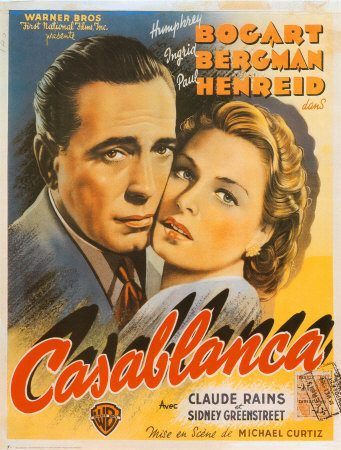
Film #24: Casablanca (1942)


Director: Michael Curtiz

Initial Release Country: United States

Times Previously Seen: 4 or 5 (last seen about 6 months ago)

20-Words-or-Fewer Summary (no spoilers):

Jaded club owner/ex-mercenary is reunited with past love, wife of underground Nazi resistance movement leader. Romance and adventure ensue.

Full Blow-by-Blow (a detailed summary, with spoilers. Fair warning):

World War II has completely erupted and the Axis is steadily marching through Europe. In the Moroccan city of Casablanca in northeast Africa, hordes of refugees are scrambling for freedom and desperately searching for ways and means to escape from the carnage. Casablanca is now a city filled with expatriates, rich and poor, and scoundrels looking to take full advantage of their desperation.

One semi-safe haven is the swinging night club Rick's Cafe Americain, run by American expatriate and former soldier-of-fortune, Rick Blaine (Humphrey Bogart). Rick is a world-weary man who seeks nothing more than to operate a viable club, clearly stating that he won't "stick his neck out for nobody." Despite this callous decree, Rick is a man who has a hidden soft spot for those he sees as decent people, and who privately despises the Nazis and their fascist ideals.
The four main players, left to right: Rick, Renault, Lazlo and Ilsa

One night, local scumbag Ugarte (Peter Lorre) shows up in Rick's, asking him to stash two exit visas, exceptionally valuable commodities in Casablanca, that Ugarte has stolen from a pair of Nazi couriers whom he has killed. Rick agrees, but Ugarte is promptly seized and killed trying to escape. Overseeing the action is the local corrupt police chief, French Captain Renault (Claude Raines) and newly-arrived Nazi Major Strasse. Strasse has arrived to find and contain escaped resistance leader Victor Lazlo, a Czechoslovakian who has suffered in a concentration camp, escaped, and continued to fight for freedom from Nazi rule.

Lo and behold, Lazlo appears, and he's not alone. With him is his beautiful wife, Ilsa Lind (Ingrid Bergman). When the pair show up at Rick's, the normally stoic Rick sees Ilsa and slips into a deep, depressive reverie. After being cordial to Victor and Ilsa, we learn that, prior to arriving in Casablanca, Rick had fallen in love with Ilsa in Paris just before the Nazis rolled in and took over. Rick had planned to flee Paris with Ilsa, but was left standing at the train station with his piano-playing comrade, Sam, and an extra train ticket. Devastated, Rick flees, not knowing what became of his love.

In modern Casablanca, Rick's heart has become hard. When Ilsa and Victor ask for his help in acquiring exit visas, he refuses, despite having the visas stolen by Ugarte. Ilsa eventually reveals that, when she and Rick were together in Paris, she was still married to Victor, though she had then thought him dead. Shortly before Rick's flight from Paris, she had learned that her husband still yet lived, and she abandoned Rick to return to her husband. Even this revelation seemingly fails to move Rick.

As Major Strasse tightens the noose around Victor, he and his wife become more desperate. Rick cooks up a scheme by which he plans to use the two exit visas for himself and the now exhausted and complicit Ilsa, apparently to leave Lazlo to the mercies of the Nazis. However, when all of the different forces converge on an airstrip, Rick offers a final surprise: he gives the visas to Ilsa and Victor and gets them on a plane, granting them their freedom. To boot, he guns down Major Strasse, a terribly severe crime that is overlooked by Captain Renault, who re-embraces his own past convictions. Victor and Ilsa fly away into the night, and Rick and Renault saunter off to who-knows-where, to fight for the Allied cause in even more distant lands.

Love and ideals conquer all.

Take 1: My Gut Reaction (done after this most recent viewing of the film, before any research):

Citizen Kane may be the most innovative and artistic work in the history of major American films, but Casablanca is the absolute pinnacle of what mainstream Hollywood can ever achieve in terms of storytelling. I can't think of a movie that has a tighter script, more memorable classic lines, and as solid a cast as this all-timer.

At the very start, things are a touch droll. During the initial scan through the city, we are treated to various scenes that convey the sense of wonder that is the thrumming populace. For the first five minutes or so, we see people getting robbed, suspected refugees shot, and even a young woman looking up at a departing plane and, dreamy-eyed, declaring, "Do you think we'll be on that plane one day?" Such a cheese-tastic line almost had me wondering just why I like this film so much.

Then, a reverse of my The Lady Eve experience occurs.

That film had an amazingly strong beginning, then faded significantly as it went along. Casablanca just gets better and better as the story unfolds. Every major and minor character is memorable, right down to the bartender in Rick's. Every scene and line of dialogue advances the story or reveals something essential about a character. And yet, despite the film being an economical hour and forty-two minutes long, it at no time seems rushed. There are quiet, ponderous moments, just as there are moments of high intrigue and suspense. The cocktail is mixed so perfectly that you don't even realize that you're being intoxicated until you've got that stupid grin on your face.

The lines. Those who haven't seen this film may not realize just how many classic lines come from this movie. When I first watched it back when I was about 21 years old, my initial thought was, "Man, that line was another cliche." Shortly after that first notion, I realized that this movie was the source for all of the cliches:

"Play it, Sam." (there is no "again," as some may have you believe)

"Of all the gin joints, in all the towns, in all the world, she walks into mine."

"Here's looking at you, kid."

"Round up the usual suspects."

"Louis, I think this is the beginning of a beautiful friendship."

There are plenty more, including this favorite gem of mine (sorry there's no clip, just the link):

"I was misinformed." Just count how many great lines are in this 2:30 bit of the film.

In between all of these more renowned lines are tons of others. Throughout nearly the entire film, I was smirking at the clever digs and cynical observations of everyone involved. The true stars of the show, though, are Humphrey Bogart and Claude Raines, who get the best lines and deliver them masterfully.

More needs to be said of Bogart and Raines. The other actors are excellent, including Bergman, Henried, Lorre and the others. However, when Bogie shows up as Rick, he becomes the stuff of legend. His weary hangdog face, subtle gestures, one-of-a-kind voice, and effortless delivery are cinematic platinum. His sarcasm is authentic and timelessly funny, his anger is intense, his depression is heart-rending, and his compassion, though sparing, is wholly redeeming. I can't possibly imagine any person playing the role as well, and no actor has filled the slot left in Hollywood once Bogart left.

Raines is the sleeper of this one. Though not as prominent as Rick, he's the character whose scenes you're waiting for. While he's mostly comic relief, like most of the characters aside from Ilsa, Victor, and Major Strasse, Raines is far superior to them all. His officious posture and self awareness as a playfully corrupt official are as entertaining and unique as they come. He's slimy, to a degree, but one whom you know has a good heart buried under all of that manicured vice. He and Rick pairing up at the airfield and heading out to unknown horizons on the war front is arguably the greatest ending a Hollywood film has ever had.

Here's one of Renault's greatest lines:


Of course, in addition to all of this is the time when the film was released. The U.S. had just seriously committed to engagement in WWII, so the collective emotions of the nation were focused on the goings on in Europe and northern Africa. If you keep in mind the uncertainty of things in those years, the film's story of love and hope becomes far more potent. As great as it is today, I can only imagine how much better it would have been to see it back in 1942.

There it is. With Casablanca, you arguably get: the greatest tale told in film, some of the greatest characters in film, the greatest lines in film, and the greatest ending in film. These things are the reasons that people have been trying for nearly 70 years to match Casablanca in terms of smoothness, tone, characterization, dialogue, and storytelling. Long before Steven Soderberg went at it, many have tried and come close, but none have matched it, in my view.

If you haven't seen this film yet, you only have two choices: watch it immediately or renounce any claim as a movie lover.

Take 2: Why Film Geeks Love This Movie (done after some further research):

As with Citizen Kane and other mammoths of film history, Casablanca has been studied and critiqued endlessly, if not for exactly the same reasons. It's a fascinating film since, while it can be called "sophisticated hokum," as one of the original script readers put it, there's a timeless charm that is exceptionally rare, though not elusive.

While the casting went through many iterations, one stood out to me. The Rick Blaine character was originally to be given to...are you ready? Ronald Reagan. Oof. I really can't get my mind around that one. I know Reagan had some clout back then, but anyone who's seen this movie can see why my eyes go wide when I consider this.

Another fairly interesting fact is that World War II itself indirectly (as well as directly) contributed to the greatness of Casablanca. Many of the supporting actors were themselves real refugees who had been prominent actors in their home countries, such as Germany, Bulgaria, Czechoslovakia, and others. This goes a long way to explaining why even the bit parts are so well played. I was a bit surprised at how dismissive the original TIME review was in regards to Raines' Captain Renault character. Bush-league?

In learning about the story and script I picked up that, in the film (it was adapted from an unproduced play called Everybody Comes to Rick's), Rick's background is left intentionally vague. In the play, it is revealed that in America, he was a lawyer with a wife and children. By omitting this, and only filling in the occasional detail about Rick's past fighting against fascist regimes, we're left with a more mysterious figure. To me, this is a fantastic example of skillful story editing.

Director Michael Curtiz was hailed as one of the great directors of his day. The surprising thing is that, apparently, he was not much of a "story" man. So much so that one writer explained that Curtiz didn't get along with writers and couldn't talk to them because, "He didn't know what the hell we were talking about." Rather, Curtiz was a master of scenes and working with actors. He may not have been able to create or adapt and tale, but once you gave it to him, he knew exactly how to translate it to film.

Something that I totally overlooked in my first take was the music. I think that this is because it's such a part of the fabric of the movie that I didn't give it much thought. It is excellent, and of course the song "As Time Goes By" is just as memorable as any of the classic lines of dialogue. Intriguing is the fact that the original music director didn't like the song, but wasn't able to find an alternative in time for the film's rushed release. I guess he had to eat a little crow on that one.

All of this is the slenderest tip of the iceberg of study that can be done on this movie. As opined above, Casablanca is not a masterpiece of high art or the culmination of genius. This film is not the ceiling of the Sistine Chapel. Rather, it's more like the most superbly crafted wooden chair. All of the pieces have been carefully carved and fit together just the way that they need to. You can sit down, lean back, run your hands over the supply curved arms, relax and marvel at how such a seemingly simple thing can be so rare and enjoyable. While it's perfection may invite overanalysis, there's no real need - just enjoy it.

Greatest ending ever? If not, it's in the discussion:


That's a wrap. 24 shows down. 81 to go.

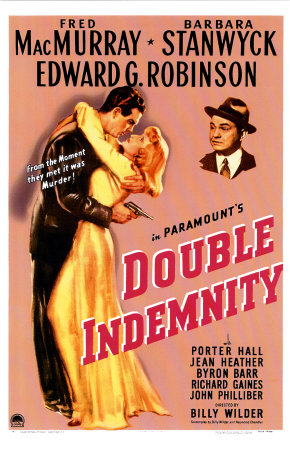
Number 3 in the 1-2-3 combo of some of my favorite films is this film noir classic. Barbara Stanwyck makes her third appearance of TIME's list, this time as a true femme fatale. I'm all geared up for another viewing of this back-stabbing, double-dealing yarn of lust and betrayal. Good, clean fun.

Please be sure to pick up all empties on the way out.