Showing posts with label Jeff Nichols. Show all posts

Sunday, February 12, 2017

Retro Trio: My Big Fat Greek Wedding (2002); The Assassination of Jesse James by the Coward Robert Ford (2007); Mud (2012)

My Big Fat Greek Wedding (2002)

Director: Joel Zwick

No, rom-com fans, I had never actually seen this one before now. While I won't say that I regret letting all these years pass without seeing it, I can certainly see why it was such a sleeper hit 15 years ago.

For those unfamiliar, the story follows Toula, a 30-year old, single Greek-American woman whose massive, boisterous family shares a stifling concern over her state of being a bachelorette. When Toula does find a man whom she loves, Ian, things get no easier due to the fact that he is not of Greek descent, a situation which Toula's grecophile family can hardly wrap their minds around. The rest of the movie is mostly a comedy of errors and culture clashes between Ian and Toula's smothering but warm family. Ian comes from a laughably quiet, poised family composed of only himself and his overly stoic WASP parents, whereas Toula's family is a virtual army of caring and passionate but nosy and noisy siblings, aunts, uncles, cousins, and family friends.

The movie is certainly fun enough, and I was pleasantly surprised at how efficiently the story is told. While it hits the standard marks expected of a rom-com, it often comes at them from different angles and never really belabors the more familiar points. One example is the self-improvement montage, where Toula decides to "go from drab to fab" by redoing her wardrobe, hair, and makeup. I feel that other movies emphasize these types of makeovers and scenes too much, but Greek Wedding offers it to us in a crisp, less-than-60 seconds sequence that makes its point and then moves on. This is one of several examples of strong pacing which keep things moving along, an essential element of good comedies.

The cast is a great asset, as well. The script is decent enough, and all of the actors get to show off their comic timing to great effect. Not every gag or line hits, but enough of them do to keep the movie worthwhile. I'll probably never be a person who goes out of my way to watch a rom-com like this, but I enjoyed this one, and I could see myself watching it again with my wife.

Side Note: My wife recently tried to watch the sequel which came out last year, and she barely made it to the 5-minute mark. She said it was that bad. Apparently it was just trotting out the same, 14-year old gags and was generally annoying to her. This begs the question, if the film makers wanted to just do a stale, unoriginal sequel as a cash grab, why wait 14 years to do it?


The Assassination of Jesse James by the Coward Robert Ford (2007)

Director: Andrew Dominik

A rather novel entry into the list of American Western movies, and one whose box office draw fell far short of its merits.

As the lengthy title suggests, the film focuses on the final few years and ultimate slaying of notorious 19th century outlaw Jesse James. Unlike most Westerns, though, this one eschews glamorizing the best-known characters or relying on fast-paced, action-based thrills. Instead, the movie is a slow meditation on the eerie expansiveness of the West, the warped and often despicable character of Jesse James, and the gradual erosion of Robert Ford's romanticization of the infamous thief and killer.

Using the source novel of the same name, the  movie tells of the relationship between the two title characters. Around the late 1870s, Jesse James (Brad Pitt) and his gang have all but ceased the robberies which made them known throughout the U.S. and even the world, but they still hold a mythical appeal in many places. Robert Ford (Casey Affleck) is a young Missourian who has long idolized James, and he finally gets his chance to be a member of his gang during one, mostly-unsuccessful, train robbery. James has family ties in the area, and he uses them to wrangle cousins and other hangers-on into his schemes, even if nearly all of them come to nothing. Ford, as one of these hopefuls, begins to see James for what he is - a mentally unstable, volatile, and sometimes murderous fiend. James is still able to be charming and charismatic at times, but they do not always cover up the far darker aspects of his nature. Over several years of acquaintance, Robert Ford eventually volunteers to kill James on behalf of the governor of Missouri, hoping that he will be hailed as a hero. Such is not necessarily the case, however, as many still incorrectly viewed James as a Robin Hood of the West. This leads many to see Ford as an underhanded scoundrel who merely killed a righteous outlaw for his own personal gain.

In several ways, this movie is not unlike Clint Eastwood's Unforgiven, in that it strips away the glamour often associated with the brutality and violence of the 19th century U.S. "Wild" West. The film does a brilliant job in depicting Jesse James as a charmer who can put his good looks and articulateness to his own selfish uses, while at the same time showing just how brutal and paranoid he is. The movie also takes the bold and effective mood of focusing more on Robert Ford and his growing disillusionment at James. Not relying on simple, pat turns of plot, the story is subtle and gradual with the erosion of Ford's romanticism of his boyhood hero. Ford is never vilified or hailed, per se, but is shown as a man who is almost helplessly swept up by powers and individuals who are simply stronger than he. When he does decide to take action for himself, seeing how it unfolds is a borderline tragedy.

The Wyeth-esque landscapes are often just as eerie as the
murderous outlaws that roam them.
The acting is outstanding. This was Casey Affleck's true breakout role as the confused Robert Ford, and it's no surprise that he has since garnered more praise for his leading roles in movies like Gone, Baby, Gone and Manchester by the Sea. Brad Pitt also turns in one of his more understated yet highly effective performances as the infamous Jesse James. The supporting cast is also stocked with strong actors, some easily recognizable such as Jeremy Renner and Sam Rockwell, and others less known.

As much as the story and acting, though, is the setting and cinematography. Like some of the greatest westerns, The Assassination of Jesse James uses the openness and quiet of the time and place to build an often eerie sense of loneliness. Compared to later and modern eras, time and space seemed to have a near-eternal quality that can be imposing, to say the least. When you consider how friends and neighbors in the area would routinely go weeks and months without seeing or hearing from each other, the isolation is daunting. When you add in the fact that an unpredictable, homicidal killer is stalking the plains, then you have the stuff of nightmares. Director Andrew Dominik uses this to great effect, along with the cinematography. Certain shots use grainy or fuzzy peripherals that enhance a sense of blurred perspective, which is in keeping with the distorted and shifting views of Robert Ford, a fractured character whose warped feelings towards James are at the heart of the film.

I may not feel the need to watch this movie again, but I now consider it among some of the very best Western films of all time. Highly recommended for those who enjoy creative film-making, and especially the Western genre.
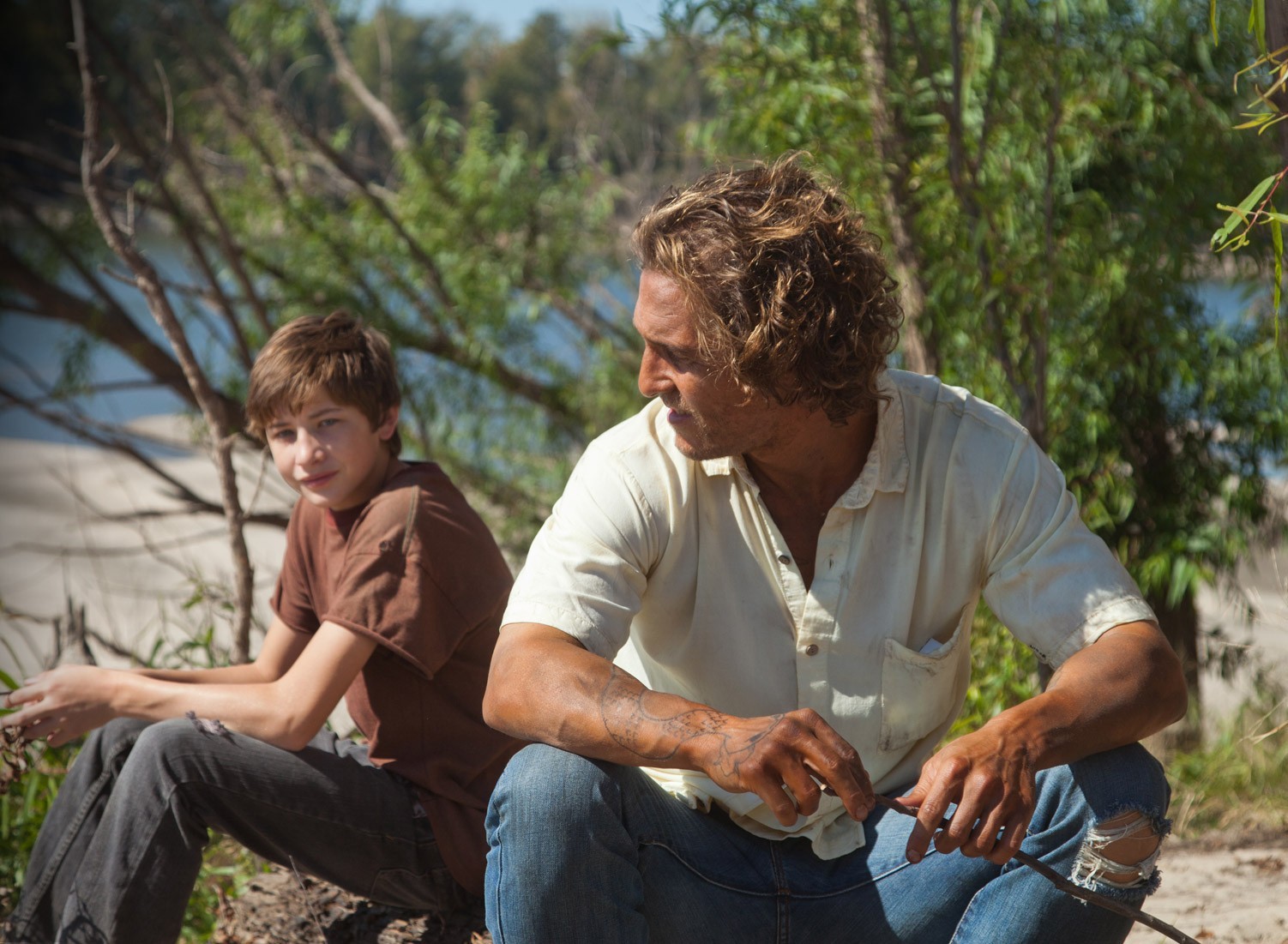

Ellis and Mud figuring each other out on the island. The
relationship between the two is the crux of the movie, although
their feelings towards others is just as important.
Mud (2012)

Director: Jeff Nichols

While it didn't meet my lofty expectations, Mud is a solid and compelling movie.

Taking place on a river in Arkansas, the movie follows two 14-year old local boys who discover an odd man (Matthew McConaughey) squatting on a small nearby island where the boys are looking to scavenge any flotsam and jetsam which the river has washed up. The man gives his name only as "Mud," and the boys take to running odd little errands for him on the Arkansas mainland, getting him food and bringing messages to a young woman to whom Mud has some mysterious dedication. The boys soon learn that local police are searching for Mud in connection with a murder in Texas. One of the boys, Ellis (Tye Sheridan), is a budding romantic who desperately wants to see Mud as a kindred spirit who has done unsavory things in the name of love. This becomes more and more difficult, however, as facts about Mud's past emerge. The tension cranks up wildly when a group of bounty hunters arrive in the area, looking to kill Mud on the orders of the murdered man's powerful and vindictive father.

This is now the third movie of director Jeff Nichols which I've seen, and it was his third film after his debut Shotgun Stories and the incredible follow-up Take Shelter. Mud is much more like the former, as it uses the setting of rural/suburban Arkansas to great effect, offering a very authentic sense of place and the people in it and telling a fairly straightforward story. Whereas Shotgun Stories was more toned-down, humanist drama, however, Mud uses elements from more popular genres like mystery, suspense, and action. The latter two elements actually weaken the film just a bit, in my view, mostly because they stand in rather stark contrast to the more genuine, emotional story of Ellis. Ellis's attempts to find love with an older girl in the area are the most touching and organic aspect of the entire movie. While it wouldn't have been enough to carry this film, it bears a genuineness that makes the more sensational and plot-driven elements feel a tad cheap.

Woven into the tale is the general sense of a childhood and youth being lost before our eyes. At the beginning of the movie, we learn that Ellis's parents are having marital difficulties. Though hardly the only reason, a major issue is that the family is almost certain to lose their house boat, which doubles as the source of his father's income as a fisherman. Ellis's desperation to flee from the disintegration of his parents' marriage, as well as their life on the river, plays a major part in why he becomes drawn to Mud. While not always completely subtle about these connections, the movie doesn't beat you over the head with it, and it does build some worthy cohesion between what could otherwise have been a very fragmented tale. This sort of cohesive storytelling seems to be a strength of Jeff Nichols, based on the three movies of his which I've seen.

I think that the only reason that I was slightly underwhelmed by this movie is that I saw it too long after it came out over four years ago. It was a well-received movie, to be sure, but it was also the true beginning of the "McConaughssaince," during which Matthew McConaughey reinvented himself as more than just an easy-going Texas dude with six-pack abs and a pretty face, cashing checks from rom-cam royalties. Within the next two years, he would receive tons of acclaim for his roles in Dallas Buyers' Club and especially True Detective, and even a few smaller cameo roles here and there. By the time I saw Mud, I had built this movie up in my mind to be an all-time great, which is unfair to expect of any film. Though it didn't (and perhaps couldn't) meet my unreasonable expectations, this is one that I can easily recommend to nearly anyone. There are a few flaws to be fussed over, but it is another solid effort from one of the U.S.'s best young filmmakers today. 

Friday, February 10, 2017

Retro Trio: The Outlaw Josey Wales (1976); Tie Me Up! Tie Me Down! (1989); Shotgun Stories (2007)

The Outlaw Josey Wales (1976)


Director: Clint Eastwood

Still one of the all-time great Westerns, even if its flaws show a bit more, these forty years later.

One of Clint Eastwood's earlier directorial efforts, Josey Wales tells the story of the title character, a Missouri farmer whose wife and child are brutally butchered by a vicious platoon of "Redlegs" - a gang of Union mercenaries - during the United States Civil War. Wales takes up his gun, joins a Confederate militia, and starts fighting the Union with a bloody vengeance. His pain over his loss is so great that, even when the war ends, he refuses to surrender his guns or himself. Instead, he goes on the run, feeling that he cannot let the burden of his anger go. Although the traumatized and jaded Wales tries his best not to make any connections with other people, he can't seem to help slowly building a retinue of followers, all of whom he saves from one threat or another. Try as he might to suppress it, some small shred of humanity and empathy keeps breaking through and inspiring an odd loyalty from a motley crew of the disaffected.

While there may be a few warts that pop up here and there, this is still a titan of a Western - one which I would place among the top 3 all time. This is one of those great films that incorporates nearly everything that audiences enjoy about a particular genre of film, while turning many of its conventions on their heads. In the case of Josey Wales, we get the makings of a grand revenge tale, and even a satisfying exacting of that revenge. However, the unexpected portion is how Wales's revenge upon the Redlegs becomes secondary to his accidental rediscovery of his own humanity and desire to live. The first act of the movie follows fairly conventional lines - Wales is so consumed with rage over his wife and child's murders that he refuses to surrender, even in the face of overwhelming odds of the Union army. It certainly seems easy to see where the tale will then go: Wales will outsmart and outgun his enemies until he gains satisfaction. Although he certianly does that, to an entertaining extent, it becomes secondary to the underlying struggle within him to find some reason to bother living. It was one of the few Westerns that touched on the true darkness and nihilism of pure vengeance, even when it may be righteous. This gives the story a much stiffer backbone than nearly all of its genre brethren.

Chief Dan George's performance as Watie is the standout
among several excellent supporting turns in this movie.
Wales's unique character is cast into greater light in the
presence of such centered companions.
But the film offers much more than cool gunfights and an existential struggle. The largest part of Wales's recovery of his soul is the oddball entourage which assembles around him. As he flees past Union forces towards Texas, he first encounters Lone Watie, an elderly Cherokee who seems to have given up most of his hope in life. Still, he maintains a bone dry sense of humor. When Wales doesn't kill him out of hand, Watie senses something honorable about the stoic gunman and decides to join him. Though Wales seems mildly annoyed by the native's company, he doesn't discourage it. Played brilliantly by Chief Dan George, Watie provides an amazing levity and heart to the film, while transcending and avoiding so many of the misrepresentations that Hollywood films constructed of Native Americans over the previous many decades. His lines, thanks in no small way to George's delivery, are just as funny and powerful now as they were 40 years ago.

And Watie is just the first of several characters through whom we sense the change in Wales. By the time he reaches Texas, Watie and George have also picked up a young Navajo woman, a cranky and tough old woman from Kansas, and her misty-eyed daughter. Though it is never stated in so many words, it is through this motley group that Wales finds a reason to live. And just when we are led to believe that we will witness a classic "cowboy versus Indian" showdown between Wales and the infamous war chief Ten Bears, the movie flips the script again and gives us an intense meeting which results in a truce between the two fierce warriors. Of course, we do get a larger-scale gunfight towards the end, but it is between Wales's new family and the vicious Redlegs who come after him. This provides a nice sense of classic revenge satisfaction, while righting some of the wrongs of so many past Westerns. Having a more diverse collection of  white people banded with a couple of Natives and fighting off an entire group of violent whites said something that no Western had completely tried to say before about cooperation and redemption.

As with nearly any movie, I can nitpick here and there, especially with movies that are four decades old. But I would rather limit this review to the many great things about this one. I think that, all told, Clint Eastwood has been major parts in all of the handful of transformative modern Westerns. Between playing Sergio Leone's "Man With No Name" in the mid-'60s, to directing and starring in The Outlaw Josie Wales in 1976, and finally doing the same with Unforgiven, I have a difficult time imagining just how anyone could ever again be at the heart of revolutionizing such a prominent genre of film.


Tie Me Up! Tie Me Down! (1989)


Original Spanish Title: Atame! 

Director: Pedro Almodovar

This seems to be the film where Almodovar started to tell stories that wandered a bit further into uncomfortable territory, while still maintaining a generally humorous tone.

The movie centers on Spanish movie actress Marina, a former porn actress who now stars in campy but more mainstream horror movies. Unbeknownst to Marina, a former one-night-stand of hers - Ricky (Antonio Banderas) - has just been released from a psychiatric hospital where he has been receiving therapy for stalking. Ricky is still obsessed with Marina, and he immediately kidnaps her in her own apartment, ties her up, and tries to convince her of his love and desire for them to be married and have a family. She is initially horrified by his bizarre obsession, but eventually comes to love his dedication.

This was the fifth Almodovar movie I've seen, but the only earlier one I'd seen was Women on the Verge of a Nervous Breakdown. While that earlier movie was almost pure comedy, with a slight dash of darkness, Tie Me Up! seems to offer the most obvious clues as to the very uncomfortable places that many of Almodovar's movie would eventually go. While it is not nearly as challenging as Talk to Her, this one looks at obsession and desire in ways that viewers are likely to struggle with. Though many of the odd interactions between Ricky and the captive Marina can be humorous, there is a disturbing quality in how Marina eventually comes to love her captor. This, despite his physical and sometimes psychological abuse of her while he keeps her as his prisoner. One could argue that Ricky's dedication is some twisted form of true love, but it seems that an equally strong argument can be made for it being thoroughly selfish as well. Yet another notion is that both people are possessed of skewed and warped perceptions of what constitutes healthy relationships, and so are actually well-suited for each other. Such is the nature of Almodovar's movies: while they may follow familiar narrative frameworks, the characters operating within them are far from traditional ones. This is what makes them so unique and fascinating, if not exactly easy to watch at all times.

As with other Almodovar movies I've seen, it is impossible to guess exactly where the story will lead. Given how many films stick with conventional themes and storylines, it is amazing that one director and writer can continue to make compelling, challenging, and in many ways beautiful movies that stand apart from all others. This one is probably not the best "starter" movie for someone who hasn't seen any of Almodovar's movies before, but it will certainly please fans of his other movies.


Shotgun Stories (2007)

Director: Jeff Nichols

An amazing directorial debut that proves that strong drama is not only to be found in big budget movies set in large cities.

Shotgun Stories tells the tale of a small but nasty feud that breaks out between two sets of half-brothers in modern day Arkansas. One group, comprised of the three brothers Son (Michael Shannon), Boy, and Kid, are the trio abandoned by their abusive father so that he could start a new life and family. This father also changed his ways enough to become a decent parent to his two new sons - Cleaman and Mark - by his second wife. When their father dies, Son leads his younger brothers to the funeral, where he berates the dead man right in front of his second family. This sparks a feud between the sons that escalates in dangerous speed and intensity.

The movie is an expert blend of captivating character study, environment, and the theme of parents' sins living on in their children. The eldest brother Son is a stoic man who may not always have the best judgement, but who has a sense of guardianship over his brothers. None of the three is particularly successful at anything. In fact, they live in near-poverty, but they do all have an earnest desire to help and support each other. From Son's perspective, this means not allowing their abusive father to be buried before he voices his view that the man abandoned them and scarred them irrevocably. When this leads to serious conflict, Son and especially his youngest brother Kid are willing to fight for each other in every way possible. None of this ancient tribalism feels the least bit contrived, to the point that it is nestled right into the rural Arkansas landscapes and neighborhoods where the story takes place.

There is a very authentic quiet to many of the scenes that can vascillate between serene and terrible. This is a quality which I've found in other well done dramas done in the rural South, such as Badlands and others. It also helps punctuate the drama and emotion that breaks out when tensions run high and violence erupts. Several of these scenes, such as a fistfight at a carwash, would likely seem small-scale if it took place within a big budget film in a large city. In Shotgun Stories, though, it bears every inch of tension of a classic gunfight, but with the added layer of genuine emotion that is rarely found in mythical standoffs of the Wild West.

The dramatic turns in the movie feel completely organic, and the resolution is one that may surprise. To this point, now several weeks after I watched the movie, I am still mulling over just what the ending suggests. It is that atypical and thought-provoking. I highly recommend this one to those who enjoy small-scale, well-crafted drama.