Showing posts with label Juliette Binoche. Show all posts

Thursday, August 1, 2019

New-ish Release: Non-Fiction (2018)

Original French Title: Doubles Vies

Director: Olivier Assayas

This movie is, in a word, "French." A friend of mine has the belief that all French movies are 15 minutes too long, and Non-Fiction proves his point with gusto. It's compelling enough for most of its length, but then really takes an odd turn that undercuts many of the strengths of the first hour and a half.

The movie follows the lives of several French people, most involved in the literature business, politics, or acting. Their lives intersect in various ways: friendships, business and romantic relationships, the latter being through marriage or infidelity. As they meet and interact with each other, whether in pairs or larger groups, they discuss their relationships and their professional lives. Among the several professional themes, the primary one is that of the place and nature of novels in the modern world. One character, Leonard Spiegel (Vincent Macaigne), is an author of modest success who has come under repeated criticism for his use of thinly-veiled autobiographical relationships in his works of "fiction." His attempts to explain this to his wife and occasional mistress keeps him in hot water, all while he and his publisher reckon with the fact that physical books are a slowly-dying industry.

The movie is compelling enough to viewers like my wife and I - people who enjoy good literature and the arts to an extent. For much of the film, the characters hash out some of the complexities involved in those fields, and it does it all with a fair amount of heart and humor.
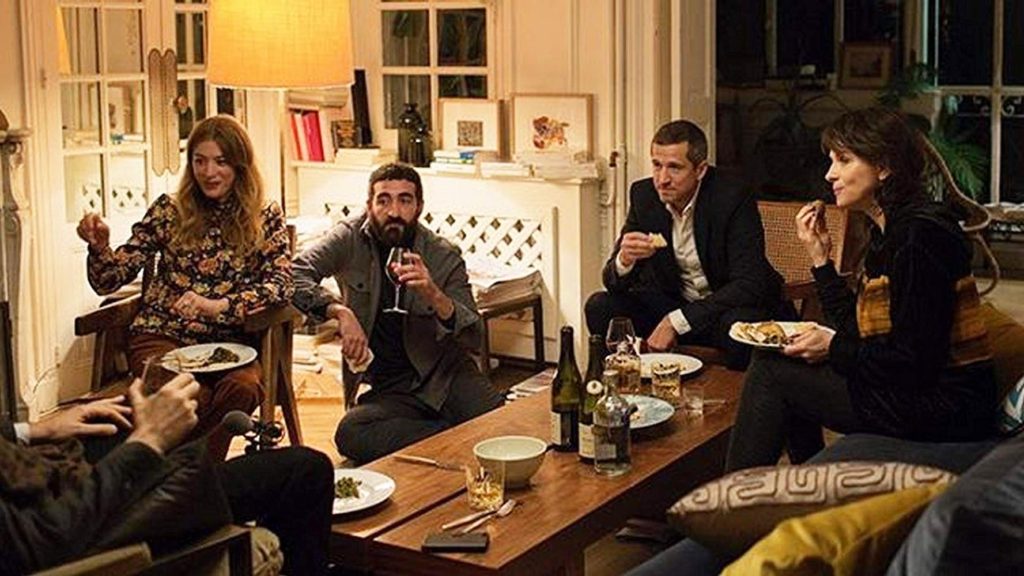
Expect plenty of conversations involving talented intellectuals,
wine, good food, and the smoking of cigarettes. In other words,
expect a French movie. 
But things become a bit too light and breezy by film's end. And the final ten minutes are almost baffling in their frivolity with not only the story but the entire nature of the film itself. There's a "meta" moment that is so clumsy and unimaginative that it renders nearly any weight that the film had previously carried useless. And despite the compelling romantic strife throughout the story, things end on a bizarrely sappy note.

Perhaps I was missing something. Maybe there was some wrinkle of satire or irony that I wasn't picking up, but the film's end really weakened so much of the rest of it. While I've only seen one of the director's other film - the absolutely brilliant The Clouds of Sils Maria - I was hoping for something a bit better. Despite strong acting and some intriguing intellectual subject matter, this one really dropped the ball at the end.

All that said, it was a fairly amusing movie. It sets up as a mostly light, humorous ensemble tale about artists in a changing modern landscape. I enjoyed it well enough for the most part, though I'll never feel the need to watch it again. 

Thursday, December 11, 2014

Before I Die #525: The English Patient (1996)


Director: Daniel Minghella

Masterfully constructed and beautifully shot, The English Patient nonetheless fell a bit flat for me. This is not unlike the director's later effort, The Talented Mr. Ripley, which I watched not long before this one.

The movie is, as you would expect, a true epic. Set before and during World War II, it follows the story of Count Lazlo de Almasy (Ralph Fiennes) and his love affair with Katherine Clifton (Kristen Scott Thomas). The way that their story is introduced and gradually revealed is brilliant, but I found the intended emotional impact lacking.

The movie opens with Lazlo and Katherine getting shot down by Germans in North Africa, with Lazlo being severely burned while lying next to Katherine's dead body. His body is found and transported to an Allied field hospital, where he is taken under the care of Hana (Juliette Binoche), a nurse with the terrible fortune of constantly falling in love with good men who get killed in the war. Hana decides to put Lazlo up in a bombed-out building and tend to him. From this, the movie uses flashbacks to fill us in on exactly how Lazlo came to be in such a sorry state.

Jumping back several years before the outbreak of the war, we see that Lazlo was an archaeologist who had been combing northern Africa for certain cave paintings. He is joined by Katherine and her husband, and he soon develops a deep and almost painful passion for Katherine. This is where the problems begin for me as a viewer. It was never fully clear to me why Lazlo and Katherine fall for each other. Lazlo is a taciturn, condescending man, with little to recommend him to any woman (aside from his dashing good looks, but Katherine seems to be above such superficiality). Katherine is a lively adventurer with an easy smile and quick wit. Sure, Lazlo is a moody romantic, which some would find attractive, but his actions don't often speak of admirable qualities. Given that the story of these two comprises much of the movie, it left me wanting a little more substance to their romance.

The story of Hana and her lovers, most notably the siekh
mine-sweeper Kip, contain the heart that the main story of
Lazlo and Katherine was lacking, in my view.
The more "modern" story of Hana is more interesting, though. Hana's relationships with the various men whom she loves and loses have real impact, since it is far easier to see what attracts her to the more grounded, truly heroic soldiers around her. When contrasted with Lazlo, these soldiers evoke far more empathy through Hana's loss of them, while Lazlo's loss of Katherine loses its emotional potency. This lack takes something away from the story.

The other elements of the film are difficult to criticize. Beautifully shot and edited, it is not surprising that the film raked in tons of awards back in 1996. The cinematography and acting justifiably invite comparisons to Lawrence of Arabia. The expanding and contracting scope of the personal wars within a greater, global war is conveyed wonderfully, so fans of large-scale, epic love stories are sure to be pleased.

The English Patient looks and often feels great. There are, however, just a few pieces of true heart that were missing for me to completely love it.