Director: Terry
Gilliam
Initial Release
Country: United States
Times Previously Seen:
twice; last time about 10 years ago.
Teaser Summary (No spoilers)
Lonely bureaucrat in an Orwellian alternate reality seeks to
escape his society’s trappings to find romantic love.
Extended Summary (More detailed synopsis, including spoilers.
Fair warning.)
In an unspecified time, in an unspecified European country, Sam
Lowry (Jonathan Price) is a mid-level bureaucrat working for the massive
government machine. He works in a dismal factory environment crammed with
pipes, papers, and employees who spend plenty of time shuffling around both themselves
and various order forms. Amid all of this, Lowry has daydreams of flying among
the clouds as an angel, seeking out a beautiful, unnamed woman who is trapped
in gossamer netting.
One day, his office receives notice of an error made by one
of the countless departments within the system – a typo has led to the brutal
arrest, retrieval, torture, and death of an innocent man, Harry Buttle. Buttle
has been mistaken for Harry Tuttle (Robert De Niro), a known “renegade and
terrorist” engineer who runs around the city, illegally fixing people’s
electrical problems without the proper paperwork. Lowry recognizes the mistake
and volunteers to bring a pittance check to the bereaved widow.
Sam assists his lazy boss in sorting out the "error" that led to Buttle's death. This kick-starts Sam's quest for his dream girl, Jill.
At the Buttle widow’s apartment, Sam comes in contact with
Jill Layton (Kim Greist), the Buttles’ upstairs neighbor, who also happens to
be the very vision of the woman in his dreams. Since Buttle’s erroneous arrest
and death, Jill has been working her way through the endless government
channels to find who is responsible for her neighbor’s wrongful death. Her
tireless pursuit of justice through these channels has also earned her status
as a fellow terrorist aid to the renegade Tuttle. Sam tries to pursue her, but
Jill offers no information and flees, fearing anyone from the government.
Back at his apartment, Sam runs into the real Harry Tuttle,
who barges in so that he can fix Sam’s broken air conditioner. While
efficiently fixing the problem, Tuttle explains that he was a government
engineer, but left because the amount of paperwork. Before Tuttle leaves, Sam
also helps him deal with a pair of government workers who show up (many hours
late) to fix his air conditioner.
Now obsessed with finding Jill, Sam decides to take a
previously-offered promotion into the Ministry of Information Retrieval, the
department in charge of all information gathering. Sam had refused the offer,
which was the result of the machinations of his image-obsessed and vain mother,
due to his contentment with his low-level, low-stress job. Now, he accepts and
becomes an Information Retrieval officer.
After obtaining some general information about Jill, he
comes across her in the office building as she continues to seek justice for
Buttle’s death. Sam finally reaches her. Jill at first tries to shake Sam away
from her, but he eventually convinces her that he is, indeed, deeply infatuated
with her. With government officers on her trail, Jill goes with Sam into
hiding. Sam sneaks back to the Ministry of Information Retrieval and falsifies
the records so that Jill shows up as “deceased”. He returns to her and the two
share a romantic evening together.
Though unglamorous and unassuming in real life, Jill is the object of Sam's self-destructive pursuit of love.
The next morning, the state police barge in and take Sam away.
He is run through the draconian, yet clinically anaesthetized legal process,
and ends up in a torture room. Just as he is about to be tortured (by his old “friend”,
Jack Lint (Michael Palin) from his previous job), his torturer is shot through
the head by Harry Tuttle and a gang of terrorist raiders. The raiders pull Sam
out of the building, and he flees with Tuttle.
The world around Sam starts to become more fantastic and
dreamlike during his escape. He and Tuttle run into a shopping center, where
Tuttle inexplicably becomes shrouded by massive amount of flying papers. When
Sam tries to pull the papers off, Tuttle seems to have vanished altogether. Sam
runs into what appears to be a church, in which a funeral is taking place. The
deceased is announced as one of Sam’s mother’s frenemies – a fellow plastic
surgery addict who had been growing ever-more deformed through botched
procedures. Next to the coffin is Sam’s mother, now transformed into a woman
who appears to be in her mid-20s, and who looks exactly like Jill. She is being
fawned over by eager young men, and she brushes Sam away from her.
Retreating outside, Sam is once again in a world even
bleaker than anything we’ve yet seen – the buildings are cold, rigid, flat,
gray structures that tower over him. A gang of policemen pick up their pursuit
of him again, chasing him into a massive wall of the flex-piping that is
ubiquitous in Sam’s life. After frantically digging through the pipes, Sam
finds himself in a trailer being driven by Jill. Once again united with his
lost love, the two drive off in seeming bliss.
However, this perfect happy ending abruptly ends when we see
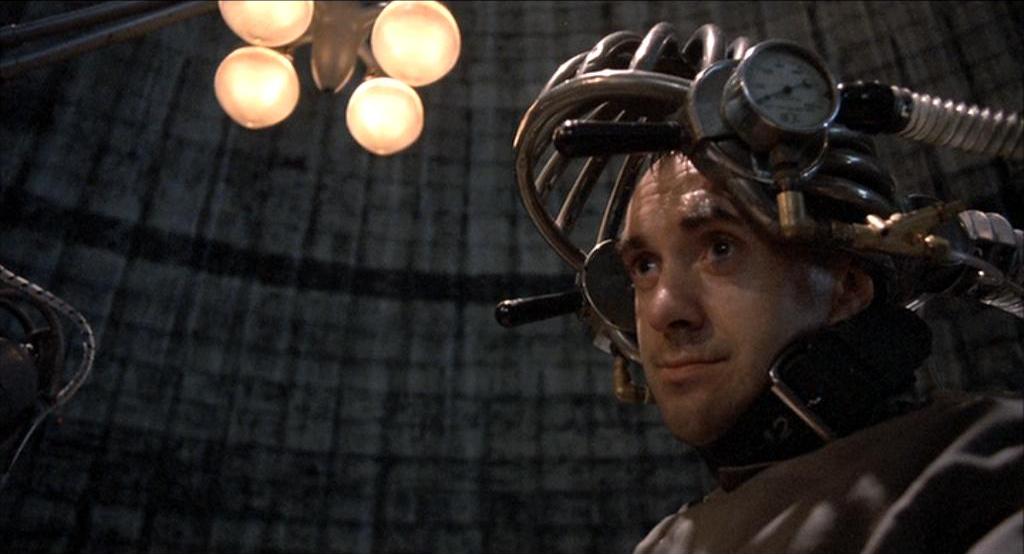
Sam back in the torture chair deep within the Ministry of Information Retrieval.
In fact, the entire escape from the torture room was a pure fantasy brought on
by the torture. Sam, now thoroughly insane, has sought refuge in his
unrealistic and childish fantasies of escape from the system that has now
effectively destroyed him.
Sam's destiny ends here - in the torturer's chair, completely insane and disconnected from his warped reality.
Take 1: My Gut
Reaction (Done after this most recent
viewing, before any further research.)
A very brief history: I love Terry Gilliam. I’m not a blind
worshipper, by any means, and there are a few of his films that have fallen
flat for me (The Fisher King and Tideland, specifically). Most of his
work, though, I find wonderful, in the truest sense of the word. From the
moment I watched Time Bandits as an
8–year old child, I was hooked. With this movie, and others like The Adventures of Baron Munchausen, I
got a great combination of childlike wonder, fun adventure, and humor that magnificently
ran from silly to wry.
With Brazil, it
was only upon this recent viewing that I can say that I now fully appreciate
it. It really is his best film, and it is not difficult to see just why it made
the TIME 100 list.
Brazil is not
Gilliam’s gravest or most serious work, but it is his most artful and will
ultimately be his most lasting. By drawing from the more timeless themes of the
human condition, namely individuality versus conformity, he sets this work
above all of his others and makes a visually arresting statement about human
psychology in the post-Industrial Age. It was something that writers and
observers had been doing for decades prior to Brazil, but Gilliam was the first to express it so stunningly in
cinema.
It’s not hard to see in the protagonist, Sam Lowry, the
essence of George Orwell’s Winston Smith in the seminal novel 1984. Lowry, like Smith, is part of a
totalitarian system in which a sprawling and invasive government has molded its
citizens into a populace that has sacrificed its creativity and freedom for the
“security” of bland superficiality. The various “Ministries” in Brazil are virtual parallel to those in 1984. The contribution that Gilliam made
in his film is that we can now see the results in the form of revolting
starkness. Between the towering grey buildings and the endless miles of piping
in Brazil, a viewer feels totally
crushed and hemmed in on all sides. As a viewer, I found myself yearning for
the more colorful, fantastic dreams that Lowry would drift into, childish and
unrealistic as they might be.
Sam's dream self. These play out like the fantasies of a 13-year-old boy, which is what Sam is, emotionally.
It is this childishness of Lowry that was my grand
revelation upon this most recent viewing. When watching this film times past, I
never quite realized that Lowry is meant to be seen as completely out of touch
with his own reality. This is something that, at one point, Jill expresses to
him in those exact words. Once Lowry sees Jill for the first time, he becomes
possessed of a completely juvenile mania to track her down, in the process
destroying his own life and any chance of happiness. I realized that this is
not due to a lack of intelligence on Sam’s part, but rather the fact that he
has been so repressed by the hulking system around him that he is not capable
of handling emotions such as love (or at least, infatuation) as a mature adult.
Instead, he charges headlong after Jill and is inevitably crushed in all ways
possible.
Someone who hasn’t seen the movie and reads my previous
paragraphs would think that Brazil is
a humorless slog through dour sociopolitical commentary. Far from it. As with
all of his other films, Terry Gilliam gives us plenty of humor to carry us
through. Gilliam was an original key member of Monty Python, and it’s not hard
to see it in any of his films, including Brazil.
No, there are no “Lumberjack” songs or overtly silly antics, but a certain
“Python” tone is there. Whether it’s the goofy hats that the government
electricians wear or the willful obliviousness of a professional torturer,
there are plenty of comedic moments, light and pitch dark, alike. It’s not
stuff of gut-busting hilarity; rather, it’s humor calculated for extreme
effect. It all conveys just how unaware nearly all of the characters in the
film are to their situation.
One of the best examples of this lack of admission is when Lowry
tracks down the Ministry’s “Information Retrieval” department on his mission to
find Jill. When he reaches the office, he hears the bloodcurdling screams of a
“detainee” being tortured in an otherwise stately-looking office. Once the
session is finished, Sam walks in to see the back of the torturer (the Jack
Lint character played by Monty Python alum Michael Palin), hunched over as he
sobs uncontrollably. Once Sam announces his presence, though, Lint turns and
composes himself in a split second, utterly refusing to face just how horrific
are the acts that he performs on a daily basis. This perpetual denial is
arguably the most lasting notion of the entire film.
Jack Lint, covered in blood from his latest victim, though putting on the eternal "good show" of a smile to others.
And it is scenes such as this one in which Gilliam’s humor
is a tremendous asset to the movie. The entire tone of the scene is one of
chilling horror, and yet you almost can’t help but chuckle when Sam confronts
his former coworker. It is one of dozens of moments that elevate Brazil from straightforward social
commentary into more Swiftian satire. It was this entire angle that had eluded
me in previous viewings, and which I am very glad to have noticed this time
around.
As you may glean, Brazil
is not a barrel of laughs. Anyone familiar with Gilliam’s other more popular,
much more “Python-esque” movies should not expect a sibling of Time Bandits, Holy Grail, or similar ilk. Rather, Brazil is those movies’ distant, dark cousin. A dark, brooding, and
far more intelligent cousin whose somewhat silly gags can mask brutally
sardonic observations.
Take 2: Why Film
Geeks Love This Movie (Done after some
further research.)
The story of Brazil’s
creation and execution is rather interesting, but nearly as interesting and
highly publicized as its studio release.
When you watch Brazil,
you’ll probably be highly amused, if not dazzled, at some of the brilliantly
funny lines of dialogue. If so, then you probably won’t be surprised by the
fact that one of the co-writers was Tom Stoppard, accomplished writer of witty
gems like Rosencrantz & Guildenstern
Are Dead. As gifted as Gilliam is, he needed some help adding narrative
cohesion and sharper dialogue to his tale, and Stoppard obliged.
Reading about Gilliam’s filmmaking reveals a few things.
Often, his crew has nightmares about the scenes that he writes, due to their
highly fantastic nature. One can easily say (as Gilliam himself probably would)
that his artistic visions usually push or pass the boundaries of practicality,
in terms of actual production. This is something that links to one of Gilliam’s
favorite filmmakers – Federico Fellini. In
Fellini’s 8 ½, the very subject is a talented director’s disconnection from
reality and how this plays out in both his life and his films. While I can’t
speak to Gilliam’s personal life, it is a problem that has almost always been a
characteristic of his movies, which often get squeezed or completely crushed by
financial backers who will not fund the grand designs of Gilliam’s dreams. When
they do happen, though, the results are often magical.

Executing shots like this has always been a nightmare for crews who work on Gilliam's films, but the end results are often stunning and impressive.
An interesting side note about Gilliam, based on past interviews
– he has a real chip on his shoulder about certain directors, namely Steven
Spielberg and George Lucas. He has considered them as panderers to the masses,
and overly commercial. In addition, he sees Lucas as particularly personifying
the uglification of movies through overuse of CGI. I have to agree, as my own
sentiments echo Gilliam’s, regarding
the StarWars prequel trilogy.
The eventual release of Brazil
is probably the most interesting tale behind the finished product. To make a
long story short, the studio executives did not see Brazil as “commercially viable”, being too long, too dark, and too
quirky for a wider audience to enjoy. Gilliam, who had contractual final cut on
the movie, staged something of a guerrilla war against one particular executive
who stalled the film’s release and who pushed for a much-altered version of the
film. A quick look at the two versions is very telling.
Gilliam’s version (as described above) is obviously very
dark, making the point that the society portrayed in
Brazil is so bleak and entrenched that a lone, unrealistic dreamer
never stands a chance. It’s a bold and interesting, if not exactly uplifting,
statement. The studio, and one man in particular named Sid Sheinberg, had the
fantasy sequences almost completely eliminated, pared the film by over 40
minutes, and gave the film a happy ending with Sam and Jill living on a “happy
valley” farm outside of the totalitarian city in which they had lived. This is
interesting since it is almost exactly what was encountered by Ridley Scott’s
Blade Runner several years prior.
One of the final shots of the legitimate Gilliam ending. The serene landscape in the background contains the "happy ending" that Sheinberg wanted to release. If he had had his way, Brazil would not only have been forgettable, but also probably a plain old, bad movie.
Gilliam flipped. He refused to put his name on any such
film, as it so distorted the story that he was telling. What followed was a
drawn out back-and-forth between studio, Gilliam, and a gaggle of lawyers. In
the end, Gilliam’s version of Brazil
was released, much to the delight of certain parties who were fighting for its
artistic integrity.
The critical reaction was actually rather mixed upon its
release in late 1985. Some hailed it as a masterpiece work, and it won several
regional awards. Other groups of critics all but ignored the movie, or gave it
lukewarm reviews. Commercially, it managed to just break even.
In the 17 years since its release, Brazil’s stature has grown impressively. While no one is going to
call it the greatest movie of all time, it is widely considered exceptional,
and is easily one of the most singular and interesting films of the 1980s. It
also served as a clear inspiration for later films, such as the Coen brothers’ The Hudsucker Proxy and others. The
“retro-future” designs of the costumes and sets, which blend older
Victorian-era styles with hyper-Industrialized and futuristic elements, has
also been seen as an inspiration for the “steam-punk” sub-culture.
Gilliam himself looks back at Brazil with overall fondness. Despite the insane headaches that its
final release caused, and the fact that he shot himself in the foot, in terms
of Hollywood, he still sees it as a success for “the little guy”. Ultimately,
it was an off-kilter movie that was made and shown as he intended. It’s not
hard to see the parallels between his fight for his movie and his character Sam
Lowry’s pursuit of his own dream. The difference is that Gilliam got the
satisfying ending that he denied Sam.
That’s a wrap. 82 shows down, 23 to go.
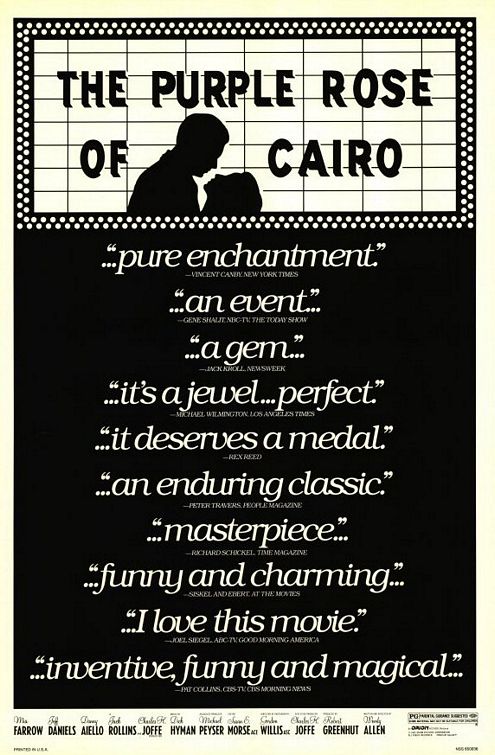
Coming Soon: The Purple Rose of Cairo (1985)
Woody Allen makes the list. The neurotic little New Yorker
is hit or miss with me. The one and only time I watched this movie, it was a
miss. I’ll try again very shortly. Come on back to see if I change my mind with
this little historical flight of fancy.
Please be sure to pick up all empties on the way out.

 Director: Daniel Minghella