

Note: The Decalogue was initially released as a ten-part
television series, with each episode being a story in and of itself, though
there is some crossover. As such, I will be offering my review in 3 parts – one
for the first three films, another for the middle four, and a third for the
final three episodes.
Director: Krzysztof Kieslowski
Initial
Release Country: Poland
Times
Previously Seen: none
Part
IV Rapid Fire Summary:
A
widowed father and his 20-year old daughter share an apartment (in the same
building as the mathematician, the doctor, and others whose tales have already
been told). He is an architect who often travels, and she is studying theater.
The two seem to have a rather odd relationship that is much more playful,
bordering on flirtatious, than most accepted father-daughter norms.

Thus begins Part IV. This is just the first of several oddly playful interactions between the daughter and father. Things get even more tangled and strange as the story unfolds.
When
the father one day leaves the country on a trip, the daughter discovers a
letter from her deceased mother, one that her father has been keeping secret
ever since her mother died giving birth. She struggles over whether to open it
or not. When she meets her father at the airport, she tells her father that she
discovered and opened the letter. She recites it, revealing that he is not her
true father.
This
sets off a strange sequence of emotions for them both. The daughter, feeling
that her “father” is no longer that, believes that they have a deeper and more
sexual attraction for one another. She makes advances on her guardian, who
seems to consider his own feelings deeply, but he refuses. She then admits that
she never opened the letter from her mother and she had forged the entire
letter, in order to figure out just how they felt about each other.
The
two decide to burn the actual letter, thus leaving the question about her
parentage ever floating above them both.
My
Take on Part IV
“Honor
they father and thy mother”
This
is my best guess as to the thematic commandment of this episode. This story is
an strange one to take, though the awkwardness subsides quite a bit by the end.
Quite a bit, but not wholly. Since we the viewers don’t know the true nature of
the seeming father/daughter’s complicated relationship, it is queer and
uncomfortable to see the way they interact. Even the way that they work towards
a resolution seems bizarre and difficult to relate to.
Still,
in and of itself, the story is as strong as any of the previous episodes. I
realize that this is becoming a common thread between most of the stories in
The Decalogue – otherwise normal people exploring one or two very singular
aspects of or incidents in their lives. In Part IV, the pair’s situation is
highly unusual and, emotionally, extremely complex – even stomach-churning to
watch at times – but it works. Just watching the episode might make you
reconsider your definitions of love and lust, and where and how these two blend
into each other. Adding the layer of family into the equation makes this tale
one that provides some very challenging notions to ponder.
Part
V Rapid Fire Summary
A
young vagrant, Jacek, around twenty years old is on the street, angry, and
desperate. He wanders the streets, committing random acts of petty cruelty and
vandalism. He does show occasional, brief moments of kindness, but mostly seems
alone and violent.
Jacek’s
violence is fully realized when, after cunning planning, he leads an unknown
taxi driver, an almost equally cruel and vice-ridden man, out into the
countryside. There, Jacek strangles the man, then brutally bludgeons his head
with a rock to kill him. There seems to be little reason for the murder, outside
of theft and Jacek’s blind need to hurt someone.
Jacek
is captured by police, and, after a year in jail, has a hearing relating to his
sentence of death. A young defense attorney makes a compelling case against the
state’s execution of the young man, but clemency is denied. On his final day,
Jacek’s lawyer stays with him before and completely through his terrifyingly
cold execution by hanging.
My
Take on Part V
Of
the first five episodes, this one and Part I are the ones that will stay with
me for a very long time. Predating the similarly-themed film Dead Man Walking,
this film is a very mature, unflinching look at the brutality of murder. By
showing the two murders in all of their grim detail, Kieslowski forces us
viewers to give some hard thought to whether there is any real difference
between a murderous act by an individual or the state. Like Part I, this one is
certainly no picnic to watch, but it’s probably a film that every person should
watch at least once.

One of the few moments that Jacek smiles, as he plays a little game with some young girls passing by. These small moments add humanity and tragedy to the otherwise nasty young man's story as murderer and murdered.
As
with the other episodes, visual artistry abounds. There are so many
well-planned and executed moments of foreshadowing, juxtaposition, and allusion
that any fan of the craft of visual storytelling can appreciate this film on
many levels.
This
one is a dark, captivating gem.
Part
VI Rapid Fire Summary
A
roughly 20-year old boy/man has a job as a quiet post office employee. He
passes his free time obsessing over an older, female artist who lives in the
apartment building across from him. He uses a telescope to peep on her sexual
exploits, and he leaves fake money order receipts in her mail slot, so that she
will come into his post office and give him a chance to interact with her. On
top of this, he takes an extra job as her milk delivery boy, just to be closer
to her a few more times every week.
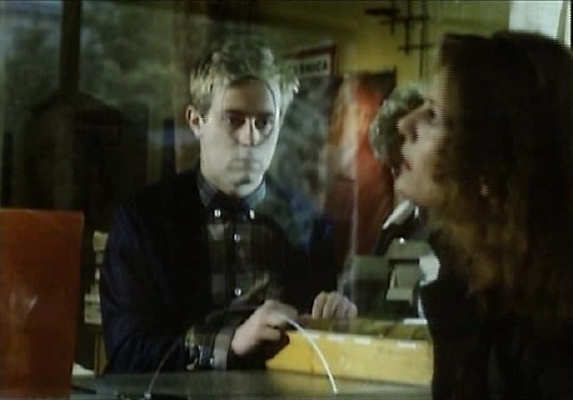
One of the first moments when the young, obsessed man lures his neighbor to the post office where he works. Their story of idealized romanticism, lust, and seduction is a novel combination of both juvenile and mature approaches to the act of sex.
Eventually,
he gives in and admits his obsession to her. Rather than completely shun this
desperate young virgin, the woman engages him in odd ways. It starts with
allowed voyeurism, but it escalates into virtual torment when she brings him
home to debunk his immature notions about romantic, idealistic love. She
seduces him so slowly and alluringly that he “releases” his pent-up desires
long before the physical act ensues. Completely ashamed, he runs home and
attempts suicide. The woman sees that her attempt at a hard lesson has gone
totally wrong, and she grows very concerned about him.
The
young man lives and, after several days of hospitalized recovery, returns to
his job at the post office. The woman goes to visit, and it is clear that the
young man is over his obsession of her, though it was nearly at the highest of
costs.
My
Take on Part VI
At
this point, I am unsure that this episode (or any of them for that matter) have
a clear “commandment” as its source. Still…
This
one is another peculiar one, on par with episode IV (above). It features two
people behaving rather outside of the norms, though the young man’s behavior
falls within typical, juvenile norms. It is rather uncomfortable to watch him
awkwardly peep on the object of his affection, with no real idea how to satiate
his desires.
As
with other episodes, this one goes far deeper than something so simple as
adolescent lust. The man’s desire has clearly developed into a warped
romanticism, and the woman is extremely sophisticated. As uncomfortable as it
is to watch, it is intriguing to see just how she exacts her “lesson” to him.
It’s not just an interesting intellectual exercise, but it’s also one of the
steamier scenes you’ll ever see.
A
final welcome ingredient is the humor. I know that any story containing an
attempted suicide isn’t going to be a yuk-fest, but this one has plenty of
funny little moments. Most of them are provided by the young man’s bumbling
towards his neighbor.
Overall,
a very different theme and tone than the previous “murder” episode, so this one
was a welcome addition to the series.
Part VII Rapid Fire Summary
A
22-year old woman, Majka, steals her own 6-year old daughter from her own
mother. Her mother has been raising the girl, telling her that she is her mother,
rather than her grandmother. This was done to avoid scandal, as the girl was
the result of Majka’s having slept with her teacher in high school. Now,
though, Majka has grown tired of her domineering, school-mistress mother, and
she threatens to take her daughter to Canada
Majka
brings her daughter to the house of the girls’ father, who has retired from
teaching and is in business making teddy bears. Majka and the man discuss her
plans, which seem half-baked, at best. When he goes out for a trip, Majka runs
off with her daughter again. Eventually, Majka’s parents find her at a train
station, as she awaits a train to the airport where she hopes to leave the
country with her daughter.
As
her mother takes her daughter from her, Majka hops onto the train and looks
back at her family standing on the platform. We do not know if she will ever
see them again.

The tenderness between Majka and her daughter is short-lived and often corrupted by multiple circumstances surrounding the two. Seeing Majka try to find some solace for them is not an easy watch.
My
Take on Part VII
This
is another one that leaves you emotionally raw, like episodes II and V. It’s
simply no picnic.
More
than those episodes, though, there are calmer moments when we can learn more
about the characters’ relationships and what has led them to such desperation.
While this is another episode that is simply too bleak to warrant repeated
viewings for me, I have to say that it’s just as strong than any other episode.
The trends of incredible acting and exceptionally well-defined characters
easily held my attention.
This
episode, as much as any of them, displays Kieslowski’s ability to imbue a short
film with an amazing amount of depth. Despite economical use of dialogue, so
much is conveyed about deep and complex relationships, that the characters
become highly familiar by the end of each chapter. Episode VII is a perfect example of this.
That
is not a wrap. Still three more episodes to watch and review, so come on back
for my reviews of Parts VIII through X.
SECOND
INTERMISSION…


