Showing posts with label Lillian Gish. Show all posts

Saturday, September 13, 2014

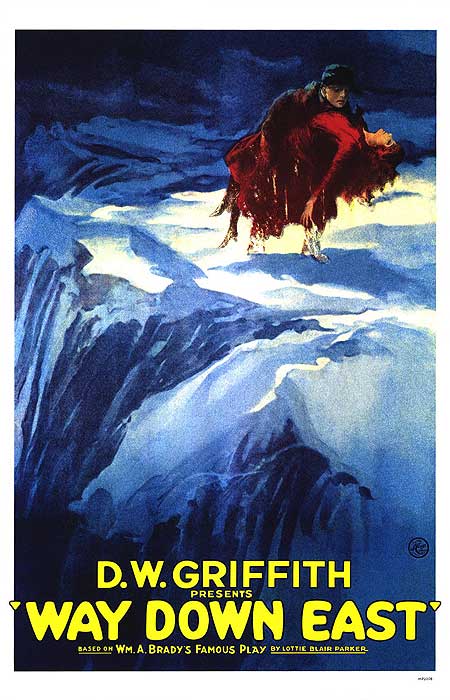
Before I Die #520: Way Down East (1920)


Director: D.W. Griffiths

This is a film that clearly stood out in its day. By tackling the sensitive social issue of gender inequality and double standards, Griffiths wasn't going down an easy road. For that, the film is highly commendable. However, like nearly all silent films viewed nearly a century later, this one didn't hold my attention for its two-and-a-half hour duration.

The story follows Anna Moore (Lillian Gish), a simple girl living in very modest circumstances in New England. In an attempt to garner some much-needed financial support, Anna travels down to Manhattan to visit some extremely wealthy relatives. In the middle of the upper-class jet set, she is seduced by a wealthy and unscrupulous playboy, Lennox Sanderson. Sanderson not only seduces her, but sets up a sham marriage in order to deceive and sleep with her. Anna becomes pregnant, Sanderson abandons her to her fate, and she eventually loses the baby to illness.
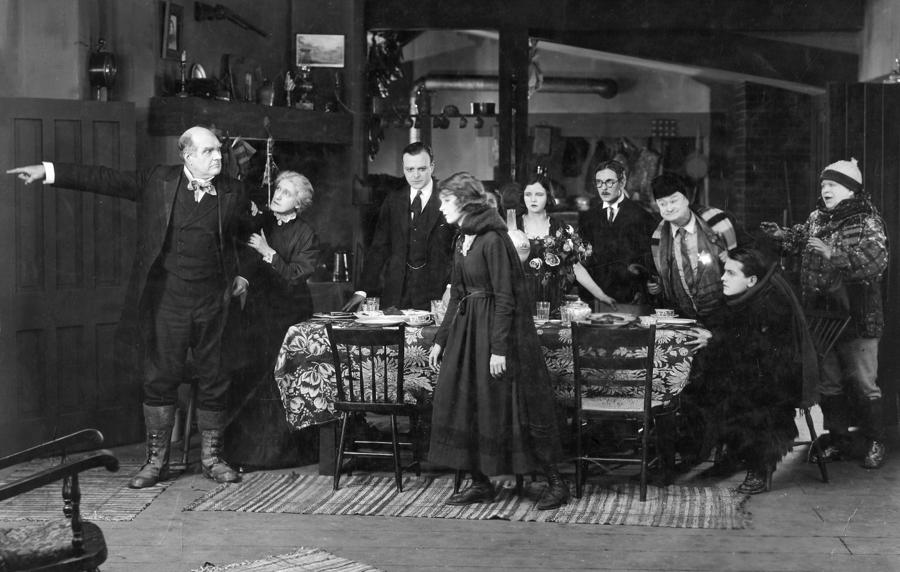
Anna is, quite literally, shown the door after the conservative
and bombastic Mr. Bartleby learns of her "shameful" past.
Now a "stained woman," Anna moves to a new town, where she assumes a new name and finds work doing various chores for the Bartelbys - a prosperous farming family; however, the family lives near the estate of the Sanderson family, whose son Lennox was the cause of Anna's misery. The Bartleby son, David (Richard Barthelmess), falls in love with Anna and hopes to marry her. Eventually, though, Anna's past catches up with her. Through gossip, people learn about her past "marriage" and child, and her employer turns her out. In a fit of misery, Anna becomes lost and almost drowns in the nearby frozen river, but David manages to save her. The two get married, along with two other couples in the town.

If the film had stuck to telling the story summarized above, it probably would have been an hour shorter, much more intense, far tighter, and a film that holds up extremely well 94 years later. Alas, the film doesn't maintain a coherent tone. Mixed in throughout an otherwise thought-provoking tale are bewildering moments of slapstick comedy more at home in a Buster Keaton or Charlie Chaplin movie, though not nearly as funny. It seemed an extremely odd film for such things. My guess is that this was simply to keep hold of a 1920 mainstream audience's attention, instead of having them deal with a heavy drama the entire time.

Another reason that this movie was a bit taxing is the same reason as nearly every other silent film - the overblown gesticulations. Admittedly, Lillian Gish was much more subtle in her gestures and movements, which was what made her one of the greats of her era. Richard Barthelmess is a bit more nuanced, as well. Nearly all other actors, though, go over the top. The stomp around, contort their faces, and generally act as if they are still giving a stage performance for children. I understand that this was all a part of the great transition from stage to film in the first few decades of cinematic storytelling, but it doesn't make it any easier to watch.

The rejected and dejected Anna, passed out on an ice floe,
awaiting a death that would a welcome release. But hey,
it's still Hollywood, right? We know Hollywood can't
let such a dismal thing happen.
The climax of the film is a mixed bag for me. The scene on the river is actually very impressive. There are some well-done stunts with David hopscotching across ice floes to rescue Anna, which could not have been easy to pull off with 1920 technology and effects. Yet it still looks pretty decent. I must admit, though, that the "all's well that ends well" ending was a tad disappointing. Maybe it was a bit of pandering to the audience again, but I feel the film would have had far more power if Anna had been allowed to die, leaving those responsible to live with how their attitudes caused it. Instead, we have a male hero dash in and save the damsel in distress, which somewhat perpetuates the stereotypes that the movie sought to tear down.

It's a good movie, to be sure, but I'll never need to watch it again. The theme holds great weight, and there is some notable acting, set design, and technical skill. Still, the movie has lost more than a little since it was created. 

Thursday, September 4, 2014

Before I Die #518: Broken Blossoms (1919)


(This is the 518th film I've seen of the 1,149 "Films to See Before You Die" list that I'm working my way through.)

Director: D. W. Griffiths

It's not hard to see why this film has a place in film history, but it's not exactly a revelation.

The tale is a simple one, with an admirable and progressive message. A young man, Cheng Huan, decides to move from his home country China to London in order to bring the solace of Buddhism to the West. After a few years, though, instead of saving souls, he finds himself scraping by in the impoverished Limehouse district. Not far away, a young girl, Lucy (Lilian Gish), is perpetually battered, both physically and mentally, by her horribly abusive father, the rage-filled, xenophobic "Battlin' Burrows." After her most recent beating, Lily stumbles into Cheng's shop. The compassionate Cheng nurses her back into health, falling in love with her. Confrontations are, of course, set up between Cheng and Burrows.

It's an honorable story, especially for the year 1919, when compassion for immigrants, especially from the Far East, was not exactly en vogue. On top of that are the themes of feminism and domestic abuse, which are other areas that mainstream cinema rarely chooses to go, even today. In that respect, Broken Blossoms is a highly respectable film.

One of the many close-ups. This one is of Burrows. The
portrayal of this rage monster was typical of the silent-film
era: completely overdone to the point of hilarity in the eyes
of a modern viewer. 
Of course, it takes a certain type of fan to "love" a silent film like this one. I can't say I'm one of those hardcore types. Though only 89 minutes, the film does drag by modern standards. There are a lot of lingering shots of Lucy cowering, Burrows scowling and snarling, and Cheng pining. I understand that such close-ups and extended shots were quite revolutionary for the time, but in 2014 they've just been far outstripped by the succeeding 95 years of film. And the narrative cards use some laughably inane poetry to tell the story.

And then there's the racism. Amazingly, this film actually has a message about compassion and breaking down barriers. And yet, it was still clearly a slave to the prevailing attitudes and language of its time. The alternate title of this film was The Yellow Man and the Girl, and Cheng is most often referred to as "Chink" by most of the Londoners, and even "Chinky" by his lady-love Lucy. It's pretty hard not to cringe every time it comes up.

Yes, it's a "great" film. But don't go out of your way for this unless you're very much an aficionado of silent film or the history of social commentary in film.