Showing posts with label social commentary. Show all posts

Wednesday, January 22, 2020

New(ish) Releases from 2019: Booksmart and Parasite

Booksmart (2019)

Director: Olivia Wilde

A new teen comedy to add to the canon of 21st century-classics.

Booksmart follows in the spiritual footsteps of Superbad by following a crazy day in the life of a couple of close high school friends, Amy (Kaitlyn Dever) and Molly (Beanie Feldstein). Amy and Molly are overachievers who are primed for upper-echelon universities, and they are in their final week of classes before graduating. But once they realize that all of their peers, to whom they had felt academically superior, are also getting into top-notch schools on the strength of skills unknown to the prideful young ladies, massive regret sets in. Namely, that they had wasted some of their high school years studying rather than occasionally cutting lose and having fun with their classmates. In an attempt to remedy this, they decide to go all-out and attend a massive graduation party where they will have all of the fun that they skipped during their previous years of study. Of course, the line to the party quickly becomes anything but straight, and the girls are sent on a rather wild, epic evening of craziness.

While the overall premise and structure of Booksmart aren't particularly novel, it breaks a few barriers by focusing on young ladies who are incredibly smart, funny, and can be every bit as raunchy as their male counterparts. While my 44-year-old self was probably not quite as entertained as a younger person might be, I still found plenty to laugh at and appreciate. The Odyssey-like journey goes through various episodes, some funnier and more creative than others, which keep the pace moving along nicely.

The strength is in the performances of Dever and Feldstein, who are great in their turns as Amy and Molly. I can't imagine that it's easy to pull off uproarious comedy in the same film where two actors need to build some genuine sympathy and heart with the audience, yet these two young stars pull it off.

I don't know that I'll go out of my way to watch this one again, but I could very easily see myself surfing across it, stopping, and staying on for the rest of the ride. At least, at any point in the purely-comedic first two acts. Things get a bit more dramatic in the third (as you would hope for a buddy comedy that aspired to be a bit more than comedy), but it's an entertaining trip worth jumping into at nearly any point.


Parasite (2019)

Director: Boon Jong-Ho

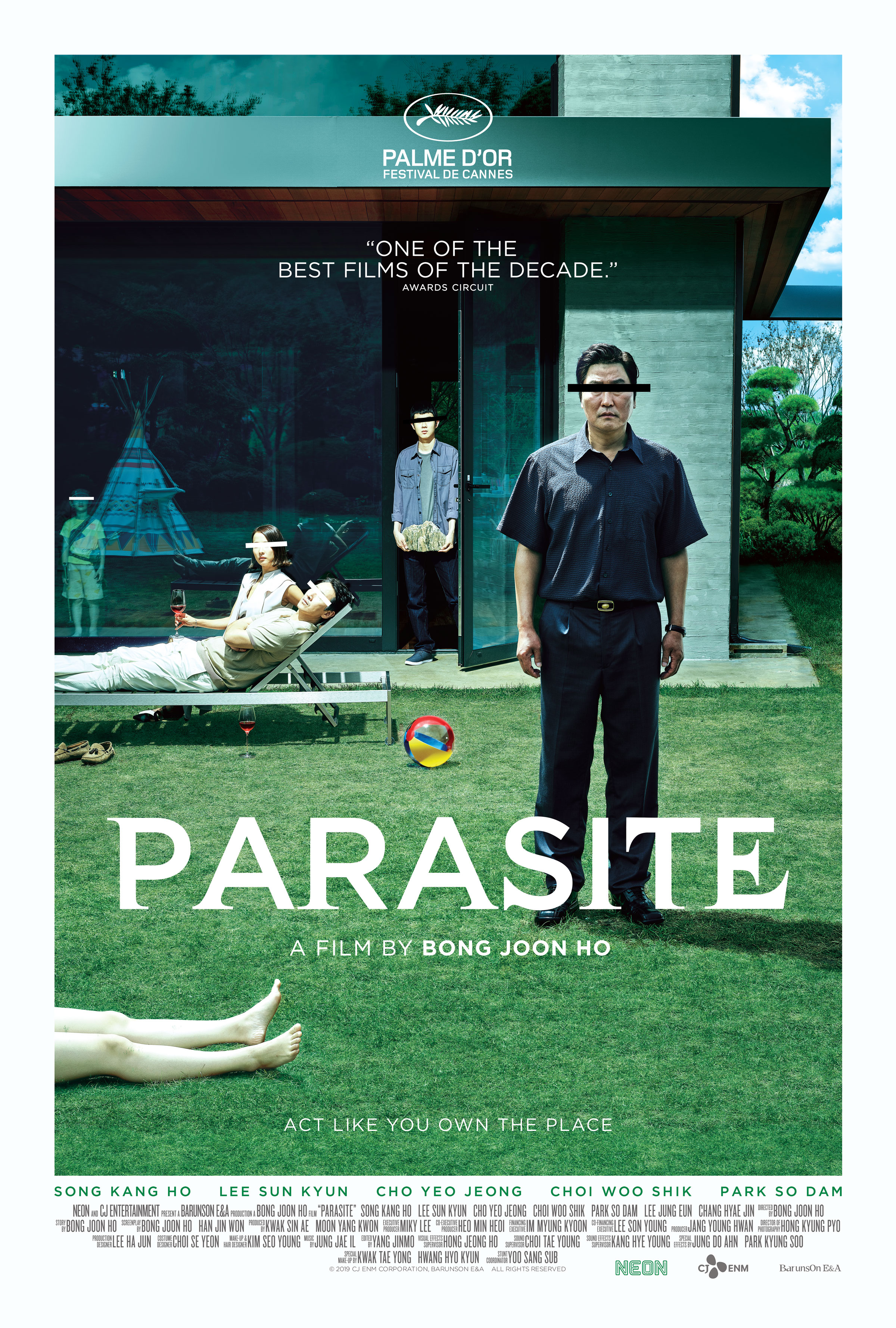
Brilliantly crafted and executed social thriller/dark comedy by a modern Korean master who seems to just keep getting better and better.

Parasite follows young South Korean man Ki-woo and his family, the Kims. The Kims are quite poor, though they all seem to be rather intelligent, if sometimes morally dubious, survivors. Ki-woo takes an opportunity to fill in for a friend as an English tutor to the 15-year old daughter of a very wealthy couple, the Parks. Ki-woo gets the job by lying about his credentials and keeping up a good front to the rather gullible Mrs. Park. The money is so good that Ki-woo finagles jobs for his family members, as well. But once the Kims get deep into the Park's lives, things take a strange turn which jeopardizes the entire scam.

A simple, spoiler-free summary of the premise hardly does this movie justice. As with director Boon's 2013 sci-fi dystopian film Snowpiercer, Parasite has a strong theme revolving around socio-economic class. The interactions both within and between the Kim and Park families say a ton about the relationships between the upper- and middle/lower-tiers on the economic spectrum, not just in South Korea but in any society. This is what elevates the story far above a mere thriller.

And suspense-thriller is what you get on the movie's surface, which it does extremely well. While it takes a bit of time for the mystery and suspense elements to kick in, they hit hard when they do; I guarantee that, if you don't know anything about the movie, then you will never be able to see where some of the twists are taking you.

The Kims, trying to make ends meet by folding pizza boxes.
What might have been completely depressing in another
movie is, in
Parasite, comical and revealing.
But, unlike say, an M. Night Shyamalan movie, Parasite goes well beyond its twists for its real impact. As already stated, the plot turns and rising tension serve to do more than simply build drama. They offer sly and sometimes brutal commentary on relations between people of very different means.

One might be tempted to think that Parasite is some horrific, dark tale that will leave one endlessly disturbed, but such is not really the case. Yes, there are dark elements to it, and even some horror elements. But there is also plenty of humor of various types, some dark but some very light. And this range of tones and gags is brought off splendidly by the flawless cast, most notably all four of the Parks - Ki-woo (Choi Woo-sik), Ki-jung (Park So-dam), Chung-sook (Jang, Hye-jin), and Ki-taek (Song Kang-ho). The others are great, but these four charismatic hucksters really make you pull for them and really make you feel the pain when tragedy hits.

I expect Parasite to rake in more than a few major awards (I think it already has, at the time that I write this), as it really is an outstanding movie. If you haven't seen it, I can't recommend it enough. While there are elements that may seem strange to those more accustomed to traditional narratives, if you can go in with an open mind and try to read in between the lines a bit, you won't be disappointed. 

Friday, September 19, 2014

Retro Trio - a Whit (Still)man Sampler: Metropolitan (1990), Barcelona (1994), and The Last Days of Disco (1998)

Metropolitan (1990)


Director: Whit Stillman

For the first fifteen minutes, I was close to turning this one off. By the half-hour mark, it had done just enough to keep me interested. By the end, I felt it was decent.

In a style drawing some rather clear tones from Woody Allen, Metropolitan focuses wholly on coming-of-age yuppies in Manhattan of the 1980s. I know, I know. It sounds pretty horrible. And honestly, during those aforementioned initial fifteen minutes, it was really demanding. The only thing to carry it through was the story of the protagonist, Tom - an idealist lower-middle class guy who finds himself dragged into the summer routine of the far wealthier class. He goes along initially as an observational experiment, to witness first-hand the "evils" that such classes embody. Conflicts start to arise, though, when he begins to fall for one of the girls who is part of the group - the sweet, pretty, and unassuming Audrey.

It's this conflict that provides nearly all of the watch-ability of the film. That, and the performance of Chris Eigeman as Nick, a cynical and self-confident yet affable motormouth who befriends Tom and attempts to guide him through the minefield of protocols that the upper class walks along. If it weren't for Tom's story and Nick, the movie would have fallen very flat.

Some of the dullness comes from the theme of the "snob" class itself. It's just far too difficult to get very wrapped up in their little plights and concerns. Although Stillman is mostly mocking them, the mockery isn't often all that funny. The more glaring weakness, though, is the performances. Several of the actors are simply not very good. The most obvious one is Taylor Nichols, who plays the annoyingly pedantic and self-righteous Charlie. Nichols completely overplays how neurotic and obsessive Charlie is, to the point that I could barely take his presence on the screen by the end of the film. Fortunately, he doesn't get a great amount of screen time, until the very end.

It's a decent movie. The fact that it was Stillman's first was enough to urge me to watch his next effort...

Barcelona (1994)

It's a better film than Metropolitan, if still not exactly a masterpiece. Following the relationship of two cousins - Ted, a stuffy salesman, and Fred, a shallow military diplomat - the movie details their dysfunctional interactions with each other and the women with whom they fall in love and lust. Everything is set in the titular city in Spain, where anti-American sentiment and ultra-sensitivity to fascism go hand-in-hand, much to the chagrin of Fred. The two cousins intermittently grow annoyed with each other, come to love the same woman, and generally get in each others' way, as they have since they were very young boys growing up in the U.S.

The movie is more consistently funny than Stillman's first movie, with the jokes being a bit sharper, and the characters being more consistently engaging. There is also the far more vibrant setting of Barcelona itself, which provides flashier locales and characters for Ted and Fred to interact with.

The movie is far from a home run, though. The writing, like Metropolitan, often seems a little more fit for the stage than for cinema, lacking the organic naturalism that one should expect to get in the medium. Detracting further from any feel of authenticity is the casting of Taylor Nichols as the main protagonist. As annoying and stilted as his performance in Metropolitan was, it is amplified in Barcelona, seeing as how he plays the main character Ted. I honestly do not know what Stillman saw in Nichols that he cast him in such a major part, but his performance was distracting in its weakness. Fortunately, Stillman also saw fit to give the second biggest role to Chris Eigeman, who once again carries the movie by playing the self-absorbed, fast-talking, and ever-contradictory Fred.

Barcelona is a step up from Metropolitan, though I didn't find it to be any sort of "breakout" film. It still smacks very heavily of being a Woody Allen movie clone, though a slightly watered down one.

The Last Days of Disco (1998)

The Last Days of Disco is probably the strongest of the three films, even if I don't find it a work of excellence.

My lack of full praise is probably due to my tempered interest in the central character type - the yuppie. Even with some decent dialogue, dramatic episodes, and an atmospheric setting, I can only care so much about the yuppie class of the 1980s. Ultimately, it is a self-absorbed type who wear on my viewing patience, not unlike the wealthy types who are the focus of the screwball comedy genre of the '30s and '40s.

The Last Days of Disco chronicle the relationships and professional woes of a handful of young people in Manhattan in, as the film states with an introductory caption, "the very early 80s." This, of course, was just when the death knell for the disco era was pealing, and the glamour that went with the disco club scene was fading out. This all sets up some fairly amusing scenarios, as those desperate to cling to the waning fashions and glamorous hedonism of the previous decade are forced to mingle with ad executives and other yuppie white collar types who were attempting to mark many of the chic areas of Manhattan as their domain. The blending of different types is fairly comical at times.

What is hard to get past is just how unlikable most of the characters are. Stillman tries to make them humorous by letting them air their views, which are usually shallow, callous, or just plain mean-spirited. Sometimes it was humorous, but often it was merely despicable, leading to my complete understanding of the late-'80s catchphrase, "Die, yuppie scum."

So I've given Whit Stillman more than a fair shake, and I think I'm done with him. Over the course of his first three films, I saw a bit of progress in the technical aspects of the movie, but the topics and characters never did enough for me to completely buy in. 

Saturday, September 13, 2014

Before I Die #520: Way Down East (1920)


Director: D.W. Griffiths

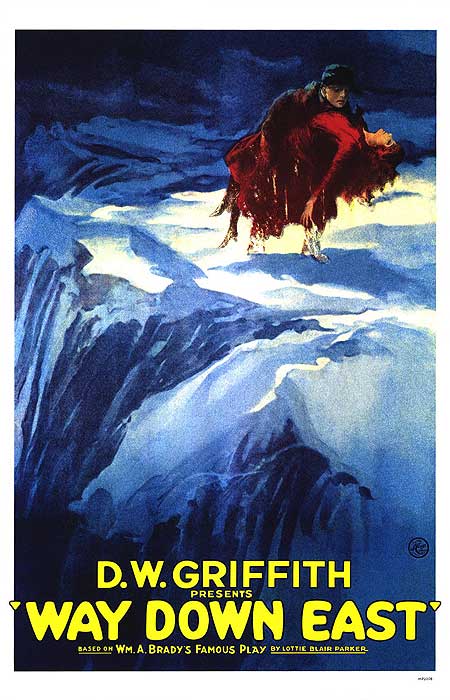
This is a film that clearly stood out in its day. By tackling the sensitive social issue of gender inequality and double standards, Griffiths wasn't going down an easy road. For that, the film is highly commendable. However, like nearly all silent films viewed nearly a century later, this one didn't hold my attention for its two-and-a-half hour duration.

The story follows Anna Moore (Lillian Gish), a simple girl living in very modest circumstances in New England. In an attempt to garner some much-needed financial support, Anna travels down to Manhattan to visit some extremely wealthy relatives. In the middle of the upper-class jet set, she is seduced by a wealthy and unscrupulous playboy, Lennox Sanderson. Sanderson not only seduces her, but sets up a sham marriage in order to deceive and sleep with her. Anna becomes pregnant, Sanderson abandons her to her fate, and she eventually loses the baby to illness.

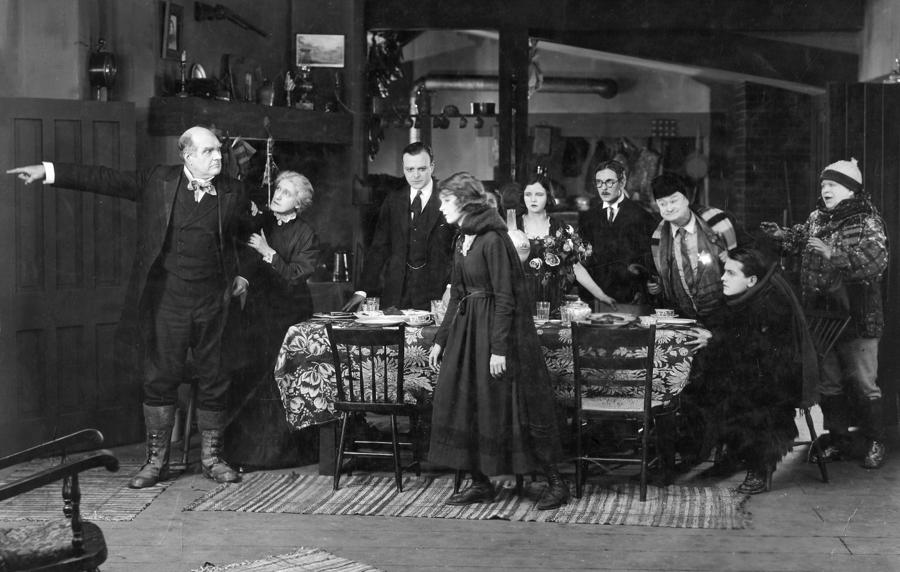
Anna is, quite literally, shown the door after the conservative
and bombastic Mr. Bartleby learns of her "shameful" past.
Now a "stained woman," Anna moves to a new town, where she assumes a new name and finds work doing various chores for the Bartelbys - a prosperous farming family; however, the family lives near the estate of the Sanderson family, whose son Lennox was the cause of Anna's misery. The Bartleby son, David (Richard Barthelmess), falls in love with Anna and hopes to marry her. Eventually, though, Anna's past catches up with her. Through gossip, people learn about her past "marriage" and child, and her employer turns her out. In a fit of misery, Anna becomes lost and almost drowns in the nearby frozen river, but David manages to save her. The two get married, along with two other couples in the town.

If the film had stuck to telling the story summarized above, it probably would have been an hour shorter, much more intense, far tighter, and a film that holds up extremely well 94 years later. Alas, the film doesn't maintain a coherent tone. Mixed in throughout an otherwise thought-provoking tale are bewildering moments of slapstick comedy more at home in a Buster Keaton or Charlie Chaplin movie, though not nearly as funny. It seemed an extremely odd film for such things. My guess is that this was simply to keep hold of a 1920 mainstream audience's attention, instead of having them deal with a heavy drama the entire time.

Another reason that this movie was a bit taxing is the same reason as nearly every other silent film - the overblown gesticulations. Admittedly, Lillian Gish was much more subtle in her gestures and movements, which was what made her one of the greats of her era. Richard Barthelmess is a bit more nuanced, as well. Nearly all other actors, though, go over the top. The stomp around, contort their faces, and generally act as if they are still giving a stage performance for children. I understand that this was all a part of the great transition from stage to film in the first few decades of cinematic storytelling, but it doesn't make it any easier to watch.

The rejected and dejected Anna, passed out on an ice floe,
awaiting a death that would a welcome release. But hey,
it's still Hollywood, right? We know Hollywood can't
let such a dismal thing happen.
The climax of the film is a mixed bag for me. The scene on the river is actually very impressive. There are some well-done stunts with David hopscotching across ice floes to rescue Anna, which could not have been easy to pull off with 1920 technology and effects. Yet it still looks pretty decent. I must admit, though, that the "all's well that ends well" ending was a tad disappointing. Maybe it was a bit of pandering to the audience again, but I feel the film would have had far more power if Anna had been allowed to die, leaving those responsible to live with how their attitudes caused it. Instead, we have a male hero dash in and save the damsel in distress, which somewhat perpetuates the stereotypes that the movie sought to tear down.

It's a good movie, to be sure, but I'll never need to watch it again. The theme holds great weight, and there is some notable acting, set design, and technical skill. Still, the movie has lost more than a little since it was created. 

Monday, August 15, 2011

Film # 58: Dr. Strangelove: Or, How I Learned to Stop Worrying and Love the Bomb (1964)


Director: Stanley Kubrick

Initial Release Country: United States

Times Previously Seen: Roughly 7 or 8 (Last time – about 5 years ago)

Teaser Summary (No spoilers)

Wingnut general unleashes nuclear bombers on Russia. Loads of bizarre and hilarious characters fumble their way through the insanity.

Extended Summary (More complete synopsis; spoilers included. Fair warning)

In the middle of the Cold War, at Burpelson Air Force Base, deranged, rogue brigadier general Jack D. Ripper (Sterling Hayden) sends out a “go” code to an entire fleet of bombers. His orders are for them to dump their nuclear payloads onto scores of targets inside the Soviet Union.


General Jack D. Ripper - the man who seeks to annihilate the entire Soviet populace based on a rather...unusual theory.

When word of this catastrophic attack command reaches the U.S. War Room, General Buck Turgidson (George C. Scott) is called to confer with the country's executive and military leaders. Turgidson is a buffoonish hawk, completely caught up in the Red Scare, and suggests that the U.S. simply allow the unauthorized attacks to take place, as this will give them the upper hand in a Third World War. President Merkin Muffley (Peter Sellers) scoffs at this and starts the process of contacting the U.S.S.R. In an attempt to warn the Soviets and seek a solution.

In the air and fast approaching Soviet air space in the crew of one of the B-52 bombers, this one being flown by Major “King” Kong (Slim Pickens). The crew is rather nervous about getting the attack codes, as it signifies the start of all-out nuclear war. Still, the crew is determined to carry out their mission.

Back in the War Room, it soon becomes very clear than recalling the bombers is an impossible task. General Turgidson explains to all present that recent and obscure legislation allows for a single general to enact an attack under his own authority under certain provisions. While these provisions were not met, the rogue General Ripper has ceased to care. The President grows more desperate.


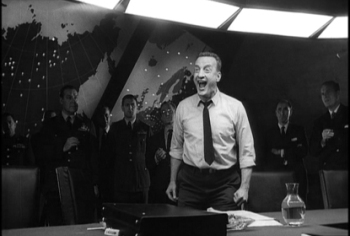
General Buck Turgidson continues his half-baked attempts in the War Room to bulldog the rest of his peers and superiors into pressing the attack on Russia.

Back at Burpelson, British group captain and executive officer Lionel Mandrake (Peter Sellers again) soon discovers that the supposed Russian attack is not true, and he confronts General Ripper. Ripper locks Mandrake into his office and explains his reason for launching the bomber attack: he believes that the communists are taking over American “bodily fluids” through fluoridation. At this point, it is clear than General Ripper is thoroughly insane. Mandrake demands the recall codes, but to no avail. He must await his psychotic superior's next move.

In the War Room, President Mandrake calls on the Soviet premier and calls in the Soviet diplomat in an attempt to resolve the crisis. In explaining the impending catastrophe, it is revealed that the Soviets have just created a “doomsday device” that will exterminate all life on the face of the earth, should any attack be made on the Soviet Union. The choices are now stark – the president enacts two assaults: one by the Americans on Burpelson Air Force Base, in order to wrest the recall codes from Ripper; and another, Soviet attack on the B-52 bombers that are rapidly approaching their targets inside the Soviet Union.

At Burpelson, the base has come under attack by the U.S. Army, and Ripper fights back. With Mandrake attempting to reason with him, Ripper keeps up his fight until the last moment. When it is clear than he can hold out no longer, Ripper commits suicide, seemingly taking the recall codes with him into the hereafter. However, Mandrake puzzles out the codes from some of Ripper's desk scribblings. After a bizarre hold-up at the hands of a dense and over-zealous army officer, Mandrake reaches the president.

In the War Room, the government's plan seems to have worked. The Soviets have shot down many of the American bombers, and the codes sent along by Mandrake have recalled all of the others. All, that is, except...

...the B-52 piloted by Major Kong. Their coding equipment having been shot up, they have not received the recall code from base. In addition, they have eluded all attempts to shoot them down. With gumption that is almost admirable, they make it to one of the targets and attempt to drop their payload. However, the bomb doors are jammed. In a final act of wherewithal, Major Kong straddles the bomb, fixes the bomb door wiring just above it, and rides the bomb down to its target. Nuclear winter has begun.


Major Kong succeeds in bringing his payload. Personally.

Back in the War Room, the mood is understandably somber. That is until the floor is taken by the wheelchair-ridden Doctor Strangelove (Peter Sellers, yet again), an ex-Nazi-turned American adviser. He seems oddly chipper about the entire scenario. He explains that the world's leaders can survive within caves beneath the earth. In his scenario, he suggests that the military and political leaders will take precedence and that they will have ample provisions to survive. In addition, in order to repopulate the earth after the fallout clears, they will need a high ratio of women to men. The cherry on top is that these women will need to be exceptionally attractive, so as better to allow the men to function in their role as procreators. With all of this to ease their worries, all of the men in the War Room seem to have already moved far beyond the nuclear apocalypse taking place above their very heads, to the point that they are already plotting how to get a leg up on post-Apocalyptic competitions with the Russians.

Did I Like It?

If you noticed how many times I've seen this film before, the answer is obvious. This most recent viewing did nothing to change my mind – this movie is one of the greatest comedy films of all time.

Now sure, there are probably other movies that I've laughed at more, and there are probably some comedies that have been wittier. But for balancing sheer inventiveness, zaniness, and canny social commentary, Dr. Strangelove is all but untouched.

While the theme of lampooning the Cold War era political philosophies of fear-mongering and arms racing may seem dated, it surely is not. The entire notion of the pre-emptive strike will never go away, and Dr. Strangelove takes the idea to its Swiftian extreme. Considering how the specter of nuclear holocaust continued to haunt the world for decades after the book and movie's release, Dr. Strangelove has serious staying power. By pushing the era's prevailing martial ideologies a little (I stress “a little”) further, it's easy to see how laughably insane they were. (We can laugh now, anyway.)

Beyond the brilliance of the story line and its execution is the real strength of the movie – the actors. Dr. Strangelove is mostly populated by caricatures goofy enough to laugh at, but also frighteningly real for what they represent. Such a strange balancing act can only be pulled off by just the right cast, and this film got it perfectly. Sterling Hayden as the chillingly calm, thoroughly insane General Ripper is as horrifying as he is hilarious. (His interactions with Mandrake are some of my favorite scenes in any movie). I can't imagine gung-ho pilot Major King Kong being played by anyone other than uber-hick, Slim Pickens. Even the bit role of Sergeant “Bat” Guano is done to pitch perfection by Keenan Wynn and his fantastically mispronounced catchphrase, “pre-versions”. As excellent as all of these, and other, actors are in the film, they are far surpassed by one of the all-time greats.

Peter Sellers, who had some of the most memorable comic performances of all time throughout his career, pulled off his greatest feat in Dr. Strangelove. In playing the amusingly sober Commander Mandrake, the oddly pliant President Muffley, and the hilariously twisted title character, he utilized every one of his considerable acting skills. It's been said of Sellers that few people (if any) actually knew the real man, for he would so completely lose himself in the characters that he was playing. In watching Dr. Strangelove, it's not hard to believe this. If you didn't know better, you may not even guess that the same actor is playing all 3 vastly different roles, as each of the three is busting your gut in vastly different ways. Just seeing him is more than worth the price of admission.


Officer Mandrake does his best to weather the storm of deranged General Ripper's apocalyptic dementia. Seller's role as Strangelove may be more iconic, but his turn as Mandrake is far funnier to me.

One interesting mental note I made as I watched the movie this most recent time – I had a moment of emotional guilt, not unlike when I was watching Double Indemnity earlier in the list. At the moment when the B-52 crew is trying to desperately make their bomb run, I felt myself pulling for them. Major Kong, the all-guts patriot/pilot redneck, shows no end of moxy by shrugging of missile attacks, broken fuel lines, and other malfunctions to get to his target and drop his payload. As I watched him almost single-handedly overcome each obstacle, I admired the simple yet brave soldier. Then I realized, “Wait a minute...this guy's about to trigger the ultimate nuclear winter!!!” There's something about watching a truly determined character use sheer willpower to smash through barriers that's gratifying, often regardless of their ultimate goal.

So yeah – I love this movie. I'll certainly watch it many more times in the years to come, and I can't recommend it highly enough. There may be a few moments where things seem a little slow (particularly in the B-52 scenes), but this film is a masterpiece the likes of which may never be duplicated.

That's a wrap. 58 films down, 48 to go.


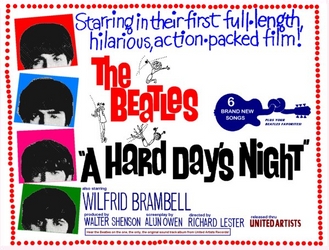
Coming (Very) Soon: A Hard Day's Night (1964)


The Fab Four in one of their early feature films. I certainly respect, if not exactly love, the Beatles. Let's see how they did on the silver screen.

Please be sure to pick up all empties on the way out.

Sunday, January 16, 2011

Film #47: Pyaasa (1957)


Title for Us English-Speaking Types:Thirst” or “The Thirsty One

Director: Guru Dutt

Initial Release Country: India

Times Previously Seen: none

Teaser Summary (No spoilers)Skilled but poor poet loses, laments, finds, loses, and finds love for women, if not humanity. Sings about it all.

Uncut Summary (The full plot synopsis, including spoilers. Fair warning.)
In 1952, India, the young poet Vijay (Guru Dutt) searches for love and work. He is clearly a very gifted poet who delivers his verses with an incredible singing voice. Yet, he is spurned everywhere he goes. While he would like to sing profound verses about lost love and the ills of society, publishers and audiences have no desire to listen.

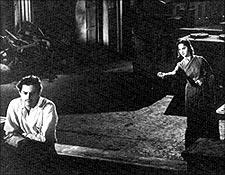
Vijay, left, receives just one of many rejections of his poetry from a publisher.
At his family's meager home, his mother tries to offer him a charity dinner, but his two older brothers heap shame and guilt on him for not being a “working” member of the family. Vijay then discovers that one brother has sold some of his poetry as waste paper. Despite his loving mother's pleas to either stay or take her with him, Vijay departs home alone.

In a nearby market, Vijay discovers that his poetry was sold to a woman who read and was interested in the verses. Alas, the vendor does not know the woman. Later that day, by the river, Vijay hears a beautiful young woman singing words that he had penned. He follows her to her home, discovers that her name is Gulabo (Waheeda Rehman) and that she is a prostitute. Vijay is far less concerned about this than getting his poetry back, which he does.


Vijay shares a close moment with Gulabo.

Soon after, Vijay is reluctantly dragged to a college reunion by a former classmate. There, he sees his past lover, Meena (Mala Sinha), with whom he had a storybook romance until she left him, inexplicably. At the reunion, he recites some extemporaneous melancholy poetry, which falls on ears that are all deaf except for Meena's and a quiet dark-eyed figure, Mr. Ghosh. Upon leaving, Vijay is met by Ghosh, who is a publisher and offers him a job, though only as a menial worker. Vijay accepts.

At Mr. Ghosh's publishing company, it soon becomes clear that Ghosh, though realizing Vijay's dream of using his poetry to reach the public, has no interest in publishing the young man's work, calling it “trash”. Vijay overhears this, but swallows his pride and stays on the job. That evening, he goes to work at a party at Ghosh's home, where a gathering of prominent poets is taking place. Here, Vijay discovers that Ghosh's wife is none other than his lost love, Meena. He breaks out into another mournful piece of sung poetry, which captivates all of the other poets there. Afterwards, Vijay sees that Meena left him for the promise of material wealth with Ghosh. It becomes clear to Ghosh that there is something between Vijay and his wife, leading him to fire Vijay.

Through all of this, Vijay occasionally runs across the prostitute Gulabo, who has clearly fallen in love with Vijay through reading his poems. Vijay seems attracted to Gulabo's loving spirit, but is conflicted over how to behave towards her.

A few days after his firing, a broke and homeless Vijay is lost in thought on the banks of the Ganges when he sees his two brothers giving last rites to someone. Vijay discovers that it was his mother, who has died before he could make any final farewell. He retreats to the home of a vice-ridden fellow poet and promptly gets drunk. Intoxicated, he drifts through the brothel area of the city and sings a rousing verse about the social ills of his country. Yet again, however, no one is listening.

A drunken and despondent Vijay unleashes his poetry on an uncaring red light district.

Financially and spiritually at rock bottom, Vijay resigns himself to suicide. He heads towards some nearby train tracks, and even gives his jacket to an emaciated vagrant, who then quietly follows him to the train yard. Just as Vijay's about to throw himself in front of an oncoming locomotive, the vagrant gets his foot caught on a different track. Vijay goes back to pull him free, but fails. Vijay survives, but in a state of shock. In a case of mistaken identity, the country at large believes Vijay to have been killed by the train, thanks to the jacket that the vagrant had been wearing when run down.

Thinking her love to be dead, Gulabo goes to Ghosh to publish Vijay's surviving poems, not knowing Ghosh's feelings towards the young man. Instead, Gulabo finds Meena in the office, and quickly discerns that Meena was the inspiration for so many of Vijay's poems of lost love. Just as this discovery is made, Ghosh arrives. He gladly accepts Vijay's poems from Gulabo, realizing that he can reap enormous profits from the presumed-dead poet.

Ghosh's plan works all too well. Vijay's poetry is a nationwide publishing sensation, touching the dispossessed souls of the populace and raking in millions. However, a problem arises for Ghosh – Vijay awakens from his stupor in the hospital. He is initially put into a sanitarium for claiming to be the famous poet Vijay, and is kept there after Ghosh, a former colleague, and even his own brothers refuse to identify him. They realize that their gravy train will most likely only continue rolling as long as Vijay is “dead”.

Eventually, Vijay manages to escape with the help of his friend, local massage oil salesman and goofball, Abdul Sattar. It has now been a year since his “death”, and Vijay follows a throng to a memorial service in his honor. At the service, the ever-cunning Ghosh lambastes the audience for being the reason that Vijay committed suicide. Seeing the scene and infuriated by the greed, avarice, and materialism he sees at work, Vijay breaks into an impassioned verse railing against these social ills. All present are stunned, including Gulabo, who is the only one who is genuinely joyed to see that Vijay is alive.

After the public revelation that he is alive, Vijay's former detractors and enemies turn coat and try to ally themselves with him now that he is on the verge of becoming immensely wealthy by acting as the country's living voice. At what is meant to be a public recognition of his true identity, Vijay disavows his name and leaves the angry mob to tear each other apart, only further acting out the very corruption that Vijay no longer wants a part of.

That night, at her brothel, a saddened Gulabo slinks into deep feelings of loss. This changes when, much to her surprise, Vijay appears at the gate. In his eyes is a profound melancholy as he tells Gulabo that he is going to go away. When she asks to where, he simply replies that he will go until he does not need to go any farther. He asks Gulabo if she will go with him, to which she gives a wordless smile. The two walk, hand in hand, into the night.

Vijay arrives at Gulabo's brothel to announce his departure from society.

Take 1: My Gut Reaction (Done after this first viewing, before any research)

It's now been about 24 hours since I watched Pyaasa, and I can't get it out of my head. This is a good thing.

After my girlfriend and I watched the movie, we were both rather quiet as we absorbed everything that had been thrown at us during the movie's two-and-a-half hours. As you can see from the mere length of my earlier synopsis, there are plenty of pivotal plot points, which make for a epic story. Add to this the Bollywood mode of adding music, and you now have an even larger piece of work. But it was neither the storyline nor the extended soundtrack that gives Pyaasa its weight. No. It's the tone and the themes.

Anyone who has read my reviews of the musicals Meet Me In St. Louis or Singin' In The Rain knows that the genre is probably my least favorite. While Pyaasa is clearly a musical, I found that I didn't mind the songs. Unlike so many Hollywood musicals, these Indian numbers were not invasive or written merely to be independent hit songs that were shoehorned into the picture (this is something that I found Meet Me In St. Louis particularly guilty of). Rather, the songs in Pyaasa are artistic expressions of the characters' feelings, and it is these very feelings that sets the movie even further above its musical brethren.

Nearly all musicals that I've seen are optimistic in tone. Sure, there may be a sad little tune thrown in here and there, but everything is generally upbeat. The songs in Pyaasa, however, have a beautifully melancholy attitude running through them all. Whether they're about unrequited love, frustration at a diseased society, or a resigned acceptance of both, there's a genuinely Romantic power to them that is absent from most musical soundtracks. In fact, the only other “sad” musical that I have seen is Lars Von Trier's uber-downer, Dancer In the Dark, but that film brought depressing to new lows despite how skillfully it was made. Pyaasa taps deeply into the ennui but it never dragged me so far down that I couldn't see a certain amount of beauty to it.

Here's a clip of one of the great songs. There are no subtitles, but the emotions are as clear as can be. This is from the class reunion at which Vijay sees his past love, Meena. I needn't explain just how he feels about her:


On top of all of this, the music is, on the whole, fantastic. While I don't really like when the singers send their voices soaring into the wavering, higher registers, the rest of the time the vocalists displayed amazing chops. All of the songs were either catchy or touching, depending on the requirements of the scene. A few songs may have gone on a tad too long, but many were quick hitters that popped up and then got out of the way of the story. I find that I really like the Indian styles with the sitar, accordion, and percussive instruments.

Another general strength is the overall story. Granted, the notion of a gifted and tortured artist being unappreciated and scorned by society is hardly new. Still, this movie imbues Vijay with thoughts and words that tap into the more universal plight of humanity. The vehicle of the love stories is a bit hackneyed, and even the “mistaken death” plot line is a rip-off of Sullivan's Travels, but the movie is effective in making the larger points.

As far as the other technical merits, they were a somewhat strange hodgepodge. Director and star Raja Dutt apes the visual and musical scoring style that had preceded him. Cinematography-wise, one can see many similarities with earlier Hollywood masterpieces like Citizen Kane and Casablanca. He does it very well, even if he wasn't exactly breaking new ground. The score is an odd scattering of popular melodies ranging from classical European to snappy American folk. The shifts were sometimes strange, bordering on comical, but they don't greatly diminish the overall film.

The acting is another point that is a mixed bag. The primary actors, especially star and director Raja Dutt, are excellent. However, most of the other parts are overdone in the throwback melodramatic styles of previous decades. It doesn't help that much of the dialogue is rather simplistic an stagey.

Would I watch this movie again? Perhaps. I have to say that the DVD version I watched appeared to be an older edition. This made for some questionable subtitles and a rather grainy look. If a reliable company like Criterion Collection were to give it a facelift and some updated translation, I would love to see it for the more polished aesthetics.

Pyaasa was a pleasant surprise, and one of the more singular films I've watched on the list yet. I can't say that it turned me into a Bollywood fan, but it has piqued my interest and given me some ideas and images that will stay with me for years to come.

Here's a clip of perhaps the most charged song in the movie. This is near the end, when Vijay sees the mob and his enemies figuratively feasting on his presumed corpse. He can take no more, and his song slowly builds to a fever pitch by the end:


Take 2: Why Film Geeks Love This Movie (Done after some further research)

Wow. Of the 47 films that I've watched for this blog thus far, Pyaasa wins the award for having the least amount information available. I'm sure this would be different if I could speak Hindi. I can't, so there's little to add to my own subjective views above.

There are a few interesting odds and ends, though. One is the all-too familiar tale of studio meddling. Raja Dutt wanted the ending to be Vijay walking off alone. The studio, certainly fearful that such an end would alienate a larger audience, demanded that Gulabo go with him. I have to say that, unlike the other movies in which such modifications were mandated, I was alright with this one. Maybe I was simply in a more romantic mood while watching it, but I was glad that my heart could hang its hat on something after Vijay's wholesale rejection of society.

On a minor, more amusing note is that the film crew wanted to film the red light district scene (maybe the most powerful and beautiful of the entire film) on location in Calcutta. They made it there, but were run off by a pack of local pimps. Among all of the problems that film makers have faced in history, I can't say that I've heard of such a thing.

Here is that famous scene in the brothel area. This is when Vijay is overwhelmed by the state of affairs in his beloved country:


That's a wrap. 47 shows down, 58 to go.

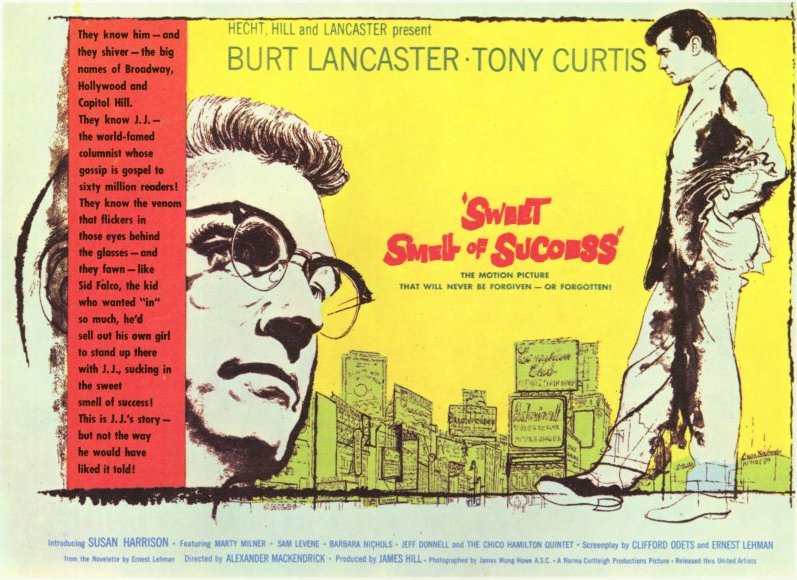
Coming Soon: The Sweet Smell of Success (1957)
Watched this one about a year ago, and thought it was decent. I've always enjoyed Burt Lancaster, and he plays a real piece of work in this one.

Please be sure to pick up all empties on the way out.

Saturday, January 1, 2011

Film #44: Invasion of the Body Snatchers (1956)


Director: Don Siegel

Initial Release Country: United States

Times Previous Seen: once (about 8 years ago)

Teaser Summary (no spoilers)

Doctor discovers growing fear of strange, replica impostors of the denizens of his all-American hometown.

Uncut Summary (Full plot synopsis, spoilers included. Fair warning)

In a Californian hospital in the mid-1950s, Doctor Miles Bennell (Kevin McCarthy) is raving and being restrained by the police. A psychiatrist arrives on the scene and calms Bennell down into semi-coherence. All he can muster, though, is that everyone is in danger of some kind of looming menace that has taken over his hometown of Santa Mira, California. Once further eased, Bennell traces his story back...

A few days prior, he had returned from a conference out of the state to his hometown. Santa Mira seems like the fully realized American dream town, as defined by widely shared post-World War II sentiments: white picket fences, a clean downtown area where the tallest buildings are a mere three stories, and a populace of genial folks, all of whom know and like each other. Upon his return, all seems to be normal to Dr. Bennell. Then, slightly odd things emerge:

While driving back to his office, he nearly runs down a local boy who is running from his grandmother, screaming that his mother is “not his mother.” When Bennell returns to his office, his nurse informs him that nearly all of the patients who had scheduled appointments earlier in the week had canceled, saying that they were now fine. In addition, a cousin of Bennell's former girlfriend, Becky Driscoll (Dana Wynter), claims that her uncle is no longer her uncle.

Becky Driscoll and Doctor Miles Bennell.

This final claim spurs Bennell to investigate. He goes to Becky's cousin's house where the young woman explains that, while her uncle looks the same and has all of the same memories, there is a strange lack of emotion and tenderness in his eyes that had always been there previously. Bennell feels that it is simply some kind of misunderstanding and assures Becky's cousin that it will surely pass.

That evening, Bennell begins to try and rekindle his past relationship with Becky. However, before he can make any real progress, he receives an urgent call from a friend and local writer, Jack Belicec and his wife, Teddy. Bennell goes to their house to find their shocking discovery laid out on their pool table: a lifeless, humanoid form that bears a close resemblance to Jack. No one is sure where the body came from, but they decide to leave it there, with the Belicecs keeping an eye on it, while Bennell takes Becky home.

Jack Belicec reveals his discovery of his own pod replica to Bennell and Becky.

At the Driscoll house, Dr. Bennell gets a disturbing feeling from Becky's father, whom he finds ascending from the basement below. He leaves, only to sneak into the basement and find another near-facsimile growing in their basement dumpster, this one resembling Becky. Bennell sneaks upstairs and rescues a slumbering Becky from the house.

Back at Bennell's house, the doctor calls the police and brings them to the Belicec's to see the “Jack” replica. The doppelganger, however, is now gone. Bennell then brings them to the Driscoll's to expose the “Becky” form, which is also gone. Just then, another police officer tells them that they have just found a burned body matching the description of the “Jack” form. The investigators chalk Bennell's notions up to delusions, and the doctor is sent home.

The next day, things start to become eerily normal again. The young boy and Becky's cousin, both of whom had claimed close relatives to no longer be themselves, now have no problems and claim that everything is fine. That night, while preparing a barbecue with the Belicecs, Bennell makes a harrowing discovery in his greenhouse: four bizarre, large plant pods. As he watches, they hatch and spill out steadily growing human shapes, each one taking on the structure of the four people present. They try to call the police, but the operator tells them that all lines both within and outside of the city, are busy. Bennell gives up and decides to leave the house with Becky, but not before destroying the pod bodies. The Belicecs decide to try and escape town on their own, leaving Bennell and Becky to do the same.

In traveling through the town, the two quickly discover that essentially all of their friends and neighbors have been transformed into pod people. Not only that, but they are trying to do the same to Bennell and Becky. The two see no immediate way out of town, and pursued by the police, escape into Bennell's office in town. Here, with some time to think, they decide that he pods take over a person's identity when the person sleeps. With this in mind, they dose up on amphetamines and decide to wait until morning.

After the sun rises the following day, Becky and Bennell see the greatest horror thus far. In the middle of town, hundreds of the people of Santa Mira, now clearly pod people, gather thousands of new pods to disperse to outlying towns and neighborhoods. The goal is clear: eventually turn every living human into a pod creature. Jack Belicec then shows up at the office with a few police, though we quickly learn that they are now, too, pod people, and the full, horrifying story is told. A few weeks prior, a few pods had rained down from space and landed near Santa Mira. The plants are parasites that can mimic any living form and take over their identities by absorbing their minds when they sleep. The new person seems to be a perfect copy, physically and mentally. The one thing missing, though, is emotion. The pod people who explain all of this to the doctor and Becky implore them to give up, ensuring them that emotions such as love are more of a hindrance than a help. The two refuse to listen and fight their way out of the clutches of their near-captors.

Becky and Miles flee from the now completely replicated townspeople of Santa Mira.

Now alone and completely on the run, Becky and Bennell frantically flee from the entire town of Santa Mira. They hide briefly in a cave, throwing the townspeople off of their trail for a few hours. Bennell eventually leaves Becky in the cave to investigate the outside, but the exhausted woman can no longer stay awake on her own. Bennell returns to her to discover that she too is now a pod person. He runs for the highway and just manages to beat the chasing townspeople.

Flash forward to the hospital. Doctor Bennell's story has failed to convince anyone of any more than that he is suffering from an intense hallucination. That is, until they receive a call from the local police detailing a traffic accident that has just sent a large truck spilling out the contents of its bed: hundreds of strange, pod-like structures. Hearing this convinces everyone in Bennell's presence of the veracity of his story, and they rush out to combat the menace. The viewers can only assume that they will emerge victorious.

Take that, you green, replicating pieces of space trash!

Take 1: My Gut Reaction (Done after this most recent viewing, before any research)

Pretty average.

Invasion of the Body Snatchers has a mildly interesting plot with some thought-provoking psychological suggestions, but ones that have been plumbed far deeper and more skillfully by many a talented science fiction writer (see anything by Philip K. Dick, for instance). The acting is adequate, but certainly nothing special. The direction and cinematography are solid, but far from revolutionary.

So why is this movie considered such a seminal one in science fiction films?

I'm sure that my further research will reveal or confirm some of my suspicions about the answer to this question, but there are several easy speculations to make:

One is that it may have been one of the first sci-fi movies to strike at deep, universal psychological fears. The clearest one is the ever-present question about human emotion. Is love truly such an enviable feeling? When one considers the pain and suffering that it can cause when lost, how many of us would really clutch so tightly to it? This is the question that the pod people pose to Bennell and Becky towards the end of the movie. Their response is the typically humanistic one – an outright refusal to exchange ostensible peace for their ability to retain their emotions. Still, while this is a curious thought experiment, its one that probably requires a more austere setting than a “vegetable aliens crash land and take over” context to ponder with any true gravity.

Here's the link to a youtube clip that gives a good sense of when things get cranked up: the all-American barbecue with friends so rudely interrupted by usurping space plants. (Sorry for the lack of an embedded clip)

The more obvious explanation for the endurance of this movie is the time in which it was made. Of course, 1956 was when the Red Scare of communism was roughly at its height. Though the ideal of a “perfect America”, as envisioned by Anglo-Americans, had crystallized and been informing popular entertainment (a la Leave it To Beaver, The Andy Griffith Show and The Honeymooners), the perpetual threat was the notion of communism. And of course, detractors of communism claimed that it was a system in which people would become little more than machines, whose sole purpose was to subsist and procreate. Invasion of the Body Snatchers clearly latches onto this primal fear of Americans and runs with it. There's even a moment during the grand exposition in Bennell's office when the doctor asks, “So, we would all be the same?” to which the pod person responds, “Yes.” Pretty hard to miss that one.

While the concept of using science fiction as a vehicle to create symbolized versions of communism isn't unique (I'd be remiss if I didn't mention The Blob, filmed here in my home of Phoenixville, PA), I believe that Invasion may have been the first film to be so blatant about it. The science fiction veneer is so thin that I find the filmmakers' notions a bit ridiculous: that viewers would equate the blank-faced pod people spawned by extraterrestrial plants with the reality of communism. It borders on contempt for one's intelligence, perhaps no more so than during the finale, when a frantic doctor Bennell is running along the highway, screaming for help and madly attempting to explain his pursuers: he stares directly into the camera and yells, “You're next! You're next!!” It may as well have been Senator Joseph McCarthy himself doing it.

The final aspect of this movie that I feel may be seen as influential is the juxtaposition of the bizarre and terrifying with the exceptionally “normal.” By giving the viewer the town of Santa Mira, a carefully-constructed vision of the Utopian, 1950s American ideal, and injecting an all-consuming, hidden, alien threat, it relies on the time-tested formula of tapping into the terror of the familiar and comfortable becoming alien and deadly. It's something that has been notably used by the likes of David Lynch in Blue Velvet and the cult classic TV show, Twin Peaks. Invasion a of the Body Snatchers is the earliest piece of film work that I've seen that uses this combination, and I suspect that it may have influenced later filmmakers.

Whatever the reason is for this movies's status within the cinema world, I feel no need to watch it again. Science fiction to me, a person who really loves a good sci-fi tale, is all about ideas. The primary thrust of it all, from H.G. Wells' The Invisible Man, through Dick's Do Androids Dream of Electric Sheep (a.k.a Blade Runner), to Darren Aronofsky's The Fountain, is the emotional and social impacts of humans' increasing grasp on universal knowledge and technology. These stories are, by nature, cautionary tales, but the best ones are not so heavy-handed with the warnings. Invasion of the Body Snatchers doesn't make much pretense about its political and social commentary, and its one that is rather outdated in my view. And while sometimes a science fiction film's other qualities can overcome an outmoded theme, Invasion doesn't quite hold up in 2010.

Take 2: Why Film Geeks Love This Movie (done after some further research)

In reading a bit more, I realize that my first take may be a little bit harsh. Still, I stand by the general feeling that, while it's far from a bad movie, Invasion of the Body Snatchers is not one that I would rate nearly as well as other science fiction movies.

First of all was that this movie suffered that same, cruel fate of several others: the Hollywood studio demand for a more “up-beat” ending. The result was that, instead of the original intended ending of Doctor Bennell running maniacally down the highway, screaming “You're next!!”, we got the happier version in which the earth will be saved by people's zero-hour realization of the invasion. Hence, in the same fashion as films like Baby Face, The Lady Eve, and others, Invasion of the Body Snatchers just misses the chance to leave its audience a bit more ponderous for being left with a more fatalistic outcome.

The lingering question and area of debate over this movie is, to no one's surprise, the allegorical question. Was it meant to be a commentary on McCarthyism or not? While director Don Seigel and star Kevin McCarthy (nominal coincidence, anyone?) deny this, I remain skeptical. Some also argue that the story is meant to warn against the danger of general conformity, whether it be through communism or dogmatic political stances. This is likely the reason that it has been remade three times, most recently in 2007's The Invasion.

Whether the film's creators had any specific political agenda or not, it is clear that the engine that drives the movie is people's fear of losing their emotions and individuality. When this is taken into account, I have to give the movie a little more credit. When one does watch and think about it, there are clearly several frightening notions suggested by the ultimate goals of the pod people.

Here's another link to the iconic ending scenes. Once again, no ability to embed the clip into the link, unfortunately.

The only other factoid of interest that I dug up was a very curious cameo. During a very brief scene at Dr. Bennell's house, Bennell nervously discovers the local gas man in his basement, reading the meter. That young, thin, polite and mustachioed young man is none other than “Bloody” Sam Peckinpah, the visionary director who would make some of the most revolutionary and violent popular films in history, notably The Wild Bunch and Straw Dogs. “He wasn't an real conformist, but he did play one in a movie.”

That's a wrap. 44 shows down, 61 to go.

Coming Soon: The Searchers (1957)

Yeee-Haaaawww!!! We finally ring in the Western in one of the best possible ways. Our first (but far from last) Western features none other than the embodiment of that truly American film creation: Mr. Marion Morrison, better known as John Wayne.

Please be sure to pick up all empties on the way out.

Thursday, March 4, 2010

Film #14: Le Crime de Monsieur Lange (1936)


Title That I Can Understand: The Crime of Mister Lange

Director: Jean Renoir

Release Country: France

Times Previously Seen: none

The Story (a summary of the plot; spoilers and all. Fair warning):

In Paris, France, Amedee Lange, a kindly, slightly naive employee for a small publishing company, toils nightly over a series of American western stories featuring a character named Arizona Jim, though the owner of the company simply laughs off any notion of actually publishing them. This owner, one Batala, is a complete scoundrel in a never-ending verbal dance to avoid facing his creditors and past lovers. On the verge of being sued, he gathers the companies funds, packs up and runs, leaving his company to deal with the disaster in his wake. Shortly after Batala hops a train out of town, we hear on the radio that the train has crashed, killing all aboard.

After the publishing company hears the news and panics for a short while, the remaining writers and artists, assisted by Batala's far more humane son, create their own co-operative and decide to publish the Arizona Jim tales. The stories become incredibly successful, and the co-operative find themselves in a new-found state of financial and social well-being, with even the shy Amedee finding love with Valentine, a beautiful and kind-hearted laundress who works nearby.

Just when things are at their height, Batala re-emerges. He had avoided death on the train and slinks back into the publishing office, threatening to reassert control over everything, take all that the co-operative has created, and perhaps even fire everyone out of spite. Upon revealing this dastardly plan to Amedee, the newly successful writer, refusing to allow the wanton destruction of so many people's lives, kills Batala and flees. At the border of France, Amedee and Valentine tell their tale to some local fishermen who have sympathy and help them flee across the border, presumably to safety.

Take 1: My Gut Reaction (done after 1 viewing & before any research):

Excellent movie, and this is saying something. I was exhausted when I started watching this, and the white subtitles were sometimes washed out by the white on the screen. Still, I was happy to fight through my fatigue and the visual barrier and see this film through to the end.

The story is told in classic flashback format. We actually open at an inn on the French border, and Valentine tells the whole tale to a bunch of locals. It works really well, as we immediately learn that this quiet and unassuming guy, Amedee, has killed someone. Great hook, right? It worked for me.

In a tight 80 minutes, you get a great feel for the setting, the characters and all the relevant plot points. It may be a touch rushed at times, but not distractingly so. I quickly developed sympathy for characters like Amedee, Valentine and others, while it took all of two minutes for the bile to rise in my throat at the sight of Batala. The publishing company owner, among a few other ancillary characters, may be a tad 2-dimensional, but he's certainly believable enough as a shifty, sleazy, if semi-charismatic, scumbag. It's another movie like Baby Face where a lot goes down in a concisely-told tale. I presume that this speaks to the director's skill.

The story itself is an interesting with one very deep question at its heart: Would you kill an inveterate leech of a human being to preserve the happiness of dozens of good people? It's one thing to ponder this hypothetical question on your own; it's another to see it play out amongst very believable, if fictional, characters. The murder doesn't come until close to the end. The rest is build-up and serves to create the power of the film.

Here's a clip from the end of the film. The subtitles are in Spanish, but just know that at this point, Batala, bastard extraordinaire, has returned and is explaining his plan to rob and gut the cooperative. Just watch Amedee's face towards the end - you can see the gears turning in his head, doing the math and having it all equal his final decision to murder:


Some may point out that none of the "good" characters is particularly strong. Amedee, the protagonist, is a bit of wimp in some ways, despite his good heart. Valentine is compassionate, but is overcoming past mistakes. The other characters' flaws are more glaring, but I think all of these add the humanistic element to the movie. By the time Amedee is faced with the choice to kill Batala, you completely realize what's at stake - the hard-earned joy of many very real people.

The acting may not be the best I've seen of the early films, but it's strong. A few of the simpler characters don't demand much range, so it's passable. The key roles of Amedee, Batala, and Valentine are played very well by Renee Lefevre, Florentine, and Jules Berry, respectively. This is all that matters.

I'd recommend this to anyone who likes old films and doesn't mind reading subtitles. The only drawback is that, right now, this one's a bit tough to find. It's not available on Netflix, so I had to order a VHS copy and pay $20.00 for it. Maybe it'll come out on DVD in the near-future, or you can find a copy at a video shop specializing in foreign and independent movies. If so, give it a shot if you want to dig into the past of solid cinema.

Take 2: Why Film Geeks Love It (done after some research on the film):

The handful of modern-day reviews of The Crime of Monsieur Lange seem to agree - it may not be absolutely perfect, but it's very unique in its mastery of telling an engaging, thoughtful tale that marries social commentary with genuine compassion, without either one becoming overbearing. Here's the short review by a fellow at TIME.

Apparently, the whole story of the cooperative springs from Jean Renoir's early affiliations with the far left movements in 1930s France. I suppose we're meant to see Batala as representing the thoroughly corrupt heads of industry. It may be a bit of a caricature, but it still works. The critiques I've read point this out as well as how Renoir didn't allow these elements to overwhelm the movie, raising it well above mere propaganda. This critic at Rotten Tomatoes puts it well.

The other lasting element is, as I had noticed, the very human characters. In later films of the French nouveau era that I've seen, like Breathless and Cleo 9 to 5, I feel like these "humanistic flaws" would become so commonplace and numerous that they led to characters who evoked no emotion from me, whatsoever. Decades before these, though, Renoir had the balance just right.

That's a wrap. 14 shows down. 91 to go.

Coming Soon: The Awful Truth (1937):

I've never seen this one, so my march through the unknown continues. Cary Grant's usually awesome, but this one is dubbed a "screwball comedy," which is a genre that I usually can't stand. Maybe this one will surprise me.
Please be sure to pick up all empties on the way out.