Showing posts with label Matt Reeves. Show all posts

Saturday, August 12, 2017

New, spoiler-free, Release! War for the Planet of the Apes (2017)

Director: Matt Reeves

A very solid ending to an overall strong trilogy, all much to my surprise.

A touch of my history with this series: for most of my life, I had never really known much about the "Apes" series of films, aside from knowing about the classic twist at the end of the original 1968 movie and the fact that there always seemed to be marathons of the first five Apes movies running on television on Sundays during my childhood in the early and mid-1980s. I also didn't bother with the attempted 2001 reboot directed by Tim Burton. I did watch about 5 minutes of it a few years after its release, which was enough to realize that it was certainly not to my tastes. It wasn't until last year, during a big screen showing of the '68 original that I decided to give it a go. My full review is here, but suffice it to say that I found that the movie has not aged well. As much as I love finding worthy movie series to get obsessed over, the original Planet of the Apes did not inspire an urge to seek out the subsequent four movies in the original series.

And so it sat until I couldn't ignore the overwhelmingly and consistently positive reviews of this most recent reboot, kicking off with Rise of the Planet of the Apes in 2011 and continuing in 2014 with Dawn of the Planet of the Apes. Rise was surprisingly good, if not completely flawless. I was impressed with how they handled the background stories plausibly and with some genuine heart. The sequel, Dawn, was a rather different movie directed by Matt Reeves (Cloverfield and Let Me In). Dawn was an even grimmer tale of a struggle for survival and identity, showing even more narrative and character savvy than its solid predecessor. At that second movie's end, the hyper-intelligent chimp Caesar and his large band of similarly-intelligent primates had defeated two aggressive adversarial factions - one ape and one human - to leave them relatively in peace amidst a world where humans have been nearly wiped out due to a simian-borne virus.

War for the Planet of the Apes picks up roughly five years after the events of Dawn, with Caesar and his community under siege from human military forces seeking to wipe them out completely. When a few members of Caesar's immediate family are killed in an assassination attempt on his life, he sends his community away to find a peaceful area farther to the east, while he and a few of his closest confidants attempt to track down and kill the man responsible for Caesar's loss - a military colonel played by Woody Harrelson. Caesar eventually finds the Colonel holed up in a small fortress with a loyal army of soldiers who are willing to kill and die for him in an effort to rid the planet of any remaining form of ape, as a form of perceived self-preservation.

The frozen, worn down shelter where Caesar's crew discovers
"Bad Ape" is one of several stunning and highly memorable
set pieces that grace the picture.
War is similar in tone to director Reeve's previous Apes movie in that it is mostly grim and severe, with only a few moments of levity. However, I never felt that this bogged down the movie, as the themes and questions raised are ones that are well worth pondering. There is also more than a little metaphorical food for thought, as one can easily view the harried apes as representing any one of the many groups of oppressed people throughout history. As one born and raised in the U.S., seeing enslaved apes being whipped, crucified, and eventually raising their fists in acts of defiant power quickly conjures up images of this country's historically brutal treatment of African Americans. It's especially hard to watch a scene in which Caesar, while being whipped, stares directly in the Colonel's eyes, and not see echoes of the similar and famous scene in Glory, with Denzel Washington offering Matthew Broderick's character the same icy glare. However, the apes could easily stand in for any "outsider" group who has been subjected to oppression and torture by those who fear them, whether its Jewish exiles of Biblical history or indigenous groups nearly everywhere in the world, Caesar's apes signify minorities' struggles throughout human history. One could probably get into a heated debate about using primates to represent such oppressed groups, but I felt that the movie handled it deftly enough.

But even such lofty themes can fall flat in films if they are not represented in sympathetic characters. As with Dawn, the film does an outstanding job with this, which is all the more impressive given that the most stirring moments are produced by computer-generated primates. Thanks to cutting-edge digital and motion-capture effects (the detail in Caesar's ever-more-vicious scowl is impeccable), along with some excellent physical acting by Andy Serkis and his "ape" cohort, it is easy to become invested in the plight of Caesar and his band. Enhancing the engagement on the character level is that the set pieces, environments, and other visual aspects of the film are outstanding, creating a cohesive look and feel to the entire movie.

I will say that, though the movie is solid top-to-bottom, it is one that I don't and perhaps won't feel the urge to see again. Despite the strength of virtually every element of the film, its grim tone and relatively unoriginal message (don't judge other groups until you know them) don't inspire repeat viewings for me. That said, I'm certainly glad I saw this final installment on the big screen, and I will be looking forward to future films that director Matt Reeves directs.

Wednesday, August 9, 2017

Retro Duo: Zodiac (2007); Dawn of the Planet of the Apes (2014)

Zodiac (2007)

Director: David Fincher

I actually saw this movie back in 2007 in the theaters and thought it was excellent. That was, however, the only time I had seen it until it popped up as streamable on Netflix about a month ago. After the mood struck me to fire it up, I was reminded of why I had such a high opinion of it a decade ago.

The movie tracks the investigation into the very real series of murders which took place in San Fransisco and other coastal California cities between the late 1960s and early 1970s. The killer infamously taunted the San Fransisco police department and media by sending letters to the major newspapers, daring them to try and discover his identity. Zodiac studies the years-long manhunt mostly through an unlikely vessel - San Fransisco Chronicle political cartoonist Robert Graysmith. As the Zodiac killer's letters arrive, Graysmith becomes more and more engaged in piecing the clues together to uncover his identity. Despite his many efforts, along with those of several dedicated and skilled police officers, the killer is never actually discovered or captured.

Zodiac is a highly unusual true crime movie, in that is offers none of the tidy satisfaction that many such movies serve up. Firstly, the murders are shown in a completely non-gratuitous way that truly chills one's bones. I greatly admire this approach, which prevents any sort of glamour from being placed on such vicious acts. Secondly, and perhaps most impressively, we do not get the satisfying, step-by-step detective tale that ends with the killer getting his just desserts. The road to identifying and arresting the man responsible is long, leads down many dead ends, and frustrates several good cops and earnest journalists into fits of near-insanity. By the middle of the movie, you can already feel these people's rage and feelings of impotence in the face of a murderer who not only brutally killed innocent people but also took pleasure out of taunting what he saw as the San Francisco establishment.

Telling such a tale in a way that is compelling cannot be an easy task, yet David Fincher pulled it off brilliantly. When I saw it in the theaters, I had a sense that the movie was overly long, though I did find it outstanding. During this second viewing, though, my sense of the movie being long-winded was completely gone. I could now see how each scene has its purpose and serves as its own small chapter in the greater tale. This is thanks to some strong writing and directing, as well as excellent performances all around by reliable actors like Jake Gyllenhall, Robert Downey Jr., Mark Ruffalo, and plenty of others. It should also come as no surprise that the cinematography and overall visuals are excellent - aspects of filming which Fincher never gives short shrift.

It's not a happy crime procedural in the vein of modern "Law and Order" shows, to be sure. But this is arguably one of the very best movies about a serial killer that has ever been made. If the topic itself is not too disturbing for you, I highly recommend setting aside the two-and-a-half hours to take this one in.


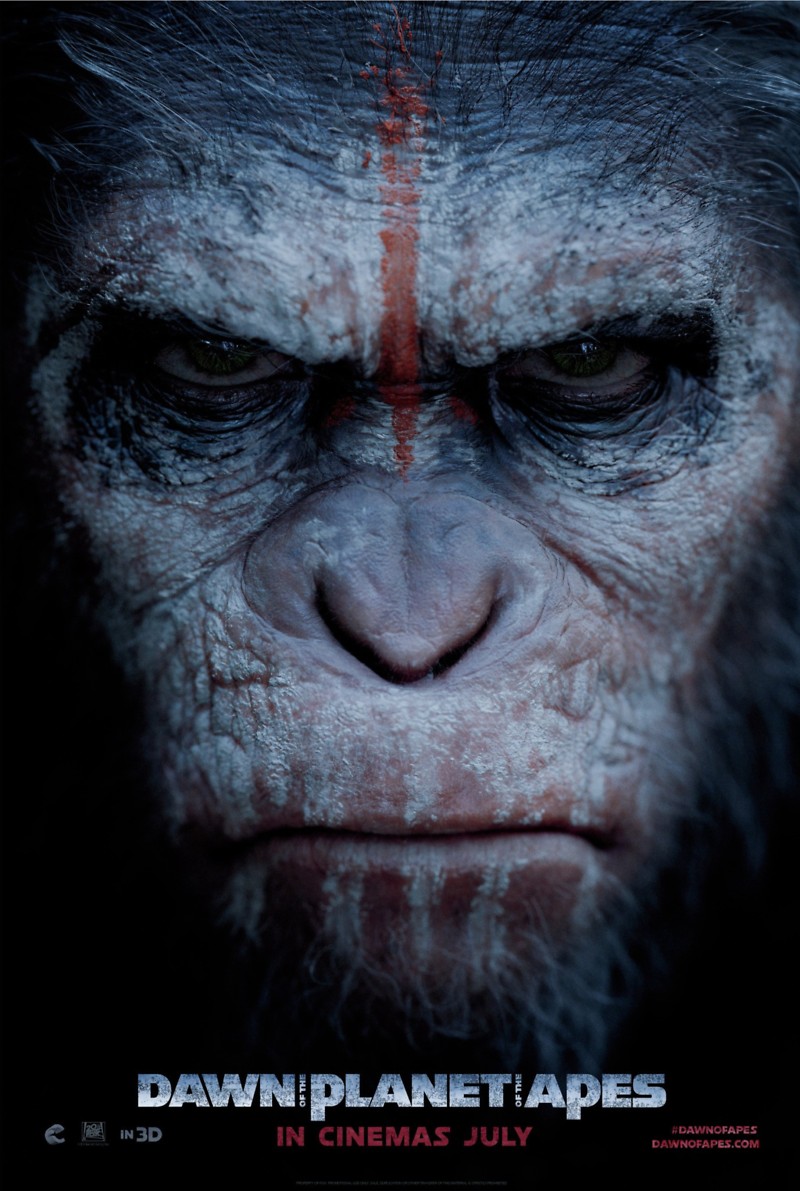
Cute little Caesar from the first movie
has learned a few hard lessons from life,
and he wears them in his gaze.
Dawn of the Planet of the Apes (2014)

Director: Matt Reeves

The second in the modern "Apes" trilogy, this was another surprisingly well-done follow-up to the equally solid Rise of the Planet of the Apes, released in 2011.

At the end of Rise, the exceptionally intelligent (thanks to genetic engineering) ape Caesar had led a large-scale escape of dozens of apes whom had been subjected to experiments and torture. Unbeknownst to Caesar, he and his brethren were also carrying a virus, known to humans as simian flu, which then began infecting the human population.

Dawn of the Planet of the Apes picks up ten years after the end of Rise. Most of humanity has been killed by the simian virus. Caesar is the head of a large clan of apes living in an organically-constructed town in the forests outside of San Francisco. Still with him are several of the apes which he initially set free, before the outbreak of simian flu. Most notable are the massive and quiet orangutan Maurice and the still-bitter, tortured, and pugnacious Koba. The apes all live in relative peace, and they haven't even seen a human in two years. That is, until they come across a small group of them nosing around the apes' forests. One human gets spooked and accidentally shoots Caesar's son, Blue Eyes. This sets off a chain of events leading to a fight between an angry contingent of the apes and an enclave of human survivors who have been scraping out a meager existence in the husk of old San Francisco.

As silly as I found the original 1968 Planet of the Apes in many ways, it is extremely difficult to find much that is silly about Dawn. Yes, there are apes running around, riding horses and using guns. On the surface, it can seem completely ridiculous. But the themes of warfare, vengeance, xenophobia, and superiority are all thoroughly relevant, and they are handled with surprising skill here. Thanks in no small part to the stunning visual effects of Weta studios and some amazing motion-capture performances by Andy Serkis and others, even the apes evoke genuine feeling that is often missing from all-human cast, struggle-for-survival dramas. The apes like Caesar and Koba speak in short, simple sentences, but many of their words carry immense weight, given the context, and show thought and emotion with which we can empathize. And since the context is a more primitive world, with very little electricity or advanced technology, the prominence of questions about existence and survival feel completely natural. The resolution blends its action with its drama quite well, with the stakes feeling quite high on both a material and emotional level; this is impressive, given just how much of it involved computer-generated primates.

While I may not feel the need to rewatch Rise or Dawn of the Planet of the Apes again any time soon, I found them both pleasant surprises and very solid films, especially the latter. Perhaps the best praise I can offer is that, while I didn't bother to catch either of the first two in the theaters despite positive reviews, I plan to catch the final installment of the trilogy on the big screen.