Showing posts with label Matthew McConaughey. Show all posts

Sunday, February 12, 2017

Retro Trio: My Big Fat Greek Wedding (2002); The Assassination of Jesse James by the Coward Robert Ford (2007); Mud (2012)

My Big Fat Greek Wedding (2002)

Director: Joel Zwick

No, rom-com fans, I had never actually seen this one before now. While I won't say that I regret letting all these years pass without seeing it, I can certainly see why it was such a sleeper hit 15 years ago.

For those unfamiliar, the story follows Toula, a 30-year old, single Greek-American woman whose massive, boisterous family shares a stifling concern over her state of being a bachelorette. When Toula does find a man whom she loves, Ian, things get no easier due to the fact that he is not of Greek descent, a situation which Toula's grecophile family can hardly wrap their minds around. The rest of the movie is mostly a comedy of errors and culture clashes between Ian and Toula's smothering but warm family. Ian comes from a laughably quiet, poised family composed of only himself and his overly stoic WASP parents, whereas Toula's family is a virtual army of caring and passionate but nosy and noisy siblings, aunts, uncles, cousins, and family friends.

The movie is certainly fun enough, and I was pleasantly surprised at how efficiently the story is told. While it hits the standard marks expected of a rom-com, it often comes at them from different angles and never really belabors the more familiar points. One example is the self-improvement montage, where Toula decides to "go from drab to fab" by redoing her wardrobe, hair, and makeup. I feel that other movies emphasize these types of makeovers and scenes too much, but Greek Wedding offers it to us in a crisp, less-than-60 seconds sequence that makes its point and then moves on. This is one of several examples of strong pacing which keep things moving along, an essential element of good comedies.

The cast is a great asset, as well. The script is decent enough, and all of the actors get to show off their comic timing to great effect. Not every gag or line hits, but enough of them do to keep the movie worthwhile. I'll probably never be a person who goes out of my way to watch a rom-com like this, but I enjoyed this one, and I could see myself watching it again with my wife.

Side Note: My wife recently tried to watch the sequel which came out last year, and she barely made it to the 5-minute mark. She said it was that bad. Apparently it was just trotting out the same, 14-year old gags and was generally annoying to her. This begs the question, if the film makers wanted to just do a stale, unoriginal sequel as a cash grab, why wait 14 years to do it?


The Assassination of Jesse James by the Coward Robert Ford (2007)

Director: Andrew Dominik

A rather novel entry into the list of American Western movies, and one whose box office draw fell far short of its merits.

As the lengthy title suggests, the film focuses on the final few years and ultimate slaying of notorious 19th century outlaw Jesse James. Unlike most Westerns, though, this one eschews glamorizing the best-known characters or relying on fast-paced, action-based thrills. Instead, the movie is a slow meditation on the eerie expansiveness of the West, the warped and often despicable character of Jesse James, and the gradual erosion of Robert Ford's romanticization of the infamous thief and killer.

Using the source novel of the same name, the  movie tells of the relationship between the two title characters. Around the late 1870s, Jesse James (Brad Pitt) and his gang have all but ceased the robberies which made them known throughout the U.S. and even the world, but they still hold a mythical appeal in many places. Robert Ford (Casey Affleck) is a young Missourian who has long idolized James, and he finally gets his chance to be a member of his gang during one, mostly-unsuccessful, train robbery. James has family ties in the area, and he uses them to wrangle cousins and other hangers-on into his schemes, even if nearly all of them come to nothing. Ford, as one of these hopefuls, begins to see James for what he is - a mentally unstable, volatile, and sometimes murderous fiend. James is still able to be charming and charismatic at times, but they do not always cover up the far darker aspects of his nature. Over several years of acquaintance, Robert Ford eventually volunteers to kill James on behalf of the governor of Missouri, hoping that he will be hailed as a hero. Such is not necessarily the case, however, as many still incorrectly viewed James as a Robin Hood of the West. This leads many to see Ford as an underhanded scoundrel who merely killed a righteous outlaw for his own personal gain.

In several ways, this movie is not unlike Clint Eastwood's Unforgiven, in that it strips away the glamour often associated with the brutality and violence of the 19th century U.S. "Wild" West. The film does a brilliant job in depicting Jesse James as a charmer who can put his good looks and articulateness to his own selfish uses, while at the same time showing just how brutal and paranoid he is. The movie also takes the bold and effective mood of focusing more on Robert Ford and his growing disillusionment at James. Not relying on simple, pat turns of plot, the story is subtle and gradual with the erosion of Ford's romanticism of his boyhood hero. Ford is never vilified or hailed, per se, but is shown as a man who is almost helplessly swept up by powers and individuals who are simply stronger than he. When he does decide to take action for himself, seeing how it unfolds is a borderline tragedy.

The Wyeth-esque landscapes are often just as eerie as the
murderous outlaws that roam them.
The acting is outstanding. This was Casey Affleck's true breakout role as the confused Robert Ford, and it's no surprise that he has since garnered more praise for his leading roles in movies like Gone, Baby, Gone and Manchester by the Sea. Brad Pitt also turns in one of his more understated yet highly effective performances as the infamous Jesse James. The supporting cast is also stocked with strong actors, some easily recognizable such as Jeremy Renner and Sam Rockwell, and others less known.

As much as the story and acting, though, is the setting and cinematography. Like some of the greatest westerns, The Assassination of Jesse James uses the openness and quiet of the time and place to build an often eerie sense of loneliness. Compared to later and modern eras, time and space seemed to have a near-eternal quality that can be imposing, to say the least. When you consider how friends and neighbors in the area would routinely go weeks and months without seeing or hearing from each other, the isolation is daunting. When you add in the fact that an unpredictable, homicidal killer is stalking the plains, then you have the stuff of nightmares. Director Andrew Dominik uses this to great effect, along with the cinematography. Certain shots use grainy or fuzzy peripherals that enhance a sense of blurred perspective, which is in keeping with the distorted and shifting views of Robert Ford, a fractured character whose warped feelings towards James are at the heart of the film.

I may not feel the need to watch this movie again, but I now consider it among some of the very best Western films of all time. Highly recommended for those who enjoy creative film-making, and especially the Western genre.
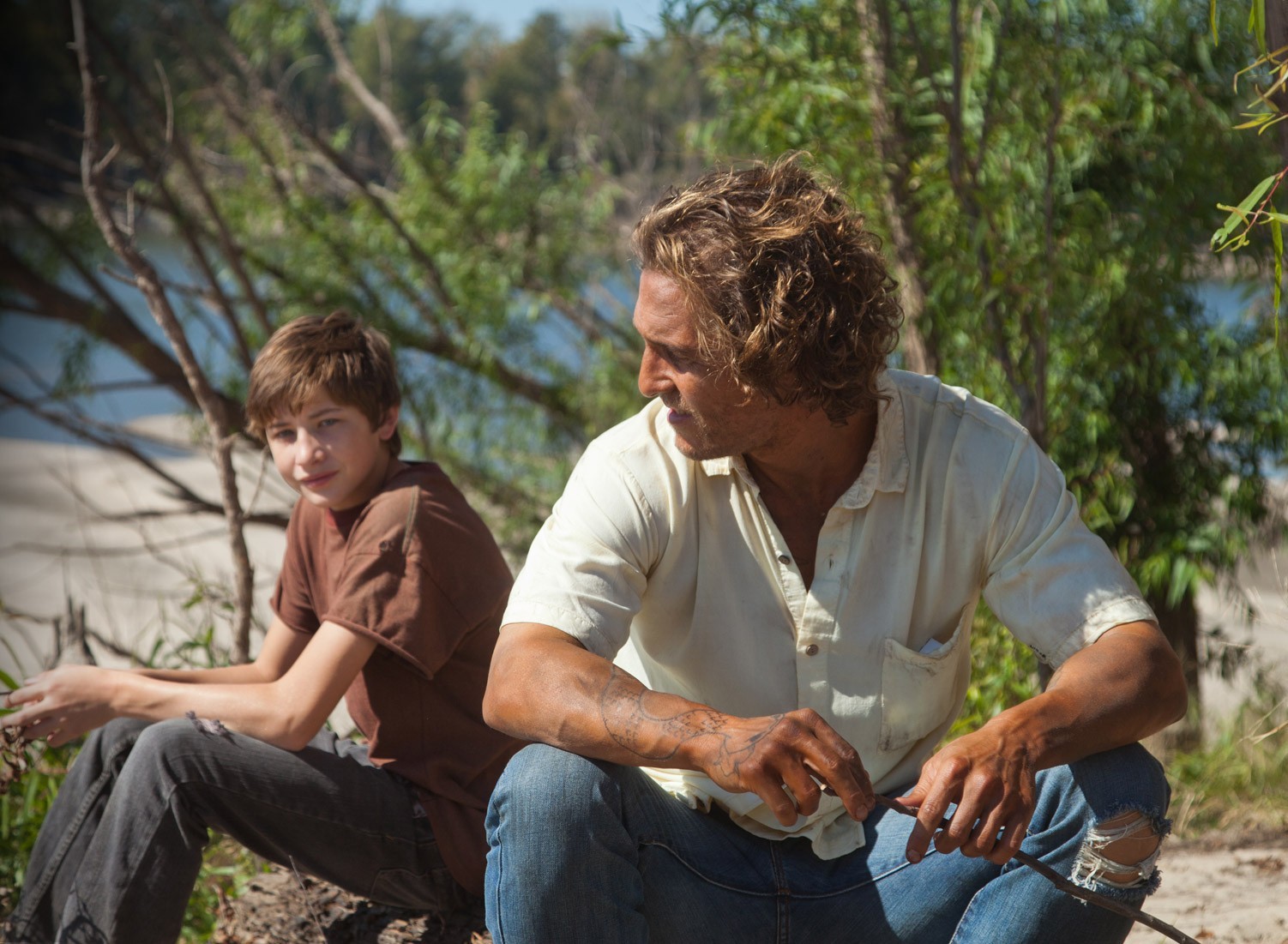

Ellis and Mud figuring each other out on the island. The
relationship between the two is the crux of the movie, although
their feelings towards others is just as important.
Mud (2012)

Director: Jeff Nichols

While it didn't meet my lofty expectations, Mud is a solid and compelling movie.

Taking place on a river in Arkansas, the movie follows two 14-year old local boys who discover an odd man (Matthew McConaughey) squatting on a small nearby island where the boys are looking to scavenge any flotsam and jetsam which the river has washed up. The man gives his name only as "Mud," and the boys take to running odd little errands for him on the Arkansas mainland, getting him food and bringing messages to a young woman to whom Mud has some mysterious dedication. The boys soon learn that local police are searching for Mud in connection with a murder in Texas. One of the boys, Ellis (Tye Sheridan), is a budding romantic who desperately wants to see Mud as a kindred spirit who has done unsavory things in the name of love. This becomes more and more difficult, however, as facts about Mud's past emerge. The tension cranks up wildly when a group of bounty hunters arrive in the area, looking to kill Mud on the orders of the murdered man's powerful and vindictive father.

This is now the third movie of director Jeff Nichols which I've seen, and it was his third film after his debut Shotgun Stories and the incredible follow-up Take Shelter. Mud is much more like the former, as it uses the setting of rural/suburban Arkansas to great effect, offering a very authentic sense of place and the people in it and telling a fairly straightforward story. Whereas Shotgun Stories was more toned-down, humanist drama, however, Mud uses elements from more popular genres like mystery, suspense, and action. The latter two elements actually weaken the film just a bit, in my view, mostly because they stand in rather stark contrast to the more genuine, emotional story of Ellis. Ellis's attempts to find love with an older girl in the area are the most touching and organic aspect of the entire movie. While it wouldn't have been enough to carry this film, it bears a genuineness that makes the more sensational and plot-driven elements feel a tad cheap.

Woven into the tale is the general sense of a childhood and youth being lost before our eyes. At the beginning of the movie, we learn that Ellis's parents are having marital difficulties. Though hardly the only reason, a major issue is that the family is almost certain to lose their house boat, which doubles as the source of his father's income as a fisherman. Ellis's desperation to flee from the disintegration of his parents' marriage, as well as their life on the river, plays a major part in why he becomes drawn to Mud. While not always completely subtle about these connections, the movie doesn't beat you over the head with it, and it does build some worthy cohesion between what could otherwise have been a very fragmented tale. This sort of cohesive storytelling seems to be a strength of Jeff Nichols, based on the three movies of his which I've seen.

I think that the only reason that I was slightly underwhelmed by this movie is that I saw it too long after it came out over four years ago. It was a well-received movie, to be sure, but it was also the true beginning of the "McConaughssaince," during which Matthew McConaughey reinvented himself as more than just an easy-going Texas dude with six-pack abs and a pretty face, cashing checks from rom-cam royalties. Within the next two years, he would receive tons of acclaim for his roles in Dallas Buyers' Club and especially True Detective, and even a few smaller cameo roles here and there. By the time I saw Mud, I had built this movie up in my mind to be an all-time great, which is unfair to expect of any film. Though it didn't (and perhaps couldn't) meet my unreasonable expectations, this is one that I can easily recommend to nearly anyone. There are a few flaws to be fussed over, but it is another solid effort from one of the U.S.'s best young filmmakers today. 

Monday, September 5, 2016

Retro Trio, Christopher Nolan Edition: The Prestige (2006); Inception (2010); Interstellar (2014)

This little themed set of reviews started with a late-night viewing of The Prestige, and ended up with my discovering that I had never reviewed Inception, which I did re-watch only about a month ago. From there, it was a small jump to add Interstellar, which I only saw once when it was released. 

The Prestige (2006)

It speaks well for a movie when you put it on late at night with the intention of watching maybe 30 minutes while you drift into sleep, and then you realize that it's past midnight and you have every intention of watching every last second of the remaining hour of the movie. This is even more impressive when it's a movie you've seen several times already, as I had with The Prestige before this most recent viewing.

Coming out a little over a year after his true breakout smash hit, Batman Begins, this movie solidified just what Christopher Nolan can do with a large budget. Though completely different in subject and presentation than his take on the famous DC superhero, The Prestige bore all of the hallmarks of Nolan's writing and directing: a non-linear narrative; a surprise ending; a dark general tone; extremely slick visuals; Michael Caine. Nolan's films virtually all blend these elements into solid films.

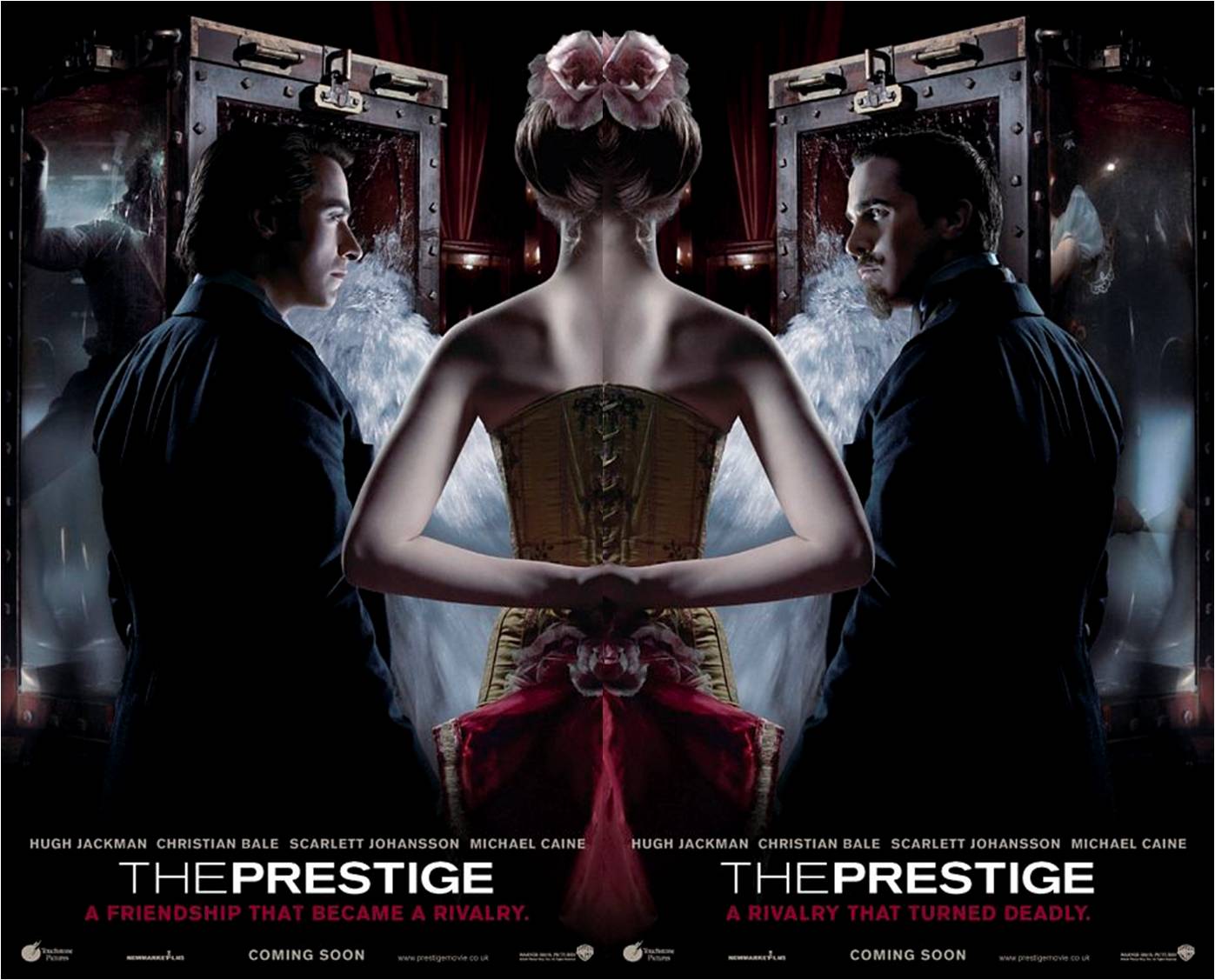
The Prestige tells the tale of two rival magicians (or "illusionists", as Gob Bluth would demand) in the early 20th century who become viciously obsessed with defeating each other, at first professionally but eventually in every way. Getting their start together as assistants to a more established stage magician in London, one of them accidentally has a hand in the death of the other's wife. This sets of a chain of events in which each one attempts to sabotage the other's act while establishing himself as the premier stage magician in London. The sabotage attempts grow ever-more-dangerous, even leading to maiming and an eventual arrest for murder.

Borden and Angier, two budding magicians before their lethal
rivalry develops. There is refreshing shift in just who is the
more sympathetic character as the plot progresses.
The story has plenty of intrigue built into it already, but Nolan enhances it with his narrative choices. Similar to his approach in Memento, he tells the story by alternating between past and present, giving us a chance to see the steps that led to the deadly opposition between two past colleagues. And not unlike that earlier movie, this is one that is likely to inspire you to want to see it again immediately after your first viewing, just so that you can follow the meaning of the earlier parts of the movie better, once you have the complete picture. I always appreciate how Nolan has fun with how he orders his narratives, and he has a strong enough grasp of the technique that it adds solid entertainment value.

This isn't to say that the movie is flawless. Similar to other Nolan movies, the romantic relationships are never really fleshed out. Despite having very good actors in the key roles - Hugh Jackman, Christian Bale, Scarlett Johannsen, and Rebecca Hall - the romance between the different pairs never feels completely natural. It's hardly the most essential part of this movie, but it is relevant enough so that the lack of completely authentic emotions results in a dulled impact at certain moments in the movie.

I suppose the one other minor criticism that I can level at the movie is that there is a truly supernatural element thrown into a movie which is otherwise all about the art of slight-of-hand. This element of the truly fantastic works quite well, given how it is introduced and used, but I would understand if some viewers find it more than a little out of place. Perhaps even as a slight bit of cheating, even.

Among Christopher Nolan's films, I would actually rate this among his very best, which for me are The Dark Knight and Inception. Anyone who happened to miss this one would do well to go back and watch it.

Inception (2010)

One could divide Nolan's movies into "original" and "adapted" groups. While the former group would include the Dark Knight trilogy and a remake like InsomniaInception would fall into the latter category. And like few directors, Nolan's originals are equal to or arguably better than his adapted films.

If you haven't seen it, Inception focuses on Cobb, an expert in the field of extraction - a method of entering another person's dreams and retrieving ideas. Cobb's services are highly prized by corporate raiders who seek to pull valuable corporate secrets out of the minds of their competitors. However, Cobb is on the run from U.S. law enforcement, as he is the prime suspect in his wife's murder. To clear his name in order to return home to his children, Cobb accepts a highly risky but possibly life-changing job of performing the questionable act of inception - the technique of implanting, rather than extracting, an idea into a person's mind. Cobb assembles a team to help him create a complex series of dream worlds through which they can enter their target's mind and incept the appropriate idea.

In keeping with the stories that Nolan usually tells, Inception unfolds on several levels. Early in the movie, we are introduced to the concept of extraction and even the notion of a dream within a dream. In the third act, though, we eventually are watching a dream within a dream within a dream within a dream within a dream (that's five levels, if you didn't count). It can be a bit disorienting or even frustrating, if you're not paying close attention. If you are, however, it can be a really fun and creative ride. Each dream takes place in a distinct environment with its own look and feel, with each one offering some new insight as to how the concepts of inception and extraction work. It helps that there is a tension and urgency built into each dream level, allowing the suspense to pull us along. Nolan has always had fun with how he plays with narratives, and it seems like he was having a blast with this one.

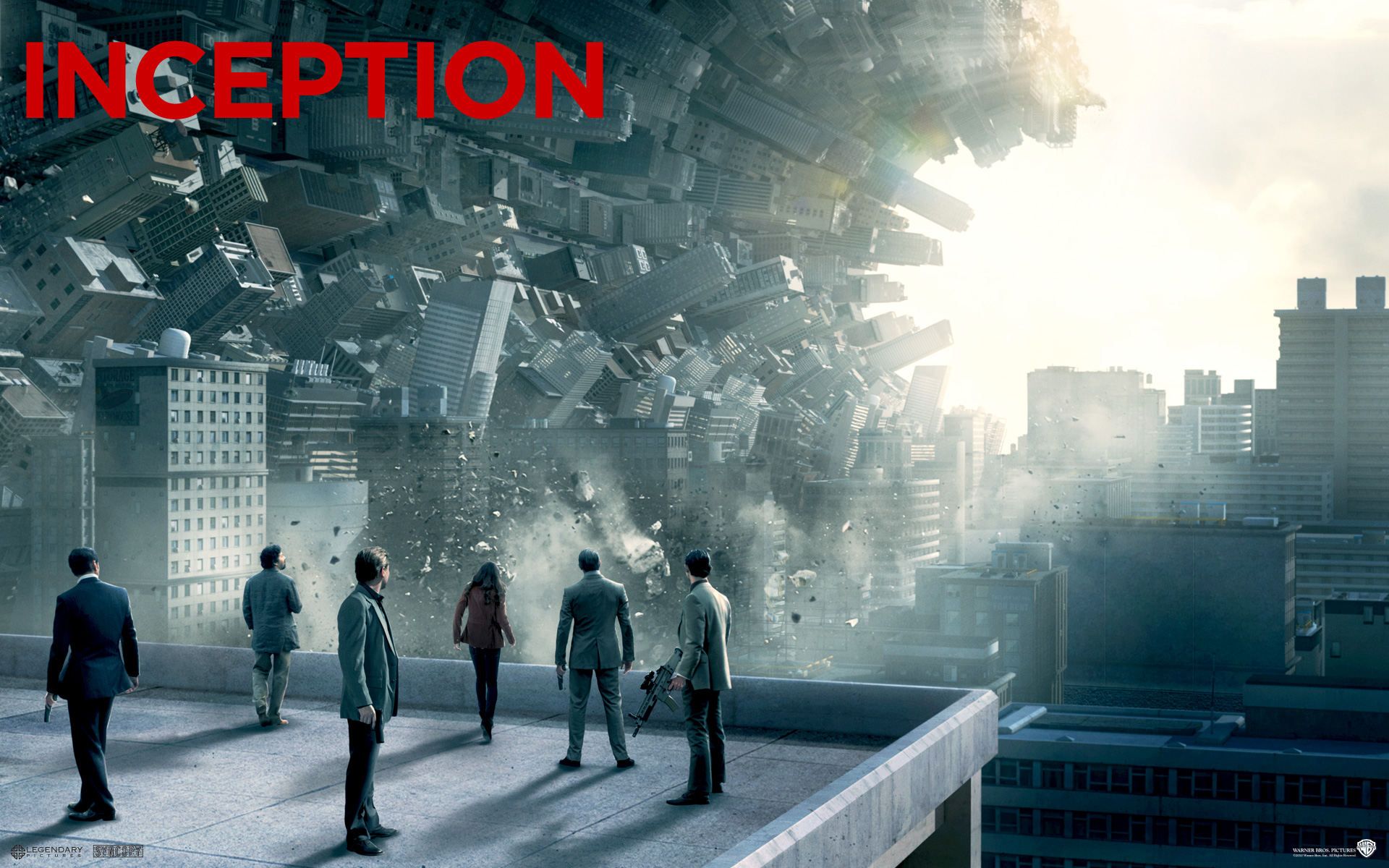
The dream-world hotel hallway fight scene is one of the most
cinematically dazzling sequences in recent times.
The visuals are possibly the best in any Nolan film, which is saying something. He has done some spectacular things on film, but Inception probably features several of his most iconic images. From the folding cities to the slow motion world explosions to the fight in the rotating hotel room, this movie offered a ton of scenes and sequences that are unlikely to be forgotten once seen. Add these to the sleek look and feel of every shot and frame typical to Nolan's pictures, and you have a movie that is visually wondrous to behold.

Upon this most recent viewing, something else finally dawned on me - the terror in the concept of being infected with an idea that you cannot banish. And if that idea is urging you to kill yourself and your loved ones? That is truly the stuff of nightmares and insanity. Inception teases this idea out and drives it home in dramatic fashion, and it was only recently that I recognized just how disturbing it is.

I remember really enjoying Inception  when it was first released, while still having a few gripes about it. There were a few questions I didn't feel were fully addressed, and some parts of the movie tried my patience a bit. Now that I have re-watched it a few times, though, I find it easier to accept the flaws as minor. The movie is actually a rarity for the last decade - a high-quality, big-budget movie that is completely original. Nearly every other mainstream, popular movie has been adapted from a book or series (Harry Potter, anything YA), has been a remake of an earlier movie or franchise (Star Trek, Star Wars), or is a sequel to a previous blockbuster (The Fast and the Furious, among others). This fact makes me root for movies like Inception and appreciate them all the more.


Interstellar (2014)

Nolan shot for the literal and figurative stars with this one. My original review is here.

Upon a second viewing, this film holds up fairly well, and I felt a tad more forgiving about a few of the elements which puzzled or annoyed me back in 2014. Matthew McConaughey's voice is still a nuisance, but a few of the performances which I previously questioned no longer agitate me. And I actually found a little more enjoyment in a few sequences which I felt dragged during my first viewing.

I still consider Interstellar one of Nolan's weaker movies, but this is very relative. Even his worst films are considerably better than most large-scale, epic Hollywood films. Curiously, I think that it will ultimately be looked upon by future viewers much more kindly than the previous year's critical darling Gravity - a movie which amazed me once but which I have never felt the need to watch again, and whose weaknesses are jarring and more obvious with every passing year. I do not foresee such a fate for Interstellar. It's not 2001 or Tarkovsky's Solaris, but it is strong enough to earn a mention and some comparison with those titans of science fiction films about space exploration.

I generally haven't changed my original feelings about the movie, except for one main aspect. I've come to a slightly better acceptance of the forces which bring Cooper back in touch with his daughter. Slightly. I do still find it rather sentimental to use the premise that love spans any breadth of space or time, but I appreciated just how the story is organized and weaves the concept into the overall tale.

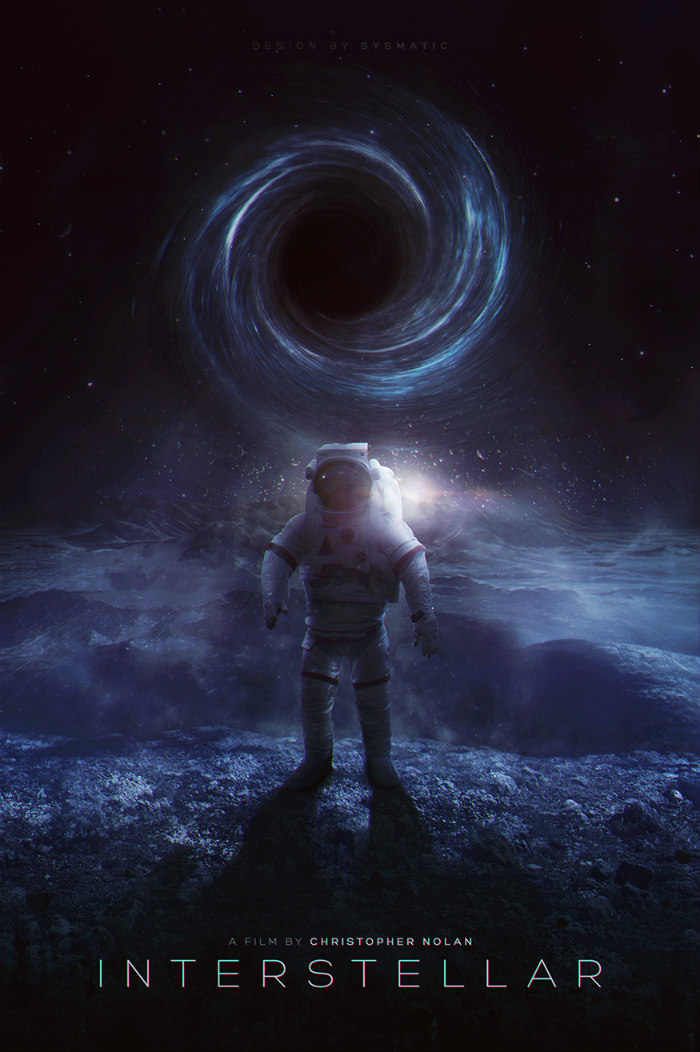
Cooper and his crew on a new planet. This was arguably the
most stunning sequences among several strong
contenders. Nolan never slacks on visuals.
One other merit which I failed to fully appreciate on my first viewing was the music. The score, composed, by longtime movie score maestreo Hans Zimmer, is wonderfully affecting. Maybe it's just my love of organ music, but I could find myself watching some of the visual sequences multiple times just to take in the pairing with the music.

Nolan's movies make up an unusually high percentage of the rather small number of movies that I own (out of the 30 blu rays that I have, 4 of them are Nolan films). I'm obviously someone who enjoys his films enough to splurge for them, knowing that I will watch them repeatedly. Yet I still feel no need to buy Interstellar. I think it is a good movie, but not one that I will need to watch again any time soon, if ever. 

Tuesday, December 2, 2014

New Release: Interstellar (2014)

Have no fear - there are no spoilers in this review.

Director: Christopher Nolan

It's certainly not a bad movie, but it's one that leaves a few things to be desired.

Christopher Nolan has always loved multi-tiered stories. Whether he's layering experience with memory as in Memento, layering illusion and showmanship with personal desires as in The Prestige, layering heroism and villainy with their own social constructs as in the Dark Knight trilogy, or any of his other movies, his films always operate on a few levels. Interstellar in no different. Unlike his best films, though, this one tries to add at least one stratum too many.

The story is mostly that of Cooper (Matthew McConaughey), a former test pilot and engineer who is living on a future earth that is slowly dying of a massive and growing blight, a la the Dust Bowl of the 1930s Midwest U.S. This one, though, is on a global scale. In a last-ditch effort to escape the seeming fate of humanity slowly choking to death on its home planet, Cooper is enlisted for a mission through a wormhole next to Saturn, beyond which he hopes to find a habitable alternative planet. Once through the hole, though, things do not go exactly as planned, forcing Cooper and his fellow astronauts to make several extremely difficult decisions that weigh their own beliefs and hopes with those of all humanity.

Many of the themes in the movie are worthy of speculation and make for some solid food for thought. The place of exploration in our society, especially when balanced against far more immediate problems, is one that people have always struggled with. In Interstellar, this makes for a legitimate source of conflict, especially as the success of Cooper's mission is far from guaranteed. Then of course, are the tremendous sacrifices that the boldest explorers must make, and not just to life and limb. When Cooper and his crew near a planet where time is distorted by gravity, they must also consider how their aging will be slowed immensely, leaving everything and everyone they know to age far more quickly while they explore. The film does a very nice job of making these theoretical consequences of space exploration more tangible and impacting on the characters.

I'm no astrophysicist, but much of the science behind the film seems solid; at least, as far as the physical rigors and obstacles which need to be overcome are concerned. These days, there have been so many excellent documentary series done on such topics that we laypeople can have a pretty good idea of what things are like for astronauts, and Nolan seems to have done all of his homework. It helps that the visuals are extremely well done, and several scenes and sequences do an excellent job of capturing the vastness and majesty of the cosmos.

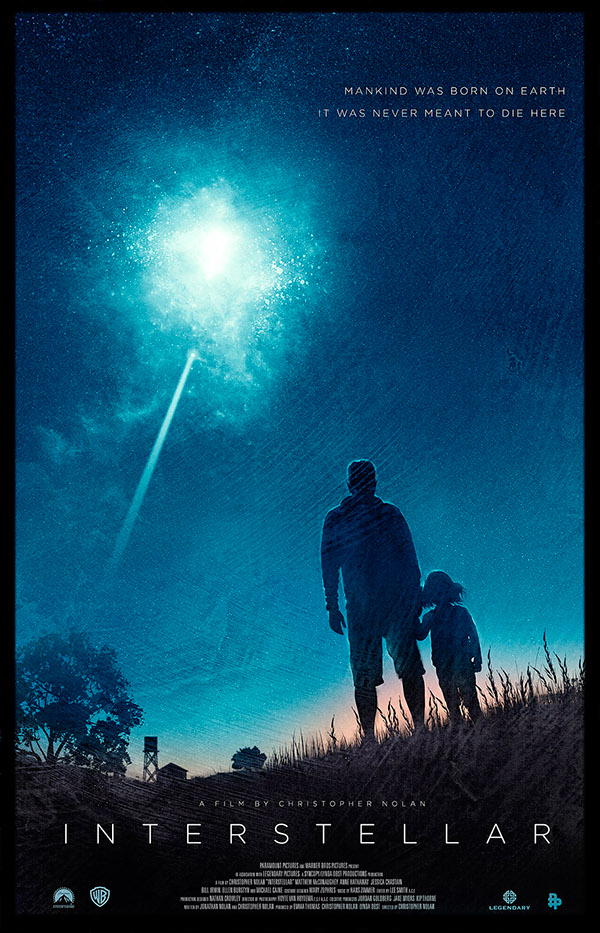
The relationship between Murph and her father is actually
endearing for the first part of the film, but grows a bit stale
as things progress. It eventually comprises what I found to
be one of the biggest weaknesses of the tale.
Where the movie goes astray is with the "human" layer of the tale. Filmmakers like Stanley Kubrick and Andrei Tarkovsky made thoughtful, insightful, artistic statements about humanity's probable destiny in space and the collective psyche of our species. Without giving away anything, I can say that I felt Nolan's attempt to weave human emotion into the story was a tad forced, with extremely shaky support. This thin tether is meant to be the link between Cooper deep in space and his daughter, Murph, back on Earth. The connection works at certain points in the movie, but is often either baffling or lacking the desired emotional effect.

Another problem I have with the film is the casting and acting. While Matthew McConaughey has proven himself to be a legitimately excellent actor in recent years, I was annoyed by the constantly hushed drone that he chose to speak in through nearly the whole movie. A tad more baffling was Nolan's choice to cast Anne Hathaway as the fellow astronaut/astrophysicist Brand. She's not terrible, but I found her lacking some of the grit, confidence, and stoicism that I associate with such professionals. I wonder if we're not starting to see Nolan fall in love with some of his own casting choices; what else would make him recast "Catwoman" in such a way? There are a few other casting choices that made me scratch my head, but I don't want to give away too much.

So the movie is a decent one, but I would have to put it towards the bottom of the Christopher Nolan catalog, especially when weighed against its huge ambition and massive budget. Nolan has never, in my view, made a "bad" movie. He has, however, made a few that smack of a bit of pretension and fall a bit short of his lofty goals. Interstellar is one of these. I would recommend that nearly anyone watch it once, but I would caution against expecting a masterpiece. Ultimately, the film just made me want to re-watch Europa Report at the earliest possible chance.