Showing posts with label Michael Winterbottom. Show all posts

Thursday, May 10, 2018

New-ish Releases: The Trip to Spain (2017); Annihilation (2018)

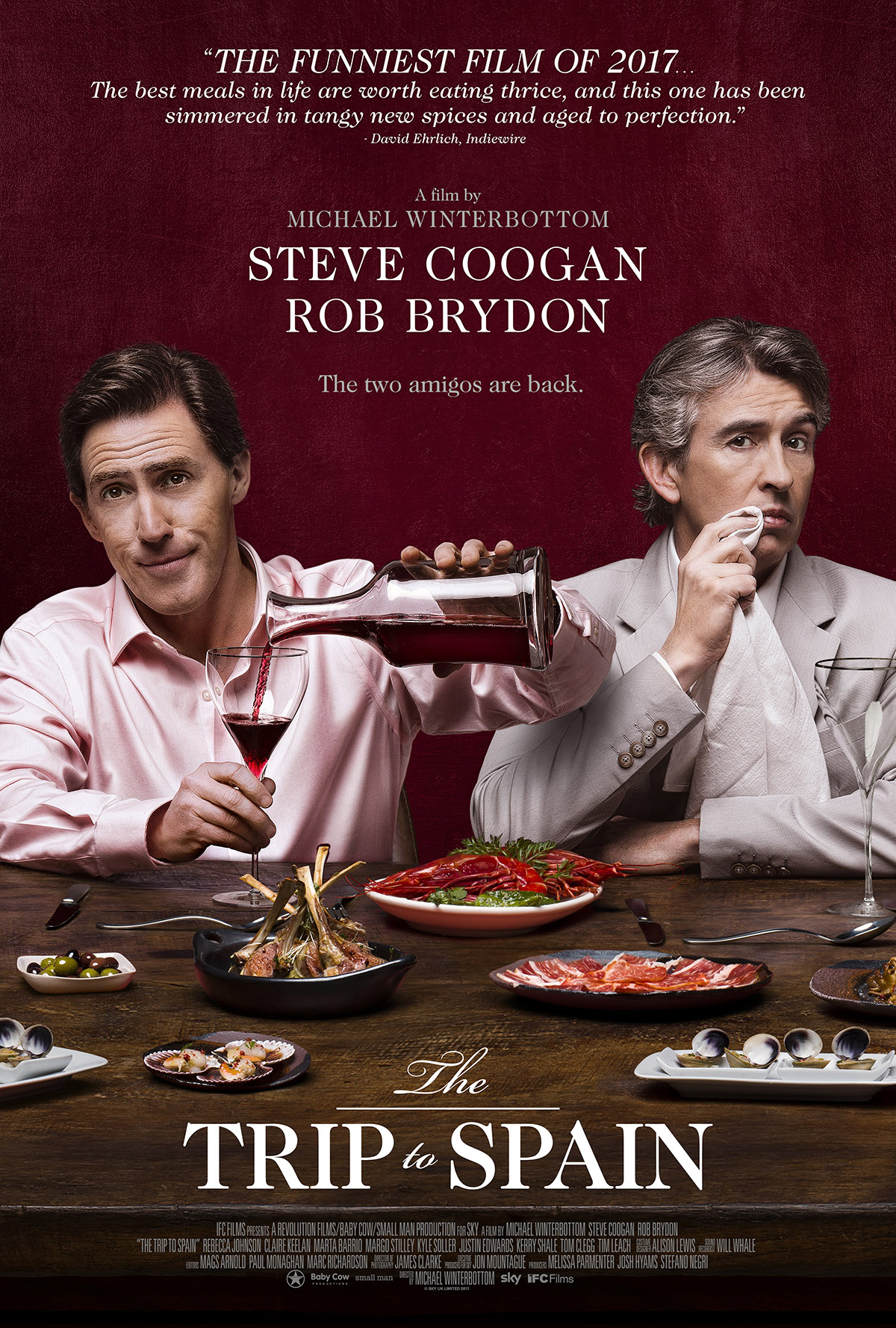
The Trip to Spain (2017)

Director: Michael Winterbottom

If you've seen the previous two "Trip" movies, starring Steve Coogan and Rob Brydon, then you know exactly what to expect. And you won't be disappointed.

The third in this film series, The Trip to Spain is a loosely-scripted, semi-documentary style show that follows the two British comedians as they tour the locales and noted restaurants of Spain. During their long car rides and frequent meals together, the two constantly riff off of one another's observations and spontaneous celebrity impressions.

It seems like a formula which might get tired, and yet it hasn't. One part of this is that Coogan and Brydon, despite having rather different comedic styles and purvues, compliment and feed off of each other brilliantly. Though the series has never been completely ad-lib, the two have plenty of freedom to improvise, which keeps things quite fresh, even three films in. The other major strength is how each of the three movies has also had a distinct vision for these semi-fictionalized versions of Coogan and Brydon, and consequently their relationship to and dynamic with each other. In the first film, Brydon was the congenial, broad, "people's" funnyman, while Coogan was a self-obsessed, semi-depressive snob. In The Trip to Italy, the roles were slightly reversed, with Coogan being more balanced and at peace with himself and Brydon having doubts about his stable but somewhat tepid home life with this long-time wife and two children. In Spain, we get a slight shift back to Coogan playing the more dislikeable character, once more being rather high on his own success (he often cites his real-life accolades for his film Philomena) and an insufferable know-it-all. These changes between the films all manage to give each one a feel of its own, to great effect.

There isn't much more to be said in a review of this movie, as its major strengths come down to watching and listening to two expert comedians do their thing. The only oddity with this chapter in the series is that the end is a bit strange, even borderline surreal. But this is a pretty minor issue. The only other thing I would recommend is that, if you are considering watching this and have not seen the previous films, you should begin with The Trip. If you find it to your liking, watch the following two films. While you certainly could watch them in any order, seeing the two progress in their order of release does offer a little extra, overarching narrative cohesion.

Annihilation (2018) [Spoiler-free first section]

Director: Alex Garland

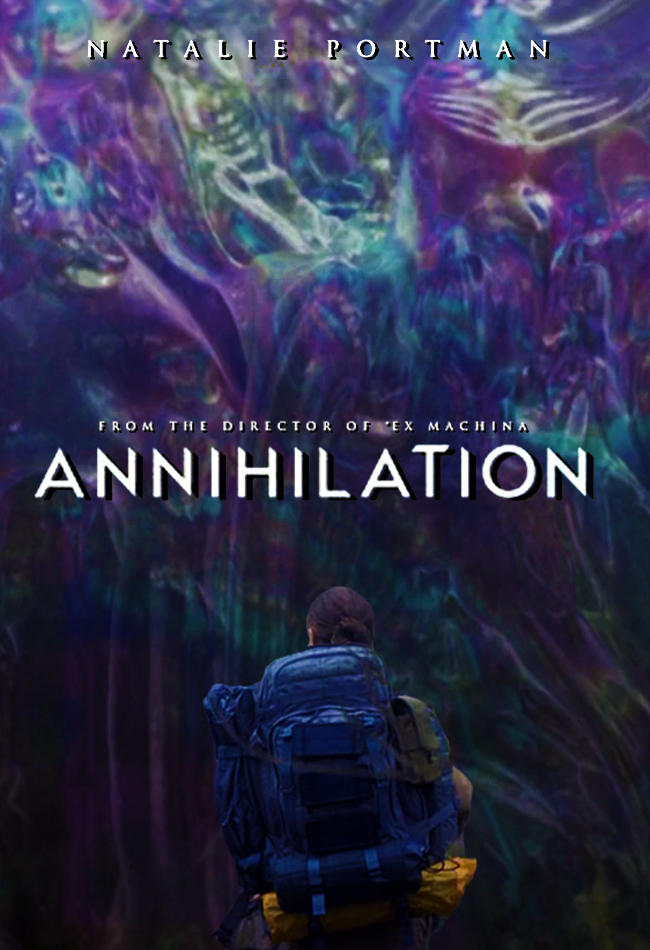
Trippy. Cerebral. Intermittently intense. This was another strong film by Alex Garland, though I didn't find it as good as his previous film.

Adapted from the novel of the same name, written by Jeff VanderMeer, Annihilation follows Lena (Natalie Portman), a former army soldier and medic who is now a university professor of biology. Through a series of strange events, Lena is brought to the site of a strange anomoly being dubbed "The Shimmer" by thr group monitoring it. The Shimmer is a strange field of wavering lights that has surrounded a remote lighthouse on the coast. Any attempts to reconnoiter inside The Shimmer has produced nothing; in fact, nothing and noone who has ever entered the anomoly has yet returned, and The Shimmer is growing to encompass more and more of the surrounding area. Lena opts to join four other women - all either expert scientists, soldiers, or both - to enter The Shimmer and see if they can discover what the previous teams could not - just what the strange effect is and what its done to their search teams. Once the five women are inside, they begin to discover odd plant and animal life that seem to defy the known laws of biology and genetics. And as they begin to uncover clues about the fate of the previous scout team, some baffling and terrifying realizations begin to emerge.

As with most of Garland's other movies, Annihilation is more of a thinking person's sci-fi movie, which is what I enjoy most about it. From the outset, we are given a few mysteries to wrap our heads around, starting with Lena's initial quarantine and her first flashbacks to before she even knew about The Shimmer. The mystery only deepens as the film progresses, with answers being parsed out at just the right pace to satisfy, while raising larger, more frightening questions. I will admit that, while I'm no expert in physics or biology, the basic premise (which I won't spoil) only seems to stand up to so much close scrutiny. Still, it is a rather fascinating idea, and it leads to one of the movie's other great strengths - the visuals.

As the quintet of explorers go deeper into the shimmer, there are more than few visual images that are stunning in their creativity and vibrance. Others are horrifying and equally impressive. Although the movie never felt slow to me, the measured pacing allows us viewers to drink in the images and disturbing ideas which they imply. People who expect or hope for frequent, dynamic action in their films will probably grow frustrated with Annihilation, but for my part, I found the balance just right. There are several short and effective action sequences, along with a handful of suspensefuul moments, but these are hardly the movie's greatest strength. Rather, there is a strong balance of stunningly colorful scenes, along with a few eerily quiet, expansive shots that are a bit reminiscent of subdued sci-fi classic Stalker by Russian master Andrei Tarkovsky.

At this point, only a couple of days after my viewing of this movie, I'm not completely sure of whether I'll feel the need to watch it again. This is somewhat telling, as I usually feel the need to watch my favorite sci-fi movies multiple times, as the best ones are always rich enough in ideas and/or sophisticated enough in structure to warrant multiple viewings. I suspect that I will see it again at some point, but I currently feel as if there wasn't much that I missed on this initial viewing. In terms of Garland's other films, this one has less in common with the masterpiece Ex Machina than with his slightly uneven though worthwhile Sunshine.

Comments with Spoilers

Just a few thought and feelings about specific details in the movie.

The visual of the soldier who has basically "exploded" into some bizarre plantlife in the swimming pool is amazing. It's perhaps the most striking of several indelible images in the movie.

The sequence towards the end with Lena facing down the source of The Shimmer was completely entrancing. The visuals and the music score had me enrapt the way that you hope a movie can do, even if for only a minute or so.

I had a bit of an issue with the way one scene was written and the way one character was performed. The minor one is how Gina Rodriguez's character, the brawny soldier Thorensen, melts down into tears at one point. This may have been a reflection of her gradually-warping mental state, but it smakced a bit of gender stereotyping to have a woman - even a hard-bitten soldier - start crying when things get tough. I had to wonder whether Garland would have written this scene the same way if it had been a male soldier in that position.
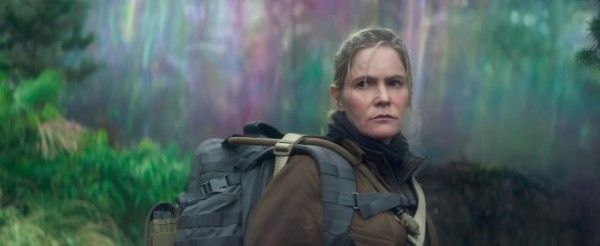
Leigh's turn as Dr. Ventress was the one aspect of the movie
which seemed out of place.
The greater frustration to me was the performance of Jennifer Jason Leigh as the psychologist and operation director Dr. Ventress. I usually find Leigh to be a great actress, but I found her portrayal of Ventress oddly out of tune with what her character was. For the entire movie, she has an oddly distracted air of near-apathy that seems completely unconnected to the urgency which she is supposed to be feeling. I understand that her nerves are worn thin from seeing multiple groups go into The Shimmer and disappear, but it seems as if this should manifest itself more as a desperate drive to get to the bottom of it all, rather than the fatalistic, apathetic attitude that she wears on her sleeve for every second of her screen time. I can't be sure if this performance choice was Leigh's or director Garland's, but it resulted in a portrayal where the facts about and even dialogue coming from the character were horribly out of sync with her demeanor.

I don't know that the movie had to "tag" the final mystery by showing the rainbow Shimmer in Lena's eyes. I thought that just showing her embracing "Kane" was suggestive enough, while leaving a little bit of room for doubt for us viewers. 

Monday, February 9, 2015

Retro Trio: Better Off Dead (1985); Kingpin (1996); Tristram Shandy (2005)

Better Off Dead... (1985)
One of the many classic scenes which, though having nothing
to do with the plot, speak to the silly fun of the entire film.


Director: "Savage" Steve Holland

At this point, I'll just assume that you've all seen this movie. If you haven't, it's probably because you're either under 25 or over 75 years old.

For those of my generation who haven't watched the movie in a long while, you may be wondering if it's still funny. Unequivocally, the answer is, "Yes." Nearly every bizarre segment and skewed sketch in this absurdist take on teen angst is still hilarious. There are a few scenes that are dated, such as the stop-motion hamburger "Van Halen" segment, but these are very few and far between. The vast majority of the movie holds up extremely well.

The key element to why this movie works is just how deadpan everyone is, most obviously John Cusack as the heartbroken and suicidal protagonist. But we should not discount the many other denizens of director Steve Holland's bizarre world, nor should we overlook just how effective their own dry approach to everything is. One need look no further than Lane Meyers's father, played by David Ogden Stiers. Stiers's stone-faced delivery of his lines had me rolling just as hard one week ago as they did two decades ago.

There are so many quirky little things in the movie that I hadn't thought of in long time, such as how enraptured the math class students are. Or the street-racing, Japanese brothers and adversaries of Lane. Or the basketball team members who are caricatured ogres. This is all great stuff, and the result of a fertile comic mind. 

It's always great to see that a key movie from one's childhood still had the goods. 


Kingpin (1996)

Director: Bobby & Peter Farrelly

I feel Kingpin to be the Farrelly Brothers' oft-forgotten masterpiece. Their highest grossing and probably best-known film is There's Something About Mary. Their first major film, Dumb and Dumber is a classic of idiotic comedy. I love the latter, and thought the former was funny but overrated. Kingpin, somehow, doesn't seem to register with nearly as many people, though, and I'm not really sure why. It's hilarious.

An early meeting between Big Ern and Roy. In this 2-minute scene, Murray
fires off no fewer than a half dozen classic lines and gags as he casually
denegrates everyone who gets within arm's length of him.
It boils down to two things: the writing and the cast. Curiously, it is one of the very few movies directed by the Farrellys that they didn't write themselves. Instead, it was written by a couple of veteran 1980s sitcom writers, Bobby Fanaro and Mort Nathan, who wrote for Benson and The Golden Girls. Knowing this, you might not expect the raunchy, sly, biting humor of Kingpin, but it's there in all its glory. There's a wealth of fantastically quotable lines throughout, and there's more than a few great dialectic and visual nods to classic films like The NaturalThe Hustler, The Color of Money, The Graduate, and more. The entire world of Kingpin is a skewed alternate reality in which bowling is wildly popular, so there's plenty of fodder for spoofing athletics.

The cast is perfect. Woody Harrelson plays naive bowling prodigy-turned alcoholic degenerate Roy Munson, who incurs the wrath of veteran bowling champion Ernie "Big Ern" McCracken by daring to actually beat him. Big Ern is played by a Bill Murray at the absolute top of his comedy game. He's deadpan. He's ruthless. He's a womanizing, supremely arrogant dirtbag who lures Munson into hustling the wrong kinds of gamblers and having his bowling hand cut off. That's right. Harrelson plays a one-handed bowler the rest of the way, leading right up to his revenge showdown with Big Ern 17 years later. If you don't see the comedy in that, then this movie isn't for you.

Kingpin is another movie that's easy to recommend giving a shot. Just like Bad Santa, you can pick up the tone and humor within the first 10 minutes, and you can tell whether you'll like it or not. Unlike a lot of comedies, it doesn't lose steam at any point, and the last 15 minutes are just as funny as the first. 


Coogan's passive annoyance in the foreground is a steady
theme when he's paired up with the loquoacious Brydon.
Tristram Shandy: A Cock and Bull Story (2005)

Director: Michael Winterbottom

I watched this for the same reason probably anybody would go back and watch it - I loved The Trip and The Trip to Italy. The semi-scripted, ad lib chemistry between comedians Steve Coogan and Rob Brydon is phenomenal, especially to those who like rapid-fire British humor.

Tristram Shandy is funny, and it's a good film, but I didn't find it as consistently funny as the "Trip" duology.

This movie is a different animal, in nearly every way. It is very much in the vein as films like Day for Night  and Federico Fellini's 8 1/2 - two films about making a film. In the case of Tristram, it focuses most on the star actor (Coogan, in this case) trying to exert his star status as the title character of a famously unadaptable work of classic English literature. The dryer forms of humor come from Coogan's passive aggressive attempts to belittle his co-stars, no one moreso than the affable Rob Brydon.  Of course, Coogan is made to look a fool often enough, whether by his own arrogance or by the wild demands of the Tristram script

Those looking for the great back-and-forth between Coogan and Brydon in the Trip movies might be a bit disappointed. While they have several scenes together, Brydon is not nearly as prominent as Coogan, whose larger celebrity is the target for humor here. The overarching theme is the madness of moviemaking, with its writes and rewrites, casting and recasting, the short-lived passions that flair up between crew members, the egos, and plenty more. From that perspective, a cinephile like myself appreciates these peaks behind the curtain of movie show business. Those who are less interested are likely to find the film a bit dull. 

Saturday, October 4, 2014

The Trip to Italy (2014)

Director: Stephen Winterbottom

Hilarious. Though I can't say everyone would love it.

If you saw The Trip, by the same director, featuring the same pair of actors, with exactly the same premise, then you know almost exactly what you're in for. With a little role reversal and a completely new setting, you get the same semi-scripted banter that Coogan and Brydon delivered in the first one. While I thought that this recent show is actually a bit tighter and funnier, it's not markedly so. Either way, if you laughed at the first, you'll laugh at the second.

If you haven't seen the first one, here's how they both go: Well-known British funnymen Steve Coogan and Rob Brydon hit the road to sample the food at several noted restaurants. While both successful comedians, their styles are rather different from one another, with Coogan seeing himself as a tad more sophisticated and Brydon sometimes aiming for a lower common denominator. They do, however, riff off of each other exceptionally well. Whether it's dreaming up and living out silly scenarios through dialogue or battling each other with dueling celebrity impersonations, their two-man improvisational skills are hard to beat.

As often as not, it's when Coogan and Brydon are kicked  back,
nattering back and forth that the film is most amusing.
Of course, this type of humor isn't for everyone. The movie has no "main story," other than Coogan and Brydon trying to live their lives as long-distance fathers, while being aging and well-known comedians. The inversion from the first film is that, while in the first it was Coogan who was portrayed as the self-absorbed, sex- and career-driven one, in Italy, Brydon seems to be going through his own mid-life crisis of self indulgence.

Interestingly, the elements of the more personal lives of the characters are perfectly balanced: they are given just enough time to add a touch of substance to the film, while never detracting from the main purpose of the film, which is to let these two guys make us laugh. No written description can do justice to the magic at play when Coogan and Brydon are in their comedic "zones," but I do offer this one clip from the first film, which I think perfectly displays their chops. For those unfamiliar, just use this as a litmus test as to whether you would care for either film.


For those who enjoyed the first and are wondering if this one hold up to it, I say unequivocally, "Yes."