Showing posts with label Jennifer Jason Leigh. Show all posts

Thursday, May 10, 2018

New-ish Releases: The Trip to Spain (2017); Annihilation (2018)

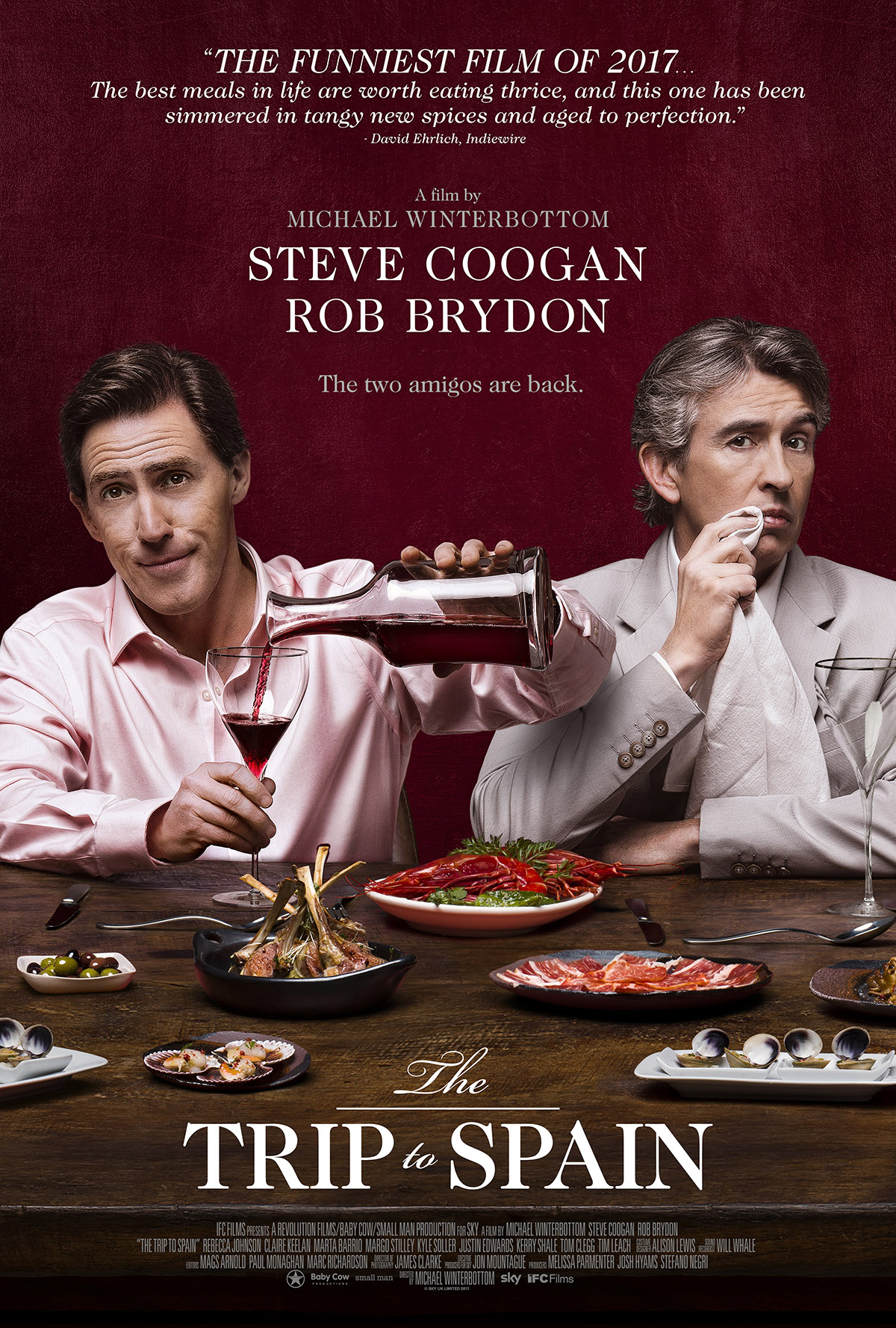
The Trip to Spain (2017)

Director: Michael Winterbottom

If you've seen the previous two "Trip" movies, starring Steve Coogan and Rob Brydon, then you know exactly what to expect. And you won't be disappointed.

The third in this film series, The Trip to Spain is a loosely-scripted, semi-documentary style show that follows the two British comedians as they tour the locales and noted restaurants of Spain. During their long car rides and frequent meals together, the two constantly riff off of one another's observations and spontaneous celebrity impressions.

It seems like a formula which might get tired, and yet it hasn't. One part of this is that Coogan and Brydon, despite having rather different comedic styles and purvues, compliment and feed off of each other brilliantly. Though the series has never been completely ad-lib, the two have plenty of freedom to improvise, which keeps things quite fresh, even three films in. The other major strength is how each of the three movies has also had a distinct vision for these semi-fictionalized versions of Coogan and Brydon, and consequently their relationship to and dynamic with each other. In the first film, Brydon was the congenial, broad, "people's" funnyman, while Coogan was a self-obsessed, semi-depressive snob. In The Trip to Italy, the roles were slightly reversed, with Coogan being more balanced and at peace with himself and Brydon having doubts about his stable but somewhat tepid home life with this long-time wife and two children. In Spain, we get a slight shift back to Coogan playing the more dislikeable character, once more being rather high on his own success (he often cites his real-life accolades for his film Philomena) and an insufferable know-it-all. These changes between the films all manage to give each one a feel of its own, to great effect.

There isn't much more to be said in a review of this movie, as its major strengths come down to watching and listening to two expert comedians do their thing. The only oddity with this chapter in the series is that the end is a bit strange, even borderline surreal. But this is a pretty minor issue. The only other thing I would recommend is that, if you are considering watching this and have not seen the previous films, you should begin with The Trip. If you find it to your liking, watch the following two films. While you certainly could watch them in any order, seeing the two progress in their order of release does offer a little extra, overarching narrative cohesion.
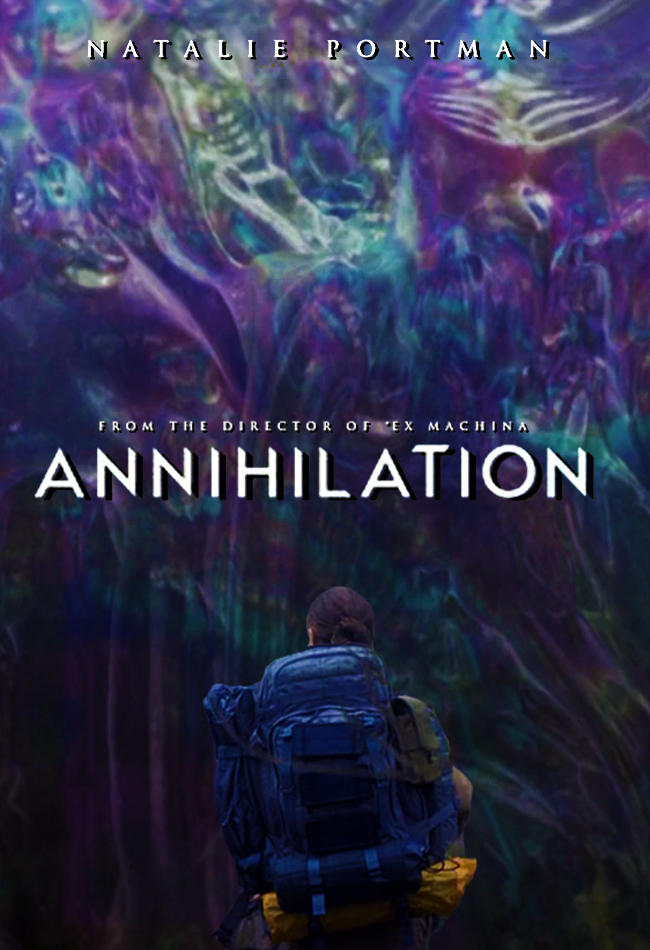

Annihilation (2018) [Spoiler-free first section]

Director: Alex Garland

Trippy. Cerebral. Intermittently intense. This was another strong film by Alex Garland, though I didn't find it as good as his previous film.

Adapted from the novel of the same name, written by Jeff VanderMeer, Annihilation follows Lena (Natalie Portman), a former army soldier and medic who is now a university professor of biology. Through a series of strange events, Lena is brought to the site of a strange anomoly being dubbed "The Shimmer" by thr group monitoring it. The Shimmer is a strange field of wavering lights that has surrounded a remote lighthouse on the coast. Any attempts to reconnoiter inside The Shimmer has produced nothing; in fact, nothing and noone who has ever entered the anomoly has yet returned, and The Shimmer is growing to encompass more and more of the surrounding area. Lena opts to join four other women - all either expert scientists, soldiers, or both - to enter The Shimmer and see if they can discover what the previous teams could not - just what the strange effect is and what its done to their search teams. Once the five women are inside, they begin to discover odd plant and animal life that seem to defy the known laws of biology and genetics. And as they begin to uncover clues about the fate of the previous scout team, some baffling and terrifying realizations begin to emerge.

As with most of Garland's other movies, Annihilation is more of a thinking person's sci-fi movie, which is what I enjoy most about it. From the outset, we are given a few mysteries to wrap our heads around, starting with Lena's initial quarantine and her first flashbacks to before she even knew about The Shimmer. The mystery only deepens as the film progresses, with answers being parsed out at just the right pace to satisfy, while raising larger, more frightening questions. I will admit that, while I'm no expert in physics or biology, the basic premise (which I won't spoil) only seems to stand up to so much close scrutiny. Still, it is a rather fascinating idea, and it leads to one of the movie's other great strengths - the visuals.

As the quintet of explorers go deeper into the shimmer, there are more than few visual images that are stunning in their creativity and vibrance. Others are horrifying and equally impressive. Although the movie never felt slow to me, the measured pacing allows us viewers to drink in the images and disturbing ideas which they imply. People who expect or hope for frequent, dynamic action in their films will probably grow frustrated with Annihilation, but for my part, I found the balance just right. There are several short and effective action sequences, along with a handful of suspensefuul moments, but these are hardly the movie's greatest strength. Rather, there is a strong balance of stunningly colorful scenes, along with a few eerily quiet, expansive shots that are a bit reminiscent of subdued sci-fi classic Stalker by Russian master Andrei Tarkovsky.

At this point, only a couple of days after my viewing of this movie, I'm not completely sure of whether I'll feel the need to watch it again. This is somewhat telling, as I usually feel the need to watch my favorite sci-fi movies multiple times, as the best ones are always rich enough in ideas and/or sophisticated enough in structure to warrant multiple viewings. I suspect that I will see it again at some point, but I currently feel as if there wasn't much that I missed on this initial viewing. In terms of Garland's other films, this one has less in common with the masterpiece Ex Machina than with his slightly uneven though worthwhile Sunshine.

Comments with Spoilers

Just a few thought and feelings about specific details in the movie.

The visual of the soldier who has basically "exploded" into some bizarre plantlife in the swimming pool is amazing. It's perhaps the most striking of several indelible images in the movie.

The sequence towards the end with Lena facing down the source of The Shimmer was completely entrancing. The visuals and the music score had me enrapt the way that you hope a movie can do, even if for only a minute or so.

I had a bit of an issue with the way one scene was written and the way one character was performed. The minor one is how Gina Rodriguez's character, the brawny soldier Thorensen, melts down into tears at one point. This may have been a reflection of her gradually-warping mental state, but it smakced a bit of gender stereotyping to have a woman - even a hard-bitten soldier - start crying when things get tough. I had to wonder whether Garland would have written this scene the same way if it had been a male soldier in that position.

Leigh's turn as Dr. Ventress was the one aspect of the movie
which seemed out of place.
The greater frustration to me was the performance of Jennifer Jason Leigh as the psychologist and operation director Dr. Ventress. I usually find Leigh to be a great actress, but I found her portrayal of Ventress oddly out of tune with what her character was. For the entire movie, she has an oddly distracted air of near-apathy that seems completely unconnected to the urgency which she is supposed to be feeling. I understand that her nerves are worn thin from seeing multiple groups go into The Shimmer and disappear, but it seems as if this should manifest itself more as a desperate drive to get to the bottom of it all, rather than the fatalistic, apathetic attitude that she wears on her sleeve for every second of her screen time. I can't be sure if this performance choice was Leigh's or director Garland's, but it resulted in a portrayal where the facts about and even dialogue coming from the character were horribly out of sync with her demeanor.

I don't know that the movie had to "tag" the final mystery by showing the rainbow Shimmer in Lena's eyes. I thought that just showing her embracing "Kane" was suggestive enough, while leaving a little bit of room for doubt for us viewers. 

Friday, February 23, 2018

Retro-Trio: Hellraiser (1987); Semi-Pro (2008); Flesh + Blood (1985)

Hellraiser (1987)

Director: Clive Barker

Sometimes you feel the urge to go back and watch a highly influential movie you hadn't seen in decades, even if you're fairly sure that it won't hold up well. Such was the case when, a few nights back, I noticed that Hellraiser was available on one of my streaming services. It was late, and I was in the mood for something twisted and dark, so I went for it.

Watching this movie now, 31 years after its original release and probably a good 25 years after I'd last seen it, the strengths and weaknesses are exactly what lay in my memory, even though most of the details had been lost in the interim.

For those who don't know the tale, it is a wildly horrific tale of Julia and the family into which she married. The rather cold, reserved Julia moves into the old, previously abandoned family house of her husband, Larry, and her step-daughter Kirsty. When first seeing the place, they realize that Larry's mysterious loner brother, Frank, had been squatting in the home not long before their arrival, though Frank is nowhere to be found at the time. Seeing his belongings sparks Julia's memories of having an extended, passionate affair with the darkly hedonistic Frank, and Julia even begins to dream about being with Frank again. A few days later, Larry cuts his hand in the home, and the blood trickles into the floorboards of the dank, upper-most room in the house. Slowly, the blood is absorbed and revives some sort of horrific, flayed human, whom Julia discovers to her horror. This creature quickly explains to Julia that he is, indeed, Frank, and that he had transported himself, via a strange black and gold magic box, into a realm of dark sadomasochism ruled by terrifying, demoniac creatures called Cenobites. Frank convinces Julia to lure more victims into his upper floor lair, where she should kill him and allow their blood to revitalize Frank into human form before the Cenobites discover him missing and pull him back into their twisted, torturous realm.

In its day, Hellraiser was one of the most creative, disturbing, and truly horrifying films made in quite some time. Sure, there had been more graphic horror movies. And there had been eerier tales told on film. But Clive Barker's feature film debut was its own stunning blend of modern gothic horror and graphic bloodletting, wrapped in a supernatural tale that hinted at its own almost Lovecraftian-level mythos. The mere conception and look of the Cenobites, tortured and disfigured creatures cloaked in black leather and adorned with various sharp, cutting instruments, was enough to give most of us nightmares. When this was added to the quality special effects that brought the nightmares to life, you had something that made a major impression, grotesque it is may have been. In watching it now, 30 years after its release, I can say that most of the visual effects, especially the costumes and basic set designs, hold up. And the pure horror elements of the story are just as disturbing now as they were then.

The effects in the movie are great, most notably on the
slowly-regenerating Frank. It calls to mind of the stellar
makeup work from Cronenberg's
The Fly.
Unfortunately, like most of even the best horror films, the non-horror aspects of the movie are fairly weak. The backstory of Frank and Julia's affair is quite shallow, with Frank being a one-dimensional "bad boy" who literally shows up in a leather jacket on Julia's doorstep, dripping with rain, and giving her the bedroom eyes right from the jump. There is zero subtlety in their lust-filled affairs, and it seems a bit odd that Julia becomes so wildly obsessed with him that she is quite literally prepared to become a serial killer just to revive him - a man who long since abandoned her to go chasing other women and satisfaction of his own carnal lusts through any means he could find. I suppose one could argue that such can be the power of lust, especially lust repressed under a cold veneer such as the one that Julia usually exudes, but this is a bit of a stretch.

The acting is rather inconsistent, too, with a few screen veterans like Andrew Robinson and Clare Higgins doing just fine, but most other cast members appear rather amateurish. It doesn't do any of them any favors that the dialogue is uncomfortably bad, aside from the few memorable catchphrases that Barker puts in the mouths of the Cenobites - "We have such sights to show you," and "We'll tear you soul apart!" delivered in actor Doug Bradley's powerful, domineering voice still resonate as some of the most memorable lines in the history of horror films. But when it comes to the more casual dialogue between the horror scenes, the attempts at humor fall completely flat and any attempt to build any compassion for the characters never materializes.

I recall having seen the immediate sequel, 1988's Hellbound: Hellraiser II, but I've never bothered with any of the seven feature-length follow-ups (several of which were straight-to-video). I can appreciate dark horror, and the more imaginative concepts which Clive Barker created those decades ago are still somewhat compelling, but there was never enough for me to go beyond those first two movies. Real horror aficionados have likely already seen these films, probably multiple times, so it is hard to recommend it to any new viewers. Only if you are a horror fan who is a bit young and never gone back to see this one would I suggest you give it a go - despite its clear flaws, it really is one of the most influential horror movies of all time, with its fingerprints still being seen in horror movies made today.


Semi-Pro (2008)

Director: Kent Alterman

It's a Will Ferrell comedy, alright.

I like Will Ferrell. He's always been good for pretty solid, consistent laughs. I have not, however, ever become a full devotee of the comedian with seemingly boundless energy. As funny as he can be, he rather quickly became a one-note comic act in my view. This is why I've never run out to catch him movies in theaters, often waiting years after their release to watch them; sometimes never bothering to watch them at all. Watching the now decade-old Semi-Pro did nothing to change my feeling about Ferrell, either positively or negatively.

The story takes for its setting the rather low-hanging comedic fruit of the disco era in 1976. Ferrell plays Jackie Moon, a one-hit music wonder who used his lone hit song's earnings to purchase the Flint Tropics - a professional basketball team in the struggling American Basketball Association (ABA). The Tropics are the worst team in the floundering ABA, only keeping their nose above water thanks to Moon's over-the-top promotional antics, including sensational halftime shows and performances. When word comes down that the ABA is going to be contracted and absorbed into the far larger and more successful NBA, the desperate Moon makes a deal to see that his team is one of the four who will make the jump into the big league. The deal requires him to get his squad to climb out of the cellar and attain 4th place in the ABA standings by season's end, no mean feat for the disogranized and talent-bereft Tropics. Hope does emerge when aging former NBA player Ed Monix (Woody Harrelson) is able to lend his veteran knowledge and help coach up talented but selfish young NBA-hopeful Clarence (Andre Benjamin).

While Ferrell's Jackie Moon character isn't exactly like Ron Burgundy in Anchorman or Ricky Bobby in Talladega Nights, Moon does bear the hallmark idiocy, self-absorption, and overconfidence of virtually every character Ferrell has ever played on TV or the big screen. Of course, there is a reason for the typecast - Ferrell is exceptionally good at the role. Despite myself, I can't help but laugh at his line deliveries, facial expressions, and overall body language when playing such over-the-top buffoons. Since Ferrell's shtick alone can become a bit tiresome at times, it helps that there's ample comedy talent around him. Will Arnett is a standout, as the whiskey-swilling, chain-smoking color commentator for Tropics' broadcasts, but there are several others who round out the proceedings well. Woody Harrelson's comedic gifts are mostly underutilized, as he plays the mature role in the film, but he does have a few moments.

As with every other Ferrell-starring film, not every gag hits, and there are probably ten to fifteen minutes of ad-libbed nattering that should have been edited out, but the movie provides frequent enough laughs to justify its purpose. It's a dumb comedy meant to provide some gut laughs. It does that just fine.


Flesh + Blood (1985)

Director: Paul Verhoeven

A rather good, gritty medieval flick with a B-movie attitude by a director who knows how to do entertaining sex and violence.

I picked this one up after seeing it pop up on more than one "underrated film" list. Despite being a true 1980s kid, I had never even heard of it. Now that I've seen it, I understand why. The movie follows a renegade band of mercenaries led by Martin (Rutger Hauer), a highly skilled and dangerously cunning fighter. Martin and his band are first used and then cheated by a regional lord in order to get his castle back from invaders. As revenge, Martin's unruly band stages an attack on a group of the lord's closest associates, including his son Steven (Tom Burlison) and Steven's bride-to-be, Agnes (Jennifer Jason Leigh). Martin's band of marauders steal the goods, only to later discover that Agnes has been hidden away in one of the wagons. She is promptly raped by Martin, although in a way whereby Agnes either does, or at least acts like she does, enjoy being violated by the strapping bandit leader. From this point, Agnes's action become rather difficult to decipher for everyone involved. She is taken with the band to a small nearby castle, where Martin's crew kills the defenders and takes over. Agnes seems to become Martin's willing woman, although when Steven and the regional lord's soldiers lay siege to the castle, Agnes continues to change her allegiances back and forth between Steven and Martin. By tale's end, Martin narrowly escapes his entire band's being wiped out by the plague, and Agnes leaves with Steven. Agnes actually sees Martin escaping, but remains silent rather than alerting Steven's men to the dangerous bandit's survival.

This is a 1980s medieval sword-swinger unlike any other I've ever seen, especially from that era. I always enjoyed the setting and characters in those romantic "Arthurian" type tales, and even plenty of the fantasy tales that were inspired by that sort of setting. Excalibur is still great, and movies like Ladyhawke and Willow always had an appeal for me. Those movies were, though, relatively PG-rated. Flesh + Blood, on the other hand, gets its hands really dirty. The murder and sex are right in your face, and Martin's rape of Agnes is downright disturbing on an original Straw Dogs level. This movie is very much about depicting a band of depraved and bloodthirsty cutthroats in all their viciousness, and it works quite well. They truly are despicable characters.

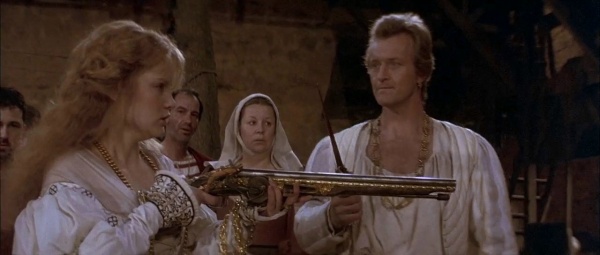
Martin is more than ready to let Agnes handle his, uh, rifle.
The previously-sheltered Agnes takes to the sex and violence
with disturbing alacrity.
The story of Agnes is also a strangely novel one. There is a bold ambiguity to her motivations, as she plays Martin and Steven off of one another, almost like a cat playing with two mice. Of course, this cat is posing as a harmless kitten, but there is a strange empowerment to her character at times. And the way that the theme of violence is handled puts me in mind of the David Cronenberg masterpiece A History of Violence, in which violence is depicted both as a repugnant aspect of human nature as well as a source of animal magnetism to others. Rutger Hauer's swaggering, bare-chested alpha male Martin is the polar opposite of the learned and thoughtful but also bold and clever Steven. The basic tale of a woman torn between "brawn" and "brains" was not a new one by a long shot, but this movie tackled the subject in a grittier way than any other I know of.

I doubt I'll ever need to see this movie again, but I was glad to have finally gone back and given it a shot. It's not for everyone, as it is a hard-R-rated movie, without a doubt. But it more than held my attention for its manageable running time, and it shed even more light on what an exciting, if uneven, resume Paul Verhoeven has put together over the decades.