Showing posts with label Out of the Past. Show all posts

Thursday, February 2, 2012

Film #72: Chinatown (1974)


Director: Roman Polanski

Initial Release Country: United States 

Times Previously Seen: two (last viewing about 7 or 8 years ago)

Teaser Summary (No spoilers)

Cunning, 1930s L.A. private eye gets wrapped up in a knotted case of small- and grand-scale corruption. Shoots his mouth off plenty.

Extended Summary (A slightly lengthier plot synopsis, spoilers included. Fair warning.) 

*Note: this will be a relatively short summary. For a fully detailed recounting, you can check out this one at Internet Movie Database.* 

In 1937 Los Angeles, private investigator Jake Gittes (Jack Nicholson) is hired by a woman, Evelyn Mulwray, to tail her husband, Hollis. Jake is to find proof of an extra-marital affair. In following him, Jake soon learns that Hollis is a chief engineer on the city’s water and power commission and that he spends nearly all of his time inspecting the lands around the city’s reservoirs. Eventually, Jake manages to witness and take photos of Hollis meeting with a young woman with whom he seems very close. The photos soon go public in the newspapers.

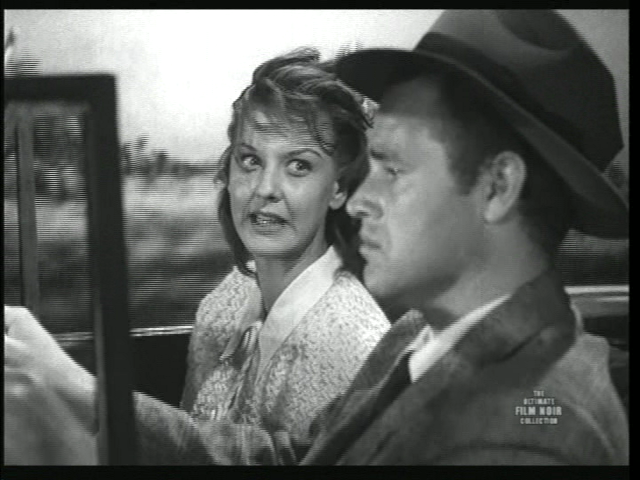
Jake and the real Evelyn Mulwray. Like any good noir film, many a cigarette is smoked by both hero and heroine. 

No sooner is Hollis Mulwray’s seeming infidelity made public than another woman turns up in Jake’s office. This woman is the real Evelyn Mulwray (Faye Dunaway), who threatens to sue Gittes over defamation. It is now clear that the woman who had hired Gittes was not, in fact, Hollis’s real wife. With his own investigator’s license on the line, Jake later makes an appeal to Evelyn and begins to investigate the case further. Evelyn agrees (suspiciously quickly) to drop any legal action against Jake, and Jake soon after discovers Hollis dead at one of the reservoirs that he would routinely inspect.

Over the course of the next several days, Gittes digs more and more deeply. Through his own ingenuity and brass, he figures out that Hollis was murdered by Evelyn’s father, Noah Cross (John Huston). The elderly Cross is exceptionally rich, but has grander designs on expanding his empire much farther. His plot involves having the very natural drought, along with his own hired thugs, spoil farmers’ crops to the point that their land becomes virtually worthless. Cross has been buying the land up cheaply, through false fronts, and plans to have the city build a dam that would bring water to his new properties. With a water supply, the land’s worth would grow exponentially. Hollis Mulwray, however, once Noah Cross’s partner on the water commission, was going to block the plan to build the dam, claiming that it would be unsafe. Hollis was, therefore, murdered by Noah Cross himself and brought out to the reservoir, to make it seem an accident.

In an even more sordid twist, Jake learns that the young girl that Hollis had visited before his death was not a mistress of any sort. She is, in fact, Evelyn’s illegitimate sister/daughter, Katherine, the product of a rape at the hands of her own father, Noah Cross. By the time Jake puts all of this together, both the police and Noah Cross are searching for Evelyn and Katherine, and they are hot on the pair’s heels. Jake decides to help them both escape to Mexico, and sets up a brief rendezvous in Chinatown. Noah Cross gets to Jake first, though, and forces him to lead him and his goons to Chinatown. Upon arriving, the police also show up and arrest Jake, who tries to explain all that he has discovered about the nefarious Mr. Cross. Evelyn and Katherine show up, manage to hustle past Noah into their car, and begin to drive away. The police open fire on the car and kill Evelyn. A screaming Katherine, staring at her murdered mother/sister, is pulled out of the car and taken away by Noah Cross. Jake, dumbfounded by the turn of events, is released by the police and slowly escorted away from the scene by his employee Walsh, who says merely, “Forget it, Jake, It’s Chinatown.”

The now-battered and weary Jake and Evelyn find brief solace with each other, shortly before it all comes crashing down. 

Take 1: My Gut Reaction (Done after this recent viewing, before any further research.) 

I really enjoy this movie, and I appreciated it even more this time than the previous two times that I’ve watched it. It stands out as a haunting classic which takes a genre that had been established several decades prior, molds it into a slightly different shape, and results in a familiar yet novel finished product.

The technical aspects of Chinatown are easy to laud. The sets, camerawork, and general look to things are flawless. Director Roman Polanski lent an attractive symmetry to many of the visuals, something that film noir movies had shown through a few outstanding movies like the Billy Wilder-directed Double Indemnity. The bit of spice added to Chinatown is the element of color. Color was nothing new at this point in movies, of course, but the splendor of the art deco Los Angeles in the 1930s is far grander when not limited to the black and white of the past. It also lends a sharper contrast to the far darker, more sinister deeds being done amidst this vibrant wonderland.

The acting is also top-notch, as can be expected from a cast that includes Nicholson and Dunaway. Nicholson, in one of his least “Nicholson” roles, shows just the right balance of weariness, heroism, cynicism, impudence, intelligence, and rebellion. The “wild man” roles he would become best known for are far removed from this far more restrained and highly effective one as Jake Gittes. Dunaway is equally potent as the infuriatingly enigmatic Evelyn Mulwray. The little cracks that she shows in her poise and grace are subtle hints at the horrors that she is working so hard not to reveal. In his more minor role, even John Huston is tremendous. There’s something truly terrifying about this tall, stooped, craggy old man and his dead black eyes that make me believe that Noah Cross truly is the embodiment of evil and greed.

He may look like a kindly old coot, but Noah Cross may just be the embodiment of pure evil. And it doesn't take long for Jake to realize it. 

The tale that these characters are part of is 99% the stuff of noir. A knowing, jaded protagonist gets hooked into a labyrinthine plot by a gorgeous woman. Said protagonist uses his own skill and wits to fight his way through various obstacles and find the truth behind the knotted lies and deceit, only to find that he comes up short in the end. And yet, the central figure, in his fatalism, somehow knew that such an end was fated for him. All of these things can be found in noir stories, classic and obscure, alike. However, these familiar elements are where Chinatown makes highly effective alterations. Noir protagonists and characters were often too slick to be real. They always have great, witty one-liners for all occasions. Jake Gittes certainly pops off at the mouth (with great wryness), but his sardonic wit and worldview seem more fleshed out. This was essential for a 1970s movie redoing a 1930s/’40s style.

The final component that I notice Chinatown remolded was just how dark it gets, figuratively. Certainly, all noir crime movies explore the seedier side of humanity. Chinatown, though, gets farther into the depths than any that I’ve ever seen. Beyond murders fueled by base greed, Chinatown gives you a look into the gaze of the devil himself in the form of Noah Cross – a man whose insatiable greed and utter lack of remorse for deeds unspeakable are appalling. Cross’s evils not only destroy the lives of his daughter and former business partner, his actions not only slowly crush the livelihood away from thousands of farmers, but also he shows not the least ounce of guilt. On top of it all, he actually gets away with all of it. There’s a dreary fatalism to it that hits far harder than other noir classics, in which the protagonist and any remaining sinister characters go down in flames. In Chinatown, though, you’re left with a voided sense of emptiness at the end.

If you expect a happy ending, just look at this last shot at Gittes's face and think again. 

So why do I like it so much? I guess it’s because it’s simply an incredible piece of storytelling, and its artistry is clear for all to see. And to be honest, I often appreciate stories that don’t give me the happy ending. Sometimes, there’s a sad beauty in destruction, as much as we might not want to admit it. And it’s this beauty that’s summed up at the end of Chinatown, with a defeated Jake Gittes walking away from the scene of the crime and the lonely trumpet wailing, signaling the final fade-out.

 Take 2: Why Film Geeks Love This Movie (Done after some further research.) 

Unlike a few other films on the TIME list, there is really no mystery as to why Chinatown is considered a great movie. There really are no weak points to it, and it created a novel concoction from familiar and enjoyable ingredients.

A few interesting notes, though. One is the script. In thinking about it after watching a few interviews with script writer Robert Towne and director Roman Polanski, it’s clear that Chinatown’s script is near perfect. I’m talking "Casablanca" perfect. Each line and scene flows smoothly into the next, burning the tale slowly into the conflagration in the end. Curious to learn two things about the original – one is that Towne wrote it with a happy ending, in which Gittes helps Evelyn Mulwray escape Noah Cross with her daughter. The movie studio was completely on board with this. Polanski, however, still in agony over the murder of his wife, Sharon Tate, at the hands on the Manson family, insisted on having a bleak finale. Polanski won his argument, and even now, Towne himself admits that it was the right call. In a 1999 interview, Polanksi even said, “If it doesn’t end in tragedy, then what’s the point?” A really interesting question, and one that many viewers might ask in a contrary way: “If the hero and heroine don’t survive hardship and win in the end, then what’s the point?” It’s this conundrum that still has viewers mulling over Chinatown.

Another interesting observation was made clear to me by an earlier film critic. As I vaguely alluded to in my first take, Faye Dunaway’s Evelyn Mulwray is very much an exotic species in film noir, though a deceptive one. On the surface and throughout much of Chinatown, she seems to be every inch the femme fatale – beautiful, deceitful, and seemingly luring the detective into some sort of trap. While all true, Mulwray is, actually, totally altruistic. She lies only to protect Katherine from the evils of her brutal father. The females in other noir films are always selfish in their motives, while Evelyn Mulwray is thoroughly selfless. This is one of the more prominent of several creative adaptations to the noir genre, and it adds spectacular depth. Chinatown is, almost 40 years later, still an outstanding movie that has lost none of its luster. Film noir may not be explored much any more, but Chinatown is a brilliant pillar of its strong past. If you haven’t seen it before, you’d do well to try it.

 That’s a wrap. 72 shows down. 33 to go.

 Coming Soon: The Godfather, Part II (1974):
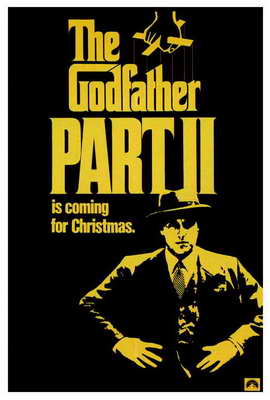
I know that Christmas of 2011 has come and gone, but I couldn’t resist this poster. I can’t wait to re-watch this rarity – a sequel to an absolute classic that equals, and arguably bests, its predecessor. Please be sure to pick up all empties on the way out.

Sunday, June 27, 2010

Film #33: White Heat (1949)


Director: Raoul Walsh

Initial Release Country: United States

Times Previously Seen: once (about 8 years ago)

Teaser Summary (no spoilers):

Homicidal psychopath criminal grits teeth, kills cops, weasels, and dirty dames. Loves his mother, though.

Uncut Summary (the whole shebang, spoilers included. Fair warning):

Cody Jarrett (James Cagney) and his crew of thieves are bad dudes. In pulling a train robbery, Cody kills a few conductors before taking off with a stack of U.S. Treasury bonds. In the action, one of his crew has his face scorched by scalding steam.

Back at their hide-out, Cody and the crew meet up with Cody's mother and wife, both of whom are more than complicit in his illegal activities. In fact, his mother urges such action so that her son can carve out a path for himself and one day be “on top of the world.” Cody has to watch his back, though, since crew member “Big Ed,” his number two, has serious designs on usurping Cody's gang and his woman, the beautiful and high-maintenance Verna (Virginia Mayo).

While gathering up and preparing to hit the road, Cody suffers from a massive, crippling headache, a chronic condition that leaves him physically prone. He recovers with some soothing from his beloved mother and gathers the gang to head out, leaving behind their severely burned accomplice.

Left to right: Verna, Ma Jarrett, and Cody take a break from homicide & robbery for a quiet moment at the drive-in.

At police headquarters, FBI Agent Philip Edwards ponders how to find Cody. A series of clues lead him to where Cody is hiding with Verna and his mother. After a brief car pursuit, they get somewhat cornered in a drive-in theater. Cody tells Verna and his ma about his back-up plan in case of such a pinch: to turn himself in and admit to another, far lesser crime. This way, he will only do two years time, get released, and take control of the gang again.

After Cody turns himself in, Agent Edwards grills Ma and Verna Jarrett, but both are too smart to implicate themselves. Edwards seems a bit stuck, but he has another plan. He sends in fellow agent Hank Fallon to pose as a convict who will room with Cody in prison, hoping to gain enough confidence to learn where Cody has hidden the loot from the train robbery.

In prison, Fallon takes on the identity of Vincent Pardo, a fictitious con. While in, he eventually wins the excessively cagey and paranoid Jarrett's hard-fought trust. Just when it looks like they have a plan to “escape” together, everything goes to hell. From the convict grapevine, Jarrett learns that Big Ed, making his big move, has killed Ma Jarrett. Cody goes ballistic, punching out several jailers and getting sent to a solitary psych ward cell.

In the clink, Cody gives under-cover agent Fallon what-for.

Cody is far from done, though. He soon collects himself and stages a daring escape, capturing the prison doctor, killing a few guards, and lighting out with Fallon/Pardo and a few of his loyal crew on the inside. Cody Jarrett is once again on the loose.

First order of business is vengeance. Cody tracks down Big Ed and Verna at a hideout house. He catches Verna first, who lies through her teeth to avoid Cody's murderous rage. While she was the one to actually pull the trigger on Ma Jarrett, she pins it on Ed. Cody barely accepts the lie and goes after Ed, who he quickly dispatches with a few slugs to the back. The Jarrett Gang is now back in business again, with Fallon/Pardo now a full member of the crew.

The gang plans a massive score to knock off the payroll at a chemical plant. The plan is to use an empty gasoline truck and a Trojan Horse strategy. Unbeknownst to the rest of the crew, though, Fallon/Pardo has tipped off his fellow officers. Once the gang breaks into the plant and begins the heist, tons of cops show up to put an end to the robbery.

Inside the plant, Cody learns of Fallon's true identity and his impending capture. He finally loses whatever sanity he has left and goes on a killing rampage, though Fallon manages to escape in the chaos. Cody manages to scale one of the massive chemical towers and continues to fire upon the police. He finally makes it to the top, fires a few rounds into the container and screams, “Finally made it, Ma! Top of the world!!”

The container explodes into a massive mushroom cloud, taking Cody's psychosis and rage with it.

Take 1: My Gut Reaction (done after this most recent viewing, before any further research):

This movie is damn fun to watch. It's not high art, and it doesn't require any kind of background to enjoy, if one doesn't mind a high-octane shoot-em-up with a bit more depth than your average cops and robbers flick.

White Heat is noirish, though certainly not pure film noir. Many of the key noir elements are there: bad people doing bad things, a beautiful and dangerous woman in the mix, backstabbing, and a protagonist up to his neck in dastardly deeds. Yet, there is nothing admirable, enviable, or even very empathetic about Cody Jarrett, unlike other noir protagonists like Jeff Markham in Out of the Past or Walter Neff in Double Indemnity. Cody Jarrett is a pure psychopath: murderous, cunning, and driven.

James Cagney was the perfect guy for such a whack-job. Cagney may have been about 5-foot-nothing, but he exuded more toughness and lethal tension than nearly anyone I've seen in film. With his pug face, ever-present sneer, and cold, narrow eyes, it's not hard to see how he could play such a wild man so well. And yet, as scary as he is when in one of his psychotic rages, he was even more frightening when he would calmly look another character in the eye, and bold-facedly tell them that he was going to kill them. Said character was then no less that looking Death straight in that little squinched-up face.

I have to say that the dialogue is really amusing, as I'm sure it was meant to be, to an extent. Cagney delivering lines like, “If that radio's dead, it'll have company.” Or even the exchange when the worm-like con who tries unsuccessfully to kill Cody pleads, “You wouldn't kill me in cold blood, would you Cody?!” and Jarrett responds, “Nah, I'll let you warm up a while!” Pure gold, and there are plenty more like them.

Here's the clip of the prison escape, including one of the aforementioned "tough-guy" lines:


That Cody's crackers, I tells ya!

Still, while White Heat is essentially a cops-and-robbers movie on the surface, there's more to it than that. By adding in Cody's severe Oedipus complex, several layers are added to the tale. It becomes clear early on that Cody only really cares about two things: his mother and her edict that her son get to the top and stay there. The fact that “the top” is a twisted version of success built on thievery and murder is almost incidental.

And here lies the really interesting poser for me. When I think about Cody Jarrett and his ultimate goal, I almost can't help but see some warped version of the American dream at work. In a country in which individual accomplishment is prized above nearly all else, Cody Jarrett is a dark, mutilated, near-success story that ends in tragedy. Through the dialogue and story, we see that he only wants to appease his mother and do something grand with his life. His brand of slash-and-burn determination is not far from what one would have found in Nelson Rockefeller or J.P. Morgan. With this in mind, I almost liken Cody Jarrett to the Daniel Plainview character in Paul Thomas Anderson's epic There Will Be Blood. All of these men, both real and fictional, sought to define themselves by the money they made, by hook or by crook, and Cody Jarrett is no exception.

The non-noir elements in White Heat neither enhance nor take away from the film. There's a fair bit of over-the-shoulder exposition on the methods that law enforcement uses to track down the Jarrett gang. I suppose that this was interesting back in '49 the way that forensic cop shows can be interesting now – it's the basic human curiosity about methodology. Still, they are very dated in this film.

In that same vein, it's a bit of a shame that the movie quite obviously had to follow the “Hollywood” script. Sure, plenty of people get offed, but they're all extras. Even when it seems Fallon is a dead duck and is about to die a semi-noble death, the Hayes Code movie gods intervene and save his hide. Not that it's an altogether bad thing, but the movie lost a slight amount of punch to me by not having the insanity have more dire consequences for the more empathetic "good" characters.

These little things aside, I really liked White Heat, and would certainly watch it again. It's also one of those movies that you can judge for yourself by just watching the first five minutes. You get plenty of the action, depth, dialogue, and acting that make it a great one, and all before you can really relax in your easy chair.

Take 2: Why Film Geeks Love this Movie (done after some further research):

While reviewer after reviewer seems to hail White Heat as an undisputed classic, there's not a wealth of exposition on the film. It's one of the those movies that, like certain other classics, can be boiled down to a few key elements. With a Charlie Chaplin movie, for example, it's always the physical gags and comical situations. With White Heat, it's really two things: the amped up violence and James Cagney.

This film was really a grand return for Cagney. He had long before established his place as the face of cinema gangsterism. His sneering, pugnacious characters made films like Angels With Dirty Faces and Public Enemy. At the end of the 30s, however, he left Warner Brothers studios, turned away from the criminal roles and expanded his horizons, doing such films as the patriotic, light-hearted Yankee Doodle Dandy and others.

About eight years later, though, Warner offered him a deal he couldn't refuse; he went back and signed a contract loaded with residuals and, more importantly, a great deal of creative control. Cagney made the most of it, evidenced greatly in White Heat. Apparently, the true-crime inspirations were Cagney's suggestions, and the final rendition of Cody Jarrett was almost wholly Cagney's brainchild. Cagney reportedly wanted to make Cody a completely psychotic amalgam of all of his past gangster roles. Well, he did just that, and it worked like gangbusters.

One good story comes from the fact that Cagney did a fair bit of improvising on the set: during the famous scene in the prison mess hall, when Cody learns that his mother has been killed, Cagney's over-the-top berserk tirade actually scared the bejesus out of all of the extras, none of whom knew what was going to occur in the scene.

Here it is. It's amazing that Cagney didn't severely hurt himself while flailing around:


Much is made of the bizarre Oedipus complex that Cody has. Many critics point out that Raoul Walsh was so skilled that he managed to have a scene in which a distraught Cody actually sits on his mother's lap and allows her to sooth him, much like an eight-year old boy whose turtle just died. I have to concur since I remember the scene, but thought absolutely nothing of it since, by this time, Cody Jarrett's psychological deficiencies were so well fleshed-out that it seemed completely normal for him.

White Heat. It may not be high art, and it may not have been a grand leap forward for cinematic storytelling, but it sure is one helluva ride and a prime performance by an actor the likes of which Hollywood may never see again.

That's a wrap. 33 shows down. 72 to go.

Coming Soon: In A Lonely Place (1950):

Another Bogie movie! On top of that, I've never seen it, and know almost nothing about it. If you read my Casablanca review, you know how I feel about Bogart. Come back and see how I think this later addition to his resume stacks up.

Please be sure to pick up all empties on the way out.

Sunday, June 20, 2010

Film #31: Out of the Past (1947)


Director: Jacque Tourneur

Initial Release Country: United States

Times Previously Seen: 2 (last about 4 years ago)

20-Words-or-Fewer Teaser (no spoilers):

Quiet, clever tough guy has to reconcile shady past with a deadly beauty and a soulless, greedy gangster.

Uncut Summary (a full synopsis, spoilers included. Fair warning):

In the small town of Bridgeport, California, Jeff Bailey (Robert Mitchum) seems a brawny, quiet gas station attendant. He goes about his business and is courting the lovely Ann Miller, though he's not very forthcoming about his past. That is, until his past shows up unexpectedly.

An acquaintance from Jeff's past rolls through town and informs Jeff that another old acquaintance, Whit Sterling (Kirk Douglass) is looking for him. Jeff reluctantly goes, but not before telling Ann about his connection to Sterling.

Several years prior, Jeff, whose real name is Jeff Markham, was a private eye in New York. It was there that he and his then-partner Jack Fisher took on a job from Sterling to track down the woman Kathie Moffat (Jane Greer), who had shot Sterling 4 times, stolen $40,000 and run off. Jeff takes the job and tracks Kathie to Acapulco.
In Acapulco, Jeff begins to fall under Kathie Moffat's spell...

Upon first finding her, Jeff plans to hand her over to Sterling; however, he soon falls in love with her, and she him. Jeff reveals himself to her, and she forgives him while also claiming that she never stole any money from Sterling. Just as the two are preparing to leave Acapulco together, Sterling and one of his thugs, Stephanos, show up. Jeff does some quick tale-telling to shake them, then quietly hops a boat back to the U.S. with Kathie.

They remain low-key in San Fransisco for some time before fate strikes a crushing blow: Jeff runs into his old partner, Jack. Jack then tracks Jeff and Kathie to a secluded cabin in the woods and demands blackmail - for the $40,000, he won't tell Sterling that Jeff and Kathie ran off. Jeff and Jack eventually get into a fist fight, which abruptly ends when Kathie guns down Jack and flees, leaving Jeff to discover that she also had the $40,000 all along.

At this point, we return to the "present," in which Jeff has now told Ann the whole story. The goodly Ann takes it in stride and hopes the best for Jeff in cleaning up whatever mess still remains. Jeff goes to Sterling's mansion in Reno, Nevada, where a few surprises are in store. First and greatest is that Kathie is once again living with Sterling. Even more is that she has told Sterling the entire tale of her and Jeff. Sterling claims that he holds no grudge, though he does feel that Jeff owes him one. One which he means to collect.

He tells Jeff to go to San Fransisco and assist in stealing certain tax documents from a lawyer who's blackmailing Sterling. In actuality, it all turns out to be an elaborate frame job, as the lawyer unexpectedly turns up dead on the same night that Jeff is to break into his office and steal the tax documents. In truth, Kathie has signed an affidavit naming Jeff as his former partner, Jack's, murderer. This is to serve as Jeff's motive for the killing. Jeff figures it out,plays along to a point, and starts making moves.

Neither the first nor last punch Jeff will receive or dish out.

He gets the tax documents and tries to trade them for the affidavit, but it doesn't work. Sterling sends one of his goons to find Jeff, but the goon ends up dead thanks to Jeff's handy assistant from the gas station, who "fishing reels" him into a local river. Jeff returns to Sterling's Reno estate, only to find Sterling shot dead by Kathie, who insists that he must flee with her if they are to have any chance of surviving. Jeff, resigned, agrees.

What Kathie doesn't know is that, while she has been packing her bags to go, Jeff has called the police. As they drive down the road, they see a police barricade in the distance. Kathie realizes that Jeff has turned them in. In a rage, she pulls a pistol and shoots Jeff. The car crashes and finishes the job, leaving both Kathie and Jeff dead.

Back in Bridgeport, Ann hears of the news and asks Jeff's assistant from the gas station if Jeff was truly going to run away with Ann. Rather than tell her the truth that he wasn't, the kid tells her yes. And so, believing herself betrayed by the man that she loved, Ann begins to move on and leaves with the town sheriff, a man who has loved her for his entire life.

Take 1: My Gut Reaction (done after this most recent viewing, before any further research):

I love this stuff.

While Detour was the poor man's version of a decent noir tale, Out of the Past is solid gold on par with Double Indemnity. When I try to figure out why I like these films so much, the answer isn't obvious: the characters are not the most believable, the plot almost always gets laughably convoluted at some point, and the visuals always flirt with crossing the line of style over substance. Still, as I mentioned in my review of Double Indemnity, I think it comes down to one thing - that the fusion of the elements of noir can only exist in film. And this makes it great.

In watching the movie with my girlfriend and her roommate, we couldn't help but chuckle here and there. The constant tough-guy glares and fast-talk invite amusement, though not ridicule. We also had to actually pause the film for a few seconds while we made absolutely sure that we understood the plot clearly. This is something that I've heard is almost required for noir - a story that gets complex almost beyond comprehension. I'm OK with this since it makes the protagonist stronger; you may not know what the blazes is going on, exactly, but Jeff Markham sure as hell does, and he's damn sure going to find a way to straighten it out!

Here's one of the great scenes when Jeff knowingly walks into the frame with the lawyer, Eels (only in noir could that name exist!):


Speaking of Jeff Markham, I have to say that Robert Mitchum is an absolute treat to watch in this thing, perhaps topping Fred MacMurray's trailblazing role as Walter Neff in Double Indemnity. Mitchum is a case-study in how to be quietly tough. With his massive build and cool gaze coming from behind those droopy eyelids of his, he made me wonder where actors like that are these days. The only one who comes to mind is David Morse, though I don't know that he's tried his hand at anything like noir. Mitchum was a rarity.

As far as femme fatales go, Jane Greer was damn good, as well. I still give the overall nod to Barbara Stanwyck in Double Indemnity, but Greer was solid. She had a pixie-like beauty that belied the sick, vicious, tainted soul buried beneath that entrancing exterior. As Moffat, Greer was seductive, sympathetic, and detestable, all in turn.

Kirk Douglass. I think this was one of his first roles. If it was, I'm amazed that he didn't get typecast to play evil s.o.b.s for his entire career. He's so convincing as the cold, calculating snake with an oily smile, that it's a wonder that he soon broke out of it to play heroes.

But I think the reason that the actors can shine so much is the dialogue. While some might view the lines as being cheesy, and they no doubt will make you laugh, it's not because they're cheesy. It's quick, macho, tough guy stuff of the highest order. Here are a few of the best:

Kathie: "I don't want to die."
Jeff: "Neither do I baby, but if I have to, I'm going to die last."

Kathie: "Oh, Jeff, you ought to have killed me for what I did a moment ago!"
Jeff: "There's time."

It's the kind of stuff that can only exist in fiction, and only in film can you see someone like Robert Mitchum deliver the lines with such unmatched, resigned stoicism. It's like he's secretly amused at everyone around him, but knows that in the end, he's the one who's going to go down. Yet he's not going down without getting some jabs in along the way, either physical or verbal. And I assure you that each jab lands squarely where it's targeted.

I will gladly watch this movie again, and would recommend it to any lover of film. It's solid on all fronts and, while it certainly didn't create the noir genre, it's about as good an example of this unique form of cinema as you can possibly find.

Take 2: Why Film Geeks Love This Movie (done after some further research):

Apparently, I'm far from the first to make note of the dialogue as the strong point in this movie. Film critic extraordinaire Mr. Ebert dedicates several paragraphs to it, and even picks out some of the gems himself in his review. I learned from this, as well, that the original screen writer's script was supposedly pretty dreadful, was re-written by James M. Cain, then re-re-written by a B-film writer named Frank Fenton. This last revision was, by most accounts, where the best lines come from. Goes to show that even a margianl writing talent may have one great script in them. Out of the Past was apparently Fenton's.

One of the many great shots throughout the film - Markham about to face his fate.

Another amusing thing that Ebert discovered in speaking with Mitchum and others involved in the film is the ever-present cigarettes. He, like myself and many others, take note that this movie may have more butts huffed than any in history. Surprising thing is that this wasn't really scripted at all - Mitchum said that was "just what we did." Different times, all right.

In reading up on Robert Mitchum, some light is shed on his singular place in the annals of acting. Reviewer after reviewer describes him as "world weary" and "indifferent" (this is no insult, I assure you) in his manner. Well, real-life Robert Mitchum led quite a young life. He was raised in Hell's Kitchen, New York, got into all sorts of mischief as a young man, ran away from home at 12, hopped railroad cars for a few years, and found odd jobs. He dug ditches, fought for prize money, and was generally a hard-ass by the time he was 17 years old. Then, he returned east and found gigs for a local theater, including everything from stagehand to song and script-writer to performer. So I suppose that he comes by his "indifference" quite honestly. When you've had to punch some guy in the face repeatedly for your supper, acting in films must be no great shakes.

Out of the Past had a lukewarm reception back in '47. This original TIME review is almost dismissively short. Though I like the film far better than this original critic, I understand what they mean by Mitchum's fatalistic composure not working as well during the tender love scenes.

Even if Mitchum isn't exactly the most romantic cat of all time, I still dig his work.

That's a wrap. 31 shows down, 74 to go.

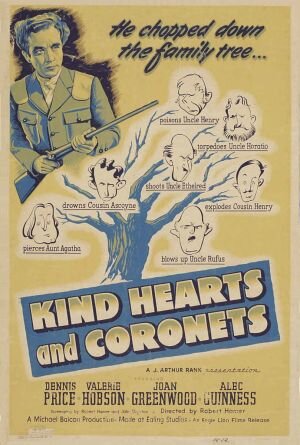
Coming Soon: Kind Hearts and Coronets (1949):

I'm almost totally in the dark on this one. Never seen it, but I've read that it's a British farce in which Alec Guinness plays a ton of humorous roles. Sound like something I might like, but I won't know for a few days.

Please be sure to pick up all empties on the way out.

Tuesday, May 25, 2010

Film #28: Detour (1945)


Director: Edgar G. Ulmer

Initial Release Country: United States

Times Previously Seen: once (about a year ago)

20-Words-or-Fewer Summary (no spoilers)

Piano player gets mixed up in two accidental deaths and a vicious harpy of a woman.

Full Blow-by-Blow (A complete summary; spoilers included. Fair warning)

New York night club piano player Al Roberts has a decent life: he plays tunes in a calm night club and is in love with the club's beautiful young songstress, Sue. One night, she expresses her desire to head out to California and try to hit it big. Al doesn't like the idea, wanting to marry Sue and stay in New York, but Sue insists. Al sullenly accepts and watches her leave, promising to get out to the west when he can.

Before long, the separation gets to be too much and Al scrounges what little dough he has and hits the road, hitching his way across the country. In Arizona, he's picked up by Charles Haskell, a fast-talking quick-buck artist with big plans to score some cash in California, then head back to Miami for a bigger score on a horse race. Amidst his endless tales, Haskell tells the tale of his picking up a young girl around Louisiana - a girl who fought off his unwanted advances, leaving him with tell-tale scratches on his hand.

Farther down the road, Al takes the wheel while Haskell seemingly sleeps. Seemingly. In fact, Haskell has quietly died in his sleep. When the drifter Al realizes that he may be suspected of murder, he panics. Instead of waiting for police, he dumps Haskell's body, swaps his clothes, and takes his car, assuming his identity. His plan is to maintain the ruse until he gets to California and can ditch all of the Haskell's belongings, freeing Al to seek out Sue.

Things go even more awry when Al picks up the hitchhiking Vera. Once in the car, not two minutes pass before Vera reveals that she was the girl who fought off Haskell back near Louisiana. Vera knows that Al is not Haskell, and she assumes that he has murdered and robbed him. Despite Al's proclamations of innocence, Vera sees him as a meal ticket who she can blackmail for cash. Al tries to wiggle his way out of it, but is forced to submit to Vera's demands to hand over the cash and stay with her until they can sell the car.

Vera the banshee begins her verbal whippings of Al the schmuck early on.

Just as Al is about to sell the car and be rid of Vera's poisonous suspicion and greed, Vera discovers the dead Haskell's final secret - he was heading to California to milk his rich and terminally ill father for tons of money. Vera tries to force Al to pose as Haskell, in the hopes of squeezing money out of the old man. Al sees this as risky beyond all reason and refuses to do it.

The argument continues back in their motel room, with both Al and Vera threatening to turn one another in to try and get what they want: Vera the money and Al his freedom. The argument heats up, and ends with Al accidentally choking Vera to death with a telephone cord. Al is now connected to two deaths. He sees fleeing as his only choice, so he hits the road.

In the end, we see Al wandering along a dusty road, slowly heading back east. That is, until a police car pulls up and tugs him into it, apparently on suspicion of the two murders. We can presume that Al Roberts' next stop is likely to be death row.

Take 1: My Gut Reaction (done after this most recent viewing, before any research):

Sometimes, going cut-rate ain't so bad.

You know what I mean. It's when you have a hankering for something, but can't be bothered to put forth a full emotional or financial commitment. You go to Taco Bell instead of an actual Mexican restaurant. You read a Dan Brown novel instead of picking up some Alexander Dumas. Sometimes, these lesser substitutes leave you satisfied (Taco Bell), and sometimes they leave you hollow and guilty (Dan Brown). Detour offers that former type of cheap satisfaction.

This movie is like a passable local dive bar. Sure, it's beat up and worn out, the people are a tad shady, and everything could use a refinish or another layer of duct tape. Still, the beer is cheap and there's an indefinable air of comfort. If Double Indemnity is the sleek speakeasy of film noir, Detour is the scuzzy, back-alley joint with dried blood on the floor.

In short, it's a pretty fun watch. I'm not altogether sure why it's proclaimed a classic. Everything about it screams D.I.Y. The acting, while not awful, is far from stellar. The visuals are a touch overdone at times, like when they went a little crazy with a fog machine to give the setting the standard murky quality of noir flicks. The dialogue comes off as a lame imitation of the masters like Raymond Chandler and James M. Cain.

And yet, it gets the big things right. The narrative is classic noir flashback, with Al Roberts drifting into a diner, agitation and anger radiating off of him. It's a perfect hook to draw you into his lurid tale of horrible luck. He may not be the brightest or most engaging character, but the story is interesting enough to follow through. How does this weary piano player get into such shape? The noir answer is always the same: a woman. Or, in this case, two women.

Al initially sets out from New York to L.A. to marry the girl he loves, a vapid lounge singer. Once he's on his way and he gets the fateful ride from Haskell, it's as if he's already standing on the gallows and just doesn't know it yet. Once Haskell has his heart attack and Al makes the fatal mistake of swapping identities with him, the wheel are set in motion and can't take him anywhere but the end.

Which brings up Vera. The woman is obviously the femme fatale, but not like any other that I've seen. Rather than the coy, subtle panthers like Phyllis Dietrichson in Double Indemnity, or even Kathie Moffat in Out of the Past, Vera is a spitting viper. There's nothing subtle about her in the least. She's a 24-going-on-50 road gal. A tattered, leaky bottle of cyanide. She's not in the film for two minutes before I came to hate her. Ann Savage plays her like she was seriously ready to rip out Tom Neal's eyes at any moment. It borders on overacting, but stays just on the right side of it to keep it from laughable.

Here's the scene when Al first picks up Vera. Start at 3:00 in and watch the rest to get the immediate "Do not touch" vibes that crush Al from the get-go:


Yeesh. Maybe he should have just plowed her over at that gas station when he had the chance.

Oddly, I lost my sympathy for Al early on. Once he makes the boneheaded mistake of ditching Haskell's body, I figured he was too stupid to make it through the whole thing. Still, he's such a sad sack that it's painful to watch Vera tear into him and use him as so much cannon fodder.

The story, while not nearly as complex, polished, or thought-provoking as noir classics, is also a case study in restraint. It never tries to do too much. The film is a mere 67 minutes and hustles along. Al's situation goes from sad to shocking, to desperate, to even more desperate, to fatal at breakneck speed. Once again, the film toes the line of moving too quickly, but manages to rein it in just when necessary by having relatively slower moments of argument/discourse between Al and Vera.

The final reminder of how fictional the world of noir is comes with the death of Vera. Yet again, it's almost humorous when Al accidentally strangles her with a telephone wire. I didn't really laugh, but if I had, it would have been laughter in self-defense rather than humor. By this point, the tragedy has reached its highest pitch, and I couldn't help but empathize with Al's desperation and fatalism. The man's goose was thoroughly cooked, and it was visible in every down-turned line of his haggard face. All that remained was the handcuffs.

Detour is a good little film that any fan of old-school noir, either film or literature, would like to some degree. Once more, I'll have to research just why it's held in high regard by critics these days, as I don't see anything particularly special about it. Then again, that's why I'm doing this little project of mine, eh?

Take 2: Why Film Geeks Love this Movie (done after some further research):

Interesting to note that I couldn't find any original reviews, which speaks to the fact that back in '45, Detour didn't make much of a splash. It has only been after decades of people returning to it that it has emerged as a standard.

Roger Ebert has an interesting analysis of Detour, in which he readily points out that the technical shoddiness is a moot point. It all comes down to Al and Vera, particularly Al. Ebert points to the notion of Andrew Britton that the film's narration may actually represent the desperate attempt of a born loser to gain some kind of sympathy from the audience. This means we can see Al as an unreliable narrator who tries to paint himself as far less pathetic, masochistic and culpable than he may truly be. Interesting.

Richard Schickel's quick capsule take at TIME is rather sparse. He does, however, compare Vera and Al locked in a room to Jean-Paul Sartre's No Exit Hell. In thinking back on the film, I can see his point.

A final notable discovery about the ending. In those days, films were not allowed to show criminals "getting away with it." This is why, rather than the film ending with Al simply drifting along the road into a fade-out, the cops come along in the last seconds and stuff him into their paddy wagon. Notable because, as I watched the movie, it struck me that a better ending may have been the mystery of Al's true fate. Here's the end of it all. Go to 5:00 to see just how censorship changed it, ever-so (?) slightly:


BONUS!! For anyone interested in taking a gander at the film, go no further than this link. The thing is public domain, so you can watch the whole thing. As mentioned, it's a short one, and you may find yourself intrigued enough to stay with it. I did. Twice. I won't be surprised if I get hooked into it again.

That's a wrap. 28 shows down, 77 to go.

Coming Soon: Notorious (1946):


Nice! Hitchcock makes his first appearance on the list. To boot, I get to see Cary Grant in something other than a screwball comedy, and the ever-stunning Ingrid Bergman.

Please be sure to pick up all empties on the way out.


Saturday, May 1, 2010

Film #25: Double Indemnity (1944)

Director: Billy Wilder

Initial Release Country: United States

Times Previously Seen: 3 (most recently about 2 years ago)

20-Words-or-Fewer Summary (no spoilers)

Insurance salesman and black widow gold digger plot murder of husband; hope to get rich off insurance policy.

The Full Treatment (A complete summary, spoilers included. Fair warning):

In 1940s Los Angeles, clever insurance salesman Walter Neff (Fred MacMurray) stops by the opulent home of rich client Mr. Dietrichson to get some signatures on an auto insurance policy. Instead, he meets Dietrichson's sultry younger wife, Phyllis (Barbara Stanwyck). After some flirtatious fast-talk, Phyllis slyly inquires about getting a life insurance policy for her husband, but without his knowing it. The quick-witted Neff immediately smells something fishy and clears out, warning Phyllis that any plot she may have to off her husband and collect insurance money is bound to fail.

And yet, after leaving, Neff can't get Phyllis or her scheme out of his mind. Sure enough, she shows at his apartment later, and they fall into each other's arms. Then and there, Walter agrees to help Phyllis with her nefarious plot. He's sure that, with his knowledge of botched murders through the insurance claims business, they can commit the crime, avoid leaving any evidence, and spend the rest of their lives together off of a $100,000 "double indemnity" insurance policy.


Walter & Phyllis: future lovers and accomplices.

Neff carefully plots the murder and coaches Phyllis in assisting him. With calculated precision, the two get Mr. Dietrichson's unwitting signature on the life insurance policy, then lure him to his own murder, making it seem like an accidental fall from the observation car of a moving train.

At first, it seems as if they will get off scott free. Then, one person starts to smell a rat. Barton Keyes, the eagle-eyed, obsessive claims manager at Neff's office, senses something amiss. Following his instincts, which he refers to as his "little man," the long-time insurance man starts to become ever surer that Dietrichson's death was not accidental. Even more, he feels that Phyllis is the culprit. The only thing he doesn't see is Neff's involvement in the whole thing, but Neff senses Keyes getting closer to the truth.

As the pressure ratchets up, Neff discovers several unsavory things about his co-conspirator, Phyllis. She was, according to Dietrichson's daughter Lola, responsible for the death of the first Mrs. Dietrichson. On top of this, Phyllis has been secretly seeing Lola's boyfriend, Nino, at night for unknown reasons. Neff realizes that he's been played for a sucker.

When Walter goes to Phyllis's house to confront her with his revelations, he throws her deceptions in her face and explains how he plans to see that she will get locked up for the murder of Dietrichson. As a kicker, he plans to absolve himself by killing Nino, who Walter will claim was her accomplice. Phyllis, cornered, pulls a gun and shoots Neff in the arm. Neff clutches her tightly and shoots her dead, the two sharing one final, warped moment of attraction for each other. Nino shows up shortly after, but Neff abandons his plan to frame and kill him, rather telling him to leave and find Lola.

The wounded Neff manages to stagger back to Keyes's office and begins to record his own confession. Just as he reaches the end, Keyes shows up and looks on with sadness and disappointment as his former employee, and perhaps friend, lies bleeding on the floor. As they await the police, Keyes does Walter one final favor - he assists his now one-armed, former friend to light one last cigarette. Sure to be his last.

Take 1: My Gut Reaction (done after the most recent viewing, before any research):

Now we get down an dirty.

After watching several artful cinematic master works and wading through the sophomoric humor of the screwball comedies on this list, I was ready for the downright nastiness of Double Indemnity. This film is a standard just as much as Citizen Kane or Casablanca, but for completely different reasons.

There are no heroes. You have to face this fact - the two main characters are murderers, one merely cold-blooded; the other ice-blooded. Rather than love being the force that attracts one to the other and gives the audience some semblance of a human connection, it's base lust. Walter is entranced by Phyllis' looks and attitude. It's almost like he refuses to realize that he's drawn to her based on the thing that makes her most dangerous - her viper-like magnetism and the promise of sensual delights, even if they're followed by his own destruction. It's this fatalism that's a hallmark characteristic of nearly all film noir protagonists (most notably in the classic Out of the Past - film #31 on the TIME list.)


"She didn't fool me this time." Oh, but she had you all along, Walt. She had you all along...

And yet, at one point, I was hoping that the killer Neff would succeed. This is not because his victim was an evil, or even a bad person. In fact, we don't know much about Dietrichson at all. He's just a pawn with a fat bank account as far as Neff, Phyllis and we viewers are concerned. I think it speaks to the movie writers' skill that there was a moment when, after the murder occurs, I actually wanted Neff to get away with it. How the hell did I become a cheerleader for a murderer?!

I chalk it up to a certain aspect of human nature, one that A-Team leader Hannibal put well: "I love it when a plan comes together." Whatever the plan is, we love to see if someone can pull it off. How else do you explain the appeal of crime movies? Well, Double Indemnity went all the way with it. Instead of giving you something slightly more palatable like bank robbers or a prison escape, you get two people who are going to kill someone for nothing more than greed and lust. Still, Walter's plan is so well-conceived and precise that you can't wait to see if it works, regardless of the motives. There was actually a moment when, as a monkey wrench is thrown into the plan and the risk of discovery increases, I felt nervous for Walter. I was actually sympathizing with a killer!

But more than this is that there is actually some form of redemption in the end. While his veins pump with 33-degree water throughout most of the movie, Walter's senses do return by the end, if only just barely. He sees Phyllis for the black widow that she is and even frees Nino from the frame job that was in place for the oblivious young man. This is what makes Neff more than just an unconscious killer.

Any viewer of this movie is getting treated to pure, unadulterated film noir. The rapid dialogue, the touch of '30s slang, the dark themes, and the deadly femme fatale are all in place. Someone who hasn't seen films in this genre may find them a bit ridiculous at first glance: no one really talks like that. No one could or would really pull these things off. No one place could have so many dynamic characters. All of these things are true. None of these things could or would exist, except for one place - the world of fiction. Whether it was books or film, the realm of noir fiction was a cohesive world all its own. This is why it was such a powerful force in American storytelling for at least two decades. Those broads, booze, and bullets tales had such a great appeal and impact that even as recently as Sin City, noir yet lives, albeit in a small corner of the cinema world.

To pull off such a twisted tale of deceit, you need good performances, and Double Indemnity has them. Fred MacMurray becomes a seminal noir man with his intense, slick talking dead pan. The amazing thing is that he's able to modulate his stoicism by the slightest of degrees, so that you can actually tell when his nerves are eating away at him, as opposed to when he's confident and relaxed. Billy Bob Thornton did this exceptionally well in the outlandish Coen brothers noir film The Man Who Wasn't There, and I suspect he may have studied MacMurray's turn as Neff in Double Indemnity.

I've made my feeling about Barbara Stanwyck pretty clear before. Her role as Phyllis Dietrichson is maybe her best-known role, but I actually prefer her roles in Baby Face and The Lady Eve. I suppose it's that, in Double Indemnity, her character is truly an irredeemable asp whose sex appeal thinly veils the venom stored in her fangs. I think I prefer when she played roles that have a heart, however tiny it might have been.

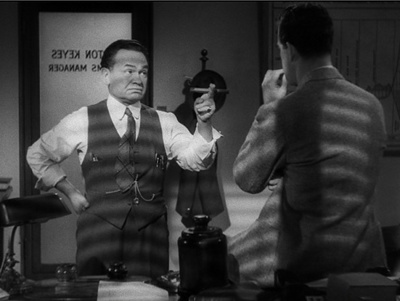
Edward G. Robinson is also incredible as the claims manager, Barton Keyes. He injects such passion into the character that you almost want to get into the insurance business, as laughable as that is; his enthusiasm is that intense.

Robinson injects so much pinched, focused energy in his role as Keyes that he nearly steals every scene in which he appears. The cantankerous, walking actuarial table does his best to keep Walt in line throughout the tale. Alas, it is to no avail.

All of these ingredients: a pitch-black plot (though a thoroughly entertaining one), engaging characters, and fantastic performances, create perhaps the first classic noir film. It helps to know what you're in for, but if you're ready for it, you'll most likely love Double Indemnity.

Take 2: Why Film Geeks Love this Movie (done after further research):

"With Double Indemnity, Billy Wilder took that idea of Americans being a bunch of fast-buck motherfuckers and turned it into art." - Elmore Leonard

And with this statement, I think Leonard sums up a lot. Like Citizen Kane and Casablanca, Double Indemnity has been food for film critic analysis for almost 70 years now. The reason being that this was the first film that artfully told a completely sordid tale that cut right to a very palpable element of the American condition: underneath the attractive exterior lurks a murderous demon.

Perhaps not surprisingly, it took a foreigner to put this idea to film, skillfully. Billy Wilder, a German immigrant who had fled during the early days of the rise of the Reich, was a student of American culture. Apparently, he was riveted by the notion that, in the States, even the most seemingly pleasant and innocuous of people had a murderer slumbering deep inside. All it took was the right trigger to wake it up. In the case of Double Indemnity, the insurance salesman Walter Neff's trigger is the trashy seductiveness of Phyllis Dietrichson.

Hollywood was terrified of this film. The salaciousness. The lack of a hero. These things seemed like poison to major studios, despite the massive popularity of dark themes in the written stories of James M. Cain and Dashiel Hammett. Once Wilder convinced the studio to make it, it was hell to cast. Too many actors and actresses saw it as career suicide. It wasn't until Wilder essentially dared Barbara Stanwyck (with the line, "Are you an actress or a mouse?!"), verbally massaged former nice-guy actor Fred MacMurray, and soothed the pride of usual-top-billed Edward G. Robinson that he had the players he needed.

Once released, Double Indemnity was not dismissed as trash, as one may suspect. Quite the contrary - it was nominated for 7 Academy Awards, winning 1, and is today considered the movie that gave birth to film noir. Never before had such a sinister tale been told with such strong acting, stylishly dark cinematography (in a time when color was growing ever-more common), and with such indelible dialogue. This movie was the parent of many later classics: Out of the Past, The Killers, Wilder's own Sunset Boulevard, and a host of others, both American and foreign.

An interesting note about the writing: the film was co-written by Billy Wilder and Raymond Chandler, based on a novella by James M. Cain. Chandler adapting a Cain novella?! That's pulp fiction madness! The really curious thing is that Chandler, Cain, and fellow pulp master Dashiell Hammett all apparently thought the others' works were garbage. I guess there's more than one plumber to dig into the dark pipes of the human psyche, and those different plumbers do not like the looks of each other.

So, why did this film resonate with Americans at this point in time? Some theorize that the time of release, with the U.S. then being familiar to the darkness of man thanks to three years at war, was more receptive to a midnight-black, adult-themed movie. No longer did every movie have to be family friendly, a hero didn't always have to win, you didn't need a song or dance number, and there didn't need to be an overt moral. Double Indemnity was created at the right time and by the right people, released in the right place, and viewed by the right audience.

The descendants of Double Indemnity are many, a few of which were previously mentioned. Along with a host of others, ones of note would be the '80s remake, Body Heat, and of course, Chinatown, which echoes the tone and even some of the exact settings in Double Indemnity. There have been more recent filmmakers who have redone noir films, but not many have the brass to make the attempt, as there is virtually no chance for blockbuster commercial success. A shame, really, as film noir is another example of the kind of world that could only exist on the silver screen. When done right, as with Double Indemnity, it's as good as anything that's ever been put on celluloid.

In parting, it must be pointed out that the Coen brothers, in addition to the more direct homage to noir, The Man Who Wasn't There, based the ultimate cult film, The Big Lebowski on the entire pulp fiction & film noir genres. If you, like I, are a devoted Little Lebowski Urban Achiever, and have ever wondered why exactly the Coens made bowling such an integral part of the film, allow me to illuminate. Here's a still from a really brief scene in which Neff mulls over the possibility of killing for money:

F***ing Neff...that creep can roll, man.

That's a wrap. 25 shows down, 80 to go.

Coming Soon: Meet Me In St. Louis (1944):


I'm really not much of a musical guy. So much so that I'm calling in reinforcements for this one - my lady friend is going to be my copilot during this viewing, making it the first film that I won't be watching alone, like some film-obsessed hermit. We'll see if she can help me confront Judy Garland and...color!!!

Please be sure to pick up all empties on the way out.