Showing posts with label Billy Wilder. Show all posts

Saturday, January 29, 2011

Film # 49: Some Like It Hot (1959)


Director: Billy Wilder

Initial Release Country: United States

Times Previously Seen: once (about 9 years ago)

Teaser Summary (no spoilers)

Pair of jazz musicians dress in drag and travel with all-girl band to flee gangsters. Shenanigans abound.

Uncut Summary (Full plot synopsis, spoilers included. Fair warning.)

Chicago, 1929. Joe (Tony Curtis) and Jerry (Jack Lemmon) are a couple of jazz musicians who play in a hot speakeasy run by notorious gangster “Spats” Colombo. That night is payday, and the two are working out how to pay back all of their many debts. Just as they bask in the appreciation of simply having a steady job, the police raid the club off of a tip from a local rat, “Toothpick” Charlie. Joe and Jerry see it coming and get out, but the police manage to shut down the place.

The next day, Joe convinces Jerry to put all of their money on a horse. The horse loses, and gone is the fellows' remaining cash, leaving them broke and jobless. They head to a talent agency, to no avail, finding only the tantalizing job for a bass fiddle and sax, their instruments, but for an all-girls group heading to Florida. Instead, they take a small gig on the far side of town. Joe even connives his way to borrowing a secretary's car to get there.

Early that same evening, the boys stroll into the garage to pick up their loaner car. While waiting for the tank to be filled, though, a pack of mafiosos storms in, led by Spats Colombo himself. They have Toothpick Charlie cornered there and gun him down, along with a half dozen other unlucky saps. Joe and Jerry witness it all and are about to join the recently deceased, but they luck out and escape the garage.

On the run, they decide to pose as women and join the all-girls band that they had heard about earlier that day. They adopt the names Josephine and Daphne, don some wigs and dresses, grab their instruments, and show up at the train station. On the train, they meet all of the other girls in the band, including the sultry Sugar Kane (Marilyn Monroe), the group's bombshell singer and ukulele player. Joe and Jerry have to fight their male urges amongst the scantily-clad women, especially the voluptuous, naive and vulnerable Sugar.

"Josephine" and "Daphne" sashay their way down the platform.

Once in Florida, Joe and Jerry seem to be in the clear, but only to an extent. While Jerry is eager to ditch the masquerade, Joe reminds him that Spats is likely looking in every jazz club in the country for them. They decide to remain Josephine and Daphne for a while longer, though it's starting to pose its own unique problems: Jerry has already had to fend off a grabby, though very wealthy suitor – the playfully lecherous Osgood Fielding III.

This also gives Joe the chance to weasel his way into Sugar's arms. He uses what he knows of her search for a rich man “with glasses” and takes on his second persona: the heir of the Shell Oil Corporation. Under this guise, he finds Sugar on the beach and she falls for it, hook, line and sinker. The two part ways, but Sugar is clearly starstruck.

Back at the hotel, Jerry receives a call from Osgood, who invites “Daphne” to an intimate evening on his yacht. Joe convinces Jerry to let him use Osgood's yacht to woo Sugar under his “Shell Oil” millionaire persona. Jerry reluctantly agrees to this as well as keeping Osgood busy on shore for the evening.

That evening, Joe's devious plan works to perfection. Jerry keeps Osgood occupied with an evening of romantic dancing while Joe works a cunning game of reverse psychology on Sugar. After ferrying her out to Osgood's yacht and pawning it off as his own, he weaves a tall tale about the freak death of a past love and how he is no longer able to feel love for any woman. Sugar, taking up the challenge to re-ignite his passions, kisses Joe repeatedly and clearly falls in love with his fictitious persona.

Sugar and "Shell Oil Junior" get further acquainted.

Back at the hotel in the morning, Joe returns from his evening of deception and snuggling with Sugar to find his pal Jerry in a bizarre daze. After a marathon evening of lively dancing, Osgood has proposed to him, and Jerry seems to actually be considering marrying the goofy old sod and extorting alimony checks from him after the inevitable annulment. Joe manages to snap Jerry out of this odd and felonious notion.

At the same time downstairs at the same hotel, one Spats Colombo has arrived for a meeting of mafia dons, all under the heading of a gathering of “Italian Opera” aficionados and presided over by head boss Little Bonaparte. Bonaparte has a serious bone to pick with Spats, as Toothpick Charlie had been a friend of his.

In the lobby, Joe and Jerry stumble across Spats, fortunately in disguise, but think that they've been discovered. They immediately hustle back to their rooms and pack for a hasty getaway. However, while clambering down the banister outside their room, they are spotted by Spats and his crew. A chase ensues, but the boys manage to elude capture by ducking under a banquet table. Unfortunately, the banquet is for the “Italian Opera” mobsters, including Spats. The banquet turns into a bloodbath as Bonaparte has Spats and his crew brutally gunned down. Joe and Jerry a discovered by Bonaparte, but the police arrive, allowing Joe and Jerry to slip away once again.

In the lobby, Joe and Jerry hide and overhear some of Bonaparte's goons explaining that they have all of the roads and public transportation routes out of town covered, in order to intercept Joe and Jerry. They realize that they can take Osgood's yacht to escape, and Jerry channels “Daphne” to make Osgood amenable. Osgood agrees, and the only order of business is for Joe to break away from Sugar without breaking her heart. He decides to once again use Osgood by sending Sugar some flowers and a diamond bracelet that Osgood had intended for “Daphne”. This initially crushes Sugar, but she decides to pursue her Shell Oil man as he flees to the shore with Joe and Osgood. She joins them on the boat just as they depart for Osgood's yacht. Joe finally comes clean to Sugar, dropping all masks, but she hardly bats an eye and accepts Joe, wholeheartedly.

Jerry, still dressed as Daphne and riding next to an elated Osgood, tries to let him down easily. Osgood is not so easily rebuffed, forcing Jerry to finally remove his wig and confess that he is, actually, a man. The euphoric Osgood misses not a beat and delivers the most timeless line of the film, saying, “Nobody's perfect.”

The love-struck Osgood and his muse, "Daphne"

Take 1: My Gut Reaction (Done after this most recent viewing, before any research)

Eh. Inconsistently entertaining.

Some Like It Hot has some really funny moments peppered into an underwhelming barrage of flat gags. The movie is clearly meant as a silly, screwball affair. From my reviews of earlier classic screwball comedies such as The Awful Truth, His Girl Friday and The Lady Eve, it should be clear that the genre is probably my second least favorite, with musicals taking the top spot. Some Like It Hot, however, eliminates the elements that I always despised, namely the focus on the rich and sophisticated class. By having the two main boobs (not counting Marilyn Monroe's) be average Joes (Josephines?), the condescension found in most screwballs is blessedly absent. Joe and Jerry are semi-lovable, if deceitful, morons who stumble their way through the movie. Unlike the typical “Cary Grant” protagonists of earlier screwballs, I found them far more amusing than annoying.

The humor is so intentionally silly that you can't help but laugh at times. This is mostly due to some great script work and top-notch comedic acting. While I couldn't care less for the endless gender humor (e.g. the fellas tripping in high heels, Jack Lemmon adjusting his fake breasts, et al), the interactions between Tony Curtis and Marilyn Monroe are priceless. Once Curtis adopts his “Shell Oil” persona, complete with a dead-on Cary Grant affectation, there are plenty of great moments between him and the laughably gullible Sugar Kane.

Here's some of the primo stuff, when Curtis and Monroe are hitting on all cylinders as "Shell Oil Junior" is trying to cunningly lure the dim-witted Sugar Kane into amore:


A personal side-note and observation: watching Marilyn Monroe in this movie is an interesting exercise, as a modern viewer. She was excellent at playing what amounts to a bimbo who is, in her own character's word, “not too bright.” More interesting to me, though, are the more subtle moments when she would be recounting past failures in love at the hands of abusive men. There are moments when, between sips of bootleg hooch, her eyes would narrow and her pain seemed eerily genuine. Knowing how Monroe's life played out and ended, I wondered just how much “acting” she was doing at these moments.

As funny as some of those moments are, there are plenty of duds to me. Nearly all of the supposedly funny moments with Spats Colombo and his gorillas were anything but. I got the sense that they almost didn't go far enough with the parody. All of the characters in the movie are meant to be cartoonish, but this concept was not fully realized with the gangsters, especially with their dialogue. Instead of being slyly ridiculous, their lines were merely hackneyed. Had some of the other characters' dialogue not been so sharp and clever, I might not have noticed, but compared to Curtis, Monroe, and Lemmon's lines, the writing for the gangsters seems a bit lazy.

One thing that distracted me a bit was the utter shallowness of the characterization, typified most by a lack of consistency. During the first portion of the film, Joe seems to be the slick-talking shyster and Jerry the level-headed, uptight straight man. Without warning, though, Jerry becomes the libidinous and irresponsible clown of the pair. Then, the voice of reason shifts back to Jerry's lips for the last part of the story. I know better than to ask for much character depth from such a goofy comedy, but a little bit of consistency would have been nice.

The plot is hardly worth mentioning. It was clearly just a device for setting up scenarios that, for mainstream Hollywood of the time, were probably rather risque. Having a bunch of nubile women scamper around in their underwear and bathing suits was probably titillating enough; the added element of Curtis and Lemmon's overtly lusty observations and comments almost certainly blazed new trails for popular sexual comedy. It goes without saying that having Marilyn Monroe's undulating curves and generously displayed cleavage, highlighted through Billy Wilder's direction, clearly sent the sex-o-meter into the red. Alas, in this day and age of Farrelly brothers and Judd Apatow flicks, such old-school fare is a relative lightweight.

Some Like It Hot is yet another movie which, if you know a little about cinema history, poses no mystery as to its lasting place in the annals of film. Still, it's another “classic” that I feel has faded to degrees in recent decades.

Take 2: Why Film Geeks Love This Movie (Done after some further research)

Some Like It Hot seems impervious to wear, as far as critics are concerned. Even now, it is ranked by the American Film Institute as the 22nd greatest American movie of all time, and THE best American comedy of all time. (I respectfully disagree.)

There are no real surprises as to what critics have loved about the movie, which are the same things that I found enjoyable: the sharp, farcical scenarios and dialogue and the timeless sensuality of Marilyn Monroe. Something that does surprise me is how many critics, including this original reviewer back in 1959, cite Jack Lemmon as turning in the strongest performance, for which he was even nominated for several awards. Lemmon was excellent, no doubt, but Tony Curtis provided me with far more laughs.

As he often does, Roger Ebert points out an interesting aspect – Monroe's ability to be such a sex-pot while remaining so genuinely innocent. He recounts the well-known (among hard-core film buffs, anyway) tales of the troubles with Monroe, including her trouble with the lines and the domineering presence of then-husband Arthur Miller. There's also the curious tale of Tony Curtis saying that kissing Marilyn Monroe was “like kissing Hitler.” Check out his review here.

Speaking of Monroe, something was confirmed for me that I made no mention of above – that she did, in fact, perform all of her own singing. I have to agree with the reviews that I read that state that she did outstanding work with them. She may not have been any kind of world-class vocalist, but she was certainly skilled enough to “sell” the lyrics, as Ebert put it. As a person who nearly always dislikes musical numbers in movies, I had absolutely no problems with any of them in Some Like It Hot.

Here's my favorite number from the movie:


Another point of note is that, due to its blatant sexuality, Some Like It Hot is credited as being one of several contemporaneous films that began to break down the Hays Production Code, the ratings code that had been in place for over two decades. In fact, it received a rating of “Condemned” by the “National Legion of Decency” back in '59. I have to think that that piqued the public's curiosity to no end. Fortunately, such Protestant ideals of art and censorship would be mostly shattered in another five or six years' time.

Considering that it's hailed as arguably the greatest closing line of all time, I have no choice but to finish up with this:


That's a wrap. 49 shows down, 56 to go.

Coming Soon: The World of Apu (1959):

The final installment of the Apu Trilogy. The second was an understated delight, and I'm intrigued to see how Satyajit Ray completed his tale of the thoroughly human Bengali boy.

Please be sure to pick up all empties on the way out.

Saturday, May 1, 2010

Film #25: Double Indemnity (1944)

Director: Billy Wilder

Initial Release Country: United States

Times Previously Seen: 3 (most recently about 2 years ago)

20-Words-or-Fewer Summary (no spoilers)

Insurance salesman and black widow gold digger plot murder of husband; hope to get rich off insurance policy.

The Full Treatment (A complete summary, spoilers included. Fair warning):

In 1940s Los Angeles, clever insurance salesman Walter Neff (Fred MacMurray) stops by the opulent home of rich client Mr. Dietrichson to get some signatures on an auto insurance policy. Instead, he meets Dietrichson's sultry younger wife, Phyllis (Barbara Stanwyck). After some flirtatious fast-talk, Phyllis slyly inquires about getting a life insurance policy for her husband, but without his knowing it. The quick-witted Neff immediately smells something fishy and clears out, warning Phyllis that any plot she may have to off her husband and collect insurance money is bound to fail.

And yet, after leaving, Neff can't get Phyllis or her scheme out of his mind. Sure enough, she shows at his apartment later, and they fall into each other's arms. Then and there, Walter agrees to help Phyllis with her nefarious plot. He's sure that, with his knowledge of botched murders through the insurance claims business, they can commit the crime, avoid leaving any evidence, and spend the rest of their lives together off of a $100,000 "double indemnity" insurance policy.


Walter & Phyllis: future lovers and accomplices.

Neff carefully plots the murder and coaches Phyllis in assisting him. With calculated precision, the two get Mr. Dietrichson's unwitting signature on the life insurance policy, then lure him to his own murder, making it seem like an accidental fall from the observation car of a moving train.

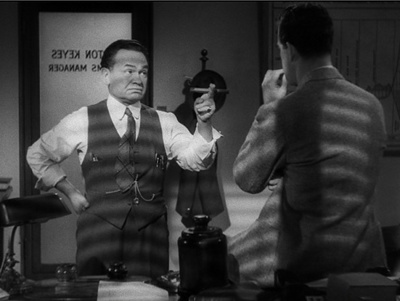
At first, it seems as if they will get off scott free. Then, one person starts to smell a rat. Barton Keyes, the eagle-eyed, obsessive claims manager at Neff's office, senses something amiss. Following his instincts, which he refers to as his "little man," the long-time insurance man starts to become ever surer that Dietrichson's death was not accidental. Even more, he feels that Phyllis is the culprit. The only thing he doesn't see is Neff's involvement in the whole thing, but Neff senses Keyes getting closer to the truth.

As the pressure ratchets up, Neff discovers several unsavory things about his co-conspirator, Phyllis. She was, according to Dietrichson's daughter Lola, responsible for the death of the first Mrs. Dietrichson. On top of this, Phyllis has been secretly seeing Lola's boyfriend, Nino, at night for unknown reasons. Neff realizes that he's been played for a sucker.

When Walter goes to Phyllis's house to confront her with his revelations, he throws her deceptions in her face and explains how he plans to see that she will get locked up for the murder of Dietrichson. As a kicker, he plans to absolve himself by killing Nino, who Walter will claim was her accomplice. Phyllis, cornered, pulls a gun and shoots Neff in the arm. Neff clutches her tightly and shoots her dead, the two sharing one final, warped moment of attraction for each other. Nino shows up shortly after, but Neff abandons his plan to frame and kill him, rather telling him to leave and find Lola.

The wounded Neff manages to stagger back to Keyes's office and begins to record his own confession. Just as he reaches the end, Keyes shows up and looks on with sadness and disappointment as his former employee, and perhaps friend, lies bleeding on the floor. As they await the police, Keyes does Walter one final favor - he assists his now one-armed, former friend to light one last cigarette. Sure to be his last.

Take 1: My Gut Reaction (done after the most recent viewing, before any research):

Now we get down an dirty.

After watching several artful cinematic master works and wading through the sophomoric humor of the screwball comedies on this list, I was ready for the downright nastiness of Double Indemnity. This film is a standard just as much as Citizen Kane or Casablanca, but for completely different reasons.

There are no heroes. You have to face this fact - the two main characters are murderers, one merely cold-blooded; the other ice-blooded. Rather than love being the force that attracts one to the other and gives the audience some semblance of a human connection, it's base lust. Walter is entranced by Phyllis' looks and attitude. It's almost like he refuses to realize that he's drawn to her based on the thing that makes her most dangerous - her viper-like magnetism and the promise of sensual delights, even if they're followed by his own destruction. It's this fatalism that's a hallmark characteristic of nearly all film noir protagonists (most notably in the classic Out of the Past - film #31 on the TIME list.)


"She didn't fool me this time." Oh, but she had you all along, Walt. She had you all along...

And yet, at one point, I was hoping that the killer Neff would succeed. This is not because his victim was an evil, or even a bad person. In fact, we don't know much about Dietrichson at all. He's just a pawn with a fat bank account as far as Neff, Phyllis and we viewers are concerned. I think it speaks to the movie writers' skill that there was a moment when, after the murder occurs, I actually wanted Neff to get away with it. How the hell did I become a cheerleader for a murderer?!

I chalk it up to a certain aspect of human nature, one that A-Team leader Hannibal put well: "I love it when a plan comes together." Whatever the plan is, we love to see if someone can pull it off. How else do you explain the appeal of crime movies? Well, Double Indemnity went all the way with it. Instead of giving you something slightly more palatable like bank robbers or a prison escape, you get two people who are going to kill someone for nothing more than greed and lust. Still, Walter's plan is so well-conceived and precise that you can't wait to see if it works, regardless of the motives. There was actually a moment when, as a monkey wrench is thrown into the plan and the risk of discovery increases, I felt nervous for Walter. I was actually sympathizing with a killer!

But more than this is that there is actually some form of redemption in the end. While his veins pump with 33-degree water throughout most of the movie, Walter's senses do return by the end, if only just barely. He sees Phyllis for the black widow that she is and even frees Nino from the frame job that was in place for the oblivious young man. This is what makes Neff more than just an unconscious killer.

Any viewer of this movie is getting treated to pure, unadulterated film noir. The rapid dialogue, the touch of '30s slang, the dark themes, and the deadly femme fatale are all in place. Someone who hasn't seen films in this genre may find them a bit ridiculous at first glance: no one really talks like that. No one could or would really pull these things off. No one place could have so many dynamic characters. All of these things are true. None of these things could or would exist, except for one place - the world of fiction. Whether it was books or film, the realm of noir fiction was a cohesive world all its own. This is why it was such a powerful force in American storytelling for at least two decades. Those broads, booze, and bullets tales had such a great appeal and impact that even as recently as Sin City, noir yet lives, albeit in a small corner of the cinema world.

To pull off such a twisted tale of deceit, you need good performances, and Double Indemnity has them. Fred MacMurray becomes a seminal noir man with his intense, slick talking dead pan. The amazing thing is that he's able to modulate his stoicism by the slightest of degrees, so that you can actually tell when his nerves are eating away at him, as opposed to when he's confident and relaxed. Billy Bob Thornton did this exceptionally well in the outlandish Coen brothers noir film The Man Who Wasn't There, and I suspect he may have studied MacMurray's turn as Neff in Double Indemnity.

I've made my feeling about Barbara Stanwyck pretty clear before. Her role as Phyllis Dietrichson is maybe her best-known role, but I actually prefer her roles in Baby Face and The Lady Eve. I suppose it's that, in Double Indemnity, her character is truly an irredeemable asp whose sex appeal thinly veils the venom stored in her fangs. I think I prefer when she played roles that have a heart, however tiny it might have been.

Edward G. Robinson is also incredible as the claims manager, Barton Keyes. He injects such passion into the character that you almost want to get into the insurance business, as laughable as that is; his enthusiasm is that intense.

Robinson injects so much pinched, focused energy in his role as Keyes that he nearly steals every scene in which he appears. The cantankerous, walking actuarial table does his best to keep Walt in line throughout the tale. Alas, it is to no avail.

All of these ingredients: a pitch-black plot (though a thoroughly entertaining one), engaging characters, and fantastic performances, create perhaps the first classic noir film. It helps to know what you're in for, but if you're ready for it, you'll most likely love Double Indemnity.

Take 2: Why Film Geeks Love this Movie (done after further research):

"With Double Indemnity, Billy Wilder took that idea of Americans being a bunch of fast-buck motherfuckers and turned it into art." - Elmore Leonard

And with this statement, I think Leonard sums up a lot. Like Citizen Kane and Casablanca, Double Indemnity has been food for film critic analysis for almost 70 years now. The reason being that this was the first film that artfully told a completely sordid tale that cut right to a very palpable element of the American condition: underneath the attractive exterior lurks a murderous demon.

Perhaps not surprisingly, it took a foreigner to put this idea to film, skillfully. Billy Wilder, a German immigrant who had fled during the early days of the rise of the Reich, was a student of American culture. Apparently, he was riveted by the notion that, in the States, even the most seemingly pleasant and innocuous of people had a murderer slumbering deep inside. All it took was the right trigger to wake it up. In the case of Double Indemnity, the insurance salesman Walter Neff's trigger is the trashy seductiveness of Phyllis Dietrichson.

Hollywood was terrified of this film. The salaciousness. The lack of a hero. These things seemed like poison to major studios, despite the massive popularity of dark themes in the written stories of James M. Cain and Dashiel Hammett. Once Wilder convinced the studio to make it, it was hell to cast. Too many actors and actresses saw it as career suicide. It wasn't until Wilder essentially dared Barbara Stanwyck (with the line, "Are you an actress or a mouse?!"), verbally massaged former nice-guy actor Fred MacMurray, and soothed the pride of usual-top-billed Edward G. Robinson that he had the players he needed.

Once released, Double Indemnity was not dismissed as trash, as one may suspect. Quite the contrary - it was nominated for 7 Academy Awards, winning 1, and is today considered the movie that gave birth to film noir. Never before had such a sinister tale been told with such strong acting, stylishly dark cinematography (in a time when color was growing ever-more common), and with such indelible dialogue. This movie was the parent of many later classics: Out of the Past, The Killers, Wilder's own Sunset Boulevard, and a host of others, both American and foreign.

An interesting note about the writing: the film was co-written by Billy Wilder and Raymond Chandler, based on a novella by James M. Cain. Chandler adapting a Cain novella?! That's pulp fiction madness! The really curious thing is that Chandler, Cain, and fellow pulp master Dashiell Hammett all apparently thought the others' works were garbage. I guess there's more than one plumber to dig into the dark pipes of the human psyche, and those different plumbers do not like the looks of each other.

So, why did this film resonate with Americans at this point in time? Some theorize that the time of release, with the U.S. then being familiar to the darkness of man thanks to three years at war, was more receptive to a midnight-black, adult-themed movie. No longer did every movie have to be family friendly, a hero didn't always have to win, you didn't need a song or dance number, and there didn't need to be an overt moral. Double Indemnity was created at the right time and by the right people, released in the right place, and viewed by the right audience.

The descendants of Double Indemnity are many, a few of which were previously mentioned. Along with a host of others, ones of note would be the '80s remake, Body Heat, and of course, Chinatown, which echoes the tone and even some of the exact settings in Double Indemnity. There have been more recent filmmakers who have redone noir films, but not many have the brass to make the attempt, as there is virtually no chance for blockbuster commercial success. A shame, really, as film noir is another example of the kind of world that could only exist on the silver screen. When done right, as with Double Indemnity, it's as good as anything that's ever been put on celluloid.

In parting, it must be pointed out that the Coen brothers, in addition to the more direct homage to noir, The Man Who Wasn't There, based the ultimate cult film, The Big Lebowski on the entire pulp fiction & film noir genres. If you, like I, are a devoted Little Lebowski Urban Achiever, and have ever wondered why exactly the Coens made bowling such an integral part of the film, allow me to illuminate. Here's a still from a really brief scene in which Neff mulls over the possibility of killing for money:

F***ing Neff...that creep can roll, man.

That's a wrap. 25 shows down, 80 to go.

Coming Soon: Meet Me In St. Louis (1944):


I'm really not much of a musical guy. So much so that I'm calling in reinforcements for this one - my lady friend is going to be my copilot during this viewing, making it the first film that I won't be watching alone, like some film-obsessed hermit. We'll see if she can help me confront Judy Garland and...color!!!

Please be sure to pick up all empties on the way out.

Sunday, March 28, 2010

Film #18: Ninotchka (1939)


Director: Ernst Lubitsch

Release Country: United States

Times Previously Seen: Once (about five years ago)

20 Words or Fewer Summary (no spoilers):

Robotic Commie cutie goes to Paris, falls in love with a Frenchy.

The Story (A full blow-by-blow, with spoilers. Fair warning):

Cold-as-ice Communist Russian negotiator Ninotchka is sent to Paris to clean up a bungled attempt by three clownish comrades to sell off some jewels confiscated from a past Russian aristocrat. When she arrives, she is hard as steel, forged by the communist ideals of Marx and Lenin. She soon meets French Duke Leon, an easy-going, semi-rakish lawyer whom she initially sees as representing all of the excesses of capitalistic society.


The first meeting of Ninotchka & Leon

And yet, she is attracted to him. Leon steadfastly melts her icy exterior and gets her to embrace some of the joys of living for the moment rather than eternal self-sacrifice. Even though they truly love each other, Ninotchka's imminent return to Russia upon the completion of her mission hovers over everything. Pushing a final fly in the ointment is Duchess Swana, the original owner of the jewels and Leon's past lover. Swana manages to ferret away her jewels and sends Ninotchka back to Russia with no Leon and no jewels. Leon is distraught and tries, by hook or by crook, to get a visa into Russia to see his love. Alas, he fails.

Back in the Soviet Union, Ninotchka cannot abandon her memories of Leon and the freedoms she had in Paris. Eventually, her superior sends her as an envoy to Constantinople, seemingly to clean up a mess similar to the one that begins the whole story, even involving the same three goofs from the first jewel mission. Once she arrives, however, she learns that the "mess" has all been a contrivance by Leon to get her out of Russia and reunite with her. Ninotchka agrees to stay with him and they live, presumably, happily ever after.

How sweet.

Take 1: My Gut Reaction (done after one viewing, before any research):

Eh - it was OK. This was how I remember feeling about it the first time I watched it. What you basically have is a romantic comedy with the added weight of certain social ideals thrown into the mix. I certainly wasn't counting down the minutes to the final credits, and I was even quite engaged for certain parts, but I won't go out of my way to watch it again.

The story itself is half-decent, and it's what kept me watching. The rightful possession of the jewels serves to conjure up questions about rightful ownership of aristocratic property. Who owns royal jewelry? The nobles whose families bought them and passed them through the decades and centuries, or the laborers whose toils truly paid for them? These interesting questions are raised and touched upon in several places, but serve as mere spice to the larger tale of love and freedom.

The love story isn't too bad. There's a light peal of truth to the fascination that the worldly Leon and the stoic Ninotchka have for one another. Yet it needs to be said that the viewer is quite obviously meant to sympathize with Leon's point of view. I guess this is natural since this was a Hollywood picture, and Paramount sure as hell wasn't going to try and sell any sympathy for communist Russian ideals.

Comedically, the film is very flat to me. There are a few bits that I think are funny. This was an early work for Billy Wilder, who co-scripted it, and his fingerprints are all over it. From the first scene, we can see the sly visual humor at work. The script is clever enough, though it's sometimes much in the screwball comedy vein of rapid-fire dialogue and predictable hoakiness that seems ingenuine to me. Still, the actors pull them off well.

Here's the initial appearance of the title character, wearing her bone-chillingly scientific efficiency on her sleeves:


Acting-wise, things are solid, with Melvyn Douglas's turn as the affable Duke Leon the standout. Garbo is good, but, as I mentioned in my review of Camille, I don't totally get the Greta Garbo sensation. The old movie posters proclaim, "Garbo Laughs!!", which is a clear indication that her frigid exterior was a selling point. She has a masculine quality that doesn't do it for me, but that's just one heterosexual man's opinion, I guess.

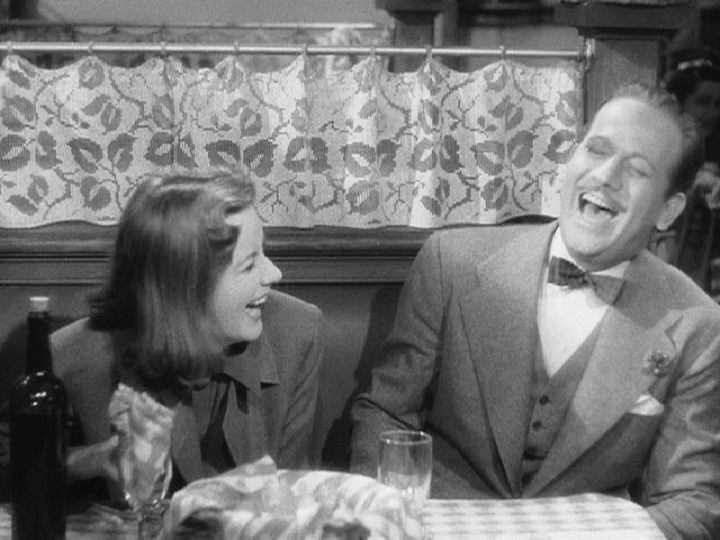
I had three main problems with this film. One. The break-neck turnaround of Ninotchka from hard-core commie to dreamy-eyed lovebird borders on ridiculous. For the first part of the film, she's as immovable in her beliefs as a pillar of iron, and is as humorless. She literally doesn't so much as crack a smile. Then, at a restaurant, Leon decides to try and break her by telling her jokes. One joke after another fails miserably until he slips and falls out of his chair. At this point, the entire restaurant breaks into uproarious laughter, Ninotchka included. It was too odd. It would have been like watching Terminator 2 during the scene where a stone-faced Arnie annihilates the entire squadron of police from the second story of Cyberdine Systems, only to then have Sarah Connor slip on a banana peel, at which the T-101 starts giggling like a school girl. It just ain't right.

This laughter comes across as authentic as a seventeen-dollar bill.

Which brings up another pair of personal bugaboos. Forced laughter and faux drunkenness. I hate the way they did it in those old films. The aforementioned restaurant scene is a perfect example, as was the last ten minutes of Swing Time. In Ninotchka, I got the double whammy of seeing Garbo and Douglas pretend to be completely shitfaced. This was almost always overdone in old films, and this was no exception. Why was no one ever the quiet, sullen drunk? Or maybe the frighteningly violent drunk? We all know those people, right? Well, Hollywood films back then had no use for them. Everyone always did the same things - slurred speech and wobbling back and forth. That's it. It annoys me.

The final nuisance was that I was a bit uneasy at the way communist Russia was protrayed. This film was made in 1939, when the serious problems that the Soviet Union was facing were becoming very real. And yet, Hollywood seemed to have no trouble poking fun and making light of it all in a somewhat condescending way. Can you imagine if George Clooney decided to do a romantic comedy in which he fell in love with a North Korean woman, and then made light of the horrors and deprivations of that society, just to give us a few yuks? I suppose I can imagine it, but it's a freaking nightmare. Ninotchka isn't as severe as all that, but there is a taint of such insensitivity there.

Ninotchka's got things that obviously bug me, but it's not bad. I certainly enjoyed it more than the trial that was The Awful Truth, or even slightly-less-annoying films like Camille or The Crowd. As with others of its day, any lover of classic cinema would surely enjoy it, as its extremely well-produced and effective in its purpose.

Take 2; or, Why Film Geeks Love This Movie (done after some further research):

No real shockers here. Back in the day, viewers loved the potent combination of clever humor, the "opposites attract" love tale, and the clear jabs at Stalinist Russia. Even the original TIME magazine reviewer back in '39 wasn't above admitting the schadenfreude felt in trashing the already-cracking communist experiment: here's his review.

Interesting to note how all of the reviews that I've read do admit to the perplexing attraction that Duke Leon inspires in Ninotchka. While I didn't see it as too absurd, I have to disagree with modern reviewer Richard Schickel's take, in which he seems to have adored the "Garbo Laughs" selling point. I found it really contrived and phony, myself.

One final point of interest is how this film was marketed in the U.S. as Garbo's first comedy, hence the focus on her laughter on the movie posters and such. Such was actually not the case, as she had done various comedy and dancing films years before in European releases. Whatever the case, it worked like gangbusters - Ninotchka grossed a mint in the U.S. and was nominated for four Academy Awards, including Best Picture.

Side-note: One of the minor roles of Ninotchka's superior officer in Russia was played by none other than Dracula himself - Bela Lugosi. In an odd twist, right after I watched this film, I caught a few minutes of Tim Burton's Ed Wood on TV. If you haven't seen Ed Wood, for God's sake, do yourself a favor and watch it now! One of the most underrated quirky comedy films ever.

That's a wrap. 18 shows down. 87 to go.

Coming Soon: His Girl Friday (1940):


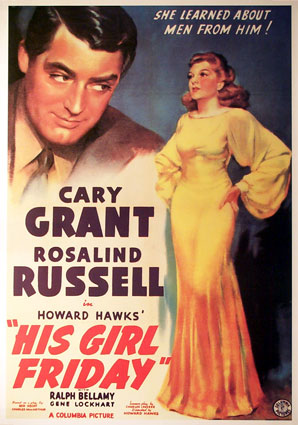
Oh boy. Another screwball comedy with Cary Grant. That last one, The Awful Truth, was the most trying thus far. I have actually seen this one, and the memories are not good. The things I do for...actually, I don't know why I'm doing it. Still, inertia is a helluva thing.
Please be sure to pick up all empties on the way out...