Showing posts with label Ridley Scott. Show all posts

Tuesday, May 30, 2017

New Release! Alien: Covenant (2017) [Spoiler-Free 1st Section]

Spoiler-Free Section

Director: Ridley Scott

Much like the previous Alien movie, Prometheus, Covenant is an uneven tale with some magnificent visuals.

My full review of 2012's Prometheus is here, but for those who don't know, can't remember, or have willfully wiped their memory of it, the basic tale is thus: in the year 2093, a crew of space explorers arrives on a distant planet, where various clues on Earth have guided them. The working theory is that this new planet may provide further hints about an alien race which may have created all life on Earth. When the crew arrive, they find a massive spacecraft filled with wonderfully advanced and terrifyingly lethal biological weaponry. This weaponry, which includes creatures seen in the previous Alien movies, kills all but two members of the crew: Doctor Elizabeth Shaw and the android David. Shaw and David narrowly escape the planet, with the intent of finding the beings that left behind such nefarious creatures of pure destruction.

Flash forward a decade. The massive spacecraft Covenant is on its way to a new planet, filled with a couple thousand human colonists and the ship's crew, all under stasis for the long trip. When things go wrong, the crew is awoken and they find themselves heading towards a planet from which they receive strange audio which sounds like music from Earth. Once on the planet of origin, they make discoveries as to the fate of the survivors of the Prometheus disaster a decade before their voyage.

Right off, I have to say that Covenant does address one of my beefs about Prometheus, regarding the nature of the android David. And while is is annoying to learn that these were left for a sequel to explain, I did find the explanations quite satisfactory. In fact, the explanations become the primary plot point and arguably most interesting element of Covenant.

Another merit of the movie is, unsurprisingly, the visuals. Between some marvelous set pieces, stunning landscapes, slick costumes, and excellent CGI, the movie looks great. There are also a few action sequences that were far better than anything I recall from Prometheus, including the penultimate showdown with the obligatory xenomorph. No, none of it comes close to topping the many great scenes in James Cameron's Aliens, but there was improvement, to be sure.

Viewers should also not be surprised to learn that the acting is solid. Michael Fassbinder is the headliner, and of course he continues his chilly portrayal of the androids David and Walter. The rest of the cast is also strong, even if Billy Crudup's neurotic performance didn't do his character any real favors. And this brings up the characters.

The crew of the Covenant. Unfortunately, many of them
often seemed like they played hooky during what I assume
should have been rigorous psychological testing and
space exploration training.
One of my major problems with Prometheus was the lack of characters who were either really intelligent or at least worth caring about. I was disappointed to learn that Covenant did not make any real strides in this department. Much like the crew of the Prometheus, the crew of the Covenant come off as bafflingly ill-equipped to deal with difficult situations. Anyone who does just a little homework on space travel knows that astronauts go through rigorous training and are very closely vetted for their abilities to remain cool under pressure. This includes when things go terribly wrong, including losing fellow crew members. Yet, several members of the Covenant seem to lack that even keel, breaking down and over-reacting to nearly every crisis. There is also a lack of organic emotion in the story, with deeply-felt bonds being forced down our throats rather than allowed to emerge more naturally. This is a real shame, as it takes much of the steam out of scenes that are meant to be moving or at least tense.

Perhaps the most disappointing element of the movie is that too many components felt like mere retreads of ideas long since overused in the Alien film series and copied by lesser imitators. While there are some concepts and themes that are new to these tales, many of the horror elements are all too familiar and far too easy to anticipate.

The litmus test for me with science-fiction movies has always been the strength of my desire to watch them again after my first viewing. Covenant does pass this basic subjective requirement, although just barely. As stunning as many of the visuals are, I won't bother seeing it again in the theater, rather waiting for home release. In doing a tad bit of research on the future of the series, I did come across a few somewhat disconcerting quotes from series honcho Ridley Scott, implying that he may just be spinning the entire series into a possibly endless "franchise" - a term which he seems to use almost disdainfully. On paper, the quotes almost suggest that the mere existence of these recent Alien movies are at least in some form a middle finger from Scott to the viewing public, which might explain the lack of creativity, relative to the earliest and best entries into the series. I hope this isn't the case, and that any future films can realize their full potential more completely. Prometheus and Covenant have come up a bit short, even if they are just engaging enough to merit more than one viewing.

Spoiler Section - You've Been Warned

A few specific reactions:

One of several tense moments in which the crew needs to
think and act quickly. Odds are, at least one person is going
to make a horribly ill-advised decision, which seems to be
a theme in the two recent Alien films.
Firstly, I think one problem I have regards the pace. In very short order, things start to go tragically wrong, with protagonist Daniels losing her husband in a brutal, fiery accident. From that horrible moment, there is a dark shadow lurking over the film that even the few attempts at levity can't escape. When one looks at the best science-fiction/action/adventure/thriller movies, including Alien and Aliens, there was always a slow buildup to the disaster and terror. Those movies spend a good thirty minutes or more allowing us to know the characters in more relaxed and often humorous scenes. We never get that with Covenant, which lowers the emotional stakes. As other crew members start dropping like flies, I can't say that I knew or cared much about any of them, which is a far cry from how I felt about many of the deaths in the first two movies. When the crew members of the Nostromo or the space marines in Aliens start dying, there was a real sense of loss. Covenant didn't offer nearly as much of that as I had hoped.

Just how is it that the writers of Prometheus and Covenant either can't or won't write authentic characters? There are plenty of examples in this most recent film, but one standout example will suffice to make my point. After Daniels's husband, who is also the crew captain, is killed in the accident, Oram assumes command. However, right from the jump, he shows a lack of backbone and leadership acumen that is baffling to say the least. This is a man who was supposedly tested and vetted to be second in command of what I assume is a trillion-dollar colonization mission on a distant planet. And at the first sign that he'll have to actually lead people, he crumbles like an eight-year-old who forgot his book report. This was yet another area where the original two films cast these more recent ones in such poor light - nearly all of the characters actually make the right decisions and show great survival instincts and skills; it's just that the xenomorph(s) are frighteningly adept killing machines.

As for the originality, it seems as though Ridley Scott and his chosen writers are tapped out of ideas when it comes to the xenomorphs themselves. Yes, we get an air-born, inhalant version of a xenomorph, and a couple of creatures that bear a different complexion and slightly different body structures. But mostly, we get the same types of chest-burster, face-hugger, and drop-from-the-rafters scenes that we've had in nearly every other Alien movie. Even though Prometheus introduces the ideas of an array of variant pathogens and lethal organisms, the movies seem to just rest on what was successful long in the past.

The android David is central to the film, and his is the most
engaging element of the film. Trying to puzzle out just what
is going though his synthetic brain is easily the most
compelling aspect of
Covenant.
It wasn't all bad, though. I actually like what they did with David's story. While the notions about artificial intelligence going rogue would probably have been fresher about 15 or 20 years ago, it is still a fascinating topic, and the enigma of David and his goals is intriguing enough to keep much of the story interesting. Upon further reflection, it does seem that the film could have revealed David's secrets more gradually and skillfully, creating greater tension. As it was, though, it was fairly compelling.

I'll also say that the penultimate action sequence was solid. While other elements of the movie were not terribly original, the fight on the landing platform between Daniels and the xenomorph, with the craft attempting to escape the planet, is the stuff of excellent big-screen, blockbuster action. It was actually far more memorable and exciting than any of the action sequences in Prometheus, which was sadly lacking in that department.

The "twist" at the end? Come on. Is there anyone who couldn't see that coming from a mile away? I'm not always the swiftest to pick up on such things, but even I knew that Walter was David from the moment we didn't actually see the end of their hand-to-hand fight. On top of that, is there an Alien movie with more of a downer ending than this one? Maybe Alien3, but at least that film concluded on an act of self-sacrificing heroism. I'm not against downer endings, when there is a greater message or suggestion being presented, but this one just seemed downright twisted. I suppose that the nearly-inevitable sequel could help take the edge off of it, and it may actually be a great straight-up action movie a la Aliens, but seeing David basically win does leave a bitter taste in the mouth. 

Tuesday, June 7, 2016

Gangster Flick 3-Pack: The Friends of Eddie Coyle (1973); The Long Good Friday (1980); American Gangster (2007)

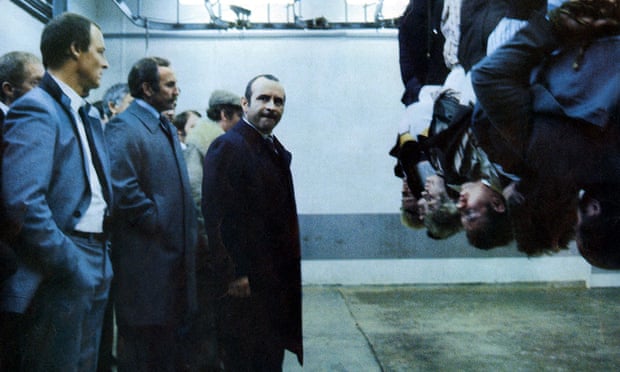
The taglines on the original movie poster say it all.
The Friends of Eddie Coyle (1973)

Director: Peter Yates

A curious movie which oozes despair and fatalism like only 1970s movies can.

Acting legend Robert Mitchum, no stranger to great noir films, plays Eddie Coyle, a mafia middle-man of the lowest-rent variety. Coyle dabbles steadily enough in the purchase and exchange of guns, but he barely manages to eke out a meager existence by which he lives in an uninspiring home with his wife and three children. Eddie is not even particularly great at what he does. As penance for flubbing a job earlier in life, he had his fingers broken in a drawer, earning the nickname "Eddie Fingers". As this movie begins, he has already been collared for illegally transporting stolen goods, and is only free on bail until he can be tried and locked away. That is, unless he turns evidence on some of his more powerful bosses.

The movie isn't always as tight as it could be. A fair amount of time is spent showing how an arms dealer whom Eddie knows goes about the dangerous work of selling guns to criminals of both the professional and amateur variety. While much of this isn't necessary to the central tale of Coyle, it is actually done well enough to remain intriguing. Many of these scenes actually exhibit much that other filmmakers could learn about how to execute tense and suspenseful scenes which still feel fairly organic.

In spite of these mildly tangential moments, the movie coheres at the end, without leaving any dangling elements. Thanks to the generally sordid nature of his business and a horribly unfortunate mix-up, Coyle is targeted for assassination. I couldn't help but think that this movie is essentially the third act of Goodfellas, when Henry Hill sees all of his past glories and successes fall away as he becomes severed from the life of crime which had nurtured him for so long. The difference with Eddie Coyle, however, is that we have no sense that Coyle ever had a "heyday" when he lived the high life and rubbed elbows with mafia big shots. For this reason, Eddie Coyle feels more sadly authentic, and of course far less entertaining, than a Scorsese or Coppola gangster movie.

The Friends of Eddie Coyle is probably too dreary for me to watch again. Still, I have to admit that it is extremely well done and still shows why it is, to this day, considered among the best gangster movies.


Harold Shand - a man who wants profitable peace but has
a frightening violent streak dragged out over the course
of this tense film.
The Long Good Friday (1980)

Director: John Mackenzie

This was the second time I've seen this one. I found it excellent the first time, and it only improved.

The only difficulty I can point out has nothing to do with the film itself. It is merely that there is an abundance of cockney crime slang, which can be tough to decipher, even for one who is familiar with it through movies and novels, like me.

Foreign phrases aside, this movie is an all-time great. Even more than 1971's Get Carter, The Long Good Friday paints a portrait of a British gangster that is as compelling as it is creative. Bob Hoskins plays Harold Shand, a London-based gangster who has overseen nearly a decade of peace and prosperity in the organized crime world. With the 1980s freshly underway, Harold has big plans for massive, mostly-legitimate expansion, and he is about to host a representative of the Sicilian-American mafia in order to forge a partnership. Just as the visit is about to begin, though, some very bad things start happening. A few of Harold's top lieutenants are killed. One of his pubs is bombed. Another bomb is found in one of his casinos. Somebody clearly has it in for him.

The movie follows Harold as he tries to figure out first what is going on, and then who is responsible, so that he knows where to aim his murderous rage. The details of the plot can be rather difficult to follow at times, due in part to the heavy accents and regional slang, but the gist is quite clear: someone is out to get Harold, and Harold is not a man who takes kindly to being gotten. It's the stuff of some of the very best gangster tales, be they in literature or film. There is an almost noir-like impenetrability to the plot, so that it is much easier to feel Harold's disorientation. It's easy to see why he makes several missteps, and its also easy to see why he reacts so violently when certain details are revealed. With each new piece of information he discovers or weeds out through beatings and torture, either the mystery deepens or the scope grows to frightening proportions. This movie is very clearly where plenty of modern British crime movies like those of Guy Ritchie took many of their cues. While the more recent movies exaggerate the entertaining aspects of hard-boiled criminals and their exploits, though, The Long Good Friday keeps the tone far darker and more menacing.

Harold Shand (middle), showing some creativity with his
methods of information extraction.
The performances by the stars of the movie are phenomenal. The secondary characters are played by many faces familiar to those who have seen some of the more popular British crime movies, and a few were even used by Guy Ritchie later in Lock, Stock, and Two Smoking Barrels and Snatch. We also get a rather young Helen Mirren as Harold's sophisticated, modern gun moll, and Mirren predictably nails the role. Most amazing of all of the strong performances, though, is that of Bob Hoskins. His turn as besieged crime lord Harold Shand is one that is arguably unmatched in British crime movies. His shifts in personality, from gregariously charismatic optimist to snarling, vengeful, and brutal thug are completely natural and captivating. His is one of those performances that draws the eye to his character in virtually every scene, and even warrants multiple viewings.

This was the second time that I've watched this movie, and I'm quite likely to watch it again. Anyone who has ever enjoyed British gangster movies owes it to themselves to watch this touchstone film in the genre.


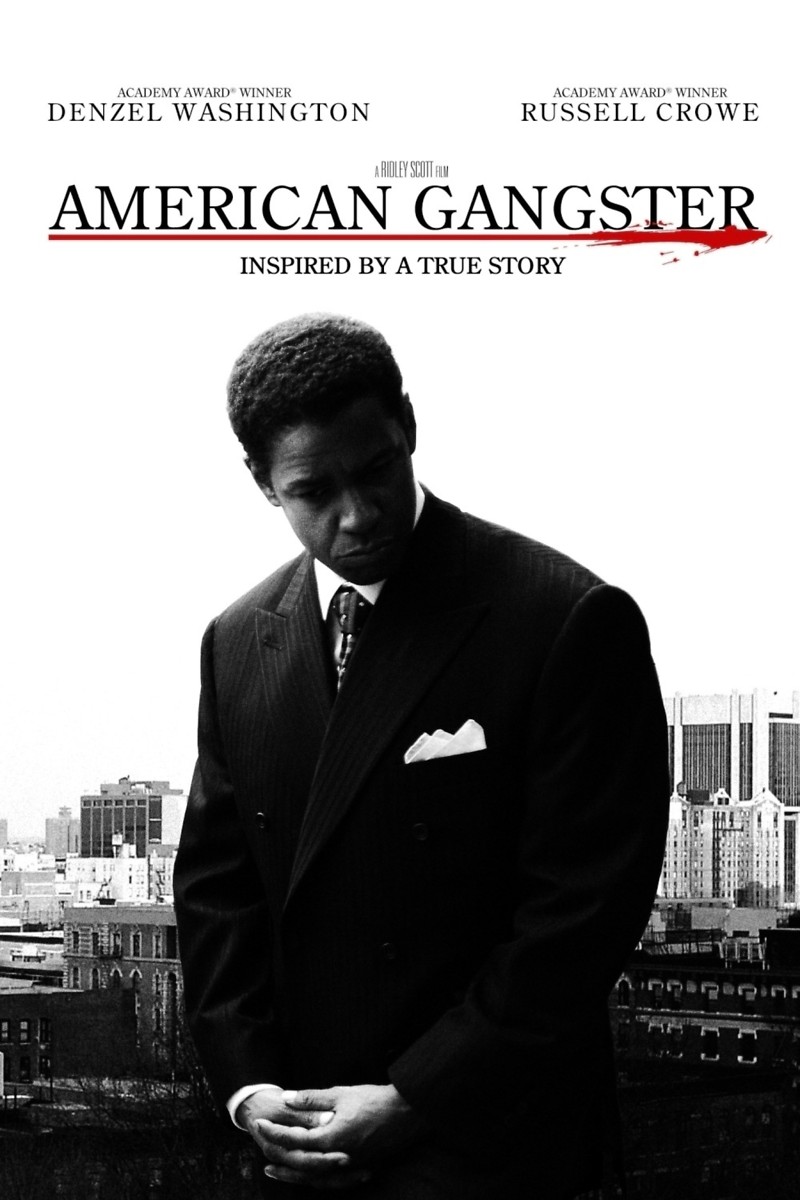
American Gangster (2007)

Director: Ridley Scott

A solid offering of a Scarface-style, making-of-a-gangster movie of a different breed, if not exactly a modern classic.

Based on real events, American Gangster follows the rise of Frank Lucas, the very real drug kingpin who rose to power in Harlem in the 1960s and 1970s. Prior to his climb to crime-lord, Lucas (Denzel Washington) had been an associate of the powerful and influential boss Bumpy Johnson. When Johnson dies, Lucas sees the opportunity to place himself in the gap left by Johnson's death, a gap left mostly in the heroin market. Knowing the landscape of the local illegal drug trade, Lucas knows that he can't compete with the already-entrenched forces of smaller local drug lords and the corrupt police force. He therefore goes directly to a major source of heroin - Vietnam. Using a few old neighborhood friends, the enterprising Lucas cuts a deal with a Vietnamese opium grower and purveyor to sell to him directly. Lucas also organizes a method for getting the opium into the U.S. on board military planes making regular trips between Vietnam and the U.S.

While Lucas's power begins to grow, New Jersey police officer Richie Roberts (Russel Crowe) is fighting the good fight. In ways very reminiscent of Serpico - another story based on true events - Roberts is one of the very few clean cops on the force, which alienates him from nearly all of his fellow officers. It is, however, his incorruptibility that brings him to the eye of state officials who make him head of a force tasked with bringing down the ever-growing illegal drug trade in the greater New York City area. This sets Roberts on the path to tracking down Frank Lucas and attempting to put together a case that will bring down the cautious and savvy criminal and his organization.

The movie bears plenty of familiar elements, the most obvious being the two well-known crime movies already mentioned. But while there may not be much that is exactly novel about the basic elements of the story, director Ridley Scott spins the tale out in entertaining and engaging ways. Richie Roberts's detective work is not unlike what we see in the first season of The Wire, with a small crew of dedicated cops using all of their wits to grasp the scope and details of a massive illegal operation and bring down those in control. The cast does plenty to elevate many of the confrontations and exchanges above their occasional mediocrity, and watching the inevitable collision between Lucas and Roberts slowly develop is engaging. The resolution of the movie is a bit atypical of such movies, and it provides a really solid scene between Washington and Crowe.

As with most movies based on real events, I did a bit of informal research to see just how close to reality the events in the film came. The short answer is: not very close. By most accounts, the real Lucas was not nearly as suave or endearing as the on-screen version, and Roberts is actually portrayed in a slightly less appealing light than the real man. This is another case in which I feel that I would almost prefer to watch a well-done documentary on this topic, even when the dramatized version is of high quality. 

Thursday, November 26, 2015

New Releases! The Martian (2015); Spotlight (2015)

The Martian (2015)

Director: Ridley Scott

A strong, sober take on outer space adventure, but one that takes no true risks.

Set in an undetermined but not-too-distant future, The Martian is the tale of Doctor Mark Watney (Matt Damon), an astrobotanist who is accidentally abandoned by his crew on Mars during an exploratory mission on the red planet. Once he awakens after being knocked unconscious, Watney must attempt to survive on a planet with almost no water, very limited food, and no immediate way to contact Earth to send a rescue team.

The strength of the film is in seeing just how a top-notch scientist uses all of his knowledge to fend off impending death at multiple turns. Watching Watney diagnose and solve problem after problem offers plenty of fascination for those who wonder exactly how someone might survive in the worst environmental circumstances.

Buoying the compelling plot is the performance of ever-reliable Matt Damon. Damon does excellent work in conveying the affable doctor's fear, frustration, elation, bemusement, and excitement at various turns in the film. He humanizes Watney in a way that stokes our hopes that he somehow safely return to Earth.

Watney takes a little break during one of his lower moments.
Not surprisingly, director Ridley Scott oversaw some
incredible visual effects within which Matt Damon could
bring Watney to life. 
These immense strengths make the movie well worth watching. However, I couldn't help but see some places where other, similar movies have outdone The Martian. The 1995 drama Apollo 13 tells a similar, albeit historically true, tale in which the NASA engineers and astronauts are less romanticized or glamorized while still being granted extreme respect for their intelligence and abilities. The 2013 film Europa Report is far more similar to The Martian, being a futuristic tale of speculative fiction about space exploration. However, this earlier film avoids Hollywood tropes such as the sometimes-misplaced playful humor and occasional caricatures which we see in The Martian (just note the socially awkward, uber-nerdy astrophysicist Rich Purnell)

The main reason that I think more highly of a movie like Europa Report is that it takes the risk of actual peril with its characters. I never for one moment watching The Martian doubt that Watney would be saved. The movie sets a tone early on that tells us viewers that we shouldn't worry too much about the lovable doctor. What I respect so much about Europa Report is that strong, dignified characters must literally die for a higher purpose - in this case broadening humanity's collective scientific knowledge. It may not be the most crowd-pleasing element, but it is one that I hold in high regard. The Martian misses out on some of this, in the name of finding a broader appeal.


Spotlight (2015)

Director: Tom McCarthy

Quite simply one of the best movies I've seen in years.

Spotlight depicts the lamentably true story of how a handful of dedicated journalists working for the Boston Globe exposed nearly 90 Catholic priests in the Boston area who had molested young children, only to have church authorities and other local institutions cover up and bury the story for decades.

The Boston priest scandal was a bombshell when it broke in 2002. The story of the victims and the protection of their abusers is one that required the utmost respect, diligence, and skill of a filmmaker. Fortunately, director Tom McCarthy and his team were clearly up to the task. Spotlight conveys just how hard it can be, even for the most skilled and dedicated journalists, to construct and publish an immensely impactful story in the proper way and at the right time. This movie truly is the All the President's Men of our time.

When watching a film based on true events, I am always wary of directors' attempts to romanticize or glamorize the real characters or actions. I found none of this in Spotlight. What we get is a group of always committed, sometimes conflicted professionals who are chasing down a social disease. The facts of the story provide all of the drama, without need for anything extra. In fact, I cannot think of a single scene or character in the movie which was superfluous to the primary story. There are no romance stories or relationship dramas thrown in for inattentive viewers, and every character feels completely fleshed out.

Liev Schreiber as editor Marty Baron. He may look and talk
like a human tranquilizer, but underneath lies the steady hand
that urged and supported the revelation that was the Boston
Catholic priest abuse scandal.
The acting, with one exception, is above reproach. My only little gripe is that I found Mark Ruffalo trying a bit too hard to display righteous indignation in an overt, twitchy way that I felt oversold the emotion. I did grow accustomed to it as the movie progressed, though. All of the other actors, major stars and lesser-knows as well, are outstanding. In particular, I found Liev Schreiber's understated yet extremely powerful turn as new editor-in-chief Marty Baron to be quietly amazing. The depiction of his character is the very portrait of a restrained yet unwavering sense of what is right and how to do it correctly. He and all of the other actors seemed well aware that this movie was far less about them or their performances, but rather it was about the horrible story that they were dramatizing. They clearly went to great lengths to get it right, just as their source people did in their jobs as journalists.

I can very easily see this film becoming an inspiration for young people who see it. Just as All the President's Men stoked the fires of meaningful journalism in the 1970's, Spotlight could very well do the same these forty year later. I certainly hope so.

Sunday, July 27, 2014

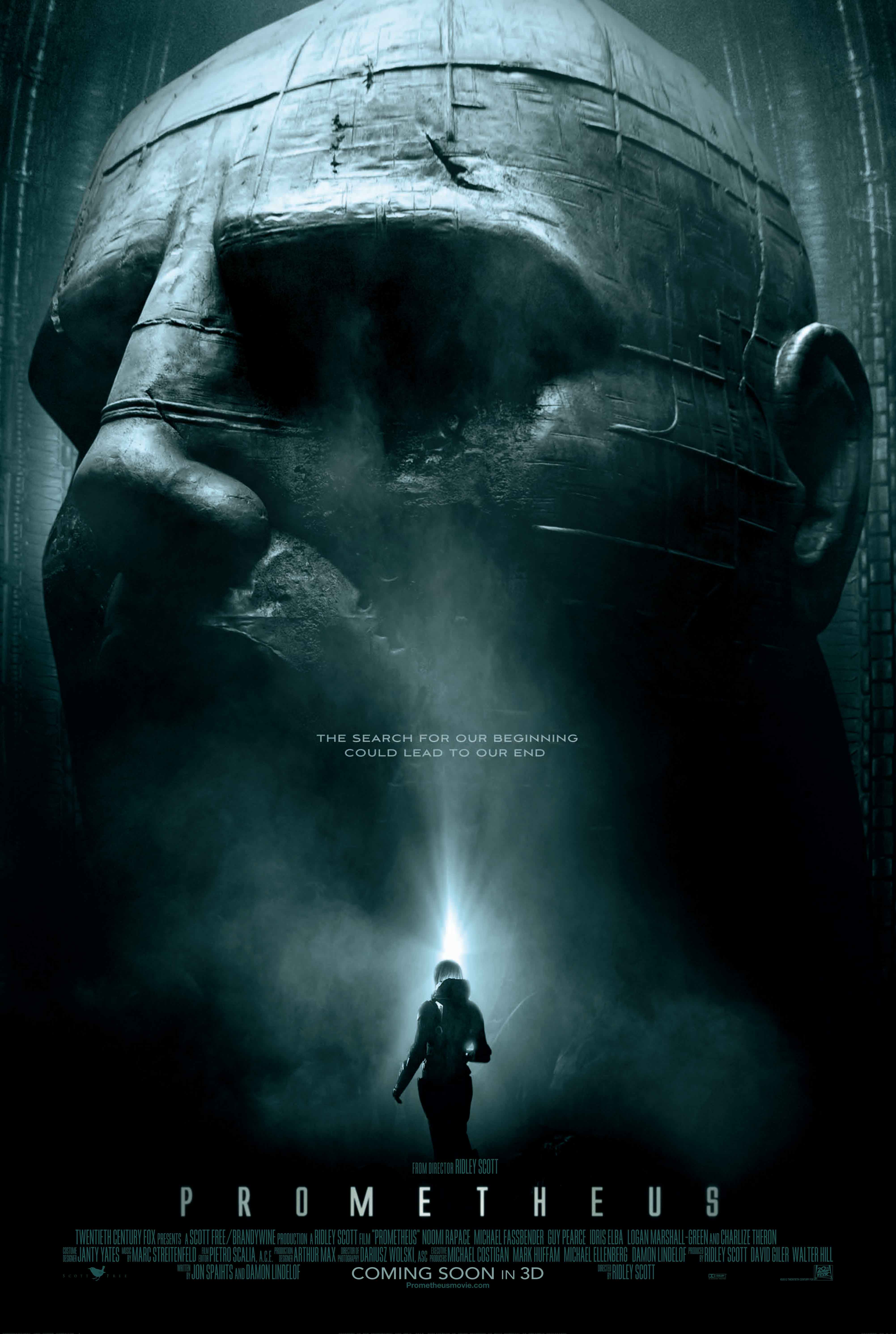
Prometheus (2012)


Director: Ridley Scott

Imagine you're really hungry and you sit down for dinner in a restaurant where the chef is a known master. You are then brought out a small amount of a phenomenal appetizer. You ask for more from the waiter, but instead he brings you a small plate of stale SPAM. You'd rather not eat it, so you just hold your nose and wait. Eventually, the waiter removes the SPAM and brings out another small plate with a tiny portion of a masterfully prepared soup. You quickly devour the four or five spoonfuls of this masterpiece, again asking for more. Once again, the waiter refuses and instead brings out a cup of cold ramen noodles. On this goes, all the way through your meal, alternating excellence and baffling inadequacy.

If you can imagine this strange hypothetical, then you have some idea of what watching Prometheus is like. It tantalizes you with moments and elements of brilliance, and then gives you something that makes your eyebrows want to dance right off your face.

When you look at the basic plot structure of this prequel to the Alien canon, it looks good: a team of scientists treks several light years across the galaxy to find creatures who not only left messages on Earth ages ago, but which also may very well have planted the very seeds of life on our planet. Once the team gets there, they discover not some benevolent creator race, but rather a bizarre structure that seems to exist for some unspeakably horrifying purpose. Once the methods of interfacing with the structure are puzzled out, it starts to reveal its history to the explorers, though not in ways that they had hoped.

David, as he puzzles out the aliens' interfacing system.
Unlike the costumes, sets, props, and visual effects in the
movie are beyond reproach.
Sounds decent, right? And honestly, it is decent. More than decent, actually. If you focus solely on the major story points, it's actually a pretty good one. And if you allow yourself to be dazzled by the amazing visual effects - and they are truly spectacular - then you might not see what so many people have complained about, and you might think Prometheus is fantastic.

To the critical movie-goer, though, there are more than a few problems with the movie. One is that the de facto protagonist, Elizabeth Shaw (Noomi Rapace), is a bit annoying. For some reason, the writers saw fit to make hers some sort of religious crusade to prove the existence of some benevolent God based on the death of her missionary father on Earth. Why? The story is fascinating enough without it becoming some form of religio-psychotherapy for one of the characters. On top of that, her love interest and colleague, Charlie (Logan Marshall-Green), is a total snoozer of a character.

Which brings us to one of the major problems: the human characters. Essentially, not one of them is well done. The scientists - you know, the ones who were supposedly hand-picked by a company that invested a trillion dollars in this venture - are either fully idiotic or a oddly detached. Not very realistic, if you ask me. The pilot, played by the ever-magnetic Idris Elba - is ridiculously "too cool for school." So much so, that even when the crew first set eyes on the the very first proof of alien life, he simply gazes passively and cracks off a few flippant one-liners. Absolutely no sense of the wonder and awe that he should be feeling with the audience. It's as if the writers were trying to give each and every person some kind of quirk or cliched personality trait just to make him or her interesting. The result is a crew of 2-dimensionals that I mostly didn't care about. What happened to scenes like the classic dinner table one in Alien (before John Hurt's chest pains), or even some of the more casual humor of the space Marines in Aliens? There was virtually none of this in Prometheus.

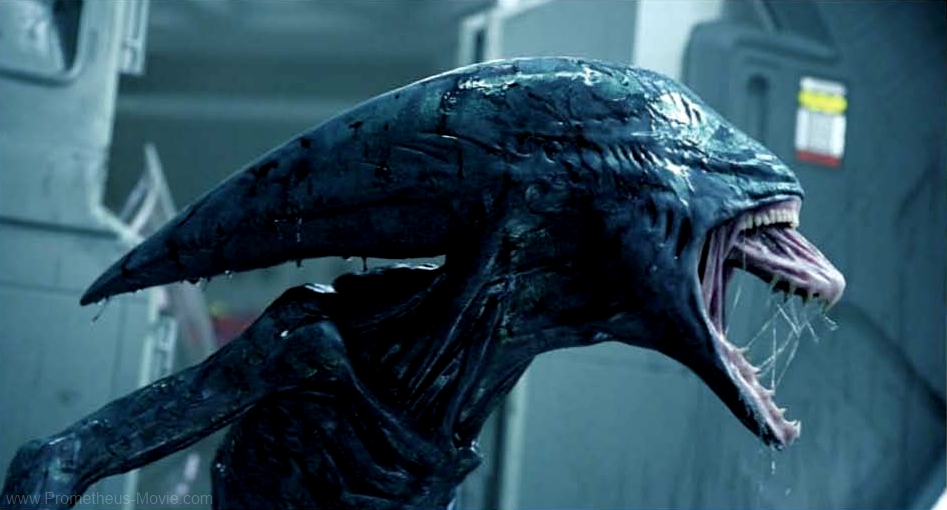
Of course, the movie wouldn't have been complete without
a little teaser at the end to create the obvious link to
the
Alien movies. This happy little guy gives it to us.
If we really want to nerd out with our critique, we can talk about David. David is the ship's android member. Androids have always been a major part of the Alien narrative. With Ash in Alien and Bishop in Aliens, the bar was set extremely high for interesting synthetic humans. David does play a key role in the story, is interesting enough, and is played extremely well by Michael Fassbinder. However, David is noticeably more advanced than either Ash or Bishop, both of whom are created many decades after David. On top of that, there are far too many of David's bizarre actions that are never fully explained. He exhibits clear signs of human emotions, which speaks either to sloppy writing or unresolved implications. What it amounted to was frustration for me as a viewer.

These problems are impossible for me to ever overlook completely, but the movie is not terrible. It ends on an interesting note, and it all but guarantees a sequel, which is scheduled to come out in 2016. Honestly, I'll go see it. Prometheus had just enough to it that I'm willing to give Ridley Scott a chance to right the wrongs of the first one. After Alien and Blade Runner, the man has earned at least that much. 

Saturday, May 5, 2012

Film # 81: Blade Runner (1982)


Director: Ridley Scott

Initial Release Country: United States

Times Previously Seen: twice (last time about 12 years ago)

Teaser Summary (No spoilers)

In the future, a bounty hunter of androids has his hands full with a gaggle of hyper-advanced targets. Trudges through rain, gets beat up a lot.

Extended Summary (More detailed plot synopsis, spoilers included)

*Note: This summary and the “Take 1” Review are based on the original, theatrical cut released in the United States in 1982. There have been several other versions of the movie, which will be discussed in “Take 2”.

**Note #2: Summarizing a complex sci-fi tale is no short task. If you’re not interested in all of the ins and outs, jump down to my “Take 1” for my basic opinion of the movie.

In a slightly alternate Earth in the year 2019, space travel has become a reality. To facilitate space travel, exploration, and colonization, androids have been developed to the point so as to be nearly indistinguishable from humans. However, a handful of extremely advanced androids have attempted to escape their labors, even sometimes killing their human controllers. Thus, they have been banned from Earth.

On Earth, at the massive Tyrell Corporation, an interview is taking place. Tyrell is the premier manufacturer of androids used in space, but they fear that they may be infiltrated by a small group of rogue androids who have killed their human owners and returned to Earth. An employee named Leon is called in for the interview with a man named Holden. Holden is what is known as a “blade runner”, a bounty hunter who tracks down and kills rogue androids. He prepares some instruments and begins to interview Leon, using analysis equipment and a series of pointed questions to elicit an emotional response, together known as the “Voight-Kampf Test”, to determine whether Leon is human or android. After a few bizarre and evasive answers that all but prove Leon to be an android, Leon pulls a gun, shoots Holden, and flees the building.

On the dark and rainy streets of Los Angeles, Rick Deckard (Harrison Ford) sits and enjoys a meal at a Japanese lunch truck. Amidst the lights, crowd, and hustle of the hyper-industrialized city, he is approached by a strangely-dressed man speaking odd street slang. The man, Gaff (Edward James Olmos), is a cop under the supervision of officer Bryant, who demands to see Deckard. Deckard is a retired blade runner who reluctantly goes to Bryant. There, he learns about Holden’s shooting at the hands of Leon, who is part of a sextet of highly dangerous androids who are in Los Angeles for unknown reasons. All six are of the “Nexus-6” model type, the most modern and advanced android produced (by the Tyrell Corporation). The Nexus-6es blend in nearly perfectly with humans, and they are faster, stronger, and impervious to physical pain.

Roy Batty, the deadliest and most eerily developed of the escaped androids that Deckard must hunt down.

Of the six escaped Nexus-6es in question, two have already been killed trying to break into Tyrell Corporation. Leon is another. The other three consist of Zhora (Joanna Cassidy), Pris (Daryl Hannah), and Roy Batty (Rutger Hauer). Roy Batty is the leader of the androids, a strangely charismatic soldier. On top of their basic functions, Bryant also informs Deckard that the Nexus-6es may have begun developing emotions, something unheard of in any past android models. This also makes detecting Nexus-6es far more difficult. Because of this, the Nexus-6 designers built a four-year lifespan into the model. Now knowing the danger, Deckard is all but forced to take the assignment of hunting and “retiring” (the word used instead of “killing”) the rogue androids.

Deckard first goes to the Tyrell Corporation headquarters, where he meets the founder himself, Tyrell, and his personal assistant, a beautiful young woman named Rachel (Sean Young). Deckard wishes to use the Voight-Kampf test on a few Nexus-6es in order to prepare for the quartet that he will track down. Tyrell, after asking some questions about the test, demands that Deckard test it on a human first, to prove that it will not give a false result. He nominates Rachel, and Deckard agrees. It takes many more questions than normal, but Deckard comes to the correct conclusion that Rachel is, in fact, an android of the Nexus-6 variety. Tyrell proudly explains that the Nexus-6 design has the added feature of implanted memories, which make detection significantly more difficult than previous models.

Deckard first goes to Leon’s house, where he finds a set of family photographs – further proof of the implanted memories that Tyrell had explained – as well as an odd animal scale in the bathtub. Outside, Leon himself meets with his fellow android Roy, explaining that a cop (Deckard) is there, so they can’t retrieve the photos. Roy leads Leon to a strange lab, where an old scientist named Chu works on genetically engineering and growing eyes for androids. Roy and Leon terrorize Chu and ask him questions about inception dates and their four-year lifespan. Chu claims to know only about eyes, but explains that Tyrell himself would have the information. Tyrell being exceptionally difficult to reach, Chu is further pressured into giving the name of J.F. Sebastian. Sebastian is a top-level android designer who would stand a better chance of reaching Tyrell.

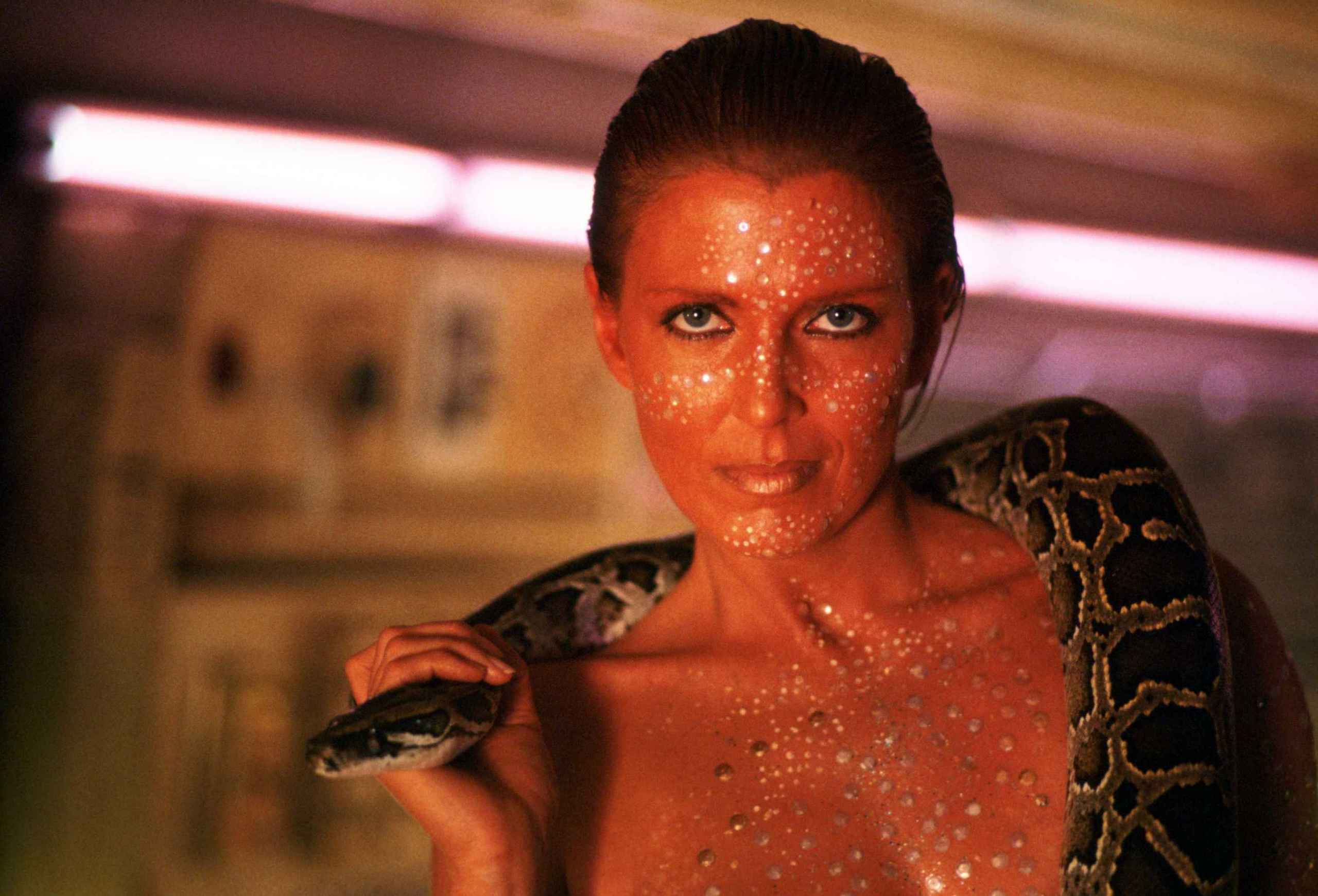
After leaving Leon’s apartment, Deckard returns home to find Rachel waiting for him. Rachel, it seems, was unable to talk with Tyrell after their earlier meeting. She seems confused about her own identity, and Deckard does little to help. He coldly explains and proves to her that her childhood memories are false, implanted by Tyrell based on his own niece’s real memories. Obviously hurt, Rachel quickly leaves. After a rest, Deckard returns to his hunt. In analyzing a few of Leon’s photos, he notices a woman with a prominent tattoo of a snake on her neck. This woman is Zhora, another of the four androids.

The beautiful yet deadly Zhora, the android which, for some reason, finds a job as an exotic dancer. She is the first escaped android that Deckard confronts.

In a beaten down part of L.A., the android Pris walks the streets before lying down underneath some newspapers on the ground. She is soon awoken by J.F Sebastian, seemingly on accident, as Sebastian rummages through the trash. Appearing frightened at first, Pris is soon soothed by Sebastian’s gentle nature and invitation to return to his home for a warm meal. Pris goes with him and discovers Sebastian’s genetic engineering workshop, filled with all sorts of android toys and human replicants.

Back on the streets, Deckard tracks Zhora via the scale that he had found (it turns out to be artificially manufactured snake scale) to an exotic nightclub where she works as a dancer. After a drink, Deckard attempts to call and apologize to Rachel, but she hangs up on him. Deckard approaches Zhora in her room, assuming the identity of a government official. Zhora quickly senses something amiss and attacks Deckard. After a struggle that spills out onto the streets, Deckard shoots Zhora dead, “retiring” her for good.

Bryant arrives on the scene, congratulates Deckard, but also informs him that he must now add Rachel to his list of androids to be retired. Rachel, it seems, has disappeared from Tyrell altogether. After Bryant leaves, Deckard sees Rachel across the street. Before he can approach her, though, Leon ambushes him. Just as Leon is about to kill Deckard, Rachel shoots Leon, retiring one of her own kind. Deckard recovers and returns to his apartment with Rachel.

At Deckard’s apartment, the two decompress from their experiences. Deckard has now softened on his view of Rachel, and he behaves much more sympathetically towards her. To the point, in fact, that he admits that he will not retire her, even though it is his job. Even more, Deckard makes physical advances on Rachel. She rebuffs him at first, but gives over and the two have sex.

Back at Sebastian’s home/workshop, Pris awakens and talks with Sebastian. He is a lonely genius who has affection for his creations. Pris has called Roy, who appears and tells Pris about Zhora and Leon’s retirements. Pris and Roy then reveal their nature to Sebastian, and they persuade/strong-arm him into helping them get to Tyrell himself. They wish to find a solution to their four-year lifespans, and Sebastian is a close enough colleague of Tyrell to get close to him.

Roy at Sebastian's apartment/workshop. He works his strategy for reaching Tyrell to demand an extension to his very short life.

At Tyrell’s impressive mansion, Sebastian gains entry, with Roy accompanying him. Tyrell, at first surprised by Roy’s presence, is forced to engage him in conversation about nullifying his short lifespan. After some scientific tête-à-tête, Roy kisses Tyrell and then kills him by crushing his skull. He then kills Sebastian, who has been paralyzed by fear.

Deckard has now left his apartment and is on the androids’ trail. Once informed of Tyrell and Sebastian’s deaths, he goes to Sebastian’s apartment. Once there, he is attacked by Pris. After a brief struggle, he shoots and kills her. Roy then appears, making for a much tougher fight. Not only is Roy built specifically for battle, with enhanced strength and speed, but his behavior has become erratic. He strips down to his underwear and pursues Deckard, toying with him rather than simply killing him.

Roy’s pursuit of Deckard leads them onto the ledge of the building, several stories above the ground. Deckard struggles to escape, and Roy seems to be showing signs of imminent shut-down, the end result of his short lifespan. Roy continues to chase Deckard across a rooftop, with Deckard at one point hanging from a ledge, precariously close to falling off and dying. Rather than let him drop, Roy inexplicably pulls him up and sets him on the roof. Roy, no longer trying to kill Deckard, explains a few of the wonders that he has seen traveling in outer space. He finally expresses great sadness about how, upon his death, all of these amazing memories will die with him. With Deckard looking on, Roy slowly shuts down, now “dead”.

Shortly after, Gaff meets Deckard at the scene. Deckard explains that he is, once and for all, finished hunting androids. As Deckard walks away, Gaff yells, “It’s too bad she won’t live. But then again, who does?”, clearly referring to Rachel.

Deckard and Rachel reunite in the end and ride off into the sunset.

Deckard returns to his apartment, where Rachel remains and is still alive. The two leave together. Some time shortly after, we see the pair flying in Deckard’s hover car through a beautiful forest landscape. In a voice over, Deckard explains that he has learned from the Tyrell Corporation that Rachel, unlike her Nexus-6 brethren, does not have the built-in four-year lifespan. Her lifespan is as unknown as any human.

Whew! Tough to concisely summarize a science-fiction movie of this sort.

Take 1: My Gut Reaction (Done after this most recent viewing, before any further research).

I’ll be very curious to watch the director’s cut in a few days. The original theatrical release of Blade Runner that I watched shows itself to be a sometimes brilliant, sometimes awkward piece of cinema. Mostly, though, it’s brilliant.

What’s awkward? First of all, the attempt to make this a classic-style noir film. While some of the noir elements – the detective, the crime, the chase, the dark tone – are welcome and well-done, others feel clunky and out of place. Primarily, the narration is a detriment. While voice-over narration is a standard of noir films, it only seems to fit true, classic noir. Double Indemnity, Out of the Past, and their ilk benefit from the stoic narration of their doomed protagonists. In Blade Runner, the narration by Rick Deckard is invasive and seems rather forced and out of place in such a futuristic setting.

Another, lesser, complaint is about the music. The group Vangelis created a moody, atmospheric soundtrack which, at times, works incredibly well. It may have been the way it was mixed or pumped out on my speakers, but there were times when the music seemed out of place. During moments when silence would have allowed more tension to build, the music score was thrumming along. I found it distracting.

There are also a few plot points that are not completely fleshed out. Most are minor, but the primary one to me is exactly why Deckard develops an affection for Rachel. I suppose that perhaps this is meant to be vague, allowing us viewers to come to our own conclusions. Still, it seems odd when Deckard begins making sexual advances on an android when we have no solid basis for why he would feel this way.

By missing just enough emotional context, this seduction scene can come off as a bit uncomfortable for viewers. It did me, anyway.

Aside from these elements, it’s easy to see why this movie is considered a classic. Ridley Scott’s vision for the setting is incredible. The Los Angeles that he created for the screen has been imitated so many times that it’s hard to comprehend it. Virtually every science fiction movie that takes place in a large city has copied Scott’s style for the “worn down metropolis”, in which technical wonders threaten to bury still-extant, eroding architectural styles of the past. The mish-mash of street-level international cultures, ubiquitous neon advertising, and familiar human character archetypes is blended amazingly well. The effect is so powerful that it has carried over (and will continue to) into endless films.

But there have been more than a few films that have shown great visual style. What sets Blade Runner above nearly all others are the high-minded speculative fiction themes. We can credit the source material author, Philip K. Dick, for this. I will explore this further down the post, but Dick was an incredible science fiction mind. While Blade Runner takes great liberties with Dick’s source novel, Do Androids Dream of Electric Sheep?, a fair bit of the meat is still there.

The point of interest is the question about artificial intelligence and what happens if it becomes so advanced that it begins to mimic human emotions. How do we proceed? Blade Runner takes this question and uses it to tease you through what, on the surface, seems to be a basic tale of cops-and-killers. By the end, though, you’re left to wonder if the androids’ motivation is any different than any human being – the urge to live. Not only that, but also the sense of tragedy that comes from death and its robbery of our experiences. Considering just how quickly our technology is developing, these questions may not be as far fetched as they first seem. If a machine can develop and express what we call “emotions”, does it cease to be a machine? This movie can make an amateur philosopher out of many of us.

While it is clearly the visuals and themes that make the movie, I would be seriously remiss if I didn’t mention the cast. The acting is certainly not the most important element of a movie like this, but the key players all do fine work. Harrison Ford as Deckard is spot-on, though the script can be a bit inconsistent at times. The lesser roles played by Sean Young, Edward James Olmos, and others are also solid. Of course, Rutger Hauer is the reason to watch. His bizarre facial contortions may seem odd at first, until you realize that he is experiencing a bevy of raw emotions condensed into his short life. Watching him work through Roy Batty’s cool rage and desperation, and then his final resignation is hypnotic.

Despite how terrifying he is throughout the movie, Hauer's final death monologue is downright heartbreaking. With a few poignant lines, you actually feel sorry for the loss of him.

Next, I’ll be watching the “Final Cut” version of the film, which has some drastic alterations:

Take 2: “The Final Cut” Version

Between my writing “Take 1” and now, I have watched the “Final Cut” version of Blade Runner. This was the version that Ridley Scott wished to be shown, but was not due to studio interference (again).

If you’re going to watch Blade Runner, be sure that it’s the “Final Cut” version. It is easily superior to the theatrical version. If you’re not paying attention, you may not notice the changes. If you do notice them, you’ll never be able to watch the original again.

The first change is that Rick Deckard’s narration is gone. Perfect! This is one of my gripes about the theatrical version. As many other viewers and I agree, the voice-over is wholly unnecessary, and without it, we can be drawn into the setting and the minds of the characters more easily.

Another change was that Ridley Scott remixed the sounds a bit. I can’t be sure, but it seemed that the music score by Vangelis was less intrusive. This was another of my mild complaints about the theatrical version.

One of the two biggest changes is the famous “unicorn scene”. A little theme in all versions of the movie is the character Gaff’s habit of making origami animals and leaving them around Deckard. When Deckard is first about to refuse the hunting job, Gaff makes a chicken. After Deckard and Gaff leave the meeting with Tyrell and Rachel, he makes a little human man with an erection. At the very end, when Deckard retrieves Rachel from his apartment, he finds an origami unicorn just outside of his door. In the theatrical version, we might just look at these as Gaff busting Deckard’s chops a little bit.

In the Final Director’s Cut, however, we have an extra scene in the middle of the film. As Deckard is drifting into a drunken sleep, he has a half-waking vision of a unicorn running through a forest. This additional scene leads us to wonder just how Gaff might have known about it. The obvious and most intriguing answer is that Deckard is, himself, an android and that Gaff knows what his memories are, much as Deckard knew what Rachel’s embedded memories were. So this one little scene, lasting less than ten seconds, adds another whole layer to the notion of identities and existence in the film. It’s a great addition, and it’s also no mystery as to why Scott wanted to keep it in the film.

The little folded piece of paper that has generated no end of debate and discussion about the protagonist's true nature. The dream sequence added in the Final Cut gives it far greater significance. 

The other major change is the ending. The theatrical version has Deckard and Rachel driving along a verdant, forested road. We get Deckard’s voice-over also telling us that the Tyrell Corporation has informed him that Rachel does not have the built-in hour year lifespan. We can assume that they live happily ever after. In the Final Cut, though, there is no idyllic ending. The movie ends just after Deckard ponders Gaff’s unicorn and then joins Rachel in the elevator. Personally, I love the vagueness and uncertainty of the Final Cut ending much more.

Take 3: Movie versus Book

A bit of a change-up here. Rather than the normal fact-digging that I do for the films on this blog, I read the source novel before I saw the film. If you’re curious about how they compare, here you go:

Firstly, I’ve come to learn that many, many people are unaware of just how many excellent science fiction movies have been based on Philip K. Dick short stories or novels. Total Recall was based on We Can Remember It For You Wholesale. Minority Report, A Scanner Darkly, and The Adjustment Bureau were from stories of the same name. There were also some mediocre-to-poor adaptations of Paycheck and others. The reason for all of these adaptations is that Dick was a brilliant ideas man, and this is clear in the inspiration for Blade Runner – the novel Do Androids Dream of Electric Sheep?

So how similar are the film and the book? Not all that much, really. In the book, the earth is a different place. The people still left on the planet are living in a dusty, perpetually overcast world in the wake of “World War Terminus”. Most humans have fled to colonies on Mars or other planets; those left on Earth are often there only because they have been labeled somehow defective. This is rather different from the thriving, hustling and bustling city that we see in Blade Runner.

Also, in the novel androids are not incredibly strong soldiers. They are simply manufactured as basic labor for off-world colonists, and they are given away as incentive to get more people off of the choking Earth. While the Roy Baty (they changed the spelling in the movie, I guess for ease of pronunciation) and Pris characters are in the book, they do not come off as being nearly as menacing as their portrayals in the film. In fact, the final showdown between the pair and Deckard is quite underwhelming in the book. They meet briefly, they get killed, and the story moves on.

Philip K. Dick (and unknown cat) - an author under-appreciated in his time and whose fertile mind forged dozens of fascinating tales. Part Jules Verne and part William S. Burroughs, his stories fluctuated between surreal and profound with unmatched nimbleness. 

Despite these obvious differences, the key element to the novel is the central theme of the film – empathy. This theme is explored much more deeply and extensively in the book, but it is still the heart of the film as well. In the novel, nearly all of the humans we meet use something called a “mood organ”, which is a device that uses sound waves to alter moods. It’s as if their world is so depressing that pleasure can only come from artificial stimulation.

On top of the mood organ is another device called an Empathy Box. People can grab hold of the handles of a Box and are immediately thrust into a first-person experience with a figure called Mercer. Mercer is a sort of messianic tragic figure who preaches about compassion, empathy, and accepting that life is an endless struggle. Deckard’s wife, Iran, is a complete addict to the Empathy Box, while Deckard has little to do with it until the end of the story.

One other way that empathy is highlighted in the novel actually makes its way into the film, though in a far lesser role. In the novel, one of the most respectable things that a person can do is own a living, biological animal. Since World War Terminus and the ever-present gray dust have killed many of Earth’s species, protecting life has become an expectation and a badge of honor. This is so important, in fact, that Deckard’s main reason for taking the hunting job is so that he can afford a real sheep to replace the android sheep that he and his wife have maintained for years (android animals being made and bought for people who want to keep up appearances). We do see some android animals in Blade Runner, but they are little more than window dressing.

Though the film clearly has to discard many of the great literary elements, for the sake of the demands of the medium, it made sure to utilize Philip K. Dick’s most lasting questions about identity. He used the science-fiction convention of androids, but his real dilemma is how to deal with people who have no empathy. In other words, sociopaths.  Can a person who does not and cannot understand others’ fear and pain truly be considered a human anymore? It’s a frightening and difficult question to ponder, and it’s the one that any thoughtful reader of the book or viewer of the film can come away with. For these reasons, anyone would be well served to do either, or both.

That’s a wrap. 81 shows down. 24 to go.

Coming Soon: Brazil (1985):


 From one semi-gloomy sci-fi future to a no-doubt-about-it, full-blown dystopia. I’m a big fan of Terry Gilliam, and this movie is often considered his strongest work. Come back and see what I think of my latest viewing of his mid-1980s masterpiece.

Please be sure to pick up all empties on the way out.