Showing posts with label Harrison Ford. Show all posts

Monday, October 9, 2017

New Release! Blade Runner 2049 (2017)

No Spoilers (have no fear)


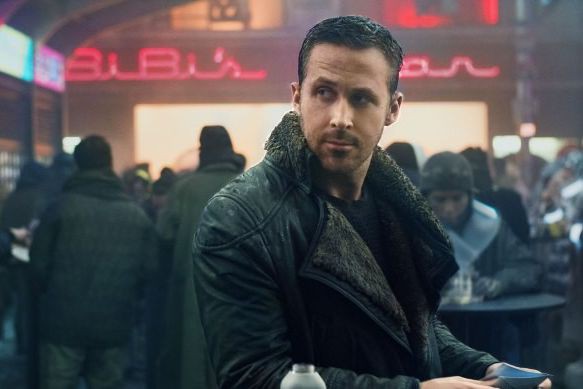
The movie's titular "blade runner," K, on the job in the big
city. There are plenty of scenes which revive the feel of the
worn-down, tech-opolis displayed in the original.
Director: Denis Villeneuve

An amazing piece of dystopian, speculative sci-fi cinema which I feel is even better than the classic original.

In the original 1982 Blade Runner (I did a very long and thorough review of it here), we had a story of Richard Deckard, a "blade runner" in the year 2019 who tracked and eliminated (known as "retiring") rogue synthetic humans, which are known as "replicants." By that movie's end, Deckard had begun changing his mind on whether there was really much difference between humans and replicants. He even falls in love with a very advanced replicant, Rachel, and escapes the authorities with her.

The new movie takes place, as the title suggests, thirty years after Deckard and Rachel's disappearance. In the thirty years after, the world has apparently suffered a few more trying episodes, including several replicant uprisings, some sort of massive blackout, and a near-famine. A reclusive and enigmatic genius, Niander Wallace (Jared Leto), was responsible for dealing with several of these crises, partly by taking over replicant production and ensuring that they would no longer develop wills of their own. To this purpose, blade runners still exist, whose job it is to track down the few remaining, older-model replicants still at large. The story follows one such blade runner, "K" (Ryan Gosling), who finds himself pulled into a larger battle between a secretive revolutionary group of replicants and the cosmically ambitious Niander Wallace. As he is drawn deeper into this conflict, K's questions about his own identity and purpose grow more troubling and unclear.

This movie lived up to my rather high expectations, though I am not terribly surprised that it had an underwhelming showing at the box office in its opening weekend. It captures a great deal of what made the original so revolutionary but also challenging, while actually enhancing it in many ways. At the heart of what made both so strong is that they perfectly represent the confounding, fascinating, and even frightening questions which emerge when one speculates about how technology does and would possibly impact us as it develops. This is what made author Philip K. Dick, responsible for the source novel, such a brilliant mind. Both Ridley Scott and Denis Villeneuve realized this and placed some of Dick's ideas right at the heart of their movies. But where the surface plot of Scott's original movie was rather simple - a detective trying to track down and eliminate a few rogue cyborgs - Villeneuve offers a more complex journey that touches on even heavier existential themes. This includes notions about self identity, one's greater purpose, and exactly how one is narrating his or her own life. Blade Runner 2049 is cerebral sci-fi at its best.

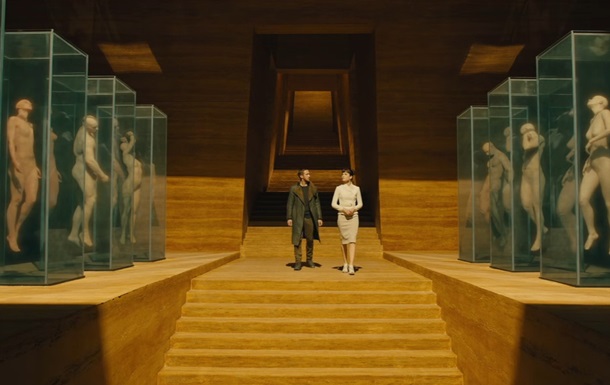
Inside the offices of the science genius Niander Wallace. This
is just one of many stunning sets which reflect the mental
states or situations of those who dwell in them.
If the movie is so good at these things, why was there a lackluster turnout on opening weekend, despite glowing reviews and a fairly ubiquitous advertising campaign? Hard to say for absolute certain, but it may not have helped its wider appeal that the film is not exactly an action-packed thrill-ride. While the original certainly has its slower, more meditative moments, it never goes more than about ten minutes without a fight of some sort, including a tense pursuit and battle during its twenty-minute climax. While 2049 does have several action sequences, all done extremely well, they are fewer and further between than the original. Anybody showing up to the theater hoping to get a J.J. Abrams-style, Star Wars/Star Trek reboot, action extravaganza was probably not going to be entertained by this movie. In fact, I heard a couple commenting as such as I left the theater with my wife. They were talking about how they wanted "something to happen" for nearly the entire movie. If these viewers general sentiment was reflective of the whole and they communicated it to others, than maybe many people decided to give it a pass. For my money, though, I thought the action scenes were handled well and used efficiently. There is one scene during a penultimate fight that I thought dragged on a bit, but this was the only such case.

Any fan of the original is likely to cite the mood and atmosphere created by the visuals and music score. The sequel makes sure to maintain some very welcome coherence with those aesthetic qualities and even update them brilliantly. With a sizable budget at his fingertips, Villeneuve was able to get the beautifully dark blend of noir and cyberpunk dystopia which Ridley Scott created back in 1982. He even goes beyond it, sending the story to several environments outside of the shadow-shrouded and rain-soaked metropolis where the original completely takes place. These evocative and impressive settings outside of the city help give this sequel an effectively episodic feel. And the music pulls off a similar trick, reviving much of the meditative and synthetic tones of the iconic Evangelis score, while adding some harder-hitting industrial sounds which can reflect the cognitive dissonance of the protagonist.

This movie's stayed embedded in my mind since I watched it three nights ago, and I will likely try to catch it on an IMAX screen while it still lasts there. It does sadden me that it hasn't done terribly well here in the U.S., as I would have hoped that there were still an audience for stunning, mentally stimulating science-fiction. I do hope that it perhaps has legs and that more people give it a chance, maybe seeing it for the incredible movie it is.

Wednesday, December 23, 2015

Star Wars: The Force Awakens (2015) [Spoiler Free first section]


I did a long review of A New Hope several years ago here, during my trip through the "All-TIME 100" great movies list. 

[Spoiler Free Section]

Director: J.J. Abrams

Extremely satisfying for fans of all types, if not exactly a life-changing experience of adventure movie viewing.

I am of the generation that first fell in absolute love with the Star Wars movies as only Generation X could have. The original trilogy came out when I was between the ages of two and eight, which are almost exactly the ages when colorful fantasy movies involving space travel, robots, and strange creatures were likely to firmly imprint themselves on a person's brain. It did for me.

Like a lot of people, I found the second trilogy a nearly-traumatic disappointment. Yes, there are a few redeeming qualities to them, but I agree with the many who feel that George Lucas completely lost touch with what made his originals so iconic.

As the hype for The Force Awakens mounted to unprecedented levels, I refused to see or watch any trailers or listen to or read any criticism. I knew that J.J. Abrams was directing it, and I had mixed feelings about this. I appreciated his Star Trek reboots, but I wasn't crazy about his heavy leaning on the earlier TV shows and movies. There were far too many coy "homages" to characters, creatures, and plotlines which were familiar to Trekkies from the decades-old classic stories. My fear was that Abrams would do the same thing with The Force Awakens.

Fortunately, my fears were (almost) completely unrealized. The Force Awakens does certainly take several key parts of the templates used in the original trilogy as its materials. The very basic plotline will be one that is extremely familiar to devotees of the Episodes IV, V, and VI, and there are certainly landscapes and scenarios that are equally familiar. However, Abrams and co-screenwriter Lawrence Kasdan (who wrote Empire Strikes Back and Return of the Jedi) injected enough new material to make the story feel adequately fresh.

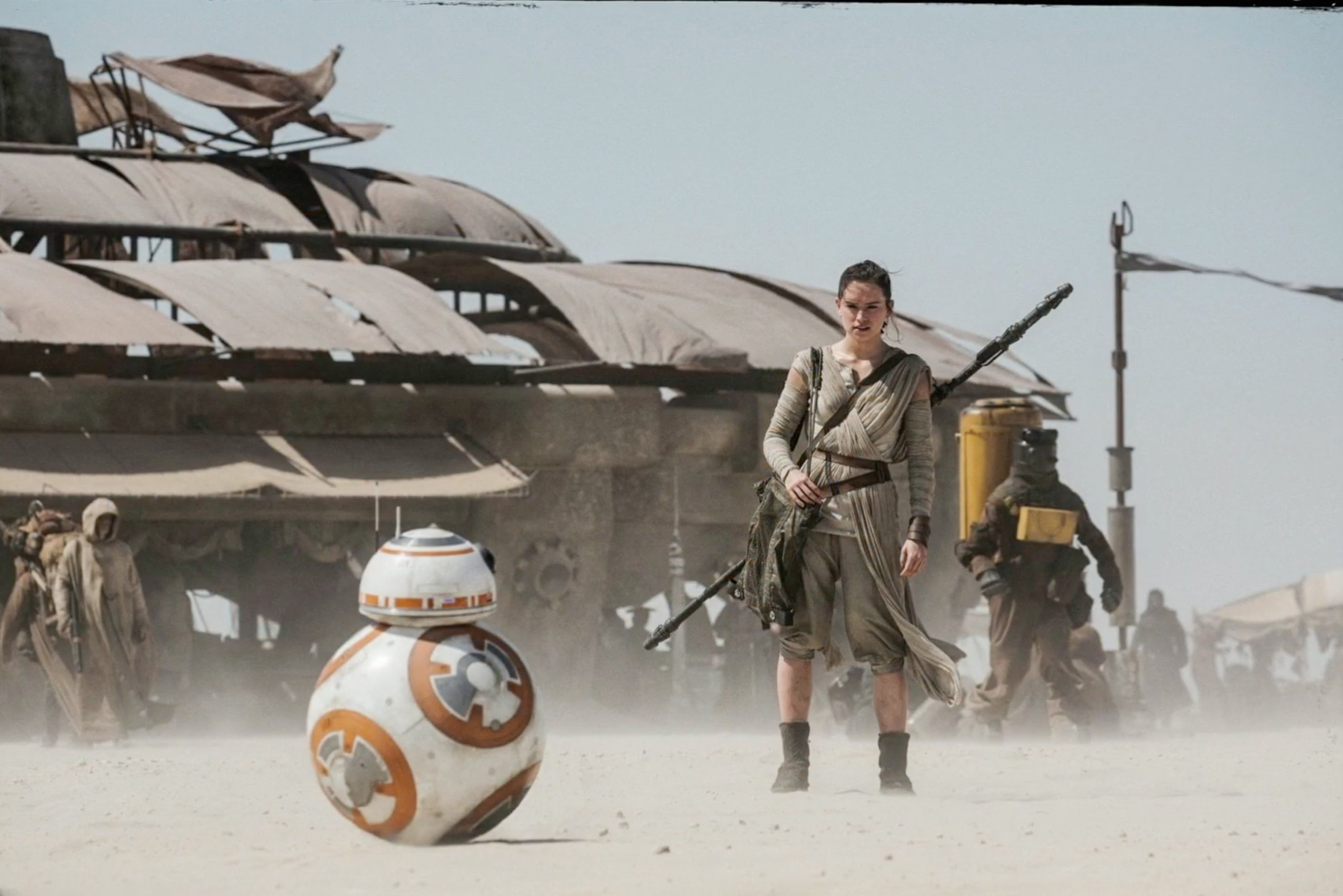
An early scene with Rey and the droid BB8 on the planet 
Jakku. If this seems an awful lot like early moments in 
A New Hope, then your head's right in the place that 
director J.J. Abrams wants it.
The familiar faces are all good to see again. Blessedly, the story does not rely too much on older characters or nostalgia for their past exploits. Characters like Han Solo and others serve nicely to bridge the gap into a new tale with new players. And the new blood looks great. The handful of new, young characters all had me itching to see more of them in future installments of the series. These were not just retreads of our old favorites. While there may be a few superficial similarities here or there, characters like Rey, Finn, and Poe are novel enough that they should be more than capable of putting their stamp on this new trilogy in the epic series. Abrams made some great casting choices as well, selecting actors who are not only talented but also relatively unknown.

Another extremely gratifying part of the experience is how Abrams returned to the look and feel of the original trilogy. Rather than the horrendous, A.D.D., hyper-polished, CGI video game aesthetic prevalent in Episodes I through III, The Force Awakens revives Lucas's original vision of a "worn down universe," where many buildings and machines look decades or even millenia old. There are also many expansive long shots with negative space, and the general pacing is more measured than the often frenetic speed of the prequel trilogy. With more time and physical space to take things in, we viewers get a chance to drink in the world and truly escape to it, rather than constantly trying to catch up with an overload of visuals moving at breakneck speed.

I really enjoyed this movie, and it's clear that Disney handed this beloved tale to the right director. It's not flawless, but given the insanely high amount of things that could have gone wrong (as George Lucas himself fell prey to), the movie is a great entry. I do have my little gripes (detailed below, along with spoilers), but I plan to see it at least once more in the theaters, and I will eagerly await the next two episodes.

[Spoiler Section. Be Warned!!!]

Getting into the story allows me to get into the details and a few of the little issues I have with the movie. 

I could accuse Abrams and Kasdan of playing it safe by using the basic stories from Star Wars and Return of the Jedi to form the plot. A young orphan of mysterious origins on a desert planet is brought into the machinations of forces battling for galactic supremacy. Said orphan is forced to uncover and face her history with an evil overlord to whom she may be related. She is forced to make several new friends who will help cripple a planet-destroying base used by an oppressive army seeking to wipe out all forms of resistance. This is all well-worn territory, to be sure. I can mostly excuse it because this movie is clearly meant as a transition from the original trilogy, but I still think that the story could have been a little more daring and creative.

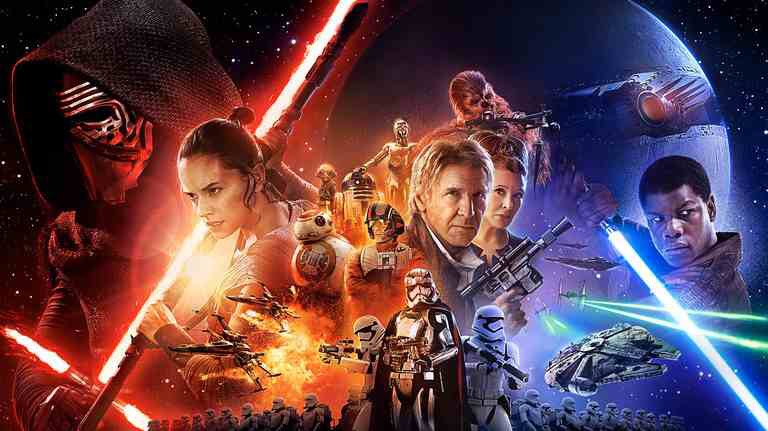
The new faces of the Star Wars series: Poe, Rey, and Finn.
I definitely think they can make this new trilogy a
worthwhile addition to the grand series.
I was, however, happy that the details were fresh enough to keep the movie from seeming dull. The new "Luke," the young scrap collector Rey, is a really strong character. In fact, she immediately shows an authentic grit which Luke took much longer to acquire. The other two primary new characters, Finn and Poe, are more original. Finn, a defected stormtrooper from the Empire holdover group The First Order, is a completely new idea for the film series. Poe, though not garnering a tremendous amount of screen time, has a genuinely warm and humane feeling about him. None of these three feels like a cut-out, and the first two show a nice amount of depth, which I sense that Poe will also exhibit if he becomes more integral in future episodes.

I'm not yet completely sold on Kylo Ren as a menacing villain, but there is promise that he may very well become one. With the Supreme Leader Snoke (awful name, by the way) stating that he will "complete Ren's training," there is potential for Ren to become a true menace on par with past Sith Lords like Vader and Sidious. I was pleased with the turn of having him reveal his face in the middle of the picture, rather than use the mask and his identity as a tired device of mystery to be dragged along for two or three movies. We do still have the McGuffin of Rey's parentage to wonder over until the release of Episode VIII, and that is plenty.

One aspect of Finn's character that does nag me is how well-adjusted he is. According to his story, he was kidnapped by the First Order as a young child and forced into stormtrooper training. He was even stripped of a name and given a mere alpha-numeric designation, including the "FN" from which his human name is derived. If this is the case, then he has been part of a machine-like system whereby almost all sense of individuality is wiped out. Given that Finn has been a part of this system for nearly his entire life, I found his light sense of humor a bit out of keeping with his background. The First Order didn't strike me as very fertile soil for light-hearted jokes. Fortunately, the humor itself is effective, and it makes for a far better prospect than attempting to make him some sort of dark, brooding character whose inner turmoil defines him. We have Kylo Ren for that.

I was very impressed with the handling of the old guard. Han Solo, Chewbacca, and Leia are a part of the story, but they are fortunately not the story. It would have been far too easy for Abrams and Kasdan to showcase the old, familiar faces in order to stroke the nostalgia of old fans. They didn't. Their parts in the greater framework of the new characters' tales feels mostly organic and blessedly understated, especially in the case of Leia.
Old favorites like these two pirates are handled very well.
Their measured presence serves to enhance rather than
overtake the story from the new, young protagonists. 

I found a lot of the humor very solid and in sync with the light tone of the original trilogy. There are some solid sight gags and little one-liners that would have been right at home in any of Episodes IV through VI. I did, however, feel that there were a few lines that had a slightly more modern feel which were a tad off-beat. Finn's quick probing to see if Rey has "a boyfriend? A cute boyfriend?" is funny, but I can't shake the sense that the word "cute" has no place in the Star Wars universe. This was one of a few moments of such banter. Fortunately, there were no serious breaks of tone or context, and the lines themselves were always amusing, thanks mostly to actor John Boyega's deliveries and timing.

(Double-Major Spoiler Alert!!) I was satisfied with Han Solo's ultimate fate. It's never fun to see a beloved character die, but Solo's death at the hands of his son is another turn which invigorates the Star Wars epic. My hope is that this is the first major step towards Ren becoming a truly and unrepentantly evil Sith Lord. We've already seen the "redemption" storyline with Anakin/Darth Vader. It would seem more than a little tired to simply retell that story.

Going Forward

I am very excited about the next installment. Abrams did such a quality job, that I am disappointed that he won't be returning. However, I am excited that Rian Johnson is directing Episodes VIII and IX. Johnson has given us some great modern films, including Brick and Looper. He's a highly skilled director who I feel is unlikely to make a hash of this major project. I can't be sure that he will approach these movies with the same passion and affection that a devoted fan like Abrams did, but I'll be very happy to pay up and find out. 

Saturday, May 5, 2012

Film # 81: Blade Runner (1982)


Director: Ridley Scott

Initial Release Country: United States

Times Previously Seen: twice (last time about 12 years ago)

Teaser Summary (No spoilers)

In the future, a bounty hunter of androids has his hands full with a gaggle of hyper-advanced targets. Trudges through rain, gets beat up a lot.

Extended Summary (More detailed plot synopsis, spoilers included)

*Note: This summary and the “Take 1” Review are based on the original, theatrical cut released in the United States in 1982. There have been several other versions of the movie, which will be discussed in “Take 2”.

**Note #2: Summarizing a complex sci-fi tale is no short task. If you’re not interested in all of the ins and outs, jump down to my “Take 1” for my basic opinion of the movie.

In a slightly alternate Earth in the year 2019, space travel has become a reality. To facilitate space travel, exploration, and colonization, androids have been developed to the point so as to be nearly indistinguishable from humans. However, a handful of extremely advanced androids have attempted to escape their labors, even sometimes killing their human controllers. Thus, they have been banned from Earth.

On Earth, at the massive Tyrell Corporation, an interview is taking place. Tyrell is the premier manufacturer of androids used in space, but they fear that they may be infiltrated by a small group of rogue androids who have killed their human owners and returned to Earth. An employee named Leon is called in for the interview with a man named Holden. Holden is what is known as a “blade runner”, a bounty hunter who tracks down and kills rogue androids. He prepares some instruments and begins to interview Leon, using analysis equipment and a series of pointed questions to elicit an emotional response, together known as the “Voight-Kampf Test”, to determine whether Leon is human or android. After a few bizarre and evasive answers that all but prove Leon to be an android, Leon pulls a gun, shoots Holden, and flees the building.

On the dark and rainy streets of Los Angeles, Rick Deckard (Harrison Ford) sits and enjoys a meal at a Japanese lunch truck. Amidst the lights, crowd, and hustle of the hyper-industrialized city, he is approached by a strangely-dressed man speaking odd street slang. The man, Gaff (Edward James Olmos), is a cop under the supervision of officer Bryant, who demands to see Deckard. Deckard is a retired blade runner who reluctantly goes to Bryant. There, he learns about Holden’s shooting at the hands of Leon, who is part of a sextet of highly dangerous androids who are in Los Angeles for unknown reasons. All six are of the “Nexus-6” model type, the most modern and advanced android produced (by the Tyrell Corporation). The Nexus-6es blend in nearly perfectly with humans, and they are faster, stronger, and impervious to physical pain.

Roy Batty, the deadliest and most eerily developed of the escaped androids that Deckard must hunt down.

Of the six escaped Nexus-6es in question, two have already been killed trying to break into Tyrell Corporation. Leon is another. The other three consist of Zhora (Joanna Cassidy), Pris (Daryl Hannah), and Roy Batty (Rutger Hauer). Roy Batty is the leader of the androids, a strangely charismatic soldier. On top of their basic functions, Bryant also informs Deckard that the Nexus-6es may have begun developing emotions, something unheard of in any past android models. This also makes detecting Nexus-6es far more difficult. Because of this, the Nexus-6 designers built a four-year lifespan into the model. Now knowing the danger, Deckard is all but forced to take the assignment of hunting and “retiring” (the word used instead of “killing”) the rogue androids.

Deckard first goes to the Tyrell Corporation headquarters, where he meets the founder himself, Tyrell, and his personal assistant, a beautiful young woman named Rachel (Sean Young). Deckard wishes to use the Voight-Kampf test on a few Nexus-6es in order to prepare for the quartet that he will track down. Tyrell, after asking some questions about the test, demands that Deckard test it on a human first, to prove that it will not give a false result. He nominates Rachel, and Deckard agrees. It takes many more questions than normal, but Deckard comes to the correct conclusion that Rachel is, in fact, an android of the Nexus-6 variety. Tyrell proudly explains that the Nexus-6 design has the added feature of implanted memories, which make detection significantly more difficult than previous models.

Deckard first goes to Leon’s house, where he finds a set of family photographs – further proof of the implanted memories that Tyrell had explained – as well as an odd animal scale in the bathtub. Outside, Leon himself meets with his fellow android Roy, explaining that a cop (Deckard) is there, so they can’t retrieve the photos. Roy leads Leon to a strange lab, where an old scientist named Chu works on genetically engineering and growing eyes for androids. Roy and Leon terrorize Chu and ask him questions about inception dates and their four-year lifespan. Chu claims to know only about eyes, but explains that Tyrell himself would have the information. Tyrell being exceptionally difficult to reach, Chu is further pressured into giving the name of J.F. Sebastian. Sebastian is a top-level android designer who would stand a better chance of reaching Tyrell.

After leaving Leon’s apartment, Deckard returns home to find Rachel waiting for him. Rachel, it seems, was unable to talk with Tyrell after their earlier meeting. She seems confused about her own identity, and Deckard does little to help. He coldly explains and proves to her that her childhood memories are false, implanted by Tyrell based on his own niece’s real memories. Obviously hurt, Rachel quickly leaves. After a rest, Deckard returns to his hunt. In analyzing a few of Leon’s photos, he notices a woman with a prominent tattoo of a snake on her neck. This woman is Zhora, another of the four androids.

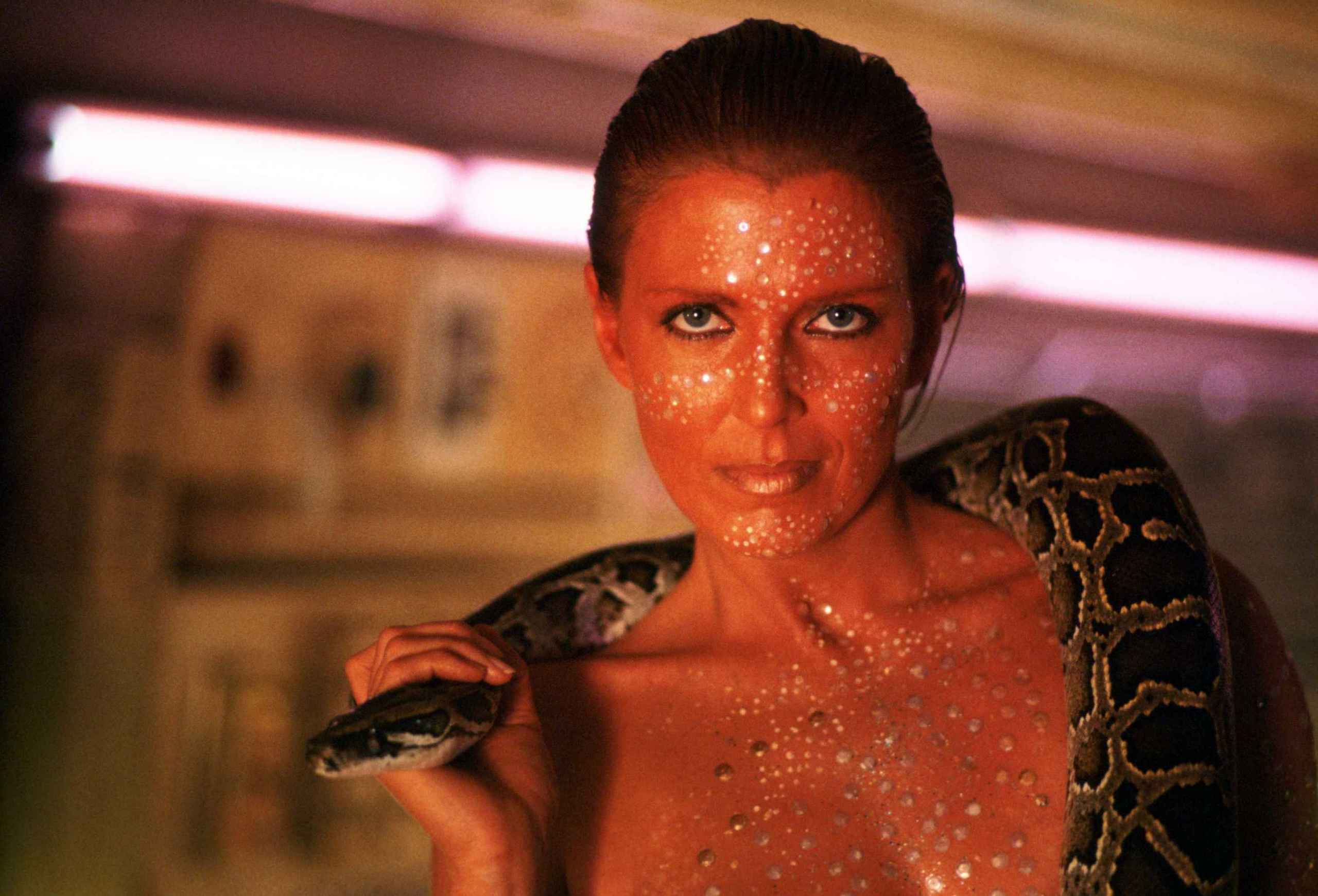
The beautiful yet deadly Zhora, the android which, for some reason, finds a job as an exotic dancer. She is the first escaped android that Deckard confronts.

In a beaten down part of L.A., the android Pris walks the streets before lying down underneath some newspapers on the ground. She is soon awoken by J.F Sebastian, seemingly on accident, as Sebastian rummages through the trash. Appearing frightened at first, Pris is soon soothed by Sebastian’s gentle nature and invitation to return to his home for a warm meal. Pris goes with him and discovers Sebastian’s genetic engineering workshop, filled with all sorts of android toys and human replicants.

Back on the streets, Deckard tracks Zhora via the scale that he had found (it turns out to be artificially manufactured snake scale) to an exotic nightclub where she works as a dancer. After a drink, Deckard attempts to call and apologize to Rachel, but she hangs up on him. Deckard approaches Zhora in her room, assuming the identity of a government official. Zhora quickly senses something amiss and attacks Deckard. After a struggle that spills out onto the streets, Deckard shoots Zhora dead, “retiring” her for good.

Bryant arrives on the scene, congratulates Deckard, but also informs him that he must now add Rachel to his list of androids to be retired. Rachel, it seems, has disappeared from Tyrell altogether. After Bryant leaves, Deckard sees Rachel across the street. Before he can approach her, though, Leon ambushes him. Just as Leon is about to kill Deckard, Rachel shoots Leon, retiring one of her own kind. Deckard recovers and returns to his apartment with Rachel.

At Deckard’s apartment, the two decompress from their experiences. Deckard has now softened on his view of Rachel, and he behaves much more sympathetically towards her. To the point, in fact, that he admits that he will not retire her, even though it is his job. Even more, Deckard makes physical advances on Rachel. She rebuffs him at first, but gives over and the two have sex.

Back at Sebastian’s home/workshop, Pris awakens and talks with Sebastian. He is a lonely genius who has affection for his creations. Pris has called Roy, who appears and tells Pris about Zhora and Leon’s retirements. Pris and Roy then reveal their nature to Sebastian, and they persuade/strong-arm him into helping them get to Tyrell himself. They wish to find a solution to their four-year lifespans, and Sebastian is a close enough colleague of Tyrell to get close to him.

Roy at Sebastian's apartment/workshop. He works his strategy for reaching Tyrell to demand an extension to his very short life.

At Tyrell’s impressive mansion, Sebastian gains entry, with Roy accompanying him. Tyrell, at first surprised by Roy’s presence, is forced to engage him in conversation about nullifying his short lifespan. After some scientific tête-à-tête, Roy kisses Tyrell and then kills him by crushing his skull. He then kills Sebastian, who has been paralyzed by fear.

Deckard has now left his apartment and is on the androids’ trail. Once informed of Tyrell and Sebastian’s deaths, he goes to Sebastian’s apartment. Once there, he is attacked by Pris. After a brief struggle, he shoots and kills her. Roy then appears, making for a much tougher fight. Not only is Roy built specifically for battle, with enhanced strength and speed, but his behavior has become erratic. He strips down to his underwear and pursues Deckard, toying with him rather than simply killing him.

Roy’s pursuit of Deckard leads them onto the ledge of the building, several stories above the ground. Deckard struggles to escape, and Roy seems to be showing signs of imminent shut-down, the end result of his short lifespan. Roy continues to chase Deckard across a rooftop, with Deckard at one point hanging from a ledge, precariously close to falling off and dying. Rather than let him drop, Roy inexplicably pulls him up and sets him on the roof. Roy, no longer trying to kill Deckard, explains a few of the wonders that he has seen traveling in outer space. He finally expresses great sadness about how, upon his death, all of these amazing memories will die with him. With Deckard looking on, Roy slowly shuts down, now “dead”.

Shortly after, Gaff meets Deckard at the scene. Deckard explains that he is, once and for all, finished hunting androids. As Deckard walks away, Gaff yells, “It’s too bad she won’t live. But then again, who does?”, clearly referring to Rachel.

Deckard and Rachel reunite in the end and ride off into the sunset.

Deckard returns to his apartment, where Rachel remains and is still alive. The two leave together. Some time shortly after, we see the pair flying in Deckard’s hover car through a beautiful forest landscape. In a voice over, Deckard explains that he has learned from the Tyrell Corporation that Rachel, unlike her Nexus-6 brethren, does not have the built-in four-year lifespan. Her lifespan is as unknown as any human.

Whew! Tough to concisely summarize a science-fiction movie of this sort.

Take 1: My Gut Reaction (Done after this most recent viewing, before any further research).

I’ll be very curious to watch the director’s cut in a few days. The original theatrical release of Blade Runner that I watched shows itself to be a sometimes brilliant, sometimes awkward piece of cinema. Mostly, though, it’s brilliant.

What’s awkward? First of all, the attempt to make this a classic-style noir film. While some of the noir elements – the detective, the crime, the chase, the dark tone – are welcome and well-done, others feel clunky and out of place. Primarily, the narration is a detriment. While voice-over narration is a standard of noir films, it only seems to fit true, classic noir. Double Indemnity, Out of the Past, and their ilk benefit from the stoic narration of their doomed protagonists. In Blade Runner, the narration by Rick Deckard is invasive and seems rather forced and out of place in such a futuristic setting.

Another, lesser, complaint is about the music. The group Vangelis created a moody, atmospheric soundtrack which, at times, works incredibly well. It may have been the way it was mixed or pumped out on my speakers, but there were times when the music seemed out of place. During moments when silence would have allowed more tension to build, the music score was thrumming along. I found it distracting.

There are also a few plot points that are not completely fleshed out. Most are minor, but the primary one to me is exactly why Deckard develops an affection for Rachel. I suppose that perhaps this is meant to be vague, allowing us viewers to come to our own conclusions. Still, it seems odd when Deckard begins making sexual advances on an android when we have no solid basis for why he would feel this way.

By missing just enough emotional context, this seduction scene can come off as a bit uncomfortable for viewers. It did me, anyway.

Aside from these elements, it’s easy to see why this movie is considered a classic. Ridley Scott’s vision for the setting is incredible. The Los Angeles that he created for the screen has been imitated so many times that it’s hard to comprehend it. Virtually every science fiction movie that takes place in a large city has copied Scott’s style for the “worn down metropolis”, in which technical wonders threaten to bury still-extant, eroding architectural styles of the past. The mish-mash of street-level international cultures, ubiquitous neon advertising, and familiar human character archetypes is blended amazingly well. The effect is so powerful that it has carried over (and will continue to) into endless films.

But there have been more than a few films that have shown great visual style. What sets Blade Runner above nearly all others are the high-minded speculative fiction themes. We can credit the source material author, Philip K. Dick, for this. I will explore this further down the post, but Dick was an incredible science fiction mind. While Blade Runner takes great liberties with Dick’s source novel, Do Androids Dream of Electric Sheep?, a fair bit of the meat is still there.

The point of interest is the question about artificial intelligence and what happens if it becomes so advanced that it begins to mimic human emotions. How do we proceed? Blade Runner takes this question and uses it to tease you through what, on the surface, seems to be a basic tale of cops-and-killers. By the end, though, you’re left to wonder if the androids’ motivation is any different than any human being – the urge to live. Not only that, but also the sense of tragedy that comes from death and its robbery of our experiences. Considering just how quickly our technology is developing, these questions may not be as far fetched as they first seem. If a machine can develop and express what we call “emotions”, does it cease to be a machine? This movie can make an amateur philosopher out of many of us.

While it is clearly the visuals and themes that make the movie, I would be seriously remiss if I didn’t mention the cast. The acting is certainly not the most important element of a movie like this, but the key players all do fine work. Harrison Ford as Deckard is spot-on, though the script can be a bit inconsistent at times. The lesser roles played by Sean Young, Edward James Olmos, and others are also solid. Of course, Rutger Hauer is the reason to watch. His bizarre facial contortions may seem odd at first, until you realize that he is experiencing a bevy of raw emotions condensed into his short life. Watching him work through Roy Batty’s cool rage and desperation, and then his final resignation is hypnotic.

Despite how terrifying he is throughout the movie, Hauer's final death monologue is downright heartbreaking. With a few poignant lines, you actually feel sorry for the loss of him.

Next, I’ll be watching the “Final Cut” version of the film, which has some drastic alterations:

Take 2: “The Final Cut” Version

Between my writing “Take 1” and now, I have watched the “Final Cut” version of Blade Runner. This was the version that Ridley Scott wished to be shown, but was not due to studio interference (again).

If you’re going to watch Blade Runner, be sure that it’s the “Final Cut” version. It is easily superior to the theatrical version. If you’re not paying attention, you may not notice the changes. If you do notice them, you’ll never be able to watch the original again.

The first change is that Rick Deckard’s narration is gone. Perfect! This is one of my gripes about the theatrical version. As many other viewers and I agree, the voice-over is wholly unnecessary, and without it, we can be drawn into the setting and the minds of the characters more easily.

Another change was that Ridley Scott remixed the sounds a bit. I can’t be sure, but it seemed that the music score by Vangelis was less intrusive. This was another of my mild complaints about the theatrical version.

One of the two biggest changes is the famous “unicorn scene”. A little theme in all versions of the movie is the character Gaff’s habit of making origami animals and leaving them around Deckard. When Deckard is first about to refuse the hunting job, Gaff makes a chicken. After Deckard and Gaff leave the meeting with Tyrell and Rachel, he makes a little human man with an erection. At the very end, when Deckard retrieves Rachel from his apartment, he finds an origami unicorn just outside of his door. In the theatrical version, we might just look at these as Gaff busting Deckard’s chops a little bit.

In the Final Director’s Cut, however, we have an extra scene in the middle of the film. As Deckard is drifting into a drunken sleep, he has a half-waking vision of a unicorn running through a forest. This additional scene leads us to wonder just how Gaff might have known about it. The obvious and most intriguing answer is that Deckard is, himself, an android and that Gaff knows what his memories are, much as Deckard knew what Rachel’s embedded memories were. So this one little scene, lasting less than ten seconds, adds another whole layer to the notion of identities and existence in the film. It’s a great addition, and it’s also no mystery as to why Scott wanted to keep it in the film.

The little folded piece of paper that has generated no end of debate and discussion about the protagonist's true nature. The dream sequence added in the Final Cut gives it far greater significance. 

The other major change is the ending. The theatrical version has Deckard and Rachel driving along a verdant, forested road. We get Deckard’s voice-over also telling us that the Tyrell Corporation has informed him that Rachel does not have the built-in hour year lifespan. We can assume that they live happily ever after. In the Final Cut, though, there is no idyllic ending. The movie ends just after Deckard ponders Gaff’s unicorn and then joins Rachel in the elevator. Personally, I love the vagueness and uncertainty of the Final Cut ending much more.

Take 3: Movie versus Book

A bit of a change-up here. Rather than the normal fact-digging that I do for the films on this blog, I read the source novel before I saw the film. If you’re curious about how they compare, here you go:

Firstly, I’ve come to learn that many, many people are unaware of just how many excellent science fiction movies have been based on Philip K. Dick short stories or novels. Total Recall was based on We Can Remember It For You Wholesale. Minority Report, A Scanner Darkly, and The Adjustment Bureau were from stories of the same name. There were also some mediocre-to-poor adaptations of Paycheck and others. The reason for all of these adaptations is that Dick was a brilliant ideas man, and this is clear in the inspiration for Blade Runner – the novel Do Androids Dream of Electric Sheep?

So how similar are the film and the book? Not all that much, really. In the book, the earth is a different place. The people still left on the planet are living in a dusty, perpetually overcast world in the wake of “World War Terminus”. Most humans have fled to colonies on Mars or other planets; those left on Earth are often there only because they have been labeled somehow defective. This is rather different from the thriving, hustling and bustling city that we see in Blade Runner.

Also, in the novel androids are not incredibly strong soldiers. They are simply manufactured as basic labor for off-world colonists, and they are given away as incentive to get more people off of the choking Earth. While the Roy Baty (they changed the spelling in the movie, I guess for ease of pronunciation) and Pris characters are in the book, they do not come off as being nearly as menacing as their portrayals in the film. In fact, the final showdown between the pair and Deckard is quite underwhelming in the book. They meet briefly, they get killed, and the story moves on.

Philip K. Dick (and unknown cat) - an author under-appreciated in his time and whose fertile mind forged dozens of fascinating tales. Part Jules Verne and part William S. Burroughs, his stories fluctuated between surreal and profound with unmatched nimbleness. 

Despite these obvious differences, the key element to the novel is the central theme of the film – empathy. This theme is explored much more deeply and extensively in the book, but it is still the heart of the film as well. In the novel, nearly all of the humans we meet use something called a “mood organ”, which is a device that uses sound waves to alter moods. It’s as if their world is so depressing that pleasure can only come from artificial stimulation.

On top of the mood organ is another device called an Empathy Box. People can grab hold of the handles of a Box and are immediately thrust into a first-person experience with a figure called Mercer. Mercer is a sort of messianic tragic figure who preaches about compassion, empathy, and accepting that life is an endless struggle. Deckard’s wife, Iran, is a complete addict to the Empathy Box, while Deckard has little to do with it until the end of the story.

One other way that empathy is highlighted in the novel actually makes its way into the film, though in a far lesser role. In the novel, one of the most respectable things that a person can do is own a living, biological animal. Since World War Terminus and the ever-present gray dust have killed many of Earth’s species, protecting life has become an expectation and a badge of honor. This is so important, in fact, that Deckard’s main reason for taking the hunting job is so that he can afford a real sheep to replace the android sheep that he and his wife have maintained for years (android animals being made and bought for people who want to keep up appearances). We do see some android animals in Blade Runner, but they are little more than window dressing.

Though the film clearly has to discard many of the great literary elements, for the sake of the demands of the medium, it made sure to utilize Philip K. Dick’s most lasting questions about identity. He used the science-fiction convention of androids, but his real dilemma is how to deal with people who have no empathy. In other words, sociopaths.  Can a person who does not and cannot understand others’ fear and pain truly be considered a human anymore? It’s a frightening and difficult question to ponder, and it’s the one that any thoughtful reader of the book or viewer of the film can come away with. For these reasons, anyone would be well served to do either, or both.

That’s a wrap. 81 shows down. 24 to go.

Coming Soon: Brazil (1985):


 From one semi-gloomy sci-fi future to a no-doubt-about-it, full-blown dystopia. I’m a big fan of Terry Gilliam, and this movie is often considered his strongest work. Come back and see what I think of my latest viewing of his mid-1980s masterpiece.

Please be sure to pick up all empties on the way out. 

Thursday, March 15, 2012

Film # 76: Star Wars (1977)


Director: George Lucas

Initial Release Country: United States

Times Previously Seen: No idea for sure, but easily 25 times. (Last time – about 3 years ago)

Teaser Summary (No spoilers)

Backwater planet yokel gets swept up in intergalactic war. Learns spirituality and how to use a magic wand.

Extended Summary (More detailed plot synopsis, spoilers included. Fair warning.)

Note: OK. I’m going to assume that virtually everyone reading this has seen Star Wars. If not, first of all, you should probably have your United States citizenship revoked. Second of all, I’m going to make this relatively brief. Third of all, if you really need a blow-by-blow of the narrative, check it out at imdb’s site here, where some detail-obsessed Star Wars nerd has gone way overboard (right down to the make and model of all of the machinery and droids).

Long ago, in a galaxy far away, on the fringe desert planet of Tatooine, young farmer Luke Skywalker (Mark Hamill) buys a couple of droids for his aunt and uncle’s farm. Little does he know that these droids, C-3PO and R2-D2 by name, were sent by Princess Leia Organa of the planet Alderaan (Carrie Fisher) to abscond with technical blueprints for the Galactic Empire’s massive, planet-destroying space station known as the Death Star. Leia is part of a rebellion against the Empire, which rules the known galaxy with an iron fist. Leia had just been captured by Lord Darth Vader (David Prowse, voiced by James Earl Jones), an imposing, black-clad prime figure within the Empire. She sent the droids away in a desperate attempt at assistance.

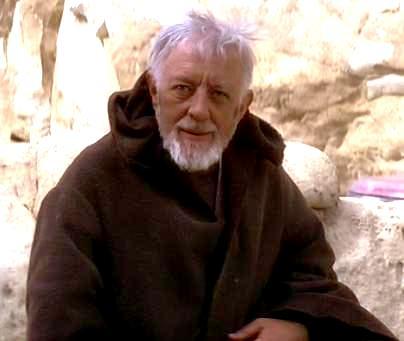
Following Leia’s orders, R2-D2 leads C-3PO and Luke deep into the desert, to the hermit Ben “Obi-Wan” Kenobi, who had long before been a Jedi Knight, an order of peace-keeping warrior monks. Obi-Wan seems to know something of Luke’s history, and after they retrieve Leia’s plea for help from R2-D2, they set out to help. Luke is reluctant at first, but his resolve is solidified when he discovers his aunt and uncle have been killed in his absence by the Empire, who are pursuing the droids. Obi-Wan also begins training Luke in the use of “The Force”, which is an energy field that binds all life and can be harnessed through concentration and discipline. It was this that Jedi used as their source of power, until they were all but wiped out by Darth Vader and the Empire.

In the desert wastes of Tatooine, the ever-patient Ben "Obi-Wan" Kenobi guides the whiny C-3PO and naive Luke Skywalker towards their destinies in the skies.

In the nearby space station of Mos Eisley, Luke, the droids and Obi-Wan hire the mercenary rogue pilot Han Solo and his companion Chewbacca, a towering, fur-covered alien with expertise in machinery and fighting. The sextet narrowly escape capture in Solo’s spacecraft, the Millennium Falcon. They head toward Leia’s home planet of Alderaan, only to find that it has been destroyed by the Death Star. They also find a massive Imperial “Star Destroyer” battleship, which captures the Millennium Falcon.

Through several tricks and some good luck, the six companions avoid capture on the Star Destroyer and rescue Princess Leia, though not without some help from Leia herself. Unfortunately, they also watch as Obi-Wan, after an extended light saber battle with his former pupil Darth Vader, is cut down and seemingly dissipates into thin air.

The remaining five companions and Princess Leia flee the Star Destroyer, though they have been, in effect, allowed to escape so that the Empire can follow them to the Rebellion’s secret base. Leia and the Rebellion use the Death Star blueprints to find a weak point, though it will require a highly risky and daring aerial assault. Luke, hungry to make a difference, immediately signs on. The self-serving Han Solo, on the other hand, takes the reward that he has been promised and leaves the Rebellion to its fate.

Luke, Leia, and Han Solo in the midst of their daring escape from the Star Destroyer. Leia insults Solo at every turn, but I think her hand in this still shot tells us everything.

With the Death Star approaching an attack window that will allow it to obliterate the rebel base, the rebel fighter squadrons attack. After an intense battle, Luke and his two wing men make a last-ditch attempt to hit the Death Star’s minuscule weak spot. With his wing men both shot down, and none other than ace pilot Darth Vader himself positioning his cross-hairs on Luke’s fighter craft, Han Solo swoops in and scatters the pursuing Imperial fighters. Luke, listening to the disembodied voice of Obi-Wan, turns off his targeting computer and uses The Force by relying on his instincts. Doing so, he hits the target and the Death Star is destroyed, saving the rebel base and fending off the Empire. At least for a time…

Take 1: My Gut Reaction (Done after this most recent viewing, before any further research.)

What does one of my generation say about this movie? In short, it’s still damn good, though some viewer maturity and the benefit of hindsight cast much more light on its shortcomings.

Star Wars is arguably the greatest pop culture phenomenon in history. Very few, if any, single entity, individual, or fictional realm in entertainment has become so famous, so widespread, and so embraced by so much of the world. Having seen this movie dozens of times, starting at age 4, it’s impossible for me to view it with fresh eyes. Yet try, I did. (Sorry, Yoda.)

It had been a few years since I’ve watched the movie (this time, I watched the original, theatrical version), and I am now 36 years old. This being the case, I can be slightly more objective than I would have been fifteen or even ten years ago. Please keep in mind that I am fully aware of the deconstruction of the Star Wars movies into their basic elements, and the fact that Lucas “borrowed” heavily from several major sources. Still…

Honestly, who wouldn't want to find out what these four chaps were up to?

Star Wars is still a lot of fun to watch, and I’m still impressed by the magic of the formula that George Lucas concocted. Until this movie, there had been absolutely nothing like it in movies. Sure, there were some highly innovative, creative, intelligent, and even visually stunning science fiction movies. However, there was nothing on Star Wars’ scale, in terms of epic storytelling and breadth of captivating elements.

True to the spirit of classic adventure movies, Star Wars tells a pretty gripping tale of a damsel in distress (though Leia is hardly helpless), fighting against tyrannical powers. The entire universe is a mystery in the beginning, but from that very first moment that you see the pursuit of Leia’s spacecraft by a gargantuan Star Destroyer, you want to know more. With every passing scene, we are given hints at a universe that is as much fantasy as science fiction. This mythical quality is given to us right away with the now-iconic phrase, “Long ago, in a galaxy far, far away…” With these words, high-tech is no longer equivalent to “futuristic”. Already, the tale has our minds expanding a bit.

The true trick of Lucas’s Star Wars galaxy was just how he blended the elements. There are cool gadgets and star ships for the techie, science fiction types. There is the mysticism and philosophy of The Force, the Jedi, and the Sith for the dreamier, more spiritual types. Most importantly for its mass appeal, though, is that there are all of the elements of a rip-roaring adventure story, complete with daring escapes and rescues, gun fights, and aerial battles. And of course, the light sabers. My cousin believes that it is the lightsaber that truly makes Star Wars what it is, and he has a point. If you take out those stately, blazing, “elegant weapons”, as Obi-Wan refers to them, then the Star Wars galaxy gets significantly blander.

The first lightsaber battle in the entire Star Wars movie franchise. These would become the hallmark ending of every single one of the six films in the series. One could argue that the lightsaber is the single most iconic prop in the history of film.

The main characters that everyone knows are almost all on display in this first film, save Yoda, who first appears in The Empire Strikes Back. Basically everyone on Earth is familiar with at least a few of the eight main characters in Star Wars. Oddly enough, in watching it this most recent time, I found Luke to be more annoying than anything else. He is rather whiny, but it’s easy to dismiss this, as he is basically a redneck farm boy who has no idea just what he’s stuck his dusty little toes into.

As much if not more than the characters, though, is simply the spectacle of the entire thing. From highly-functioning robots to bizarre species of creatures like the Jawas, Bantas, to the entire motley crew in Mos Eisley space station, so many things in the movie capture the eye and the imagination. I do have to say, also, that this is where the original, untouched theatrical release needs to be cherished. Lucas’s attempts to go back and give his own films facelifts met with harsh criticism from purists, and I wholeheartedly agree. There was absolutely nothing wrong with anything in the originals, in terms of the visuals. Simply using makeup and costumes, without the benefits of computer generated imaging, always makes those characters more tangible to me. Computer graphics are incredible these days, but let’s face it – we can always tell when they’re computer graphics. Not using these high-tech methods helps us suspend our disbelief a little more easily, in my opinion, and the original Star Wars was and is testament to this.

One thing that does not hold up over the years, or at least has become a more obvious weakness, is the dialogue in the movie. Now that most of us have seen the other George Lucas-penned scripts in Phantom Menace and Attack of the Clones, it’s even easier to see that the man was simply atrocious at writing dialogue. While Star Wars isn’t nearly as bad as Episodes I or II, it’s far from good. There’s a lot of hokum and very hackneyed attempts at humor. Probably the main reason that it doesn’t stand out as much is that the actors are talented enough to gloss it over. Hamill, Ford, Fisher, Guinness, and Jones are much stronger presences than Hayden Christensen and Natalie Portman, and the discrepancy in their abilities to sell lame dialogue shows it. The cast of the original Star Wars was, three-fingered hands down, far superior.

Even hungover with horrendous bed-head, Alec Guinness could out-act anyone else in the Star Wars series. He needed all of his skill to overcome the oft-lame dialogue.

So upon watching it this time, the movie is still great fun to watch. Perhaps I can’t really look at it with total objectivity since it captured a place in my heart at the time when all of our hearts are so impressionable – those magic years between ages three and ten when fantastic stories and movies can imprint themselves on our very beings. I suppose an older viewer who watches Star Wars for the first time may be a tad disappointed, considering just how massive the entire franchise has become. All the same, I think anyone can marvel at just how unique a potion George Lucas mixed up for us, and I know that I’ll never tire of the original trilogy.

Take 2: Further Thoughts (Based on the context of the entire Star Wars series & random factoids.)

Did you notice how, on the “All-TIME 100 Films” list, certain film series are put together and counted as one movie? Namely, The Apu Trilogy, The Godfather Parts I and II, and The Lord of the Rings? Notice how Star Wars sits alone, without either of its immediate sequels, The Empire Strikes Back or Return of the Jedi? Did you notice that? I did. So, why do you think it is?

My guess is that, while the original trilogy was just that, Star Wars can actually stand alone and separate from the latter two films, which rely on the other two. When any Star Wars dork is asked which of the six films in the series is the best, the answer is almost overwhelmingly The Empire Strikes Back, and I agree. I suppose that this movie wasn’t included because, unlike Star Wars, it did not end with any sense of closure. It was therefore connected to the slightly inferior Return of the Jedi (only made weaker by those silly little Disney puppets, the Ewoks). With the choice of either putting only Star Wars on the list or having to include the entire trilogy, I guess the list compilers went with the former option. It makes sense to me.

That's right, fellas. Your respectable series just got down-graded to pre-kindergarten levels. Don't worry in the back there, Luke. In a little while, you'll have an awesome lightsaber fight with your pops...

So, in light of Episodes I, II and III, what do I think? Basically, Episode I is nearly putrid. I remember how, back in 1999, as a 23-year old who was unspeakably excited about the new films, I was bafflingly disappointed. Like many of my ilk, the entire Jar-Jar Binks character was insulting to my intelligence (and, I assume, the intelligence of anyone over the age of four). Liam Neeson and Ewan McGregor were fine, but Jake Lloyd as the young Anakin Skywalker was dreadful (I checked imdb and he hasn’t had an acting gig since then. Small wonder.) The film is only watchable because of the pod races and the three-way light saber battle at the end between Obi-Wan, Qui-Gon and Darth Maul. Aside from these few things, The Phantom Menace was a flashy mess.

After that debacle, things got a tad better with Episode II, and even closer to tolerable with Episode III. Still, none of these prequels could hold a Yoda-levitated candle to any of the original three, not even its weakest link, Return of the Jedi. To me, the reason is simple. George Lucas got too crazy trying to use modern movie magic to try and please every fan. Star Wars and Empire Strikes Back did things using special effects to greatly enhance an engaging, if simple, adventure story. When he went back and did the prequels, it was almost as if the effects became the story.

After Episode II, Attack of the Clones, came out, a friend of mine was disgruntled with it and told me that it seemed like George Lucas had basically read a bunch of fan emails and tried to satisfy every fanboy’s wildest fantasies. You want to see more of Boba Fett? Well, here’s his daddy, Jango Fett! You want to see Yoda use a light saber? Well, here’s Yoda bouncing around with a light saber! It continued in Episode III, but not as egregiously.

Yoda getting his game on in Attack of the Clones. One of several elements Lucas put in seemingly to appease many fans' daydream desires. Personally, I liked it better when Yoda's martial prowess was merely implied and never revealed.

When I go back and watch Episodes IV and V, I absolutely love how scaled down the effects are and how the tale itself is the dominating force. There are many things that are hinted at, but never completely explained. How did Obi-Wan and Luke end up in the Tatooine desert? How did Yoda end up in the swamps of Dagobah? What pushed Darth Vader to the dark side of the force? In truth, I didn’t really need to know the answers to these questions, though I wanted to. Now that I do know, I basically wish that Lucas hadn’t even bothered with the prequels and simple left it all up to our imaginations. It would have saved me a lot of disappointment and would have left Episodes IV, V and VI to stand on their own, something they can do quite well.

Now that nearly three decades have passed since Return of the Jedi was originally released, there has been no end of study done of the Star Wars phenomenon. By now, many people are aware that its tremendous success was no accident. In conceiving his “science fiction soap opera”, George Lucas consulted the renowned cultural anthropologist Joseph Campbell on just what constituted the ultimate story. In a thoughtful (some cynics might say Machiavellian) approach, Lucas used what he learned about popular myths to construct the overall drama of the Skywalkers. The archetypical protagonist that is universal to the greatest of human mythology became Anakin Skywalker/Darth Vader – the flawed hero who falls from grace, then redeems himself in his waning hours.

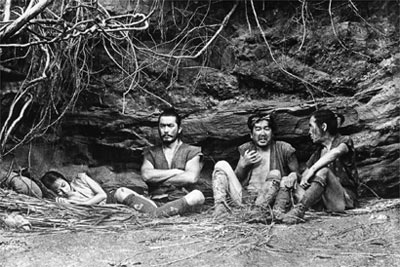
We also learned long ago that the filming of the original Star Wars itself was far from original. In basic narrative and even in shot composition, George Lucas “borrowed” (many say “stole”) from Akira Kurosawa’s classic adventure tale The Hidden Fortress. Despite these borrowed elements, Lucas was one of the earliest to depict a science fiction universe that was used up and grungy, unlike nearly all of the sleek, polished looks of sci-fi TV shows and films that had come previously. Sort of like what Sergio Leone did to the Western picture.

A shot from Akira Kurosawa's 1958 samurai movie, The Hidden Fortress. In this shot, you see the "inspirations" for Princess Leia, Obi-Wan Kenobi, and the droids C-3PO and R2-D2. Lucas also used the settings and locations in his first Star Wars movie.

Out of the countless other oddities and peculiarities about this series, there are two about the cast that have always intrigued me. Perhaps not surprisingly, they both deal with actors who were talented and professional, but didn’t really think much of their roles.

The first is Harrison Ford. He basically thought Han Solo was an idiot. And you know what? After watching the Star Wars movies as an adult, it’s obvious that Han Solo was not the sharpest tool in the shed. He was brave and funny, and he was an amusing rogue, but mostly he was a dolt. Harrison Ford has always said that he would always play Indiana Jones as often as possible because he liked the character, but that he would never play Han Solo again because he was a dunce. In fact, Ford tried to convince George Lucas to have Solo killed off at the end of either Empire or Jedi, to no avail.

The other is Alec Guinness. Anyone who has seen Alec Guinness in his film roles between the 1940s and 1970s knows that he was incredible. Whether it was as Fagan in Oliver Twist, his multitude of roles in Kind Hearts and Coronets, Colonel Nicholson in Bridge on the River Kwai, or any others, you know that he was an actor of incredible range and skill. As Obi-Wan Kenobi, he absolutely nailed the part as the wizened old knight who could quietly harness supernatural powers while mentoring the clueless young Luke. Guinness himself, however, seriously disliked certain things about playing Kenobi. One was that he found the dialogue to be atrocious, and could barely stomach delivering such hokey lines. He even succeeded where Harrison Ford failed – he convinced George Lucas to kill off Kenobi, ostensibly because he felt it strengthened Kenobi as a character (which it does). Later, though, Guinness admitted that it was also because he wanted to get out of reading dialogue that he found horrendous. More nuisance was to come in the succeeding years, as Star Wars mania grew to epic proportions. Guinness, a man of staggering accomplishment on both stage and film long before Star Wars, would forever after be known as “Obi-Wan Kenobi”.

In very limited screen time, Guinness played Kenobi so well that it became his blessing and his curse. This "silly role with terrible lines" overshadowed his previous decades of outstanding work. Oh well. At least he made serious cash out of it.

I used to feel sorry for Alec Guinness in that last respect. That was until I found out that he did something that showed great foresight. Unlike nearly everyone else involved with the original Star Wars movie, he thought that it would be highly successful. He therefore negotiated a contract that would pay him percentage royalties rather than a flat fee. As you can imagine, this ultimately led him to live very comfortably for the rest of his days. I guess in the end, it was a decent enough trade-off for him. Leave it to the Brit to show some foresight and do the responsible thing.

I could, like nearly any fan of science fiction and films, go on forever about the Star Wars franchise. Suffice it to say that it’s an incredible world that Lucas constructed, and it’s fun to go back into that world from time to time. These days, people can do it through novels, video games, role playing games, comic books, and myriad other sources. Still, there’s nothing quite like going right back to where it all started – with that massive, groundbreaking film in 1977 that set new standards for wondrous adventure movies. I’ll be shocked and amazed if the phenomenon of Star Wars dies out in my lifetime, and I know that I’ll go back and watch those original three every few years for as long as I live.

That’s a wrap. 76 shows down. 29 to go.

Coming Soon: Mon oncle d’amerique (1980)


This is one of the few “modern” movies that I know absolutely nothing about. It’s French and Gerard Depardieau is in it. That’s all I’ve got. Come on back in a week or so to find out what I think of it.

Please be sure to pick up all empties on the way out.