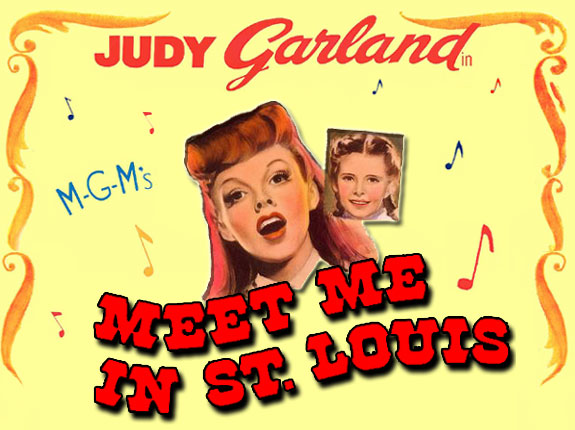
 Director: Vincente Minelli
Initial Release Country: United States
Times Previously Seen: none
20-Words-or-Fewer Summary (no spoilers, not that it matters):
Well-to-do, cheery family sings their way through a potential move from St. Louis to New York in 1903.
Blow-by-Blow Summary (detailed plot outline, with spoilers):
It's 1903 and the World's Fair is coming to Saint Louis, Missouri. The four sisters in the Smith family, a wealthy, happy tribe, have concerns. The two eldest daughters, Esther (Judy Garland) and Rose (Lucille Bremer), are pining to marry eligible bachelors. Esther has her sights set on the new dashing neighbor, John Truett (Tom Drake), while Rose awaits the proposal of another strapping young fellow. Their two much younger sisters are chuckling through the formative years of their innocent childhood.
Their father drops a bit of a bombshell when he arrives home one day and announces that the family will be moving to New York, so that he can take a new position. The family is greatly upset at the things that they will have to abandon in St. Louis: potential husbands, friends, and the fast-approaching World's Fair.
 Here's Esther, regaling the riveted riders with her "Clang...the Trolley" tune.
The entire family sings their way through all of their joys and fears, with Mr. Smith finally making the decision not to move, in order to preserve his family's happiness and roots in their beloved city. His decision is rewarded in the end, when his daughters both become engaged and they all drink in the majesty of the World's Fair of 1904.
 Here's Esther, regaling the riveted riders with her "Clang...the Trolley" tune.
The entire family sings their way through all of their joys and fears, with Mr. Smith finally making the decision not to move, in order to preserve his family's happiness and roots in their beloved city. His decision is rewarded in the end, when his daughters both become engaged and they all drink in the majesty of the World's Fair of 1904.
Take 1: My Gut Reaction (done after one viewing, before any research on the film):
This movie can kiss my ass.
Up to this point, I would say The Awful Truth had been the most taxing on my patience. Now, there is a new, undisputed champion of insufferability: Meet Me in St. Louis.
It's going to take some research for me to figure out why this movie made TIME magazines list of 100 important films. I have my theories, which I'll expound upon below, but I don't need to ponder my feelings about watching this movie - I couldn't stand it.
I've made clear my feelings on musicals before. The only shot a musical has in entertaining me is if: (1) the story has enough substance to hold my interest, and (2) the music is well-woven into the fabric of the film. This is why a musical like Swing Time or Cabaret is enjoyable for me. Meet Me in Saint Louis contains everything that steers me away from the genre. It's pure fluff and a textbook case of style over substance.
The story is as edgy as a down pillow. I honestly couldn't have cared less about the privileged Smith clan and their "problems" of finding love and dealing with a possible move to New York. After watching Citizen Kane, Casablanca, and Double Indemnity, three movies with a great amount of creative artistry and psychological sophistication and maturity, Meet Me in St. Louis was like watching an episode of The Wiggles. Actually, the Wiggles think the Smiths are a bunch of pansies.
Shocking factoid: Double Indemnity and Meet Me in St. Louis were released mere months apart, both to great success. This blows my mind and speaks to some kind of multiple personality disorder that U.S. culture was beginning to undergo.
The songs are bubble-gum fare of the highest order. The best-known cuts are "Clang Goes the Trolley" and "Have Yourself a Merry Little Christmas," the latter of which is actually a classic and a legitimately great song. Aside from that, however, the only thing I can say about the music is that it's infectious. That's not a complement - I mean infectious in the same way that Mad Cow disease is infectious. You can't shake it and it will melt your brain.
You may (or may not) ask, "How on earth did you make it through nearly two hours of a film that you so obviously hated?" Good question. The answer is that my girlfriend and I took the opportunity to persistently add our own snarky commentary and voice-overs, a la Mystery Science Theater 3000. Two scenes in particular gave us some good ammunition. One was when a confused and enraged Judy Garland believes that her little sister has been roughed up by the neighbor, John. She promptly goes over and pummels the shit out of him. The second was when little "Tootie" Smith, after hearing her older sister attempt to sooth her sadness by singing "Have Yourself a Merry Little Christmas," runs outside, grabs a massive stick, and commences to decapitate, eviscerate and disembowel the placid snowpeople in their front lawn. I'll save you the trouble and offer this latter little gem here (it is actually the one scene from the movie that I'd listen to and watch again):
That little chick's got a mean backswing.
Obviously, sarcasm was my only chance to survive through this piece of work. So, why is this movie touted so highly? My guess is that it was the first of its kind: a shockingly vibrant, well-shot formulaic musical. I'm not sure if there was a predecessor to it: Gone With the Wind type visuals, absolutely nothing controversial, and a string of snappy tunes, however sappy I think they may be. It's either that or simply the endurance of the Christmas song, which has become part of the American pop culture and holiday landscape.
I believe I've made myself clear. I do realize that many people love this type of film: The Sound of Music, West Side Story, Grease, and others could be put into the same category. I will say this though: even though I don't like any of these three films, either, at least they have a shade more edge to them. Meet Me in St. Louis is, to me, an absolutely G-Rated exercise in forgettable excess.
To paraphrase Leo from Miller's Crossing: if I never see it again, it'll be soon enough.
Take 2: Why Film Geeks Love this Movie (done after some further research):
Surprisingly, there's really not much out there to explain exactly what sets Meet Me in St. Louis apart from the others. Based on Richard Schickel's quick-shot review, I glean that this movie has a place in history for being the first film that offered the musical format using more down-to-earth characters (rather than high-minded, pure aristocrats, I assume).
The original review is an interesting little read, if only for two things. One is the line, "even the deaf should love this film." Oh, political correctness, where were you in 1944? While amusing, this little gag does point out that the visuals were impressive. The second thing the reviewer mentioned comes at the end - that the whole story and look of the film are too beautiful and attractive to be mistaken for the truth. These things, and the popularity of the songs, are seemingly what have dubbed this film a "classic."
And this, as stated before, is probably the bone that sticks in my craw. I don't mind heavy doses of complete fiction (I'm too big a fantasy and sci-fi nerd to try and argue that), but I can't take the froo-froo veneer of a film like Meet Me in St. Louis. Sorry.
That's a wrap. 26 shows down, 79 to go.
Coming Soon: Les Enfants du Paradis ("Children of Paradise"; 1945):

A 3-hour French drama set in a circus and revolving around a love triangle involving a mime. On the surface, it seems like a death sentence. Come on back and see if and how I survive this one.
Please be sure to pick up all empties on the way out.