Showing posts with label Meet Me in St Louis. Show all posts

Sunday, January 16, 2011

Film #47: Pyaasa (1957)


Title for Us English-Speaking Types:Thirst” or “The Thirsty One

Director: Guru Dutt

Initial Release Country: India

Times Previously Seen: none

Teaser Summary (No spoilers)Skilled but poor poet loses, laments, finds, loses, and finds love for women, if not humanity. Sings about it all.

Uncut Summary (The full plot synopsis, including spoilers. Fair warning.)
In 1952, India, the young poet Vijay (Guru Dutt) searches for love and work. He is clearly a very gifted poet who delivers his verses with an incredible singing voice. Yet, he is spurned everywhere he goes. While he would like to sing profound verses about lost love and the ills of society, publishers and audiences have no desire to listen.

Vijay, left, receives just one of many rejections of his poetry from a publisher.
At his family's meager home, his mother tries to offer him a charity dinner, but his two older brothers heap shame and guilt on him for not being a “working” member of the family. Vijay then discovers that one brother has sold some of his poetry as waste paper. Despite his loving mother's pleas to either stay or take her with him, Vijay departs home alone.

In a nearby market, Vijay discovers that his poetry was sold to a woman who read and was interested in the verses. Alas, the vendor does not know the woman. Later that day, by the river, Vijay hears a beautiful young woman singing words that he had penned. He follows her to her home, discovers that her name is Gulabo (Waheeda Rehman) and that she is a prostitute. Vijay is far less concerned about this than getting his poetry back, which he does.
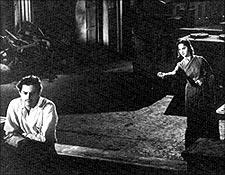

Vijay shares a close moment with Gulabo.

Soon after, Vijay is reluctantly dragged to a college reunion by a former classmate. There, he sees his past lover, Meena (Mala Sinha), with whom he had a storybook romance until she left him, inexplicably. At the reunion, he recites some extemporaneous melancholy poetry, which falls on ears that are all deaf except for Meena's and a quiet dark-eyed figure, Mr. Ghosh. Upon leaving, Vijay is met by Ghosh, who is a publisher and offers him a job, though only as a menial worker. Vijay accepts.

At Mr. Ghosh's publishing company, it soon becomes clear that Ghosh, though realizing Vijay's dream of using his poetry to reach the public, has no interest in publishing the young man's work, calling it “trash”. Vijay overhears this, but swallows his pride and stays on the job. That evening, he goes to work at a party at Ghosh's home, where a gathering of prominent poets is taking place. Here, Vijay discovers that Ghosh's wife is none other than his lost love, Meena. He breaks out into another mournful piece of sung poetry, which captivates all of the other poets there. Afterwards, Vijay sees that Meena left him for the promise of material wealth with Ghosh. It becomes clear to Ghosh that there is something between Vijay and his wife, leading him to fire Vijay.

Through all of this, Vijay occasionally runs across the prostitute Gulabo, who has clearly fallen in love with Vijay through reading his poems. Vijay seems attracted to Gulabo's loving spirit, but is conflicted over how to behave towards her.

A few days after his firing, a broke and homeless Vijay is lost in thought on the banks of the Ganges when he sees his two brothers giving last rites to someone. Vijay discovers that it was his mother, who has died before he could make any final farewell. He retreats to the home of a vice-ridden fellow poet and promptly gets drunk. Intoxicated, he drifts through the brothel area of the city and sings a rousing verse about the social ills of his country. Yet again, however, no one is listening.

A drunken and despondent Vijay unleashes his poetry on an uncaring red light district.

Financially and spiritually at rock bottom, Vijay resigns himself to suicide. He heads towards some nearby train tracks, and even gives his jacket to an emaciated vagrant, who then quietly follows him to the train yard. Just as Vijay's about to throw himself in front of an oncoming locomotive, the vagrant gets his foot caught on a different track. Vijay goes back to pull him free, but fails. Vijay survives, but in a state of shock. In a case of mistaken identity, the country at large believes Vijay to have been killed by the train, thanks to the jacket that the vagrant had been wearing when run down.

Thinking her love to be dead, Gulabo goes to Ghosh to publish Vijay's surviving poems, not knowing Ghosh's feelings towards the young man. Instead, Gulabo finds Meena in the office, and quickly discerns that Meena was the inspiration for so many of Vijay's poems of lost love. Just as this discovery is made, Ghosh arrives. He gladly accepts Vijay's poems from Gulabo, realizing that he can reap enormous profits from the presumed-dead poet.

Ghosh's plan works all too well. Vijay's poetry is a nationwide publishing sensation, touching the dispossessed souls of the populace and raking in millions. However, a problem arises for Ghosh – Vijay awakens from his stupor in the hospital. He is initially put into a sanitarium for claiming to be the famous poet Vijay, and is kept there after Ghosh, a former colleague, and even his own brothers refuse to identify him. They realize that their gravy train will most likely only continue rolling as long as Vijay is “dead”.

Eventually, Vijay manages to escape with the help of his friend, local massage oil salesman and goofball, Abdul Sattar. It has now been a year since his “death”, and Vijay follows a throng to a memorial service in his honor. At the service, the ever-cunning Ghosh lambastes the audience for being the reason that Vijay committed suicide. Seeing the scene and infuriated by the greed, avarice, and materialism he sees at work, Vijay breaks into an impassioned verse railing against these social ills. All present are stunned, including Gulabo, who is the only one who is genuinely joyed to see that Vijay is alive.

After the public revelation that he is alive, Vijay's former detractors and enemies turn coat and try to ally themselves with him now that he is on the verge of becoming immensely wealthy by acting as the country's living voice. At what is meant to be a public recognition of his true identity, Vijay disavows his name and leaves the angry mob to tear each other apart, only further acting out the very corruption that Vijay no longer wants a part of.

That night, at her brothel, a saddened Gulabo slinks into deep feelings of loss. This changes when, much to her surprise, Vijay appears at the gate. In his eyes is a profound melancholy as he tells Gulabo that he is going to go away. When she asks to where, he simply replies that he will go until he does not need to go any farther. He asks Gulabo if she will go with him, to which she gives a wordless smile. The two walk, hand in hand, into the night.

Vijay arrives at Gulabo's brothel to announce his departure from society.

Take 1: My Gut Reaction (Done after this first viewing, before any research)

It's now been about 24 hours since I watched Pyaasa, and I can't get it out of my head. This is a good thing.

After my girlfriend and I watched the movie, we were both rather quiet as we absorbed everything that had been thrown at us during the movie's two-and-a-half hours. As you can see from the mere length of my earlier synopsis, there are plenty of pivotal plot points, which make for a epic story. Add to this the Bollywood mode of adding music, and you now have an even larger piece of work. But it was neither the storyline nor the extended soundtrack that gives Pyaasa its weight. No. It's the tone and the themes.

Anyone who has read my reviews of the musicals Meet Me In St. Louis or Singin' In The Rain knows that the genre is probably my least favorite. While Pyaasa is clearly a musical, I found that I didn't mind the songs. Unlike so many Hollywood musicals, these Indian numbers were not invasive or written merely to be independent hit songs that were shoehorned into the picture (this is something that I found Meet Me In St. Louis particularly guilty of). Rather, the songs in Pyaasa are artistic expressions of the characters' feelings, and it is these very feelings that sets the movie even further above its musical brethren.

Nearly all musicals that I've seen are optimistic in tone. Sure, there may be a sad little tune thrown in here and there, but everything is generally upbeat. The songs in Pyaasa, however, have a beautifully melancholy attitude running through them all. Whether they're about unrequited love, frustration at a diseased society, or a resigned acceptance of both, there's a genuinely Romantic power to them that is absent from most musical soundtracks. In fact, the only other “sad” musical that I have seen is Lars Von Trier's uber-downer, Dancer In the Dark, but that film brought depressing to new lows despite how skillfully it was made. Pyaasa taps deeply into the ennui but it never dragged me so far down that I couldn't see a certain amount of beauty to it.

Here's a clip of one of the great songs. There are no subtitles, but the emotions are as clear as can be. This is from the class reunion at which Vijay sees his past love, Meena. I needn't explain just how he feels about her:


On top of all of this, the music is, on the whole, fantastic. While I don't really like when the singers send their voices soaring into the wavering, higher registers, the rest of the time the vocalists displayed amazing chops. All of the songs were either catchy or touching, depending on the requirements of the scene. A few songs may have gone on a tad too long, but many were quick hitters that popped up and then got out of the way of the story. I find that I really like the Indian styles with the sitar, accordion, and percussive instruments.

Another general strength is the overall story. Granted, the notion of a gifted and tortured artist being unappreciated and scorned by society is hardly new. Still, this movie imbues Vijay with thoughts and words that tap into the more universal plight of humanity. The vehicle of the love stories is a bit hackneyed, and even the “mistaken death” plot line is a rip-off of Sullivan's Travels, but the movie is effective in making the larger points.

As far as the other technical merits, they were a somewhat strange hodgepodge. Director and star Raja Dutt apes the visual and musical scoring style that had preceded him. Cinematography-wise, one can see many similarities with earlier Hollywood masterpieces like Citizen Kane and Casablanca. He does it very well, even if he wasn't exactly breaking new ground. The score is an odd scattering of popular melodies ranging from classical European to snappy American folk. The shifts were sometimes strange, bordering on comical, but they don't greatly diminish the overall film.

The acting is another point that is a mixed bag. The primary actors, especially star and director Raja Dutt, are excellent. However, most of the other parts are overdone in the throwback melodramatic styles of previous decades. It doesn't help that much of the dialogue is rather simplistic an stagey.

Would I watch this movie again? Perhaps. I have to say that the DVD version I watched appeared to be an older edition. This made for some questionable subtitles and a rather grainy look. If a reliable company like Criterion Collection were to give it a facelift and some updated translation, I would love to see it for the more polished aesthetics.

Pyaasa was a pleasant surprise, and one of the more singular films I've watched on the list yet. I can't say that it turned me into a Bollywood fan, but it has piqued my interest and given me some ideas and images that will stay with me for years to come.

Here's a clip of perhaps the most charged song in the movie. This is near the end, when Vijay sees the mob and his enemies figuratively feasting on his presumed corpse. He can take no more, and his song slowly builds to a fever pitch by the end:


Take 2: Why Film Geeks Love This Movie (Done after some further research)

Wow. Of the 47 films that I've watched for this blog thus far, Pyaasa wins the award for having the least amount information available. I'm sure this would be different if I could speak Hindi. I can't, so there's little to add to my own subjective views above.

There are a few interesting odds and ends, though. One is the all-too familiar tale of studio meddling. Raja Dutt wanted the ending to be Vijay walking off alone. The studio, certainly fearful that such an end would alienate a larger audience, demanded that Gulabo go with him. I have to say that, unlike the other movies in which such modifications were mandated, I was alright with this one. Maybe I was simply in a more romantic mood while watching it, but I was glad that my heart could hang its hat on something after Vijay's wholesale rejection of society.

On a minor, more amusing note is that the film crew wanted to film the red light district scene (maybe the most powerful and beautiful of the entire film) on location in Calcutta. They made it there, but were run off by a pack of local pimps. Among all of the problems that film makers have faced in history, I can't say that I've heard of such a thing.

Here is that famous scene in the brothel area. This is when Vijay is overwhelmed by the state of affairs in his beloved country:


That's a wrap. 47 shows down, 58 to go.

Coming Soon: The Sweet Smell of Success (1957)
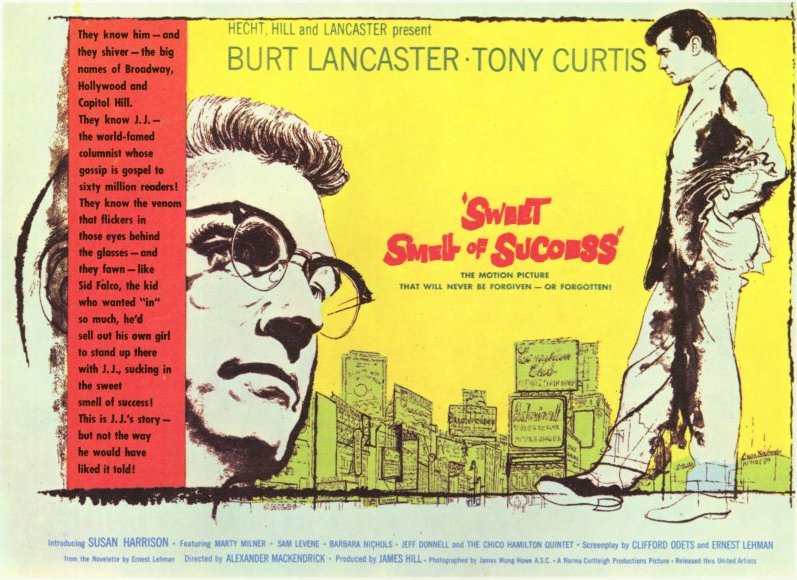
Watched this one about a year ago, and thought it was decent. I've always enjoyed Burt Lancaster, and he plays a real piece of work in this one.

Please be sure to pick up all empties on the way out.

Tuesday, June 8, 2010

Film #30: It's a Wonderful Life (1947)


Director: Frank Capra

Initial Release Country: United States

Times Previously Seen: none (though I'd seen the last 30 minutes about 4 times)

20-Words-or-Fewer Summary (no spoilers):

All-American, self-sacrificing nice guy gets in a serious jam, contemplates offing himself, then gets help from an angel.

Uncut Summary (a full blow-by-blow, spoilers included. Fair warning.):

In the quaint American town of Bedford Falls, George Bailey grows up. From childhood, he proves to be exceptionally kind and selfless. At age 12, George saves his little brother, Harry, from drowning in a frozen pond. At age 15, he prevents his pharmacist boss from making a fatal error with his drug mixing. These actions, while wonderfully admirable, are the easiest of George's altruistic feats.

Here's George at 20, showing just how far he's going to be from sanity in one hour, movie time.

At 20, just as he prepares to travel the world before going to college, George (Jimmy Stewart) is called upon to take over his uncle and father's savings and loan business. There's really no money in it, and it stymies George's life-long dream of exploring the globe; however, he feels obligated to keep the local Scrooge, Mr. Potter, from getting his greedy fingers on the business. George sucks it up and takes the position, agreeing to hold down the fort until his younger brother returns from college in four years' time.

Four years later, a newly-married Harry returns from college. Surprisingly (or not), Harry has an opportunity to take a promising job with his father-in-law's company. The ever-generous George gives his brother a pass and decides to stick with the job. On the plus side, he realizes his love for beautiful girl-next-door, Mary (Donna Reed). Just after they get married, the town forces Harry to make another sacrifice. There's a serious bank run and the newlyweds have to use their travel money to support the savings and loan's depositors.

Over the course of the next fifteen years or so, the Great Depression comes and goes, as does World War II. Many of George's friends and his brother have seen the world and made plenty of money. In the meantime, George has remained in Bedford Falls with Mary. They have very little money, but they have four children and a lovely house that Mary has slowly renovated over the years.

And then, on Christmas Eve, disaster strikes. As a government loan officer shows up to see the books at Bailey Savings and Loan, Uncle Billy misplaces $8,000, which falls into the hands of the still-stodgy Mr. Potter. When the disappearance is revealed to George, he soon grows desperate. Desperation eventually turns to panic, and panic to mania. After pleading with an unsympathetic Potter for a loan, George decides to kill himself, hoping that his life insurance policy will pay for the missing cash. He staggers to the town bridge...

Watching from, literally, on high the entire time have been the heavenly host. The angels have heard the prayers of George's concerned friends and family and decide to help. They send Angel, Second Class Clarence Oddbody (Henry Travers). Clarence keeps George from ending himself and even grants him his transitory dark wish: that he'd never been born.

Initially writing off Clarence as some random kook, George returns to town to face the music. Little does he realize that Clarence has not been joking. As he traverses Bedford Falls, George confronts the reality of the town had he never existed: Potter has turned it into a commercialized den of iniquity, loaded with bars, cabarets, and desperate people. Most the George's friends and family are either in dire straits or dead. George refuses to accept this warped reality and slowly loses his mind, only barely grasping the positive influence that he has had on the many lives in the town. Mentally and emotionally shattered, he returns to the bridge.
While a devastated George nearly hits bottom, the angel Clarence returns reality right-side-up. George soon realizes that his friends and family are back to those he always knew. Despite the still-present financial trouble, he is overjoyed to return to this familiar reality and sprints through the town, filled with Christmas cheer.

George returns to his home to find his four children, but also the local police, who are waiting to arrest him for the absent $8,000. While George is far less concerned about this than before, it soon ceases to be a problem: Mary returns with all of George's friends in the town, all of whom have decided to pitch in a help George out of his fix. George is redeemed, the Savings and Loan in saved, and everyone has a merry Christmas.

Hip-Hip...Hooray!!

Take 1: My Gut Reaction (done after one viewing, before any further research):

I might just be a very sick and disturbed person. The things I like about this film may classify me as some kind of psychotic.

By nearly any account, It's a Wonderful Life is an American Christmas classic. It clearly follows in the tradition of Dickens's A Christmas Carol, and has been referenced and imitated endless times in the decades since the 1940s. We all know how many times it gets shown during the holiday season, and this speaks to its enduring place in our U.S. culture. It's a 20th century fable that has stood the test of time remarkably well.

I really don't like most of it. Most of it, mind you.

I chalk the things I don't like up the temporal context. It's a Wonderful Life was released on December 20th, 1946. World War II had ended, optimism was high the United States, and the entertainment machine was just starting to tap into the nascent "American Dream" that would mold popular film and TV culture for roughly the next thirty years. It's a Wonderful Life was one of the first films to get the formula down correctly: the all-American town; the idyllic, romantic home; the beautiful, dutiful wife; the four adorable kids; and the hard-working, self-sacrificing husband. Movies and TV shows would keep churning out this cookie-cutter again and again.

This is mainly what I don't like about this movie. While the film is not devoid of some characters with true depth, most of the Bedford Fallsians are very one-dimensional. Mr. Potter as the local Mammon is greed and evil incarnate. Uncle Billy is a bumbling boob. Martini is an almost offensive caricature of Italian Americans, complete with a gaggle of kids, an outrageous accent, and an affable dimness. In fact, nearly all of the town reminded me of the Saint Louis portrayed in Meet Me in St. Louis - a lot of hokey lines and flashy stereotypes, very little substance.

Here's the first 10 minutes or so from the film. Just pick any random 2 minutes from it and you'll see just how far off of the "Gee-Shucks"-o-Meter this first half or so of this film is:


This leads me to the moments I like in the film, and I can sum it up in one idea: when George Bailey starts to go batshit. The viewer can sense it building throughout the film's first hour-and-a-half (the much more familiar Christmas scenes only make up the last 30 minutes of the movie) - after every sacrifice made as an adult, you can see some small piece of George get crushed into a little ball and tossed into some dark corner of his soul. Well, after the money gets lost and George is facing jail time, he loses it, and he steadily devolves into a near-madman. And I all but revelled in every moment of it.

Hear me out. It should be obvious that I disliked the setting of Bedford Falls. The cheese factor is off the charts, and my feelings about the characters should be clear. The only grounding force is George Bailey (and, before he dies, George's father). As I saw George's dreams get suppressed by the stiflingly simple-minded townies and the cartoonishly evil Mr. Potter, I totally empathized with George, though I think my feelings different than those that Frank Capra intended. While I think he meant for the viewer to pull for George to snap out of his doldrums and realize the gifts around him, I was actually rooting for George to crack some skulls. It was how I would have felt had someone dropped me into the set of Meet Me in St. Louis - that I was stuck in some twisted, nightmarishly Disneyfied version of the American dream.

And so, as George began to rant, rave and rage against the trappings of Bedford Falls, I wanted him to succeed. Or at least to escape. He obviously feels the same at the darkest moment of the film - when he stands on the bridge and contemplates jumping. I certainly wasn't hoping for that, but I surely understood it.

Here's a great moment after the money disappears and George's frenzy begins. It's exactly the way any real human would act if he found himself amongst a gaggle of half-baked, fictional goobers. Probably most disturbing is from time 2:00 to about 5:00:


Somebody get that man a case of Southern Comfort, fer chissakes!

The latter 30 minutes were odd to see again. The truth is, I always thought that I had seen this film. I came to learn, though, that I had really only seen the last 30 of this 132-minute long tale. The well-known ending is really just adapted (ripped off?) from A Christmas Carol - instead of visiting past, present, and future realities as Ebenezer Scrooge does, though, George gets to see a world in which he never existed. Once this final portion of the film is set up in its initial 5 minutes, the remaining 25 belabor the point. I must concede, however, that this is from the perspective of 34-year-old who has grown up with science fiction, alternate reality, and time-jumping tales having already gone far beyond novel.

Despite my thinking that It's A Wonderful Life is overlong and devoid of any real teeth, there are some things to like. Jimmy Stewart is very good, though he is at his Jimmy Stewartest - clever, goofy, lovable, and gosh-darn-it, just a heckuva fella! While his performance as George Bailey has a dark element, I prefer his turns in The Shop Around the Corner, Rope and Vertigo. Donna Reed is also quite good, though her character is not totally fleshed out. She's certainly more vivid than almost everyone else in Bedford Falls, but there's still something a bit lacking.

And now, my greatest shame.

I truly did get choked up at the end. Not at the stupid "Every time a bell rings...." blah-blah-blah quote (by the way - that kid was teeth-grittingly annoying). No, the throat actually tightened when George finds that he has been left Clarence the angel's copy of Tom Sawyer, in which is inscribed "Remember that no man is a failure who has friends." That one got me. It's the same way I felt at the end of City Lights. Now, Frank Capra can join Charlie Chaplin on the short list of filmmakers of sappy movies that still squeezed a few tears from me.

Jerks.

Take 2: Why Film Geeks Love This Movie (done after further research):

It's a Wonderful Life is such a quintessentially American film that I could spend months researching critics' raves and gushing praise. Instead of all that, I picked the titan of the industry: Roger Ebert. I really like a lot of Ebert's reviews since he judges films based on what they were trying to do, not necessarily on how they stack up to other films.

Roger loves this old Frank Capra classic for reasons that I think most fans like it: the simple charm of a moral tale told in a cozy town, featuring affable characters. I have to disagree with Roger on a few points, though. While he finds the admittedly slapstick humor in the earlier segments of the movie charming (falling into a swimming pool, George Bailey talking to a naked Mary hiding in a bush), I found them tedious. Ebert even uses the word "corny" to describe a few of the scenes, but he does so with acceptance and warmth. Not me.

Ebert's synopsis is worth reading for the little history lesson it gives, as well. It's a Wonderful Life, while considered a very good film upon it's release (here's TIME's glowing review back in 1946), it shortly after went to sleep. It went to sleep for about three decades and was all but forgotten.

Then, it became public domain. This meant that any television station that could get its hands on the film could show it without cost. And so, guess what got shown over and over and over during Christmas time? You got it. Hence, a Christmas movie tradition was born, though I feel like it's lost some steam in recent decades, most notably to A Christmas Story.

Richard Corliss actually puts it all very succinctly here. He's absolutely right that this film is hard to see with fresh eyes, and I agree that everyone should try it if they haven't in a while. While I may not rush back to see this film again, I have to say that it's certainly not bad, and I never felt like it was wasting my time. Once the next snow falls for you, give this one a try - I all but guarantee that you won't hate it, and I suspect many of you will actually like it more than you expect.

That's a Christmas wrap (yuk yuk). 30 shows down, 75 to go.

Coming (Very!) Soon: Out of the Past (1947):


Shady dames, quiet tough guys, and lots and lots of shadows. Yup! It's more noir!! That's what I'm talkin' about, ya mug.

Please be sure to pick up all empties on the way out.

Wednesday, May 5, 2010

Film #26: Meet Me in St. Louis (1944)

Director: Vincente Minelli

Initial Release Country: United States

Times Previously Seen: none

20-Words-or-Fewer Summary (no spoilers, not that it matters):

Well-to-do, cheery family sings their way through a potential move from St. Louis to New York in 1903.

Blow-by-Blow Summary (detailed plot outline, with spoilers):

It's 1903 and the World's Fair is coming to Saint Louis, Missouri. The four sisters in the Smith family, a wealthy, happy tribe, have concerns. The two eldest daughters, Esther (Judy Garland) and Rose (Lucille Bremer), are pining to marry eligible bachelors. Esther has her sights set on the new dashing neighbor, John Truett (Tom Drake), while Rose awaits the proposal of another strapping young fellow. Their two much younger sisters are chuckling through the formative years of their innocent childhood.

Their father drops a bit of a bombshell when he arrives home one day and announces that the family will be moving to New York, so that he can take a new position. The family is greatly upset at the things that they will have to abandon in St. Louis: potential husbands, friends, and the fast-approaching World's Fair.

Here's Esther, regaling the riveted riders with her "Clang...the Trolley" tune.

The entire family sings their way through all of their joys and fears, with Mr. Smith finally making the decision not to move, in order to preserve his family's happiness and roots in their beloved city. His decision is rewarded in the end, when his daughters both become engaged and they all drink in the majesty of the World's Fair of 1904.

Take 1: My Gut Reaction (done after one viewing, before any research on the film):

This movie can kiss my ass.

Up to this point, I would say The Awful Truth had been the most taxing on my patience. Now, there is a new, undisputed champion of insufferability: Meet Me in St. Louis.

It's going to take some research for me to figure out why this movie made TIME magazines list of 100 important films. I have my theories, which I'll expound upon below, but I don't need to ponder my feelings about watching this movie - I couldn't stand it.

I've made clear my feelings on musicals before. The only shot a musical has in entertaining me is if: (1) the story has enough substance to hold my interest, and (2) the music is well-woven into the fabric of the film. This is why a musical like Swing Time or Cabaret is enjoyable for me. Meet Me in Saint Louis contains everything that steers me away from the genre. It's pure fluff and a textbook case of style over substance.

The story is as edgy as a down pillow. I honestly couldn't have cared less about the privileged Smith clan and their "problems" of finding love and dealing with a possible move to New York. After watching Citizen Kane, Casablanca, and Double Indemnity, three movies with a great amount of creative artistry and psychological sophistication and maturity, Meet Me in St. Louis was like watching an episode of The Wiggles. Actually, the Wiggles think the Smiths are a bunch of pansies.

Shocking factoid: Double Indemnity and Meet Me in St. Louis were released mere months apart, both to great success. This blows my mind and speaks to some kind of multiple personality disorder that U.S. culture was beginning to undergo.

The songs are bubble-gum fare of the highest order. The best-known cuts are "Clang Goes the Trolley" and "Have Yourself a Merry Little Christmas," the latter of which is actually a classic and a legitimately great song. Aside from that, however, the only thing I can say about the music is that it's infectious. That's not a complement - I mean infectious in the same way that Mad Cow disease is infectious. You can't shake it and it will melt your brain.

You may (or may not) ask, "How on earth did you make it through nearly two hours of a film that you so obviously hated?" Good question. The answer is that my girlfriend and I took the opportunity to persistently add our own snarky commentary and voice-overs, a la Mystery Science Theater 3000. Two scenes in particular gave us some good ammunition. One was when a confused and enraged Judy Garland believes that her little sister has been roughed up by the neighbor, John. She promptly goes over and pummels the shit out of him. The second was when little "Tootie" Smith, after hearing her older sister attempt to sooth her sadness by singing "Have Yourself a Merry Little Christmas," runs outside, grabs a massive stick, and commences to decapitate, eviscerate and disembowel the placid snowpeople in their front lawn. I'll save you the trouble and offer this latter little gem here (it is actually the one scene from the movie that I'd listen to and watch again):


That little chick's got a mean backswing.

Obviously, sarcasm was my only chance to survive through this piece of work. So, why is this movie touted so highly? My guess is that it was the first of its kind: a shockingly vibrant, well-shot formulaic musical. I'm not sure if there was a predecessor to it: Gone With the Wind type visuals, absolutely nothing controversial, and a string of snappy tunes, however sappy I think they may be. It's either that or simply the endurance of the Christmas song, which has become part of the American pop culture and holiday landscape.

I believe I've made myself clear. I do realize that many people love this type of film: The Sound of Music, West Side Story, Grease, and others could be put into the same category. I will say this though: even though I don't like any of these three films, either, at least they have a shade more edge to them. Meet Me in St. Louis is, to me, an absolutely G-Rated exercise in forgettable excess.

To paraphrase Leo from Miller's Crossing: if I never see it again, it'll be soon enough.

Take 2: Why Film Geeks Love this Movie (done after some further research):

Surprisingly, there's really not much out there to explain exactly what sets Meet Me in St. Louis apart from the others. Based on Richard Schickel's quick-shot review, I glean that this movie has a place in history for being the first film that offered the musical format using more down-to-earth characters (rather than high-minded, pure aristocrats, I assume).

The original review is an interesting little read, if only for two things. One is the line, "even the deaf should love this film." Oh, political correctness, where were you in 1944? While amusing, this little gag does point out that the visuals were impressive. The second thing the reviewer mentioned comes at the end - that the whole story and look of the film are too beautiful and attractive to be mistaken for the truth. These things, and the popularity of the songs, are seemingly what have dubbed this film a "classic."

And this, as stated before, is probably the bone that sticks in my craw. I don't mind heavy doses of complete fiction (I'm too big a fantasy and sci-fi nerd to try and argue that), but I can't take the froo-froo veneer of a film like Meet Me in St. Louis. Sorry.

That's a wrap. 26 shows down, 79 to go.

Coming Soon: Les Enfants du Paradis ("Children of Paradise"; 1945):


A 3-hour French drama set in a circus and revolving around a love triangle involving a mime. On the surface, it seems like a death sentence. Come on back and see if and how I survive this one.

Please be sure to pick up all empties on the way out.