
This is now the 616th movie I've watched from the 1,199 films on the "Before You Die" list that I'm gradually working my way through.
 Original German Title: Der Blaue Engel
Director: Josef von Sternberg
A very well-done, if notably different, adaptation of a classic novel.
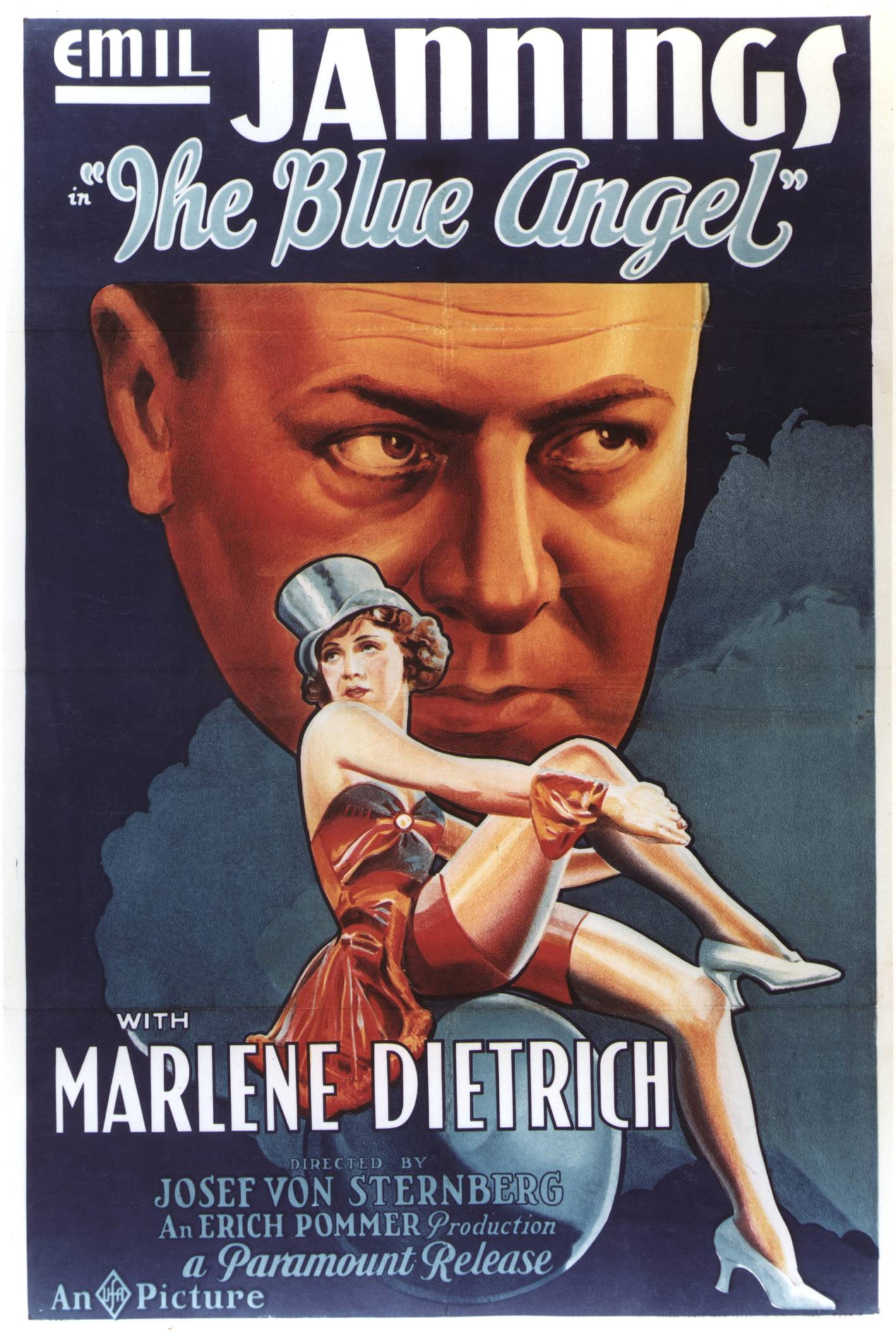
The story is based on German author Heinrich Mann's novel Professor Unrat (Professor Garbage, in English), wherein a tyrannical professor in a mid-sized German town becomes enamored of a young performer in a local burlesque house. In the film, Professor Rath (Emil Jannings) follows several students to the burlesque house, the titular Blue Angel, where he first lays eyes on the seductive young performer Lola Lola (Marlene Dietrich), and rather quickly falls in love. The previously stuffy Rath has a lapse of propriety shortly after he begins his affair with Lola, and he soon loses his job at the college. He does marry Lola, but is then forced to simply act as her personal assistant after his savings run out. Over the next few years, growing more impoverished, Rath takes on a role as a clown in Lola's traveling show. Rath has been slowly losing his purpose in life, and the final straws come when the show returns to the town where he was shamed and fired from his former college. Though initially refusing to take the stage and be laughed at by former pupils, colleagues, and neighbors, his manager threatens him with firing. While suffering the on-stage humiliation as a clown, his beloved Lola has also turned her gaze to a new, younger lover - a stage strongman who has ingratiated himself to her. Rath suffers a nervous breakdown. He first tries unsuccessfully to kill Lola, then flees and staggers back to the college where he had previously worked. There, he shuffles to his old desk, lays down, clutches the desk, and quietly passes away.
The movie is obviously a tragedy, and it is one told skillfully and efficiently. The interesting turn in the movie is just how it takes a relatively unsympathetic character, in the bullying professor, and turns him into a figure for whom we ultimately feel some pain. This is quite different from the novel, in which the professor only grows more despicable and hateful as the tale grows on, to the point that even when he meets an undesirable fate, we readers feel little to no sympathy for him. A film version that followed the original story would have been less enjoyable, and frankly probably would not have worked terribly well in the medium as it does in literature. The movie stands out among its contemporaries, regardless. I haven't seen many movies from around this time which dared to tell such a story. Curiously, the ones I have seen - The Last Laugh and The Last Command - feature the very same Emil Jannings who stars in The Blue Angel. Jannings apparently found a niche in playing men who suffer severe trauma, and with good reason. He does an excellent job.
This movie is also notable in that it was the first major, highly successful picture to feature Marlene Dietrich. To me, she is actually more impressive than Jannings in that she represents the subtler, more nuanced, and naturalistic style of acting which would set the very best actors apart in the coming decades. Fans of music in movies are also likely to enjoy a few of the musical numbers included in the film. While I'm generally not a fan of musicals, I had no problem with the tunes included here, as they are quite catchy, and they completely fit the settings in all cases.
The Blue Angel is a movie I would recommend to anyone who appreciates quality humanist tragedies. I would even suggest reading the novel, either before or after viewing the movie. They do differ in some significant ways, but they are both expertly-crafted works of art.
A side-note - I watched the German-language version of this movie. Curiously, since the stars of the show were quite fluent in English, there is also an English-language version of it as well. It's a rare thing that an entire cast is able to shoot an entire movie in two different languages. This also gives a nice option to English-speaking viewers who can't stand subtitles.
That's 616 down; only 583 to go before I can die.
Director: Josef von Sternberg
A very well-done, if notably different, adaptation of a classic novel.
The story is based on German author Heinrich Mann's novel Professor Unrat (Professor Garbage, in English), wherein a tyrannical professor in a mid-sized German town becomes enamored of a young performer in a local burlesque house. In the film, Professor Rath (Emil Jannings) follows several students to the burlesque house, the titular Blue Angel, where he first lays eyes on the seductive young performer Lola Lola (Marlene Dietrich), and rather quickly falls in love. The previously stuffy Rath has a lapse of propriety shortly after he begins his affair with Lola, and he soon loses his job at the college. He does marry Lola, but is then forced to simply act as her personal assistant after his savings run out. Over the next few years, growing more impoverished, Rath takes on a role as a clown in Lola's traveling show. Rath has been slowly losing his purpose in life, and the final straws come when the show returns to the town where he was shamed and fired from his former college. Though initially refusing to take the stage and be laughed at by former pupils, colleagues, and neighbors, his manager threatens him with firing. While suffering the on-stage humiliation as a clown, his beloved Lola has also turned her gaze to a new, younger lover - a stage strongman who has ingratiated himself to her. Rath suffers a nervous breakdown. He first tries unsuccessfully to kill Lola, then flees and staggers back to the college where he had previously worked. There, he shuffles to his old desk, lays down, clutches the desk, and quietly passes away.
 |
| Marlene Dietrich as Lola Lola, the alluring burlesque performer who attracts and eventually shatters the stuffy Professor Rath. |
This movie is also notable in that it was the first major, highly successful picture to feature Marlene Dietrich. To me, she is actually more impressive than Jannings in that she represents the subtler, more nuanced, and naturalistic style of acting which would set the very best actors apart in the coming decades. Fans of music in movies are also likely to enjoy a few of the musical numbers included in the film. While I'm generally not a fan of musicals, I had no problem with the tunes included here, as they are quite catchy, and they completely fit the settings in all cases.
The Blue Angel is a movie I would recommend to anyone who appreciates quality humanist tragedies. I would even suggest reading the novel, either before or after viewing the movie. They do differ in some significant ways, but they are both expertly-crafted works of art.
A side-note - I watched the German-language version of this movie. Curiously, since the stars of the show were quite fluent in English, there is also an English-language version of it as well. It's a rare thing that an entire cast is able to shoot an entire movie in two different languages. This also gives a nice option to English-speaking viewers who can't stand subtitles.
That's 616 down; only 583 to go before I can die.


