Showing posts with label william powell. Show all posts

Monday, March 8, 2010

Film #15: The Awful Truth (1937)


Director: Leo McCarey

Release Country: United States

Times Previously Seen: none

The Story (in which I painstakingly lay out the plot; spoilers and all. Fair warning):

Jerry Warriner returns from a supposed trip to Florida to find his wife, Lucy, not at home. When she returns with her dashing music instructor, she explains that they were delayed overnight due to a car breakdown and had to stay the night in an inn. Jerry becomes suspicious and begins to level his accusations. During the snide grilling, Lucy discovers that Jerry may not have actually been in Florida. She becomes suspicious. Things get heated and the two end up filing for divorce.
The divorce proceedings come off, and the couple have only to wait out a 90-day period before it is official. During this period, Lucy starts to get friendly with her new neighbor, Dan Leeson, a kindly, if simple, rancher from Oklahoma. Jerry, under the guise of apathy, openly sabotages the blooming romance by continually highlighting the vast differences between Lucy and Dan. The marriage is off.

With Lucy and Dan's relationship over, Jerry Warriner begins to see a different lady of his own high society sect. When Lucy discovers this, she goes for a little tete-a-tete and decides to torpedo Jerry's engagement in the same way he did hers. Her method is to pose as his drunken sister at a social event and insinuate that Jerry is equally incorrigible. That marriage is off.

After this second detonation of a budding marriage and some automobile trouble, Jerry and Lucy end up stuck in their old cabin in the woods. The two mull things over, and realize that they still do love each other. Just before the 90-day deadline on their divorce, they admit their love for one another and all is peachy keen once again.

Take 1: My Gut Reaction (done after 1 viewing & before any research on the film):

UUUUUUUUUUUGGGGGGGGGGHHHHHhhhhhhhhhhhhhhh... Man, do I HATE screwball comedies, and this movie is screwball to the absolute core. Thing is, there are virtually no technical flaws to be found in this movie, in my view. Directing? Great. Acting? Phenomenal. Set design? Costumes? Flawless. Dialogue? Sharp as can be. Characters? Ah-HA!!! And this is where I go off.

There is nothing specific to The Awful Truth that I dislike. My problem is with almost the entire genre of "screwball" films. And I've really, really tried. I have. Over the last decade or so, I've watched about a half dozen "classic" screwball films. In pondering them, I think I can pinpoint what separates the ones that I'm OK with versus the ones that make me feel like I wasted 90 minutes of my life. Here goes...

I like It Happened One Night and My Man Godfrey. I hate Bringing Up Baby, The Awful Truth, His Girl Friday, and The Philadelphia Story. What separates them? Well, one thing is that Bringing Up Baby and The Philadelphia Story star Katherine Hepburn, who I can't stand in any role (I'll delve into this in a future post, no doubt). On top of that, though, the latter listed films seem to lack any characters who I can relate to and sympathize with. It Happened One Night had an earthy wit to it, and My Man Godfrey had William Powell, who was the absolute man. Not to mention that these two films were grounded at least a little more in everyday problems. The rest are all about high society types looking for love, cracking wise, and having "madcap hijinks" all along the way.

Here's where The Awful Truth is at its screwiest:


It's a yuk-fest, alright. I'd rather watch my cat bathe himself.

What it comes down to is that I simply didn't care one bit. The two main characters, Lucy and Jerry, are filthy rich and totally self-absorbed. Sure, they're good-looking, clever and playful, but what's the point of the film? I think I understand the appeal - it's the same reason people watch reality shows like The Celebrity Apprentice, Celebrity Rehab, or Celebrity (name of reality show here) - people are fascinated with the rich and wealthy. People are even more fascinated when the rich and wealthy make asses of themselves. I'm not one who's drawn by such things, so perhaps this contributes to my apathy for these films.

I think that this is perfectly illustrated in The Awful Truth by the way that the character Dan Lesson is portrayed. He's an Oklahoma rancher who's obviously a well-meaning, kind person, but one who lacks the cosmopolitan sophistication of Jerry and Lucy. Well, the movie makes Dan out to be an utter buffoon fit for nothing more than Jerry to cunningly embarrass and condescend to. I just wanted to pat Dan on the back and tell him, "Look, ol' hoss, you don't want nothing to do with these backwards Yankees. Get on back to ranch, do what you do best, and leave these well-dressed a-holes to themselves."

So you don't think I'm trying to destroy this film, let me reiterate that the film does what it intends to with incredible skill. In fact, the only reason it was tolerable at all to me were the strong performances of Cary Grant and Irene Dunne, though Dunne's New England affectations annoyed me a bit. Those two knew how to balance the ridiculous with the calculated very well, though the ridiculosity (it's a word now) gets to be a bit much.

The awful truth is that I can't say that this is a bad movie at all - it would be insulting to the highly skilled people who created it. But I have to give a qualified recommendation only to people who liked the films that I mentioned before in the "I hate these screwball movies" roll call. Otherwise, stay away.

Take 2: Why Film Geeks Love It (done after some research on the film):

After reading the many gushing reviews of this film (here's the fellow at TIME magazine's feelings), I almost feel like a cretin for disliking it so much. I don't care, though. I still don't like it.

The reasons this film gets cited as so influential are several. One is that it really launched Cary Grant's career and forged the character that he would play in essentially every movie for the rest of his life - the smooth, easy-talking, quick-witted loverman. If you've seen any of Cary Grant's other movies (Hitchcock or otherwise), you'll see the first incarnation of whatever character he played in those films in The Awful Truth. He was so damn good at it right out of the box, there's no wonder he carved such a massive place in films with it.  

Here's a mildly amusing scene that illustrates pretty much everything that I like and loathe (mostly loathe) in the film:


I was also reminded that the basic tale of The Awful Truth is ripped right out of the pages of Shakespeare; Much Ado About Nothing, mostly. That old tale had Beatrice and Benedict, two head-strong types who loved each other but wouldn't admit it, go through all kinds of shenanigans before facing the facts of their feelings. Yes, I have read that play. Yes, I have seen the Kenneth Brannagh adaptation. Yes, I hated them all.

What can I say? This is obviously a type of film that I don't like. I've tried my damnedest to figure out why, and even to have a more open mind and just enjoy the comedy. I haven't been able to do it for most of these films, though. I will be getting another chance soon, however, as His Girl Friday and The Lady Eve are coming up soon on the list. We'll see if I've vented all of my vitriol on this subject before then.

That's a wrap (Thank the Lord). 15 down. 90 shows to go.

Coming Soon: Dodsworth (1936):
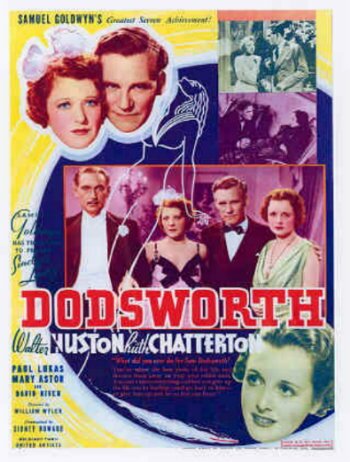
I've never heard of this one, and I have no idea what to expect. These are the moments when I am often pleasantly surprised and end up discovering some of my favorite movies.

Please be sure to pick up all empties on the way out...

Tuesday, January 19, 2010

Film #4: The Last Command (1928)


Note: This film not being in-print on DVD, I had to order a VHS version. I was able to catch a whiff of nostalgia as I pushed the tape into the decades-old player in my classroom. The whirring, clicking dinosaur sounded not unlike the first Terminator at the end of the film: nothing but a twisted torso and one robotic arm desperately scraping itself along the factory floor, lunging for Sarah Connor. Man, these old machines are great.

Times Previously Seen: none

Initial Release Country: United States

The Story (in which I flatly describe the plot and spoil the hell out of the movie for you):
A palsied, uncertain old man is hired as an extra in a Hollywood war movie, seemingly because he has the right look and merely claims to be a former general in the Russian Imperial army and cousin to the fallen Czar. We quickly learn through flashback that this man is not lying. In fact, he is former Grand Duke Sergeus Alexander, and the the director of the movie is a former Russian revolutionary who recognizes the old general and sees this as an opportunity to exact his revenge on the man who arrested him 10 years prior. It is also the director's last stab at the Russian aristocratic power of the past.

During the flashback, we see the general to have been a bit arrogant and blustering, but also deeply concerned about his troops and the welfare of Russia. He has loyalty to his cousin, the Czar, but does not blindly follow orders. He is a thoughtful man who develops a sincere caring for a beautiful young actress. The actress, a revolutionary herself, is captured and swayed into admiration for the general. Once the Bolshevik Revolution occurs, the young woman saves the general's life from a bloodthirsty mob, then herself falls victim to a tragic train crash. The general, torn apart professionally, spiritually and mentally, flees Russia.

Ten years later, in Hollywood, he is made to reenact his past role as general. In the middle of acting in the scene, the vivid memory of his past life is triggered, he slips into a delusional passion to defend his mother Russia and dies on the set.


A scene from the beginning of the film, depicting the distant, haunted gaze of Sergeus Alexander.


Take 1: My Gut Reaction (A review done before any kind of research on the movie):

This is a great film, silent or not. Sure, there are some elements and aesthetics that I can gripe about (and I will, further down), but this film is a masterpiece. So much so that, during the last 20 minutes or so, I wasn't even taking the notes that I normally take when doing these reviews. I was that gripped. The main character, Sergeus Alexander, is that rare thing in all stories, be they in films, TV, novels or theater: a complete human. So many stories are weakened by simplified caricatures of pre-determined archetypes: hero or villain; good or evil; powerful or weak, and rarely do the twain meet. The greatest characters, however, are people in full, warts and all. Sergeus is one of those characters.

In the beginning of the movie, you feel pity for this old, traumatized and feeble man as the other extras on the movie set taunt him, thinking his claims about his identity are nonsense. When we start to see his life as a general, we quickly resent him, his arrogant posture, his belittling of disrespectful officers, and his seeming callousness toward suspected revolutionaries. Then, we start to see more aspects of him: his tenderness towards the young actress, despite her attempt to assassinate him; his genuine concern for his soldiers' lives; and his deep love for the integrity of his home country. Once we get the sense of the complete man and understand how admirable he is, despite and because of his flaws, it's truly painful to see it all come crashing down around him. He loses his livelihood, his love, and his country, all in one fell swoop when the Empire falls. During the end scene, I was completely enthralled by the general's unbridled release of emotion - emotion that had been caged in by a decade of sorrow.

One of the first scenes in which the seemingly tyrannical general subtly reveals his more humane tenderness.

Something else that you can see in this clip is how the acting has evolved. Almost gone are the grandiose movements of earlier silent films. The actors behave and talk much more realistically, being on-par with modern thespians. Thanks to this, the 21st century viewer can more easily sense the emotions of the characters and empathize with them. As exhibit A, I suggest looking at the general's walk and face when he's retrieving his mistress/would-be assassin's cigarette, pondering whether he's about to die for his love of her; maybe even dutifully accepting it. The whole movie is filled with such moments. The capper is the look on Sergeus' face as his life is ripped from him. From contented to utterly haunted, his wide eyes are burned into my mind. Emil Jannings, who won the very first "Best Actor" Academy Award for the role, was truly amazing.

Alas, it was not a perfect viewing experience. A few minor things made me wince just a bit. One was the music score. Maybe the original, in-theater score was better, but this tape had the standard silent film organ music. I realize that this was the norm for the day, but here in 2010, it made me feel like I was watching an Icecapades extravaganza during an intermission at a minor league hockey game. For a moment, I thought the Hanson brothers were going to charge onto the screen and start throwing wicked hip checks.

Another, more prominent blemish is the gaps in the story. The flashback format works extremely well, but the ten-year time jump gives you no explanation as to how Alexander gets from crying in the Russian snow to subsistence living in a Hollywood boarding house. I realize that it's not the most crucial detail, but I wondered about it all the same.

The only other bugaboo was the titles. It has nothing to do with the acting or the other, more essential components of the movie, but a few of them were distractingly hokey. The prize-winner was when the general captures his revolutionary mistress and says, "You are now my prisoner of war. And my prisoner of love!" Ouch. Not even Sir Laurence Olivier could pull off that line.

But that's it for the downside. Fairly easily overlooked, and leaving me saying that this is easily the most enjoyable film I've watched from the list so far. In fact, I had initially planned to sell the tape after watching the film. Now, I plan to keep it and watch it at least once more. If you think you have the patience for a silent flick (it's just under 90 minutes), this one's a gem.

Take 2: A Few More Thoughts After Some Research (or, "Why Film Geeks Love This Movie"):

There's actually not a ton of analysis of this film out there, perhaps because the story, while packing emotional power, is rather straightforward. The one thing that the critics of the past and present point to is the acting. As mentioned, Emil Jannings garnered the very first Academy Awards for Best Actor in this one (amazingly, he was also nominated for The Way of All Flesh in the same year). Here's the original TIME Magazine review of The Last Command. I particularly like the description of Jannings as "clumsy-faced, blacksmith-muscled" and "think-fingered," while the writer praises him.

In addition to Jannings's brilliant acting is that of William Powell, who portrayed the general's nemesis as the Russian Bolshevik revolutionary-turned-Hollywood film director (it's far less ridiculous in the film than it reads - trust me). I know Powell from a few talkie films like The Thin Man and My Man Godfrey. While he's fantastic in those later films, I agree with critics who give him the nod - his subtle facial gestures and calm, steely gazes were just as effective in silent films. He lent yet another strong presence to an incredible movie.

That's a wrap. 4 films in the can. 101 to go.
Next Film: The Crowd (1928):
I guess this film was a smash-hit in China, based on the bilingual movie poster here. Like the previous two films, this one will be a totally new experience for me. Check back in a few days for the review.