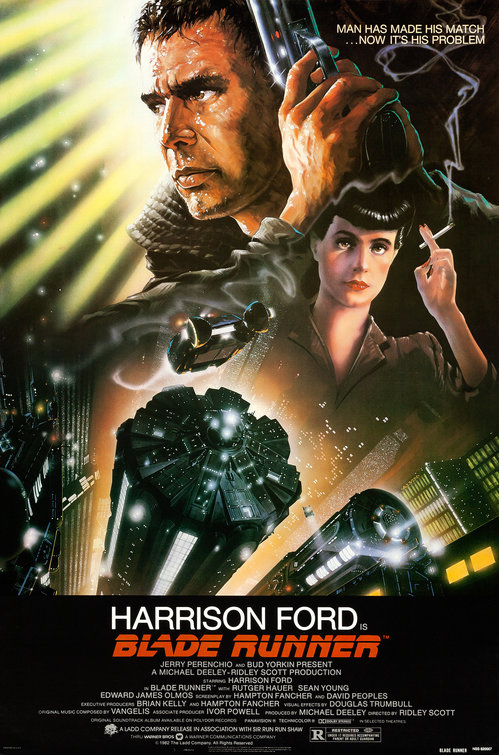
Sunday, August 26, 2012

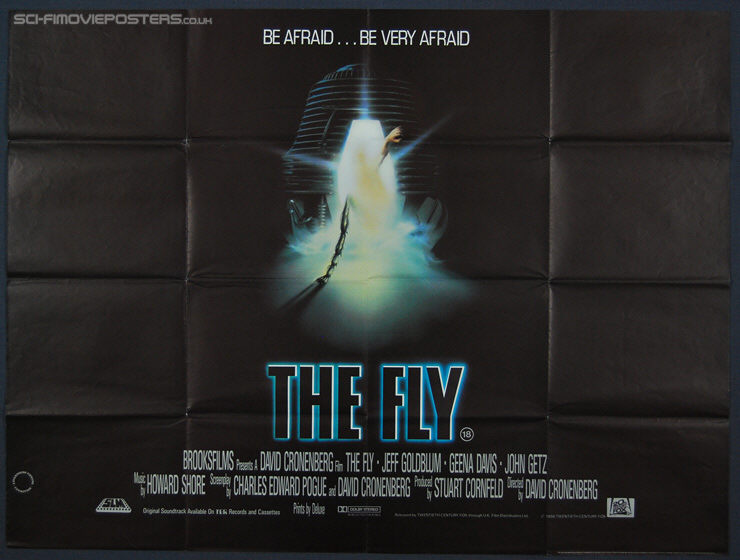
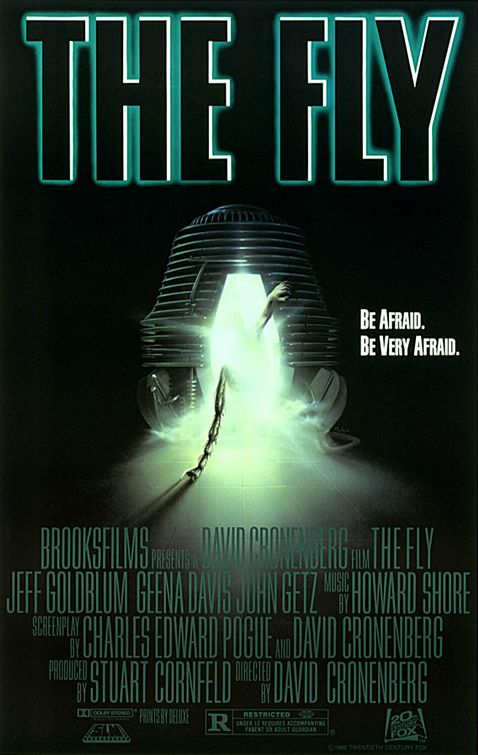
Film #84: The Fly (1986)


Director: David Cronenberg

Initial Release Country: United States

Times Previously Seen: around 5 or 6 (last time probably 20 years ago)

Rapid-Fire Summary:

At a science convention, an eager young journalist, Veronica Quaife (Geena Davis) meets an eccentric and enthusiastic man named Seth Brundle (Jeff Goldblum). Brundle swears to Veronica that he is sitting on the invention that will change human history. Though skeptical at first, Veronica is curious enough to follow Brundle to his warehouse laboratory and finds that he has created telepods – mechanical devices that can transport matter instantaneously from one location to another. The only problem is that it can only work on inorganic objects. Brundle proclaims, though, that he will work this out soon enough.

Over the next few weeks and months, Veronica chronicles Brundle's attempts to solve the “organic matter” problem, and begins a romantic relationship with the quirky yet charming genius. He eventually figures out how to transport organic matter, though he waits before attempting it on a human. One night, however, in a drunken fit of daring, Brundle steps into the pod and successfully transports himself. What he doesn't know, though, is that a housefly has flown into the pod at the same time, and that they have both been fused on a genetic level.

As the next few days and weeks unfold, Brundle begins to undergo and gradual yet steady transformation. At first, he shows phenomenal strength and energy levels. Eventually, though his skin starts to change and he begins to exhibit territorial and violent tendencies. Brundle discovers the truth about how he and the fly are now becoming some sort of mutated hybrid of each other, and tries to discover some way to stop it. His efforts fail, however, and he continues his horrifying metamorphosis.

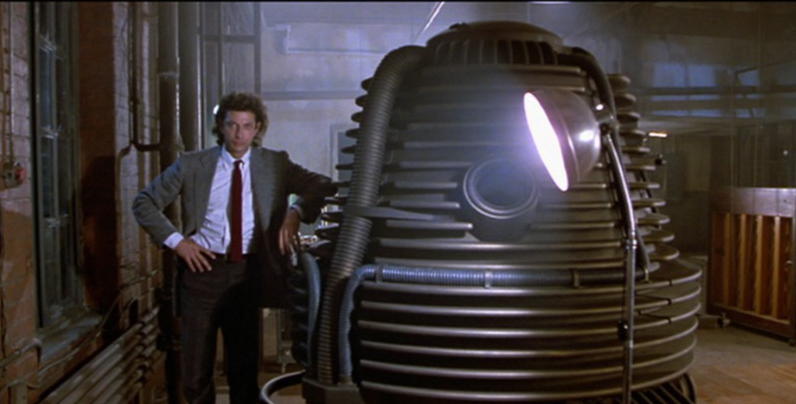
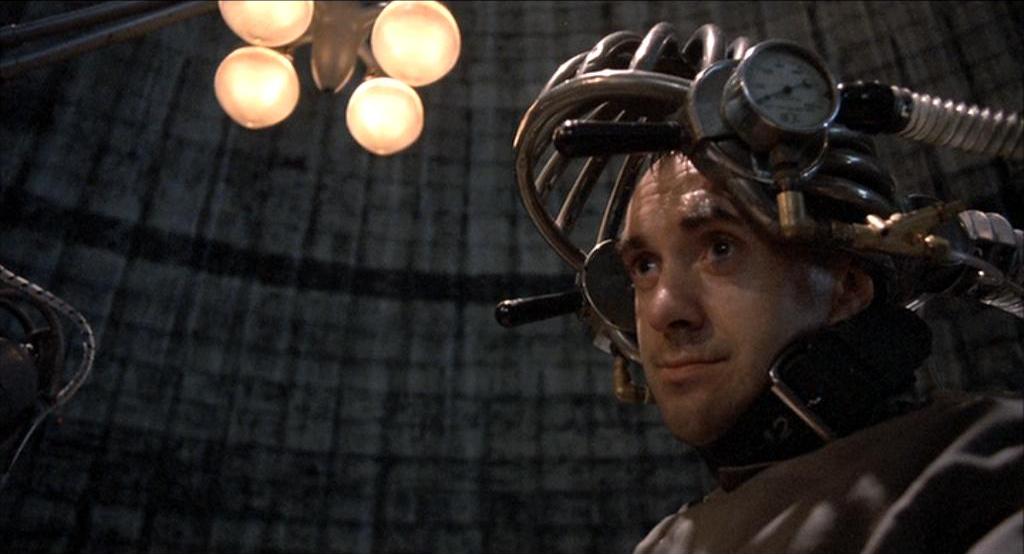
Dr. Seth Brundle, next to his greatest invention, and the very thing that will spell his grisly doom.

Making matters even more terrifying is the fact that Veronica discovers that she is pregnant with Seth's baby. While she had previously been attempting to help Seth find a cure, she has had to flee from his increasingly brutal and warped nature. When she goes to have an abortion of their child, Seth abducts her from the hospital and brings her to his lab. The now-barely recognizable Brundle hopes to enact a mad plan by which he will transport and fuse himself, Veronica, and their unborn child into one creature. Brundle almost succeeds, if not for Veronica's past lover and current editor, who fends off Brundle long enough for Veronica to escape.

In the end, a mishap with the telepods leaves the Brundle/fly creature fused with part of the pod. The creature claws its way to Veronica and begs for the mercy of death, which Veronica grants by shooting it.

My Take (Done after this most recent viewing):

This movie still packs every bit of punch that it had 26 years ago.

The Fly is as horrifying as it is compelling. I'm not any kind of horror film buff, but I'll take one in every once in a while. From what I have seen in the decades since David Cronenberg's science-fiction horror show, I can't think of another film that is as powerfully hypnotic and terrifying.

As stated at the end of my last review, I remember watching this movie many times when it was available on VHS, back when I was 12 and 13 years old. I was certainly freaked out by it back then, and I'm pretty sure that I'll have a few nightmares after this most recent viewing as well. As a kid, I was enthralled by the special effects that transformed Jeff Goldblum into the titular creature. These were, of course, the very things that brought The Fly to popular consciousness back in 1986. To this day, they hold up amazingly well, and they illicit the same visceral reaction now that they always have and always will.

This montage shows the stomach-turning devolution of Dr. Brundle. Watching it unfold throughout the film is part of the macabre magnetism.

The visuals, though, tell only a part of what makes this movie so powerful. Primarily, it is that, right up to the end, you care about the people involved. This includes, surprisingly, the monster that Dr. Brundle becomes. In the early going, we quickly see that he is quirky, brilliant, and oddly charismatic. The love that develops between him and Veronica feels very genuine. This is what makes his slow and terrible transformation and destruction so tragic.

The character of Veronica amplifies this even more. Through the entire macabre affair, she tries to help Brundle, even towards the end, when virtually nothing of the man that she loves is left. Arguably the most powerful scene is the final one. As the Brundle creature emerges from the telepod, now an utterly grotesque fusion of the man, the fly, and hulking parts of an inanimate telepod, the tale does not go the traditional horror movie route. In nearly all horror films, the monster makes a final lunge at the fleeing humans, only to be killed in self defense. In The Fly, instead, the monster crawls up to Veronica and makes a final plea for the release of death by gently drawing the shotgun to its own head. This shows that there is some final shred of humanity, if only in the form of self-pity, left inside of it. It is a pathetic emotion, but one that inspires just enough compassion to give the tale its final cruel and tragic twist.

A less obvious theme in the film is that of primal, animal attraction. In the beginning stages of Brundle's transformation, when he still appears to be human, he shows phenomenally enhanced strength and drive. One just has to look at the faces of Veronica and Tawny during these stages to see how attracted they are to his seeming virility, while at the same time being slightly afraid. These are two very basic, very tightly interwoven compulsions in humans, whether we want to admit it or not. It is also these same two aspects that Cronenberg explored more overtly in A History of Violence.

Through most of the movie, including most of his repulsive metamorphosis, Goldblum makes Seth Brundle a far more sympathetic character than you might expect.

The storytelling is incredibly tight. Even though there were plenty of the quieter, more interpersonal scenes that I had forgotten from my childhood viewings, the movie never slows down. Right from the opening scenes, we get caught up in the wonder of discovery and the potential for what Dr. Brundle has created. We then get the thrill of watching him improve and develop his invention so that it can transport organic matter. Once he teleports himself, not knowing that the fly has been fused with him, it's almost impossible to stop watching. Especially if you haven't seen the movie before, waiting to find out just how far Brundle's physical appearance will deteriorate is a bizarre magnet, pulling us along.

The performances certainly enhance, if not necessarily make, the movie. Geena Davis does a fine job expressing the compassion, disgust, and revulsion that the part requires. More than her, though, is Jeff Goldblum. Once you see this movie, it is no mystery as to why he has been typecast as “the creepy yet charismatic scientist” in no less than a half dozen films. In The Fly, Goldblum exhibited probably the widest range of his acting life, going from the shy, witty, brilliant innovator to the brute creature, while retaining an oddly charming gallows humor through nearly the entire gut-wrenching affair. It was a feat that few actors could have pulled off.

The Fly is one of those films that is powerful in so many different ways that I can see why it is considered “great”. That being said, it is disturbing and grotesque enough that I can't see myself watching it again for at least a very long time. Fortunately, though, it is a film that imprints itself so strongly in one's mind, that watching it twice in a short time is an effort in redundancy.

That's a wrap. 84 shows down. 21 to go.

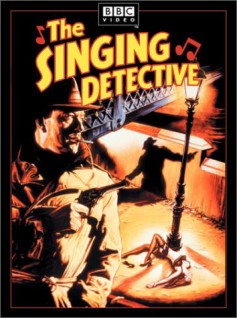
Coming Soon: The Singing Detective (1986):


This promises to be a more light-hearted affair than the last made-for-TV film series that I watched, Berlin Alexanderplatz. I really don't know anything about it, though. This is often a very good thing, and I'll find out soon enough.

Please be sure to pick up all empties on the way out.

Monday, June 25, 2012

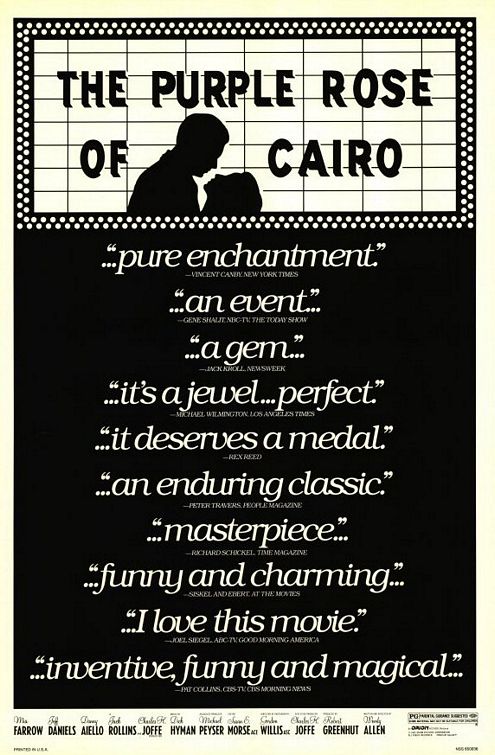
Film # 83: The Purple Rose of Cairo (1985)


Director: Woody Allen

Initial Release Country: United States

Times Previously Seen: once (about 2 years ago)

Teaser Summary (No spoilers)

Depression-era dame escapes from the drudgery of her life at the movie theater, only to have one of the screen characters come to life and pursue her.

Extended Summary (More detailed synopsis, including spoilers. Fair warning.)

New Jersey, the Great Depression. Cecilia (Mia Farrow) is feeling the full brunt of the economic malaise that the country is in. She lives in a tiny, run-down apartment and struggles to maintain a monotonous waitressing job at a local diner. To make matter much worse, her husband Monk (Danny Aiello) is a complete leech. He wastes his time gambling with friends and cavorting with other women rather than looking hard for a job. He also drinks too much and abuses the meek Cecilia regularly.

Cecilia’s only real pleasure in life is watching movies. She is a regular at the local theater and voraciously watches everything that plays. She knows all of the films’ stories, actors, and actresses, and she adores the romantic personalities and stories on the screen. Even though no one around her, including her sister and her husband, shares or understands her passion, Cecilia is perpetually enthralled by movies.

Cecilia (in the front), slogging through her waitress job. Her sister, like everyone else close to her, dismisses Cecilia as a flighty dreamer.

One day, Cecilia goes to see the latest film release – The Purple Rose of Cairo – which is a standard 1930s adventure/screwball comedy/romance picture. She loves the film, especially the character Tom Baxter (Jeff Daniels), who is a handsome, well-spoken and well-mannered explorer from a rich family. Cecilia tries to explain her love of the picture to her sister at her job the next day, but gets distracted, drops several plates (something she has done several times before), and she gets fired. She returns home to find Monk drinking and joking with another woman, both of whom drunkenly stagger out into the night. Cecilia decides to go back to the movie theater.

Over the next few days, Cecilia continues to watch The Purple Rose of Cairo repeatedly. Suddenly, in the middle of her fifth viewing, the Tom Baxter character on the screen turns and makes eye contact with Cecilia. He then begins to address her directly. Cecilia, stunned at first, then replies. They talk briefly about how much Cecilia must love the movie, and then Tom Baxter literally walks out of the movie – from the black and white screen to full-color “real” life with Cecilia. All of the theater-goers witness the same thing, but before they can do anything more than stammer, Tom and Cecilia leave the theater.

Through the evening, Tom and Cecilia stroll around town and talk. It becomes clear that Tom, though now in the real world, is still very much a fictional construct. He is brave and adventurous, and he has highly romantic notions about love, sex, and the world around him. Cecilia is highly captivated by Tom, and she almost seems to be falling in love with him; however, she pulls away on account of her being married. They part ways, but Cecilia promises to return the next evening.

Cecilia and Tom get to know one another, despite the massive divide of one being a real human and the other being a fictional character come to life.

Back at the movie theater, The Purple Rose of Cairo is still showing, sans Tom Baxter. The rest of the characters in the movie, rather than continuing on with their parts, have stopped what they were doing and are directly addressing the audience. It seems that they cannot continue the movie until Tom returns. Word of this gets out and makes it all the way back to Hollywood, where the movie studio that produced The Purple Rose of Cairo begins to panic about possible ramifications of a rogue movie character that has entered reality. On top of this, other “Toms” in other movie theaters around the country have begun trying to “escape” the screen.

The studio goes into action. They contact the actor who plays Tom Baxter, Gil Shepherd (Jeff Daniels). Shepherd is a self-involved rising star in Hollywood, and he is interested only in advancing his career. When he hears about the escaped Tom Baxter and the potential fallout for his career, he jumps on a plane to New Jersey.

The next day, Tom Baxter explores the city, unintentionally ending up in a brothel. There, his naivete and charm woo the prostitutes, though he has no intentions of sleeping with any of them, due to his impossibly pure sense of nobility and honor. Elsewhere, Cecilia accidentally runs into Gil Shepherd, who has arrived to track down Tom. The two men looking exactly alike, Cecilia first mistakes him for Tom, but soon realizes that she is talking to Gil, an actor whose work she has admired for years. The two pair up to seek out Tom and sort out the entire situation.

Through the day, Cecilia and Gil seem to grow close. As they roam the town searching for Tom, Cecilia shares her love of movies with Gil. Gil, completely egoistic and narcissistic, is all too happy to soak up her admiration. In a moment of seemingly true affection, the two end up in a music shop and play several songs together, Cecilia playing a ukulele and Gil singing. A real romance seems to be budding, and this forces them to find some sort of solution to their strange dilemma.

In the middle of their search for Tom, Cecilia and Gil seem to find the beginnings of a legitimate romance. Little does Cecilia expect the awful truth.

Eventually, Cecilia and Gil find Tom back at the movie theater, where the screen characters of The Purple Rose of Cairo still wait impatiently for Tom to rejoin them. Tom and Gil both engage in a war or words for Cecilia’s affection, with Gil eventually convincing Cecilia to let Tom return to the screen, so that she can join him. Gil tells her to return to Hollywood with him, where they can be together. Cecilia chooses Gil, and Tom reluctantly reassumes his place on the silver screen.

Gil returns to his hotel, with a promise to meet Cecilia so they can go back to Hollywood together. Cecilia goes to her own rickety home, packs her bags, and bids a very short farewell to her befuddled and angered husband, Monk. When Cecilia gets to Gil’s hotel, though, she is told that he has already left. We briefly see that this is true, with Gil on a plane already headed back to California. Apparently, his “love” for Cecilia was mostly a ruse to get her help in forcing his Tom character back to the screen. Though Gil does seem somewhat guilty over his machinations, he does not return for Cecilia.

Back in New Jersey, Cecilia is now without a lover, home, job, or husband. She returns to her one place of refuge – the movie theater. There, she loses herself in the latest film – Top Hat, starring Fred Astaire and Ginger Rogers, who gleefully dance about the screen, possessed of a joy that Cecilia may never come close to knowing.

Take 1: My Gut Reaction (Done after this most recent viewing, before any further research)

I enjoyed this movie a bit more than the first time I watched it, and I can see why it is widely considered Woody Allen’s best and most accessible movie.

For people who either don’t know or don’t like Woody Allen movies, The Purple Rose of Cairo is one of the least “Woody Allen” of them. By this, I mean that it is the very rare Allen movie in which Allen himself does not appear and there is no “Woody Allen” proxy, as we find in films like Bullets Over Broadway, Celebrity, or Midnight in Paris, in which the “Woody” is played by another actor like John Cusack, Kenneth Brannagh, or Owen Wilson, respectively. For anyone who finds Allen’s ever-neurotic intellectual persona annoying, this is a major merit in favor of The Purple Rose of Cairo.

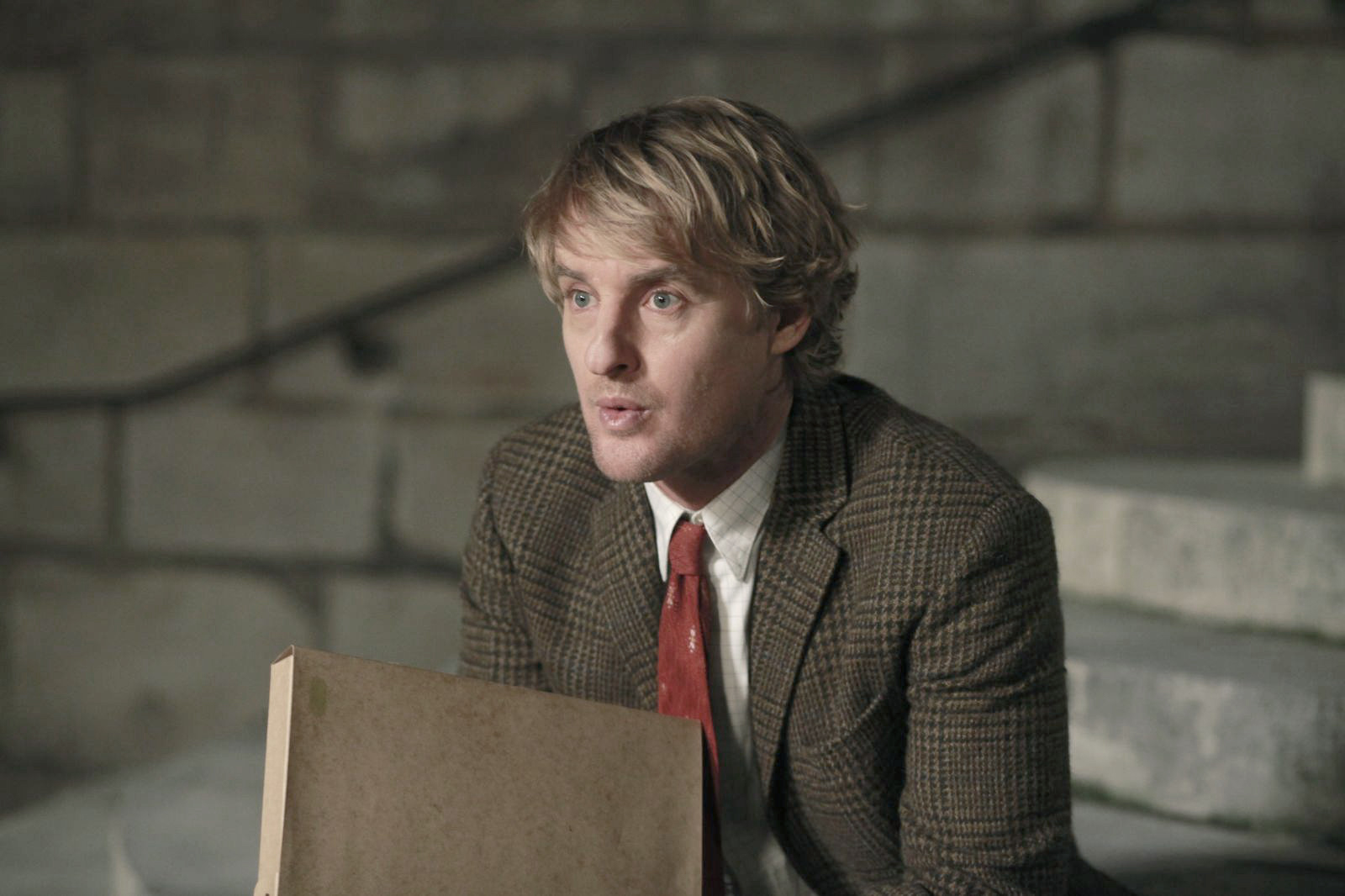
Owen Wilson, the de facto "Woody Allen" in Midnight in Paris. For those who don't care for these characters, Purple Rose  is blessedly absent of them and their predictable neuroses.

Another feature that often shows up in Allen’s movies is the intellectual vibe, which is something that the Purple Rose of Cairo mostly lacks. This is a good thing. Often, Allen’s movies feature jokes that require a viewer’s knowledge of literary or cinematic history. This is easily seen in his most recent film, Midnight in Paris, in which most of the gags are lost if you don’t have some background knowledge of Ernest Hemingway, F. Scott Fitzgerald, and the like. While I personally enjoyed the jokes in that film, I find them somewhat exclusionary at times. The Purple Rose of Cairo is a movie that requires no such prior knowledge on the part of the viewer. It is self-contained, and thus can be enjoyed by nearly anyone.

Purple Rose does, however, bear certain other hallmarks of Woody Allen storytelling. The entire concept of a movie character literally coming to life shows some of the zaniness that you get in some of his other films, again most notable in Midnight in Paris, in which the protagonist is able to cavort with various literary figures from the past. Similarly, The Purple Rose of Cairo is a flight of fancy that sets up some really humorous and thought-provoking interactions and conversations.

This brings up what, to me, is the strength of the film, though one that doesn’t quite go far enough – the study of we viewers’ relationships to films and the film industry. All of us who watch fictional movies are, to some degree, escapists. We seek to escape into some other world and dwell there as passive observers for a time. The character Cecilia is far more dedicated (one could say “addicted”) than most, and with good reason, given that her reality is so miserable. For her, films are the one place where things make sense and are pleasurable. However, this far from tells the whole tale.

The hopelessly transfixed Cecilia, whose attraction to film goes beyond affection and well into the realm of dependency. There are probably far more Cecilias out there than we care to acknowledge these days.

Once Tom jumps off of the screen and Gil becomes involved, the tale begins to approach a criticism of movie magic and the film industry in general. One can start to see Cecilia as a dupe who has been lured by the carefully crafted, artificial glitz and glamour of Hollywood. Not just the films themselves, but also the entire culture surrounding movie stars. This is typified by the Gil Shepherd character. While it becomes clear early on that Gil is totally self-obsessed with becoming a film star, we and Cecilia are led down a romantic path of “true love”, only to be left high and dry at the end. I can’t help but see Cecilia as being the eternal mark for various con artists – her deadbeat husband, the fantasy world of popular movies, and the movie business itself. All of these elements in her life, exemplified in the film by Monk, The Purple Rose of Cairo, and Gil Shepherd, extort her for everything she has. While I felt that Woody Allen was making these criticisms, I think he eased up just a tad, so as not to make the film overly depressing or to rob it of its oft-comic tone.

It is this “going half way” feeling that I have that prevents me from considering this movie an absolute great. There were a few too many topics that were either half-baked or incompletely explored. For instance, the Tom Baxter character often explains his actions as “being written into his character”, as if they were set in stone and unchangeable, such as his duty to defend Cecilia by getting into a fist fight with Monk. Yet, there are certain moments when he makes realizations about the “real” world and starts to adapt, such as when he insists on running out on an expensive dinner check. These conflicts of innate character could have been delved into a bit more and given an even-more thorough treatment. If we’re going to start mashing up fiction and reality, let’s see what the ramifications will be, especially on people like Tom and Cecilia.

On the technical side, The Purple Rose of Cairo is all but flawless. It’s a great film to look at, hear, and just take in, especially for film lovers. Woody Allen’s affection for cinema is very clear, despite an implied condemnation of its overall effect on certain people. The film paints an evocative portrait of the Depression in the U.S., even though it only covers a handful of geographic areas. Anyone who enjoys 1930s styles and attitudes would certainly love the aesthetic of The Purple Rose of Cairo.

It's not hard to bask in the look and feel of many of the scenes in the film. Especially in the movie theater, the Art Deco style does a great job of transporting us back to a time when very few of us were alive.

For a fairly light-hearted movie like this, I often ask myself “Would I watch it again?” My answer is “Yes,” which speaks to its staying power. However, I wouldn’t go quite so far as calling it a “great” film. I don’t know that it broke any barriers or showed any particular mastery of the medium. I find it to be a clever, imaginative, and well-told story, but not one that I feel compelled to return to again and again.

Take 2: Why Film Geeks Love this Movie (Done after some further research.)

Since The Purple Rose of Cairo is not some epic, laborious task of a film, there’s not a ton of insight to be found in researching it. This is not a film with the combative release history of Brazil, or a film that was the target of hardcore blacklisting like Citizen Kane. Thus, analysis and criticism of it is somewhat limited and narrow. Also, none of it adds much that one can’t see upon viewing the movie for oneself. There are a few interesting thoughts, though:

One is the point that the movie ends on such a down note. This is something that may very well take a first-time viewer aback, given the otherwise playful tone of the rest of the film. In fact, the distributor Orion Studios wanted Allen to change it (here we go again, with the U.S. film industry wanting the “happy ending” to beef up the bottom line). Like other filmmakers with integrity before him, Allen absolutely refused. This truly did make for a much more poignant and thoughtful film. Had Cecilia been able to fulfill her dream of escaping her sad life with either Gil or Tom, the deepest and most meaningful points of the movie would have been lost.

On these deeper points, uber-critic Roger Ebert did a nice job of summing it up in his original review. Ebert does a good job of explaining its understated strengths, and signs off on his critique with the great sentence, “The more you think about "The Purple Rose of Cairo", and about the movies, and about why you go to the movies, the deeper the damned thing gets.”

I can’t say it better myself.

That’s a wrap. 83 shows down. 22 to go.*

Coming Soon: The Fly (1986)


 This movie scared the absolute hell out of me when I was 11 years old. All the same, I watched it no less than half a dozen times. Why would I do that to myself? Maybe I’ll figure it out when I watch it again.

Please be sure to pick up all empties on the way out.

*It has come to my attention that a mere few weeks ago, the main film critic at TIME magazine, Roger Corliss, has thrown a curve ball. Corliss helped compose the original “100 Great Movies” List that I have been using for this blog, but he has just added 20 films to the list, ranging the entire chronological spectrum from 1923 to 2011. I may try to add what I can, but here are his additions, if you’re curious.

Thursday, May 31, 2012

Film # 82: Brazil (1985)

Director: Terry Gilliam

Initial Release Country: United States

Times Previously Seen: twice; last time about 10 years ago.

Teaser Summary (No spoilers)

Lonely bureaucrat in an Orwellian alternate reality seeks to escape his society’s trappings to find romantic love.

Extended Summary (More detailed synopsis, including spoilers. Fair warning.)

In an unspecified time, in an unspecified European country, Sam Lowry (Jonathan Price) is a mid-level bureaucrat working for the massive government machine. He works in a dismal factory environment crammed with pipes, papers, and employees who spend plenty of time shuffling around both themselves and various order forms. Amid all of this, Lowry has daydreams of flying among the clouds as an angel, seeking out a beautiful, unnamed woman who is trapped in gossamer netting.

One day, his office receives notice of an error made by one of the countless departments within the system – a typo has led to the brutal arrest, retrieval, torture, and death of an innocent man, Harry Buttle. Buttle has been mistaken for Harry Tuttle (Robert De Niro), a known “renegade and terrorist” engineer who runs around the city, illegally fixing people’s electrical problems without the proper paperwork. Lowry recognizes the mistake and volunteers to bring a pittance check to the bereaved widow.

 Sam assists his lazy boss in sorting out the "error" that led to Buttle's death. This kick-starts Sam's quest for his dream girl, Jill.

At the Buttle widow’s apartment, Sam comes in contact with Jill Layton (Kim Greist), the Buttles’ upstairs neighbor, who also happens to be the very vision of the woman in his dreams. Since Buttle’s erroneous arrest and death, Jill has been working her way through the endless government channels to find who is responsible for her neighbor’s wrongful death. Her tireless pursuit of justice through these channels has also earned her status as a fellow terrorist aid to the renegade Tuttle. Sam tries to pursue her, but Jill offers no information and flees, fearing anyone from the government.

Back at his apartment, Sam runs into the real Harry Tuttle, who barges in so that he can fix Sam’s broken air conditioner. While efficiently fixing the problem, Tuttle explains that he was a government engineer, but left because the amount of paperwork. Before Tuttle leaves, Sam also helps him deal with a pair of government workers who show up (many hours late) to fix his air conditioner.

Now obsessed with finding Jill, Sam decides to take a previously-offered promotion into the Ministry of Information Retrieval, the department in charge of all information gathering. Sam had refused the offer, which was the result of the machinations of his image-obsessed and vain mother, due to his contentment with his low-level, low-stress job. Now, he accepts and becomes an Information Retrieval officer.

After obtaining some general information about Jill, he comes across her in the office building as she continues to seek justice for Buttle’s death. Sam finally reaches her. Jill at first tries to shake Sam away from her, but he eventually convinces her that he is, indeed, deeply infatuated with her. With government officers on her trail, Jill goes with Sam into hiding. Sam sneaks back to the Ministry of Information Retrieval and falsifies the records so that Jill shows up as “deceased”. He returns to her and the two share a romantic evening together.

 Though unglamorous and unassuming in real life, Jill is the object of Sam's self-destructive pursuit of love.

The next morning, the state police barge in and take Sam away. He is run through the draconian, yet clinically anaesthetized legal process, and ends up in a torture room. Just as he is about to be tortured (by his old “friend”, Jack Lint (Michael Palin) from his previous job), his torturer is shot through the head by Harry Tuttle and a gang of terrorist raiders. The raiders pull Sam out of the building, and he flees with Tuttle.

The world around Sam starts to become more fantastic and dreamlike during his escape. He and Tuttle run into a shopping center, where Tuttle inexplicably becomes shrouded by massive amount of flying papers. When Sam tries to pull the papers off, Tuttle seems to have vanished altogether. Sam runs into what appears to be a church, in which a funeral is taking place. The deceased is announced as one of Sam’s mother’s frenemies – a fellow plastic surgery addict who had been growing ever-more deformed through botched procedures. Next to the coffin is Sam’s mother, now transformed into a woman who appears to be in her mid-20s, and who looks exactly like Jill. She is being fawned over by eager young men, and she brushes Sam away from her.

Retreating outside, Sam is once again in a world even bleaker than anything we’ve yet seen – the buildings are cold, rigid, flat, gray structures that tower over him. A gang of policemen pick up their pursuit of him again, chasing him into a massive wall of the flex-piping that is ubiquitous in Sam’s life. After frantically digging through the pipes, Sam finds himself in a trailer being driven by Jill. Once again united with his lost love, the two drive off in seeming bliss.

However, this perfect happy ending abruptly ends when we see Sam back in the torture chair deep within the Ministry of Information Retrieval. In fact, the entire escape from the torture room was a pure fantasy brought on by the torture. Sam, now thoroughly insane, has sought refuge in his unrealistic and childish fantasies of escape from the system that has now effectively destroyed him.

Sam's destiny ends here - in the torturer's chair, completely insane and disconnected from his warped reality.

 Take 1: My Gut Reaction (Done after this most recent viewing, before any further research.)

A very brief history: I love Terry Gilliam. I’m not a blind worshipper, by any means, and there are a few of his films that have fallen flat for me (The Fisher King and Tideland, specifically). Most of his work, though, I find wonderful, in the truest sense of the word. From the moment I watched Time Bandits as an 8–year old child, I was hooked. With this movie, and others like The Adventures of Baron Munchausen, I got a great combination of childlike wonder, fun adventure, and humor that magnificently ran from silly to wry.

With Brazil, it was only upon this recent viewing that I can say that I now fully appreciate it. It really is his best film, and it is not difficult to see just why it made the TIME 100 list.

Brazil is not Gilliam’s gravest or most serious work, but it is his most artful and will ultimately be his most lasting. By drawing from the more timeless themes of the human condition, namely individuality versus conformity, he sets this work above all of his others and makes a visually arresting statement about human psychology in the post-Industrial Age. It was something that writers and observers had been doing for decades prior to Brazil, but Gilliam was the first to express it so stunningly in cinema.

It’s not hard to see in the protagonist, Sam Lowry, the essence of George Orwell’s Winston Smith in the seminal novel 1984. Lowry, like Smith, is part of a totalitarian system in which a sprawling and invasive government has molded its citizens into a populace that has sacrificed its creativity and freedom for the “security” of bland superficiality. The various “Ministries” in Brazil are virtual parallel to those in 1984. The contribution that Gilliam made in his film is that we can now see the results in the form of revolting starkness. Between the towering grey buildings and the endless miles of piping in Brazil, a viewer feels totally crushed and hemmed in on all sides. As a viewer, I found myself yearning for the more colorful, fantastic dreams that Lowry would drift into, childish and unrealistic as they might be.

 Sam's dream self. These play out like the fantasies of a 13-year-old boy, which is what Sam is, emotionally.

It is this childishness of Lowry that was my grand revelation upon this most recent viewing. When watching this film times past, I never quite realized that Lowry is meant to be seen as completely out of touch with his own reality. This is something that, at one point, Jill expresses to him in those exact words. Once Lowry sees Jill for the first time, he becomes possessed of a completely juvenile mania to track her down, in the process destroying his own life and any chance of happiness. I realized that this is not due to a lack of intelligence on Sam’s part, but rather the fact that he has been so repressed by the hulking system around him that he is not capable of handling emotions such as love (or at least, infatuation) as a mature adult. Instead, he charges headlong after Jill and is inevitably crushed in all ways possible.

Someone who hasn’t seen the movie and reads my previous paragraphs would think that Brazil is a humorless slog through dour sociopolitical commentary. Far from it. As with all of his other films, Terry Gilliam gives us plenty of humor to carry us through. Gilliam was an original key member of Monty Python, and it’s not hard to see it in any of his films, including Brazil. No, there are no “Lumberjack” songs or overtly silly antics, but a certain “Python” tone is there. Whether it’s the goofy hats that the government electricians wear or the willful obliviousness of a professional torturer, there are plenty of comedic moments, light and pitch dark, alike. It’s not stuff of gut-busting hilarity; rather, it’s humor calculated for extreme effect. It all conveys just how unaware nearly all of the characters in the film are to their situation.

One of the best examples of this lack of admission is when Lowry tracks down the Ministry’s “Information Retrieval” department on his mission to find Jill. When he reaches the office, he hears the bloodcurdling screams of a “detainee” being tortured in an otherwise stately-looking office. Once the session is finished, Sam walks in to see the back of the torturer (the Jack Lint character played by Monty Python alum Michael Palin), hunched over as he sobs uncontrollably. Once Sam announces his presence, though, Lint turns and composes himself in a split second, utterly refusing to face just how horrific are the acts that he performs on a daily basis. This perpetual denial is arguably the most lasting notion of the entire film.

 Jack Lint, covered in blood from his latest victim, though putting on the eternal "good show" of a smile to others.

And it is scenes such as this one in which Gilliam’s humor is a tremendous asset to the movie. The entire tone of the scene is one of chilling horror, and yet you almost can’t help but chuckle when Sam confronts his former coworker. It is one of dozens of moments that elevate Brazil from straightforward social commentary into more Swiftian satire. It was this entire angle that had eluded me in previous viewings, and which I am very glad to have noticed this time around.

As you may glean, Brazil is not a barrel of laughs. Anyone familiar with Gilliam’s other more popular, much more “Python-esque” movies should not expect a sibling of Time Bandits, Holy Grail, or similar ilk. Rather, Brazil is those movies’ distant, dark cousin. A dark, brooding, and far more intelligent cousin whose somewhat silly gags can mask brutally sardonic observations.

Take 2: Why Film Geeks Love This Movie (Done after some further research.)

The story of Brazil’s creation and execution is rather interesting, but nearly as interesting and highly publicized as its studio release.

When you watch Brazil, you’ll probably be highly amused, if not dazzled, at some of the brilliantly funny lines of dialogue. If so, then you probably won’t be surprised by the fact that one of the co-writers was Tom Stoppard, accomplished writer of witty gems like Rosencrantz & Guildenstern Are Dead. As gifted as Gilliam is, he needed some help adding narrative cohesion and sharper dialogue to his tale, and Stoppard obliged.

Reading about Gilliam’s filmmaking reveals a few things. Often, his crew has nightmares about the scenes that he writes, due to their highly fantastic nature. One can easily say (as Gilliam himself probably would) that his artistic visions usually push or pass the boundaries of practicality, in terms of actual production. This is something that links to one of Gilliam’s favorite filmmakers – Federico Fellini. In Fellini’s 8 ½, the very subject is a talented director’s disconnection from reality and how this plays out in both his life and his films. While I can’t speak to Gilliam’s personal life, it is a problem that has almost always been a characteristic of his movies, which often get squeezed or completely crushed by financial backers who will not fund the grand designs of Gilliam’s dreams. When they do happen, though, the results are often magical.

 Executing shots like this has always been a nightmare for crews who work on Gilliam's films, but the end results are often stunning and impressive.

An interesting side note about Gilliam, based on past interviews – he has a real chip on his shoulder about certain directors, namely Steven Spielberg and George Lucas. He has considered them as panderers to the masses, and overly commercial. In addition, he sees Lucas as particularly personifying the uglification of movies through overuse of CGI. I have to agree, as my own sentiments echo Gilliam’s, regarding the StarWars prequel trilogy.

The eventual release of Brazil is probably the most interesting tale behind the finished product. To make a long story short, the studio executives did not see Brazil as “commercially viable”, being too long, too dark, and too quirky for a wider audience to enjoy. Gilliam, who had contractual final cut on the movie, staged something of a guerrilla war against one particular executive who stalled the film’s release and who pushed for a much-altered version of the film. A quick look at the two versions is very telling.

Gilliam’s version (as described above) is obviously very dark, making the point that the society portrayed in Brazil is so bleak and entrenched that a lone, unrealistic dreamer never stands a chance. It’s a bold and interesting, if not exactly uplifting, statement. The studio, and one man in particular named Sid Sheinberg, had the fantasy sequences almost completely eliminated, pared the film by over 40 minutes, and gave the film a happy ending with Sam and Jill living on a “happy valley” farm outside of the totalitarian city in which they had lived. This is interesting since it is almost exactly what was encountered by Ridley Scott’s Blade Runner several years prior.

 One of the final shots of the legitimate Gilliam ending. The serene landscape in the background contains the "happy ending" that Sheinberg wanted to release. If he had had his way, Brazil would not only have been forgettable, but also probably a plain old, bad movie.

Gilliam flipped. He refused to put his name on any such film, as it so distorted the story that he was telling. What followed was a drawn out back-and-forth between studio, Gilliam, and a gaggle of lawyers. In the end, Gilliam’s version of Brazil was released, much to the delight of certain parties who were fighting for its artistic integrity.

The critical reaction was actually rather mixed upon its release in late 1985. Some hailed it as a masterpiece work, and it won several regional awards. Other groups of critics all but ignored the movie, or gave it lukewarm reviews. Commercially, it managed to just break even.

In the 17 years since its release, Brazil’s stature has grown impressively. While no one is going to call it the greatest movie of all time, it is widely considered exceptional, and is easily one of the most singular and interesting films of the 1980s. It also served as a clear inspiration for later films, such as the Coen brothers’ The Hudsucker Proxy and others. The “retro-future” designs of the costumes and sets, which blend older Victorian-era styles with hyper-Industrialized and futuristic elements, has also been seen as an inspiration for the “steam-punk” sub-culture.

Gilliam himself looks back at Brazil with overall fondness. Despite the insane headaches that its final release caused, and the fact that he shot himself in the foot, in terms of Hollywood, he still sees it as a success for “the little guy”. Ultimately, it was an off-kilter movie that was made and shown as he intended. It’s not hard to see the parallels between his fight for his movie and his character Sam Lowry’s pursuit of his own dream. The difference is that Gilliam got the satisfying ending that he denied Sam.

That’s a wrap. 82 shows down, 23 to go.

Coming Soon: The Purple Rose of Cairo (1985)


Woody Allen makes the list. The neurotic little New Yorker is hit or miss with me. The one and only time I watched this movie, it was a miss. I’ll try again very shortly. Come on back to see if I change my mind with this little historical flight of fancy.

Please be sure to pick up all empties on the way out.

Saturday, May 5, 2012

Film # 81: Blade Runner (1982)


Director: Ridley Scott

Initial Release Country: United States

Times Previously Seen: twice (last time about 12 years ago)

Teaser Summary (No spoilers)

In the future, a bounty hunter of androids has his hands full with a gaggle of hyper-advanced targets. Trudges through rain, gets beat up a lot.

Extended Summary (More detailed plot synopsis, spoilers included)

*Note: This summary and the “Take 1” Review are based on the original, theatrical cut released in the United States in 1982. There have been several other versions of the movie, which will be discussed in “Take 2”.

**Note #2: Summarizing a complex sci-fi tale is no short task. If you’re not interested in all of the ins and outs, jump down to my “Take 1” for my basic opinion of the movie.

In a slightly alternate Earth in the year 2019, space travel has become a reality. To facilitate space travel, exploration, and colonization, androids have been developed to the point so as to be nearly indistinguishable from humans. However, a handful of extremely advanced androids have attempted to escape their labors, even sometimes killing their human controllers. Thus, they have been banned from Earth.

On Earth, at the massive Tyrell Corporation, an interview is taking place. Tyrell is the premier manufacturer of androids used in space, but they fear that they may be infiltrated by a small group of rogue androids who have killed their human owners and returned to Earth. An employee named Leon is called in for the interview with a man named Holden. Holden is what is known as a “blade runner”, a bounty hunter who tracks down and kills rogue androids. He prepares some instruments and begins to interview Leon, using analysis equipment and a series of pointed questions to elicit an emotional response, together known as the “Voight-Kampf Test”, to determine whether Leon is human or android. After a few bizarre and evasive answers that all but prove Leon to be an android, Leon pulls a gun, shoots Holden, and flees the building.

On the dark and rainy streets of Los Angeles, Rick Deckard (Harrison Ford) sits and enjoys a meal at a Japanese lunch truck. Amidst the lights, crowd, and hustle of the hyper-industrialized city, he is approached by a strangely-dressed man speaking odd street slang. The man, Gaff (Edward James Olmos), is a cop under the supervision of officer Bryant, who demands to see Deckard. Deckard is a retired blade runner who reluctantly goes to Bryant. There, he learns about Holden’s shooting at the hands of Leon, who is part of a sextet of highly dangerous androids who are in Los Angeles for unknown reasons. All six are of the “Nexus-6” model type, the most modern and advanced android produced (by the Tyrell Corporation). The Nexus-6es blend in nearly perfectly with humans, and they are faster, stronger, and impervious to physical pain.

Roy Batty, the deadliest and most eerily developed of the escaped androids that Deckard must hunt down.

Of the six escaped Nexus-6es in question, two have already been killed trying to break into Tyrell Corporation. Leon is another. The other three consist of Zhora (Joanna Cassidy), Pris (Daryl Hannah), and Roy Batty (Rutger Hauer). Roy Batty is the leader of the androids, a strangely charismatic soldier. On top of their basic functions, Bryant also informs Deckard that the Nexus-6es may have begun developing emotions, something unheard of in any past android models. This also makes detecting Nexus-6es far more difficult. Because of this, the Nexus-6 designers built a four-year lifespan into the model. Now knowing the danger, Deckard is all but forced to take the assignment of hunting and “retiring” (the word used instead of “killing”) the rogue androids.

Deckard first goes to the Tyrell Corporation headquarters, where he meets the founder himself, Tyrell, and his personal assistant, a beautiful young woman named Rachel (Sean Young). Deckard wishes to use the Voight-Kampf test on a few Nexus-6es in order to prepare for the quartet that he will track down. Tyrell, after asking some questions about the test, demands that Deckard test it on a human first, to prove that it will not give a false result. He nominates Rachel, and Deckard agrees. It takes many more questions than normal, but Deckard comes to the correct conclusion that Rachel is, in fact, an android of the Nexus-6 variety. Tyrell proudly explains that the Nexus-6 design has the added feature of implanted memories, which make detection significantly more difficult than previous models.

Deckard first goes to Leon’s house, where he finds a set of family photographs – further proof of the implanted memories that Tyrell had explained – as well as an odd animal scale in the bathtub. Outside, Leon himself meets with his fellow android Roy, explaining that a cop (Deckard) is there, so they can’t retrieve the photos. Roy leads Leon to a strange lab, where an old scientist named Chu works on genetically engineering and growing eyes for androids. Roy and Leon terrorize Chu and ask him questions about inception dates and their four-year lifespan. Chu claims to know only about eyes, but explains that Tyrell himself would have the information. Tyrell being exceptionally difficult to reach, Chu is further pressured into giving the name of J.F. Sebastian. Sebastian is a top-level android designer who would stand a better chance of reaching Tyrell.

After leaving Leon’s apartment, Deckard returns home to find Rachel waiting for him. Rachel, it seems, was unable to talk with Tyrell after their earlier meeting. She seems confused about her own identity, and Deckard does little to help. He coldly explains and proves to her that her childhood memories are false, implanted by Tyrell based on his own niece’s real memories. Obviously hurt, Rachel quickly leaves. After a rest, Deckard returns to his hunt. In analyzing a few of Leon’s photos, he notices a woman with a prominent tattoo of a snake on her neck. This woman is Zhora, another of the four androids.

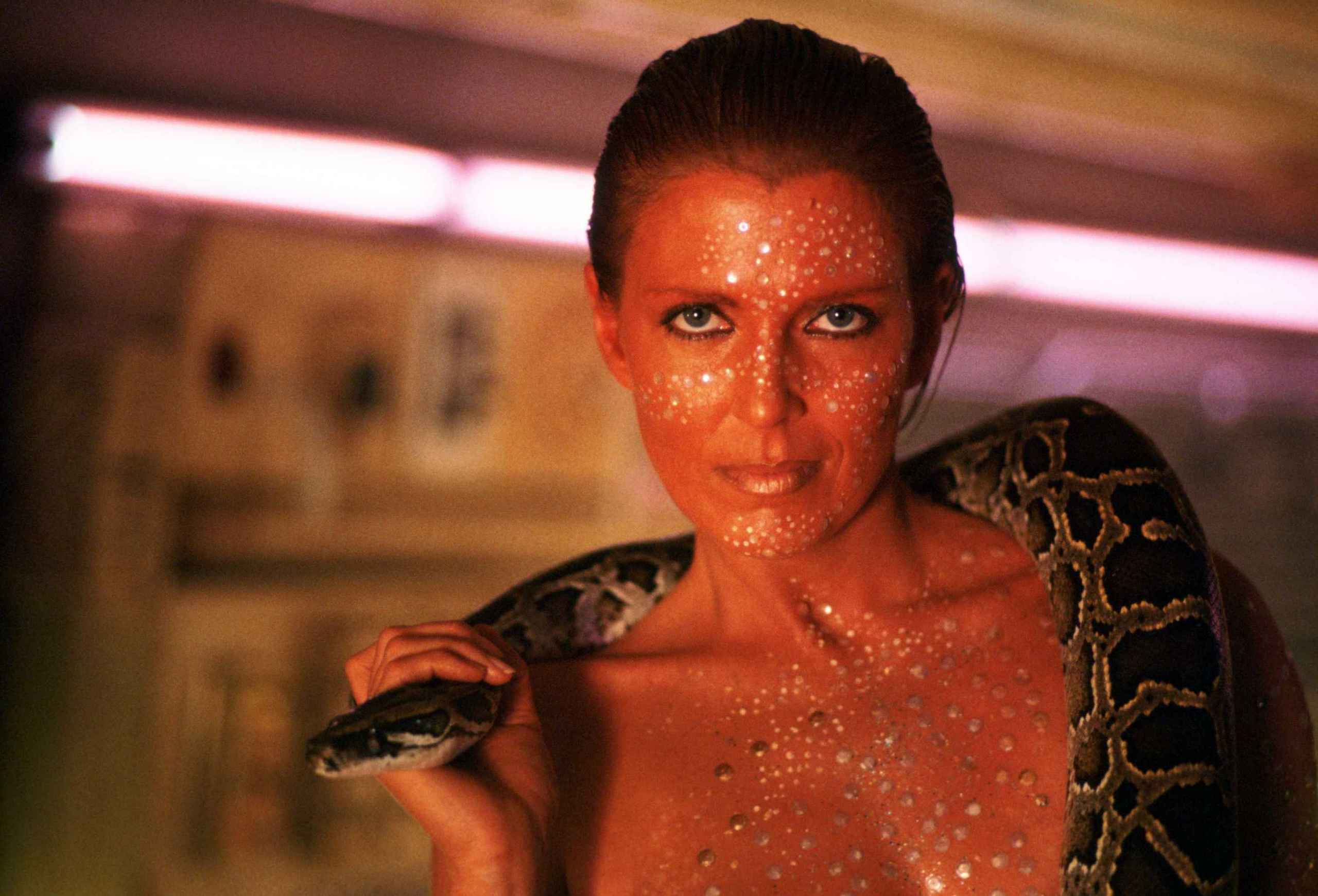
The beautiful yet deadly Zhora, the android which, for some reason, finds a job as an exotic dancer. She is the first escaped android that Deckard confronts.

In a beaten down part of L.A., the android Pris walks the streets before lying down underneath some newspapers on the ground. She is soon awoken by J.F Sebastian, seemingly on accident, as Sebastian rummages through the trash. Appearing frightened at first, Pris is soon soothed by Sebastian’s gentle nature and invitation to return to his home for a warm meal. Pris goes with him and discovers Sebastian’s genetic engineering workshop, filled with all sorts of android toys and human replicants.

Back on the streets, Deckard tracks Zhora via the scale that he had found (it turns out to be artificially manufactured snake scale) to an exotic nightclub where she works as a dancer. After a drink, Deckard attempts to call and apologize to Rachel, but she hangs up on him. Deckard approaches Zhora in her room, assuming the identity of a government official. Zhora quickly senses something amiss and attacks Deckard. After a struggle that spills out onto the streets, Deckard shoots Zhora dead, “retiring” her for good.

Bryant arrives on the scene, congratulates Deckard, but also informs him that he must now add Rachel to his list of androids to be retired. Rachel, it seems, has disappeared from Tyrell altogether. After Bryant leaves, Deckard sees Rachel across the street. Before he can approach her, though, Leon ambushes him. Just as Leon is about to kill Deckard, Rachel shoots Leon, retiring one of her own kind. Deckard recovers and returns to his apartment with Rachel.

At Deckard’s apartment, the two decompress from their experiences. Deckard has now softened on his view of Rachel, and he behaves much more sympathetically towards her. To the point, in fact, that he admits that he will not retire her, even though it is his job. Even more, Deckard makes physical advances on Rachel. She rebuffs him at first, but gives over and the two have sex.

Back at Sebastian’s home/workshop, Pris awakens and talks with Sebastian. He is a lonely genius who has affection for his creations. Pris has called Roy, who appears and tells Pris about Zhora and Leon’s retirements. Pris and Roy then reveal their nature to Sebastian, and they persuade/strong-arm him into helping them get to Tyrell himself. They wish to find a solution to their four-year lifespans, and Sebastian is a close enough colleague of Tyrell to get close to him.

Roy at Sebastian's apartment/workshop. He works his strategy for reaching Tyrell to demand an extension to his very short life.

At Tyrell’s impressive mansion, Sebastian gains entry, with Roy accompanying him. Tyrell, at first surprised by Roy’s presence, is forced to engage him in conversation about nullifying his short lifespan. After some scientific tête-à-tête, Roy kisses Tyrell and then kills him by crushing his skull. He then kills Sebastian, who has been paralyzed by fear.

Deckard has now left his apartment and is on the androids’ trail. Once informed of Tyrell and Sebastian’s deaths, he goes to Sebastian’s apartment. Once there, he is attacked by Pris. After a brief struggle, he shoots and kills her. Roy then appears, making for a much tougher fight. Not only is Roy built specifically for battle, with enhanced strength and speed, but his behavior has become erratic. He strips down to his underwear and pursues Deckard, toying with him rather than simply killing him.

Roy’s pursuit of Deckard leads them onto the ledge of the building, several stories above the ground. Deckard struggles to escape, and Roy seems to be showing signs of imminent shut-down, the end result of his short lifespan. Roy continues to chase Deckard across a rooftop, with Deckard at one point hanging from a ledge, precariously close to falling off and dying. Rather than let him drop, Roy inexplicably pulls him up and sets him on the roof. Roy, no longer trying to kill Deckard, explains a few of the wonders that he has seen traveling in outer space. He finally expresses great sadness about how, upon his death, all of these amazing memories will die with him. With Deckard looking on, Roy slowly shuts down, now “dead”.

Shortly after, Gaff meets Deckard at the scene. Deckard explains that he is, once and for all, finished hunting androids. As Deckard walks away, Gaff yells, “It’s too bad she won’t live. But then again, who does?”, clearly referring to Rachel.

Deckard and Rachel reunite in the end and ride off into the sunset.

Deckard returns to his apartment, where Rachel remains and is still alive. The two leave together. Some time shortly after, we see the pair flying in Deckard’s hover car through a beautiful forest landscape. In a voice over, Deckard explains that he has learned from the Tyrell Corporation that Rachel, unlike her Nexus-6 brethren, does not have the built-in four-year lifespan. Her lifespan is as unknown as any human.

Whew! Tough to concisely summarize a science-fiction movie of this sort.

Take 1: My Gut Reaction (Done after this most recent viewing, before any further research).

I’ll be very curious to watch the director’s cut in a few days. The original theatrical release of Blade Runner that I watched shows itself to be a sometimes brilliant, sometimes awkward piece of cinema. Mostly, though, it’s brilliant.

What’s awkward? First of all, the attempt to make this a classic-style noir film. While some of the noir elements – the detective, the crime, the chase, the dark tone – are welcome and well-done, others feel clunky and out of place. Primarily, the narration is a detriment. While voice-over narration is a standard of noir films, it only seems to fit true, classic noir. Double Indemnity, Out of the Past, and their ilk benefit from the stoic narration of their doomed protagonists. In Blade Runner, the narration by Rick Deckard is invasive and seems rather forced and out of place in such a futuristic setting.

Another, lesser, complaint is about the music. The group Vangelis created a moody, atmospheric soundtrack which, at times, works incredibly well. It may have been the way it was mixed or pumped out on my speakers, but there were times when the music seemed out of place. During moments when silence would have allowed more tension to build, the music score was thrumming along. I found it distracting.

There are also a few plot points that are not completely fleshed out. Most are minor, but the primary one to me is exactly why Deckard develops an affection for Rachel. I suppose that perhaps this is meant to be vague, allowing us viewers to come to our own conclusions. Still, it seems odd when Deckard begins making sexual advances on an android when we have no solid basis for why he would feel this way.

By missing just enough emotional context, this seduction scene can come off as a bit uncomfortable for viewers. It did me, anyway.

Aside from these elements, it’s easy to see why this movie is considered a classic. Ridley Scott’s vision for the setting is incredible. The Los Angeles that he created for the screen has been imitated so many times that it’s hard to comprehend it. Virtually every science fiction movie that takes place in a large city has copied Scott’s style for the “worn down metropolis”, in which technical wonders threaten to bury still-extant, eroding architectural styles of the past. The mish-mash of street-level international cultures, ubiquitous neon advertising, and familiar human character archetypes is blended amazingly well. The effect is so powerful that it has carried over (and will continue to) into endless films.

But there have been more than a few films that have shown great visual style. What sets Blade Runner above nearly all others are the high-minded speculative fiction themes. We can credit the source material author, Philip K. Dick, for this. I will explore this further down the post, but Dick was an incredible science fiction mind. While Blade Runner takes great liberties with Dick’s source novel, Do Androids Dream of Electric Sheep?, a fair bit of the meat is still there.

The point of interest is the question about artificial intelligence and what happens if it becomes so advanced that it begins to mimic human emotions. How do we proceed? Blade Runner takes this question and uses it to tease you through what, on the surface, seems to be a basic tale of cops-and-killers. By the end, though, you’re left to wonder if the androids’ motivation is any different than any human being – the urge to live. Not only that, but also the sense of tragedy that comes from death and its robbery of our experiences. Considering just how quickly our technology is developing, these questions may not be as far fetched as they first seem. If a machine can develop and express what we call “emotions”, does it cease to be a machine? This movie can make an amateur philosopher out of many of us.

While it is clearly the visuals and themes that make the movie, I would be seriously remiss if I didn’t mention the cast. The acting is certainly not the most important element of a movie like this, but the key players all do fine work. Harrison Ford as Deckard is spot-on, though the script can be a bit inconsistent at times. The lesser roles played by Sean Young, Edward James Olmos, and others are also solid. Of course, Rutger Hauer is the reason to watch. His bizarre facial contortions may seem odd at first, until you realize that he is experiencing a bevy of raw emotions condensed into his short life. Watching him work through Roy Batty’s cool rage and desperation, and then his final resignation is hypnotic.

Despite how terrifying he is throughout the movie, Hauer's final death monologue is downright heartbreaking. With a few poignant lines, you actually feel sorry for the loss of him.

Next, I’ll be watching the “Final Cut” version of the film, which has some drastic alterations:

Take 2: “The Final Cut” Version

Between my writing “Take 1” and now, I have watched the “Final Cut” version of Blade Runner. This was the version that Ridley Scott wished to be shown, but was not due to studio interference (again).

If you’re going to watch Blade Runner, be sure that it’s the “Final Cut” version. It is easily superior to the theatrical version. If you’re not paying attention, you may not notice the changes. If you do notice them, you’ll never be able to watch the original again.

The first change is that Rick Deckard’s narration is gone. Perfect! This is one of my gripes about the theatrical version. As many other viewers and I agree, the voice-over is wholly unnecessary, and without it, we can be drawn into the setting and the minds of the characters more easily.

Another change was that Ridley Scott remixed the sounds a bit. I can’t be sure, but it seemed that the music score by Vangelis was less intrusive. This was another of my mild complaints about the theatrical version.

One of the two biggest changes is the famous “unicorn scene”. A little theme in all versions of the movie is the character Gaff’s habit of making origami animals and leaving them around Deckard. When Deckard is first about to refuse the hunting job, Gaff makes a chicken. After Deckard and Gaff leave the meeting with Tyrell and Rachel, he makes a little human man with an erection. At the very end, when Deckard retrieves Rachel from his apartment, he finds an origami unicorn just outside of his door. In the theatrical version, we might just look at these as Gaff busting Deckard’s chops a little bit.

In the Final Director’s Cut, however, we have an extra scene in the middle of the film. As Deckard is drifting into a drunken sleep, he has a half-waking vision of a unicorn running through a forest. This additional scene leads us to wonder just how Gaff might have known about it. The obvious and most intriguing answer is that Deckard is, himself, an android and that Gaff knows what his memories are, much as Deckard knew what Rachel’s embedded memories were. So this one little scene, lasting less than ten seconds, adds another whole layer to the notion of identities and existence in the film. It’s a great addition, and it’s also no mystery as to why Scott wanted to keep it in the film.

The little folded piece of paper that has generated no end of debate and discussion about the protagonist's true nature. The dream sequence added in the Final Cut gives it far greater significance. 

The other major change is the ending. The theatrical version has Deckard and Rachel driving along a verdant, forested road. We get Deckard’s voice-over also telling us that the Tyrell Corporation has informed him that Rachel does not have the built-in hour year lifespan. We can assume that they live happily ever after. In the Final Cut, though, there is no idyllic ending. The movie ends just after Deckard ponders Gaff’s unicorn and then joins Rachel in the elevator. Personally, I love the vagueness and uncertainty of the Final Cut ending much more.

Take 3: Movie versus Book

A bit of a change-up here. Rather than the normal fact-digging that I do for the films on this blog, I read the source novel before I saw the film. If you’re curious about how they compare, here you go:

Firstly, I’ve come to learn that many, many people are unaware of just how many excellent science fiction movies have been based on Philip K. Dick short stories or novels. Total Recall was based on We Can Remember It For You Wholesale. Minority Report, A Scanner Darkly, and The Adjustment Bureau were from stories of the same name. There were also some mediocre-to-poor adaptations of Paycheck and others. The reason for all of these adaptations is that Dick was a brilliant ideas man, and this is clear in the inspiration for Blade Runner – the novel Do Androids Dream of Electric Sheep?

So how similar are the film and the book? Not all that much, really. In the book, the earth is a different place. The people still left on the planet are living in a dusty, perpetually overcast world in the wake of “World War Terminus”. Most humans have fled to colonies on Mars or other planets; those left on Earth are often there only because they have been labeled somehow defective. This is rather different from the thriving, hustling and bustling city that we see in Blade Runner.

Also, in the novel androids are not incredibly strong soldiers. They are simply manufactured as basic labor for off-world colonists, and they are given away as incentive to get more people off of the choking Earth. While the Roy Baty (they changed the spelling in the movie, I guess for ease of pronunciation) and Pris characters are in the book, they do not come off as being nearly as menacing as their portrayals in the film. In fact, the final showdown between the pair and Deckard is quite underwhelming in the book. They meet briefly, they get killed, and the story moves on.

Philip K. Dick (and unknown cat) - an author under-appreciated in his time and whose fertile mind forged dozens of fascinating tales. Part Jules Verne and part William S. Burroughs, his stories fluctuated between surreal and profound with unmatched nimbleness. 

Despite these obvious differences, the key element to the novel is the central theme of the film – empathy. This theme is explored much more deeply and extensively in the book, but it is still the heart of the film as well. In the novel, nearly all of the humans we meet use something called a “mood organ”, which is a device that uses sound waves to alter moods. It’s as if their world is so depressing that pleasure can only come from artificial stimulation.

On top of the mood organ is another device called an Empathy Box. People can grab hold of the handles of a Box and are immediately thrust into a first-person experience with a figure called Mercer. Mercer is a sort of messianic tragic figure who preaches about compassion, empathy, and accepting that life is an endless struggle. Deckard’s wife, Iran, is a complete addict to the Empathy Box, while Deckard has little to do with it until the end of the story.

One other way that empathy is highlighted in the novel actually makes its way into the film, though in a far lesser role. In the novel, one of the most respectable things that a person can do is own a living, biological animal. Since World War Terminus and the ever-present gray dust have killed many of Earth’s species, protecting life has become an expectation and a badge of honor. This is so important, in fact, that Deckard’s main reason for taking the hunting job is so that he can afford a real sheep to replace the android sheep that he and his wife have maintained for years (android animals being made and bought for people who want to keep up appearances). We do see some android animals in Blade Runner, but they are little more than window dressing.

Though the film clearly has to discard many of the great literary elements, for the sake of the demands of the medium, it made sure to utilize Philip K. Dick’s most lasting questions about identity. He used the science-fiction convention of androids, but his real dilemma is how to deal with people who have no empathy. In other words, sociopaths.  Can a person who does not and cannot understand others’ fear and pain truly be considered a human anymore? It’s a frightening and difficult question to ponder, and it’s the one that any thoughtful reader of the book or viewer of the film can come away with. For these reasons, anyone would be well served to do either, or both.

That’s a wrap. 81 shows down. 24 to go.

Coming Soon: Brazil (1985):


 From one semi-gloomy sci-fi future to a no-doubt-about-it, full-blown dystopia. I’m a big fan of Terry Gilliam, and this movie is often considered his strongest work. Come back and see what I think of my latest viewing of his mid-1980s masterpiece.

Please be sure to pick up all empties on the way out. 

Saturday, April 28, 2012

Film # 80: E.T.: The Extra-Terrestrial


Director: Steven Spielberg

Initial Release Country: United States

Times Previously Seen: 5 or 6, probably (Last seen – around 25 years ago).

Teaser Summary (No spoilers)

Young boy meets kindly little stranded alien. They bond by helping each other and getting drunk, among other things.

Extended Summary (Lengthier plot synopsis, including spoilers. Fair warning.)

In a forest just outside a Californian suburb, a spacecraft is on the ground. Its crew, a short and hairless species of extra-terrestrial, is gathering plant samples. When a group of very curious men arrives nearby, the visitors quickly retreat to their ship. One of their members, though, is left behind due to the need to escape detection. His ship departs, but this lone, stranded alien evades capture by scuttling down to the nearby neighborhood.

In one of the homes near the woods, a young boy named Elliot (Henry Thomas) is sent out by his older brother Michael (Robert McNaughton) and his friends to get a pizza. In doing so, Elliot follows a strange noise to the nearby storage shed, where he tosses a softball in. When some unseen thing tosses it back, Elliot dashes inside and tries to convince his family of what he saw, but to no avail. They find nothing, discredit Elliot, and they all go to bed.

The alien, in the woods as he's about to be left behind by his crew.

Later that night, however, Elliot goes back out to the shed, where he stumbles across the alien from the woods. Both are terrified of each other, and the alien scampers back to the forest. The next day, Elliot’s friends and family still dismissing his tales of the creature, he bikes to the woods and scatters candy about in an attempt to lure the creature out. The plan does not initially seem to work. However, late that night, with Elliot sleeping in a chair outside their shed, the alien slowly emerges. Elliot wakes and the two quietly size each other up. Eventually, the alien leaves a handful of the candy that Elliot had left for him.

Elliot uses more of the candy to lure the alien up to his room. Once Elliot sees the creature in full, he sees that it is a short (shorter even than him), brown, almost reptilian creature with large eyes. The creature seems totally peaceful and willing to follow Elliot around.

The next day, Elliot fakes being sick to stay home. He shows the creature around the house and tries to explain as much as he can about the objects around them. That afternoon, Elliot shows the creature to his older brother and their younger sister, Gertie (Drew Barrymore). After the initial shock, the siblings accept the creature as a docile curiosity and swear not to tell anyone.

Later that night, while the children attempt to explain where they are on a globe, the creature levitates several balls of play-doh and communicates through this and gestures that his home is in the distant stars. Elliot and his siblings now understand that the creature is, in fact, an alien or “E.T.”, for “extra-terrestrial”. On top of this, the E.T. (which becomes Elliot’s de facto name for the creature), instantly revives a dying plant simply by touching it with a glowing finger. Apparently, E.T.’s powers are beyond human comprehension.

Gertie and E.T., holding one of the plants that he empathically brought back to life.

The next day, while Elliot is at school about to dissect frogs with his class, E.T. explores the house. He starts scavenging various electronic devices to assemble a make-shift communicator, intending to contact his home planet and ask for rescue. He also downs several beers, becoming drunk in the process. Amazingly, Elliot starts to show the same effects of intoxication in his class. Clearly, some kind of mental and physical bond has emerged between the human boy and the alien he is fostering.

Upon returning home, Elliot finds that Gertie has taught E.T. to talk in a rudimentary form of English. E.T. explains his plan to contact his home world with his cobbled transmitter, and Elliot is eager to help. This is growing ever more important, as both E.T. and Elliot start showing signs of illness. Unbeknownst to any of them, though, is that there are shadowy government agents searching the neighborhood, and they have just pinpointed the alien that they are searching for.

The following day is Halloween. Amid the revelry, Elliot takes E.T. to the forest, where the alien sets up his communicator and sends his S.O.S. into the stars. In the night, however, E.T. and Elliot get separated. Elliot wakes in the forest, but E.T. is nowhere in sight. Later that day, Michael goes back to the woods and finds E.T., face down near a storm drain, pale and barely alive. Michael brings the shallowly-breathing alien back home, where Elliot is also showing the effects of severe illness. Not knowing what else to do, Michael reveals E.T. to their mother. In shock, she grabs the weakened Elliot and tries to run out of the house, only to be met by an entire squad of government scientists and soldiers.

The government scientists quarantine the entire house and begin to study E.T. and Elliot, attempting to save both of them. One of the men who was first looking for the aliens in the forest arrives and explains that they want to help. Eventually, despite their efforts, the bond between E.T. and Elliot dissipates, and E.T.’s health declines further. All of his vital signs stop, and he is declared dead.

Before the scientists take E.T. away, the lead scientist allows Elliot a private moment to say goodbye to the alien. As he is doing so, Elliot tells the dead E.T. that he loves him. Immediately after, E.T. regains consciousness and explains to Elliot that his fellow crew members are returning to rescue him. Quickly pulling a ruse, Elliot and Michael manage to get E.T. out of the house and into an ambulance, escaping the government agents.

After being revived, E.T. assists in his own escape, about to levitate his rescuers into the air.

Several of Michael’s friends quickly catch up to the fleeing trio, and they manage to further evade the government agents. The ultimate moment is when E.T. levitates all five of his rescuers and their bicycles high into the air and into the forest. When night falls, E.T.’s ship returns to the spot where they first had to leave him. E.T. is now rescued.

Upon their farewells, E.T. finally points to Elliot’s heart and tells him that “I’ll be right here.” E.T. then boards his mother ship and the craft returns to the skies.

Take 1: My Gut Reaction (Done upon this recent viewing, before any further research.)

This one has lost quite a bit of luster, in my eyes. This is probably for a few reasons.

First, let me lay out the things that I still like about E.T. For a PG-rated family flick, there is still a great amount of wonder to be found in the movie. Since there are certain things that are never fully explained, mostly about E.T.’s race and powers, the viewer is left with a very healthy amount of curiosity. Because I hadn’t seen the movie since I was about 10 years old, I noticed things like the fact that E.T.’s crew all seem to be intergalactic botanists. This is an interesting, pacifist portrait to paint of a group of aliens, and one that you wouldn’t expect in a massive-budget Hollywood movie.

More than E.T’s seeming job as an interstellar sample gatherer, though, are his strange powers and abilities. What can the viewers make of the clear psychic bond between E.T. and not only his own species, but with seemingly all living things around him? Despite the fact that they appear to be a stunted and physically handicapped, the species is clearly possessed of abilities far beyond human reach. You can have a field day thinking of the ramifications or imagining just what E.T’s home-world and civilization must be like. The fact that these questions are never answered is probably the most indelible piece of magic in the movie, to me.

E.T's ability to communicate and empathize with other living organisms, signaled by his glowing chest and finger, are left for us to puzzle and wonder over.

The other clear strength is more general and about Spielberg himself. While I often have my gripes about his films (I’ll get to those in a paragraph or two), no one can fault the man’s technical skill as a director. From his earliest movies in the 1970s, Spielberg showed himself able to set up crisp, clean shots that told a story through pictures as much as dialogue. Let’s face it – his films are almost always pleasurable to look at and take in. This is because his framing of shots and choreographing of action is virtually flawless. It may not always be creative or interesting, but he always knows how to use film technique effectively. E.T. is no exception.

So why doesn’t E.T. hold the same spot in my heart that it did 30 years ago, when at six years old I had my parents take me to see it three times in the theater? Well, the easy answer is that I’m not a kid anymore. But this doesn’t tell the whole story. Number one is that in the succeeding three decades, I have grown into a more sophisticated fan of science fiction. Rather than a heart-warming story about a boy and his alien, I now usually go to science fiction novels and movies to find interesting speculations about the very real ramifications of scientific discoveries. E.T. doesn’t offer any of this, giving us something that is more a blend of fantasy and sci-fi, rather than pure sci-fi.

More to the point, as a better-versed fan of science-fiction, E.T. raises a few too many “techy” questions that I can’t let go. How, exactly, does E.T.’s spacecraft even sniff the ground in California without getting blown to bits by the Air Force? Why did E.T.’s species not wear any type of insulator suits to prevent transmission or contraction of diseases, as the title character seemed to? These are the kinds of questions that I couldn’t have even thought of as a kind, but I can now. And when I do, the lack of answers lets the balloon out of my disbelief’s suspension.

Another one of my little bugaboos is related to one of the movie’s strengths – Spielberg’s direction. I praise Spielberg’s direction for being very crisp and clean, but in E.T., this is a mild detriment when it comes to plot, themes, and characterization. By now, it’s easy to figure the Spielberg story blueprint for family films: amazing, supernatural events + sympathetic child(ren) + a mild dash of humorously crass dialogue + sentimentality. Voila! Summer blockbuster!! Sure, E.T. shows much more imagination, heart, and production value than the endless copycats that followed, but it’s all a tad too adorable for me now.

Honestly, who could resist those big ol' baby blues?

Speaking of adorable, E.T. might be the single best example of Spielberg’s mastery at emotional manipulation, and it all comes down to one, simple decision about the way the E.T. looked – his eyes. What better way to ensure that everyone and their brother can empathize with a creature that otherwise looks like some mashed up reptile? Give it massive, blue, human eyes. Hey, it’s worked in Japanese anime and manga for all these decades, so why wouldn’t it work for Steven Spielberg?

One final note of distaste. This is the first film that I’ve done for this blog that features something that has become standard is a lot of commercial movies – product placement. Anyone who was alive when E.T. came out remembers how sales of Reese’s Pieces spiked. This, no doubt, helped push the rock of marketing even further towards the cliff.

This is another film from the “All-TIME” list that does have me wondering why it was included on their list. Sure, it was a massive hit, and it was a different take on the tale of the alien visitor. Is this enough to consider it one of the “all time great” films and rank it with the likes of Citizen Kane, Ikiru, Persona, and the like? My hunch is no, but I’ll do some more research for my “Take 2” (below).

So, as it stands, I don’t see myself watching E.T. again for a long time, if ever. I would certainly watch it with a young child who had never seen it before, and I suppose that a young would really enjoy it, just as I did long ago. But on my own, I wouldn’t waste my time.

Take 2: Why Film Geeks Love This Movie (Done after some further research on film.)

Apparently, I’ve become a bit of a jaded cynic.

In digging into E.T.’s original reception, I have rediscovered the insanely positive reactions that the film inspired. As we all know, it was massively popular, setting box office records that stood for many years. More than this, though, is what I learned about critical responses. E.T. was nominated for NINE Academy Awards, including “Best Picture”. The capper for me was that Richard Attenborough, the director who beat out E.T. with his remarkable biopic Gandhi, said that he not only thought E.T. would win, but that it should win Best Picture. Over Gandhi, for Pete’s sake!!

It doesn’t stop there. The E.T. character was nominated for TIME Magazine’s “person of the year”, the first time a film character had ever been nominated. In late 1982, the film was screened at the United Nations, and Steven Spielberg was given a U.N Peace Medal.

Sheesh! That little brown dude seriously stirred up some love!

Many were stunned when Gandhi beat out E.T. for Best Picture. Maybe the Academy people just got confused by the physical similarities between Ben Kingsly and the cute, bronzed little alien.

Lest anyone think that this was simply a “right place, right time” kind of movie, it was re-released on big screens in 2002, and it raked in another $60 million. From my own personal experience as an English as a Second Language teacher, I have seen the ubiquity of E.T. Nearly all of my students, from the farthest reaches of the globe and many of them born long after E.T. first came out, have seen and know the movie. Clearly, this film story has some serious staying power.

Despite all of this evidence to its “greatness”, I still can’t sign off on it. I suppose that I can agree that it is “great” in that the film makes an enduring connection with young people all over the world. In this sense, it transcends so may of the boundaries that prevent our different cultures from appreciating each others’ art forms. From a personal perspective, though, I can’t place E.T. anywhere near the level of bolder, more imaginative films, either within or outside of the science fiction genre.

Here endeth my mild skewering of the world’s most beloved, dumpy, glowing alien.

That’s a wrap. 80 shows down. 25 to go.

Coming Soon: Blade Runner (1982):


 I follow up family-friendly science fiction in the form of E.T. with a trip to the dark, twisted side of science fiction. This one, an adaptation from a story by the brilliant, paranoid writer Philip K. Dick, is all high-concept and sleek style.

Please be sure to pick up all empties on the way out.