Sunday, November 6, 2016

Doctor Strange (spoiler free & spoiler versions)

Director: Scott Derrickson

Spoiler-Free Section

A solid and fun entry into the Marvel Cinematic Universe (MCU), if not one that I count among the absolute best in the series.

The 14th movie in the MCU, Doctor Strange follows the title character Doctor Steven Strange's evolution into mystic heroism. Strange is a neurosurgeon whose brilliance as a medical doctor is only matched by his own arrogance. Tragedy strikes when a car accident results in severe nerve damage to Strange's hands, leaving him desperate for any type of procedure - no matter how radical - that might return the use of his hands. He follows a lead to a village in Nepal, where he is taken into a monastery that trains people in mystic arts. These arts not only allow their users to perceive alternate dimensions and realities, but also to channel energies for fantastic purposes. Though Strange is initially only interested in regaining the use of his hands and reclaiming his life as the world's foremost neurosurgeon, he is eventually thrust into a battle against a terrifying extra-dimensional threat to Earth.

The first thing I'll say about Doctor Strange is to commend it for being the most self-contained movie the MCU has produced in a while. Even 2014's Guardians of the Galaxy included a few characters and concepts introduced in earlier MCU films. There are a couple of very brief references to such things in Doctor Strange, but not knowing them does nothing to diminish a viewer's enjoyment of the movie. This is something that has inevitably become more and more difficult for MCU films, but this latest movie does it well.

The story vacillates between some very fun and creative elements and some tepid, unimaginative ones. In order to stay true to the comic book origins of the character, the writers opted to follow the model that has already been used in plenty of other origin movies, comic book or otherwise. An arrogant and successful man is stricken by personal tragedy. The tragedy makes him take stock of his life, and he adopts a more benevolent and heroic perspective of the world. Then he saves it. Doctor Strange doesn't deviate from this formula. It does, however, make the protagonist's redemption a bit more interesting through the introduction of magic into the MCU. Strange, a man of pure empirical science, must learn to embrace concepts beyond those taught by Western schools of logic. Perhaps it's a bit trite, but it makes for a decent enough dynamic between Strange and his teachers in the monastery. I'll also say that the primary villains in Doctor Strange do show a bit more imagination and depth than most in the MCU. While the villains aren't as unique as, say, Zemo in Civil War, their motivations are a bit more intriguing than the one-dimensional punching bags we've seen in many of the MCU films.

The characters are just compelling enough, without ever being completely magnetic. Strange is a strong enough character that he can carry the movie, but he's a bit too similar to Tony Stark to feel completely fresh. Doctor Strange's mentor, The Ancient One (Tilda Swinton) is probably the most intriguing character outside of the title character, but we are only let in on so much. There are a few others who show some potential, but that potential never seems fully tapped or explored.

The MCU movies, even the darkest ones like Captain America: The Winter Soldier, have always included a solid amount of humor. Doctor Strange is no exception. But while I was amused at some of the visual gags and dialogue, this movie is in the middle of pack in terms of just how funny it was, compared to its MCU brethren. Considering just how funny Benedict Cumberbatch can be, especially when playing a supremely intelligent but dry and arrogant asshole as in the BB''s Sherlock series, I was surprised that he wasn't given a sharper script to work with.

Tilda Swinton is a great choice as The Ancient One - the
Sorcerer Supreme of the Mystic Arts. Her ageless look and
unflappable affect is spot-on.
The visuals are yet another mixed bag that fall just on the right side of the line between "OK" and "good". The fighting and action sequences are nothing special, in terms of the actual hand-to-hand combat. It's probably unfortunate that the Russo brothers have spoilt us so much with the previous two Captain America movies, in which the fighting and action sequences are amazing. Compared to those, the fighting in Doctor Strange often seems very humdrum. Fortunately, the overall visuals make up for it. While one could say that the movie borrows a bit too heavily from the visual wizardry of Christopher Nolan's Inception, it does it with enough of its own flourishes to still make it stunning. When the various sorcerers are warping reality and jumping between dimensions, it's simply a treat for the eyes to drink it all in. Probably my favorite sequence is when Doctor Strange is first hurtled through a light-filled, kaleidoscopic, warp-speed tour of the multiverse. I saw this movie in standard format, but I've already planned to see in in 3-D, on an IMAX screen, if only to see that sequence again. It's one of the trippiest film moments I've seen in a while. To be honest, it's the kind of thing I was hoping for more of in the film.

So Doctor Strange is a solid fantasy action flick, when taken on its own. When taken in the context of the 14 MCU movies released to date, I have it in the middle of the pack, behind the strongest films like The Avengers, the Russos' Captain America movies, and a few others.

Spoiler-Laden Section!! Be warned.

I feel the need to comment on some of the specifics.

Firstly, I have to seriously question just how secure Kamar-Taj has been kept when Steven Strange discovers its existence. So he finds out that some random dude went there and got his broken spine healed, and then he just tracks him down to a local basketball court, shooting hoops? Not only that, but the guy gives up the name of the place in the blink of an eye. I would expect the Ancient One and the keepers of such powerful forces to do much better job of keeping the lid on their practices and their location, given just how dangerous their practices are.

Strange's training provides some compelling and entertaining
moments, but I felt like they could have built his progression
a bit more gradually and creatively.
I felt that the pace of the movie was a little herky-jerky at times. I love a good training montage as much as the next person, and this movie could have used a better one. After he is accepted into Kamar-Taj, Strange goes from struggling beginner to baffling mastery in a span of less than 10 minutes of film time. I feel that the writers could have used a little more time to offer some creative views on just how the system of magic works. Magic is, by nature, a story element that is ripe for creativity. Yet Doctor Strange only gives us vague, standard explanations about "harnessing extra-dimensional forces" and little more. Maybe this is something that will be explored in future movies, but I was hoping for more from this one. I think it would have greatly enhanced the movie if maybe 10 more minutes had been dedicated to the details of Strange's learning the specific nature of the mystic arts and slowly building up mastery of them. Tony Stark's gradual construction of the Mark-2 Iron Man suit in the first movie was a blast to watch, and Doctor Strange could have followed a similar path.

I did really like the way the Ancient One's death plays out. The questions about her allegiances was set up fairly well, and the serenity around the death scene was a welcome change. Sure, one could say that it was just like Ugue's death in Kung-Fu Panda, but whatever. It was still a nice change from the bloody deaths that most mentors suffer in action movies, without sacrificing the impact that it has on the protagonist.

Strange's defeat of Dormammu was a real saving grace for me. Until then, the plot was following overly familiar lines. Massively powerful creature tries to dominate/destroy the planet. Things are exploding. People are dying. We've seen that plenty of times in other MCU movies. But then Strange gets clever. The use of the forbidden technique of time manipulation to stick Dormammu in a loop was great. And Strange sacrificing himself into the loop, to be killed over and over, is a unique act of heroism. It provided an entertaining series of scenes, as well as a powerful development of the character.

So like nearly everything about the movie, the details were both hit and miss with me, with the hits being a bit stronger than the misses. I like the foundation set up in this movie, and I think the character can become a vehicle for some really creative and wonderful tales. I hope that the writers who handle Strange going forward can tap into the immense potential he has.

Wednesday, November 2, 2016

Before I Die #586: Strike (1924)

This is the 586th movie I've seen out of ht 1,187 films on the "Before You Die" list that I'm gradually working my way through.

Original Russian Title: Strachka

Director: Sergei Eisenstein

An obvious propaganda piece that nonetheless showcased its director's then-cutting edge mastery of film grammar and technique.

Strike was the first feature films by Sergei Eisenstein, who would go on to become one of the most influential and famous of all Russian directors, with movies like Battleship Potemkin, October, Alexander Nevsky, and Ivan the Terrible. This first movie of his told the story of a group of factory workers who decide to unionize and strike as a way to stand up to their capitalist overlords, with predictably disastrous consequences.

The movie is clearly the stuff of pure propaganda, though propaganda which mostly comes down on the correct side of history. Still, it paints an extremely black-and-white picture. While it has now been well-documented that plenty of corporate leaders thoroughly exploited workers during the Industrial Revolution, Strike quite literally gives us scenes with fat, cigar-smoking, wine-guzzling industrial capitalists guffawing at the slaughter of their workers. I have no doubt that there were more than a few soulless factory owners (and still are), but these portrayals were yet more of the one-dimensional characterizations which I find terribly dull in any story, especially one which is purporting to be giving a historical account. The same over-simplification and romanticism is given nearly all of the characters in the movie, which is quite the norm for nearly all of the silent movies that I've watched.

A superimposition which communicated the image of the
workers being cogs in a machine which they don't control.
Such cinematic techniques were still rather new at the time,
but Eisenstein used them to great effect.
When one does look beyond the characters and now-overly familiar plot, the film clearly shows cinematic skill on par with the very best directors of the times. Nearly every scene and shot shows an excellent eye for compelling camera angles, transitions, and movement. I eventually found it much more interesting to simply ignore the story and inter-title cards and just study the visuals. There are even some well-constructed and well-chosen set pieces and sequences which are quite striking (no pun intended), and which I'll probably remember for years. These 91 years after the film's release, it is such visuals that give us reason to watch the movie, rather than any narrative creativity.

When I try to compare Strike to other "classics" of the silent film era which I've seen, the only other movies that seem similar are D.W. Griffiths's Birth of a NationIntolerance, and even Orphans of the Storm. Movies that were using dramatized "history" to teach moral lessons through an epic scale. While Eisenstein's movie shows several key visual, cinematic innovations, I felt that Strike hadn't yet made the strides in narrative or characters that an even earlier movie like Micheaux's 1920 Within our Gates had shown several years prior. Still, it's well worth watching for those who enjoy studying the visual evolution of early film.

That's 586 movies down. Only 601 more to watch before I can die. 

Saturday, October 29, 2016

New(ish) Releases: Zootopia (2016); In the Heart of the Sea (2016)

Zootopia (2016)

Directors: Byron Howard, Rich Moore, and Jared Bush

I wouldn't call it a hands-down classic, but Zootopia is a highly respectable entry into the canon of modern animated family films that don't condescend to younger viewers.

The movie mostly follows the story of Judy Hopps, an upbeat rabbit with dreams of being a police officer in the cosmopolitan super-city Zootopia, where all species of animals live in ostensible harmony. The world Hopps lives in is populated by all manner of animals who have long since evolved beyond their basic predator/prey hardwiring. Instead, they live in civilized manners, with jobs, homes, and families. This does not mean, however, that certain problems and prejudices don't exist. Some animals types are presumed to have or lack certain skills for certain tasks. In the case of Judy Hopps, as a rabbit, she is assumed not to have the strength, tenacity, or instincts to be a police officer. She has her chance to prove everyone wrong when she finds herself in the middle of a case of several missing animals in Zootopia.

The very clear theme running throughout the movie is that individuals shouldn't be stereotyped or generalized. While this may seem trite to mature adults, the movie sends the message in rather savvy ways. There is also the added depth of the larger notion that certain types of individuals are more prone to bestial, primitive behavior than others. This clearly touches on racism and other dangerous ideas which are still relevant topics, even early in the 21st century. As someone who didn't watch this movie with any children - just his fellow Generation X wife - we both felt that the movie was rather clever in how it got its points across.

But is the movie funny? It is, after all, and animated family film. The answer is yes - it is funny. I wouldn't put it on the same plane as the very best Pixar movies or other animated films of that caliber, but there are plenty of funny lines and visual gags. There are more than a few jokes and references that are clearly designed with older viewers in mind, but children should never feel lost or bored. The voice-actors all do great work, and the visuals are eye-popping in their vibrancy. There are also plenty of clever visual gags, often relating to how the various animals of different sizes and physcial needs all co-exist within the city of Zootopia.

This was a really enjoyable animated movie. I imagine that kids would love it, and adults are likely to enjoy it plenty, as well.


Movie posters like this one promised a sense of awe at the
incredible profession of classic whale hunting. Some of this
came through, but not nearly as much as I had hoped.
In the Heart of the Sea (2016)

Director: Ron Howard

With so many excellent ingredients there for a great movie, it was surprising to see that this one didn't totally manage to live up to its potential.

The movie is a dramatization of many true events which befell the Nantucket whaling ship the Essex, whose sinking inspired Herman Melville to write Moby Dick. We start with Herman Melville in the late 1840s, convincing an aging man to tell of his time as a cabin boy on the Essex, a whaling ship surrounded by strange rumours. Melville's interviewee eventually tells the author the tale of how the Essex, thanks to the desperation and frustration of its at-odds captain and first mate, went dangerously far out into the Pacific Ocean and were attacked by a massive, frighteningly aggressive white whale. The Essex was sunk, and the crew had to endure the harrowing ordeal of finding some means of rescue while drifting along in tiny boats, well over a thousand miles from any inhabited shore.

The movie doesn't do anything poorly, but I didn't find that it did anything exceptionally well, either. The cast is strong, including the likes of Chris Hemsworth, Tom Holland, Cilian Murphy, Brendan Gleeson, and several other less-know but equally capable actors. All of them do just fine with what they were given, though the script seemed to be lacking the snap that would elevate it above adequate. The tale itself also contains the compelling power struggle between the captain and first mate, which provides some amount of drama, but it feels as if it falls just a bit short of reaching truly gripping heights.

First mate Owen Chase (right) and his friend, Matthew Joy.
The bond between Chase and Joy is more hinted at than ever
fully explored, diluting some of the film's impact.
The pacing seemed to feel a little bit off in certain places, as well. Once the Essex sets out on its journey, we get the excitement of seeing just how complicated the task of operating a whaling vessel is. Anyone with the slightest curiosity for seafaring is likely to be engaged in the ship's departure from port and how it heads into its first major squall. After this, though, it seems as if the story was a bit rushed. The friction between the captain and first mate didn't have enough time to fully simmer before it came to a real head. And when crewmen eventually start dying for various reasons, it felt as if it lacked as much emotional punch as it could have had. Perhaps this could have been improved with a few more scenes of the crewmen relaxing or working on the ship, where we could have seen their personalities a bit more. Whatever the case, the reasonable 122-minute running time could have used a good ten to fifteen more creative minutes to add some emotional heft.

The visuals are probably the strongest aspect of the  movie, but like the other aspects, they weren't as captivating as possible. The majesty of seafaring and, at times, the whales which the Essex hunts are sometimes captured well, and you get a sense of the enormity and grandeur of the oceans and traversing them. And there are a few clever shots here and there. However, I found some of the sequences during the actual hunting to be less exciting than I had hoped. Having read Moby Dick not long ago, I can easily recall how exciting a really well-done film adaptation could be of a whale hunt. In the Heart of the Sea conveys some of this adventure, but here also I couldn't help but be a tad underwhelmed by something which should truly inspire awe. I suppose seeing the movie in a theater may have helped this, but I feel that my television screen should still have been conveying more awe from certain scenes.

This movie was just on the right side of the question "Is it worth your time?" My wife and I certainly didn't feel that we wasted our time watching it, but neither of us will ever return to it. I would recommend it with the slight caveat not to expect greatness. Truthfully, the only lasting effect the movie had on me was making me want to re-watch the underrated Master and Commander: The Far Side of the World from 2003. 

Wednesday, October 26, 2016

Idiot Boxing: Ash vs Evil Dead, season 1 (2015); Luke Cage, season 1 (2016)

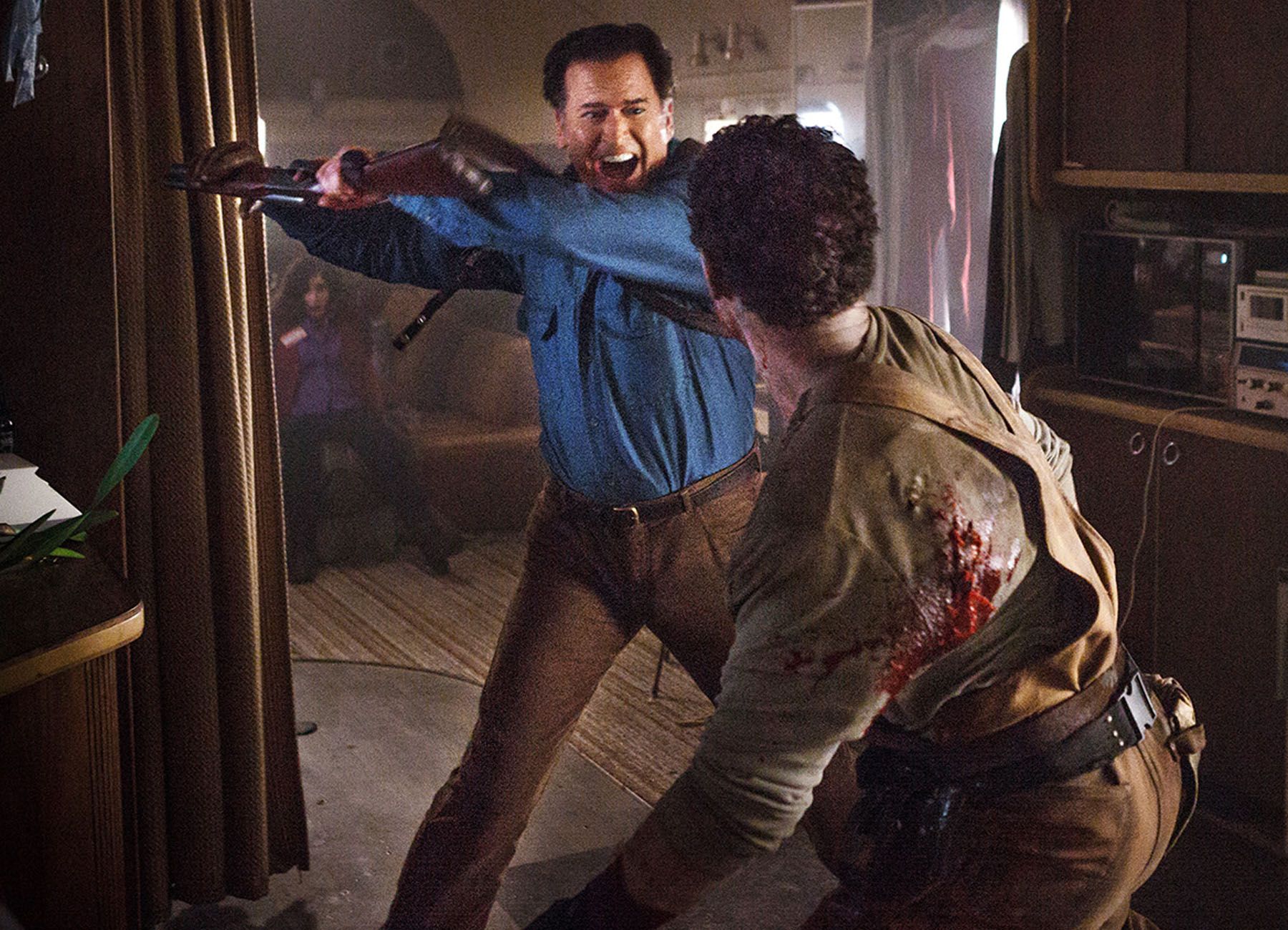
Oh, how very, very long have we waited to see Ash back and
smashing ghouls in the face with the butt of his shotgun?
Far too long, I says.
Ash vs Evil Dead, season 1 (2015)

The comedy horror genre is such an interesting one, in that it is deceptively tough to master. Still, one of its great pioneers, Sam Raimi, has shown us that he can still tap into the magic formula and give us some hilariously violent gore and one-liners with this first season of a show that was a long time in coming.

Ages ago (1987, to be precise), a friend of mine with a truly quirky sense of humor became obsessed with the movie Evil Dead II - an odd flick that had plenty of truly creepy elements to it, but also had a ton of bizarre and comical flourishes. I confess that I really didn't understand my friend's undying devotion, although I did watch the movie with him no fewer than a half dozen times. Clearly, there was something that was compelling about it, even if I couldn't fully grasp what it was. Years later, though, I was able to go back and see just how singularly brilliant writer and director Sam Raimi was, and just how entertaining and unique leading man Bruce Campbell was. They teamed up for the sequel Army of Darkness several years later in 1992, and it was fun if not quite the novel, odd masterpiece that was Evil Dead II. Still, the entire trilogy had inspired a strong cult following - one which constantly asked for more from the dynamic duo of Raimi and Campbell.

Nearly 25 years later, those wishes came true. Last year was the first season of Ash vs. Evil Dead. It picks up roughly 30 years after Evil Dead II (the continuity never addresses the events in Army of Darkness). Ash Williams is living in a trailer home and is essentially a loser in every sense of the word, although you would hardly know it from the swagger that he has. Despite living hand-to-mouth in a broken down single-wide and working as a lowly clerk at a discount retail chain store, he struts about and grins as if he were God's gift to humanity. Especially female humanity. While he hasn't had to battle the forces of evil in nearly three decades, this all changes when he foolishly and accidentally unleashes the Deadites upon the earth once again. He is forced to team up with two of his coworkers - Pablo and Kelly - to take down the ghoulish monsters yet again.

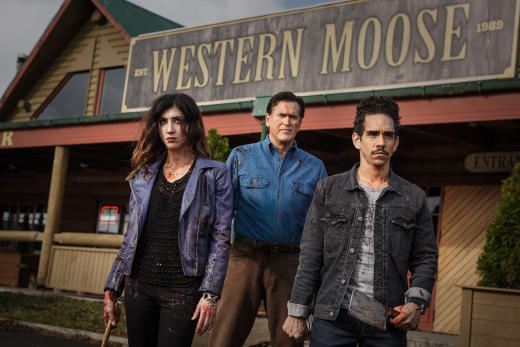
Ash with his new partners in Deadite slaying - Kelly and
Pablo. These two are pretty solid as slightly more grounded
comic relief. They make for a good trio. 
The show hits all of the marks that fans of the films would be looking for. While not every gag hits and not every sequence is noteworthy, there is enough in each episode to keep it all entertaining. And nearly every episode has at least one classic, laugh-out-loud moment. And while much of the plot serves as an excuse to just have Ash and his companions shooting and chopping up Deadites, there is actually a story arc happening. It's certainly not as tight as some of the very best horror or science-fiction out there, but slick, meticulously crafted stories are not what you come to this party for. You tune into Ash vs Evil Dead to see Bruce Campbell trade one-liners and bloody shots with hellish creatures. And that's what the show gives you.

The first season is not on par with Evil Dead II, but it would be unfair to expect it to be. That cult classic can never truly be equalled, even by its own creator Sam Raimi (who is a major part of this new show). Still, Ash vs Evil Dead does a really nice job tapping into a horror vein that we really haven't seen since Army of Darkness. And it certainly does feel good to take another hit from the king, baby.


Luke Cage, season 1 (2016)

Arguably the best Netflix Marvel show yet, which is saying something.

The character Luke Cage was introduced in last year's A.K.A. Jessica Jones, also on Netflix. While Cage played a fairly key role in that series, he was ultimately a secondary character who was in a handful of episodes and ultimately was sidelined during the season's grande finale showdown. He was an intriguing character who begged to have some of the questions about him answered, and Luke Cage does an exceptional job of it.

We last saw Cage recovering from a point-blank shotgun blast in Hell's Kitchen, where he was assisting Jessica Jones in her pursuit of Kilgrave. We now find him a little farther north, in Harlem, where he is laying quite low, working two rather menial jobs as a barbershop janitor and a restaurant dishwasher. Soon, however, he finds himself in the middle of a gang war involving Harlem natives whose cirminal enterprises are deeply entrenched in the drug trade and politics of the region.

This show is easily one of, if not the best, of the four Netflix Marvel show seasons yet (I'll probably need to rewatch the first season of Daredevil before I make that claim, as it was the reigning leader). The tone of the Netflix shows is now abundantly clear - they will take their time and focus on characters far more than the movies can. It was done extremely well with the first seasons of Daredevil and Jessica Jones, and Luke Cage does arguably an even better job of it. Cage was shown to be a powerful, intriguing character with depths hinted at during his appearances in Jessica Jones. In his own show, all of those hints are fully realized, as we get a very well-rounded, conflicted character whose reluctance to use his powers comes from a very understandable place. And Cage is wonderfully fleshed out through the quips and charm that he displays when he does let his guard down, not unlike what was shown in Jessica Jones.

As much as the title character, Luke Cage makes the location of Harlem its own character. The show spends plenty of time digging into the extremely rich history of the African-American presence in the area, including its politics, art, sports, and music. Oh, the music. But I'll get to that later. It was nice to finally see a high-quality fantasy action film or show that features a mostly minority cast. Nearly all of the characters are tied to the African-American roots and traditions that are either deep within Harlem itself, or deep within the general experience of being black in the United States. Many of these themes are right out in the open, such as the importance of men's barber shops as safe, comforting places, or finding a workable definition of being a righteous man amidst chaotic conditions. Others are perhaps hinted at, such as Luke Cage wearing a hoodie, which could be seen as a recognition of the Trayvon Martin slaying several years ago. In so many places, Luke Cage looks racial issues squarely in the face, and the show is better for it.

Luke in front of Pop's Barbershop - a very authentic feeling
slice of Harlem, where Cage, Pop, and the locals talk sports,
politics, the neighborhood, or just bust balls.
Of course, it is a Marvel Cinematic Universe show, not a social science documentary. And Luke Cage gets the fun comic book stuff right. Cage's powers of super strength and unbreakable skin might not be the flashiest or most creative, but the writers of the show made entertaining use of his abilities and showing them off. While there are several excellent fights and show-downs, my favorite occurred in episode 3 - "Who's Gonna Take the Weight?" Here, Cage walks right into a heavily fortified Harlem building with nothing more than a grim face and a really bad attitude. While bullets deflect harmlessly off of him and he hurls one thug after another out of his way, the fun is immeasurably enhanced by the background track "Bring the Ruckus" by New York City natives The Wu-Tang Clan. The sequence was, for me, as fun, impressive, and satisfying as the single-take warehouse beatdown sequence in the first season of Daredevil. I've even gone back to rewatch that sequence a few times, and I still love it.

Mentioning the Wu brings up one area of Luke Cage that is head and shoulders above every Marvel film or show done to date - the music. From the opening theme to the closing credit music, Luke Cage features the baddest and most appropriately attitude-laden tunes in the MCU. While many of the jams fall in the genres of hip hop, rap, or modern rhythm and blues, there are more than a few songs that throwback to the great jazz and funk tunes of the 50s, 60s, and 70s. Guardians of the Galaxy has a great soundtrack, but it is intentionally out of place with its setting, in ways that are as goofy as they are effective. From the singles to the orignal score, the soundtrack of Luke Cage completely belongs right where it is, and will be hard for other shows to match.

My only complaint about Luke Cage is one that I can level at the other three Netflix Marvel shows - that they haven't yet seemed to completely master the 13-episode season. I do greatly appreciate that the shows, with roughly 11 hours of time to work with, are able to dig deeply into the characters and their environments. Still, all four shows have had moments where things seemed to be dragging just a bit. Luke Cage was not an exception. It's not necessarily that the shows are getting off on tangents or getting repetitive; it is more the case of certain scenes and sequences featuring dialogue or character exchanges that lack the sharp drama or sizzle of the very best parts of the season. Such things tend to stand out if you watch the entire season over the course of a few days.

Obviously, I was impressed by Luke Cage. The Netflix wing of the MCU is clearly in great shape right now, with only one more character to introduce before Cage, Daredevil, Jones, and Iron Fist team up in the Defenders mini-series slated for later next year. I'm excited for it. 

Friday, October 21, 2016

Before I Die #585*: The Thief of Bagdad (1924)

This is the 585th film I've seen from the 1,187 movies on the "Before You Die" list that I'm gradually working my way through. *Once again, the people at the "Before You Die" crew have updated their list by adding 10 more movies to the list, seven of which I have already seen. Hence the jump of numbers between this film and the previous "Before You Die" film that I reviewed. 

Director: Raoul Walsh

Quite the spectacle which must have set a new bar for film back in its time. Still, it is a silent movie, and The Thief of Bagdad now suffers from several of that era's limitations.

The story draws from the world famous Tales of the Arabian Nights, combining several elements from various tales to create the character of The Thief, played by Douglass Fairbanks. The Thief (his real name is never revealed) is a carefree pickpocket and robber who manages to take what he wants and evade capture at every turn, laughing the entire time. He eventually decides to try his most ambitious scheme - to win the hand of the beautiful princess of Bagdad (sic) by posing as a prince and competing with other monarchs from Mongolia, Persia, and India for her hand. Each must try and procure a "rare object" from somewhere in the world and present it to the king, who will give his daughter to the man who obtains the object he deems the rarest and most precious.

As far as silent movies go, I found The Thief of Bagdad far more watchable than most of its contemporaries, if not exactly the most profound of films. While it is long (nearly two-and-a-half hours), the story continues to move and change at a fairly vigorous pace. In the spirit of classical epic adventures, the hero must travel to faraway and strange lands, battle adversaries both human and inhuman, and brave all manner of peril. Although the actual elements of danger are nothing new to modern viewers, I couldn't help but be impressed at just how many innovations director Raoul Walsh utilized to dazzle the audience. Yes, they will seem almost laughably rudimentary to us now, over 90 years later, but compared to its contemporaries, this movie must have seemed like the Avatar of its day.

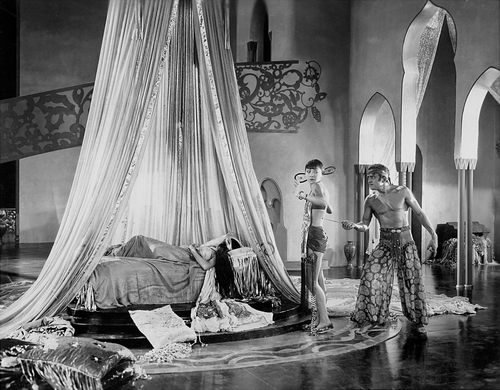
This still shows just how much work went into the sets and
costumes on this massive production. It's as lavish and eye-
catching as anything you will see from this era of movies. 
I think another reason I found this movie more enjoyable than other massive-scale silent films is that it clearly is not taking itself seriously. It is pure fantasy, meant for pure entertainment. Because of this, it is far easier to excuse a lack of character depth or plot sophistication. When you are dealing with fantastic tales meant mostly for children, you can't really criticize a film the same way you would a humanist drama, such as Foolish Wives or The Wheel. Such films were aiming high in terms of studying the human condition, but could only do so much due to a lack of sound and acting techniques still rooted a little too much in theater. And it certainly doesn't hurt that Douglas Fairbanks was clearly a great actor for this type of role, flashing a proto-Clark Gable grin as he artfully dances and escapes from one precarious pitfall to another.

A curious note to me is that the movie was directed by Raoul Walsh, whom I previously only knew for the classic gangster movies he would oversee later - The Roaring Twenties, High Sierra, and White Heat. I guess it goes to show that great directors really can do anything, whether it's hard-nosed crime flicks or swashbuckling family movies. I wouldn't recommend this movie to anyone but hard-core film buffs or true aficionados of silent film, but it was still rather fun.

That's 585 movies down. Only 602 to go before I can die. 

Saturday, October 15, 2016

Idiot Boxing: Orphan Black, season 4 (2016); Ballers, season 1 (2015)

Orphan Black, season 4 (2016)

A quality return to the strong roots of the show, after what I found to be an overly expansive third season.

In the wake of the overwhleming revelations about more Lida clones, in addition to a whole parcel of psychotic, soldier Castor clones in season 3, season 4 gets back to some of the basics laid out in the first season. Namely, what Neolution was ever truly after, and how Sarah and her sisters can avoid death via the latent illness built into their DNA. Blessedly, the tale narrows its focus more on a smaller amount of characters and goes back to the very beginning of the story and even before, when we get to see what led up to Beth Childs's suicide - the event which drew Sarah into the entire affair way back in the pilot episode.

I have to admit that, after not having watched the show since the end of the previous season, it helped that the pace slowed down and returned to familiar territory. Later in this season, my mind was actually racing to recall certain characters and events which I hadn't seen or thought about in at least a year, but starting this fourth season a bit more slowly was a great help. And while the end of this season did raise a few puzzling questions and may not have offered the satisfaction that you might hope for from a season finale, the pieces are clearly in place for the fifth season - reportedly the shows last.

Sarah (left) and relative newcomer to "Clone Club," Crystal.
The bimbo Crystal is definitely a comic relief, but they don't
overdo her presence - just one of many examples of how this
season gets the tricky balancing act of the show correct.
The story in season 4 focuses more on the power struggle within Neolution regarding the future of their genetic engineering and eugenics projects. The primary players are the young a eerily exotic-looking Evie Cho, and Lida clone Rachel Duncan, who is still recovering from her attack at the hands of Sarah. As Evie and Rachel try to out-maneuver one another, Sarah and her sisters attempt to uncover more truths about their place in the entire affair. While the plot points can get a bit convoluted at times, the important points clarify by season's end.

Like many such briskly-paced thrillers, Orphan Black will occasionally make use of the speed of its narrative to gloss over actions or points that don't always add up. Characters will sometimes act in ways that do not show the intelligence or foresight that their characters are meant to possess, usually in the name of creating interesting dynamics or moving the plot forward. Fortunately, these aspects do not hamstring the show, as they are usually relatively minor points that never sabotage the major themes or motivations.

It's almost a given at this point, but the acting is tremendous. Tatiana Maslany hasn't slackened a bit in her acting gymnastics of playing seven different, very distinct clones. She finally won an Emmy for it, as well, which is beyond well-deserved, if not a year or two late. The rest of the cast holds just as well, but Maslany truly is the show.

I was really pleased with this season. After season three, which had expanded the character roster and scope to almost dizzying size, I was afraid that I was watching a show that had no real end-game plan and was just spinning out ideas in order to keep the show running for as long as they could. Season four, however, showed that there was always a clear plan in mind, and the show is heading towards its ultimate resolution. If the final season even comes close to living up to this promise, this will become a classic of modern speculative fiction.


Ballers, season 1 (2015)

It's not a game-changing, mind-blowing sports drama/comedy, but Ballers had just enough surprises to be engaging.

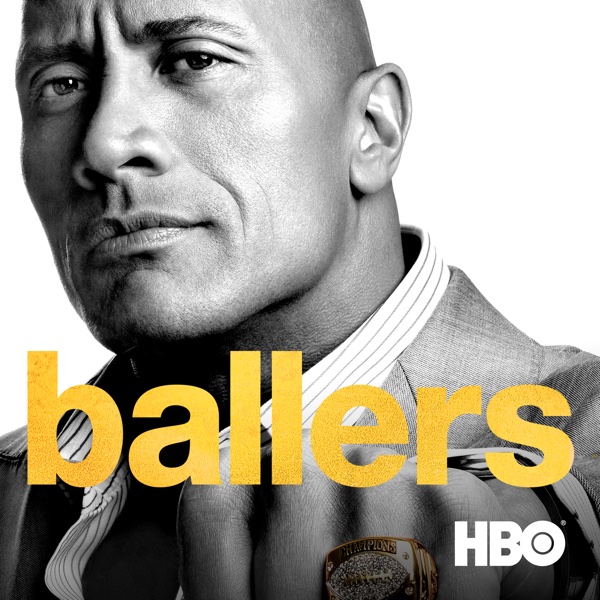
Starring Dwayne "The Rock" Johnson as a recently-retired former star NFL linebacker Spencer Strasmore, the show follows "Spence", who is based in Miami, as he tries to forge a new career as a financial planner for current NFL players. The show draws on the antics of rich, immature athletes for much of its entertainment value. A fist fight in a club over a verbal insult. Raucous parties with booze, drugs, and women. More than one athlete too self-absorbed to realize how ridiculous his behavior is. These are not exactly new grounds being broken. While I didn't find many of the athletes' antics particularly hilarious or revelatory, I will admit that there are more than a few good lines of dialogue sprinkled in.

Rather than the inside look at the daily insanity of the lives of some wealthy pro athletes, it is the character of Spence and what revolves around him that gives the show a dash of novelty. Spence represents that segment of athletes that make for the sadder stories. The gifted athlete who forged a great career, but has far less to show for it than he probably should. Although very accomplished as a player, Spence has very little of the financial security that other modern athletes of his caliber ought to have. His attempt to forge a new career as a financial planner seems to be a form of redemption as much as a way to pay his bills. In trying to find his very first clients, he sees men not much younger or further from their post-playing days than Spence is, and he is trying to help them avoid the mistakes that he made. This is, of course, easier said than done when dealing with extremely competitive, egotistical personalities. The drama arising from Spence's attempts to make his clients, and sometimes their delusional entourages, see the light is often compelling, humorous, or both. One memorable example is watching Spence's incredulity when having to tell one of his star clients why its not a good idea to be snorting cocaine off of a woman's breasts in front of dozens of people on a party boat. Such scenes' humor is often carried by Dwayne Johnson's acting and wonderfully expressive face, which bears every ounce of frustration that a parent would have trying to talk sense into a four year old. The Rock has shown his acting chops before this, and Ballers just further confirms that he is far more than just a tall pile of muscles.

Spence and Ricky Jerret, Spence's most volatile client. Much
of this first season focuses on Spence working to not only get
Ricky a solid contract but also helping Ricky avoid acting
like an adolescent in ways that harm his brand.
Another unexpected layer is that Spence himself is also dealing with the physical toll left by his many years playing football. The concern hovering over Spence for much of this first season is the possibility of head trauma - a condition for which he is highly reluctant to get checked out. While the resolution does come, it offers a rather palatable outcome that perhaps undercuts the seriousness of this issue. I only hope that it is revisited in future episodes, if not with Spence directly, then with one or more of his clients. There is also the Spence's ongoing use/abuse of painkilling medication, which is not fully addressed in this season, but is clearly presented as an issue which will be further explored.

I actually liked this first season more than I had expected, although it is hardly breaking breaking any new ground. While it is interesting to focus on the off-the-field issues of professional athletes, much of Ballers is relatively light fare, some but not all of which is entertaining. I'll be checking out the second season to see how it evolves, and if it lives up to the potential this first season shows. 

Wednesday, October 12, 2016

New(ish) Releases: The Lobster (2015); X-Men: Apocalypse (2016)

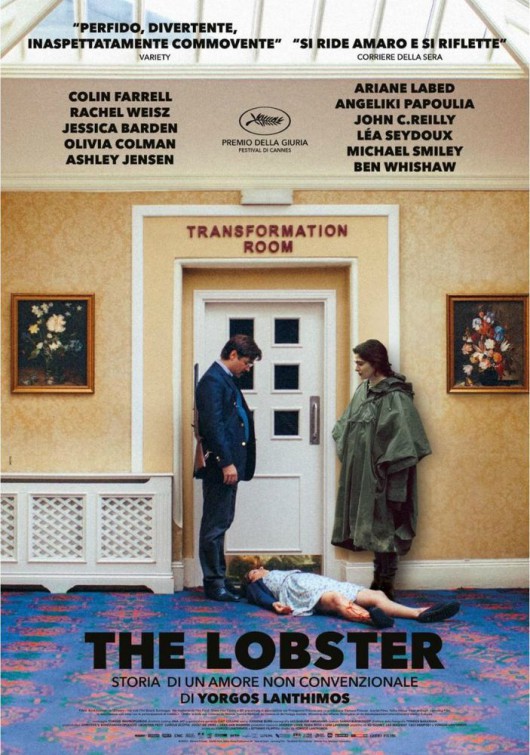
Sure, the reviews are in Italian, but this
poster is one of the best ones I found that
conveys some sense of the "Wes Anderson
meets Franz Kafka" tone.
The Lobster (2015)

Director: Yorgos Lanthimos

A rather brilliant, if often cold, piece of speculative, dystopian fiction.

Set at an unspecified time and place but one which seems not terribly far removed from our reality in the early 21st century, The Lobster follows David, a man whose wife is no longer with him. In this alternate world, adults are not allowed to be single. Instead, when their partner leaves through death or choice, the newly-single person is taken to a hotel where they are given forty-five days to find a new mate among the other single people at the hotel. If they are unable to find a mate, they will be turned into an animal of their own choosing.

If that description sounds strange, then it should. And there are plenty of other details that emerge about the bizarre world of the film that add to the unnerving oddity of it all. David, played by Colin Farrell, is an empathetic if mostly pathetic protagonist, who trudges along the pathways laid out by society. That is, until desperation leads him down a far more dangerous path. Seeing him try to negotiate his very limited and thoroughly unappealing options can be compelling, if ultimately depressing in nearly every way.

There is humor that runs throughout nearly the entire picture, although it is of an extremely dry and dark strain of comedy. The tone and crisp, careful cinematography of the movie put me in mind of several of Stanley Kubrick's films, in particular A Clockwork Orange, another terrifying dystopian story that has its own disturbing humor and internal logic. Like A Clockwork Orange, the overarching theme of The Lobster is society's control over individuals, although the latter focuses on romantic relationships between individuals, rather than looking at aberrant, violent criminal behavior. For this reason, The Lobster has far more intellectual food for thought to offer a larger audience, even if that audience will have to put in some serious mental energy to get beyond the strangeness of the proceedings. Imagine if Wes Anderson did a film adaptation of a Franz Kafka tale, and you get some idea. This is not to say that the movie is without a soul - it most certainly has it. But by the very nature of the film's themes, it must only give it out in very brief, small portions.

The denizens of the hotel go out for their daily hunting
expedition. What they are hunting and why is one of the many
darkly humorous and outlandish elements of the story.
The technical aspects of this movie are incredible. The cinematography captures the sad beauty of the settings and costumes perfectly, and the acting is pitch-perfect. Colin Farrell once again shows that he is far more than just a pretty face, as he plays the sad sack David wonderfully. Rachel Weisz is also her typically strong self, as are all of the other actors, minor and major alike. While the film's mood never asks the actors to emote very much, completely by design, the cast is able to add the subtle layers necessary to prevent the entire affair from coming off like robots on film.

This is a difficult movie to widely recommend. I found it quite fascinating, and well worth watching the one time. I am unlikely to watch it again, but I think that viewers who are unafraid of challenging movies that appeal far more to logos rather than pathos would find a lot in it. Whether I ever watch it again or not, The Lobster is certainly one of a kind, and a film that is extremely well-crafted.


X-Men: Apocalypse (2016)

Director: Bryan Singer

Despite being aware of the poor reviews, I was stunned at how weak this X-Men movie was, given who was at the helm and the resources he was working with.

Not long ago, I did a complete rundown of the primary X-Men movies, with a separate review of Days of Future Past. My takeaway is that, of the seven X-Men movies released before Apocalypse, there were three really good movies, two decent ones, and two really bad ones. Considering that Brian Singer had directed the three best (and one of the decent) movies in the series, I was confident that the recent entry would be solid. Yet somehow, Singer tumbled into a couple of the major pitfalls that he had skillfully avoided prior to Apocalypse.

Continuing with the retracing of the steps of the X-Men which was begun with First Class, Apocalypse picks up in 1983 - nearly ten years after the events of Days of Future Past. Mystique is a rogue who protects victimized mutants, and Magneto is off the grid, living the quiet life of a family man in Poland, under an alias. Charles Xavier's school in New York is thriving, with dozens of young mutants receiving an education while learning how to use their superhuman abilities. Meanwhile, in the middle of Egypt, a ancient mutant named En Sabah Nur is awakened after being buried for thousands of years. En Sabah Nur, also known as Apocalypse, is a virtually-immortal mutant who is able to transfer his consciousness into other mutants, not only avoiding death but also absorbing their abilities. He is also convinced that he is meant to rule the entire world, and goes about seeing this vision become a reality immediately after he is awakened in 1983. To this end, he starts to dominate and recruit powerful mutants, including Magneto and other faces familiar to fans of the X-Men comic books from decades past.

While the movie does boast a few good scenes and strong performances by its highly formidable cast, there are too many messy or sloppy elements. Apocalypse himself is yet another one-dimensional comic book villain with plans for world domination. And there is quite literally nothing else we ever learn about his motivations beyond this. This is what made Days of Future Past so strong - even the adversaries like Bolivar Trask and ultimately Magneto had motivations that were complex and provided some real drama. Using another megalomaniac as the arch enemy in the sequel film simply feels like a step backwards, as it merely served as an excuse for one battle scene after another. I can appreciate well-done fight sequences in this type of movie, but there is always a saturation point. Apocalypse hit mine by the midway point of the movie, which isn't good with a film that clocks in at nearly two-and-a-half hours. Such tedium probably wouldn't have set in had the action scenes shown a little more creativity, but they didn't. Case in point is the Quicksilver scene, in which his power is on display in order to save the students at Xavier's Academy. It's somewhat fun, but it's really just a lengthier retread of the same visual effect which was so much fun in the previous movie, during Magneto's breakout of the Pentagon. What was novel and entertaining the first time felt a little bit like the writers had run out of new ideas in the follow-up movie.

Jean Grey, Nightcrawler, and Cyclops. Just three of way too
many "newcomers" who have long histories within the X-Men
mythology. In trying to give nearly all of them their moments,
the movie ultimately fails to give any of them any truly
meaningful ones. Or any worhtwhile depth, for that matter.
And then there is the fault that was one of the most glaring with X-Men 3 back in 2006 - character overload. I can only guess at how Singer allowed this to happen, as he so carefully avoided it in the previous movie. In Days of Future Past, despite including a couple dozen mutant characters, the movie felt tight thanks to its focus on only three or four of the stongest ones. Unfortunately, no such focus occurs in Apocalypse, where we constantly jump from one character to another, with no one's deeper stories teased out or elaborated upon.

I try never to be so arrogant to believe that I could come up with a better movie than the actual professionals, but I can't help it with this movie. I can't shake the feeling that this movie would have been far better served if it spent more time telling the back story of En Sabah Nur - about how his powers gradually increased and why he decided that he was fit to dominate the entire world. From that, a slower build of the threat and menace of Apocalypse would likely have had much greater impact. Instead, we get a tale that felt rushed and jammed with far too many characters to care enough about any of them, particularly the newcomers to the reboot trilogy.

I must remind everyone (including myself) that Apocalypse does have some fun ideas and solid sequences in it. For fans of the series, it is worth checking out, to be sure. I would simply caution anyone who saw and liked the previous two films to keep a tight rein on your expectations. I found Apocalypse to easily be the weakest of the reboot trilogy, and ultimately a missed opportunity that wasted, if not exactly all, then many of its vast resources.