Showing posts with label films based on books. Show all posts

Tuesday, July 31, 2018

New-ish Releases, Spoiler-Free Reviews: Justice League (2017); It (2017)

Justice League (2017)

No Spoilers!

Director: Zack Snyder

This one was OK, which actually qualifies as a pleasant surprise to me.

Justice League was the fifth film in the "DC Extended Universe" (DCEU). After paying to see the underwhelming Man of Steel in 2013 and then the utter mess that was Batman v. Superman: Dawn of Justice a couple of years ago, I swore off paying theater prices to see any of the DCEU flicks. While I broke that vow to see Wonder Woman, after all of that movie's mostly-deserved high praise, that initial boycotting paid off by my avoiding the sloppy Suicide Squad. While I am glad that I didn't shell out theater price for Justice League, I have to say that it was a reasonably satisfying at-home rental.

The story picks up several of the ostentatiously dangling and flapping threads left over from Batman v. Superman. With Clark Kent/Superman's apparent death at the hands of the Doomsday monster, the alien conqueror Steppenwolf sees his chance to lead an assault on Earth and take over the planet. It's an attempt which he had made in the past, only to be rebuffed by the collective forces of several of earth's mythically powerful races. Now that Steppenwolf is back with a massive army of fear-feasting insectoids, Batman recruits one known ally, Diana Prince/Wonder Woman, to enlist the aid of other people with apparent superpowers. These lead them to band together a group that includes Barry "The Flash" Allen, Arthur "Aquaman" Curry, and Victor "Cyborg" Stone.

In most ways, the movie is fairly paint-by-numbers. I will admit that I suspect Joss Whedon, who was brought in to take over as writer/director after Snyder had a family tragedy to deal with, probably was responsible for some of the more intriguing and clever narrative ties in the film. I also wouldn't be surprised if he had a hand in writing some of the more engaging fight sequences. The one which I found most entertaining seemed very much like something we would have seen in The Avengers. Whether it was Whedon or co-writer Chris Terrio, this movie definitely had the lighter tone and funnier gags that Batman v. Superman was painfully lacking. It still wasn't nearly on par with the best MCU or even X-Men flicks, but it was a clear improvement.

Jason Momoa certainly cuts a striking figure as Aquaman, but
the outline and dialogue never came together for me. Most of
the other characters were handled more deftly.
The core characters are a mixed bag. The villain Steppenwolf is dull - a typically one-dimensional warmonger who wants to crush everything in his path. The voice acting by Northern Irish acting veteran Ciaran Hinds is powerful, though. In terms of "The League," I found it hit-and-miss. I've personally never had a problem with Ben Affleck as Batman, and he continues to be fine here. Gal Gadot continues to be great as Wonder Woman, as well. Ezra Miller was rightfully hailed as maybe the biggest revelation in this one, as he plays the iconic Flash exceptionally well, lightening things up nicely. Cyborg, however, I found extremely dull, and this particular vision of Aquaman felt completely off to me. As a group, though, the good outweighed the bad, and the dynamics work well enough.

I can't say that Justice League won me back over to the DCEU, but it did give me an enjoyable two hours. Looking ahead, the film franchise's next movie is Aquaman, headed up by James Wan, known for recent "Fast...Furious" films and the recent Star Trek Beyond. Given my feelings for how Aquaman was handled in Justice League, and my apathy towards the Fast and Furious movies, I don't anticipate that I'll be seeing that one. I do hope that the powers behind the DCEU take some note of what worked in Justice League, though, as they really are sitting on a wealth of great fantasy characters whom they could use to make some wildly entertaining movies.

Spoilers!! You've Been Warned!

Great intro sequences with Wonder Woman. While her solo movie last year had some solid action scenes, her rescue at the bank was top-notch. And the sequence with the Amazons trying to defend the Mother Box from Steppenwolf's attack has some really fun visuals, too.

It was a brief moment, but I absolutely loved the moment when the Flash is running up on a still-deranged Superman, thinking his he has the jump on him, only to have the Man of Steel's eyes turn directly towards him, well aware of the Scarlet Speedster's approach. I have to think that that was a Joss Whedon addition, as it seems like just the type of subtle-but-awesome moment that Whedon has a knack for.

Speaking of Superman, it was probably the least surprising "twist" to bring him back in this one. It was handled fine, if not exactly in a compelling or creative way. The iconic superhero does serve as a half-decent deus ex machina, but he does raise the eternal concern with such a powerful character - how do you find a villain strong enough and interesting enough to contend with him, let alone him and his super-powered buddies?


It (2017)

Director: Andy Muschietti

A solid horror movie, if one that is drawing from several wells that have been heavily tapped by earlier scare flicks.

Based on the hit 1986 novel by popular horror master Stephen King, It follows a group of young kids in their pre- and early teens in the fictional town of Derry, Maine, a seemingly quaint little area that has a history of disturbingly high rate of missing children and horrific disasters. This tale begins in the summer of 1988, when a little boy, Georgie, is apparently sucked into a drainage opening by a monster masquerading as a circus clown. We fast forward a year, with Georgie's older brother, Bill, and his friends wrapping up the school year and looking forward to a summer of freedom. Soon, however, other children start to disappear, and Bill and his friends start to have terrifying hallucinations embodying their worst fears. Wrapped up with these fears isthe same clown, which calls itself Pennywise, that took Bill's kid brother Georgie. Sure that Pennywise means to take and devour them all, Bill and his friends must decide what to do in order to survive and possibly find any of the other children whom Pennywise has already taken.

The movie is a very solid horror movie that I put in the same box as recent horror hits like The Conjuring - it's not really doing anything new, but it uses tried-and-true horror movie techniques extremely well. You get the creepy piano music, a scary clown, creaky doors, dark basements, a spooky and dilapidated house, and almost every other trope you can imagine from such films from the past. Fortunately, director Andy Muschietti executes everything effectively, and he does implement some creative visual scares with sharp editing and a few truly startling moments. On the whole, though, I wasn't dazzled by any wealth of novelty here.

Although this movie is based on a much earlier novel, which had previously been adapted for TV in 1990, it's almost impossible to ignore its similarities with recent nostalgia-laden smash hit TV show Stranger Things, which itself is a bit of a love letter to fiction creators like Stephen King. If the 1980s setting, small town, and gang of 12- and 13-year old misfits isn't enough to make the comparison clear, It even features Finn Wolfhard, one of the young stars of Stranger Things. It doesn't do quite as good a job as the Netflix TV show of invoking the sense of fun and camaraderie, but the bond between the young kids - who dub themselves "The Losers' Club" - is effective enough.

Dank, shadowy sewers are only one of many well-known horror
tropes here. We also get eerie old houses, creaky doors, and
more, to go right along with the scary clown at the center.
The movie isn't one for subtlety, beyond even the standard horror elements already covered. The secondary characters leave no scrap of doubt as to their roles. The bullies are sneering, cackling, jackal-like predators whose every actions are despicable. The single, sleazy father of female Loser's Club member Emily simply oozes lecherousness. The shut-in mom of hypochondriac Eddie seems to have no redeeming qualities whatsoever. And on it goes, with anyone who is not a Loser's Club member being no more than two-dimensional, and basically of no help to the kids. This is an overly convenient narrative device, as it is about the only way that the kids are left to fend for themselves. It's not a fatal flaw, as the movie does need to keep its focus on the kids themselves, but I would have appreciated seeing one or two adults who actually seemed to care about their kids suffering through hellacious trauma.

Though It didn't stun me with anything exceptionally novel, it was a decent enough horror flick. It was always meant as the first of a two-part film series, with the sequel It: Chapter 2 set for a September 2019 release. I doubt that I'll bother seeing it in theaters, but I'll check it out eventually. The concept of a horror movie flashing forward 27 years to see the adult versions of the first movie's children protagonists deal with the returning horror is an interesting concept. 

Saturday, February 3, 2018

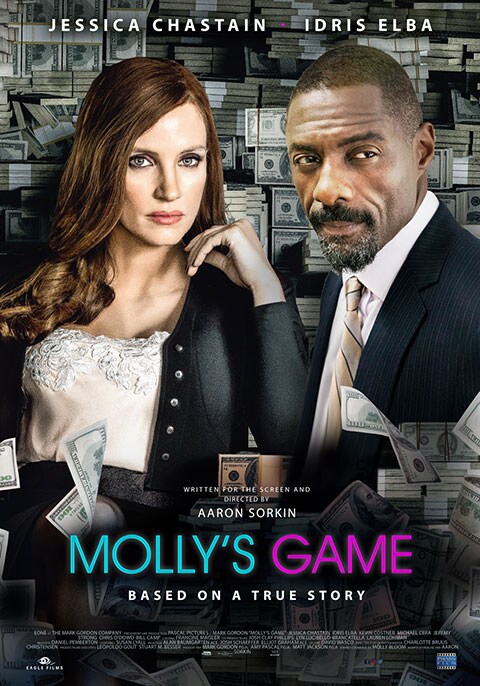
New Release! Molly's Game (2017)

Director: Aaron Sorkin

An entertaining film that touches on the ever-fascinating world of high-stakes poker, although a film that bears writer/director Aaron Sorkin's fingerprints a bit too prominently in places. It can also be filed under the category of films that could possibly pale in comparison to a well-done documentary.

The story is adapted from the memoir of the titular Molly Bloom (Jessica Chastain), a former Olympic hopeful skier whose athletic aspirations were dashed by a pair of horrific injuries. The highly intelligent Bloom found herself in Los Angeles, where she almost accidentally begins managing a weekly high-stakes poker game for her boss - a fairly unsuccessful and disorganized talent agent who somehow has enough celebrity connections to make the game a hot ticket for poker-loving movie stars. Before long, Molly's administrative skills and acumen allow her to usurp her boss's poker game and run it herself. This is quite lucrative for Molly, but the world of high-stakes poker, even among well-known celebrities, can be a seedy business. The shadier elements of the world begin to cause Molly serious problems. These problems compound until she finds herself arrested and having to decide whether she wants to cooperate with the FBI by giving up all of the information she has on her clients or remain silent and possibly go to jail for several years.

The movie does a nice job combining elements found in earlier classic movies like Goodfellas and Casino, especially in terms of topic, pace and editing. The didactic elements about the world of underground poker are fairly engaging, and the story is packed with colorful characters. Also like those earlier classics, the story clicks along at a brisk tempo, only a few times ever slacking. As one can imagine looking at the cast list, including Chastain, Idris Elba, and more than a few other well-known veteran actors, the performances are strong.

Despite so many strengths, the movie doesn't every rise above "good" for me. One reason is that, like virtually every "based on a true story" movie, the movie's appeal lies a bit too heavily on the fact that it is a true story. If the movie were fiction, I don't know that it would have nearly the same attraction for viewers. This, for me, is often a weakness. Only very creative writers and directors can elevate a true story above its innate appeal. Scorsese is obviously one of the true masters of this, having done it with the already-mentioned Goodfellas and Casino, but also an earlier classic like Raging Bull. Molly's Game, in aping the styles of those movies, doesn't do anything novel cinematically to feel especially fresh.

The initial courtroom scene, one of the first where Sorkin's
sometimes heavy scripting hand can be detected through the
obviously orchestrated gags and verbal
tete-a-tete.
A larger problem for me is Aaron Sorkin. Sorkin is obviously an exceptionally sharp writer, as evidenced by his impressive resume of lauded movie and TV show scripts. But at some point several years ago, he entered into a particular category of filmmakers that has actually become a slightly dubious club for me: those who are most famous for their ability to write dialogue. Two others who immediately come to mind are Quentin Tarantino and Joss Whedon. From my view, all three writers have put together some wonderfully entertaining verbal exchanges on film, but all three have also fallen in love with their own virtuosity in this realm. In nearly every one of their last few films, one can sense several moments where the snappy, clever dialogue has actually trumped more important story elements like character integrity or a sense of authenticity of voice. In Sorkin's case, I first noticed this in his HBO show The Newsroom, but it is also obvious in moives like Steve Jobs and The Social Network. Molly's Game is no different, featuring several scenes where Sorkin was probably being too clever and playful for the story's own good. In just one example, Idris Elba's lawyer character Charlie Jaffey is in court with Molly Bloom, though he has not accepted her case. As she is about to be arraigned, he keeps shifting places back and forth next to her, giving her advice, backing away, and repeating the maneuver. It is meant to be a humorous visual and verbal exchange gag, but it ends up being an obvious contrivance that one can see coming all too quickly. There are others, too, and they create the situation of "seeing the writer's hand on the paper" too often, which only serves to take one's mind out of the story.

One other feeling that I can't shake about this movie is that I can't say that I ultimately care much about Molly Bloom. Yes, her story is a unique one, to be sure. But the general stakes never feel terribly high, and she doesn't cut as sympathetic a character as I think Sorkin was trying to construct. Ultimately, as smart as she is, she makes several very foolish and selfish decisions, and she pays a fairly high price for them. Not having read the book, I was genuinely curious about the resolutions to her quite precarious position at certain points, but I can't say that I truly felt much compassion for her plight or any great sense of victory or failure at film's end.

Molly's Game is another one of those movies that I enjoyed seeing, thanks to solid filmmaking and acting, but won't bother to watch again. 

Saturday, October 29, 2016

New(ish) Releases: Zootopia (2016); In the Heart of the Sea (2016)

Zootopia (2016)

Directors: Byron Howard, Rich Moore, and Jared Bush

I wouldn't call it a hands-down classic, but Zootopia is a highly respectable entry into the canon of modern animated family films that don't condescend to younger viewers.

The movie mostly follows the story of Judy Hopps, an upbeat rabbit with dreams of being a police officer in the cosmopolitan super-city Zootopia, where all species of animals live in ostensible harmony. The world Hopps lives in is populated by all manner of animals who have long since evolved beyond their basic predator/prey hardwiring. Instead, they live in civilized manners, with jobs, homes, and families. This does not mean, however, that certain problems and prejudices don't exist. Some animals types are presumed to have or lack certain skills for certain tasks. In the case of Judy Hopps, as a rabbit, she is assumed not to have the strength, tenacity, or instincts to be a police officer. She has her chance to prove everyone wrong when she finds herself in the middle of a case of several missing animals in Zootopia.

The very clear theme running throughout the movie is that individuals shouldn't be stereotyped or generalized. While this may seem trite to mature adults, the movie sends the message in rather savvy ways. There is also the added depth of the larger notion that certain types of individuals are more prone to bestial, primitive behavior than others. This clearly touches on racism and other dangerous ideas which are still relevant topics, even early in the 21st century. As someone who didn't watch this movie with any children - just his fellow Generation X wife - we both felt that the movie was rather clever in how it got its points across.

But is the movie funny? It is, after all, and animated family film. The answer is yes - it is funny. I wouldn't put it on the same plane as the very best Pixar movies or other animated films of that caliber, but there are plenty of funny lines and visual gags. There are more than a few jokes and references that are clearly designed with older viewers in mind, but children should never feel lost or bored. The voice-actors all do great work, and the visuals are eye-popping in their vibrancy. There are also plenty of clever visual gags, often relating to how the various animals of different sizes and physcial needs all co-exist within the city of Zootopia.

This was a really enjoyable animated movie. I imagine that kids would love it, and adults are likely to enjoy it plenty, as well.


Movie posters like this one promised a sense of awe at the
incredible profession of classic whale hunting. Some of this
came through, but not nearly as much as I had hoped.
In the Heart of the Sea (2016)

Director: Ron Howard

With so many excellent ingredients there for a great movie, it was surprising to see that this one didn't totally manage to live up to its potential.

The movie is a dramatization of many true events which befell the Nantucket whaling ship the Essex, whose sinking inspired Herman Melville to write Moby Dick. We start with Herman Melville in the late 1840s, convincing an aging man to tell of his time as a cabin boy on the Essex, a whaling ship surrounded by strange rumours. Melville's interviewee eventually tells the author the tale of how the Essex, thanks to the desperation and frustration of its at-odds captain and first mate, went dangerously far out into the Pacific Ocean and were attacked by a massive, frighteningly aggressive white whale. The Essex was sunk, and the crew had to endure the harrowing ordeal of finding some means of rescue while drifting along in tiny boats, well over a thousand miles from any inhabited shore.

The movie doesn't do anything poorly, but I didn't find that it did anything exceptionally well, either. The cast is strong, including the likes of Chris Hemsworth, Tom Holland, Cilian Murphy, Brendan Gleeson, and several other less-know but equally capable actors. All of them do just fine with what they were given, though the script seemed to be lacking the snap that would elevate it above adequate. The tale itself also contains the compelling power struggle between the captain and first mate, which provides some amount of drama, but it feels as if it falls just a bit short of reaching truly gripping heights.

First mate Owen Chase (right) and his friend, Matthew Joy.
The bond between Chase and Joy is more hinted at than ever
fully explored, diluting some of the film's impact.
The pacing seemed to feel a little bit off in certain places, as well. Once the Essex sets out on its journey, we get the excitement of seeing just how complicated the task of operating a whaling vessel is. Anyone with the slightest curiosity for seafaring is likely to be engaged in the ship's departure from port and how it heads into its first major squall. After this, though, it seems as if the story was a bit rushed. The friction between the captain and first mate didn't have enough time to fully simmer before it came to a real head. And when crewmen eventually start dying for various reasons, it felt as if it lacked as much emotional punch as it could have had. Perhaps this could have been improved with a few more scenes of the crewmen relaxing or working on the ship, where we could have seen their personalities a bit more. Whatever the case, the reasonable 122-minute running time could have used a good ten to fifteen more creative minutes to add some emotional heft.

The visuals are probably the strongest aspect of the  movie, but like the other aspects, they weren't as captivating as possible. The majesty of seafaring and, at times, the whales which the Essex hunts are sometimes captured well, and you get a sense of the enormity and grandeur of the oceans and traversing them. And there are a few clever shots here and there. However, I found some of the sequences during the actual hunting to be less exciting than I had hoped. Having read Moby Dick not long ago, I can easily recall how exciting a really well-done film adaptation could be of a whale hunt. In the Heart of the Sea conveys some of this adventure, but here also I couldn't help but be a tad underwhelmed by something which should truly inspire awe. I suppose seeing the movie in a theater may have helped this, but I feel that my television screen should still have been conveying more awe from certain scenes.

This movie was just on the right side of the question "Is it worth your time?" My wife and I certainly didn't feel that we wasted our time watching it, but neither of us will ever return to it. I would recommend it with the slight caveat not to expect greatness. Truthfully, the only lasting effect the movie had on me was making me want to re-watch the underrated Master and Commander: The Far Side of the World from 2003. 

Thursday, June 11, 2015

Idiot Boxing: Game of Thrones full series review


Since we are now nearing the end of Season 5 of HBO's Game of Thrones series, I've gone back to watch the first four seasons (only the first two of which I'd already seen).

I should state that, long before the HBO series, I was a tremendous fan of the book series A Song of Ice and Fire. Since 2001, I’ve read the first three books three times each, the fourth twice, and A Dance With Dragons once. I recall the excitement I felt at the low-key announcement back in 2006 that HBO had purchased the rights to the series, and I wondered if they would be able to do such a great literature series real justice. Here are my thoughts on the results so far:

Casting actor Sean Bean as the patriarch Ned Stark was just
one of countless excellent choices made by the show runners.
Season 1

Season 1 was a phenomenal start to what could have been a disaster. As a devotee of the novels, I could hardly have been more pleased.

Following the arc of the first novel - A Game of Thrones - the show sets up the Stark family and the lands of Westeros brilliantly. It's a massive, detailed world, with no end of characters and motivations, locales, and mysteries to be discovered, and a lesser team of creators could have fumbled things in many ways. Instead, show creators David Benioff and D.B. Weiss knew exactly where and how to streamline things, without losing the lifeblood of the show.

The story of Ned Stark's tragic journey to the capital King's Landing is a great one, told very well in this first season. Those who hadn't read the book before the show were as stunned by Ned's fate as I was when I read of it long ago. This, of course, sets a certain tone that continues through George R. R. Martin's novels - that no characters is ever "safe". It's one that very few writers have the courage to follow, given the difficulty in creating characters that thoughtful readers love and will follow. Martin has never minded offing a strong character, if it makes sense within the tale or it makes the story more interesting.

The acting was without reproach. There will always be some characters who won't match the way a reader envisions them, and this TV series is no different. More importantly, though, is that they all nail the spirits of their characters perfectly. Sean Bean wears his anguished sense of duty right on his sleeve. Maisie Williams carries every scrap of Arya's toughness and surliness in her tiny little frame and on her face. I could go on and on, without finding a single casting misstep.

Shae and Tyrion - my least and most favorite characters,
respectively, through much of the TV series. 
The only things I can even gripe about are very minor, and they only come from my close familiarity with the novels. The very small one is that Robert Baratheon is nowhere near as physically large as I felt he should have been. Mark Addy is a great actor, but his character is described in the books as being a massive man, though one grown fat after 17 years of indulgence. In his scenes, Addy is often shorter than several other men in the room, which takes a little something away from the power that he is meant to have. My other gripe is with a lesser character, but it is far more annoying: that of Shae, Tyrion's favored prostitute. She only appears towards the end of the first season, but she very quickly becomes extremely biting and confrontational towards Tyrion. This is something that never happens in the books, and runs counter to nearly everything she is about. In the books, she is perpetually sweet and loving towards Tyrion (even if out of self-interested greed rather than genuine affection). In the novels, she will become pouty when dissatisfied, but she never exhibits the fury or surliness that the TV character has.

Two rather small things in a first season filled with literally hundreds of potential pitfalls. Not bad at all, really.

Season 2
The Battle of the Blackwater was the best of several
extremely tense situations in which characters' true
mettle (and lack of) is on full display. 

This season mostly follows A Clash of Kings, the second novel in the Song of Ice and Fire series. The arc of this season, as with the novel, is the further fracturing of Westeros as the Lannisters take over the kingdom. Various other kings proclaim themselves, including each of dead King Robert's two brothers Renley and Stannis, as well as Ned's eldest son Robb being dubbed "King of the North." This leads to battles and preparations for battles that raise the stakes ever higher. Meanwhile, across the sea, Daenerys seeks to not only survive with her three newly-hatched dragons but also build an army to sail back to Westeros and reclaim the Iron Throne.

The maneuvering of the major players is plenty fascinating, but they are not even my favorite part of season two. What I love is that this is Tyrion's true time to assert himself. Once his father grudgingly makes him acting Hand of the King, Tyrion has the freedom to use his considerable wiles and intelligence to constantly one-up his many adversaries. It's an amazingly entertaining display of brains over brawn, and Peter Dinklage continues to fulfil the promise of the character.

In season 2, we also start to see the TV series creators Weiss and Benioff modify and streamline certain parts of Martin's original tale, to great effect. The standout change to me is the running story at Harrenhal of Arya Stark accidentally becoming the serving girl to Tywin Lannister, who is unaware of exactly who she is. The scenes between Maisie Williams and Charles Dance are all incredible, and they enhance the series tremendously.

One other aspect of note stand out. If any viewers of the series found that they particularly liked the episodes Blackwater in season 2 and The Pointy End in season 1, then you may note what these two episodes have in common: they were both adapted for the screen by George R.R. Martin himself. Martin, who has a ton of work experience in TV through shows like Beauty and the Beast and others, shows that he can carry his brilliant writing skills from novel to screenplay form.

Season 3

The third season begins to show more adjustments and alterations to the source books, while keeping nearly all of Martin's original "Holy s--t!" moments intact, as detailed in the novel A Storm of Swords, with a sprinkling in of material from the next book A Feast for Crows.

Jaime and Brienne - one of the greatest odd couples ever.
There's plenty of fun to be had just deciding whether Jaime's
tongue or Brienne's martial prowess is more impressive. 
The major story arcs follow Tyrion's attempts to rise up after being cast down by his stern father, Jon Snow's double agency with the Wildlings as they march against the Wall, Robb Stark's military conquests, and Daenerys's gathering of her army across the sea. There are plenty of other plotlines that are excellent, if not as large in scale as the others.

As with the novels, one of the best arcs is that dealing with Jamie Lannister and Brienne of Tarth - two characters who are so opposed in every way that their unlikely pairing becomes the stuff of brilliant storytelling. The show's handling of Jaime's development as a character is just as deft as George R.R. Martin's, and it becomes just as compelling as any of the larger scale stories unfolding.

Any viewer of the show knows that the 8th episode of the season, The Rains of Castamere, contains what was, to date, the most shocking and violent plot turn in the series. Without giving it away for any who haven't yet seen it, suffice it to say that just when you think you're getting a footing on how the broader story is playing out, the tale completely flips things on you. As usual, such chaos creates plenty of fodder for the various characters in Westeros to test their mettle. This serves as the perfect set-up for the following season.

Season 3 does seem to be going heavier with the sadism than previous seasons. The most obvious example is Theon's imprisonment by Ramsey Snow. It's hardly the only one, but the brutality and graphic nature of the images can be off-putting once the point of Ramsey's twisted nature is made abundantly clear. By the end of this season, my hope is that this doesn't become an expanding trend.

Season 4

Things continue to roll along nicely in season 4, with a few of my earlier annoyances vanishing but others growing. 
The Viper and the Mountain - a brutal highlight of season 4.
As much as I love Bronn's cunning duel in the Eyrie in season 1,
this duel is perhaps the best of the series so far. 

We finally get the satisfaction of seeing one despicable character get killed in suitably gruesome fashion. This, of course, sets off the sad but compelling story of Tyrion's horrible tumble from grace. This plot line is a strong one, though it's hard to watch Tyrion take even more abuse, especially after acquitting himself so well during seasons 2 and parts of 3. Still, it did lead to the fantastic duel between the Viper and the Mountain, which was almost as good as in the source novel. 

The other storylines are all compelling in their ways. One of my favorites is Jaime's development after returning to King's Landing, sans sword hand, where he has to reinvent himself. This also leads to the fun pairing of the amusing squire Podrick with the grim Brienne. These two make for a curious contrast with the other odd couple of this season - Arya and the Hound. Arya's darkening worldview is one of the more fascinating, if ultimately disturbing, arcs of the entire series.

As always, Daenerys still gathers herself across the Narrow Sea, where she continues her conquest of liberation. Seeing how she deals with the grayer areas of leadership add some welcome depth to this storyline. It also gave us one  of the best killings of the series, when Daario Naharis takes out the Champion of Mereen in hilariously, awesomely efficient fashion.

The penultimate episode was arguably the best of the series to that point. This is the only episode to date which has remained exclusively in one setting - the Wall, where Jon Snow attempts to fight with his fellow Crows against the oncoming hordes of Wildlings. This episode had all of the tension and excitement of some of the very best battle scenes from the Lord of the Rings trilogy.

Two annoyances stick with me after watching the whole season. The lesser one is how actor Aiden Gillen has gone a little overboard voicing Littlefinger. He always gave him a rather sinister tone, but in this season it becomes almost cartoonish. His voice has the low, hushed tone of a one-dimensional schemer in a lame TV crime drama. It's a distraction.

The irredeemably odious Karl. Along with Joffrey and Ramsey,
he completes a trifecta of horrid characters that exist to do
little more than turn viewers' stomachs. 
More pervasive and annoying, however, is a concern of mine from season 3 - the escalating sadism. The books and show have always had some brutal characters, and Joffrey was clearly a nasty little sociopath from the get-go. But whereas Joffrey was the lone main character who was a sadist through the first three seasons, we now get more of the depraved Ramsey Snow mutilating and tormenting Theon and others. If that's not enough, we get multiple scenes of the vicious Karl lording over what is essentially a rape camp north of the Wall. There were times when the show wandered a little too close to - and arguably into - the realm of torture porn. Fortunately, most of these elements were front-loaded into the first 4 or 5 episodes, leaving the more palatable stuff for the latter half of the season.

The Next Season is Coming...

So that's my overall run-down. While I haven't stayed on top of the series from week to week like the most dedicated viewers, I do think it's an outstanding show. I'm just happy to live in a time and place where the technology and resources exist to bring such a vibrant, engaging, and epic tale to visual life.

A review of season 5 will be coming, once I catch up on all of the shows in a week or two...

Saturday, May 5, 2012

Film # 81: Blade Runner (1982)


Director: Ridley Scott

Initial Release Country: United States

Times Previously Seen: twice (last time about 12 years ago)

Teaser Summary (No spoilers)

In the future, a bounty hunter of androids has his hands full with a gaggle of hyper-advanced targets. Trudges through rain, gets beat up a lot.

Extended Summary (More detailed plot synopsis, spoilers included)

*Note: This summary and the “Take 1” Review are based on the original, theatrical cut released in the United States in 1982. There have been several other versions of the movie, which will be discussed in “Take 2”.

**Note #2: Summarizing a complex sci-fi tale is no short task. If you’re not interested in all of the ins and outs, jump down to my “Take 1” for my basic opinion of the movie.

In a slightly alternate Earth in the year 2019, space travel has become a reality. To facilitate space travel, exploration, and colonization, androids have been developed to the point so as to be nearly indistinguishable from humans. However, a handful of extremely advanced androids have attempted to escape their labors, even sometimes killing their human controllers. Thus, they have been banned from Earth.

On Earth, at the massive Tyrell Corporation, an interview is taking place. Tyrell is the premier manufacturer of androids used in space, but they fear that they may be infiltrated by a small group of rogue androids who have killed their human owners and returned to Earth. An employee named Leon is called in for the interview with a man named Holden. Holden is what is known as a “blade runner”, a bounty hunter who tracks down and kills rogue androids. He prepares some instruments and begins to interview Leon, using analysis equipment and a series of pointed questions to elicit an emotional response, together known as the “Voight-Kampf Test”, to determine whether Leon is human or android. After a few bizarre and evasive answers that all but prove Leon to be an android, Leon pulls a gun, shoots Holden, and flees the building.

On the dark and rainy streets of Los Angeles, Rick Deckard (Harrison Ford) sits and enjoys a meal at a Japanese lunch truck. Amidst the lights, crowd, and hustle of the hyper-industrialized city, he is approached by a strangely-dressed man speaking odd street slang. The man, Gaff (Edward James Olmos), is a cop under the supervision of officer Bryant, who demands to see Deckard. Deckard is a retired blade runner who reluctantly goes to Bryant. There, he learns about Holden’s shooting at the hands of Leon, who is part of a sextet of highly dangerous androids who are in Los Angeles for unknown reasons. All six are of the “Nexus-6” model type, the most modern and advanced android produced (by the Tyrell Corporation). The Nexus-6es blend in nearly perfectly with humans, and they are faster, stronger, and impervious to physical pain.

Roy Batty, the deadliest and most eerily developed of the escaped androids that Deckard must hunt down.

Of the six escaped Nexus-6es in question, two have already been killed trying to break into Tyrell Corporation. Leon is another. The other three consist of Zhora (Joanna Cassidy), Pris (Daryl Hannah), and Roy Batty (Rutger Hauer). Roy Batty is the leader of the androids, a strangely charismatic soldier. On top of their basic functions, Bryant also informs Deckard that the Nexus-6es may have begun developing emotions, something unheard of in any past android models. This also makes detecting Nexus-6es far more difficult. Because of this, the Nexus-6 designers built a four-year lifespan into the model. Now knowing the danger, Deckard is all but forced to take the assignment of hunting and “retiring” (the word used instead of “killing”) the rogue androids.

Deckard first goes to the Tyrell Corporation headquarters, where he meets the founder himself, Tyrell, and his personal assistant, a beautiful young woman named Rachel (Sean Young). Deckard wishes to use the Voight-Kampf test on a few Nexus-6es in order to prepare for the quartet that he will track down. Tyrell, after asking some questions about the test, demands that Deckard test it on a human first, to prove that it will not give a false result. He nominates Rachel, and Deckard agrees. It takes many more questions than normal, but Deckard comes to the correct conclusion that Rachel is, in fact, an android of the Nexus-6 variety. Tyrell proudly explains that the Nexus-6 design has the added feature of implanted memories, which make detection significantly more difficult than previous models.

Deckard first goes to Leon’s house, where he finds a set of family photographs – further proof of the implanted memories that Tyrell had explained – as well as an odd animal scale in the bathtub. Outside, Leon himself meets with his fellow android Roy, explaining that a cop (Deckard) is there, so they can’t retrieve the photos. Roy leads Leon to a strange lab, where an old scientist named Chu works on genetically engineering and growing eyes for androids. Roy and Leon terrorize Chu and ask him questions about inception dates and their four-year lifespan. Chu claims to know only about eyes, but explains that Tyrell himself would have the information. Tyrell being exceptionally difficult to reach, Chu is further pressured into giving the name of J.F. Sebastian. Sebastian is a top-level android designer who would stand a better chance of reaching Tyrell.

After leaving Leon’s apartment, Deckard returns home to find Rachel waiting for him. Rachel, it seems, was unable to talk with Tyrell after their earlier meeting. She seems confused about her own identity, and Deckard does little to help. He coldly explains and proves to her that her childhood memories are false, implanted by Tyrell based on his own niece’s real memories. Obviously hurt, Rachel quickly leaves. After a rest, Deckard returns to his hunt. In analyzing a few of Leon’s photos, he notices a woman with a prominent tattoo of a snake on her neck. This woman is Zhora, another of the four androids.

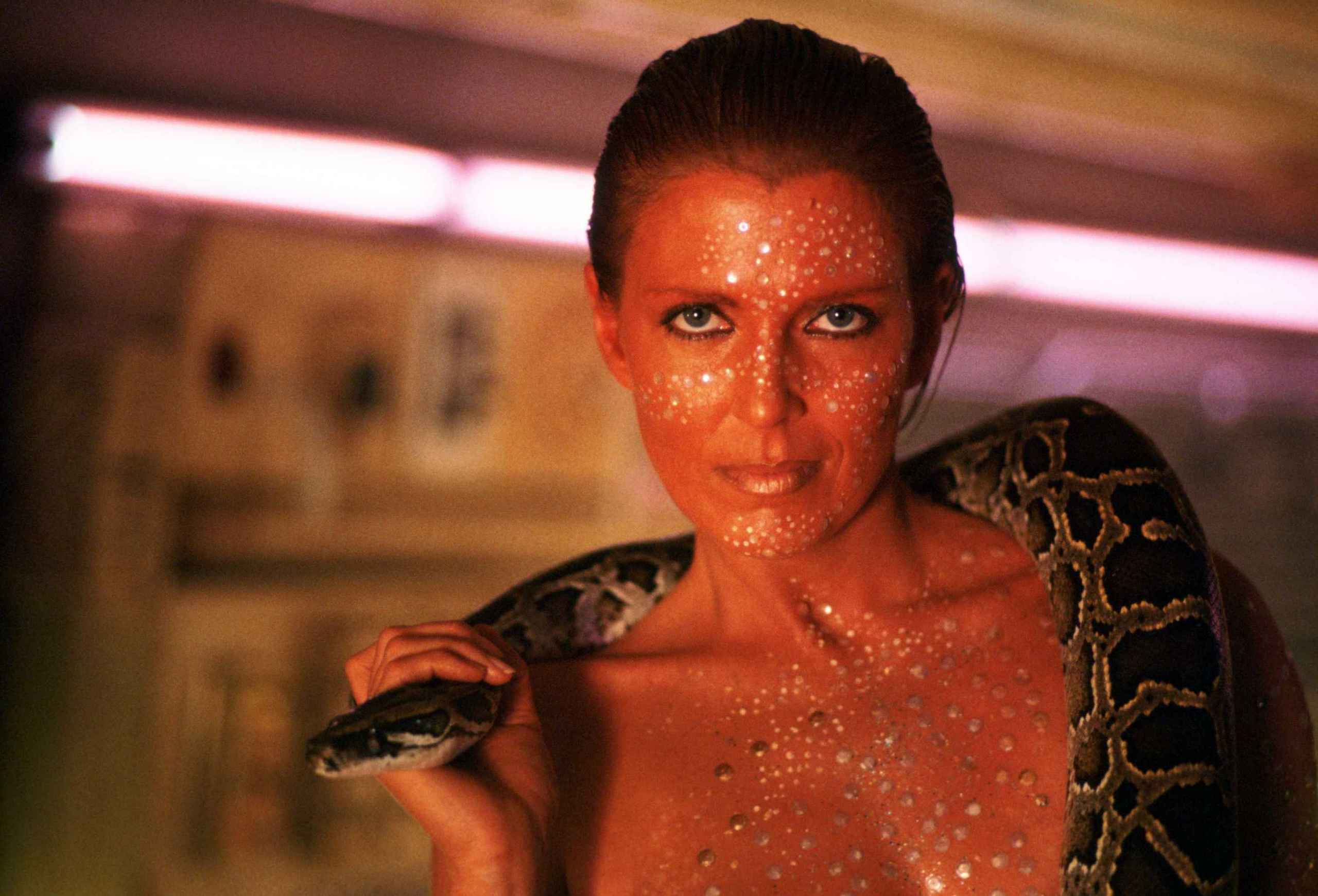
The beautiful yet deadly Zhora, the android which, for some reason, finds a job as an exotic dancer. She is the first escaped android that Deckard confronts.

In a beaten down part of L.A., the android Pris walks the streets before lying down underneath some newspapers on the ground. She is soon awoken by J.F Sebastian, seemingly on accident, as Sebastian rummages through the trash. Appearing frightened at first, Pris is soon soothed by Sebastian’s gentle nature and invitation to return to his home for a warm meal. Pris goes with him and discovers Sebastian’s genetic engineering workshop, filled with all sorts of android toys and human replicants.

Back on the streets, Deckard tracks Zhora via the scale that he had found (it turns out to be artificially manufactured snake scale) to an exotic nightclub where she works as a dancer. After a drink, Deckard attempts to call and apologize to Rachel, but she hangs up on him. Deckard approaches Zhora in her room, assuming the identity of a government official. Zhora quickly senses something amiss and attacks Deckard. After a struggle that spills out onto the streets, Deckard shoots Zhora dead, “retiring” her for good.

Bryant arrives on the scene, congratulates Deckard, but also informs him that he must now add Rachel to his list of androids to be retired. Rachel, it seems, has disappeared from Tyrell altogether. After Bryant leaves, Deckard sees Rachel across the street. Before he can approach her, though, Leon ambushes him. Just as Leon is about to kill Deckard, Rachel shoots Leon, retiring one of her own kind. Deckard recovers and returns to his apartment with Rachel.

At Deckard’s apartment, the two decompress from their experiences. Deckard has now softened on his view of Rachel, and he behaves much more sympathetically towards her. To the point, in fact, that he admits that he will not retire her, even though it is his job. Even more, Deckard makes physical advances on Rachel. She rebuffs him at first, but gives over and the two have sex.

Back at Sebastian’s home/workshop, Pris awakens and talks with Sebastian. He is a lonely genius who has affection for his creations. Pris has called Roy, who appears and tells Pris about Zhora and Leon’s retirements. Pris and Roy then reveal their nature to Sebastian, and they persuade/strong-arm him into helping them get to Tyrell himself. They wish to find a solution to their four-year lifespans, and Sebastian is a close enough colleague of Tyrell to get close to him.

Roy at Sebastian's apartment/workshop. He works his strategy for reaching Tyrell to demand an extension to his very short life.

At Tyrell’s impressive mansion, Sebastian gains entry, with Roy accompanying him. Tyrell, at first surprised by Roy’s presence, is forced to engage him in conversation about nullifying his short lifespan. After some scientific tête-à-tête, Roy kisses Tyrell and then kills him by crushing his skull. He then kills Sebastian, who has been paralyzed by fear.

Deckard has now left his apartment and is on the androids’ trail. Once informed of Tyrell and Sebastian’s deaths, he goes to Sebastian’s apartment. Once there, he is attacked by Pris. After a brief struggle, he shoots and kills her. Roy then appears, making for a much tougher fight. Not only is Roy built specifically for battle, with enhanced strength and speed, but his behavior has become erratic. He strips down to his underwear and pursues Deckard, toying with him rather than simply killing him.

Roy’s pursuit of Deckard leads them onto the ledge of the building, several stories above the ground. Deckard struggles to escape, and Roy seems to be showing signs of imminent shut-down, the end result of his short lifespan. Roy continues to chase Deckard across a rooftop, with Deckard at one point hanging from a ledge, precariously close to falling off and dying. Rather than let him drop, Roy inexplicably pulls him up and sets him on the roof. Roy, no longer trying to kill Deckard, explains a few of the wonders that he has seen traveling in outer space. He finally expresses great sadness about how, upon his death, all of these amazing memories will die with him. With Deckard looking on, Roy slowly shuts down, now “dead”.

Shortly after, Gaff meets Deckard at the scene. Deckard explains that he is, once and for all, finished hunting androids. As Deckard walks away, Gaff yells, “It’s too bad she won’t live. But then again, who does?”, clearly referring to Rachel.

Deckard and Rachel reunite in the end and ride off into the sunset.

Deckard returns to his apartment, where Rachel remains and is still alive. The two leave together. Some time shortly after, we see the pair flying in Deckard’s hover car through a beautiful forest landscape. In a voice over, Deckard explains that he has learned from the Tyrell Corporation that Rachel, unlike her Nexus-6 brethren, does not have the built-in four-year lifespan. Her lifespan is as unknown as any human.

Whew! Tough to concisely summarize a science-fiction movie of this sort.

Take 1: My Gut Reaction (Done after this most recent viewing, before any further research).

I’ll be very curious to watch the director’s cut in a few days. The original theatrical release of Blade Runner that I watched shows itself to be a sometimes brilliant, sometimes awkward piece of cinema. Mostly, though, it’s brilliant.

What’s awkward? First of all, the attempt to make this a classic-style noir film. While some of the noir elements – the detective, the crime, the chase, the dark tone – are welcome and well-done, others feel clunky and out of place. Primarily, the narration is a detriment. While voice-over narration is a standard of noir films, it only seems to fit true, classic noir. Double Indemnity, Out of the Past, and their ilk benefit from the stoic narration of their doomed protagonists. In Blade Runner, the narration by Rick Deckard is invasive and seems rather forced and out of place in such a futuristic setting.

Another, lesser, complaint is about the music. The group Vangelis created a moody, atmospheric soundtrack which, at times, works incredibly well. It may have been the way it was mixed or pumped out on my speakers, but there were times when the music seemed out of place. During moments when silence would have allowed more tension to build, the music score was thrumming along. I found it distracting.

There are also a few plot points that are not completely fleshed out. Most are minor, but the primary one to me is exactly why Deckard develops an affection for Rachel. I suppose that perhaps this is meant to be vague, allowing us viewers to come to our own conclusions. Still, it seems odd when Deckard begins making sexual advances on an android when we have no solid basis for why he would feel this way.

By missing just enough emotional context, this seduction scene can come off as a bit uncomfortable for viewers. It did me, anyway.

Aside from these elements, it’s easy to see why this movie is considered a classic. Ridley Scott’s vision for the setting is incredible. The Los Angeles that he created for the screen has been imitated so many times that it’s hard to comprehend it. Virtually every science fiction movie that takes place in a large city has copied Scott’s style for the “worn down metropolis”, in which technical wonders threaten to bury still-extant, eroding architectural styles of the past. The mish-mash of street-level international cultures, ubiquitous neon advertising, and familiar human character archetypes is blended amazingly well. The effect is so powerful that it has carried over (and will continue to) into endless films.

But there have been more than a few films that have shown great visual style. What sets Blade Runner above nearly all others are the high-minded speculative fiction themes. We can credit the source material author, Philip K. Dick, for this. I will explore this further down the post, but Dick was an incredible science fiction mind. While Blade Runner takes great liberties with Dick’s source novel, Do Androids Dream of Electric Sheep?, a fair bit of the meat is still there.

The point of interest is the question about artificial intelligence and what happens if it becomes so advanced that it begins to mimic human emotions. How do we proceed? Blade Runner takes this question and uses it to tease you through what, on the surface, seems to be a basic tale of cops-and-killers. By the end, though, you’re left to wonder if the androids’ motivation is any different than any human being – the urge to live. Not only that, but also the sense of tragedy that comes from death and its robbery of our experiences. Considering just how quickly our technology is developing, these questions may not be as far fetched as they first seem. If a machine can develop and express what we call “emotions”, does it cease to be a machine? This movie can make an amateur philosopher out of many of us.

While it is clearly the visuals and themes that make the movie, I would be seriously remiss if I didn’t mention the cast. The acting is certainly not the most important element of a movie like this, but the key players all do fine work. Harrison Ford as Deckard is spot-on, though the script can be a bit inconsistent at times. The lesser roles played by Sean Young, Edward James Olmos, and others are also solid. Of course, Rutger Hauer is the reason to watch. His bizarre facial contortions may seem odd at first, until you realize that he is experiencing a bevy of raw emotions condensed into his short life. Watching him work through Roy Batty’s cool rage and desperation, and then his final resignation is hypnotic.

Despite how terrifying he is throughout the movie, Hauer's final death monologue is downright heartbreaking. With a few poignant lines, you actually feel sorry for the loss of him.

Next, I’ll be watching the “Final Cut” version of the film, which has some drastic alterations:

Take 2: “The Final Cut” Version

Between my writing “Take 1” and now, I have watched the “Final Cut” version of Blade Runner. This was the version that Ridley Scott wished to be shown, but was not due to studio interference (again).

If you’re going to watch Blade Runner, be sure that it’s the “Final Cut” version. It is easily superior to the theatrical version. If you’re not paying attention, you may not notice the changes. If you do notice them, you’ll never be able to watch the original again.

The first change is that Rick Deckard’s narration is gone. Perfect! This is one of my gripes about the theatrical version. As many other viewers and I agree, the voice-over is wholly unnecessary, and without it, we can be drawn into the setting and the minds of the characters more easily.

Another change was that Ridley Scott remixed the sounds a bit. I can’t be sure, but it seemed that the music score by Vangelis was less intrusive. This was another of my mild complaints about the theatrical version.

One of the two biggest changes is the famous “unicorn scene”. A little theme in all versions of the movie is the character Gaff’s habit of making origami animals and leaving them around Deckard. When Deckard is first about to refuse the hunting job, Gaff makes a chicken. After Deckard and Gaff leave the meeting with Tyrell and Rachel, he makes a little human man with an erection. At the very end, when Deckard retrieves Rachel from his apartment, he finds an origami unicorn just outside of his door. In the theatrical version, we might just look at these as Gaff busting Deckard’s chops a little bit.

In the Final Director’s Cut, however, we have an extra scene in the middle of the film. As Deckard is drifting into a drunken sleep, he has a half-waking vision of a unicorn running through a forest. This additional scene leads us to wonder just how Gaff might have known about it. The obvious and most intriguing answer is that Deckard is, himself, an android and that Gaff knows what his memories are, much as Deckard knew what Rachel’s embedded memories were. So this one little scene, lasting less than ten seconds, adds another whole layer to the notion of identities and existence in the film. It’s a great addition, and it’s also no mystery as to why Scott wanted to keep it in the film.

The little folded piece of paper that has generated no end of debate and discussion about the protagonist's true nature. The dream sequence added in the Final Cut gives it far greater significance. 

The other major change is the ending. The theatrical version has Deckard and Rachel driving along a verdant, forested road. We get Deckard’s voice-over also telling us that the Tyrell Corporation has informed him that Rachel does not have the built-in hour year lifespan. We can assume that they live happily ever after. In the Final Cut, though, there is no idyllic ending. The movie ends just after Deckard ponders Gaff’s unicorn and then joins Rachel in the elevator. Personally, I love the vagueness and uncertainty of the Final Cut ending much more.

Take 3: Movie versus Book

A bit of a change-up here. Rather than the normal fact-digging that I do for the films on this blog, I read the source novel before I saw the film. If you’re curious about how they compare, here you go:

Firstly, I’ve come to learn that many, many people are unaware of just how many excellent science fiction movies have been based on Philip K. Dick short stories or novels. Total Recall was based on We Can Remember It For You Wholesale. Minority Report, A Scanner Darkly, and The Adjustment Bureau were from stories of the same name. There were also some mediocre-to-poor adaptations of Paycheck and others. The reason for all of these adaptations is that Dick was a brilliant ideas man, and this is clear in the inspiration for Blade Runner – the novel Do Androids Dream of Electric Sheep?

So how similar are the film and the book? Not all that much, really. In the book, the earth is a different place. The people still left on the planet are living in a dusty, perpetually overcast world in the wake of “World War Terminus”. Most humans have fled to colonies on Mars or other planets; those left on Earth are often there only because they have been labeled somehow defective. This is rather different from the thriving, hustling and bustling city that we see in Blade Runner.

Also, in the novel androids are not incredibly strong soldiers. They are simply manufactured as basic labor for off-world colonists, and they are given away as incentive to get more people off of the choking Earth. While the Roy Baty (they changed the spelling in the movie, I guess for ease of pronunciation) and Pris characters are in the book, they do not come off as being nearly as menacing as their portrayals in the film. In fact, the final showdown between the pair and Deckard is quite underwhelming in the book. They meet briefly, they get killed, and the story moves on.

Philip K. Dick (and unknown cat) - an author under-appreciated in his time and whose fertile mind forged dozens of fascinating tales. Part Jules Verne and part William S. Burroughs, his stories fluctuated between surreal and profound with unmatched nimbleness. 

Despite these obvious differences, the key element to the novel is the central theme of the film – empathy. This theme is explored much more deeply and extensively in the book, but it is still the heart of the film as well. In the novel, nearly all of the humans we meet use something called a “mood organ”, which is a device that uses sound waves to alter moods. It’s as if their world is so depressing that pleasure can only come from artificial stimulation.

On top of the mood organ is another device called an Empathy Box. People can grab hold of the handles of a Box and are immediately thrust into a first-person experience with a figure called Mercer. Mercer is a sort of messianic tragic figure who preaches about compassion, empathy, and accepting that life is an endless struggle. Deckard’s wife, Iran, is a complete addict to the Empathy Box, while Deckard has little to do with it until the end of the story.

One other way that empathy is highlighted in the novel actually makes its way into the film, though in a far lesser role. In the novel, one of the most respectable things that a person can do is own a living, biological animal. Since World War Terminus and the ever-present gray dust have killed many of Earth’s species, protecting life has become an expectation and a badge of honor. This is so important, in fact, that Deckard’s main reason for taking the hunting job is so that he can afford a real sheep to replace the android sheep that he and his wife have maintained for years (android animals being made and bought for people who want to keep up appearances). We do see some android animals in Blade Runner, but they are little more than window dressing.

Though the film clearly has to discard many of the great literary elements, for the sake of the demands of the medium, it made sure to utilize Philip K. Dick’s most lasting questions about identity. He used the science-fiction convention of androids, but his real dilemma is how to deal with people who have no empathy. In other words, sociopaths.  Can a person who does not and cannot understand others’ fear and pain truly be considered a human anymore? It’s a frightening and difficult question to ponder, and it’s the one that any thoughtful reader of the book or viewer of the film can come away with. For these reasons, anyone would be well served to do either, or both.

That’s a wrap. 81 shows down. 24 to go.

Coming Soon: Brazil (1985):


 From one semi-gloomy sci-fi future to a no-doubt-about-it, full-blown dystopia. I’m a big fan of Terry Gilliam, and this movie is often considered his strongest work. Come back and see what I think of my latest viewing of his mid-1980s masterpiece.

Please be sure to pick up all empties on the way out. 

Sunday, February 19, 2012

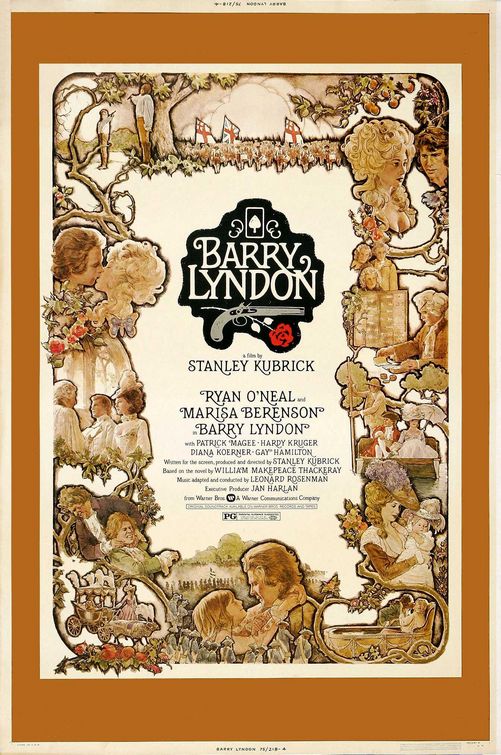
Film # 74: Barry Lyndon (1975)


Director: Stanley Kubrick

Initial Release Country: United States

Times Previously Seen: once (about 12 years ago)

*Weird, Egotistical Note: After now watching 74 shows from TIME’s “100 All-TIME Films” list, this is the first film released within my lifetime. Funny to think that, as viewers were seeing this movie for the very first time, I was wailing away in a crib on a military base in South Carolina.

Teaser Summary (No spoilers)

18th century Irish commoner spends lots of time on many rungs of the social ladder. Duels and massive decorative hats abound.

Extended Summary (Longer plot synopsis, including spoilers. Fair warning.)

What follows is a fairly complete summary. For a meticulously detailed synopsis, check out imdb’s version through this link.

Late 18th century Ireland. Redmond Barry (Ryan O’Neal) is a young lad whose father is killed in a duel. He soon falls in love with his cousin, Nora, who returns his affection readily. However, when Nora accepts a marriage proposal from a stately, if uppity, English officer, Barry becomes furious. He insults the officer to the point of demanding a duel. Barry shoots the officer, seemingly killing him. On the advice of his cousins and his second, an Irishman in the English army named Grogan, he flees his hometown for Dublin, hoping to escape the inevitable pursuit of the law.

Langdon getting held up as he flees from the English army.

On the way to Dublin, Barry is robbed of all but his clothing. Desperate for any kind of escape, he joins the British army and heads off to war. After a few brief skirmishes and witnessing the death of his lone friend, the rediscovered Grogan, Barry decides to desert his post. Using a stolen officer’s uniform and identification papers, Barry enters Prussian-controlled areas near Holland. His hope is to return to Ireland.

Instead, he is captured by a savvy Prussian officer, Captain Potzdorf (Harry Kruger), and forced to join the Prussian army. Barry spends several years with Prussian forces, among a regiment composed mostly of scoundrels and cold-blooded killers. From these, Barry learns the cold means of survival and the arts of deceit. In one particular battle, Barry saves Potzdorf. This act is rewarded with back-handed recognition, a reward, and some small measure of trust.

Barry is recruited by Potzdorf and the Prussian Minister of Police to keep tabs on a suspected spy, a gambler of Irish origin named the Chevalier de Balibari (Patrick Magee). Barry readily accepts; however, upon meeting the Chevalier, he becomes emotional in the company of a fellow countryman and betrays his true mission. The Chevalier takes him in and the two become co-conspirators. Barry helps the Chevalier cheat nobles in games of chance, at the same time feeding the Prussian government useless information about his new confidant.

Eventually, Barry and the Chevalier manage to concoct a ruse to escape from Prussia unscathed. They then spend several years traveling around Europe. The Chevalier continues to cheat wealthy aristocrats out of their money, and Barry assists by successfully dueling any reluctant debtors.

Barry plies his trade as a master duelist, a perfect profession for any amoral rogue with the necessary skills.

Barry eventually sets his sights higher – true wealth in the form of the English countess Lady Lyndon, whom he meets at a gambling table. Barry courts the married Lady, which infuriates her aged and decrepit husband. The Lord Lyndon is so enraged, in fact, that when he starts an argument with the calculating Barry, he dies of a heart attack. This leaves the way wide open for Barry to swoop in and marry the love-struck Lady Lyndon and assume his new title – Barry Lyndon.

Over the next several years, Barry’s married life on his wife’s English estate disintegrates. While his wife stays home and looks after her son from her first marriage, Sir Charles, and hers and Barry’s son, Bryan, Barry himself lives a life of opulent leisure. His excessive drinking and philandering does not go unnoticed by his step-son, Sir Charles. Though merely ten years old when his mother remarries, the boy quickly develops acute hated for his rogue of a stepfather. This hatred only grows stronger as time passes.

Within these years, Barry’s mother comes to live with them and she points out how Barry needs to attain his own title, thus decreasing his total reliance on his wife’s fortune. Following this advice, Barry begins to spend lavishly on art, parties, and greasing the social wheels for his ascendancy into “higher spheres” of social worth. Things seem to be moving in the right direction until, at a party on the Lyndon estate, Lord Charles bursts in and announces his utter hatred for his stepfather in front of the guests. The enraged Barry mercilessly attacks his step son and pummels him in front of their guests. Word soon spreads of Barry’s brutality, and his “friends” completely ostracize him.

Barry turns his attentions toward his natural son, Bryan. As opposed to his horrid treatment of Lord Charles, Barry showers Bryan with true love and affection. Unfortunately, Bryan suffers a terrible horse riding accident just before his ninth birthday and dies a few days after. Barry and Lady Lyndon are so distraught that Barry’s mother must take over the family’s finances. When she dismisses Lady Lyndon’s closest associate, the vicar Reverend Runt, word gets out to Lord Charles, who has been living away from his family’s estate after the beating received at the hands of his stepfather.

Barry in the center of the frame, Attempting to drown his sorrow over his son's death. Little does he know that things are about to get even worse...

Lord Charles, supported by some of his family’s close friends, seeks out Barry and challenges him to a duel. In a secluded barn, Lord Charles wins the right to the first shot, but misfires. Upon his chance to return fire and likely kill Lord Charles, Barry opts to fire his pistol into the ground. Lord Charles, instead of being satisfied, demands another shot. He takes it and hits his stepfather in the leg. Barry is taken to a nearby inn for treatment, while Lord Charles rushes back to his family estate and quickly reasserts control over the household.

Barry must suffer his leg being amputated. More than this, though, he is given an ultimatum from Lord Charles – leave England forever and accept a 500 guineas annuity from the Lyndon family, or stay and suffer arrest on the grounds of his massive debts. Barry leaves England, and we are told that he returned to continental Europe to return to the gambling profession, “without his previous success”.

Take 1: My Gut Reaction (Written after this recent viewing, before any research.)

A story about this viewing of Barry Lyndon:

My girlfriend and I sit down a few evenings ago to watch it. The film moves on at its’ leisurely pace and time clicks on. At roughly the 90-minute mark, the “Intermission” screen pops up. My girlfriend goes slightly slack, her eyes widen, her jaw drops, and she asks, “How long is this movie?!” With a semi-knowing grin, I turn and reply, “It’s three hours long. We’ve got 90 more minutes to go.” Eyes still wide, she shakes her disbelieving head. After hanging in for another 30 minutes or so, she gives up and goes to bed. I stay up and watch the full film, enjoying it right up until the end.

This little tale of our viewing I think sums up how nearly all people feel about Barry Lyndon – you either love it, or you see it as too long and dull to take. Clearly, I am in the former group.

I have to say that this is one of those movies that you have to know what you’re in for and be in just the right state of mind to watch. Barry Lyndon is slow. Extremely slow. Kubrick took the approach of relying far less on dialogue and far more on slow zooms of panoramic landscapes and interiors. If you prefer more kinetic action and emotional dialogue, the three-hour Barry Lyndon will be an effort in frustration. I, however, love watching the movie. The lush colors, attention to detail, and expansive wide-angle shots are like classic works of art slowly coming to life (emphasis on “slowly”). The beauty of the natural surroundings, castles, and costumes throws into contrast the dastardly deeds that people are committing throughout the film.

This is the very first shot of the film, both in filming terms and in dueling terms. The entire visual style and story theme are set up within this shot - breathtaking beauty wholly encompassing human destruction.

The story itself is epic in scale, and I’m a sucker for a good epic. Following the roughly twenty-year rise and fall of Langdon Barry is a spectacle, as it allows the viewer to traipse through the Europe of William Makepeace Thackeray (the author of the source novel). To be sure, there is some interpersonal exploration done, but the movie is mostly given to sweeping powers of the times - war and class distinction – and their effects on humanity.

One of the recurring themes in the film is the duel, and it is these scenes that are most striking and intense to me. While all of the duel scenes (three with pistols, one with swords) are incredibly hypnotizing, it is the final one between Barry and his stepson, Lord Charles Bullingdon, that is an absolute masterpiece. The measured ritual with which the scene plays out and the very visible terror on the face of Bullingdon are perfection. The scene plays out with agonizing deliberation, forcing you to get into the heads of those involved. Once you do this, it’s not difficult to imagine just how terrifying a prospect it must have been to stare at someone standing ten paces from you, and you stared into their eyes just before they killed you or vice versa. It’s a version of Sergio Leone’s extended western gunfights, though a far more chilling one.

Guiding us through Barry’s journeys is a bemused narrator. As a rule, I find narration in films to be something of a crutch, borrowed from the realm of literature. Films should be able to tell their stories through visuals and dialogue. However, there are a few films in which it can enhance, and Barry Lyndon is a mixed bag. At times, the narrator’s commentary is tinged with sly gallows humor that I can only guess was Thackeray’s and which adds some welcome levity. In other moments, it does indeed seem a cheap way out of conveying humor or emotion directly through the characters’ words or actions.

Barry, we are told by other character and the narrator, is a hot-blooded young man. You'd hardly know it from his face here, which is the same bland expression he wears through nearly the entire film.

This downplay (or lack of) emotional dialogue is probably one clear reason that people may not like this movie. There is an overall stillness to the movie, save perhaps a few scenes of warfare and brief fighting. Knowing that Kubrick was a meticulous perfectionist, I am quite sure that this was intentional, and this tranquility pervades even to the acting. Even during tense confrontations and emotional moments, everything is very placid. While this is soothing in most places, after about two-and-a-half hours, the characters almost seem devoid of any real feeling.

This sensation of dead calm would not be so obvious if not for the performance of the title character actor, Ryan O’Neal. Some of the film’s minor characters do actually show more spirit. In stark contrast, O’Neal’s facial expression almost never changes throughout the movie, which leaves the viewers to rely on the narrator and guesswork to glean Barry’s true desires. Perhaps we viewers are supposed to take this as an outward sign of Barry’s emotional detachment, but it really just comes off as flat and unengaging most of the time.

This brings up the other reason most people probably dislike this movie. The morning after I watched it, my girlfriend and I discussed it. As she considered how Barry is a mostly despicable character, she rightfully wondered, “What’s the point?” I imagine countless other viewers have asked the same question. When I ponder the answer, I always return to the epigram of the film:


With this final message, we are left to wonder perhaps not about the point of the movie, but rather about the point of all of the violence and pain depicted in the movie. Violence and pain that certainly was based on real actions of the times. In watching Redmond Barry get caught up in the materialism and territorial struggles of his age, I can’t help but think of a movie critic who suggested something very cogent about Stanley Kubrick’s films. Kubrick’s movies, while covering a vast spectrum of genres, including war, action, science fiction, horror, and drama, all had the same basic message underlying them: humans are not fallen angels, but rather ascendant apes. Barry Lyndon, like all of Kubrick’s other films, shows just how not just one person but an entire society can slip into barbarism. Even when the players are dressed in the finest of clothes, living in the plushest of mansions, and possessing the most stunning of lands, they are no less capable of the basest primitive cruelties.

A happy message, it is not. But it is certainly one worth pondering. Barry Lyndon gives you the chance to calmly mull it over while drinking in the cultural splendor of a bygone age. It’s not for everyone, but I’d recommend everyone at least watch the 90-minute first act and find out for themselves.

Take 2: Why Film Geeks Love This Movie (Done after a little further research.)

A few surprises on things that I’ve found (and not found) in reading up a little more in Barry Lyndon.

The movie was, as mentioned, based on a far lesser known novel my William Makepeace Thackeray, who is now far better known for Vanity Fair. Barry Lyndon, though, is often referred to as the first “anti-hero” English novel. Kubrick clearly kept this idea true to its roots. Kubrick also kept the setting and characters basically the same, though he took out a few family connections that were in the novel. One such is that the Chevalier de Balibari (as I probably should have figured, based on the name) is, in the book, actually an uncle of Barry’s who had fled Ireland. The novel’s tale goes that he was kicked off his land and dispossessed by the Lyndons themselves, into whose family Langdon marries much later. This is probably a more interesting plot connection, and I wonder why Kubrick left it out. Perhaps he felt it far too convenient, but who knows?

Another interesting departure from the novel is that the film ends significantly before the novel’s tale, with several notable differences. In the film, the story ends just after Barry is shot and loses his leg in the duel with Lord Charles, and he is forced to leave England, accepting his modest annuity. In the book, the duel does not exist, and Barry actually becomes a member of British parliament. He sends his step-son to the Americas to fight in the Revolutionary War, and is accused of trying to have his son killed. He is stripped of his title and forced out of the country. Eventually, he is jailed for debts and spends the final seventeen years of his life in prison, with only his elderly mother to attend him. Obviously, Kubrick couldn’t tell all of this story using the measured pace that he wanted, so he chucked it.

A fairly recent edition of Thackeray's original novel. Kubrick was faithful to most key elements, but made several notable changes.

Another interesting difference between novel and film is the tone. From what I’ve read on it, Thackeray’s novel is told in first person by Barry himself, with an overtly humorous tone. In it, Barry is an early example of the “unreliable narrator”, who seems oblivious to his own shortcomings. Kubrick eschewed this and achieved a much more objective look at the character and his world. This accounts for the very detached feeling of the movie.

When released, Barry Lyndon was something of a disappointment. While it did pull in seven Academy Award nominations (winning four in the technical categories of art direction, costumes, cinematography, and music) and received fair critical acclaim, it did not win over all critics or the public, especially those with high expectations of Stanley Kubrick. In his original review in 1975, Roger Ebert probably summed up a lot of the feeling of the day. He described it as having “the arrogance of genius” and lauds its many brilliant merits. He does, however, note of O’Neal’s performance that “Kubrick has directed Ryan O’Neal in the title role as if he were a still life. It's difficult to imagine such tumultuous events whirling around such a passive character.” This is really the only critical note I found of O’Neal’s flat-line turn as Barry.

In recent years, Barry Lyndon has gradually gained more attention as one of the greatest of films. More and more, critics seem to be willing to see its cold, calm tone not as an example of a bad decision on Kubrick’s part but rather a very unique and artistic way of observing and telling a human story. One can call it hopeless or dreary, and I can’t necessarily argue, but I have to say that I will always find it mesmerizing.

That’s a wrap 74 shows down. 31 to go.

Coming Soon: Taxi Driver (1976)


Oh, boy. Anyone who’s seen this movie knows that it contains every ounce of dark despair that the mid-1970s United States could muster. It’s also an incredible piece of film making, and the first of three Martin Scorsese movies on the list. Come on back in about a week or so to see what I make of my return to the sad tale of Travis Bickle.

Please be sure to pick up all empties on the way out.