Wednesday, March 21, 2018

New Release! Tomb Raider (2018)

Director: Roar Uthaug

A completely average reboot that wastes some legitimate resources and acting talent.

Like plenty of men now in their early-forties, I played the original 1996 Tomb Raider game on the Playstation back when it was released. It was a fun little adventure/action/puzzle game, if not one that totally grabbed me. I didn't bother with any of the many sequels for a long while. I also didn't bother seeing the two feature films starring Angelina Jolie back in 2001 and 2003, as they looked rather campy and silly. I did, however, play the more 2015 reboot of the video game series, which was actually very well done and quite entertaining. This last interaction with the series, along with my brother-in-law's desire to see the film, is what brought me to the theater to see a movie I otherwise wouldn't have bothered with.

The film tells the story of Lara Croft, an heiress to a billion-dollar business empire who has little desire to claim her vast fortunes. We meet Lara as she tries to scrape out a meager living in downtown London. She is eventually confronted with the unavoidable task of signing documents which will declare her father, who went missing seven years prior, legally deceased, also making her responsible for the family's vast fortune. Lara quickly discovers some cryptic clues as to her father's mysterious disappearance, however, and she jets off to follow his cold trail and learn more. She initially traces her father's path to Hong Kong, and then to a tiny, remote, barely-known island off the southern coast of Japan. There, she discovers an entire crew of captive men being forced to search for some sort of treasure alluded to in little-known legends about a Japanese empress's tomb. Lara becomes embroiled in a game of survival and a race to prevent the potential thieves, led by the cold-blooded Mathias Vogel (Walton Goggins), from accomplishing their goal.

Tomb Raider is ultimately a pretty forgettable attempt to blend the most recent versions of the video game series with a few dashes from the Indiana Jones movies which have always inspired the character. There are a few culprits, but the two obvious ones are a lack of a sharp script and a misguided choice in tone.

Expect a mud-caked, battered Lara to hang from many
cliffs and grit many teeth. Actress Alicia Vikander certainly
looked and acted the part. If only the script had risen to her
dedication and acting levels.
The dialogue and character interactions never rise above mildly interesting, and often they are flat-out dull. This has nothing to do with most of the acting. Alicia Vikander and Walton Goggins do as much as they can with the lame dialogue they were given to work with (Dominic West, who plays Lara's father goes overboard, though). The film also misses out on chances to add a bit more depth to a few characters, such as Lu Ren, the young boat captain who accompanies Lara to the island. The basic idea of the character was fine, and actor Daniel Wu does well in the role; alas, nothing much was done with him to inspire interest in his plight.

The weakness in the script can also be connected to the general tone and approach to the film. About 20 minutes into the film, virtually the entire movie is pure survival adventure, with one cliff-hanger after another bombarding you. Some of the early sequences and set-pieces are actually decent. But when there are laughable coincidences and lame devices connecting one thrill-scene after another, for over an hour straight, it gets old pretty quickly. Some decent levity and comedy might have helped here, but the movie has a fairly humorless tone much of the time. And the occasional attempts at comedy always fall very flat, again due to mediocre writing more than any problems with the performances.

This iteration of Tomb Raider is one of those movies that you'd probably feel fine about watching if you're just looking for a decent, two-hour distraction while channel surfing at home, late at night. But I wouldn't suggest anyone go out of their way for it. 

Wednesday, March 7, 2018

Before I Die #620: Earth (1930)

This was the 620th film I've now seen out of the 1,199 films on the "Before You Die" list which I'm gradually working my way through.

Original Russian Title: Zemlya

Director: Aleksandr Dovzhenko

A curious old silent Russian movie that was intermittently hypnotizing and baffling, the latter only slightly due to poor subtitles.

This tidy little, 76-minute movie tells the story of a group of Russian peasant farmers who obtain a mechanized tiller/thresher, a highly advanced piece of machinery for the day. One group uses the thresher to till the fields of the wealthy land-owning kulaks, in a bid to take control over the land on which the peasants do most of the work. The young man most responsible for the tilling is killed that night, while drunkenly wandering home. This death leads to his young wife's death through grief, and his father swearing revenge. This leads to a greater uprising in which the kulaks are brought down, thus heralding a new age in which peasants have control over their own lives.

Earth is a quick watch, which I found to be fortunate. Although I can appreciate the film artistry and clear passion that went into this pre-Stalin era Russian movie, it was quite obviously meant for a particular audience. Namely, the common Russian peasant of the 1920s, '30s, and even '40s. Like many of the great Russian movies in and around the time of the Bolshevik Revolution, this one wears its propagandic nature right on its sleeve: the kulaks are evil, and the common peasants are the downtrodden heroes. As simple as that premise is, this movie is actually rather confusing for someone who doesn't understand exactly how Russian agrarian society was organized, along with its built-in tensions. I honestly had to pause the movie and do a bit of research on the Internet so that I didn't get lost. For me, one mark of any great piece of art is that is doesn't rely as much on context and can stand on its own feet. In this regard, Earth doesn't hold up well. A Russian citizen or Russian scholar would probably follow the grander themes without trouble, but the rest of us are bound to be at least a little confused.

There are plenty of wonderful outside shots in the film,
including Vassily's funeral march. The implication is also
rather clear - nature itself, in the form of the sunflowers'
down-turned heads, mourn the loss of one of their own.
Though the narrative elements are not terribly accessible, director Dovzhenko's skills as a filmmaker are quite clear. He uses a variety of then-deft film techniques to tell the story in evocative, poetic ways that can be quite engaging. He will superimpose shots of nature with the age-lined faces of the peasants. He will allow the camera to linger on farm machinery as it churns away, not unlike the brilliant Russian film Man with a Movie Camera from the prior year. Such fascinating camerawork and editing made me wish I had been watching a better copy of the film, as opposed to the online streaming version I found, which was passable but hardly of Criterion Collection quality.

Put this one in the same category as movies like Battleship Potemkin and October - silent Russian Revolution propaganda movies by excellent filmmakers in their day, but movies which now are mostly for academics and pure students of the visual aspects of film.

That's 620 movies down. Only 579 to go before I can die. 

Monday, February 26, 2018

Retro-Trio: Two Days, One Night (2014); Kong: Skull Island (2017); In Her Shoes (2005)

Two Days, One Night (2014)

Directors: Jean-Pierre Dardenne, Luc Dardenne

Very well-done, human drama that relies on genuine distress to remain engaging.

The story is that of Sandra (Marion Cotillard), a woman in Belgium has just gotten over the hump of a horrible depressive episode. However, she just learns that she has lost her job due to a vote held behind her back. Her coworkers were forced to choose to either keep Sandra on the staff or to accept their sizable annual bonuses. She and a friend quickly appeal to the manager to hold a re-vote the following Monday, a mere two days away. Sanda much now frantically track down as many coworkers as possible and convince them to forego their bonuses so that she can return to her job - a job that she desperately needs.

This movie is certainly not an "upper" by any means. While there is just enough humor and levity to prevent things from getting overly grim, there is a very real sense of panic as Sandra rushes about on her desperate mission. This is, of course, what makes the film strong. As she speaks with each of her coworkers, we become invested in how they will respond. Some are sympathetic and offer to vote in Sandra's favor. Others try to be understanding but admit that they need their bonus money. Still others grow angry at Sandra for even asking them to give up their bonus for her sake. It is a very human drama where the stakes feel all too real, and the excellent acting sells its reality.

My wife, who tends to enjoy this kind of movie a bit more than me, even admitted that Sandra could get a bit much at times. Her husband, a rather kindly fellow who stays by her side through the particularly rough patches, becomes a quietly sympathetic character in the movie, as he offers no end of support. By film's end, one may grow a bit tired of the emotional ups and downs. Still, the ride is pretty well worth it, as it offers genuinely touching moments of the sort that can be tough to find in movies these days.

A few nights after watching this one, I felt the urge to go for nearly the completely opposite genre...


Kong: Skull Island (2017)

Director: Jordan Vogt-Roberts

Somewhat to my surprise, I enjoyed this movie, even though I'm not particularly a fan of monster movies.

The second in the newly-created "Monsterverse" franchise (the first being 2014's Godzilla), Kong:Skull Island takes place in the 1970s, as the U.S. begins to pull out of Vietnam. A tiny government agency (two guys, really) convinces a congressman to fund an expedition to a mysterious island in the South Pacific. The official Bill Randa (John Goodman) and the geologist Houston Brooks (Corey Brooks) believe that the unexplored island may contain bizarre lifeforms which the U.S. would do well to obtain before any of their Cold War enemies do. With funding, they round up a team including a tracker, several scientists and observers, and an Army platoon who has just been decommissioned from the Vietnam War. But when the crew arrive on the island, known as Skull Island, they very soon come across a massive, 100-foot ape which attacks them and wipes out several of their helicopters and soldiers. Now scattered, the team must try to regroup and find their way off of the treacherous Skull Island. As they wander, they discover more dangers and wonders about the home of Kong.

This movie is solid fun. Yes, it does attempt to get a tad serious in a few spots, but it never overdoes it. Mostly, it's a well-done action romp. The cast is great, with a ton of screen veterans like the aforementioned Goodman, and also Samuel L. Jackson as the warmonger platoon captain, Tom Hiddleston as the capable tracker, and slightly lesser characters played by vets like Brie Larsen and John C. Reilly. They don't always have super sharp dialogue to work with, but they almost always sell it well.

The action is mostly great. I'm not a particular fan of monster movies, but this one did a really nice job of keeping some surprises up its sleeve as the story went along. Mostly, the fun came when a seemingly serene part of Skull Island would suddenly turn into some sort of lethal monster. There is an entertainment in realizing that literally anything in the lush landscape could come to life and start killing the humans who have encroached here. Helping keep the vibe up-tempo and heart rates racing, this movie has one of the more kick-ass soundtracks I've heard in a while, with heavy metal and rock 'n roll greats from the early '70s like Black Sabbath, The Stooges, and Credence. Pretty hard to miss with such titans of great rock music enhancing the on-screen action.

So as of now, I'm on board with the Monsterverse. It's two-for-two in my book, which was much more than I could say for the big-budget DC Extended Universe after its first two movies, Man of Steel and Batman v. Superman. I may even go check out Godzilla: King of Monsters when it comes out in 2019, if I'm in the mood for a fun popcorn flick.

And then Valentine's Day came along, which swings me back in the complete opposite direction again with...


In Her Shoes (2005)

Director: Curtis Hanson

An enjoyable chick flick, even for a dude like me.

This is one of my wife's favorite movies, and Valentine's Day seemed like an appropriate time to watch it with her. It tells the story of two sisters, Maggie (Cameron Diaz) and Rose (Toni Collette), living in Manhattan. Maggie is a consummately irresponsible "party girl" and almost pathological liar, while here sister Rose is a highly responsible though rather uptight lawyer of no small means. The sisters have an established routine of Maggie getting herself into trouble, often through her drinking and/or lying, and running to seek shelter with Rose. This mildly codependent bond is shredded when Maggie is caught sleeping with Rose's current boyfriend and boss. Kicked out of Rose's apartment and with no other idea of where to go, Maggie hops a train down to Florida to find her and Rose's estranged grandmother, Ella (Shirley MacLaine). There, Maggie begins to learn more about their hidden family issues, while back up in Philadelphia, her sister deals with the fallout of her boyfriend having cheated on her.

It's easy to see why this movie is considered a pinnacle of "chick flick"-dom. It focuses on female characters, and it hits virtually every emotional mark that the genre is known for hitting; namely, relationships of several types. Relationships with one's sister. Relationships with potential boyfriends and husbands. Relationships with one's grandmother. Relationships with the family members who've gone missing. These are all handled very well in this movie, with a solid balance of humor and gravity that even a less sensitive fellow like myself can appreciate. The dynamics between the primary characters all feel quite genuine, and the parts are written and acted very well by the stars.

I also appreciate the tone of the movie. Many films in this genre are a bit too "light and fluffy" for me. I remember watching a chunk of My Best Friend's Wedding years ago, and being unable to stomach the contrivances and so-obviously cutesy nature of much of the story and gags. In Her Shoes keeps the stakes just high enough that there is some weight to the characters' thoughts and actions, while never getting too bogged down into any sort of darkness. This was not easy, as the movie does deal with learning disorder, mental instability in a parent, the need for Maggie to change her self-absorption, and similarly deeper topics. Screenwriter Susannah Grant did a really nice job adapting Jennifer Weiner's successful novel of the same name.

So I have to give this movie the highest compliment I possibly can for this type of movie: not only did I enjoy watching it, but I wouldn't mind watching it again should the wife suggest it. It's made the shortlist!

Friday, February 23, 2018

Retro-Trio: Hellraiser (1987); Semi-Pro (2008); Flesh + Blood (1985)

Hellraiser (1987)

Director: Clive Barker

Sometimes you feel the urge to go back and watch a highly influential movie you hadn't seen in decades, even if you're fairly sure that it won't hold up well. Such was the case when, a few nights back, I noticed that Hellraiser was available on one of my streaming services. It was late, and I was in the mood for something twisted and dark, so I went for it.

Watching this movie now, 31 years after its original release and probably a good 25 years after I'd last seen it, the strengths and weaknesses are exactly what lay in my memory, even though most of the details had been lost in the interim.

For those who don't know the tale, it is a wildly horrific tale of Julia and the family into which she married. The rather cold, reserved Julia moves into the old, previously abandoned family house of her husband, Larry, and her step-daughter Kirsty. When first seeing the place, they realize that Larry's mysterious loner brother, Frank, had been squatting in the home not long before their arrival, though Frank is nowhere to be found at the time. Seeing his belongings sparks Julia's memories of having an extended, passionate affair with the darkly hedonistic Frank, and Julia even begins to dream about being with Frank again. A few days later, Larry cuts his hand in the home, and the blood trickles into the floorboards of the dank, upper-most room in the house. Slowly, the blood is absorbed and revives some sort of horrific, flayed human, whom Julia discovers to her horror. This creature quickly explains to Julia that he is, indeed, Frank, and that he had transported himself, via a strange black and gold magic box, into a realm of dark sadomasochism ruled by terrifying, demoniac creatures called Cenobites. Frank convinces Julia to lure more victims into his upper floor lair, where she should kill him and allow their blood to revitalize Frank into human form before the Cenobites discover him missing and pull him back into their twisted, torturous realm.

In its day, Hellraiser was one of the most creative, disturbing, and truly horrifying films made in quite some time. Sure, there had been more graphic horror movies. And there had been eerier tales told on film. But Clive Barker's feature film debut was its own stunning blend of modern gothic horror and graphic bloodletting, wrapped in a supernatural tale that hinted at its own almost Lovecraftian-level mythos. The mere conception and look of the Cenobites, tortured and disfigured creatures cloaked in black leather and adorned with various sharp, cutting instruments, was enough to give most of us nightmares. When this was added to the quality special effects that brought the nightmares to life, you had something that made a major impression, grotesque it is may have been. In watching it now, 30 years after its release, I can say that most of the visual effects, especially the costumes and basic set designs, hold up. And the pure horror elements of the story are just as disturbing now as they were then.

The effects in the movie are great, most notably on the
slowly-regenerating Frank. It calls to mind of the stellar
makeup work from Cronenberg's
The Fly.
Unfortunately, like most of even the best horror films, the non-horror aspects of the movie are fairly weak. The backstory of Frank and Julia's affair is quite shallow, with Frank being a one-dimensional "bad boy" who literally shows up in a leather jacket on Julia's doorstep, dripping with rain, and giving her the bedroom eyes right from the jump. There is zero subtlety in their lust-filled affairs, and it seems a bit odd that Julia becomes so wildly obsessed with him that she is quite literally prepared to become a serial killer just to revive him - a man who long since abandoned her to go chasing other women and satisfaction of his own carnal lusts through any means he could find. I suppose one could argue that such can be the power of lust, especially lust repressed under a cold veneer such as the one that Julia usually exudes, but this is a bit of a stretch.

The acting is rather inconsistent, too, with a few screen veterans like Andrew Robinson and Clare Higgins doing just fine, but most other cast members appear rather amateurish. It doesn't do any of them any favors that the dialogue is uncomfortably bad, aside from the few memorable catchphrases that Barker puts in the mouths of the Cenobites - "We have such sights to show you," and "We'll tear you soul apart!" delivered in actor Doug Bradley's powerful, domineering voice still resonate as some of the most memorable lines in the history of horror films. But when it comes to the more casual dialogue between the horror scenes, the attempts at humor fall completely flat and any attempt to build any compassion for the characters never materializes.

I recall having seen the immediate sequel, 1988's Hellbound: Hellraiser II, but I've never bothered with any of the seven feature-length follow-ups (several of which were straight-to-video). I can appreciate dark horror, and the more imaginative concepts which Clive Barker created those decades ago are still somewhat compelling, but there was never enough for me to go beyond those first two movies. Real horror aficionados have likely already seen these films, probably multiple times, so it is hard to recommend it to any new viewers. Only if you are a horror fan who is a bit young and never gone back to see this one would I suggest you give it a go - despite its clear flaws, it really is one of the most influential horror movies of all time, with its fingerprints still being seen in horror movies made today.


Semi-Pro (2008)

Director: Kent Alterman

It's a Will Ferrell comedy, alright.

I like Will Ferrell. He's always been good for pretty solid, consistent laughs. I have not, however, ever become a full devotee of the comedian with seemingly boundless energy. As funny as he can be, he rather quickly became a one-note comic act in my view. This is why I've never run out to catch him movies in theaters, often waiting years after their release to watch them; sometimes never bothering to watch them at all. Watching the now decade-old Semi-Pro did nothing to change my feeling about Ferrell, either positively or negatively.

The story takes for its setting the rather low-hanging comedic fruit of the disco era in 1976. Ferrell plays Jackie Moon, a one-hit music wonder who used his lone hit song's earnings to purchase the Flint Tropics - a professional basketball team in the struggling American Basketball Association (ABA). The Tropics are the worst team in the floundering ABA, only keeping their nose above water thanks to Moon's over-the-top promotional antics, including sensational halftime shows and performances. When word comes down that the ABA is going to be contracted and absorbed into the far larger and more successful NBA, the desperate Moon makes a deal to see that his team is one of the four who will make the jump into the big league. The deal requires him to get his squad to climb out of the cellar and attain 4th place in the ABA standings by season's end, no mean feat for the disogranized and talent-bereft Tropics. Hope does emerge when aging former NBA player Ed Monix (Woody Harrelson) is able to lend his veteran knowledge and help coach up talented but selfish young NBA-hopeful Clarence (Andre Benjamin).

While Ferrell's Jackie Moon character isn't exactly like Ron Burgundy in Anchorman or Ricky Bobby in Talladega Nights, Moon does bear the hallmark idiocy, self-absorption, and overconfidence of virtually every character Ferrell has ever played on TV or the big screen. Of course, there is a reason for the typecast - Ferrell is exceptionally good at the role. Despite myself, I can't help but laugh at his line deliveries, facial expressions, and overall body language when playing such over-the-top buffoons. Since Ferrell's shtick alone can become a bit tiresome at times, it helps that there's ample comedy talent around him. Will Arnett is a standout, as the whiskey-swilling, chain-smoking color commentator for Tropics' broadcasts, but there are several others who round out the proceedings well. Woody Harrelson's comedic gifts are mostly underutilized, as he plays the mature role in the film, but he does have a few moments.

As with every other Ferrell-starring film, not every gag hits, and there are probably ten to fifteen minutes of ad-libbed nattering that should have been edited out, but the movie provides frequent enough laughs to justify its purpose. It's a dumb comedy meant to provide some gut laughs. It does that just fine.


Flesh + Blood (1985)

Director: Paul Verhoeven

A rather good, gritty medieval flick with a B-movie attitude by a director who knows how to do entertaining sex and violence.

I picked this one up after seeing it pop up on more than one "underrated film" list. Despite being a true 1980s kid, I had never even heard of it. Now that I've seen it, I understand why. The movie follows a renegade band of mercenaries led by Martin (Rutger Hauer), a highly skilled and dangerously cunning fighter. Martin and his band are first used and then cheated by a regional lord in order to get his castle back from invaders. As revenge, Martin's unruly band stages an attack on a group of the lord's closest associates, including his son Steven (Tom Burlison) and Steven's bride-to-be, Agnes (Jennifer Jason Leigh). Martin's band of marauders steal the goods, only to later discover that Agnes has been hidden away in one of the wagons. She is promptly raped by Martin, although in a way whereby Agnes either does, or at least acts like she does, enjoy being violated by the strapping bandit leader. From this point, Agnes's action become rather difficult to decipher for everyone involved. She is taken with the band to a small nearby castle, where Martin's crew kills the defenders and takes over. Agnes seems to become Martin's willing woman, although when Steven and the regional lord's soldiers lay siege to the castle, Agnes continues to change her allegiances back and forth between Steven and Martin. By tale's end, Martin narrowly escapes his entire band's being wiped out by the plague, and Agnes leaves with Steven. Agnes actually sees Martin escaping, but remains silent rather than alerting Steven's men to the dangerous bandit's survival.

This is a 1980s medieval sword-swinger unlike any other I've ever seen, especially from that era. I always enjoyed the setting and characters in those romantic "Arthurian" type tales, and even plenty of the fantasy tales that were inspired by that sort of setting. Excalibur is still great, and movies like Ladyhawke and Willow always had an appeal for me. Those movies were, though, relatively PG-rated. Flesh + Blood, on the other hand, gets its hands really dirty. The murder and sex are right in your face, and Martin's rape of Agnes is downright disturbing on an original Straw Dogs level. This movie is very much about depicting a band of depraved and bloodthirsty cutthroats in all their viciousness, and it works quite well. They truly are despicable characters.

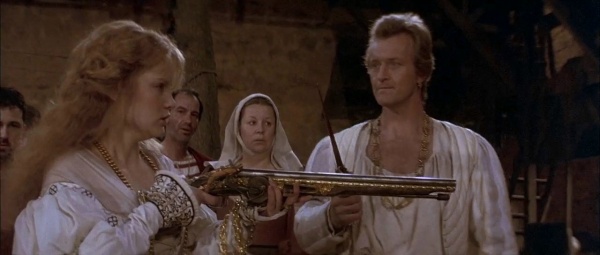
Martin is more than ready to let Agnes handle his, uh, rifle.
The previously-sheltered Agnes takes to the sex and violence
with disturbing alacrity.
The story of Agnes is also a strangely novel one. There is a bold ambiguity to her motivations, as she plays Martin and Steven off of one another, almost like a cat playing with two mice. Of course, this cat is posing as a harmless kitten, but there is a strange empowerment to her character at times. And the way that the theme of violence is handled puts me in mind of the David Cronenberg masterpiece A History of Violence, in which violence is depicted both as a repugnant aspect of human nature as well as a source of animal magnetism to others. Rutger Hauer's swaggering, bare-chested alpha male Martin is the polar opposite of the learned and thoughtful but also bold and clever Steven. The basic tale of a woman torn between "brawn" and "brains" was not a new one by a long shot, but this movie tackled the subject in a grittier way than any other I know of.

I doubt I'll ever need to see this movie again, but I was glad to have finally gone back and given it a shot. It's not for everyone, as it is a hard-R-rated movie, without a doubt. But it more than held my attention for its manageable running time, and it shed even more light on what an exciting, if uneven, resume Paul Verhoeven has put together over the decades.

Wednesday, February 21, 2018

New Release! Three Billboards outside Ebbing, Missouri (2018)

Director: Martin McDonagh

A brilliantly biting, strikingly dark comedy that is noted director Martin McDonagh's best to date.

Taking place in the titular small town in roughly modern times, local woman Mildred Hayes (Frances McDormand) rents out three billboards lined up in a row along a little-used road near her home. On the billboards, she places three connected phrases, the ultimate message of which is to question the local sheriff, William Willoughby (Woody Harrelson), as to why he has yet to find the person(s) responsible for the rape and murder of her teenage daughter, a horrific act which happened a year prior. The billboards set off a range of emotions in several of the townspeople, and they expose more than a few sentiments that have lingered slightly beneath the surface for many. Most of these sentiments are connected to deep anger, and the only person who might be angrier than Mildred herself is the none-too-bright deputy Dixon (Sam Rockwell), a racist and homophobic thug who more often than he wishes finds himself in the middle of the firestorm that Mildred sets off with her billboards.

Anyone who has seen Martin McDonagh's other films In Bruges or Seven Psychopaths knows that he loves his humor pitch-dark, and Three Billboards is right in line with his previous movies. But while In Bruges was more overtly comic, and Seven Psychopaths had a much more bizarre, overall gonzo feel to it, Three Billboards includes more genuine, and genuinely moving, emotional turns. Yes, the plot turns and even sometimes the characters are quite obviously works of fiction, given the sometimes-extreme nature of what occurs and the main players' reactions. But it all has a mostly cohesive feel, and one that is helped along by plenty of downright hilarious (but again, dark) comedy. McDonagh seems to have found his best balance of his sly storytelling abilities and a certain poignancy with which he has only flirted in the past. The running theme he works with here is that of anger in several forms, and how people handle it in sometimes highly destructive ways, even when that anger is justified. This seems like a topic especially relevant to our current times.

Frances McDormand is an immense force in this movie,
utterly unafraid to face down anyone she sees as coming
between her and her desired justice. This includes head-
strong bully cops, like Sam Rockwell's Officer Dixon.
This movie has, along with grabbing a nomination for Oscar Best Picture, has also been nominated for a couple of acting Academy Awards. I can't argue, with Frances McDormand once again turning in a brilliant performance as the ever-salty, tough- and mad-as-hell Mildred. And Sam Rockwell is excellent as the mostly repugnant Officer Dixon, though I actually think that he has had a few performances even more worthy of recognition than this one, most notably in Moon. Though not nominated for any grand awards, Woody Harrelson also turns in a typically fine performance, and all of the bit players are great.

I will say that not everything in the movie fits perfectly into place. There are a few over-the-top or simply oddball scenes which feel too much at odds with the overall tone at times. And the change that Officer Dixon undergoes is a bit inexplicable in a few ways. Still, the movie's strengths do more than enough to outweigh such questionable elements.

At this point, I have seen eight of the nine nominees for Oscar Best Picture, and Three Billboards is among my favorites. Though it might not be as tight or quite as narratively polished as several of the other nominees, it is, along with Get Out, the gutsiest and most unique of them all. I give it a semi-outside chance at winning, but I'll be surprised if it wins the big award. 

Monday, February 19, 2018

New Release! Black Panther (2018)

Spoiler-Free Section! Don't Panic.

Director: Ryan Coogler

It may not be among the very best fantasy/action movies ever, but Black Panther is easily the most wonderfully unique superhero movie yet put on screen.

Part of the Marvel Cinematic Universe (MCU) and introduced in 2016's Captain America: Civil War, the title character's real name is T'Challa (Chadwick Boseman), crown prince in the tiny, fictitious African country of Wakanda. To the rest of the world, Wakanda is a poor nation which has virtually no dealings with the international community. However, the truth is that Wakanda possesses technology so incredibly advanced that it puts the rest of the planet to shame. To avoid undue attention due to their otherworldly rescources, Wakanda has hidden itself for centuries behind a large cloaking shield, appearing from the outside like an undeveloped rainforest. Not long before the events of this movie, Wakanda's previous king was murdered, leaving T'Challa to claim the throne and continue his ancestors' rule over their country. A great aid to Wakanda's kings is the ubiquitous presence of the ultra-rare metal vibranium, which also leads to the growth of a special herb which can grant its consumer amazingly enhanced strength, speed, and senses, thus creating the protector persona of "The Black Panther." A serious threat emerges, however, when T'Challa pursues Ulysses Klaue (Andy Serkis), an arms dealer who has escaped Wakandan justice for decades. Working with Klaue is the mysterious mercenary Erik "Killmonger" Stevens, who has eyes on the Wakandan throne, a plan to take it, and a dark vision for how to use Wakanda's vastly superior technology.

Right off, I'll point out the two things that could have been a bit better with the film, though there aren't many. As an action/adventure story, the fight and action sequences were solid but nothing terribly special. This is in keeping with other MCU movies, which often don't standout with their action or fight choreography, with only a few exceptions such as several sequences in The Avengers and nearly any of the brilliant fight scenes in the second and third Captain America films: The Winter Soldier and Civil War. They're decent, but don't capture my attention as much as they probably could. One exception is a thrilling bar fight followed by a pursuit sequence along the streets of Busan, South Korea, where T'Challa's chief general and bodyguard Okoye (Dania Gurira) completely owns the screen with her tough and willful demeanor and physicality. Aside from this, the action was simply adequate, perhaps partially due to a slight overuse of CGI.

The second is that I felt that not enough time is given over to exploring the main villain, Erik Killmonger. In some ways, which I'll get into in the spoiler section below, he is impressively unique in the MCU. However, a little more time in his background, and perhaps even a little more nuance to his character, might have gone a longer way towards building the sense of the threat which he poses throughout the movie. The film is not short, clocking in at 134 minutes, but I wouldn't have minded another ten or so minutes following Killmonger's past or even his current path to dominate Wakanda. As it is, I felt that his scheme and its ramifications unfold a bit too quickly to be have maximum impact for the story. And while he is a villain who represents something deeper than any past MCU villain, who tend to be rather dull, he is presented in a mostly one-note way that becomes stale not long after the character truly emerges.

T'Challa, flanked by spy master Nakia (left) and his fiercest
general and bodyguard Okoye) right. The CGI is a bit too
heavy for my tastes, but the diversity of intriguing characters
far outweighs any aesthetic shortcomings of the film.
Those two area aside, Black Panther is an amazing entry into the MCU for several reasons. The most obvious, and the one which is rightfully getting so much attention, is that this movie is the very first big-budget action/adventure movie, superhero or not, to be completely dominated by African-descended artists. From the director right on down through the writers and cast, we see black people in charge of everything. And the story bears the same long-overdue characteristic. Yes, there have been plenty of movies that focused on Africans and African-descended peoples before, but any large-scale production of them has always had them in the role of victim and the oppressed. And while such stories have certainly needed to be told, Black Panther represents a great acheivement in providing a great adventure tale in which Africans are in positions of great power, and the story is not about dealing with subordination at the hands of others. Rather, it is almost Shakespearian in its themes of responsibility of leadership, and the consequences of turning one's back on those less fortunate. At every turn of this movie, it is black people who are in control, and they all make it thoroughly clear that they have long had their own stories to tell.

Not stopping at moving the MCU a quantum leap forward in terms of black representation, another inspiring aspect is the movie's inclusion of many strong female characters. According to the mythology of the fictional Wakanda, the royal bodyguards are all women warriors who also serve as Wakanda's special forces units. Their general, Okoye, is as bad-ass a character as you're going to find in the MCU. Though she doesn't possess any superpowers, seeing her fighting skills and vibranium-strength determination are worth the price of admission. And lest that not be enough, T'Challa's younger sister Shuri (Letitia Wright), is a scientific genius who oversees Wakanda's unparalleled science corps. A witty and playful presence, she is just as important to T'Challa's success as any powers or political position he possesses.

This brings me to perhaps a less obvious but more profound characteristic of the movie: it's always about far more than its title character. This might seem obvious until one thinks about it a bit more. All superhero movies thus far have been about a single person or an ensemble "team." All of the MCU movies and most other superhero films are about a lone person - a Tony Stark, Bruce Wayne, Steve Rogers, Bruce Banner, and on and on - who undergoes some physical, emotional, or mental change and sets out to help or change the world. Black Panther, however, is different. It is not about some lone vigilante doing what he thinks it right - it is about a very capable young leader who is constantly, from the very first scenes of the movie, thinking about his country and its people. His fate is not separate from theirs - they are all tightly interwoven, so that as he goes, so goes his beloved Wakanda, and vice-versa. This is illustrated throughout the movie's tale, as evidenced by just how important the secondary characters are. His general Okoye, Wakandan spy and former love Nadia, his sister Shuri, his brother W'Kabi, and so many others are all more invested in T'Challa's success than any group of secondary characters in any superhero movie that I can think of. And this is to say nothing of the even larger theme of isolationism, which is a subject with a real-world relevence only matched in the MCU by The Winter Soldier and its themes of geopolitics and global surveillance.

The icing on this rather rich cake of superhero movie novelties is that the movie is mostly a joy to look at. Though it is disconcertingly dark and shadow-laden in its first few sequences, the film soon burst to vibrant life, featuring dazzling colors and landscapes. The costumes, blends of traditional African clothing from various tribes and ethnic groups with creative modern wear, are enjoyable to take in. The Panther's costume is one of the best in the MCU, relatively simple as it is. The set designers also did some fascinating things to create the Wakandan capital city, creating a sort of Blade Runner type blend of futuristic and worn-in traditional city features, only in the far sunnier and pleasant setting of the gorgeous plains, hills, and mountains of Africa. To go along with the lush visuals is the most novel soundtrack yet offered in a major superhero movie. Along with musical genius Mark Mothersbaugh's quirky, techno-sci-fi score for Thor: Ragnarok last November, the soundtrack and score for Black Panther is a unique mix of traditional African sounds and modern hip-hop, much of it crafted by current "it guy" rapper Kendrick Lamar.

Black Panther really is worthy of the hype. Even if it does not do the action/adventure elements of superhero movies to the highest quality, it breaks so much new ground in skilled ways that it will forever stand as a touchstone for fantasy and action/adventure movies to come, showing that these are not landscapes only for white Westerners. Not by a longshot.

I would have preferred a few more scenes such as this one,
although where tempers are running just a tad cooler. It would
have allowed Killmonger's purpose to take on a bit more
weight than his always-seething rage ever allows. 
Spoiler-Laden Section. You've Been Warned

A few additional thoughts on specifics:

To continue my thoughts on the Erik "Killmonger" character - his arc was simultaneously thrilling in its depth but frustrating in its lack of detailed development. As the narrative unfolds and we learn that Killmonger is the son of the former king's brother, who was slain for arguably well-intentioned treason, we understand why he is so enraged and on his mission to wrest the throne away from T'Challa. And actor Michael B. Jordan plays the righteous anger part exceptionally well. He is, with every word and step, all menacing swagger and frightening visionary. However, I felt that an opportunity was missed to completely humanize him. We learn that he grew up an orphan on the rough streets of 1990s Oakland, and the poverty and depravation that he lived and saw fueled his desire to rise through the ranks of the U.S. military and become a highly effective black ops assassin. But the scenes with him never slow down enough to show him as anything more than a seething ball of rage. This is a character who has obviously thought his plan through and been working through it for literally decades. We must infer that he is smart and calculating, but also that he feels immense pain at a sense of abandonment by his ancenstral country. The anger is all there on the screen, but the deep pain that must reside in his heart never is. I think that this is where I would like to have seen just a little more time, even just a scene or two, where Killmonger is not just raging at all of the Wakandans whom he confronts, but rather lays out clear, well-reasoned grievances at their feet. There is a bit of this, but I feel more would have served the character and story a bit better.

I was quite impressed with the use of the lone "connector" character to the broader MCU, American C.I.A. agent Everett Ross (Martin Freeman). Ross was introduced, along with T'Challa, in Civil War, and then was presented mostly as a somewhat arrogant figure. In Black Panther, he is used to nice effect, only becoming the "outsider" to Wakanda later in the film, and never becoming any sort of lens through which white viewers like myself are supposed to see and understand the world of Wakandan's people and rich culture. And Ross, while providing more than a few laughs, never devolves into mere comic relief. We learn that, before becoming a C.I.A. agent, he had been an air force pilot - a background which eventually allows him to lend a hand to T'Challa's people in their grand fight against Killmonger.

I'll admit that I was hoping for the post-credits scene to include Steve Rogers, as we've neither seen nor heard of his whereabouts since Civil War. While that didn't happen, we got almost the next best thing, and it was great to see Bucky Barnes brought out of his voluntary coma and presumably nursed back to health by Shuri. It's not as strong a teaser for Infinity War as the end of Thor: Ragnarok, but a decent one all the same. 

Saturday, February 17, 2018

New Release! Phantom Thread (2018)

Director: Paul Thomas Anderson

A beautifully-constructed and acted film, though one that seemed to be missing one or two essential ingredients to fully resonate with me.

The movie follows the romance between Stevens Woodcock (Daniel Day-Lewis) and Alma (Vicky Krieps). Woodcock is a 60-something-year-old fashion designer of the highest order in 1950s England, catering to artistocrats and royalty both local and international. A quirky, finicky sort, Woodcock has never been married and tends to only maintain brief relationships with an cycle of ever-changing young muses. When he attracts what is likely to be the latest object of his peculiarly self-absorbed affections, Alma, he soon learns that she has more of an individual will than his past loves. Alma's independent spirit begins to play havok with Woodcock's guarded emotions, eventually affecting his ability to maintain his intense focus on his fashion design business, which he runs with his stern elder sister, the business-savvy Cyril (Lesley Manville).

As I write this, it has been about a week since I saw the movie, and I am still processing the film and deciding exactly how much I liked it. And I did like it. Yet, it still has not completely grabbed hold of my imagination or spirit in the way that other Anderson movies have, such as There Will Be Blood or even Boogie Nights, in its way. P. T. Anderson loves immersing himself and us viewers into worlds which we are unlikely to have seen before - whether the world of the changing 1970s pornography business, the ruthless world of big oil around the turn of the 20th century, or the world of aristocratic fashion in 1950s England. And like those earlier films, Phantom Thread  presents that last world in a highly engaging way, even for someone like me who knows and cares very little about it. By constructing setting and characters so skillfully, we are drawn into just what makes the highly prickly Woodcock and his exquisite work so very attractive to those around him.

A large part of the setting's appeal is the lush and lavish sets and costumes on dislpay throughout the picture. Again, I am one who cares little about fashion, but it is hard not to enjoy the visual splendor of this movie, at least on a purely aesthetic level.

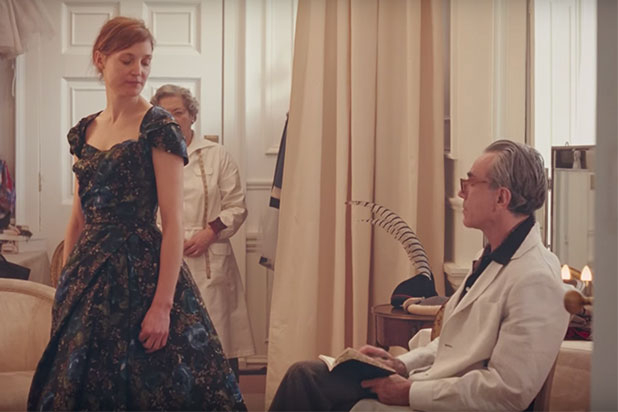
Alma (left) jabs back after Woodcock suggests that she she
"has no taste." The emotional tug-of-war is at the heart of
this film, though it is a relatively measured battle described
with the same calm pace as Woodcock's design process.
Of course, the visuals are merely the shallowest aspect of this movie. Anderson's best movies have always been about the interactions between interesting characters. With Phantom Thread, I felt that this was almost accomplished, but fell just short of completely arresting me. Woodcock's genius, eccentricities, and difficult nature are fairly fascinating. And there is an intellectual appeal to the way that Alma becomes what seems to be the first real challenge to his carefully-constructed world and identity. But it is mostly an intellectual appeal, rather than an emotional one. This is partly due to the calm, often cold and detached way that the story is told and the characters often behave. Alma is clearly meant to be the more grounded, no-nonsense, open character here, yet we only ever learn so much about her. The story does get into Woodcock's family background and we get some important bits about his childhood, but Alma? We never learn so much as which country she is from, anything about her family, or much else. She almost serves purely as a bizarre balm to Woodcock's closed-off inner soul - a sort of uber-British version of the "manic pixie dreamgirl" type - whose sole purpose in the story is to "fix" the broken genius.

This is, obviously, just my current read on the movie. Even now I feel that other interpretations can be made; I'm likely to rethink my own feelings about this movie, even if I don't bother to see it again any time soon. It is one, however, which I would recommend to most people. Provided that you don't grow bored with very "British" movies that tend to move with a very measured pace and focus on rather subtle interactions between oft-uptight characters, then you're likely to find something to like in this one.