Showing posts with label Alex Garland. Show all posts

Wednesday, May 6, 2020

Idiot Boxing: Devs, season 1 (2020)

No Spoilers - Read Away!

Director: Alex Garland

Solid, cerebral sci-fi that offers some meaty food for thought, even if the pacing and dialog aren't always enhancing the story as much as they could.

Written and directed by Alex Garland (Ex Machina, Annihilation), the story takes place in a not-too-distant future and follows Lily (Sonoya Mizuno), a young programmer at the tech company Amaya. Her boyfriend, Sergei, has just been promoted into Amaya's most secretive and exclusive division, known only as "Devs." Before long, things take a turn for the worse, leading Lily to greatly fear for herself and start looking into exactly what Devs is. This also brings her closer to the somewhat enigmatic owner of Amaya, Forest (Nick Offerman), who has a vision that goes well beyond using tech for getting faster emails and business transactions.

Devs was an engaging watch, though one that came off as feeling that it was a bit smarter and sleeker than it ultimately was. Don't get me wrong - there are some really compelling speculations in the story. They mostly revolve around just how far predictive algorithms might go and the ever-growing reach of big data. And they take these themes into some wondrous and frightening places, in terms of their impacts on humans. But there are more than a few moments when the pace, tone, and dialog lend an air being overly didactic. One particular episode was little more than a slow explanation of causality, complete with innumerable long, pregnant pauses between thought groups and characters simply repeating the other's question back to them. It became rather frustrating, especially since the dialog in the show is nothing special (this has never been one of Garland's areas of strength, though he's fantastic at many other aspects of film-making). Despite the occasional narrative drag, the mystery and greater themes carry the story through its eight episodes pretty well.

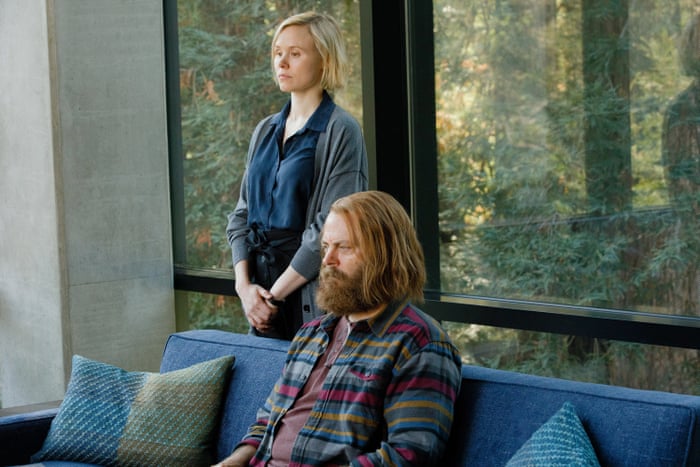
Forest and his chief scientist, Katie. These two can be more
than a little intimidating, though the show does try to give
them a bit more depth than your run-of-the-mill, dubious
STEM types.
The look and feel are what one might expect from Garland, if you'd seen his previous two films. There is a slick aesthetic at work, though not one without warmth and life in many places. The camerawork is solid, and the visuals can be quite stunning at times. There are, however, some sections and even whole episodes of the show where the settings are a bit bland. And without the benefit of sharper dialog to distract one, it can lead to a few moments that feel overly long and dull.

The acting is very good, though the cast sometimes had to work with dialog that wasn't allowing them to show off everything they were capable of. Sonoya Mizuno shows decent range, though the story never fully explores  or utilizes a genius that is mostly hinted at in earlier episodes. Nick Offerman is excellent as the imposing, obsessive tech mogul Forest, often easily shifting between seemingly down-to-earth everyman and detached egomaniac. Peeling back the layers of his backstory and personality is a big part of what keeps the show engaging through the series.

I do recommend this one to fans of cerebral science-/speculative fiction. It's not perfect. It's not even as good as Garland's best work. But it certainly has enough to feel fairly rewarding, including some troubling themes and commentary on our ever-more digitally connected world. 

Thursday, May 10, 2018

New-ish Releases: The Trip to Spain (2017); Annihilation (2018)

The Trip to Spain (2017)

Director: Michael Winterbottom

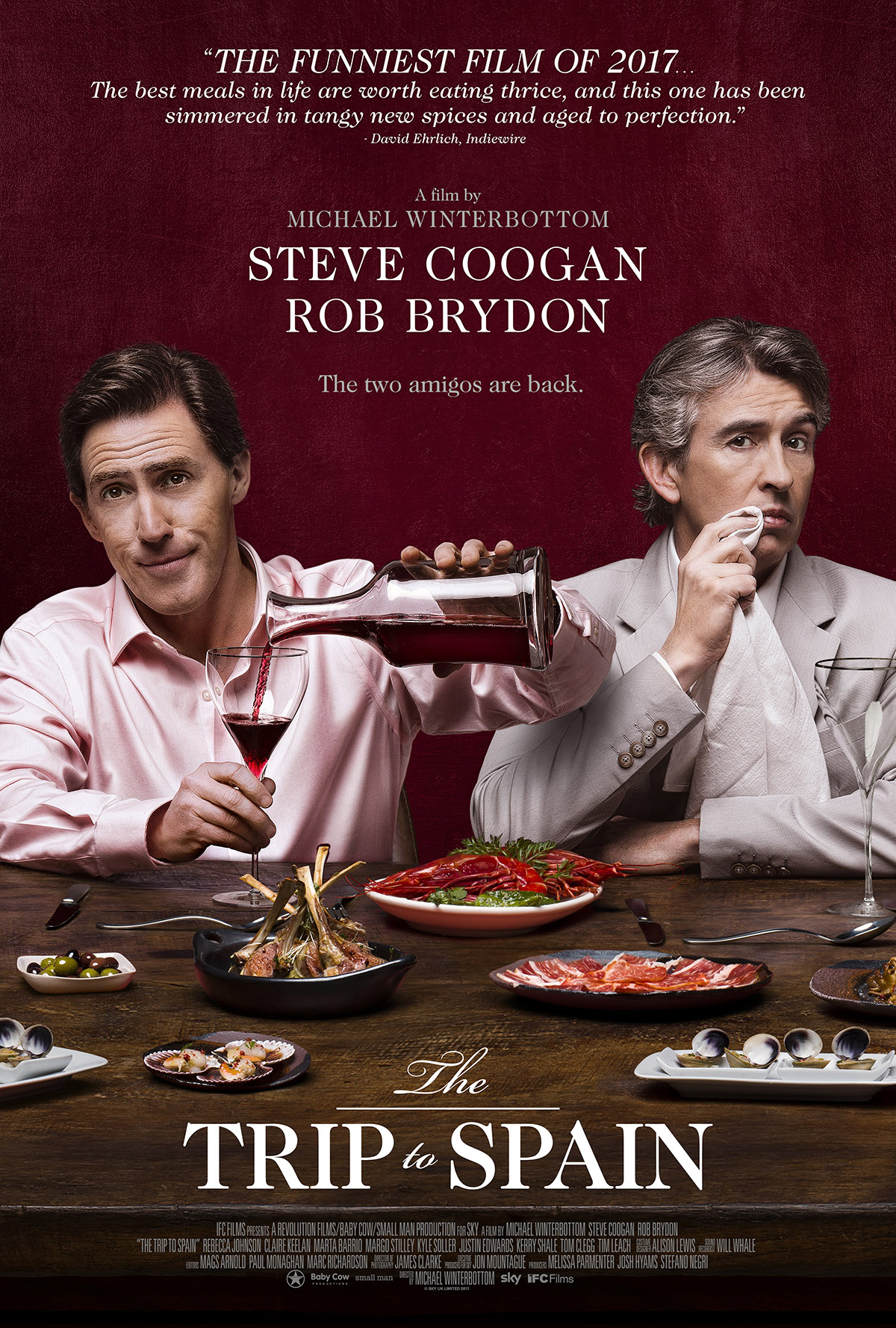
If you've seen the previous two "Trip" movies, starring Steve Coogan and Rob Brydon, then you know exactly what to expect. And you won't be disappointed.

The third in this film series, The Trip to Spain is a loosely-scripted, semi-documentary style show that follows the two British comedians as they tour the locales and noted restaurants of Spain. During their long car rides and frequent meals together, the two constantly riff off of one another's observations and spontaneous celebrity impressions.

It seems like a formula which might get tired, and yet it hasn't. One part of this is that Coogan and Brydon, despite having rather different comedic styles and purvues, compliment and feed off of each other brilliantly. Though the series has never been completely ad-lib, the two have plenty of freedom to improvise, which keeps things quite fresh, even three films in. The other major strength is how each of the three movies has also had a distinct vision for these semi-fictionalized versions of Coogan and Brydon, and consequently their relationship to and dynamic with each other. In the first film, Brydon was the congenial, broad, "people's" funnyman, while Coogan was a self-obsessed, semi-depressive snob. In The Trip to Italy, the roles were slightly reversed, with Coogan being more balanced and at peace with himself and Brydon having doubts about his stable but somewhat tepid home life with this long-time wife and two children. In Spain, we get a slight shift back to Coogan playing the more dislikeable character, once more being rather high on his own success (he often cites his real-life accolades for his film Philomena) and an insufferable know-it-all. These changes between the films all manage to give each one a feel of its own, to great effect.

There isn't much more to be said in a review of this movie, as its major strengths come down to watching and listening to two expert comedians do their thing. The only oddity with this chapter in the series is that the end is a bit strange, even borderline surreal. But this is a pretty minor issue. The only other thing I would recommend is that, if you are considering watching this and have not seen the previous films, you should begin with The Trip. If you find it to your liking, watch the following two films. While you certainly could watch them in any order, seeing the two progress in their order of release does offer a little extra, overarching narrative cohesion.


Annihilation (2018) [Spoiler-free first section]

Director: Alex Garland

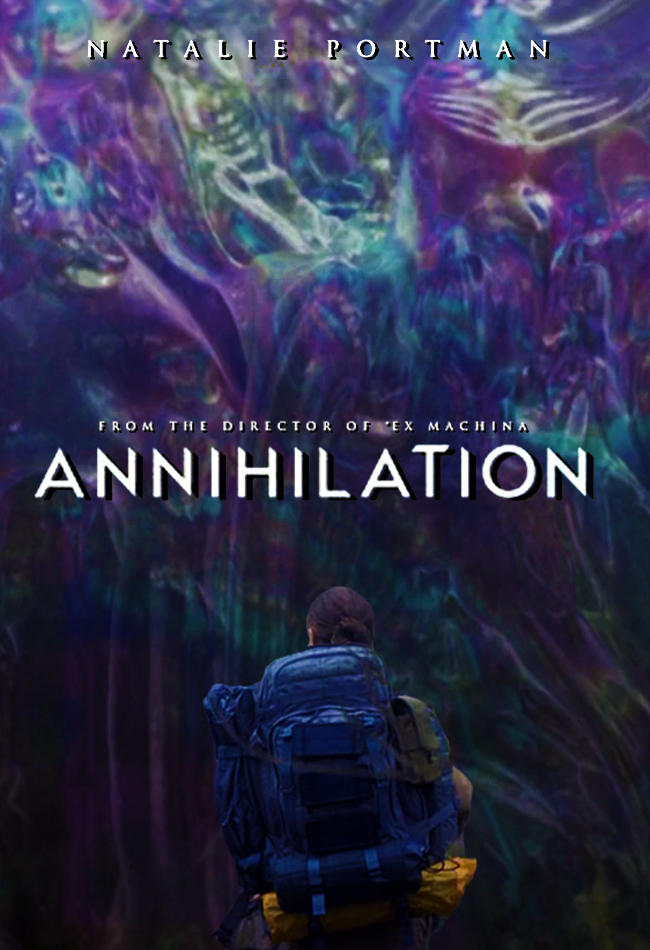
Trippy. Cerebral. Intermittently intense. This was another strong film by Alex Garland, though I didn't find it as good as his previous film.

Adapted from the novel of the same name, written by Jeff VanderMeer, Annihilation follows Lena (Natalie Portman), a former army soldier and medic who is now a university professor of biology. Through a series of strange events, Lena is brought to the site of a strange anomoly being dubbed "The Shimmer" by thr group monitoring it. The Shimmer is a strange field of wavering lights that has surrounded a remote lighthouse on the coast. Any attempts to reconnoiter inside The Shimmer has produced nothing; in fact, nothing and noone who has ever entered the anomoly has yet returned, and The Shimmer is growing to encompass more and more of the surrounding area. Lena opts to join four other women - all either expert scientists, soldiers, or both - to enter The Shimmer and see if they can discover what the previous teams could not - just what the strange effect is and what its done to their search teams. Once the five women are inside, they begin to discover odd plant and animal life that seem to defy the known laws of biology and genetics. And as they begin to uncover clues about the fate of the previous scout team, some baffling and terrifying realizations begin to emerge.

As with most of Garland's other movies, Annihilation is more of a thinking person's sci-fi movie, which is what I enjoy most about it. From the outset, we are given a few mysteries to wrap our heads around, starting with Lena's initial quarantine and her first flashbacks to before she even knew about The Shimmer. The mystery only deepens as the film progresses, with answers being parsed out at just the right pace to satisfy, while raising larger, more frightening questions. I will admit that, while I'm no expert in physics or biology, the basic premise (which I won't spoil) only seems to stand up to so much close scrutiny. Still, it is a rather fascinating idea, and it leads to one of the movie's other great strengths - the visuals.

As the quintet of explorers go deeper into the shimmer, there are more than few visual images that are stunning in their creativity and vibrance. Others are horrifying and equally impressive. Although the movie never felt slow to me, the measured pacing allows us viewers to drink in the images and disturbing ideas which they imply. People who expect or hope for frequent, dynamic action in their films will probably grow frustrated with Annihilation, but for my part, I found the balance just right. There are several short and effective action sequences, along with a handful of suspensefuul moments, but these are hardly the movie's greatest strength. Rather, there is a strong balance of stunningly colorful scenes, along with a few eerily quiet, expansive shots that are a bit reminiscent of subdued sci-fi classic Stalker by Russian master Andrei Tarkovsky.

At this point, only a couple of days after my viewing of this movie, I'm not completely sure of whether I'll feel the need to watch it again. This is somewhat telling, as I usually feel the need to watch my favorite sci-fi movies multiple times, as the best ones are always rich enough in ideas and/or sophisticated enough in structure to warrant multiple viewings. I suspect that I will see it again at some point, but I currently feel as if there wasn't much that I missed on this initial viewing. In terms of Garland's other films, this one has less in common with the masterpiece Ex Machina than with his slightly uneven though worthwhile Sunshine.

Comments with Spoilers

Just a few thought and feelings about specific details in the movie.

The visual of the soldier who has basically "exploded" into some bizarre plantlife in the swimming pool is amazing. It's perhaps the most striking of several indelible images in the movie.

The sequence towards the end with Lena facing down the source of The Shimmer was completely entrancing. The visuals and the music score had me enrapt the way that you hope a movie can do, even if for only a minute or so.

I had a bit of an issue with the way one scene was written and the way one character was performed. The minor one is how Gina Rodriguez's character, the brawny soldier Thorensen, melts down into tears at one point. This may have been a reflection of her gradually-warping mental state, but it smakced a bit of gender stereotyping to have a woman - even a hard-bitten soldier - start crying when things get tough. I had to wonder whether Garland would have written this scene the same way if it had been a male soldier in that position.

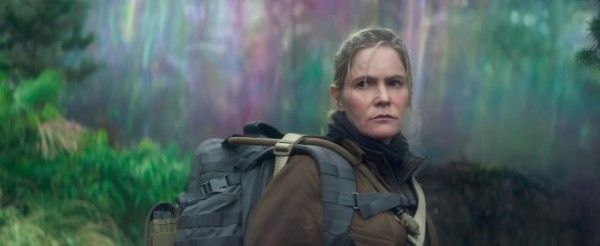
Leigh's turn as Dr. Ventress was the one aspect of the movie
which seemed out of place.
The greater frustration to me was the performance of Jennifer Jason Leigh as the psychologist and operation director Dr. Ventress. I usually find Leigh to be a great actress, but I found her portrayal of Ventress oddly out of tune with what her character was. For the entire movie, she has an oddly distracted air of near-apathy that seems completely unconnected to the urgency which she is supposed to be feeling. I understand that her nerves are worn thin from seeing multiple groups go into The Shimmer and disappear, but it seems as if this should manifest itself more as a desperate drive to get to the bottom of it all, rather than the fatalistic, apathetic attitude that she wears on her sleeve for every second of her screen time. I can't be sure if this performance choice was Leigh's or director Garland's, but it resulted in a portrayal where the facts about and even dialogue coming from the character were horribly out of sync with her demeanor.

I don't know that the movie had to "tag" the final mystery by showing the rainbow Shimmer in Lena's eyes. I thought that just showing her embracing "Kane" was suggestive enough, while leaving a little bit of room for doubt for us viewers. 

Thursday, February 18, 2016

New(ish) Releases (2015): Ex Machina; Dope; Straight Outta Compton

Ex Machina (2015)

Director: Alex Garland

A brilliant piece of original speculative fiction.

Ex Machina begins with Caleb, a young computer programmer in a large company, winning a competition to spend a week with his company's eccentric, reclusive, and brilliant founder, Nathan. Caleb is taken to Nathan's home in a beautiful, isolated area, where he is told that he will take part in a ground-breaking experiment. Nathan has been building robots with cutting-edge artificial intelligence, the long-time dream and goal of computer programmers whereby a machine actually possesses all the deepest and most complex intellectual capacities of human beings. Caleb's job will be to interview Nathan's latest creation, Ava, a robot given the form of a beautiful young woman. Nathan is told to apply his knowledge as a programmer to assess whether Ava could pass as a human.

Within the first few days of his stay at Nathan's beautifully sleek but confined home, Caleb senses something amiss. His host drinks himself into a total stupor every night. Several parts of the house are firmly locked by Nathan's state-of-the-art smart home security measures. Caleb is charmed by Ava when they first meet, but she soon tells him that Nathan torments her, out of the sight of others. Eventually, Caleb is mentally scrambling to determine whether he is part of some twisted experiment, or whether he is being manipulated by one or both of the hyper-intelligent beings in the house with him.

It is rare to get a science fiction film that is confident enough to keep its pace measured and its aesthetic simple and clean, but this is what Ex Machina does. The result is a striking work with a ton of intellectual and emotional power. The character of troubled genius Nathan is fascinating to attempt to analyze, though such an exercise is difficult for much of the film. Caleb, the far more sympathetic character, evokes the kind of feeling which we reserve for the good-hearted and vulnerable. The three-way psychological war is subtle enough that it never relies on cheap thrills or obvious melodrama. There is tension, but it is cerebral in nature, and it builds wonderfully to a shocking finish.

When taken with other films penned by Alex Garland, such as Sunshine and Dredd, Ex Machina means that I now have a smart, modern science-fiction movie writer who I am glad to follow to the theater.


Dope (2015)

Director: Rick Famuyiwa

A phenomenally creative update to the "coming up in the 'hood" movies of the late '80s and early '90s.

Dope chronicles several very tense and sometimes funny weeks in the life of Malcolm (Shameik Moore), a high school senior growing up in 2014 in Inglewood, California, an area notorious for its poverty and danger. Malcolm is an unusual kid for his time and place - he's a young black man with a passion for learning at school, science fiction, punk music, and 1990s hip-hop and rap music and clothing styles. Basically, he's a geek. He and his two misfit friends, Jib and Diggy, spend far too much time trying to avoid the various perils rife in his neighborhood, tellingly nicknamed "The Bottoms."

One night at a club which Malcolm and his friends have nervously wormed their way into, a gunfight breaks out over a raid on a drug deal. After the chaos abates and the trio flee to safety, they discover that an entire brick of uncut cocaine has been stuffed into Malcolm's backpack, which had been placed behind the bar for safekeeping. This puts Malcolm, Jib, and Diggy in the difficult position of deciding what to do with it. Various social pressures and personal desires assert themselves, understandably, as these three nerds in the 'hood try to cope with a situation which could land one or all of them in prison.

Following such a description, you may be surprised to learn that Dope is an incredibly funny movie. Malcom, Job, and Diggy are such awkward fish out of water, despite being natives to The Bottoms, that their simplest, everyday interactions are often comedy gold. This is enhanced by some great direction by Rick Famuyiwa. For sections of the movie, Malcolm is almost a Ulysses-type character. He needs every bit of his considerable smarts to survive an array of dangerous and bizarre characters and situations. Almost every stage in his mini-epic journey has a distinctive sense of place, and it makes a viewer eager to see just what awaits Malcolm and his comrades around the next corner.

Dope is a wonderfully clever update to films from the late 1980s and the 1990s like Juice or Boyz In The Hood. It shines a light on a part of the United States that is far too often overlooked, and it does it with style and respect. A larger message is there, but it is not what you might expect, and it is nowhere near as heavy-handed as those earlier groundbreaking movies.


The original members. Unlike many of the "gangsta" rappers
who followed in their footsteps, these guys came by their
anger and perspectives honestly, as the movie shows.
Straight Outta Compton (2015)

Director: F. Gary Gray

Slick and compelling dramatization of the formation and dissolution of one of the iconic music groups of the late 20th century.

While the above-reviewed film Dope is a brilliant fictional tale of modern life in a rough section of Los Angeles, Straight Outta Compton is the dramatized tale of the very real hardcore rap group N.W.A. in the late 1980s and early 1990s in neighborhoods not far from the Inglewood in Dope. Those of us over age 35 are bound to have strong recollections of the waves that this group made at that time, and this movie does the members' stories justice.

Blessedly, the movie doesn't bother going back too far into the lives of the group's members. Rather, it picks up just before they come together and start performing. Director F. Gary Gray made the savvy move to quickly establish the social ills that Andre Young, O'Shea Jackson, and Eric Wright (Dr. Dre, Ice Cube, and Eazy E, as they were better known) and fellow N.W.A. members lived every day. The movie then jumps into just how they channeled their frustrations, anger, and musical talents into a form of rap music that became wildly popular while scaring the pants off of the conservative white establishment. The focus on how the music reflected and was influenced by incidents such as the Rodney King beating and other institutional racial injustices is what propels this movie beyond a mere music biopic.

Eazy E's business partnership with manager Jerry Heller is
at the crux of much of the drama. Actors Jason Mitchell
and Paul Giamatti add plenty of power to their dynamic.
The movie is not flawless. A bit of research can tell one how certain details are glossed over or completely ignored (Dr. Dre's abuse of women, for one) or how certain events in the film either did not happen or were manipulated by the writers for more narrative punch. It also comes as no surprise that the movie's executive producers - Ice Cube and Dr. Dre - are painted in the most positive light. The movie also slows a bit when it comes to Eazy E's HIV diagnosis. Still, the lion's share of violent and unhinged incidents depicted can be confirmed with a bit of research, so one should fight the urge to dismiss the wilder elements as pure fiction. Pure truth or somewhat embellished, the movie is extremely well-paced, well-acted, and it remains interesting for nearly all of its 140-plus minutes. This is true even for someone like my wife, who knew very little about the group or its members but enjoyed the film.

Obviously, anyone with a severe distaste for gangsta rap will have difficulty with this film, as it does feature a considerable amount of the music of the era. That aside, and if one can handle the very authentic blue language and hedonism on full display in the movie, then they should give this one a go. 

Sunday, January 17, 2016

Retro Trio: Sunshine (2007); The Big Lebowski (1998); Shall We Dance? (2004)

Sunshine (2007)

Director: Danny Boyle

Smart, intriguing sci-fi that goes a bit off the rails in the third act.

Sunshine is set in a future where our sun is slowly dying, leading to a gradual cooling of Earth and the impending, subsequent death of all living things on it. To prevent such a complete devastation, a crew of astronauts is piloting a ship, the Icarus II, towards the sun in order to deliver a nuclear payload to the star's center. This will trigger a rebirth of the sun's energy and allow life to continue on our planet. A similar mission had been sent a few years prior, on the original Icarus craft, but it failed with no word from the crew, who have been presumed dead.

Of course, the Icarus II's trip does not go as planned. Once they get close enough to the sun, they receive some form of message from the original Icarus. The crew make the risky decision to investigate. Technical problems start to emerge after the detour is taken, and lives are lost. Matters go from bad to worse when one of the original Icarus's crew members, Pinbacker, is discovered to be alive and completely insane. Pinbacker sneaks aboard the Icarus II and, convinced that humanity deserves to die, does everything he can to sabotage their mission to deliver the payload.

Sunshine boasts a great many strengths as a film. Written by Alex Garland (28 Days Later, Dredd, Ex Machina), the story is wonderfully smart science fiction. Beyond the mere adventure of the Icarus II's mission, there is plenty of character conflict and psychological probing. The crew must repeatedly make extremely difficult decisions, similar to what is seen in the predecessor film Alien, and also later space travel movies like Europa Report and Interstellar. Such films are all the stronger due to the stakes on every level.

The acting is also top-notch. There are many actors who either were already well-established, like Michelle Yeoh, or have since become so, such as Cillian Murphy, Chris Evans, Rose Byre, and others. Every one of them displays their characters' stengths and weaknesses phenomenally well, which is essential for such science fiction movies to ascend beyond a mere genre piece.

My only real issue with the movie comes from its third act. When the tension is at its absolute peak, the visuals and editing become extemely trippy and herky-jerky, which is a technique that director Danny Boyle has put to good use several times in his career. For Sunshine, however, I found it unnecessary and disorienting. Simply, I lost my sense of spatial orientation bewteen characters and actions. I realize that this might have been Boyle's intent, but this knowledge didn't make it any easier to watch.

This aesthetic gripe aside, I thought that Sunshine was a great piece of science fiction cinema. Along with other Alex Garland-written movies like Dredd and Ex Machina, I've found that rare, reliable sci-fi writer whom I plan to follow faithfully for at least the next several years.


The Big Lebowski (1998)

Directors: Joel and Ethan Coen

Like many fans of this film, I could probably write a doctoral thesis on what I love about it. For the purposes of this blog, I'll keep it relatively short and sweet. I think this movie is an absolute classic, and I can't imagine it ever getting old.

The entire concept has "Coen Brothers" written all over it. What if we tell an LA noir crime story, a la Dashiell Hammett or Raymond Chandler, only instead of a weary but capable PI in the middle of it all, we thrust a burnt-out stoner into the role of protagonist? It's a great starting concept, though it was one which required a lot more spice to make a memorable movie. The Coen brothers were up to the challenge.

If you read a bare-bones, general plot synopsis of the tale, it would bear a striking similarity to film noir - an unsuspecting citizen is mistaken for a wealthy local by a shady and powerful figure. The young wife of this shady and powerful figure is soon after kidnapped, at which point, the protagonist is soon thrown into the machinations of various parties who are interested in the million-dollar ransom put up for her release. The path to resolution is a winding one, along which the protagonist meets many strange characters, each with his or her own motivations.

That blueprint could just as easily have been some lesser-known Hammett or Chandler novel. Instead of Sam Spade trying to navigate the troubled waters of the tale, though, we get "The Dude," a loveable but interminably lazy stoner whose sensibilities never escaped the hippie movement of the 1960s. The powerful figures he meets include the self-aggrandizing Jeoffrey Lebowski, porn producer Jackie Treehorn, and the son of Arthur Digby Sellers ("you ever hear of a little show called 'Branded,' Dude?!"), among many others. Each and every appearance is hilariously memorable, all done in a style that only the Coen brothers would even attempt to pull off.

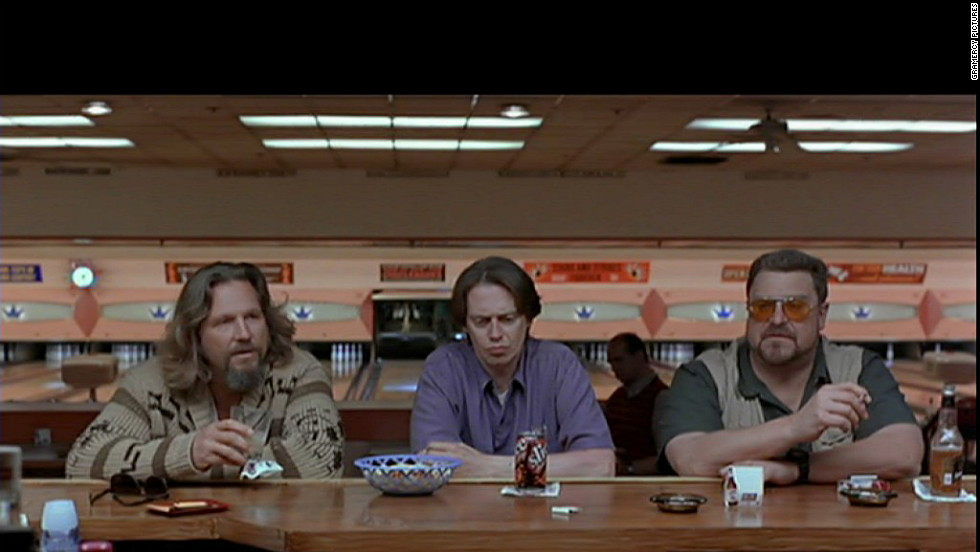
One of the countless moments of hilarious banter between
oddballs in the movie. This one involves nihilists, marmots,
and the Dude possibly getting castrated. Where else
would you possibly find such a thing?
While the Coen brothers have made snappy, memorable dialogue a regular feature in their movies, none is as highly quotable as The Big Lebowski (Raising Arizona is a contender, but it falls short). Thanks to sharp and quirky comedic writing and brilliant comic acting on the parts of over a dozen actors, nearly every line humorously expresses something about the oddball character who delivers it. From "It really tied the room together," to "The bums will always lose," to "Nobody fucks with the Jesus," and endless others, fans of this movie can send themselves into a tantric frenzy when they get into a room and start firing off line after memorable line.

It is arguable that The Big Lebowski is not "great cinema," and that it is not the Coen Brothers' best movie. However, it is certainly their most beloved. Being such a strange fusion of their unusual, and ususually effective, comic sensibilties and their passion for classic noir cinema, this movie is such a singular work that its cult classic status is more than well-deserved.


Shall We Dance? (2004)

Director: Peter Chelsom

Certainly not my cup of tea, but it's easy to see the appeal for many.

Shall We Dance is the story of John Clark (Richard Gere), a family man in New York City who seems a bit discontent with his normal, though very enviable, life. On his normal bus ride home, he spies a beautiful young woman staring forelornly out of a window to a dance school. He eventually and reluctantly enrolls in dance classes there, albeit without telling his wife, Beverly (Susan Sarandon). He even gets a bit of instruction from the sad muse from the window, Paulina (Jennifer Lopez), an exceptional dancer and teacher.

The movie is almost pure fluff. There is very little that is dangerous or challenging. A few of the characters do experience a tribulation or two here and there, but none of them is so great that it can't be overcome with some laughter and a touch of attitude. The main comic relief comes from the characters Bobbie and Link (Lisa Anne Walter and Stanley Tucci), two oddballs with great passion for dancing. Along with the mere presence of these two, there is plenty of light humor sprinkled regularly through the film, in the form of slapstick on the dance floor or airy dialogue.

The movie accomplishes its goals, thanks mostly to its incredibly talented cast. Supporting members like the aforementioned Walter and Tucci, along with Bobby Cannavale, often sell some rather tepid gags through sheer force of acting talent. Also, having Richard Jenkins give a great deadpan performance in a small role is a welcome element. These things were just enough to hold my attention. They help buoy the primary husband/wife/hot dance instructor relationship drama that takes very few risks and I found only slightly interesting.

Shall We Dance is probably not a movie that I'll need to watch again. It was certainly a good enough movie for those in a rom-com kind of mood.