Showing posts with label Alfred Hitchcock. Show all posts

Sunday, October 1, 2017

Before I Die #614: Blackmail

This is the 614th movie I've now seen out of the 1,199 movies on the "Before You Die" list that I've gradually working my way through.


Director: Alfred Hitchcock

A pretty curious early work from suspense master Alfred Hitchcock. It clearly displays some of his early mastery of the visual aspects of the medium, though the actual story itself drags more than it ought to, especially for a film only 85 minutes long.

The story follows Alice White, a young woman in 1920s London, who is "playing the field" a bit in terms of dating. Although seemingly attached to Scotland Yard detective Frank Webber, Frank pays far more attention to his work than to Alice. Perhaps for this reason she has begun to show interest in a new suitor - an artist named Mr. Crewe. One evening, after Alice deceptively blows off Frank, she meets Crewe and eventually is enticed up to his apartment. Crewe makes unwanted advances and eventually tries to rape Alice, who defends herself and ends up killing Crewe with a knife. Alice flees the scene. The next day, Frank and his fellow detectives arrive on the murder scene, where Frank secretly finds evidence that Alice is the killer in the form of a forgotten glove. He spirits it away and returns to her, but the two are soon confronted and blackmailed by a man, Tracy, who had quietly seen Alice entering Crewe's apartment. Tracy's blackmail attempts work for a short while, in small ways, but he is eventually suspected of murder himself. He is ultimately pursued and dies while trying to escape capture. Despite being off the hook, Alice seems to still be troubled by her conscience.

This was a fairly fascinating movie for a few reasons. This is the earliest Hitchcock movie I've seen, and one can certainly see many elements that are familiar in his pictures. There is a daring use of dark subject matter, such as attempted rape and successful murder, at the heart of the story. It also goes beyond merely being a crime procedural, offering gray areas in terms of who the guilty and innocent are. And then there is the psychological aspect, seen mostly obviously in Alice, who was clearly justified in defending herself against the aggressive advances of Crewe, but still feels the conflict of one who has killed a person. While I've seen some other contemporary films that utilized one or two of these themes, Blackmail is the earliest one I've seen that brings them all together through such a small-scale, personal story. For this, it certainly stands out.

Alice tries on a dress at the behest of Crewe. This little idea
is one that Hitchcock would later really run with in his more
classic movie
Vertigo.
The aesthetic elements of the movie are a mixed bag. The set designs are good for the era, with many of them creating a distinctive sense of place. This is especially true in the dastardly Crewe's apartment, which I can still picture very easily in my mind, even these couple of weeks after I watched the movie. Staging certain scenes (or even whole movies) in a single, confined location is something that Hitchcock would do later with even greater success in films like Rope or Rear Window, and we get a preview of it here. The acting is fair enough, though still a tad too rooted in the physical showmanship more suited for stage acting. Strangely, the audio doesn't truly kick in until nearly 10 minutes into the movie. I've read that this is because Hitchcock had already begun filming when the British Film Institute (who was providing funding) decided to make the movie a sound picture. This shift doesn't exactly ruin anything, but it is rather noticeable.

Blackmail is a movie that has a clear place in the history of great cinema, even if it's not likely to become any person's favorite movie, or even anyone's favorite Hitchcock movie. While the brilliant director would go on to make many better films, this one clearly shows his talent when he was still relatively young. For this, it is worth a look for fans of the early sound era and Hitchcock's overall body of work.

That's 615 movies down. Only 584 to go before I can die. 

Friday, November 7, 2014

Before I Die #523: The Bird with the Crystal Plumage (1970)

Original Italian Title: L'ucello dalle piume di cristallo

Director: Dario Argento

It's a good movie, to be sure, but one that didn't quite live up to the cultist hype, in my view.

To be fair, my expectations were rather high, given how highly touted this film and director are by some cinephiles and film critics. Perhaps it is due to director Dario Argento's body of work and solid reputation as a solid suspense and horror filmmaker. I can't be sure, as this was the first of his films that I've ever seen. Therefore, I can only give my thoughts on this film based on its own merits, rather than where it fits into Argento's career arc.

The movie is often compared to several of Hitchcock's most famous suspense films, with good reason. There are Hitchcockian elements throughout the film - a bystander witnesses a brutal murder attempt (a la Rear Window), and he then gets wrapped up in a cat-and-mouse game with a psychopathic killer on the loose in Rome. There are plenty of well-executed moments of tension and fear, including a few pursuits through and around the winding streets of the ancient city.

Probably the most obvious strength of the movie is the visual technique. It's amazing to me just how many Italian filmmakers seem to have an innate knack for framing shots. Whenever I see a Da Sica, Leone, Fellini, or other Italian director's film, it's obvious that they have a portraitist's eye for composing a four-sided picture in the most beautiful manner. Dario Argento is another fine example. So many of the scenes are just enjoyable to drink in, thanks to a keen photographer's eye and some vibrant costumes and set designs.

Alas, the film wasn't what I would call a "masterpiece." There are some actions by the main characters that defy logic to a certain extent, and some of the dialogue is stilted and artificial (though I must admit that one line was hilarious - when a police inspector, without a trace of irony, asks for a suspect lineup with the line, "Bring in the perverts."). The acting was also a bit spotty, being what you would expect from a low-budget spaghetti Western. Somehow, I'm used to the amateurish acting in those more mythical Leone Westerns, but it seemed out of place in this more modern, realistic, urban setting.

One of many haunting, visceral, and masterfully framed shots
in the movie. The cinematography is an inarguable strength.
Those criticisms aside, I must confess that the movie did offer me something pleasantly unexpected - an interesting theme on human memory and psychology. In something one might ponder after reading or seeing Rashomon, The Bird with the Crystal Plumage finds its resolution to the mystery in a way that relies very heavily on the mental state of the witness - a mental state that can apply to many of us. It is this ultimate reveal that sets the movie apart from the great Hitchcock movies, though these latter may be superior in terms of coherence and overall execution.

I'll be eager to see some more of Argento, as I've heard some enthusiasts say that they consider a few of his other films even better than this one. If they are, then I expect some very impressive things. 

Sunday, March 6, 2011

Film #52: Psycho (1960)


Director: Alfred Hitchcock

Initial Release Country: United States

Times Previously Seen: once (about 8 years ago)

Teaser Summary (No spoilers)

Restless secretary steals serious cash, then runs across a socially awkward creep at a motel.

Uncut Summary (A full plot synopsis, serious spoilers included. Fair warning. No seriously, if you have not watched this movie and have intention of doing so, do NOT read this summary!)

In Phoenix, Arizona, Marion Crane (Janet Leigh) is a secretary who has an itch to change her life. She's wrapped up with a lover, Sam (John Gavin) who must use much of the little money that he makes on alimony payments. She's been in the same static job for ten years. Her professional and romantic lives are in a complete rut.

And then, opportunity presents itself. Her boss has just completed a major deal with an out-of-town high-roller. The new client comes into the office, makes some overtly lecherous passes at Marion and drops $40,000 on her desk. The money is part of her boss's new deal with the man, and she is charged with putting the money in the bank. Instead of seeing the task through, though, she takes the money and hits the road. She clearly sees this as a chance to join Sam and use the money to live a better life.

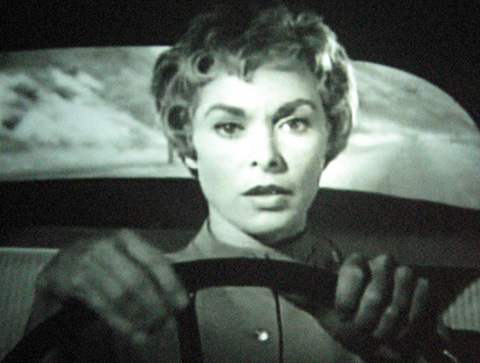
Marion, driving away from Phoenix, considers her recent theft.

Once she hits the road, Marion gradually becomes a nervous wreck. She begins to imagine her boss, friends and relatives wondering where she is and just how the imminent pursuit will begin. She eventually pulls over and falls asleep on the side of the road, only to be awoken in the morning by a curious police officer. Rather shakily, she tries to brush the cop off, but only succeeds in arousing his suspicions. She does, however, manage to avoid any kind of arrest or more serious trouble for the time being.

The next night, with rain pouring down and her nerves worn thin, Marion decides to pull into a roadside lodge called the Bates Motel, a twelve-room inn that sits beneath the shadow of an imposing Victorian-era house. She sees the silhouette of an old woman in the window from the road, but it is a young man who comes dashing down to help her. The man, Norman Bates (Anthony Perkins), is friendly in his greeting and checks Marion in for the evening. Despite her fatigue, Norman convinces her to have some dinner and chat with him in the motel office.

In the course of their conversation, it becomes clear that Norman is a rather awkward fellow. He explains that the motel, which once was on the major highway, has seen very little business in recent years and that he is inextricably bound to his mother. This surprises Marion somewhat, as she had overheard the woman's voice berating and browbeating Norman in their home a short time earlier. In hearing about Norman's trapped existence, Marion becomes more ponderous and even rethinks her larcenous plan.

In the office of his motel, Norman describes his own lonely life to a receptive Marion.

After she retires to her room (into which Norman briefly peeks through a hidden hole in the wall) Marion seems determined to return to Phoenix, give back the money, and avoid trapping herself by becoming a bona fide felon. Having made this life-preserving decision, she hops into the shower, with horrendous results. A shadowy figure of a woman stalks into the bathroom with a massive knife, attacks and kills Marion, leaving her body on the floor.

Moments later, Norman comes running from the house and into Marion's room, where he finds the horrifying remains of Mother's attack. Once he recovers himself, he carefully gathers up the body, along with all of her personal affects (including the $40,000, which was hidden in a newspaper), loads everything into her car, and pushes it all into a nearby swamp.

Roughly a week later, Marion's sister Lila shows up in California, where Sam works. By now, people back in Phoenix assume that Marion stole the $40,000 and must be with Sam. Sam admits that he knows nothing about this and hasn't seen Marion since their last rendezvous before she stole the money. Also on the case is private investigator Arbogast, who has been hired by Marion's boss to recover the money. Arbogast decides that Marion must have been somewhere close, and he starts looking into all of the nearby motels.

After searching dozens of motels in the area, Arbogast eventually arrives at the Bates Motel. In questioning Norman Bates, Arbogast finds not only probable evidence of Marion's presence in the form of an alias in the motel registry, but also a suspiciously nervous Norman Bates. He doesn't get any direct admissions from Bates, but squeezes an admission from Bates that he saw Marion. Bates also accidentally implies that Marion had spoken with his mother. When Arbogast asks to speak with Norman's mother, however, Norman rebuffs him, explaining that his mother is an invalid and unable to take visitors. Arbogast reluctantly leaves.

After quickly checking in with Lila and Sam, Arbogast decides to return to the Bates motel and try to speak with Mrs. Bates. Once he returns, he quietly strolls directly to the Bates house and enters. As he ascends the stairs, however, the same be-dressed, knife-wielding figure who murdered Marion sets upon Arbogast. Before he can react, he is knocked down the stairs and stabbed to death.

The figure of Norman in front of his family home, where things become more mysterious and murderous.

Back in town, Sam and Lila grow nervous. Having not heard from Arbogast for hours past his stated meeting time, they call the local police. The sheriff is skeptical of what he hears, especially when Sam and Lila relate their notion that Mrs. Bates knows something about Marion's whereabouts. The sheriff explains his surprise by informing the two that Mrs. Bates died ten years before. This raises the question: exactly who is the “Mrs. Bates” back in the Bates house?

Sam and Lila decide to take matters in their own hands and head to the Bates Motel themselves. They have Norman Bates check them in as a phony married couple and hatch their investigation. Sam distracts and interrogates Norman while Lila slips away to the house. She searches through the house, but finds no evidence of “Mother”. Back at the motel, Norman grows very nervous under Sam's questioning, realizes the ploy, knocks Sam out and runs to the house.

In the Bates house, Lila sees Norman coming and scuttles down into the basement. In a far corner, she sees the back of an old, withered woman sitting in a rocking chair, presumably the enigmatic Mrs. Bates. When she turns the chair around, however, she is mortified to see that it is, instead, the semi-mummified and rotted remains of the deceased woman. Just as Lila shrieks in horror, she turns to see the door behind her burst open and Norman Bates, donning his mother's dress and a wig, hoisting a massive blade and ready to kill her. In the nick of time, Sam barrels in and subdues Norman before he can get to Lila.

Some time later, back at the police station and with Norman in custody, a psychologist explains everything. After intense interviewing of Norman, he explains that Norman has been a split personality. That he had, in fact, been so close to his domineering mother as a young boy and man that he felt them to be inseparable. Eventually, however, Norman's mother had taken a lover and began to shun her son. Norman apparently suffered a severe mental collapse and killed his mother and her lover. Unable to take the guilt, his mind fractured further and he began to live out both his own life as well as that of his dead mother. He took it so far that, if he would ever have any yearnings for any other woman, his “Mother” half would lash out and kill that woman. Hence the death of Marion and the subsequent killing of Arbogast.

In the end, Norman Bates was no more. After the final shock and capture, the only personality left was the “Mother” part of his persona. Left in a solitary room, he mutely awaits their judgment, lost in his own mind and delusional to the point that he believes that his current silence and timidity will save him. “They'll look at me and say,” thinks “Mother” while staring into space,”'She wouldn't hurt a fly.'”

A final look at Bates, lost in his own mind.

Take 1: My Gut Reaction (Done after this most recent viewing, before any research)

This is definitely one that has seriously lost some of its luster.

Don't get me wrong. This is not because of any flaws in the film; it is simply due to the passage of time and the fact that so many of the elements that were dazzlingly fresh and shocking in Psycho became old hat some time ago.

I realize that I may be smacking around a very sacred cow here, as Psycho is universally acclaimed by critics as a cornerstone of cinema. No argument there. It is obvious that with this film, Alfred Hitchcock took mainstream viewers to places they had never been before, and he changed both suspense and horror films forever. Still, a viewer who is coming into Psycho for the first time is bound to be underwhelmed a bit. I think it helps to look at each of the strongest and innovative elements of the movie and see how they have held up over the past fifty years:

One – The psychological darkness. As far as a I know, Psycho was the first popular movie (by an immensely accomplished and respected director) to take watchers into darker places than they had ever been. The disturbing nature of the brutal knife murders and the probing look at Norman Bates' mental schisms were certainly new ground for the 1960 viewer. Anyone with a shred of morbid curiosity would have been enthralled by the entire concept. Now, in 2011, however, we cannot be shocked by such things as split personalities or fairly graphic violence in movies. Our culture has grown highly aware of bizarre psychological maladies and has seen them used in fiction for decades now, from films like Sisters and Seven, to television shows like Dexter. Within a modern context, this element of Psycho is knocked down several weight classes.

Two – The “twist” at the end. When a crazed Norman comes crashing through the basement door, in drag and knife held high, I admit that it still gives me a bit of a jolt. I imagine that if I had seen it as a viewer in 1960, I probably would have soiled my pants. I can only imagine how many minds were blown by that famous scene and how it probably haunted people for years. Once again, though, a modern viewer cannot be so easily caught off guard. The notion of “the twist” has been done so many times that we are almost trained to anticipate it. The wilder the possibility, the more likely we are to expect it. This cat-and-mouse game between viewer and screenwriter has fueled the entire careers of people like M. Night Shyamalan. In the end, Psycho's finale is now severely watered down.

Three – The sex! From the very earliest movie posters to the first seconds of the movie, Hitchcock makes no bones about titillating you. The very first scene has Janet Leigh in a rocket bra, lounging in a post-coital afterglow in bed with her strapping lover, Sam. Add to this a few other scenes with a touch of skin and the shower scene, and you have a film that probably had the more Puritanical elements of our society up in arms. Once again, though, what was probably highly erotic in 1960 film does not pack quite the same punch these days. It's not that Janet Leigh isn't still sexy in the movie (she certainly is), but one need only scan a magazine rack these days to find no less than a dozen “FHM”-type publications which don covers that go well beyond Psycho in terms of skin and sultriness.

Here's that most famous of shower scenes:


Four – The camerawork. Psycho has, without a doubt, some of the most iconic shots and scenes in film history. It's nearly on par with Casablanca in terms of being so thoroughly entrenched in popular culture that even people who have never seen the film are familiar with several of the images. This strength of the film most certainly does hold up. The composition of some of the scenes is still stunning, and shots like the slow, backward-panning, spiraling shot of a dead Marion on the bathroom floor are just as powerful now as ever.

So, from this little list of mine, only one out of the four groundbreaking elements has anywhere near the same force that it had decades ago.

I should point that, in addition to the camerawork, there are several excellent verbal exchanges throughout the film, most notably between Norman and Marion and Norman and Arbogast. This is part in due to the writing and part due to outstanding acting, with Anthony Perkins turning in a phenomenal performance as the twitchy, intense, creepy and yet oddly vulnerable Norman Bates.

Despite the handful of lasting merits, I would suggest that anyone new to Psycho not get their hopes too high. It's still a good movie, and one worth watching at least once, but I think that any newcomer under the age of 40 will likely not feel it to be one of the greatest films that they've ever seen. For many, there may be a “seen that before” feeling to it all.

Take 2: Why Film Geeks Love This Movie (Done after some further research):

There are all sorts of great little tidbits about Psycho; some are well-known and some are pure urban myth.

The book Psycho, written by H.P Lovecraft understudy Robert Bloch, was based on a very real incident of a murderer in Wisconsin. The screenwriter, Joseph Stefano, along with Hitchcock, decided to alter many things in order to appeal to the audience. Foremost is that the Norman Bates character, who in the book is an overweight, boorish and wholly unsympathetic butcher, would become a handsome, mildly charming and very vulnerable person. It's quite a trick that would not have been possible had Anthony Perkins not given such convincing life to the role.

Speaking of Perkins, I learned that he was, in fact, a gay man who had struggled throughout his life under the pressures of homophobic society. Apparently, he was often rather uncomfortable around women, and for decades at odds with his own desires. While he would later be very open about his sexual orientation and find some semblance of comfort, one has to believe that these very strains were tapped into to create such an affecting performance in Psycho.

The shower scene, one of the most famous in all of cinema, is surrounded by all sorts of tales. From the difficulties of setting up and editing a nude scene to using chocolate syrup as blood to Janet Leigh having to lay stock still during the final pull-away shot, all of these were very true. They also amounted to this seemingly simple, 1-minute piece of finished film taking a whole week to shoot. One myth that I myself had shattered is that Hitchcock had ordered that, during the moment Bates pulls back the curtain, the shower water be turned ice cold in order to extract a more blood-curdling scream from Leigh. This, according to Leigh herself, was entirely untrue. Makes for an amusing story, though.

One of the scenes that will seem to drag to modern audiences is the psychiatrist's exposition near the very end. This scene was, in fact, one that Hitchcock initially felt unnecessary. The screenwriter Stefano, however, himself undergoing psychiatric treatment at the time, convinced him otherwise and it stayed. I think this is yet another element that was probably quite interesting to the 1960 viewer but will seem unduly long and all but redundant to us here in the 21st century.

The release of the movie created several trends, as well. The studio, under Hitchcock's adamant demands, ordered all theaters not to allow any late entrants into the shows. In addition, there were rather humorous signs posted outside of many theaters imploring people not to spoil the ending for others. In seeing footage of this, it became clear that Psycho was meant to be at least as exciting as it was disturbing. In fact, Joseph Stefano said he was pleasantly surprise at just how many people, on leaving the theater, would be simultaneously gasping and laughing. He likened it to how people feel when exiting a really good roller coaster. I have to feel that this is exactly as Hitchcock intended. He wasn't trying to create Silence of the Lambs, but rather an engaging thrill-ride of a movie.

The critics, unlike the audiences, were not as amused. Many of them gave it very tepid reviews, such as this original TIME magazine review, and some panned it altogether. Many of these professionals seemed to think it beneath the director of such sharp, colorful, and adventurous movies like North by Northwest, To Catch a Thief, and many others in the prior Hitchcock canon. Joseph Stefano offered another theory on the lukewarm critical reception: that the reviewers were annoyed that they were not allowed to watch previews of the movie, but had to wait until nationwide release like everyone else. Perhaps this is the case, but we'll never know for sure. Curiously enough, several critics who initially torched the film would later list it among the year's best.

I have to repeat that I think any fan of films needs to see this movie at least once. You may not find it to live up to its massive reputation, but it is one that you can have fun developing an opinion on.

This is the original, full-length trailer hosted by the incomparable Alfred Hitchcock himself. It is absolutely hilarious and reveals so much of the man's genius:


That's a wrap. 52 shows down, 53 to go.

Coming Soon: Half-Time Awards!!

In honor of my finishing essentially half of this list that I started a little over a year ago, I will look back over the first 52 shows that I've watched, develop some awards of my own, and dish out completely non-existant prizes. I may drop an F-bomb or two, and maybe I'll post myself in eight different outfits, a la Anne Hathaway. After that little intermission, it's back to the movies!

Please be sure to pick up all empties on the way out.

Tuesday, June 1, 2010

Film #29: Notorious (1946)


Director: Alfred Hitchcock

Initial Release Country: United States

Times Previously Seen: once (about 8 months ago)

20-Words-or-Fewer Summary (no spoilers):

Gorgeous, floozy booze-bag is enlisted by suave G-Man to spy on expatriate Nazi sect in Brazil.

Full Summary (a full blow-by-blow of the plot, spoilers included. Fair warning):

In Miami, former Nazi John Huberman is convicted of treason against the United States. His daughter, Alicia Huberman (Ingrid Bergman) goes home and drowns her sorrows at a small soiree at her home. Present at the party is T.R. Devlin (Cary Grant), whom Alicia believes to be a local policeman simply sent to keep an eye on her. He is, in fact, a federal agent whose task is to survey Huberman to determine if she can help the U.S. government infiltrate a suspected Nazi contingent in Brazil.

Alicia has a reputation of loose relationships and being a bit of a tippler. Upon discovering Devlin's true purpose, she initially turns him away. When Devlin confronts her with proof of her love for the U.S. and hatred for the tenets of Nazism (in the form of a taped conversation with her father), she relents and agrees to accompany him to Brazil.

Once in Brazil, the service's plot is made known: Alicia is to ingratiate herself to one Alexander Sebastian (Claude Raines), a past acquaintance who was friends with John Huberman and loved his daughter, Alicia. Once the false love is impressed, it is to be exploited and Alicia is to reveal anything that she uncovers in her dealings with Sebastian. Complicating things, however, is that Devlin and Alicia fall in love with each other. Yet, the stoic and professional Devlin refuses to allow his feelings for Alicia interfere with the mission, and he allows her to use herself as erotic bait.

Agent Devlin has his first encounter with a tipsy Alicia Huberman

The plan works, but all too well. Sebastian once again falls in love with Alicia. So much so that he proposes marriage. Along with Sebastian's love for her, Alicia also discovers that Sebastian is indeed in the middle of a plot by Nazi German expatriates to somehow reestablish some sort of Nazi power in the world. Despite his discomfort at letting his love further embed herself in such dirty dealings, Devlin and the local U.S. feds allow Alicia to marry Sebastian, in the hopes of unearthing further details of the plot.

Once Alicia is married to Sebastian, they throw a party at which Devlin arrives, posing as a playboy American on holiday, and discovers that the Germans are stockpiling plutonium deposits from a nearby mountain range. Unfortunately, Sebastian later discovers Alicia and Devlin's true identities and treachery. Sebastian and his aged mother, also of fundamental Nazi leanings, then begin to slowly poison Alicia, hoping to quietly dispatch her without further alerting the U.S. agents.

In the end, Devlin figures out what is happening and arrives at the Sebastian estate. He slyly extricates Alicia, finally confessing his love to her as she is in bed, near death from poisoning. Upon leaving with her, he leaves Sebastian behind to face his fellow Nazi conspirators, who now know the full scale of his indiscretions and will presumably "deal" with him. We are left to assume that Alicia will be nursed back to health with her love, Devlin, at her side, and that Alexander Sebastian will be "silenced" by his compatriots.

Take 1: My Gut Reaction (done after this most recent viewing, before any research):

Really good film. Probably one of Hitchcock's absolute best, which is saying something.

After seeing Grant, Bergman, and Raines in a few earlier films, Notorious was a great departure in terms of characters. Up to this point in the list, Cary Grant had played some of the more annoying characters to me. Between The Awful Truth and His Girl Friday, I had almost forgotten what I liked about him. Now, with his role as T.R. Devlin, he finally sloughs off the skin of an arrogant sophisticate and plays a far more intriguing character. He's calm, cool, efficient, and every inch the professional spy, with nary a condescending bone in his body. Even in the face of the drop-dead gorgeous Alicia Huberman, who he admittedly loves, he doesn't let his emotions get in the way of his job. You may not love him for it, but there's a legitimate strength to him that I hadn't seen in his earlier roles.

Bergman is another one. Coming off her role in Casablanca as Ilsa Lund, which was a relatively weak character, playing Alica Huberman is a great departure. In her very first scenes, she's drunk as a skunk and buck wild. She promptly gets rough with Devlin, who only subdues her with a few quick judo chops and a pinch to a pressure point. She has real fire and shows even more acting skill, convincingly playing a woman transitioning from being a "notoriously" loose Jezebel to a person of great conviction, courage and ability.

Here's a great scene in Brazil which exemplifies everything that Bergman and Grant do well in this movie - tease each other with surgical precision. The first full 5 minutes is well worth watching:


Those last few minutes really skirted the Puritanical movie codes of the day.

Raines does a similar chameleon act. As Captain Renault in Casablanca, he was an eminently lovable rogue. As Alexander Sebastian in Notorious, however, he does a fantastic turn as a semi-suave yet contemptible Nazi. Just as his key role to complete the triad of classic characters with Bergman and Bogart in Casablanca, he does the same with Grant and Bergman in this Hitchcock standard.

The story is perfect for Hitchcock's direction. While the initial romance between Devlin and Alicia is a touch rushed in the early going, it never feels essentially unnatural. It's certainly not hard to see how they fall for each other. It's also balanced beautifully and woven into the espionage tale masterfully. The emotional power is as much left to careful glances and gestures as it is to the occasional outbursts of charged dialogue between Grant and Bergman. These things elevate this tale far above a mere suspense yarn or even an adventurous romance.

The only parts that seemed a bit out of whack to me had to do with timing. One was the aforementioned budding romance. While the characters have been together for over a week (a reasonable time for love to bloom), we viewers have had about 10 minutes with Devlin and Alicia. It was ever-so speedy to me. The other moment is at the end, as Alicia lies on her deathbed and Devlin comes in to rescue her. As he finally breaks down and opens his heart to her, my eyebrows gradually furrowed as a wondered, "has this guy forgotten that there's a cabal of murderous Nazis lingering downstairs?!" It was obviously a necessary scene, but stood out as a bit forced amidst an otherwise masterfully paced movie.

While Hitchcock had already done several very well-received movies by 1946, this may have been his strongest to that point. The exotic locale of Brazil made a great backdrop, and the opulent setting of the Sebastian estate create a great sense of place. Hitchcock always made great use of location, and his eventual use of color would dazzle in films like Vertigo or North By Northwest, but the black-and-white scenes in Notorious are just as striking, if in a more subtle way.

I would say that all but the most ardent Alfred Hitchcock or Cary Grant haters would love this movie. It's engaging and unique, and yet another classic film that has spawned endless imitation attempts (really, James Cameron's True Lies, while entertaining, is just a modified, high-octane, lesser rendition of Notorious). For the real deal without the gunfire or body count, go back to this all-timer.

Take 2: Why Film Geeks Love This Movie (done after some further research):

Plenty of good analysis of this film out there. Hitchcock has obviously been one of the most accomplished, celebrated, and prolific filmmakers in history. Any film fan worth his or her salt can pick out one or two favorites, and it seems that Notorious regularly makes the top 2 or 3 for most film aficionados. And yet, it seems to me that it is less famous than Hitchcock standards like Psycho, The Birds, North by Northwest, or even Vertigo. Why?

Those others had certain shock value to them, and this really interesting essay by William Rothman points out several things, foremost perhaps that this film was virtually the last "optimistic" Hitchcock movie. Coming in the middle of his career, it seems that he hit his stride as a storyteller and director, and he melded the dark aspects that were his hallmark with a more palatable ending for a wider audience.

Rothman points to the relationship between Devlin and Alicia as "perverse," which is true. They constantly torment each other, and not playfully. Devlin all but dares Alicia to run into the arms of Sebastian, just as Alicia willfully plays up her reputation as a drunken tart. Both of them seem to relish the opportunities to torture the other out of some sense of twisted attraction. Before Rothman's essay, I hadn't really considered it, but he seems right on.

One of the really intriguing things to arise from this movie is "The McGuffin," which has become a byword in film. The McGuffin can be defined as the thing that the plot and characters revolve around, in the case of Notorious, it's the wine bottles (filled with uranium, we later discover). Hitchcock coined the term and explained how the actual form of the McGuffin is not important, as long as we sense its importance to the main characters. Hitchcock used the device many times, but other modern examples would be the briefcase in Pulp Fiction, "The Formula" in The Spanish Prisoner, or even "unobtainium" in Avatar. I've always liked the enigma behind these vague objects, and now I know from whence they came.

An additional point about the McGuffin in Notorious - the plutonium. At the time of Notorious's release, the ins and outs of atomic weaponry were far from common knowledge. The fact that Hitchcock and the filmmakers used it as a focal point got the attention of more than one security official in the U.S. They were investigated as to where and how they had learned that plutonium was a key ingredient in the making of such a devastating weapon. Curious, no?

One final note is the original TIME magazine review. It indicates how successful the film was, even back in the day. I particularly like the writer's little jabs at how clumsy Alicia and Devlin are when it comes to the key and the wine bottles. Check out their last paragraph for a few good laughs. Here's the scene the writer was referencing:


All analysis just reinforces what a pillar this movie is in the halls of suspense film. A few more Hollywood studios might do well to study it and try to better emulate its careful fusing of elegance and simplicity to create an incredible piece of work.

That's a wrap. 29 down. 76 to go.

Coming Soon: It's A Wonderful Life (1946):


It's Christmas in June!! It's going to be weird watching this, since it's about 90 billion degrees outside here in eastern PA, but maybe Jimmy Stewart and Zuzu can take my mind off of the heat.

Please be sure to pick up all empties on the way out.