An OK second-tier spaghetti Western, clearly aping the style so inimitably pioneered by Sergio Leone a few years prior.
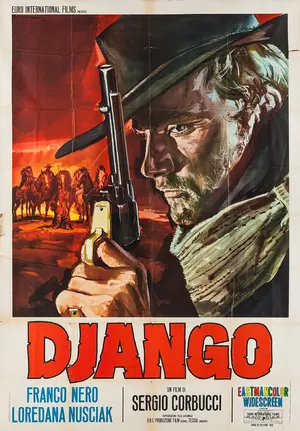
The movie follows Django, a mysterious and lethal drifter who drags around a coffin everywhere he goes. When Django wanders into a town, he finds himself quickly caught between two feuding groups - one a gang of Mexican revolutionaries and the other a crew of ex-Confederate soldiers. Django rescues a young woman, Maria, from one side, and soon is shifting his allegiances between groups, eventually including a group of bank robbers, to serve his own ends. In the end, he cunningly kills off his adversaries and drags his wounded self off to begin a new life with Maria.
Django is decent enough fare for the genre, but I can't say it spurred any desire to watch more of its ilk. I absolutely love Sergio Leone's "Man With No Name" movies, along with his others. But as much as I love them, I also realize how ultimately silly they can be in certain respects, and it's only in the hands of a narrative and cinematic master that one can easily look beyond those films' weaknesses in terms of emotional depth or complexity. Django does a nice job using solid film technique to capture that same hyper-colored-yet-dusty aesthetic of Leone's movies, and it even has a few of the clever plot devices of those earlier movies. But it doesn't all come together or have quite the complete sense of coherence of the originals.
This was apparently a huge movie, though, Maybe not quite as big, worldwide, as Leone's westerns, but big enough to spawn a ton of sequel films, starring quite a few different actors in the lead roles. It really was like a spaghetti western Jame Bond kind of franchise through the 1960s and 1970s, and even hanging on well beyond that, with the most obvious recent incarnation being Quentin Tarantino's version of the character, starring Jamie Foxx. With this in mind, I would recommend it to those who love the look and feel of A Fistful of Dollars and its semi-sequels enough that they want more of the same. For my part, I won't be going out of my way to take in more of them.
Salvatore Giuliano (1962)
Director: Francesco Rosi
An interesting but dizzying tale based on real events and told with skill and some creativity.
The titular historical figure is presented as an enigma. Between roughly 1940 and 1950, Giuliano was an outlaw who fought for and against various factions, and often for himself, within a fractured Sicily. Between Italian nationalists, Sicilian separatists, aspiring communists, and the Mafia, Giuliano managed to either placate or keep all potential adversaries at bay. Through kidnapping, murder, effective guerrilla fighting tactics, and a juggling of connections, he evaded capture for an entire decade. In 1950, however, he finally met his fate.
The figure of Giuliano is curious enough, but this movie takes a very interesting approach to telling the story. Instead of presenting a sort of biopic with its infamous subject at its center, director Francesco Rosi keeps the outlaw at the periphery. In fact, aside from a few shots of Giuliano's dead body, we never see his living, breathing face in the movie. Instead, the bandit is used to probe into the social and political forces swirling around the Sicilian countryside, and how they both create, sustain, and ultimately wipe out a person of Giuliano's singular nature. It's an engaging approach which had me constantly trying to piece the puzzle together, with mostly satisfying results.
Admittedly, there are some details that I simply could not keep up with. Rosi seems to have made this movie assuming that many of its viewers would be familiar with Giuliano's story, given his infamy and the fact that his life played out only twelve years before the movie's release. Perhaps to an Italian, European, or even a some American viewers in the 1960s, the endless stream of names and factions was easier to keep straight, but such was not the case for me. This chaotic narrative structure was frustrating at times, but never so much that I lost the general thread of the tale.
The cast was apparently mostly stocked with Sicilian locals, which is always a double-edged sword. You get plenty of characters who are the genuine article, in terms of appearance, but they are often lacking in acting skills. This can be a bit distracting.
Salvatore Giuliano is a well-made film with some commendable artistry to it. It's certainly worth seeing for fans of Italian cinema and mafia movies. It makes for an interesting compliment and even prequel film to more modern, realistic takes on the subjects such as Gomorrah. I'm not likely to watch it again, though.
Things Change (1988)
Director: David Mamet
Though noticeably lighter than Mamet's other movies, Things Change is yet another of his that I find competent but far from mind-blowing.
The movie centers on two very different New Yorkers: Gino (Don Ameche) and Jerry (Joe Mantegna). Gino is an elderly shoe-shiner who hails from Italy. One day, two mafiosi approach him with a deal: take the rap and spend three years in jail for one of their associates who bears an uncanny resemblance to him, and in return their bosses will pay him handsomely. Gino accepts, and he is given over to the care of Jerry, a mafia soldier who is in the doghouse with his bosses. Jerry, seeing that the kindly and genteel Gino will be spending his next few years in prison, decides to buck his bosses' orders and fly Gino to Lake Tahoe for a good time. Once in Tahoe, however, Gino and Jerry get mixed up with local mafia members and have to dance around being discovered.
The movie is fairly light-hearted, in the way that few mafia or David Mamet movies are. There are plenty of attempts at charming humor, but I found most of them uninteresting, despite sometimes being unexpected. The bond between Gino and Jerry is a bit touching, but it does smack a bit of sentimentality and a lack of natural progression.
I've now seen about a half dozen David Mamet movies, and I am simply not much of a fan. His plots are fine, and he has a keen eye for visuals. However, his dialogue is very often overthought and has a herky-jerky feel that can feel artificial at times. And for whatever reasons, every Mamet-directed movie I've watched features at least one oddly stiff performance by actors. Things Change is no exception.
This movie wasn't a chore to watch, but it's not hard for me to see why it is currently out of print and it is never really mentioned among the best gangster movies of all time, despite solid performances by great actors like Ameche and Mantegna. Hardly a must-see for mafia movie buffs.
Bugsy (1991)
Director: Barry Levinson
A movie that has several impressive things going for it, but ultimately fails to live up to its potential.
Bugsy tells the story of infamous gangster Benjamin "Bugsy" Siegel's final decade of life from 1937 to 1947. The film has three things going for it: some fascinating history of mobsters and Las Vegas, brilliant visuals, and a lot of strong acting. Without these things, the movie would be borderline awful. With them, it all rounds out to be a glamorous but highly messy film.
By all historical accounts, Siegel was a volatile mixture of charm, good looks, and unpredictable violence. Caring less about money than about grand schemes and respect, he thought and lived large. Warren Beatty does a fine job as the iconic gangster, simply oozing confidence and a hair-trigger temper. However, he is often severely let down by an uneven script, which has numerous and odd shifts in tone. Siegel's erratic mood swings rarely feel organic, just as the reactions by those around him are sometimes peculiar if not downright ridiculous. There are also several scenes which perhaps seemed like good ideas on paper but fail in the execution. Having Siegel running around his house in a goofy chef's hat while trying to juggle a child's birthday party and defend himself against his murderous mafia partners is apparently meant to be humorous. Instead, it comes off as odd and a bit tiresome, as do several other scenes. On top of this is that the pacing of the film never seems quite right, with whole months or years zipping by, often with overly subtle or no time cues to indicate the passage. This plays havoc with the personal relationships, which are a key element to much of the movie's drama.
Despite all of these problems I had with the film, I was fascinated to keep learning a little more about how Siegel was involved in the earliest roots of turning Las Vegas into the Mecca of hedonism and wanton spending that it is today. From the moment we see him and a few friends drive out and see a lone, sad "casino" spark Siegel's ultimate vision, I had to see the movie through to the end. It didn't hurt that the movie is a pleasure to look at, in all respects.
What I had forgotten was just how much praise this movie received back in 1991. It was nominated for ten Oscars, in fact (it only won 2, for Art/Set-Direction and Costume Design). These days, though, it is not even mentioned as being in the same league as all-time great gangster movies, let alone great all-around movies. I am honestly surprised that it received all of that original acclaim, given that it came out a whole year after Goodfellas, which raised the bar so very high for such movies. Bugsy clearly has its merits, but they are equaled by its glaring faults.
A slow, frightening burn of a mafia movie. This was one of the more unique and unnerving gangster movies I've yet seen.
Mafioso takes some time to get to the "mafia" elements. For much of the film, we follow Antonio Badalamenti, a native Sicilian who has long since left his home island and become a successful manager in a Milanese industrial factory. He has a beautiful wife and two charming little daughters, whom he is bringing home for a 2-week vacation during which they will meet his family for the first time. Antonio has also been given a peculiar little task by his superior at the factory - to deliver a "very valuable" small package to Don Vincenzo, an extremely prominent man in Antonio's hometown. Antonio's manager says that he and his "friends" in New Jersey, U.S.A., have some business with Vincenzo, though the details are not explained to Antonio. The fastidious and ever-pleasant Antonio agrees without hesitation.
Upon arriving in Sicily, Antonio quickly embraces his old roots. His large and traditional family welcomes him warmly into their home, though Antonio's cosmopolitan wife has difficulty adjusting to the earthy and standoffish demeanor of her husband's mother and aunts. Antonio begins to reconnect and catch up with his old friends, who refer to him by his old nickname "Nino." It soon becomes clear that the entire town is still dominated by Don Vincenzo, the patriarchal mafia leader who commands respect and admiration of nearly everyone in town. There are hints at possible dissenters, though we are led to believe that such malcontents have been dispatched. Despite this air of death, Antonio pays his obligatory respects and delivers his manager's package to the Don.
Then Antonio's world goes completely sideways.
Just as his wife seems to be acclimating and Antonio begins to fully relax, he is pulled into the mafia world which he had left behind long before. Being an "outsider" and a preternaturally good shot, Antonio is pegged to exact an assassination. The otherwise kindly factory manager is all but kidnapped and forced to embark on a strange and dizzying journey to New York City, where he is expected to execute a rival Don.
Mafioso is undoubtedly one of the strangest and most intriguing gangster movies I've ever seen. The senses of place are so well established that we can easily grasp the anxiety, confusion, and terror that Antonio falls into. Our introduction to Antonio is in Milan, where his satisfied clockwork attention to detail speaks of a man right at home in the bustling modern city. Once in Sicily, though, we soon see the culture from which he comes. His town and family follow modes that are fastly fixed in traditions hundreds of years old, from the burka-like robes that the older women wear to the vicious culture of murder and vendetta which the men fully embrace and accept as a fact of life. When Antonio is made an assassin against his will and whisked away to New York City, we get the sense that he has fallen down some horrible rabbit hole where he must act out the very worst things which he had sought to escape in going to Milan.
This movie has stayed with me since watching it a few days before writing this. It is a frightening prospect to consider that one's childhood environment can reach out and warp a person into becoming a monster, and this is what Mafioso presents to us. It can be slow in the telling, as the buildup is very gradual, but this lends it even more power. It is not at all difficult to see why this is considered one of the great gangster movies.
Movie pairing: I couldn't help but think that the modern Sicilian mafia movie Gomorrahmakes for a great follow-up viewing for Mafioso. Like the latter, the former explores just how organized crime can impact average people who may have or may want nothing to do with the nefarious crime organization.
Al Capone (1959)
Director: Richard Wilson
A solid film which is even more fascinating when taken in the historical context of gangster movies which came before and after it.
As you can guess, Al Capone offers the tale of the infamous Chicago gangster's violent and ruthless rise to power in the Depression Era. It starts from his arrival in Chicago, following his departure from his native New York City under shady circumstances. Capone (Rod Steiger) becomes a bouncer at a bar run by friend and fellow criminal Johnny Torrio. Through Torrio's connections to Chicago's organized crime syndicates, the ruthless and vicious Capone quickly rises to the head of the local families. He readily employs any method to obtain and maintain power, including murder, extortion, election fixing, and legal manipulation. Law enforcement does catch up to Capone by the mid-1930s, though, after he has spent nearly a decade lording over much of Chicago. His many legal transgression land him in Alcatraz Prison for several years.
The historical points covered in the film are familiar to most Americans with any interest in this iconically notorious criminal. What Al Capone offered was a less glamorous portrait of the title villain than many previous biopics had offered. In fact, star Rod Steiger had refused the first three scripts sent to him since he felt they showed Capone in overly glamorous tones. What the 1959 version gives us is a snarling, pugnacious, and murderous thug who happened to be in the right place at the right time, and who had enough low cunning to satisfy his unrelenting greed. This was a rare depiction of a man who had often been exhibited without his more repellent characteristics.
The fascinating aspect of this movie was how, technique-wise, it so clearly had a foot in both the past and future, with 1959 being the fulcrum. Rod Steiger's performance is the most obvious. While his raging, manic rants evoked images of more overblown acting techniques from the earlier half of the 20th century, the dialogue sometimes had a more disturbing and modern authenticity. The quieter, creepier moments also had a realism which is far eerier than nearly any movie that came before it. The sliminess with which Capone oozes his way into the life of his future wife has a naturalistic look which is unnerving.
This is a great gangster movie to watch in the middle of several of it's predecessors and successors. One can clearly see how it acted as a sort of bridge between earlier films like Key Largo or White Heat, and later films like Bonnie and Clyde or Dillinger.
Charley Varrick (1973)
Director: Don Seigel
Interesting in its grittiness and tension, but a crime movie lacking soul.
Walter Matthau plays the titular thief, a very clever and calculating bank robber who pulls a daring heist with his wife and three other professional larcenists. Things don't go quite as planned, though, in several ways. During the robbery, Varrick's wife and two other members of the five-person crew are killed by police. Once Varrick and the lone other survivor, the hot-headed Harman, execute the rest of their careful getaway, they discover that the amount of cash taken far exceeds their expectations. While the impetuous Harman thinks little of this beyond imagining just how he'll spend his six figures in stolen loot, the wiser Varrick knows that such a large sum will be sorely missed. The two soon learn that Varrick is all-too correct, as the money belonged to the mafia, who has sent a ruthless hitman on their trail.
The crime elements of the story are actually quite good. In ways that foreshadow Cormac McCarthy's No Country for Old Men (as well as the Coen Brothers superb film adaptation), you have a cold-blooded and chillingly intelligent killer chasing down an equally crafty thief. Watching just how they circle and re-circle one another makes for fairly compelling viewing. For me, though, this is where my interest stopped.
The characters simply didn't evoke any kind of empathy, sympathy, or any other emotion which made me care for them one way or the other. Walter Matthau has often played ornery but likable characters. Charley Varrick is not one of them. Varrick doesn't bat an eye as his wife and fellow bank robbers mercilessly gun down police officers. Varrick himself also shows little care for any of the other people whom he sells out or puts in harm's way. The only thing you're left to admire about him is that he is smarter than the other criminals around him and after him.
And then there's the misogyny. What gritty crime movie made between 1967 and 1978 would be complete without a funk jazz music score to accompany a woman getting slapped a few times before jumping into bed with her abuser? Between movies like Point Blank, Dirty Harry, and plenty of others including Charley Varrick, this bizarre sadomasochism was practically a matter of course. For my part, such scenes make me want to take a shower afterwards.
Charley Varrick is a decent enough movie to see one time, if you know how to take your '70s film crime with its requisite amount of sleaze and utter lack of amorality. I'll never need to bother again, though.
This is Gep, in one of the countless amazing shots presented in this outstanding movie.
The Great Beauty (2013)
Original Italian Title: La Grande Bellezza
Director: Paulo Sorrentino
An outstanding film, with an embarrassment of film technique riches.
For the first ten minutes or so of The Great Beauty, one might think they've been lured into an endless patchwork of visual imagery, with no clear or personal narrative. The film opens with several sequences of tourists marveling at and photographing some of the well-worn paths and sights of Rome, to a background of choir song. We then shift to a raucous nighttime party, which includes revelers of various ages and states of drunkenness and euphoria. Just when you think that film is simply going to be a visual panorama of the ancient city and its denizens, though, the film slows and focuses on a dapper gentleman in his sixties, who begins to narrate his perspective. This is Gep Gambardella - the heart and soul of The Great Beauty.
Gep is a writer who has produced nothing for over three decades. In his youth, though, he wrote a modern Italian masterpiece. Rather than build on this success by continuing his craft, though, he changed his goal to becoming the grandmaster of the Roman socialite scene. And he succeeded. For years and years, he was the epicenter of the social and artistic party world in the city.
Now, however, Gep is growing weary of the endless dance. Following Gep around the city, as he searches for more meaningful personal connections and even contemplates taking up his pen again, is a fantastic trip. He is affable, incredibly insightful and imaginative, and humorous, despite occasionally wearing his condescension on his sleeve. Watching Gep slowly disconnect from the shallower, more carnal, material realm that has been his comfort zone for so long, while he tries to reconnect with his own artistic nature, is captivating. And with his writer's eye, he is always aware of his own actions, in multiple contexts, and his commentary is priceless.
This vibrant sequence, in addition to being a visually dazzling, has a depth, complexity, and tragedy to it that can only be experienced by viewing the film. It's one of many of its kind in the movie.
If Gep provides the emotional and intellectual substance of the film, cinematographer Luca Bigazzi provides the visual substance. Like an amazing number of Italian films, nearly every shot and sequence is perfectly framed and executed. You could pause the film at nearly any moment and be looking at something that could be hanging in an art gallery. Both the expansive exterior landscape shots and the interiors of the classical buildings are presented in all their glory, much to any film viewer's delight.
Gep's is a very personal story, but the context in which is occurs is just as important a theme. The writer's perspective has shifted to one of disgust for the hedonism that has consumed much of his city, including himself. It is a harsh criticism, and one that predictably resulted in confusion and outright anger from Italian intellectuals and artists who saw the film. Whether this was because they thought it was a gross, self-hating misrepresentation or whether they were uncomfortable seeing their own reflections a little too clearly, I can only guess.
The Great Beauty is too rich a film to adequately encapsulate in a post like this one. It should be clear, though, that I greatly enjoyed the film and will enjoy another viewing of it. Highly recommended.
Hara-Kiri: The Death of a Samurai (2011)
Director: Miike, Takashi
I was excited about this movie, having thoroughly enjoyed Miike's 13 Assassins. This other samurai period drama is equally as good, though in mostly different ways.
Hara-Kiri opens somewhat slowly, but very hypnotically. We watch as a local leader of a powerful clan of samurai grants an audience to a ragged-looking man who claims to be a ronin - a masterless samurai - who has lost his feudal lord, and who seeks to commit ritual suicide on their grounds, in an effort to reclaim his honor. The leader is quietly informed that this is likely a scam, with the ronin hoping that he will be given a modest amount of money and be sent on his way. This suspicion is confirmed when the samurai on the grounds find that the ronin's "sword" is a wooden fake. Instead of merely chiding and banishing him, they sadistically force him to go through with the suicide, with the wooden sword.
This scene is brutal to watch, as it is meant to be. What follows is a slow and painful revelation of exactly who the ronin was, and how he found himself in such dire straits. We watch a sad tale of love, poverty, and hope repeatedly dashed, forcing a young man into taking a gamble that ends horrifically.
This may all sound like a painful viewing experience, and it certainly is at several points in the film. There is much of the stuff of high melodrama, complete with tears of anguish and string music. However, there is far more to the tale to recommend it to those of us who have less interest in simply being depressed. Highly involved in the story is the young man's father-in-law, Kageyu, a former samurai of an clan who had been wiped out. When Kageyu becomes involved in his son's death, the movie becomes a study of the ostensible and often hypocritical notion of "honor" in medieval samurai culture. This analysis is what vaults this movie beyond most of its ilk.
Kageyu takes theh pose of ritual suicide, a posture that is the touchstone for the entire picture.
And in case you were wondering if there are any decent sword fights, the answer is a hearty "yes." Though they are few and far between for the first 90 minutes of the film or so, the movie ends with a wild one-man-versus-dozens whirlwind of sharp steel and righteous indignation. On its surface, it might seem like sensational, gratuitous action. But when you realize just what is driving that single warrior to fight so hard, the grander statement sinks in deeper and deeper. The final effect is powerful, to say the least.
Hara-Kiri: The Death of a Samurai is a great modern entry into an already-rich canon of samurai films. Highly recommended for anyone who doesn't mind a more brooding, challenging look at one of the most romanticized figures in the history of warfare.
Bad Santa (2003)
Director: Terry Zwigoff
Bad Santa is filthy, raw, and unrelenting. And it's hilarious.
The mission of this movie is clear, right from the jump: take the most cherished, purportedly selfless holiday in the land and tell a borderline-X-rated story centered on it. Mission riotously accomplished. Billy Bob Thornton plays Willie - a completely degenerate, alcoholic safe-cracker who, with his partner Marcus, poses as a mall Santa Claus in order to case the joint and rob the place blind on Christamas Eve.
You can probably guess where the humor derives from: the gloriously foul-mouthed, slovenly Willie interacting with hopeful kids is one area, but his generally fatalistic, hedonistic attitude towards the universe is the grander source of comedy. In a move that is initially self-serving, Willie invites himself into the home of Thurman - a socially awkward young boy who believes he is the real Santa Claus, and whose father is in prison for embezzlement. Willie takes every possible advantage of the naive Thurman, spewing language fit for a bar filled with drunken soldiers. Some of the funniest bits are Willie's puzzlement over Thurman's relentless attempts to gain his friendship, which Thornton converys through countless great facial expressions and deliveries of dialogue.
There's not a lot more to say about Bad Santa. If you haven't seen it, there is this clear positive: you will be able to tell whether you'll enjoy it by watching no more than the first 3 minutes. That's as long as it takes to get a sense of the film's humor, the protagonist's depravity, and the oncoming onslaught of linguistic filth. If you watch those initial moments and find yourself chuckling, then you'll certainly enjoy this extremely off-beat Christmas flick.
Original Italian Title: L'ucello dalle piume di cristallo
Director: Dario Argento
It's a good movie, to be sure, but one that didn't quite live up to the cultist hype, in my view.
To be fair, my expectations were rather high, given how highly touted this film and director are by some cinephiles and film critics. Perhaps it is due to director Dario Argento's body of work and solid reputation as a solid suspense and horror filmmaker. I can't be sure, as this was the first of his films that I've ever seen. Therefore, I can only give my thoughts on this film based on its own merits, rather than where it fits into Argento's career arc.
The movie is often compared to several of Hitchcock's most famous suspense films, with good reason. There are Hitchcockian elements throughout the film - a bystander witnesses a brutal murder attempt (a la Rear Window), and he then gets wrapped up in a cat-and-mouse game with a psychopathic killer on the loose in Rome. There are plenty of well-executed moments of tension and fear, including a few pursuits through and around the winding streets of the ancient city.
Probably the most obvious strength of the movie is the visual technique. It's amazing to me just how many Italian filmmakers seem to have an innate knack for framing shots. Whenever I see a Da Sica, Leone, Fellini, or other Italian director's film, it's obvious that they have a portraitist's eye for composing a four-sided picture in the most beautiful manner. Dario Argento is another fine example. So many of the scenes are just enjoyable to drink in, thanks to a keen photographer's eye and some vibrant costumes and set designs.
Alas, the film wasn't what I would call a "masterpiece." There are some actions by the main characters that defy logic to a certain extent, and some of the dialogue is stilted and artificial (though I must admit that one line was hilarious - when a police inspector, without a trace of irony, asks for a suspect lineup with the line, "Bring in the perverts."). The acting was also a bit spotty, being what you would expect from a low-budget spaghetti Western. Somehow, I'm used to the amateurish acting in those more mythical Leone Westerns, but it seemed out of place in this more modern, realistic, urban setting.
One of many haunting, visceral, and masterfully framed shots in the movie. The cinematography is an inarguable strength.
Those criticisms aside, I must confess that the movie did offer me something pleasantly unexpected - an interesting theme on human memory and psychology. In something one might ponder after reading or seeing Rashomon, The Bird with the Crystal Plumage finds its resolution to the mystery in a way that relies very heavily on the mental state of the witness - a mental state that can apply to many of us. It is this ultimate reveal that sets the movie apart from the great Hitchcock movies, though these latter may be superior in terms of coherence and overall execution.
I'll be eager to see some more of Argento, as I've heard some enthusiasts say that they consider a few of his other films even better than this one. If they are, then I expect some very impressive things.
Star film director attempts to balance the manic production process of his current project with his own flights of fancy and real personal problems.
Extended Summary (A more complete plot synopsis, spoilers included. Fair warning)
Star film director Guido Anselmi (Marcelo Mastroianni) is surrounded by chaos. He is in the midst of producing his latest movie – a high-budget monster that has his creative team scrambling to and fro, trying to meet their distracted director's insufferably vague demands. Wannabe actors and actresses constantly badger Guido for parts in the movie, financial backers seek to know more about the mysterious project, and critics, religious figures, and journalists from all over the world nag him for his views on everything from love to politics to religion. In the middle of the maelstrom, Guido, suffering from poor health, goes to a spa, bringing the entire circus with him.
In his mind's eye, Guido dreams himself a balloon about to be brusquely yanked back to earth.
Added to all of the hoopla surrounding the movie itself are Guido's personal problems. He asks his mistress, the pretty but hopelessly dense and materialistic Carla (Sandra Milo), to join him. She offers a bit of escapist comfort, but only for a short while before the pressures of the film start to weigh down on Guido once more.
Throughout the dizzying tap-dance, Guido often finds his only respite in his own fantasies. He recalls past loves and scenarios, painting them with the exceptionally vibrant palette of his revisionist imagination. From floating above the crowd as a balloon, to interactions with past lovers, to conversations with his dead father, Guido loses himself in his own mind as easily as he lights up a fresh cigarette. However, just like the cigarette, each fantasy burns down to its end, leaving him back in reality.
The ever-chic looking Guido, taking in the world around him. What the mind behind the shades does to that world is anyone else's guess.
His reality becomes even more muddled when, after his desperate plea for mature companionship, Guido's wife Luisa (Anouk Aimee) comes to visit him at the spa. The reunion is amiable enough at the start, but soon turns sour as Luisa realizes that her husband is still the same immature dreamer who has cheated on and left her many times in the past. Their 20-year marriage seems completely destroyed when, at a set of screen tests, Luisa sees that her husband has used their most intimate conversations as fodder for his movie script. She storms out of the screen tests, with only marginal protests by Guido.
By this time, the pressures on Guido to become more active in the filming process, respond to critics, and answer to his financial backers finally get to him. At an ill-conceived tea party at one of the movie sites (with scaffolding for a massive rocket ship), Guido is put on a dais and commanded to give answers. In his mind, he escapes by imagining himself crawling under the table, pulling a gun and shooting himself. In reality, he merely cancels the entire picture and sends the entire hoipaloi packing.
In his final waking dream, Guido stares at the now-useless scaffolding and imagines an entire carnival of characters being led about by a little boy in all white, with a flute. The boy directs everyone off of the stage, remains for a few moments more, and is the last to leave.
My Take on the Film
This is a movie that will divide viewers into 2 clear camps: those who find it incomprehensible, Eurotrash nonsense, and those who find it a phenomenally skillful, humorous and entertaining look at the life and mind of an artist. When I first watched this movie about five years ago, I was probably more in the former group, but I am now with the latter.
If you are a movie viewer who demands a plot-driven story that follows the classic hero/heroine overcoming obstacles to prevail for truth and justice, Federico Fellini is not the director for you, and the film 8 ½ is probably the ultimate Fellini film. This is not least of all because it is certainly the most auto-biographical of his many films. I suppose some may say that a film director making a film about a film director making a film is the height of narcissism and self-aggrandizement. This thought did occur to me, but I dismiss it. For any person who has ever attempted any artistic endeavor, it is not hard to understand the character Guido Anselmi's desire to leave behind the trappings of the material world and vanish into any number of fantasy worlds of our own making. Therein lies the emotion of 8 ½ – the desire of escapism. After all, what are most of us looking for in films but to escape?
That attempt at intellectual analysis aside, the most striking thing about 8 ½ is the portrayal of Guido's daydreams. On my past viewing, I simply wasn't paying enough attention to see how they were related to everything else going on in the film. Now, however, I see the very clear connections and why each and every one of his flights of fancy are touching and/or hilarious. This is part of what is captivating about this movie – the viewer is waiting to see just when Guido will warp the world around him into his own vision, and exactly how he will do it. From the very beginning, in which he imagines himself drifting out of his car stuck in traffic and up into the air like a balloon, to the very end in which he sees his role as director symbolized by the little boy leading around thousands of strange characters, it all points to the absurdities that swirl around the world of art.
This is not to equate the absurd with the useless. Absurdity is the ocean in which many comic treasures can be found, and Fellini was the Jacques Cousteau of finding such. He had a such a great eye for the strange, silly, and wonderful moments in life that entertainers can provide. From the little, insensitive comments towards babbling actors to the hilariously ridiculous visions of Guido as the head of his own harem, 8 ½ runs a spectacular gamut of humor.
The ocean-side prostitute, Saraghina - One of the countless indelible images in the movie.
Not only could Fellini find this great variety of humor, but he could present it in such an appealing, eye-catching way that his films are often a pleasure to watch. Even someone who has no time for the fanciful nature of 8 ½ has to admit that the film is captivating to look at. From the cast, all striking either for their beautiful or singular looks, to the sets, locales, and shot framing, everything is in its proper place in the movie. It all further reinforces the notion that art can provide the order and pleasure that real life rarely offers.
A final merit to be pointed out is that Fellini cut himself no breaks in this movie. While the character who represents him, Guido, is fairly likable and, but the accounts of the ancillary characters, an artistic genius, his failings as a man are made plain for all to see. Once his wife, Luisa, and his sister show up, it becomes clear that, emotionally, Guido is nothing more than a scared and selfish little child. He lies to cover up his infidelities and uses his and his wife's most intimate moments as little more than fodder for his own movie script. What you get is a man who represents many a great artist – brilliant in his medium but sorely lacking when it comes to the quieter, closer moments of life.
I suppose if I can knock this film at all, it is that it ran out of just a little bit of steam by the end. Coming in at over 2 hours and 15 minutes, I found myself flagging a little bit by the time the end was near. I felt that I had received a near overdose of Guido Anselmi's perpetual mental fluctuations and just wanted the end to come. However, I must say that this may have been because it was late at night, and I was probably just tired. Turn my experience into a cautionary tale – set aside the right time to watch this movie.
The final image of the movie, with the little "band leader" boy symbolizing the director himself.
That's a Wrap. 56 shows down. 49 to go.
Coming Soon:Charade (1963)
This one may be a bit of an effort. Despite having some kick-ass actors in it (Cary Grant and James Coburn, to name a few), it also contains one of my least favorite leads – Audrey Hepburn. Come an back to see if I can stomach it.
Please be sure to pick up all empties on the way out.
Financially strapped geezer getting elbowed out of apartment ponders suicide. Has a cute dog.
Uncut Version (Full plot synopsis, spoilers and all. Fair warning)
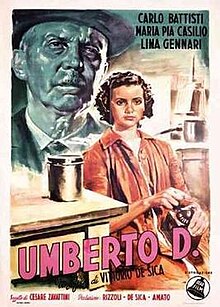
Umberto Domenico Ferrari (Carlo Battisti) is a retired government pensioner in 1950 Rome. We see him with other retirees picketing for better pensions and learn that he is in some debt. This is only part of a larger problem, however.
Umberto owes most of his debt to his landlady, a self-absorbed social climber who has been raising Umberto's rent in order to force him out of her building. Umberto's only real friends seem to be his spunky little dog, Flike (pronounced like...well, “like”) and the pretty, guileless young maid (Maria-Pia Casilio) in his building. It doesn't take long to see that he is a rather lonely man who has no prospects to speak of. The only things that seem to keep him going are Flike and a mild sense of spite for the world around him, most notably his landlady.
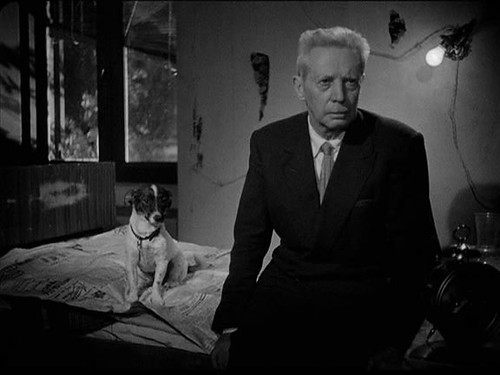
Umberto and Flike in their dank, lonely apartment.
After becoming sick with a fever and spending some time in a public hospital, Umberto attempts to track down past friends and co-workers to borrow some of the money he needs to stay in his apartment. All of his efforts are, however, rebuffed. In the middle of hustling around, he loses Flike. After a nerve-wracking trip to the local pound, where he witnesses dozens of dogs put down, Umberto finds his trusty canine companion.
Following another bout of loan refusals from friends, Umberto comes a hair's breadth from panhandling on the street. His dignity, alas, does not allow him to stoop, though he tries to let Flike hold his hat out for a brief moment. At this point, he returns to his room, which is being stripped of his goods and remodeled around him. Despondent, he plans to end his own life by jumping in front of a train. Only one obstacle exists: Flike.
Umberto tries to find a boarding home for his dog, but cannot. He tries to give him to a young girl whom he knows, but her guardians will not allow it. He tries to fool Flike into running off with a group of young children in a park, but Flike will not part with his master. Resigned, Umberto decides that the only thing left for him is to take Flike in his arms and end both of their lives together.
Grabbing Flike and cradling him, Umberto slowly and slyly crosses the guard rails as a train comes. Just as the train roars close and he prepares to step in front, though, Flike resists and fights his way out of Umberto's arms, running from the tracks. Umberto runs after Flike, who is now too scared to come near his master. Rather than abandon Flike and turn his back on his own life, Umberto decides to coax Flike's trust back out of him and play catch. Our old pensioner has decided to live, as sparse as that life might be.
Man's best friend, indeed.
Take 1: My Gut Reaction (Done before any research on the film)
This was an effort to get through.
I chalk this one up as another that fits in the category of “Great Films that I'll Never Watch Again”. I can't say that there's anything wrong with the movie. Judged on its own merit, it's brilliant. It does something that, at the time, was probably very new, and it has a genuine emotional impact in the end.
But God, did it take a long time to get there. And the movie is only 90 minutes long. It felt like 180 at times. Watching Umberto schlep around Rome from one miserable failure to the next was just plain depressing. It reminded me a lot of the only other De Sica movie I've seen: The Bicycle Thief. One unfortunate fellow with little to live for getting dumped on repeatedly by the people around him and life in general.
Doesn't sound like a fun viewing experience? It isn't.
As I said, though, I can't complain about any technical merits at all. The story is constructed well, the script seems decent (though what do I know – I don't speak Italian), the cast was solid, and the cinematography is incredible (probably the greatest strength, in fact). It's just that, in the end, I was left with a hollow feeling.
I must admit to how effective the sentimental aspects of the film are; namely, the relationship between Umberto and Flike. The three most striking scenes involve both characters: the rescue of Flike from the pound, Umberto having Flike hold out his hat to beg for money (for he's still too proud), and the grande finale of near-suicide/canicide. Still, I couldn't help but feel that this sentimentality was a bit cheap, as strong as it was.
This is a good example of one of the few Flike-less touching moments, when Umberto's desperation is high enough for him to consider begging:
Without knowing the exact history of cinema (though I'll be looking it up), this movie seems a forerunner of the French verite films of the 50s and 60s – that “realistic” approach that was rife with world-weariness and “everyday” problems, and the social ills that were the cause and/or effect. Those movies were hailed as edgy for their “realism” and their unflinching gaze at the uncomfortable truths of life. I hate them. They always seemed to have some sly tone of melancholy and apathy that was dressed up in a chic aesthetic, seeming to say “We're fashionable and hip, but we can be depressed, too.” Umberto D. has none of the fashion sense, but all of the sadness.
Of course, some movies are sad as hell and I still love them. For instance, Aronofsky's The Fountain or Wong Kar-Wai's In the Mood For Love. Umberto D. is a whole other kind of sad, even if there is redemption in the end. There's a worn-in, all-too-familiar feel to the situations in De Sica's movie. Perhaps this was his point; he wanted to make people squirm as they looked at the fallout of a society that turns its back on the elderly. For Umberto, the only thing that saves him is his faithful mutt, though even that's unintentional on said mutt's part.
A movie like this just leaves me feeling that humanity is scum, and I don't really need cinema to feel that way. Just watching the evening news is enough.
Take 2: Why Film Geeks Love This Movie (done after some further research)
After dwelling upon this movie for several days, and reading several essays on it, I've softened my stance a little bit. I am still quite positive, though, that I'll never watch it again.
It seems that this movie, according to people who know a ton more than I, that Umberto D. marked a bit of a transitional era in film making. Prior to its release, Vittorio De Sica could seemingly do no wrong. He had been a shining acting star in the 20s and 30s, and his first several films has met with popular and critical acclaim in the mid-40s. Umberto D., however, bombed horribly within Italy. Why? The explanation offers some interesting insights.
De Sica's earlier films were what is known as “neorealist”, meaning that they eschewed formal actors, formal stories, and elaborate production for much more naturalistic tales told by non-professional actors. The idea was to present fictional tales that told tragic tales in a near-documentary style. This approach apparently struck a chord with people, as they saw it as revelatory and cathartic. They made a clear statement about the ills of society and their effect on the individual.
Umberto D., while still in a neorealist style, removed some of the core elements, namely the overt condemnation of social malfunctioning. When I think back on it, this is true. One is not really meant to see Umberto as the victim of some soulless government machine. He's simply a lonely man whose seclusion is as much his own doing as his environment's. This seems like a small change of pace, so why such a dramatic shift in reception within its home country?
According to this essay by Peter Becker, it was basically timing. In the 50s, as opposed to the 40s, there was an optimism washing through Italy that precluded the “airing of dirty laundry” to other countries through film. The government of this time, which had considerable influence on media, saw Umberto D. as a pointless look at a tiny pocket of quiet sadness that still dwelt within its own borders. Feeling that it cast a poor light on their country, they panned it and stifled any chance it had at commercial success in Italy. Such was not to be the case in other countries, however, as places like the U.S., France and England hailed it as a masterpiece.
Umberto as he awaits the oncoming train that he hopes will end his life.
On revisiting the sentimentality of the movie, which I initially felt was a bit base, I think that my opinion has been swayed by Stuart Klawans in this essay of his. He analyzes the purpose of Flike in the movie and makes a great case that sentimentality need not necessarily cheapen a film's emotional impact. He sums it up with the line, “ If the main character feels that his humanity itself is slipping away, his sense of being a proper man, then why shouldn’t he have a sentimental relationship with a dog?” Well put, and this point actually makes me feel much better about being choked up at the end of the film.
Here's the final scene, which can certainly be appreciated without having seen the rest of the film. Be warned - it's a spoiler if you're into the mystery of the tale:
Umberto D. - certainly an excellent movie, though one that you need to be in a somber mood for. That's a wrap. 36 down. 69 to go.
Coming Soon: Singin' In The Rain (1952)
If this blog has taught you anything about me, it's that I hate musicals. This movie, surprisingly, is one that I've seen and remember liking. I'll see if my opinion holds after another viewing.
Please be sure to pick up all empties on the way out.



.jpg)
.jpg)