Showing posts with label Bande a part. Show all posts

Friday, June 14, 2013

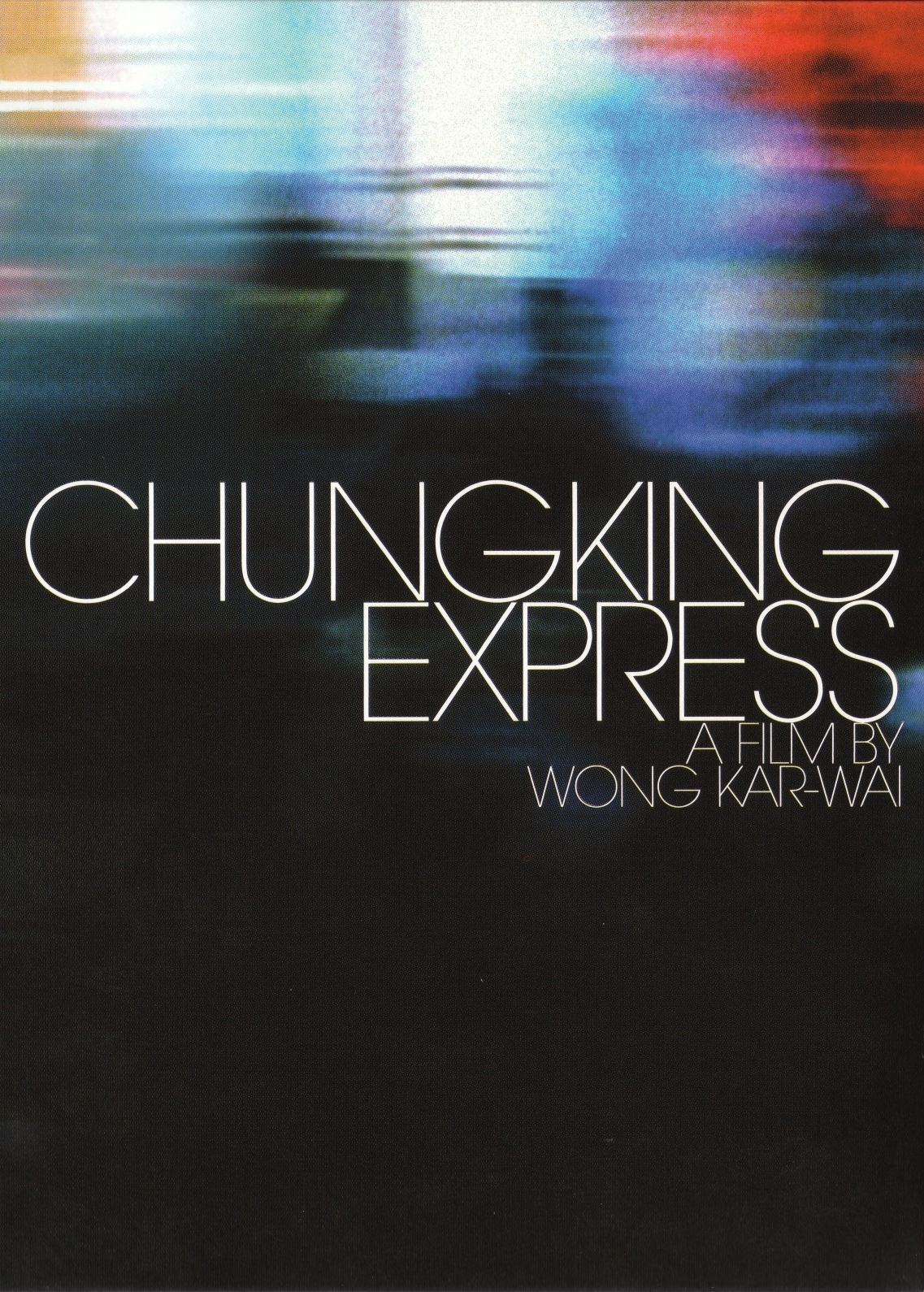
Film #97: Chungking Express (1995)


Original (Cantonese) Title: Chung Hing sam lam

Director: Wong Kar-Wai

Initial Release Country: Hong Kong (China)

Times Previously Seen: none

Semi-Rapid-Fire Summary

In 1990s Hong Kong, young police officer #223, He Qiwu, is battling loneliness in the wake of a lost love. His girlfriend has broken up with him just a few weeks prior, and he tries to deal with it by leaving voice messages for her on a daily basis. He has also given himself a deadline of 30 days, which he counts using expiration dates on can of pineapples, within which to hear from her. He tells himself that if he does not hear from her, he will abandon his hope of a reconciliation.

When the 30 days is up, Qiwu devours all of the cans of pineapples and heads to a bar to drown his sorrows. After several drinks, he spots and comes on to a beautiful woman in a blond wig. Unbeknownst to Qiwu, the icy woman is embroiled in a drug smuggling double-cross and is in the bar for some quietude. Still, she eventually succumbs to Qiwu’s persistent overtures and brings him up to her hotel room. Any amorous hopes that Qiwu may have are dashed, though, as the woman promptly falls sound asleep, leaving him to eat room service food and watch movies on the hotel television.

Qiwu tries to move past his former love with booze and some pick-up moves.

The day after, Qiwu has left the woman in the hotel room, and he seems on the verge of mentally moving past his ex-girlfriend. However, he receives a birthday message from her, perhaps giving him some shred of hope.

At a short-order restaurant frequented by Qiwu, another police officer, #663, is battling his own romantic breakup. Between getting coffee and food at the restaurant, he reminisces over a romance with a beautiful flight attendant. He copes by simply doing his duty as a cop and making humorous observations to the inanimate objects in his apartment, many of which belonged to his ex.

Taking notice of 663 is Faye – a somewhat flighty young woman who works the counter at the restaurant. Very secretively, Faye’s interest in 663 grows. In a turn of events, she ends up with a letter and apartment key from 663’s ex. Rather than passing them along to the dejected officer, Faye keeps the letter and uses the key to explore his tiny apartment while he is away at work. At first, she simply looks around, but eventually she begins to clean and care for the dwelling. This seems to be the only way that the socially awkward young woman can try to connect with the object of her infatuation.

Cop #663, lost in his own thoughts as the love-struck Faye gazes on.

After a few weeks of her clandestine care-taking, Faye is caught in the apartment by 663. Though shocked, the man is not critical. In fact, he allows Faye to stay a while and the two fall asleep on his couch. The following day, 663 and Faye plan to have an actual “date” at a nearby restaurant and bar. However, Faye stands up 663, leaves her job at the restaurant, and actually departs Hong Kong altogether. In a perhaps not-coincidental turn, she becomes a flight attendant in order to see the world. One year later, Faye returns to find that 663 has bought and is renovating the restaurant. The two talk a while, though we cannot be sure whether they will have any kind of future together.

My Take on the Film:

Chungking Express is a good movie that certainly shows a lot of skill from a then-young director. It’s quirky, thoughtful, and stylish in places. I can’t say that I was blown away, though.

In telling the story of the two lonely police officers, we get some very heartfelt slices of life in the hyperactive East Asian metropolis of Hong Kong. The stories of He Qiwu and Cop 663 are ones that come across as very authentic, and you can’t help but feel for both men. They seem to represent two of presumably countless other people in the vast city that can’t seem to find the romantic connections that they crave. The ways that they deal with their loneliness are quite different from one another, but show them both to be very sympathetic in their humorous attempts to cope with their dilemmas. It all has a feel rather reminiscent of the French New Wave films of Godard and Truffaut from the 1960s. In particular, Band ofOutsiders has the same genuine playfulness mixed with a tragedy that, admittedly, is more palpable.

Only being loosely connected to one another, the movie comes off as really two shorter films, stitched together only by the short-order food stand that they both frequent. The first story, that of Qiwu, I found to be the more engaging of the two. Qiwu is love-struck and pines away over his ex-girlfriend by marking off the days after their breakup by buying cans of pineapples, all of which will expire 30 days after his April Fool’s Day dumping. He tells himself that he will give his ex until May 1st to allow him back into her life. It’s a funny little system that reflects the little ways that we lie to ourselves in order to cling to past happiness. In Qiwu’s case, though, it clearly doesn’t work very well, as he falls in love with the mysterious woman in the blonde wig. The evening of unsatisfied amore in the hotel room is another slightly comical yet sad moment in his life. You end up feeling for him, though in a very realistic rather than classically romantic way.
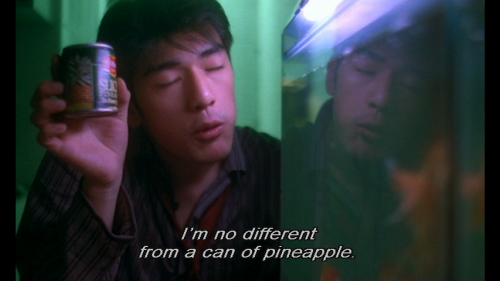
Qiwu's loneliness is cast in a rather humorous light, through his pineapple can counting system.

The tale of Cop 663 is one of a different sort. It has its own feel, but it has some of the same lighthearted wistfulness of Qiwu’s story. 663 is a slightly older man who seems more controlled and world-weary than Qiwu. Tony Leung, who is phenomenal in this as well as Kar-Wai’s later film In the Mood for Love, has the amusing quirks of consoling his household goods while seeming oblivious to some of the most obvious things. Faye’s initial quiet interest in 663 is charming at first, but for me it lapses into disturbing stalker behavior – something akin to a more eerie version of the title character’s antics in the playful French film Amelie. I don’t know that this was Kar-Wai’s intent, but it is the impression I came away with. Nevertheless, the story certainly held my attention, even if I wasn’t left completely satisfied at the end.

Aesthetically, the film is rock-solid. Thanks to excellent camerawork, the film conveys Hong Kong as a vibrant, ever-churning mass of bodies, buildings, and colors. Some of the scenes in Qiwu’s story use an impressionistic, herky-jerky style of editing that I’m not a fan of, but it didn’t distract. A lot of the movie is simply enjoyable to look at, something that is also further honed in In the Mood for Love.

663's observations of and to the various inanimate objects in his apartment add a really warm, amusing layer to his seemingly passive demeanor.

One little nuisance has stuck with me since I watched this movie several days ago. In 663’s story, Faye is obsessed with the song California Dreamin’ by the Mamas and the Papas. The song is played no less than four times within a forty-five minute span, and it wore me out. Ever since I watched it, I can’t get the song out of my head, it was so firmly jack-hammered into me by the movie. I don’t care how appropriate a song is in a film story or even how good a song it is, no tune should be played this many times in any movie. It just wears thin.

Will I watch this movie again? I doubt it. I would, however, recommend it as a good one.

That’s a wrap. 97 shows down. 8 to go.

Coming Soon: Ulysses’ Gaze (1997)


I’ve had a hell of a time even trying to find a copy of this one. I have to be skeptical of a “masterpiece” that’s not even in print, in this day and age when everything you could imagine is at your fingertips. Maybe I’ll be surprised…


Please be sure to pick up all empties on the way out.

Saturday, August 27, 2011

Film #60: Bande a part (1966)


Title for us English-speaking Types: Band of Outsiders

Director: Jean-Luc Godard

Initial Release Country: France

Times Previously Seen: none

Teaser Summary (No spoilers)

Trio of young, restless Parisians attempt a heist, in their own silly, amateurish way.

Extended Summary (A more complete plot synopsis, spoilers included. Fair warning)

In 1960s Paris, buddies Arthur (Claude Brasseur) and Franz (Sami Frey) are in the midst of planning a burglary. The two men are complete novices at thievery, but they seem bored and mildly desperate, and opportunity presents itself. That opportunity has come through Odile (Anna Karina), a pretty young girl whom Franz has met at an English school. Odile lives with her aunt in an impressive home, where she says their current boarder has a stash of millions of francs which he has stolen from the government. Odile tells Arthur and Franz that the money is left in an unlocked cabinet in an unlocked room. The three decide to relieve him of the money and escape their dull lives in Paris.

Over the course of a few days, the three grapple with their impending crime and their own feelings for each other. All three seem friendly enough, in their own flighty ways, but they all face uncertainties. Franz is a bright, well-read man who has genuine feelings for Odile. Odile, the youngest, the most nervous and guilt-ridden of the three, falls for Arthur. Arthur has a quirky yet dark charm, but is somewhat cold and beholden to his heartless and greedy family.

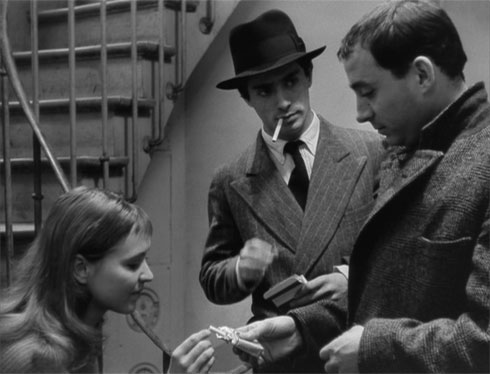
The triangle takes shape: Odile (left), accepts a cigarette from Arthur (right), after coldly refusing Franz (middle).

When the planned date of the robbery approaches, problems start to arise. Odile’s nervousness increases, but the fellows calm her enough to go in and allow them entry to the house. After they “break” in, they soon discover that the previously unlocked room is now firmly locked. They try the outside window, but this too is locked. Odile explains that her aunt and the boarder must have gotten suspicious, based on her own slight disheveling of the room on a previous search through it. Franz and Arthur, frustrated, abandon the job for the day, but pledge to return on the morrow.

The next day, the scene from the prior day repeats itself, to a degree. Odile lets the men in, and Arthur and Franz bully her aunt into giving them the room key, and then they bind her, gag her, and lock her in a massive cabinet. They get into the boarder’s room, but the cabinet is now empty of all but a few thousand francs. When they return to try and get the money’s location out of the aunt, she appears lifeless. They assume she is dead and they flee the house. Just as Arthur, Franz, and Odile are about to drive away, Arthur decides to double back and check to see if the aunt is indeed dead. He promises to meet Franz and Odile a short while later.

During the second robbery attempt, Arthur unleashes his nasty side, while Odile looks on.

Franz and Odile, driving away from the house, spot Arthur’s nefarious uncle, who has known of the planned caper all along, heading towards the house. Franz has a bad feeling about it all, makes a quick U-turn, and tries to catch up. When he and Odile approach the house, their fears are realized: they see Arthur emerge from the house, go into an attached doghouse, and fish the missing money out. As he is carrying the bundles of cash away, his own uncle steps out of the bushes and shoots him several times, the money spilling onto the lawn. Arthur does manage to shoot and kill his uncle in return, but then dies himself. Odile and Franz, watching from afar, then see Odile’s aunt, alive and well, come out of the house just as the boarder arrives on the scene. The two scoop up the money and scramble inside. Franz and Odile leave the bloody scene and drive away.

On the road away from the carnage, Franz and Odile share their feelings for each other and realize that they love one another, even through the attempted crime gone horribly wrong. They decide to board a ship and head to Brazil, where they hope to live happily together and explore a place far removed from their lives in Paris.

Take 1: My Gut Reaction (Done before any further research)

This was a peculiar little movie, but a rather enjoyable one.

Before watching Band of Outsiders, the only other Jean-Luc Godard film I had seen was the influential science fiction film, Alphaville. I found Alphaville interesting and imaginative, but also rather baffling. Band of Outsiders was also a bit baffling, but in different and more amusing ways.

While watching this movie, I couldn't help but think of one of my absolute favorite comedies, The Big Lebowski, that fantastic, bizarro take of the Coen brothers on the noir genre. The Coen's clearly took the premise of “What if a burnt-out stoner were thrown into a 1940s-style noir crime tale set in 1990's Los Angeles?” and ran with it. In Band of Outsiders, Godard seemed to do something similar, asking, “What if three semi-hapless youths tried to pull a heist, and the story were told in noir style?” The results are pretty entertaining and, I imagine, quite novel for 1964.

From the beginning, the film does a good job of establishing the tone. Franz and Arthur drive out and “case” the house they plan to rob, but they can't help lapsing into silly games of “Billy the Kid versus Pat Garrett,” romping and rolling around the street like a couple of 8-year-olds. Master criminals, these are not.

Arthur and Franz, clowning around in the middle of their first recon of the house.

When the young, pretty, uncertain and almost accidentally devious Odile appears, she adds another dimension. Like Franz and Arthur, she knows only that she doesn't like her current life in Paris. Throughout the film, the three flirt with each other and make attempts to reveal their feelings about and to one another, without much success. Franz has a deeper, more thoughtful attraction to Odile, who is infatuated with the more reckless, immature and mysterious Arthur, who lusts for Odile but is more interested in the loot. It's a half-baked love triangle that one would expect from aimless youth.

The style of the film is a comedic take on noir movies. The voice-over narration reveals the inner thoughts of the three main characters. In a standard noir, such as Out of the Past or Double Indemnity, this adds psychological depth, mood and tension through terse, poetic language. In Band of Outsiders, it provides an extra layer of humor by revealing that neither Franz, Arthur, nor Odile is possessed of so much as a fraction of the ability, weariness or resignation of legitimate noir protagonists. They are restless and scattered, and their preoccupations make them horribly suited for lives of crime. But, what else are they going to do?

The plot itself is nothing extraordinary. When I saw “French” and “crime” on the DVD summary, I was ready for something quite different. Having enjoyed several French crime/escape flicks, such as Le Trou and Rififi, I hoped for a similarly tight, fast-paced caper film. Band of Outsiders makes the object of the thieves' desires one that any crime film can utilize – bundles of dirty cash – but makes its obtainment (and failure of) so simple that it's laughable. The money just sits in a cabinet, and the thieves are first thwarted when the cabinet is locked, and later when the money is moved into a nearby doghouse. There's something oddly and hilariously more realistic about all of this.

The "bande" kill some time before the heist by racing through the Louvre. Just one of their sillier adventures.

The acting is all solid. The roles were not extremely demanding, but the three main characters needed to convey uncertainly and antsiness in just the right amounts, and all of them did so. As with any film in a language that one doesn't speak, I'm sure that I even missed some of the subtle humor that can be conveyed by phrasing and tone, but the subtitles seemed to do a good enough job to keep me laughing in appropriate moments.

If a have to knock my viewing experience at all, I would say that it was due to the disorienting nature of the movie. Perhaps this was due to my ignorance of the film going in, but it takes a while to get a full grip on what the movie is trying to do. There are moments of silliness, gravity, dancing, somber soul-searching, deaths by gunshots, and overblown death throes, among others. At times it borders on incoherent, but it never slipped over the edge to me.

Another thing that tried my patience a little was the dialogue. Like many French nouveau movies of the same era, the characters tend to speak in oddly existential epigrams at times. This may have been another element that Godard meant as a mild spoof, but it was hard to be sure. When someone like Odile, who, according to the narrator “wondered if the boys noticed her breasts moving beneath her sweater,” later observes that, "All that is new is, by that fact, automatically traditional." It's hard to tell whether this is supposed to imbue her with a more rounded character, or if we are simply supposed to laugh at her suddenly-found profundity and/or pretension (two things that many French films have in nauseating abundance). Hard for me to say.

Band of Outsiders was a fun, quirky little film to watch. It was far from taxing, length-wise (a mere 93 minutes), and never got mired too deeply in the few elements that I could have found annoying. Would I watch it again? Perhaps, but I wouldn't rush to do so.

Fin. Franz and Odile take a slow boat to Brazil - some place that's not France.

Take 2: Why Film Geeks Love This Movie (Done after some further research)

Not a ton of information out there on this movie, and nothing that surprised me or altered my view of it too much.

In general, it seems that this movie is revered for the blending of its lighthearted tone with its aping of previously-established styles. Several scenes and visuals in the film inspired several later homages in other movies. The one most often mentioned is the “Madison dance” scene. I didn't mention it, but it is a standout scene for its humorous strangeness. One of the more modern and well-known homages of the scene is the Vincent Vega/Mia Wallace dance number in Pulp Fiction.

The famous "Madison dance" scene. Strange? Yup.

A rather heady 2003 essay by Joshua Clover can be found here. Mr. Clover is clearly well-versed in film history, and he draws connections between many elements of Bande A Part, its American root elements, and the relationship to the French New Wave movement of the time. It's an interesting read, though dizzying at times.

That's a wrap. 60 shows down; 45 to go.

Coming Soon: Persona (1966)


Ingmar Bergman has gone all serious, psychological, and disturbing on us! Last time one of his films was in this list, it was the delightful Smiles of a Summer Night. I've seen Persona before, and I know not to expect the easygoing, sly comedy of that earlier film.

Please be sure to pick up all empties on the way out.