Showing posts with label The Big Lebowski. Show all posts

Wednesday, June 1, 2016

New Release! The Nice Guys

Director: Shane Black

One of the best times I've had at the movies in recent years. It might not be perfect or blindingly original in all facets, but The Nice Guys is a hilarious entry into the oft-botched genre of R-rated buddy flicks.

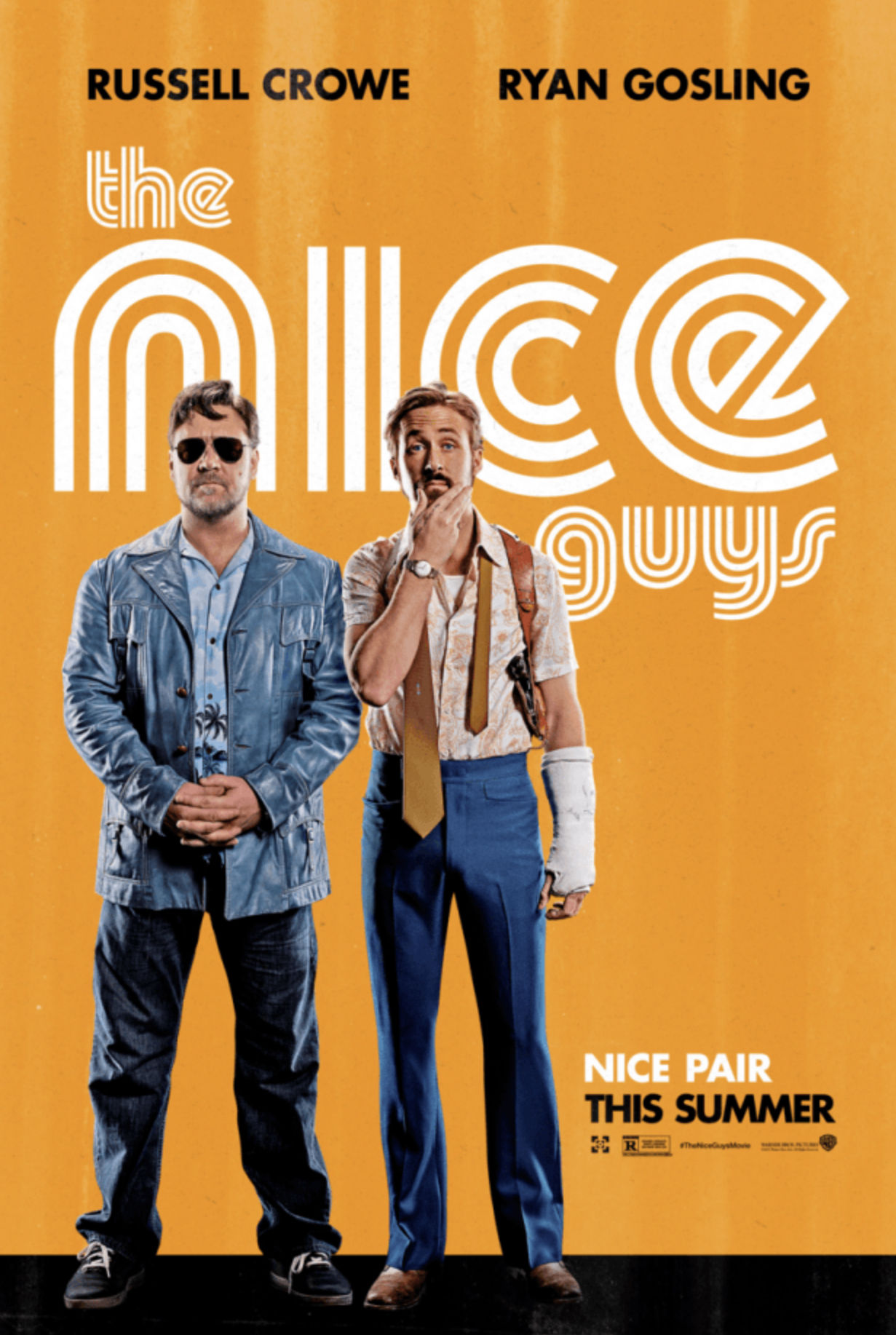
The movie follows Holland March (Ryan Gosling), a private investigator who is put on the case of finding a missing young woman, Amelia, in the drug-fueled Sodom and Gomorrah that was 1977 Hollywood, California. The case itself bears several odd elements, made all the more challenging by the fact that March is not only an alcoholic but also oddly inept at his job. Fortunately for him, he is joined by the sober and much more capable muscle-for-hire Jackson Healy (Russell Crowe). The two find themselves trying to navigate the winding, bizarre trail that Amelia leaves through the Hollywood porn industry, justice department, and even the U.S. automotive industry.

Writers Shane Black and Anthony Bagarozzi fully embraced the neo-noir style and did it tremendous justice, while at the same time turning plenty of its familiar cliches on their ears. There are more than a few sequences which begin in very familiar fashion to crime movie lovers, but which take sly little comic turns. In a move gleefully similar to The Big Lebowski, making the "hero" detective a booze-addled goof creates plenty of opportunity for humor, and the movie capitalizes.  And the characters only enhance the gags. While March does have reasons for being so down on his luck, it doesn't lessen the hilarity of his missteps and posturing. He's the perfect pairing to the grizzled, no-nonsense Healy, and their dynamic is a blast to watch. Peppered throughout all of this are several great little sight gags which are among some of the best I've seen in some time.

Gosling and Crowe make the blend of tough and hilarious
look deceptively smooth and easy. They enhance Black's
already-great script to another level.
It is difficult to imagine better casting for March and Healy than Ryan Gosling and Russell Crowe. They play their characters to a tee, and left me with the same feeling that any successful buddy movie should leave - the desire to see more of them. There are a few minor characters that may not have completely fit the bill, but these were the few exceptions among the mostly-strong supporting cast.

As I write this review, the movie has been out for about two weeks and hasn't done exceptionally well at the box office. I do hope that it picks up, as I feel that this type of quality, R-rated comedy is a bit of a dying breed in movies. 

Sunday, November 29, 2015

New(ish) Releases: Inherent Vice (2014); What We Do in the Shadows (2015); Get Hard (2015)

Inherent Vice (2014)

Director: Paul Thomas Anderson

The Big Lebowski meets Fear and Loathing in Las Vegas. As you may imagine, this works brilliantly at times but is a hazy mess at others.

Inherent Vice bears many hallmarks of the noir film genre: A male detective protagonist. A (quasi) femme fatale. An array of strange and suspicious characters. A nefarious plot which grows complex enough to baffle nearly any viewer. The story was clearly taking from the pages of the earliest noir novelists like Chandler and Hammett, as well as the classic noir film directors such as Raoul Walsh and Billy Wilder.

Where Inherent Vice would seemingly take a different slant on the noir genre is how it makes the private investigator protagonist a semi-burned out stoner, Larry "Doc" Sportello (Joaquin Phoenix). That is, it would be a different slant if the Coen brothers hadn't already done it nearly 20 years ago in The Big Lebowski. Granted, there is far less comedy and far more grasping for some sort of vague profundity in Inherent Vice. Still, it is impossible to watch the parade of comically bizarre and eminently "Los Angeles" characters and not think of the dozens of oddballs whom The Dude encounters while trying to track down Bunny Lebowski. The Dude had Walter, Jackie Treehorn, Maude Lebowski, the German nihilists, and plenty of others. Doc has Michael Wolfmann (Eric Roberts, in a solid performance), Detective "Bigfoot" Bjornsen (Josh Brolin, the same), Jade the hooker, Dr. Blatnoyd, D.D.S., the Nazi skinhead bikers, and plenty of others. Vice is clearly the spiritual successor of The Big Lebowski's tale of "a strange dude among far stranger and scarier people." It does make for a rather fun, trippy, 20th century American odyssey.

I have not read Thomas Pynchon's source novel, though I must assume that it provides the film adaptation's inconsistent, incoherent voice-over narration. Amidst what is sometimes very straightforward slapstick or gumshoe storytelling, the thoughts and observations of the nebulous character Sortilege often seem out of place and pretentious, if not downright ridiculous. The main characters also suffer from this same strange inability to completely flesh themselves out, whether through their actions or dialogue. It is simply quite difficult to get any firm grasp on who or what each person is supposed to be. When you mix in the sometimes-frantic tone, which I associate with Terry Gilliam's wildly uneven adaptation of Hunter S. Thompson's Fear and Loathing in Las Vegas, then there tends to be just a little too much emulation of earlier iconic pieces of work. Honestly, Inherent Vice even has Benicio del Toro in a cameo playing a fast-talking, unhinged lawyer, just like in Fear and Loathing.

All of this said, I will likely watch this movie again in the future, probably after reading Pynchon's novel. The performances are certainly commendable, even hypnotic at times. The movie seems strongest when at its most comical, even if this is also when it wanders too deeply into the territory of being a Lebowski clone. The story also includes enough of the noir hallmark twists and turns to provide amusing mental exercise in simply keeping up with everything. Some of the work pays off, while some left me wondering at the exact purposes of certain parts of the film.

Inherent Vice is another film in the Paul Thomas Anderson catalogue which shows the director's eye for visuals and dedication to crafting something engaging. This recent effort, though, is arguably his least accessible film to date. Those who like a clear, straightforward narrative and tone will probably find this 140-plus minute movie frustrating. Even those who appreciate elements of the film will likely find their patience tried more than a few times.

What We Do in the Shadows (2015)

Directors: Jemaine Clement and Taika Waititi

Maybe not quite an instant classic in the Spinal Tap class, but this is a great mockumentary.

Mimicking the tone of "days in the lives of" documentaries, What We Do in the Shadows follows four flatmates in New Zealand who happen to be vampires, ranging in age from around 150 to over 8,000 years old. Though having all of the powers glamorized through popular fiction, the four undead roomies are not immune to many nuisances similar to those experienced by the living, though their problems have very peculiar twists. They bicker about who has to clean the dishes, but they do it while floating in the air and hissing at each other. They try to keep the carpets clean, but mostly from their accidentally hitting a victim's artery and spraying blood all over the apartment. Since they can't cast a reflection in a mirror, they have to draw rough sketches of each other in order to know what they look like. And on it goes.

The movie is hilarious in a variety of ways. Some of the gags and lines are immediately and gut-bustingly funny. Others are far more wry, but they are likely to stay with you and grow funnier the more you think about them. One example is how the vampires, in their attempts to go clubbing, are constantly frustrated by the fact that they must, in keeping with well-known vampire lore, be invited inside. Watching the main trio of powerful creatures get turned away from club after club grew funnier the more I replayed it in my mind. This was just one of dozens of similar gags.

The cast is all but perfect. True to the humor seen in director/star Jemaine Clement's HBO series The Flight of the Conchords, everything is done in complete deadpan. The actors were, to a person, spot on in their absurd matter-of-fact approach to being vampires, meeting vampires, or even being eaten by vampires. A particular standout is co-director Taika Waititi, who plays Viago, the single most amusing and memorable character in the film. Viago was born in 18th century Austria, and is a hilariously chipper "dandy," as his roommate and fellow vampire Vladimir calls him. Waititi plays this undead creature of the night with such hilarious cheerfulness that his performance alone is worth your time.

I have a feeling that this movie will only grow funnier upon repeat viewings, as do the very best mockumentaries.


Get Hard (2015)

Director: Etan Cohen

Enjoying this movie requires two simple things: Be a fan of either Will Ferrell or Kevin Hart, and check your brain in before you watch it. I am, and I did, and I had just enough fun to justify spending 100 minutes with this comedy.

The  movie has problems, to be sure. The script and tone smack of disorganization and overreliance on improv by the highly energetic co-stars. The attempts to use race and racial stereo-typing as sources of humor sometimes fall flat at best, and horribly offensive at worst. Many of the scenarios are far too ridiculous to hold up to even the slightest bit of scrutiny. All the same, it provided just enough of the stupid humor that I was looking for that night.

My main concern going in was that I would find the hyper-active Kevin Hart extremely annoying. Blessedly, he's the far straighter character, resulting in his toning down his energy level enough to remain funny without getting too clownish. Ferrell is the far more ridiculous character here, which has always been his comfort zone. Between his occasionally manic outbursts and deadpan absurdity, he can carry many would-be dud scenes. Granted, there are several scenes so ill-conceived that neither Ferrell nor Hart could breath humor into them.  All the same, I got a good solid laugh every 5 or 10 minutes, which is all I really look for in a movie that clocks a 29% positive rating on Rotten Tomatoes.

The most frustrating thing about movies like Get Hard is that they have far more potential. In the opening scenes, it seems as if we are in for a well-done satire on wealth, privilege, and racial stereotyping. Around 15 minutes in, though, the satire fades and an oddly serious tone takes over. The remaining hour or so continue to zig-zag between complete zaniness and half-baked or misguided attempts at social commentary. If the movie had had a clearer vision of itself and more imagination and courage with the script, it could have been far better. As it was, it ends up in the same barrel as Talladega Nights - an intermittently funny flick that I'll never watch again. 

Saturday, August 27, 2011

Film #60: Bande a part (1966)


Title for us English-speaking Types: Band of Outsiders

Director: Jean-Luc Godard

Initial Release Country: France

Times Previously Seen: none

Teaser Summary (No spoilers)

Trio of young, restless Parisians attempt a heist, in their own silly, amateurish way.

Extended Summary (A more complete plot synopsis, spoilers included. Fair warning)

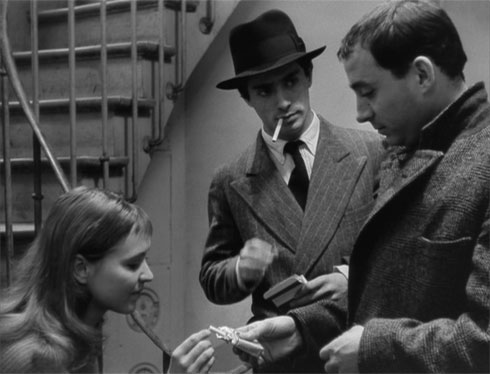
In 1960s Paris, buddies Arthur (Claude Brasseur) and Franz (Sami Frey) are in the midst of planning a burglary. The two men are complete novices at thievery, but they seem bored and mildly desperate, and opportunity presents itself. That opportunity has come through Odile (Anna Karina), a pretty young girl whom Franz has met at an English school. Odile lives with her aunt in an impressive home, where she says their current boarder has a stash of millions of francs which he has stolen from the government. Odile tells Arthur and Franz that the money is left in an unlocked cabinet in an unlocked room. The three decide to relieve him of the money and escape their dull lives in Paris.

Over the course of a few days, the three grapple with their impending crime and their own feelings for each other. All three seem friendly enough, in their own flighty ways, but they all face uncertainties. Franz is a bright, well-read man who has genuine feelings for Odile. Odile, the youngest, the most nervous and guilt-ridden of the three, falls for Arthur. Arthur has a quirky yet dark charm, but is somewhat cold and beholden to his heartless and greedy family.

The triangle takes shape: Odile (left), accepts a cigarette from Arthur (right), after coldly refusing Franz (middle).

When the planned date of the robbery approaches, problems start to arise. Odile’s nervousness increases, but the fellows calm her enough to go in and allow them entry to the house. After they “break” in, they soon discover that the previously unlocked room is now firmly locked. They try the outside window, but this too is locked. Odile explains that her aunt and the boarder must have gotten suspicious, based on her own slight disheveling of the room on a previous search through it. Franz and Arthur, frustrated, abandon the job for the day, but pledge to return on the morrow.

The next day, the scene from the prior day repeats itself, to a degree. Odile lets the men in, and Arthur and Franz bully her aunt into giving them the room key, and then they bind her, gag her, and lock her in a massive cabinet. They get into the boarder’s room, but the cabinet is now empty of all but a few thousand francs. When they return to try and get the money’s location out of the aunt, she appears lifeless. They assume she is dead and they flee the house. Just as Arthur, Franz, and Odile are about to drive away, Arthur decides to double back and check to see if the aunt is indeed dead. He promises to meet Franz and Odile a short while later.

During the second robbery attempt, Arthur unleashes his nasty side, while Odile looks on.

Franz and Odile, driving away from the house, spot Arthur’s nefarious uncle, who has known of the planned caper all along, heading towards the house. Franz has a bad feeling about it all, makes a quick U-turn, and tries to catch up. When he and Odile approach the house, their fears are realized: they see Arthur emerge from the house, go into an attached doghouse, and fish the missing money out. As he is carrying the bundles of cash away, his own uncle steps out of the bushes and shoots him several times, the money spilling onto the lawn. Arthur does manage to shoot and kill his uncle in return, but then dies himself. Odile and Franz, watching from afar, then see Odile’s aunt, alive and well, come out of the house just as the boarder arrives on the scene. The two scoop up the money and scramble inside. Franz and Odile leave the bloody scene and drive away.

On the road away from the carnage, Franz and Odile share their feelings for each other and realize that they love one another, even through the attempted crime gone horribly wrong. They decide to board a ship and head to Brazil, where they hope to live happily together and explore a place far removed from their lives in Paris.

Take 1: My Gut Reaction (Done before any further research)

This was a peculiar little movie, but a rather enjoyable one.

Before watching Band of Outsiders, the only other Jean-Luc Godard film I had seen was the influential science fiction film, Alphaville. I found Alphaville interesting and imaginative, but also rather baffling. Band of Outsiders was also a bit baffling, but in different and more amusing ways.

While watching this movie, I couldn't help but think of one of my absolute favorite comedies, The Big Lebowski, that fantastic, bizarro take of the Coen brothers on the noir genre. The Coen's clearly took the premise of “What if a burnt-out stoner were thrown into a 1940s-style noir crime tale set in 1990's Los Angeles?” and ran with it. In Band of Outsiders, Godard seemed to do something similar, asking, “What if three semi-hapless youths tried to pull a heist, and the story were told in noir style?” The results are pretty entertaining and, I imagine, quite novel for 1964.

From the beginning, the film does a good job of establishing the tone. Franz and Arthur drive out and “case” the house they plan to rob, but they can't help lapsing into silly games of “Billy the Kid versus Pat Garrett,” romping and rolling around the street like a couple of 8-year-olds. Master criminals, these are not.

Arthur and Franz, clowning around in the middle of their first recon of the house.

When the young, pretty, uncertain and almost accidentally devious Odile appears, she adds another dimension. Like Franz and Arthur, she knows only that she doesn't like her current life in Paris. Throughout the film, the three flirt with each other and make attempts to reveal their feelings about and to one another, without much success. Franz has a deeper, more thoughtful attraction to Odile, who is infatuated with the more reckless, immature and mysterious Arthur, who lusts for Odile but is more interested in the loot. It's a half-baked love triangle that one would expect from aimless youth.

The style of the film is a comedic take on noir movies. The voice-over narration reveals the inner thoughts of the three main characters. In a standard noir, such as Out of the Past or Double Indemnity, this adds psychological depth, mood and tension through terse, poetic language. In Band of Outsiders, it provides an extra layer of humor by revealing that neither Franz, Arthur, nor Odile is possessed of so much as a fraction of the ability, weariness or resignation of legitimate noir protagonists. They are restless and scattered, and their preoccupations make them horribly suited for lives of crime. But, what else are they going to do?

The plot itself is nothing extraordinary. When I saw “French” and “crime” on the DVD summary, I was ready for something quite different. Having enjoyed several French crime/escape flicks, such as Le Trou and Rififi, I hoped for a similarly tight, fast-paced caper film. Band of Outsiders makes the object of the thieves' desires one that any crime film can utilize – bundles of dirty cash – but makes its obtainment (and failure of) so simple that it's laughable. The money just sits in a cabinet, and the thieves are first thwarted when the cabinet is locked, and later when the money is moved into a nearby doghouse. There's something oddly and hilariously more realistic about all of this.

The "bande" kill some time before the heist by racing through the Louvre. Just one of their sillier adventures.

The acting is all solid. The roles were not extremely demanding, but the three main characters needed to convey uncertainly and antsiness in just the right amounts, and all of them did so. As with any film in a language that one doesn't speak, I'm sure that I even missed some of the subtle humor that can be conveyed by phrasing and tone, but the subtitles seemed to do a good enough job to keep me laughing in appropriate moments.

If a have to knock my viewing experience at all, I would say that it was due to the disorienting nature of the movie. Perhaps this was due to my ignorance of the film going in, but it takes a while to get a full grip on what the movie is trying to do. There are moments of silliness, gravity, dancing, somber soul-searching, deaths by gunshots, and overblown death throes, among others. At times it borders on incoherent, but it never slipped over the edge to me.

Another thing that tried my patience a little was the dialogue. Like many French nouveau movies of the same era, the characters tend to speak in oddly existential epigrams at times. This may have been another element that Godard meant as a mild spoof, but it was hard to be sure. When someone like Odile, who, according to the narrator “wondered if the boys noticed her breasts moving beneath her sweater,” later observes that, "All that is new is, by that fact, automatically traditional." It's hard to tell whether this is supposed to imbue her with a more rounded character, or if we are simply supposed to laugh at her suddenly-found profundity and/or pretension (two things that many French films have in nauseating abundance). Hard for me to say.

Band of Outsiders was a fun, quirky little film to watch. It was far from taxing, length-wise (a mere 93 minutes), and never got mired too deeply in the few elements that I could have found annoying. Would I watch it again? Perhaps, but I wouldn't rush to do so.

Fin. Franz and Odile take a slow boat to Brazil - some place that's not France.

Take 2: Why Film Geeks Love This Movie (Done after some further research)

Not a ton of information out there on this movie, and nothing that surprised me or altered my view of it too much.

In general, it seems that this movie is revered for the blending of its lighthearted tone with its aping of previously-established styles. Several scenes and visuals in the film inspired several later homages in other movies. The one most often mentioned is the “Madison dance” scene. I didn't mention it, but it is a standout scene for its humorous strangeness. One of the more modern and well-known homages of the scene is the Vincent Vega/Mia Wallace dance number in Pulp Fiction.

The famous "Madison dance" scene. Strange? Yup.

A rather heady 2003 essay by Joshua Clover can be found here. Mr. Clover is clearly well-versed in film history, and he draws connections between many elements of Bande A Part, its American root elements, and the relationship to the French New Wave movement of the time. It's an interesting read, though dizzying at times.

That's a wrap. 60 shows down; 45 to go.

Coming Soon: Persona (1966)


Ingmar Bergman has gone all serious, psychological, and disturbing on us! Last time one of his films was in this list, it was the delightful Smiles of a Summer Night. I've seen Persona before, and I know not to expect the easygoing, sly comedy of that earlier film.

Please be sure to pick up all empties on the way out.

Saturday, May 1, 2010

Film #25: Double Indemnity (1944)

Director: Billy Wilder

Initial Release Country: United States

Times Previously Seen: 3 (most recently about 2 years ago)

20-Words-or-Fewer Summary (no spoilers)

Insurance salesman and black widow gold digger plot murder of husband; hope to get rich off insurance policy.

The Full Treatment (A complete summary, spoilers included. Fair warning):

In 1940s Los Angeles, clever insurance salesman Walter Neff (Fred MacMurray) stops by the opulent home of rich client Mr. Dietrichson to get some signatures on an auto insurance policy. Instead, he meets Dietrichson's sultry younger wife, Phyllis (Barbara Stanwyck). After some flirtatious fast-talk, Phyllis slyly inquires about getting a life insurance policy for her husband, but without his knowing it. The quick-witted Neff immediately smells something fishy and clears out, warning Phyllis that any plot she may have to off her husband and collect insurance money is bound to fail.

And yet, after leaving, Neff can't get Phyllis or her scheme out of his mind. Sure enough, she shows at his apartment later, and they fall into each other's arms. Then and there, Walter agrees to help Phyllis with her nefarious plot. He's sure that, with his knowledge of botched murders through the insurance claims business, they can commit the crime, avoid leaving any evidence, and spend the rest of their lives together off of a $100,000 "double indemnity" insurance policy.


Walter & Phyllis: future lovers and accomplices.

Neff carefully plots the murder and coaches Phyllis in assisting him. With calculated precision, the two get Mr. Dietrichson's unwitting signature on the life insurance policy, then lure him to his own murder, making it seem like an accidental fall from the observation car of a moving train.

At first, it seems as if they will get off scott free. Then, one person starts to smell a rat. Barton Keyes, the eagle-eyed, obsessive claims manager at Neff's office, senses something amiss. Following his instincts, which he refers to as his "little man," the long-time insurance man starts to become ever surer that Dietrichson's death was not accidental. Even more, he feels that Phyllis is the culprit. The only thing he doesn't see is Neff's involvement in the whole thing, but Neff senses Keyes getting closer to the truth.

As the pressure ratchets up, Neff discovers several unsavory things about his co-conspirator, Phyllis. She was, according to Dietrichson's daughter Lola, responsible for the death of the first Mrs. Dietrichson. On top of this, Phyllis has been secretly seeing Lola's boyfriend, Nino, at night for unknown reasons. Neff realizes that he's been played for a sucker.

When Walter goes to Phyllis's house to confront her with his revelations, he throws her deceptions in her face and explains how he plans to see that she will get locked up for the murder of Dietrichson. As a kicker, he plans to absolve himself by killing Nino, who Walter will claim was her accomplice. Phyllis, cornered, pulls a gun and shoots Neff in the arm. Neff clutches her tightly and shoots her dead, the two sharing one final, warped moment of attraction for each other. Nino shows up shortly after, but Neff abandons his plan to frame and kill him, rather telling him to leave and find Lola.

The wounded Neff manages to stagger back to Keyes's office and begins to record his own confession. Just as he reaches the end, Keyes shows up and looks on with sadness and disappointment as his former employee, and perhaps friend, lies bleeding on the floor. As they await the police, Keyes does Walter one final favor - he assists his now one-armed, former friend to light one last cigarette. Sure to be his last.

Take 1: My Gut Reaction (done after the most recent viewing, before any research):

Now we get down an dirty.

After watching several artful cinematic master works and wading through the sophomoric humor of the screwball comedies on this list, I was ready for the downright nastiness of Double Indemnity. This film is a standard just as much as Citizen Kane or Casablanca, but for completely different reasons.

There are no heroes. You have to face this fact - the two main characters are murderers, one merely cold-blooded; the other ice-blooded. Rather than love being the force that attracts one to the other and gives the audience some semblance of a human connection, it's base lust. Walter is entranced by Phyllis' looks and attitude. It's almost like he refuses to realize that he's drawn to her based on the thing that makes her most dangerous - her viper-like magnetism and the promise of sensual delights, even if they're followed by his own destruction. It's this fatalism that's a hallmark characteristic of nearly all film noir protagonists (most notably in the classic Out of the Past - film #31 on the TIME list.)


"She didn't fool me this time." Oh, but she had you all along, Walt. She had you all along...

And yet, at one point, I was hoping that the killer Neff would succeed. This is not because his victim was an evil, or even a bad person. In fact, we don't know much about Dietrichson at all. He's just a pawn with a fat bank account as far as Neff, Phyllis and we viewers are concerned. I think it speaks to the movie writers' skill that there was a moment when, after the murder occurs, I actually wanted Neff to get away with it. How the hell did I become a cheerleader for a murderer?!

I chalk it up to a certain aspect of human nature, one that A-Team leader Hannibal put well: "I love it when a plan comes together." Whatever the plan is, we love to see if someone can pull it off. How else do you explain the appeal of crime movies? Well, Double Indemnity went all the way with it. Instead of giving you something slightly more palatable like bank robbers or a prison escape, you get two people who are going to kill someone for nothing more than greed and lust. Still, Walter's plan is so well-conceived and precise that you can't wait to see if it works, regardless of the motives. There was actually a moment when, as a monkey wrench is thrown into the plan and the risk of discovery increases, I felt nervous for Walter. I was actually sympathizing with a killer!

But more than this is that there is actually some form of redemption in the end. While his veins pump with 33-degree water throughout most of the movie, Walter's senses do return by the end, if only just barely. He sees Phyllis for the black widow that she is and even frees Nino from the frame job that was in place for the oblivious young man. This is what makes Neff more than just an unconscious killer.

Any viewer of this movie is getting treated to pure, unadulterated film noir. The rapid dialogue, the touch of '30s slang, the dark themes, and the deadly femme fatale are all in place. Someone who hasn't seen films in this genre may find them a bit ridiculous at first glance: no one really talks like that. No one could or would really pull these things off. No one place could have so many dynamic characters. All of these things are true. None of these things could or would exist, except for one place - the world of fiction. Whether it was books or film, the realm of noir fiction was a cohesive world all its own. This is why it was such a powerful force in American storytelling for at least two decades. Those broads, booze, and bullets tales had such a great appeal and impact that even as recently as Sin City, noir yet lives, albeit in a small corner of the cinema world.

To pull off such a twisted tale of deceit, you need good performances, and Double Indemnity has them. Fred MacMurray becomes a seminal noir man with his intense, slick talking dead pan. The amazing thing is that he's able to modulate his stoicism by the slightest of degrees, so that you can actually tell when his nerves are eating away at him, as opposed to when he's confident and relaxed. Billy Bob Thornton did this exceptionally well in the outlandish Coen brothers noir film The Man Who Wasn't There, and I suspect he may have studied MacMurray's turn as Neff in Double Indemnity.

I've made my feeling about Barbara Stanwyck pretty clear before. Her role as Phyllis Dietrichson is maybe her best-known role, but I actually prefer her roles in Baby Face and The Lady Eve. I suppose it's that, in Double Indemnity, her character is truly an irredeemable asp whose sex appeal thinly veils the venom stored in her fangs. I think I prefer when she played roles that have a heart, however tiny it might have been.

Edward G. Robinson is also incredible as the claims manager, Barton Keyes. He injects such passion into the character that you almost want to get into the insurance business, as laughable as that is; his enthusiasm is that intense.

Robinson injects so much pinched, focused energy in his role as Keyes that he nearly steals every scene in which he appears. The cantankerous, walking actuarial table does his best to keep Walt in line throughout the tale. Alas, it is to no avail.

All of these ingredients: a pitch-black plot (though a thoroughly entertaining one), engaging characters, and fantastic performances, create perhaps the first classic noir film. It helps to know what you're in for, but if you're ready for it, you'll most likely love Double Indemnity.

Take 2: Why Film Geeks Love this Movie (done after further research):

"With Double Indemnity, Billy Wilder took that idea of Americans being a bunch of fast-buck motherfuckers and turned it into art." - Elmore Leonard

And with this statement, I think Leonard sums up a lot. Like Citizen Kane and Casablanca, Double Indemnity has been food for film critic analysis for almost 70 years now. The reason being that this was the first film that artfully told a completely sordid tale that cut right to a very palpable element of the American condition: underneath the attractive exterior lurks a murderous demon.

Perhaps not surprisingly, it took a foreigner to put this idea to film, skillfully. Billy Wilder, a German immigrant who had fled during the early days of the rise of the Reich, was a student of American culture. Apparently, he was riveted by the notion that, in the States, even the most seemingly pleasant and innocuous of people had a murderer slumbering deep inside. All it took was the right trigger to wake it up. In the case of Double Indemnity, the insurance salesman Walter Neff's trigger is the trashy seductiveness of Phyllis Dietrichson.

Hollywood was terrified of this film. The salaciousness. The lack of a hero. These things seemed like poison to major studios, despite the massive popularity of dark themes in the written stories of James M. Cain and Dashiel Hammett. Once Wilder convinced the studio to make it, it was hell to cast. Too many actors and actresses saw it as career suicide. It wasn't until Wilder essentially dared Barbara Stanwyck (with the line, "Are you an actress or a mouse?!"), verbally massaged former nice-guy actor Fred MacMurray, and soothed the pride of usual-top-billed Edward G. Robinson that he had the players he needed.

Once released, Double Indemnity was not dismissed as trash, as one may suspect. Quite the contrary - it was nominated for 7 Academy Awards, winning 1, and is today considered the movie that gave birth to film noir. Never before had such a sinister tale been told with such strong acting, stylishly dark cinematography (in a time when color was growing ever-more common), and with such indelible dialogue. This movie was the parent of many later classics: Out of the Past, The Killers, Wilder's own Sunset Boulevard, and a host of others, both American and foreign.

An interesting note about the writing: the film was co-written by Billy Wilder and Raymond Chandler, based on a novella by James M. Cain. Chandler adapting a Cain novella?! That's pulp fiction madness! The really curious thing is that Chandler, Cain, and fellow pulp master Dashiell Hammett all apparently thought the others' works were garbage. I guess there's more than one plumber to dig into the dark pipes of the human psyche, and those different plumbers do not like the looks of each other.

So, why did this film resonate with Americans at this point in time? Some theorize that the time of release, with the U.S. then being familiar to the darkness of man thanks to three years at war, was more receptive to a midnight-black, adult-themed movie. No longer did every movie have to be family friendly, a hero didn't always have to win, you didn't need a song or dance number, and there didn't need to be an overt moral. Double Indemnity was created at the right time and by the right people, released in the right place, and viewed by the right audience.

The descendants of Double Indemnity are many, a few of which were previously mentioned. Along with a host of others, ones of note would be the '80s remake, Body Heat, and of course, Chinatown, which echoes the tone and even some of the exact settings in Double Indemnity. There have been more recent filmmakers who have redone noir films, but not many have the brass to make the attempt, as there is virtually no chance for blockbuster commercial success. A shame, really, as film noir is another example of the kind of world that could only exist on the silver screen. When done right, as with Double Indemnity, it's as good as anything that's ever been put on celluloid.

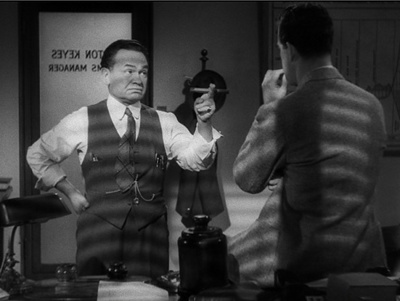
In parting, it must be pointed out that the Coen brothers, in addition to the more direct homage to noir, The Man Who Wasn't There, based the ultimate cult film, The Big Lebowski on the entire pulp fiction & film noir genres. If you, like I, are a devoted Little Lebowski Urban Achiever, and have ever wondered why exactly the Coens made bowling such an integral part of the film, allow me to illuminate. Here's a still from a really brief scene in which Neff mulls over the possibility of killing for money:

F***ing Neff...that creep can roll, man.

That's a wrap. 25 shows down, 80 to go.

Coming Soon: Meet Me In St. Louis (1944):


I'm really not much of a musical guy. So much so that I'm calling in reinforcements for this one - my lady friend is going to be my copilot during this viewing, making it the first film that I won't be watching alone, like some film-obsessed hermit. We'll see if she can help me confront Judy Garland and...color!!!

Please be sure to pick up all empties on the way out.