Showing posts with label Cold War. Show all posts

Wednesday, February 24, 2016

New(ish) Releases!! Brooklyn, The Big Short, and Bridge of Spies

Brooklyn (2015)

Director: John Crowley

A great example of a simple tale told exceptionally well.

Brooklyn is the story of Eilis (pronounced "Ay-lish", and played by Saoirse Ronan), a young woman in Ireland who emigrates to Brooklyn, New York in the 1950s. Though very smart and attractive, Eilis goes through most of the typical stages of culture shock and homesickness. She eventually settles into her job and begins a romance with a charming young local man of Italian heritage. Just as she decides to fully commit to him, though, she is pulled back to Ireland by an unexpected tragedy. She is then torn between choosing between her old life in Ireland and her new one in New York.

There is nothing terribly complex about the plot in Brooklyn. Rather, its complexity lies in the emotions at play when someone must make a very difficult, life-altering decision. Eilis's is not a tale of epic, world-changing choices or even wide-sweeping tragedy. Instead, it is about more common life decisions which greatly affect the person who makes them and the people closest to them, when either option will cause severe pain to several people involved. In Brooklyn, the different options are set across the Atlantic from each other, but the vastness of the emotional differences is what gives the movie its dramatic power.

Brooklyn looks amazing. So amazing, in fact, that it is quite obvious that it is a work of fiction. The actors' good looks and the high sheen on every prop and set offers us viewers enough separation to realize that we are not watching a documentary or even a film memoir. This might be a weakness in other films, but in Brooklyn it works since the tale and the acting are organic and masterfully performed. In a way, it actually enhances the struggle and sadness Eilis deals with, given that it is happening in an otherwise supernaturally beautiful place.

I don't know that I will ever need to see Brooklyn again, unless I wish to drink in the aesthetic once more. It was, however, an excellent movie and well worth seeing.


The Big Short (2015)

Director: Adam McKay

Who knew that learning about big finance and a massive recession could be so entertaining?

With a dazzling combination of strong narrative, steady pacing, daring creativity, and phenomenal acting, director Adam McKay crafted Michael Lewis's source book into an educative and often surprisingly fun ride. The movie follows a few groups of individuals who were among the small handful to accurately predict the impending housing market crash in 2008. Leading us through the complicated tale is the fourth-wall battering ram narrator Jared Vennett (Ryan Gosling), a smug financier who takes several breaks from his attempts to get filthy rich betting against the housing market in order to teach us viewers about exactly how things went so horribly wrong. It's a great device that spices up what could otherwise be some rather dull details about the minutiae of high finance. One could rightly argue that it is a narrative crutch, but it is an entertaining one.

The characters central to the story are portrayed as varied bands of oddballs, crusaders, noble aspirants to wealth, or some combinations of those three. The film versions of Michael Burry, the awkward mathematical genius and medical doctor-turned financier, and Mark Baum, a righteously furious financier with a serious grudge against corrupt bankers, are magnetic. The performances of Christian Bale and Steve Carell, respectively, bring them to life in hilarious and fascinating ways to the point that I found myself itching for the next scene with them. While those two stand out, the many players around them all nail their roles to a tee.

The unraveling of the causes behind the greatest economic crash in modern history makes for a fascinating and upsetting education. The Big Short, despite its steady humor, lets us all in on the rampant greed, irresponsibility, and grand-scale corruption that essentially allowed a relatively small group of wealthy bankers and financiers to bilk millions of people out of nearly a trillion dollars. It has a very similar feel to Martin Scorsese's The Wolf of Wall Street, though focused on the entire odious panorama of banking thievery rather than a single avaricious crook and his Biblical hedonism.

I would gladly watch this movie again, if not to try and pick up some of the economic and financial explanations more clearly, then to simply re-watch the great performances and galloping narrative. I don't know that this movie will win the Best Picture Oscar for which it is nominated, but it is definitely in that top tier of candidates.

Bridge of Spies (2015)

Director: Steven Spielberg

Flawless technique. Crisp narration. Strong acting. Fairly predictable story arc. In other words, a Steven Spielberg film.

Bridge of Spies's greatest strengths lie in its source material and in its actors' and director's technical abilities in terms of storytelling in film. At this point in their careers, guys like Tom Hanks and Steven Spielberg simply do not drop the ball. Ever. This is not to say that everything they do is fantastic. In fact, I find very little creativity in anything they do. However, they are also masters of professionalism and the technical aspects of film. Their movies always look great, feature clear narratives, and allow top-flight actors to play their roles extremely well. Bridge of Spies is no exception. Sets and costumes look great. The lighting, cinematography, and editing are above reproach. Lines are delivered in appropriate tones and with expert timing. None of this should surprise anyone who has seen more than a few Spielberg's many films. The only criticism that one can level at Spielberg is that he really never takes any artistic chances. By now, though, we know that, as great a director as he is, the man is simply not an auteur.

The story itself is certainly an interesting slice of real history. Hanks plays James Donovan, a brilliant insurance lawyer in the 1950s who is tapped by the U.S government to be legal counsel to Rudolf Abel (Mark Rylance). Abel is accused of spying for the U.S.S.R., and the U.S. government wants to ensure that Abel is shown to be given competent legal advice, so as to avoid any public accusations of mistreatment or lack of due process. The case was one of many such ostentatious political maneuvers during the height of the Cold War between the U.S. and the Soviet Union. Donovan does an exceptional job, even managing to help Abel avoid what would have almost certainly been the death penalty. Three years later, Donovan is again recruited to negotiate a prisoner exchange, whereby the U.S. will exchange Abel for a captured U.S. pilot and a captured college student. Donovan must achieve all of this under very shady and uncertain circumstances in a chaotic East Berlin, where the infamous Berlin Wall has just been completed.

The summary itself should spark a fair amount of interest, and the tale is unfolded as well as one would expect from this group of film-making talents. I must say though, as is typical for most of Spielberg's movies, the ultimate outcome was never really in question (and no, I hadn't read anything about this case before seeing the movie). Thankfully, some of the details and the paths which the story takes are a bit surprising, but the ultimate destination held nothing remarkably thoughtful. Of course, this can be due to the limitations of telling a historical tale. This doesn't make it any more exciting, though.

I personally put this movie in that second tier of this year's Best Picture nominees: "Very good, but not winning material". It's a very well-done movie which will probably have no lasting impact on the landscape of cinematic history. 

Monday, August 15, 2011

Film # 58: Dr. Strangelove: Or, How I Learned to Stop Worrying and Love the Bomb (1964)


Director: Stanley Kubrick

Initial Release Country: United States

Times Previously Seen: Roughly 7 or 8 (Last time – about 5 years ago)

Teaser Summary (No spoilers)

Wingnut general unleashes nuclear bombers on Russia. Loads of bizarre and hilarious characters fumble their way through the insanity.

Extended Summary (More complete synopsis; spoilers included. Fair warning)

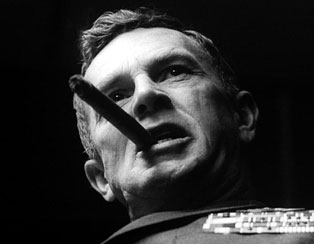
In the middle of the Cold War, at Burpelson Air Force Base, deranged, rogue brigadier general Jack D. Ripper (Sterling Hayden) sends out a “go” code to an entire fleet of bombers. His orders are for them to dump their nuclear payloads onto scores of targets inside the Soviet Union.


General Jack D. Ripper - the man who seeks to annihilate the entire Soviet populace based on a rather...unusual theory.

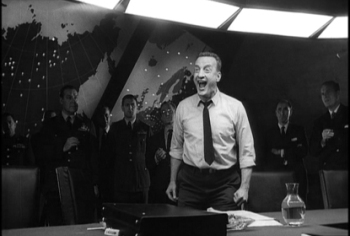
When word of this catastrophic attack command reaches the U.S. War Room, General Buck Turgidson (George C. Scott) is called to confer with the country's executive and military leaders. Turgidson is a buffoonish hawk, completely caught up in the Red Scare, and suggests that the U.S. simply allow the unauthorized attacks to take place, as this will give them the upper hand in a Third World War. President Merkin Muffley (Peter Sellers) scoffs at this and starts the process of contacting the U.S.S.R. In an attempt to warn the Soviets and seek a solution.

In the air and fast approaching Soviet air space in the crew of one of the B-52 bombers, this one being flown by Major “King” Kong (Slim Pickens). The crew is rather nervous about getting the attack codes, as it signifies the start of all-out nuclear war. Still, the crew is determined to carry out their mission.

Back in the War Room, it soon becomes very clear than recalling the bombers is an impossible task. General Turgidson explains to all present that recent and obscure legislation allows for a single general to enact an attack under his own authority under certain provisions. While these provisions were not met, the rogue General Ripper has ceased to care. The President grows more desperate.


General Buck Turgidson continues his half-baked attempts in the War Room to bulldog the rest of his peers and superiors into pressing the attack on Russia.

Back at Burpelson, British group captain and executive officer Lionel Mandrake (Peter Sellers again) soon discovers that the supposed Russian attack is not true, and he confronts General Ripper. Ripper locks Mandrake into his office and explains his reason for launching the bomber attack: he believes that the communists are taking over American “bodily fluids” through fluoridation. At this point, it is clear than General Ripper is thoroughly insane. Mandrake demands the recall codes, but to no avail. He must await his psychotic superior's next move.

In the War Room, President Mandrake calls on the Soviet premier and calls in the Soviet diplomat in an attempt to resolve the crisis. In explaining the impending catastrophe, it is revealed that the Soviets have just created a “doomsday device” that will exterminate all life on the face of the earth, should any attack be made on the Soviet Union. The choices are now stark – the president enacts two assaults: one by the Americans on Burpelson Air Force Base, in order to wrest the recall codes from Ripper; and another, Soviet attack on the B-52 bombers that are rapidly approaching their targets inside the Soviet Union.

At Burpelson, the base has come under attack by the U.S. Army, and Ripper fights back. With Mandrake attempting to reason with him, Ripper keeps up his fight until the last moment. When it is clear than he can hold out no longer, Ripper commits suicide, seemingly taking the recall codes with him into the hereafter. However, Mandrake puzzles out the codes from some of Ripper's desk scribblings. After a bizarre hold-up at the hands of a dense and over-zealous army officer, Mandrake reaches the president.

In the War Room, the government's plan seems to have worked. The Soviets have shot down many of the American bombers, and the codes sent along by Mandrake have recalled all of the others. All, that is, except...

...the B-52 piloted by Major Kong. Their coding equipment having been shot up, they have not received the recall code from base. In addition, they have eluded all attempts to shoot them down. With gumption that is almost admirable, they make it to one of the targets and attempt to drop their payload. However, the bomb doors are jammed. In a final act of wherewithal, Major Kong straddles the bomb, fixes the bomb door wiring just above it, and rides the bomb down to its target. Nuclear winter has begun.


Major Kong succeeds in bringing his payload. Personally.

Back in the War Room, the mood is understandably somber. That is until the floor is taken by the wheelchair-ridden Doctor Strangelove (Peter Sellers, yet again), an ex-Nazi-turned American adviser. He seems oddly chipper about the entire scenario. He explains that the world's leaders can survive within caves beneath the earth. In his scenario, he suggests that the military and political leaders will take precedence and that they will have ample provisions to survive. In addition, in order to repopulate the earth after the fallout clears, they will need a high ratio of women to men. The cherry on top is that these women will need to be exceptionally attractive, so as better to allow the men to function in their role as procreators. With all of this to ease their worries, all of the men in the War Room seem to have already moved far beyond the nuclear apocalypse taking place above their very heads, to the point that they are already plotting how to get a leg up on post-Apocalyptic competitions with the Russians.

Did I Like It?

If you noticed how many times I've seen this film before, the answer is obvious. This most recent viewing did nothing to change my mind – this movie is one of the greatest comedy films of all time.

Now sure, there are probably other movies that I've laughed at more, and there are probably some comedies that have been wittier. But for balancing sheer inventiveness, zaniness, and canny social commentary, Dr. Strangelove is all but untouched.

While the theme of lampooning the Cold War era political philosophies of fear-mongering and arms racing may seem dated, it surely is not. The entire notion of the pre-emptive strike will never go away, and Dr. Strangelove takes the idea to its Swiftian extreme. Considering how the specter of nuclear holocaust continued to haunt the world for decades after the book and movie's release, Dr. Strangelove has serious staying power. By pushing the era's prevailing martial ideologies a little (I stress “a little”) further, it's easy to see how laughably insane they were. (We can laugh now, anyway.)

Beyond the brilliance of the story line and its execution is the real strength of the movie – the actors. Dr. Strangelove is mostly populated by caricatures goofy enough to laugh at, but also frighteningly real for what they represent. Such a strange balancing act can only be pulled off by just the right cast, and this film got it perfectly. Sterling Hayden as the chillingly calm, thoroughly insane General Ripper is as horrifying as he is hilarious. (His interactions with Mandrake are some of my favorite scenes in any movie). I can't imagine gung-ho pilot Major King Kong being played by anyone other than uber-hick, Slim Pickens. Even the bit role of Sergeant “Bat” Guano is done to pitch perfection by Keenan Wynn and his fantastically mispronounced catchphrase, “pre-versions”. As excellent as all of these, and other, actors are in the film, they are far surpassed by one of the all-time greats.

Peter Sellers, who had some of the most memorable comic performances of all time throughout his career, pulled off his greatest feat in Dr. Strangelove. In playing the amusingly sober Commander Mandrake, the oddly pliant President Muffley, and the hilariously twisted title character, he utilized every one of his considerable acting skills. It's been said of Sellers that few people (if any) actually knew the real man, for he would so completely lose himself in the characters that he was playing. In watching Dr. Strangelove, it's not hard to believe this. If you didn't know better, you may not even guess that the same actor is playing all 3 vastly different roles, as each of the three is busting your gut in vastly different ways. Just seeing him is more than worth the price of admission.


Officer Mandrake does his best to weather the storm of deranged General Ripper's apocalyptic dementia. Seller's role as Strangelove may be more iconic, but his turn as Mandrake is far funnier to me.

One interesting mental note I made as I watched the movie this most recent time – I had a moment of emotional guilt, not unlike when I was watching Double Indemnity earlier in the list. At the moment when the B-52 crew is trying to desperately make their bomb run, I felt myself pulling for them. Major Kong, the all-guts patriot/pilot redneck, shows no end of moxy by shrugging of missile attacks, broken fuel lines, and other malfunctions to get to his target and drop his payload. As I watched him almost single-handedly overcome each obstacle, I admired the simple yet brave soldier. Then I realized, “Wait a minute...this guy's about to trigger the ultimate nuclear winter!!!” There's something about watching a truly determined character use sheer willpower to smash through barriers that's gratifying, often regardless of their ultimate goal.

So yeah – I love this movie. I'll certainly watch it many more times in the years to come, and I can't recommend it highly enough. There may be a few moments where things seem a little slow (particularly in the B-52 scenes), but this film is a masterpiece the likes of which may never be duplicated.

That's a wrap. 58 films down, 48 to go.


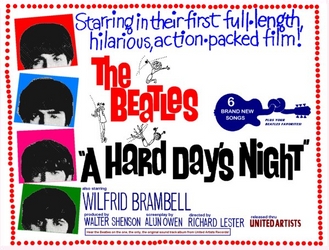
Coming (Very) Soon: A Hard Day's Night (1964)


The Fab Four in one of their early feature films. I certainly respect, if not exactly love, the Beatles. Let's see how they did on the silver screen.

Please be sure to pick up all empties on the way out.