Showing posts with label Sterling Hayden. Show all posts

Thursday, March 24, 2016

Gangster Flick 3-Pack: The Killing (1956); High Sierra (1941); Mesrine (2008)

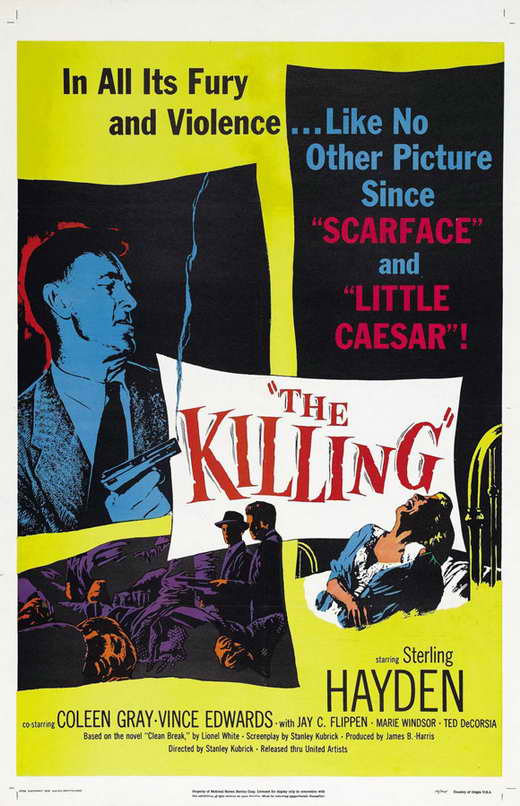
The Killing (1956)

Director: Stanley Kubrick

An uneven but fairly compelling early work from a film master, and a rather uniquely dark caper movie.

The title of the movie refers to the slang term of making a large amount of money in a short time, as well as the more literal reference to murder. Both meanings are appropriate for this film. The Killing is a caper tale centered on a group who plan to rob a horse track of two million dollars. The head of the group, Johnny Clay (Sterling Hayden), is the only professional thief in the group. The others are racetrack employees who, for various reasons, are looking to make a lot of money quickly. Clay plots out a very thorough and meticulous plan which requires expert timing. Once the plan starts to unfold, various hiccups begin to make things even harder than they already were, with Clay doing everything he can to execute his big score.

The movie takes a hard look at the brutal and dark consequences of crime, as do all of the very best noir  movies. All but one or two of the most minor members of the thieving crew are shown to be rather selfish, callous men whose greed or general weakness leads them into ever-more-foolish decisions. Unlike lesser crime films, The Killing does nothing to glamorize the thieves or their unsavory deeds. There is the compelling nature of the plan and its execution, as with all good caper movies, but this hardly overshadows the crew's dark motivations.

The primary distraction in this movie is the dialogue. Many of the characters are constantly spouting off tough guy lines in a rushed manner that spoke to some weak acting and uninspired scripting. This was especially disappointing considering that legendary crime fiction writer Jim Thompson wrote the script. Despite this, had I been watching this movie with someone else, we almost certainly would have been having plenty of good laughs at the abundance of silly, forced lines.

A lesser but rather obvious merit of the movie is the cinematography. This might not come as a major surprise, given that Stanley Kubrick directed this movie. Still, The Killing was his first major, full-length feature film. The then-only-28-year-old Kubrick was already showing his uncanny eye for striking camera angles, lighting, and using visual grammar to tell stories. This alone makes it worth seeing, as it is a very early but major step along a genius's path towards film mastery.
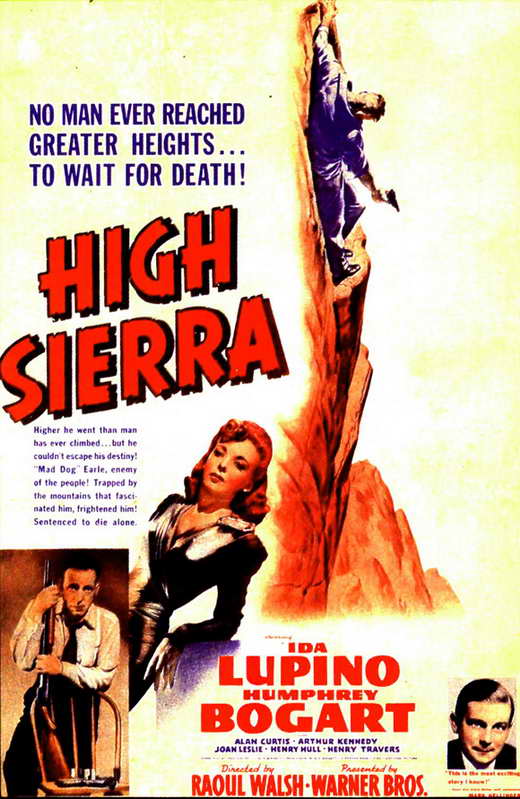

High Sierra (1941)

Director: Raoul Walsh

A compelling basic story buried within some painfully dated dialogue and acting.

I love Humphrey Bogart. While I haven't seen the majority of the many films he was in, I have seen around a half dozen of his best-known and best-loved movies. From these, it's easy to see why he became and still is a movie legend. With this in mind, I was excited to watch one of his relatively early starring roles in a crime movie. I have to admit some disappointment, however.

The story is actually the stuff of very strong noir. Bogart plays Roy Earle, a bank robber who has just been released from prison and is already setting up his next major score. The hard-boiled Earle came from a small town in Indiana, and he seems to have a tiny soft spot for small-town folks. This is clear when he comes across a farming family making its way out to California, whom he helps in several ways. Outside of his tender spot for such people, Earle is a rather severe man who does not suffer fools lightly, and will not hesitate to use violence if he feels the need.

One part of the story revolves around Earle's current big score - a jewelry heist arranged through an old associate of his. His partners in the caper are a couple of young, hot-blooded hoods who Earle dislikes but tolerates. The other part of the tale relates to Earle's relationships with two women; one is a young member of the farming family, and the other is a weary and jaded former dance girl. Seeing Earle try to juggle all of these aspects of his life is the real meat of the movie, and the story takes some turns which are intriguing in their unpredictability. I admire how the movie steered clear of a nice, pat, Hollywood ending.

Unfortunately, I had to work rather hard to maintain my appreciation. Even more than the above-reviewed The Killing, the dialogue and much of the acting in High Sierra have aged horribly. While there are some memorable lines, far too much comes right from the cheap, pulp "dime store hood" handbook. Bogart was a great enough actor that he could sell some of the dialogue better than his supporting cast, but even Bogie could only do so much. Also, the storyline involving the farming family is fraught with completely inorganic and illogical jumps. I feel that this movie served as an earlier, less balanced attempt at what director Raoul Walsh would do far better eight years later with the classic White Heat. I'll watch that latter picture again any time. High Sierra, however, is not one I'll ever return to.

Mesrine (2008)

Director: Jean-Francois Richet

Absolutely brilliant, if grim, biopic of a larger-than-life arch criminal.

Mesrine is the story of real-life French criminal Jacque Mesrine (pronounced "may-reen"), one of the most irrepressible, vicious, and public felons in the 20th century. Mesrine took to crime fairly early in the 1960s, after a stint in the French Army. He quickly became a noted burglar, bank robber, and violent thug with an appetite for women and high living. Though he made attempts at leading a "straight" life, they were few and relatively short-lived. For nearly all of his adult life, Mesrine was committing serious and violent crimes, eluding capture, being captured, or escaping from prison. A fair number of his exploits played out in the public eye, thanks to an image he created of himself which appealed to certain sects of the French masses.

Prior to watching this 2-film epic, I had no idea who Mesrine was, but I was fascinated. The movie urged me to look up some facts about the man, and it would seem that the film does not embellish his wild life. His story is told with a vibrance and energy found in some of the best gangster movies, such as Goodfellas or Bonnie and Clyde. The main difference with Mesrine, though, is that there is even less whitewashing of the man's most despicable actions. While it's made clear that Mesrine possessed good looks and charisma enough to seduce women, fellow criminals, and the French public at large, it doesn't balk at showing that he was also a brutal murderer who would torture or even kill anyone who offended his massive ego. The actions which play out on screen can be terrible, but I still found them compelling, given what an outsized persona Mesrine fashioned for himself.

A classic knee-capping, true to the violent nature of the title
character. It's so brutal that you might fail to notice just how
masterful the colors and  lighting of the scene are. This is
typical in these two movies.
The technical aspects of the movie are impressive. The set design and cinematography are first-rate, casting the ugly but oft-exciting world of Jacque Mesrine's life into a palatable light. The acting is also exceptional, with Vincent Cassel turning in a phenomenal performance in the title role. Some of the transitions between time periods can feel a bit rushed, which is surprising for a movie released in two parts and adding up to over four hours. This may just be a function of the sheer quantity of curious activities in which Mesrine invovled himself. The creators could probably have justified adding a tad more to it and making it a mini-series or a trilogy, if they thought anyone could stomach another hour or two of a rather detestable figure like Mesrine.

Mesrine is one of the darker, harder-hitting gangster movies one is likely to see. For those who enjoy well-executed dramatizations of very real and very frightening criminals, though, this movie is difficult to top. 

Friday, January 1, 2016

Before I Die #561: The Asphalt Jungle (1950)

This is the 561st that I've watched of the 1,172 films on the "Before You Die" List that I'm gradually working my way through.

Director: John Huston

A decent enough noir flick, but one that I'm a bit surprised is held in such high esteem.

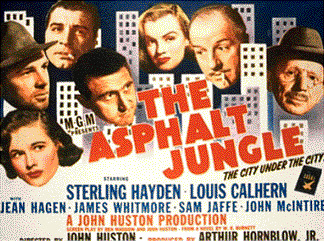
The basic tale focuses on a bank heist, masterminded by a recently paroled master thief, Doc Riedenschneider (Sam Jaffe). Doc arrives in a new city, where he quickly gets to work assembling a small crew who will help him pull off his long-planned score. The gang he gathers includes the safe-cracker Louis Ciavelli, the gunman Dix Handley (Sterling Hayden), and the driver Gus Minissi. Doc has his plot bankrolled by a shady lawyer, Alonzo Emmerich (Louis Calhern). The heist begins well enough, but multiple complication start to arise, between one crew member being shot by police, and the entire gang being double-crossed by Emmerich.

In terms of noir crime plots, The Asphalt Jungle is solid, if not completely novel. It seems a sort of hybrid between 1946's The Killers and 1948's The Killing (noir films weren't noted for originality in their titles). In fact, the latter film also starred Sterling Hayden, who is also the key player in Jungle. The familiarity of the story and tone robbed the movie of some of its edge for me. Still, the suspense as the heist unfolds is on par with some of the very best crime movies.

Dix (far left) and Riedenschneider (far right) display their
spoils to their ostensible patron, the oily Emmerich.
I found the characters varyingly engaging. Doc Riedenschneider is certainly the most unique and entertaining of the lot. A quirky and brilliant old thief with a weakness for young ladies is bound to be entertaining, and he is. The primary character Dix, however, I found rather dull compared to other classic noir protagonists. There is some complexity beneath his gruff exterior, but he's still rather simple. Sterling Hayden is an all-time great stoic, but it robbed the character of some intrigue. Most others in the film are fairly shallow, though acted well enough.

The classic noir era of the 1940s and '50s provided me with some of my absolute favorite movies. I still watch Double Indemnity and Out of the Past every few years with growing love and appreciation. Checking out another touted film from the era like The Asphalt Jungle was enjoyable, but I can't put it in the same class as those other masterpieces. 

Monday, August 15, 2011

Film # 58: Dr. Strangelove: Or, How I Learned to Stop Worrying and Love the Bomb (1964)


Director: Stanley Kubrick

Initial Release Country: United States

Times Previously Seen: Roughly 7 or 8 (Last time – about 5 years ago)

Teaser Summary (No spoilers)

Wingnut general unleashes nuclear bombers on Russia. Loads of bizarre and hilarious characters fumble their way through the insanity.

Extended Summary (More complete synopsis; spoilers included. Fair warning)

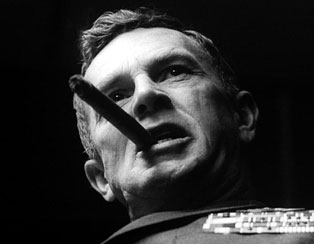
In the middle of the Cold War, at Burpelson Air Force Base, deranged, rogue brigadier general Jack D. Ripper (Sterling Hayden) sends out a “go” code to an entire fleet of bombers. His orders are for them to dump their nuclear payloads onto scores of targets inside the Soviet Union.


General Jack D. Ripper - the man who seeks to annihilate the entire Soviet populace based on a rather...unusual theory.

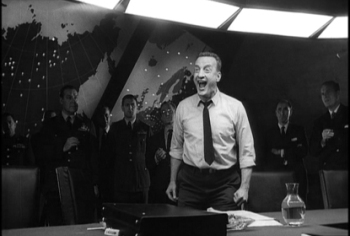
When word of this catastrophic attack command reaches the U.S. War Room, General Buck Turgidson (George C. Scott) is called to confer with the country's executive and military leaders. Turgidson is a buffoonish hawk, completely caught up in the Red Scare, and suggests that the U.S. simply allow the unauthorized attacks to take place, as this will give them the upper hand in a Third World War. President Merkin Muffley (Peter Sellers) scoffs at this and starts the process of contacting the U.S.S.R. In an attempt to warn the Soviets and seek a solution.

In the air and fast approaching Soviet air space in the crew of one of the B-52 bombers, this one being flown by Major “King” Kong (Slim Pickens). The crew is rather nervous about getting the attack codes, as it signifies the start of all-out nuclear war. Still, the crew is determined to carry out their mission.

Back in the War Room, it soon becomes very clear than recalling the bombers is an impossible task. General Turgidson explains to all present that recent and obscure legislation allows for a single general to enact an attack under his own authority under certain provisions. While these provisions were not met, the rogue General Ripper has ceased to care. The President grows more desperate.


General Buck Turgidson continues his half-baked attempts in the War Room to bulldog the rest of his peers and superiors into pressing the attack on Russia.

Back at Burpelson, British group captain and executive officer Lionel Mandrake (Peter Sellers again) soon discovers that the supposed Russian attack is not true, and he confronts General Ripper. Ripper locks Mandrake into his office and explains his reason for launching the bomber attack: he believes that the communists are taking over American “bodily fluids” through fluoridation. At this point, it is clear than General Ripper is thoroughly insane. Mandrake demands the recall codes, but to no avail. He must await his psychotic superior's next move.

In the War Room, President Mandrake calls on the Soviet premier and calls in the Soviet diplomat in an attempt to resolve the crisis. In explaining the impending catastrophe, it is revealed that the Soviets have just created a “doomsday device” that will exterminate all life on the face of the earth, should any attack be made on the Soviet Union. The choices are now stark – the president enacts two assaults: one by the Americans on Burpelson Air Force Base, in order to wrest the recall codes from Ripper; and another, Soviet attack on the B-52 bombers that are rapidly approaching their targets inside the Soviet Union.

At Burpelson, the base has come under attack by the U.S. Army, and Ripper fights back. With Mandrake attempting to reason with him, Ripper keeps up his fight until the last moment. When it is clear than he can hold out no longer, Ripper commits suicide, seemingly taking the recall codes with him into the hereafter. However, Mandrake puzzles out the codes from some of Ripper's desk scribblings. After a bizarre hold-up at the hands of a dense and over-zealous army officer, Mandrake reaches the president.

In the War Room, the government's plan seems to have worked. The Soviets have shot down many of the American bombers, and the codes sent along by Mandrake have recalled all of the others. All, that is, except...

...the B-52 piloted by Major Kong. Their coding equipment having been shot up, they have not received the recall code from base. In addition, they have eluded all attempts to shoot them down. With gumption that is almost admirable, they make it to one of the targets and attempt to drop their payload. However, the bomb doors are jammed. In a final act of wherewithal, Major Kong straddles the bomb, fixes the bomb door wiring just above it, and rides the bomb down to its target. Nuclear winter has begun.


Major Kong succeeds in bringing his payload. Personally.

Back in the War Room, the mood is understandably somber. That is until the floor is taken by the wheelchair-ridden Doctor Strangelove (Peter Sellers, yet again), an ex-Nazi-turned American adviser. He seems oddly chipper about the entire scenario. He explains that the world's leaders can survive within caves beneath the earth. In his scenario, he suggests that the military and political leaders will take precedence and that they will have ample provisions to survive. In addition, in order to repopulate the earth after the fallout clears, they will need a high ratio of women to men. The cherry on top is that these women will need to be exceptionally attractive, so as better to allow the men to function in their role as procreators. With all of this to ease their worries, all of the men in the War Room seem to have already moved far beyond the nuclear apocalypse taking place above their very heads, to the point that they are already plotting how to get a leg up on post-Apocalyptic competitions with the Russians.

Did I Like It?

If you noticed how many times I've seen this film before, the answer is obvious. This most recent viewing did nothing to change my mind – this movie is one of the greatest comedy films of all time.

Now sure, there are probably other movies that I've laughed at more, and there are probably some comedies that have been wittier. But for balancing sheer inventiveness, zaniness, and canny social commentary, Dr. Strangelove is all but untouched.

While the theme of lampooning the Cold War era political philosophies of fear-mongering and arms racing may seem dated, it surely is not. The entire notion of the pre-emptive strike will never go away, and Dr. Strangelove takes the idea to its Swiftian extreme. Considering how the specter of nuclear holocaust continued to haunt the world for decades after the book and movie's release, Dr. Strangelove has serious staying power. By pushing the era's prevailing martial ideologies a little (I stress “a little”) further, it's easy to see how laughably insane they were. (We can laugh now, anyway.)

Beyond the brilliance of the story line and its execution is the real strength of the movie – the actors. Dr. Strangelove is mostly populated by caricatures goofy enough to laugh at, but also frighteningly real for what they represent. Such a strange balancing act can only be pulled off by just the right cast, and this film got it perfectly. Sterling Hayden as the chillingly calm, thoroughly insane General Ripper is as horrifying as he is hilarious. (His interactions with Mandrake are some of my favorite scenes in any movie). I can't imagine gung-ho pilot Major King Kong being played by anyone other than uber-hick, Slim Pickens. Even the bit role of Sergeant “Bat” Guano is done to pitch perfection by Keenan Wynn and his fantastically mispronounced catchphrase, “pre-versions”. As excellent as all of these, and other, actors are in the film, they are far surpassed by one of the all-time greats.

Peter Sellers, who had some of the most memorable comic performances of all time throughout his career, pulled off his greatest feat in Dr. Strangelove. In playing the amusingly sober Commander Mandrake, the oddly pliant President Muffley, and the hilariously twisted title character, he utilized every one of his considerable acting skills. It's been said of Sellers that few people (if any) actually knew the real man, for he would so completely lose himself in the characters that he was playing. In watching Dr. Strangelove, it's not hard to believe this. If you didn't know better, you may not even guess that the same actor is playing all 3 vastly different roles, as each of the three is busting your gut in vastly different ways. Just seeing him is more than worth the price of admission.


Officer Mandrake does his best to weather the storm of deranged General Ripper's apocalyptic dementia. Seller's role as Strangelove may be more iconic, but his turn as Mandrake is far funnier to me.

One interesting mental note I made as I watched the movie this most recent time – I had a moment of emotional guilt, not unlike when I was watching Double Indemnity earlier in the list. At the moment when the B-52 crew is trying to desperately make their bomb run, I felt myself pulling for them. Major Kong, the all-guts patriot/pilot redneck, shows no end of moxy by shrugging of missile attacks, broken fuel lines, and other malfunctions to get to his target and drop his payload. As I watched him almost single-handedly overcome each obstacle, I admired the simple yet brave soldier. Then I realized, “Wait a minute...this guy's about to trigger the ultimate nuclear winter!!!” There's something about watching a truly determined character use sheer willpower to smash through barriers that's gratifying, often regardless of their ultimate goal.

So yeah – I love this movie. I'll certainly watch it many more times in the years to come, and I can't recommend it highly enough. There may be a few moments where things seem a little slow (particularly in the B-52 scenes), but this film is a masterpiece the likes of which may never be duplicated.

That's a wrap. 58 films down, 48 to go.


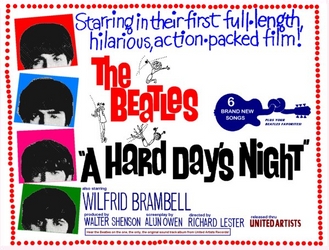
Coming (Very) Soon: A Hard Day's Night (1964)


The Fab Four in one of their early feature films. I certainly respect, if not exactly love, the Beatles. Let's see how they did on the silver screen.

Please be sure to pick up all empties on the way out.