
No Spoilers (have no fear)
Director: Denis Villeneuve
An amazing piece of dystopian, speculative sci-fi cinema which I feel is even better than the classic original.
In the original 1982 Blade Runner (I did a very long and thorough review of it here), we had a story of Richard Deckard, a "blade runner" in the year 2019 who tracked and eliminated (known as "retiring") rogue synthetic humans, which are known as "replicants." By that movie's end, Deckard had begun changing his mind on whether there was really much difference between humans and replicants. He even falls in love with a very advanced replicant, Rachel, and escapes the authorities with her.
The new movie takes place, as the title suggests, thirty years after Deckard and Rachel's disappearance. In the thirty years after, the world has apparently suffered a few more trying episodes, including several replicant uprisings, some sort of massive blackout, and a near-famine. A reclusive and enigmatic genius, Niander Wallace (Jared Leto), was responsible for dealing with several of these crises, partly by taking over replicant production and ensuring that they would no longer develop wills of their own. To this purpose, blade runners still exist, whose job it is to track down the few remaining, older-model replicants still at large. The story follows one such blade runner, "K" (Ryan Gosling), who finds himself pulled into a larger battle between a secretive revolutionary group of replicants and the cosmically ambitious Niander Wallace. As he is drawn deeper into this conflict, K's questions about his own identity and purpose grow more troubling and unclear.
This movie lived up to my rather high expectations, though I am not terribly surprised that it had an underwhelming showing at the box office in its opening weekend. It captures a great deal of what made the original so revolutionary but also challenging, while actually enhancing it in many ways. At the heart of what made both so strong is that they perfectly represent the confounding, fascinating, and even frightening questions which emerge when one speculates about how technology does and would possibly impact us as it develops. This is what made author Philip K. Dick, responsible for the source novel, such a brilliant mind. Both Ridley Scott and Denis Villeneuve realized this and placed some of Dick's ideas right at the heart of their movies. But where the surface plot of Scott's original movie was rather simple - a detective trying to track down and eliminate a few rogue cyborgs - Villeneuve offers a more complex journey that touches on even heavier existential themes. This includes notions about self identity, one's greater purpose, and exactly how one is narrating his or her own life. Blade Runner 2049 is cerebral sci-fi at its best.
If the movie is so good at these things, why was there a lackluster turnout on opening weekend, despite glowing reviews and a fairly ubiquitous advertising campaign? Hard to say for absolute certain, but it may not have helped its wider appeal that the film is not exactly an action-packed thrill-ride. While the original certainly has its slower, more meditative moments, it never goes more than about ten minutes without a fight of some sort, including a tense pursuit and battle during its twenty-minute climax. While 2049 does have several action sequences, all done extremely well, they are fewer and further between than the original. Anybody showing up to the theater hoping to get a J.J. Abrams-style, Star Wars/Star Trek reboot, action extravaganza was probably not going to be entertained by this movie. In fact, I heard a couple commenting as such as I left the theater with my wife. They were talking about how they wanted "something to happen" for nearly the entire movie. If these viewers general sentiment was reflective of the whole and they communicated it to others, than maybe many people decided to give it a pass. For my money, though, I thought the action scenes were handled well and used efficiently. There is one scene during a penultimate fight that I thought dragged on a bit, but this was the only such case.
Any fan of the original is likely to cite the mood and atmosphere created by the visuals and music score. The sequel makes sure to maintain some very welcome coherence with those aesthetic qualities and even update them brilliantly. With a sizable budget at his fingertips, Villeneuve was able to get the beautifully dark blend of noir and cyberpunk dystopia which Ridley Scott created back in 1982. He even goes beyond it, sending the story to several environments outside of the shadow-shrouded and rain-soaked metropolis where the original completely takes place. These evocative and impressive settings outside of the city help give this sequel an effectively episodic feel. And the music pulls off a similar trick, reviving much of the meditative and synthetic tones of the iconic Evangelis score, while adding some harder-hitting industrial sounds which can reflect the cognitive dissonance of the protagonist.
This movie's stayed embedded in my mind since I watched it three nights ago, and I will likely try to catch it on an IMAX screen while it still lasts there. It does sadden me that it hasn't done terribly well here in the U.S., as I would have hoped that there were still an audience for stunning, mentally stimulating science-fiction. I do hope that it perhaps has legs and that more people give it a chance, maybe seeing it for the incredible movie it is.
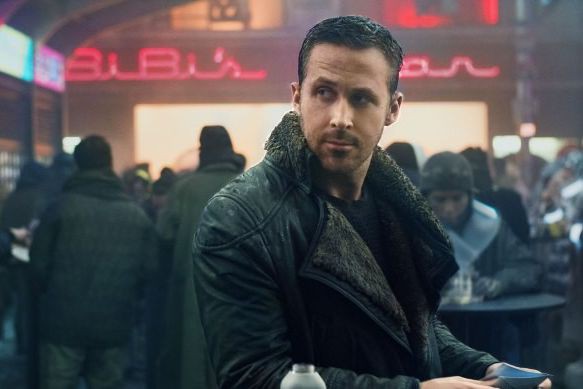 |
| The movie's titular "blade runner," K, on the job in the big city. There are plenty of scenes which revive the feel of the worn-down, tech-opolis displayed in the original. |
An amazing piece of dystopian, speculative sci-fi cinema which I feel is even better than the classic original.
In the original 1982 Blade Runner (I did a very long and thorough review of it here), we had a story of Richard Deckard, a "blade runner" in the year 2019 who tracked and eliminated (known as "retiring") rogue synthetic humans, which are known as "replicants." By that movie's end, Deckard had begun changing his mind on whether there was really much difference between humans and replicants. He even falls in love with a very advanced replicant, Rachel, and escapes the authorities with her.
The new movie takes place, as the title suggests, thirty years after Deckard and Rachel's disappearance. In the thirty years after, the world has apparently suffered a few more trying episodes, including several replicant uprisings, some sort of massive blackout, and a near-famine. A reclusive and enigmatic genius, Niander Wallace (Jared Leto), was responsible for dealing with several of these crises, partly by taking over replicant production and ensuring that they would no longer develop wills of their own. To this purpose, blade runners still exist, whose job it is to track down the few remaining, older-model replicants still at large. The story follows one such blade runner, "K" (Ryan Gosling), who finds himself pulled into a larger battle between a secretive revolutionary group of replicants and the cosmically ambitious Niander Wallace. As he is drawn deeper into this conflict, K's questions about his own identity and purpose grow more troubling and unclear.
This movie lived up to my rather high expectations, though I am not terribly surprised that it had an underwhelming showing at the box office in its opening weekend. It captures a great deal of what made the original so revolutionary but also challenging, while actually enhancing it in many ways. At the heart of what made both so strong is that they perfectly represent the confounding, fascinating, and even frightening questions which emerge when one speculates about how technology does and would possibly impact us as it develops. This is what made author Philip K. Dick, responsible for the source novel, such a brilliant mind. Both Ridley Scott and Denis Villeneuve realized this and placed some of Dick's ideas right at the heart of their movies. But where the surface plot of Scott's original movie was rather simple - a detective trying to track down and eliminate a few rogue cyborgs - Villeneuve offers a more complex journey that touches on even heavier existential themes. This includes notions about self identity, one's greater purpose, and exactly how one is narrating his or her own life. Blade Runner 2049 is cerebral sci-fi at its best.
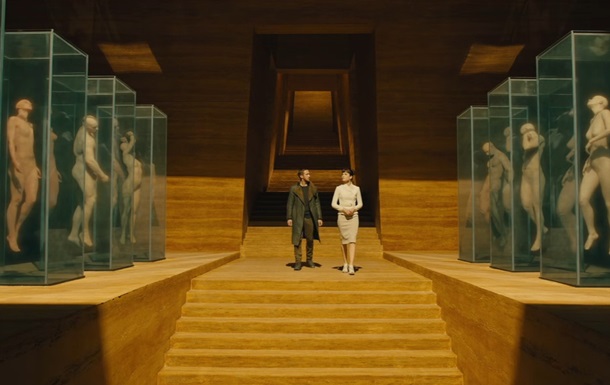 |
| Inside the offices of the science genius Niander Wallace. This is just one of many stunning sets which reflect the mental states or situations of those who dwell in them. |
Any fan of the original is likely to cite the mood and atmosphere created by the visuals and music score. The sequel makes sure to maintain some very welcome coherence with those aesthetic qualities and even update them brilliantly. With a sizable budget at his fingertips, Villeneuve was able to get the beautifully dark blend of noir and cyberpunk dystopia which Ridley Scott created back in 1982. He even goes beyond it, sending the story to several environments outside of the shadow-shrouded and rain-soaked metropolis where the original completely takes place. These evocative and impressive settings outside of the city help give this sequel an effectively episodic feel. And the music pulls off a similar trick, reviving much of the meditative and synthetic tones of the iconic Evangelis score, while adding some harder-hitting industrial sounds which can reflect the cognitive dissonance of the protagonist.
This movie's stayed embedded in my mind since I watched it three nights ago, and I will likely try to catch it on an IMAX screen while it still lasts there. It does sadden me that it hasn't done terribly well here in the U.S., as I would have hoped that there were still an audience for stunning, mentally stimulating science-fiction. I do hope that it perhaps has legs and that more people give it a chance, maybe seeing it for the incredible movie it is.


