Showing posts with label Ryan Gosling. Show all posts

Monday, October 9, 2017

New Release! Blade Runner 2049 (2017)

No Spoilers (have no fear)


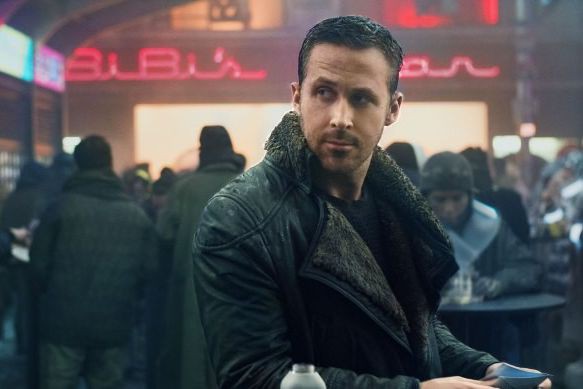
The movie's titular "blade runner," K, on the job in the big
city. There are plenty of scenes which revive the feel of the
worn-down, tech-opolis displayed in the original.
Director: Denis Villeneuve

An amazing piece of dystopian, speculative sci-fi cinema which I feel is even better than the classic original.

In the original 1982 Blade Runner (I did a very long and thorough review of it here), we had a story of Richard Deckard, a "blade runner" in the year 2019 who tracked and eliminated (known as "retiring") rogue synthetic humans, which are known as "replicants." By that movie's end, Deckard had begun changing his mind on whether there was really much difference between humans and replicants. He even falls in love with a very advanced replicant, Rachel, and escapes the authorities with her.

The new movie takes place, as the title suggests, thirty years after Deckard and Rachel's disappearance. In the thirty years after, the world has apparently suffered a few more trying episodes, including several replicant uprisings, some sort of massive blackout, and a near-famine. A reclusive and enigmatic genius, Niander Wallace (Jared Leto), was responsible for dealing with several of these crises, partly by taking over replicant production and ensuring that they would no longer develop wills of their own. To this purpose, blade runners still exist, whose job it is to track down the few remaining, older-model replicants still at large. The story follows one such blade runner, "K" (Ryan Gosling), who finds himself pulled into a larger battle between a secretive revolutionary group of replicants and the cosmically ambitious Niander Wallace. As he is drawn deeper into this conflict, K's questions about his own identity and purpose grow more troubling and unclear.

This movie lived up to my rather high expectations, though I am not terribly surprised that it had an underwhelming showing at the box office in its opening weekend. It captures a great deal of what made the original so revolutionary but also challenging, while actually enhancing it in many ways. At the heart of what made both so strong is that they perfectly represent the confounding, fascinating, and even frightening questions which emerge when one speculates about how technology does and would possibly impact us as it develops. This is what made author Philip K. Dick, responsible for the source novel, such a brilliant mind. Both Ridley Scott and Denis Villeneuve realized this and placed some of Dick's ideas right at the heart of their movies. But where the surface plot of Scott's original movie was rather simple - a detective trying to track down and eliminate a few rogue cyborgs - Villeneuve offers a more complex journey that touches on even heavier existential themes. This includes notions about self identity, one's greater purpose, and exactly how one is narrating his or her own life. Blade Runner 2049 is cerebral sci-fi at its best.

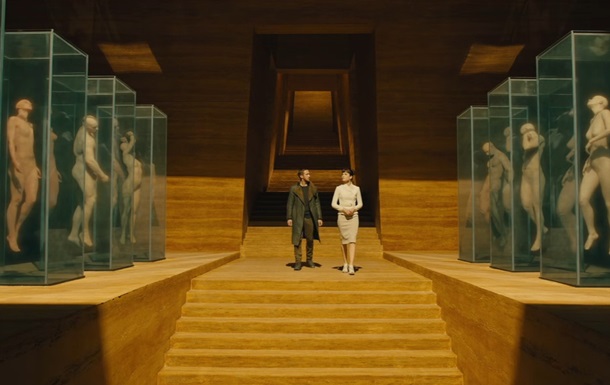
Inside the offices of the science genius Niander Wallace. This
is just one of many stunning sets which reflect the mental
states or situations of those who dwell in them.
If the movie is so good at these things, why was there a lackluster turnout on opening weekend, despite glowing reviews and a fairly ubiquitous advertising campaign? Hard to say for absolute certain, but it may not have helped its wider appeal that the film is not exactly an action-packed thrill-ride. While the original certainly has its slower, more meditative moments, it never goes more than about ten minutes without a fight of some sort, including a tense pursuit and battle during its twenty-minute climax. While 2049 does have several action sequences, all done extremely well, they are fewer and further between than the original. Anybody showing up to the theater hoping to get a J.J. Abrams-style, Star Wars/Star Trek reboot, action extravaganza was probably not going to be entertained by this movie. In fact, I heard a couple commenting as such as I left the theater with my wife. They were talking about how they wanted "something to happen" for nearly the entire movie. If these viewers general sentiment was reflective of the whole and they communicated it to others, than maybe many people decided to give it a pass. For my money, though, I thought the action scenes were handled well and used efficiently. There is one scene during a penultimate fight that I thought dragged on a bit, but this was the only such case.

Any fan of the original is likely to cite the mood and atmosphere created by the visuals and music score. The sequel makes sure to maintain some very welcome coherence with those aesthetic qualities and even update them brilliantly. With a sizable budget at his fingertips, Villeneuve was able to get the beautifully dark blend of noir and cyberpunk dystopia which Ridley Scott created back in 1982. He even goes beyond it, sending the story to several environments outside of the shadow-shrouded and rain-soaked metropolis where the original completely takes place. These evocative and impressive settings outside of the city help give this sequel an effectively episodic feel. And the music pulls off a similar trick, reviving much of the meditative and synthetic tones of the iconic Evangelis score, while adding some harder-hitting industrial sounds which can reflect the cognitive dissonance of the protagonist.

This movie's stayed embedded in my mind since I watched it three nights ago, and I will likely try to catch it on an IMAX screen while it still lasts there. It does sadden me that it hasn't done terribly well here in the U.S., as I would have hoped that there were still an audience for stunning, mentally stimulating science-fiction. I do hope that it perhaps has legs and that more people give it a chance, maybe seeing it for the incredible movie it is.
Sunday, September 17, 2017

Retro Duo: Drive (2011); The Heat (2013)

Drive (2011)

Director: Nicolas Winding Refn

One of my favorite movies from the last decade. I just watched it for the fourth or fifth time, and I still marvel at it.

The basic story elements are straight out of the mythical Western movies of Sergio Leone: a quiet man with no name and a particular skill set is not bothered by committing acts outside of the law. However, he does have a certain code of honor to which he holds himself. When he sees the forces of darkness closing in, he decides to use his skills to fight back. In the case of director Nicolas Winding Refn's Drive, instead of a gunfighter, we have "Driver" (Ryan Gosling), who is a movie stunt driver moonlighting as a getaway "wheel man" for robbers. When Driver (his real name is never given) falls in love with his neighbor, Irene (Carey Mulligan), he starts to show a tenderness unseen to us before. This nearly all vanishes, however, when Irene's husband is first paroled out of prison but then forced into committing a robbery that goes horribly wrong. Driver then finds himself in a race to track down the gangsters responsible, while keeping Irene and her little boy safe.

While Drive is not telling a story that is particularly fresh, it updates the "quiet, lone hero" tale wonderfully and tells it with such cinematic excellence that it shames other movies that have tried the same thing since Leone first mastered it in the mid-1960s. Admittedly, it helps if one has a certain affinity for this type of protagonist. I've long been a fan of Leone and Clint Eastwood's (we can technically throw Charles Bronson in there, too) Man With No Name character. I'm far from the only boy in the history of humanity who's been fascinated by the fantasy of the ever-cool and unflappable hero who is so skilled that he can take down any adversary, often without breaking much of a sweat. Ryan Gosling's Driver is cut from that same cloth, though he's traded in Eastwood's dusty serape for a slick, silver driving jacket with a badass scorpion on the back.

I know, I know. If you haven't seen the movie, you're thinking, "Come on. A silent, badass loner wearing a scorpion jacket? This is a joke, right?" No. It's not. By a lesser filmmaker, it would be laughable, to be sure. But this screenplay and direction are so tight that it's brilliant. The narrative is a case-study in cinematic efficiency, with nary a wasted scene or throwaway line to be found in the entire film. And while there is certainly plenty of intense action and violence in the latter parts of the movie, much of the earlier segments feature delicate and subtle visual cues to tell the story. These subtleties are what make the action sequences in the third act of the movie so much more impactful.

I've spoken to a few friends who have watched the movie and simply found it too slow, quiet, and brooding for their liking. I understand this. If one prefers their action to be highly kinetic and offer strings of one-liners to bridge the action scenes, a la the Fast and the Furious franchise, then Drive is not the movie for you. In place of those styles of storytelling, Drive offers stunningly framed and lit scenes, expert editing, a meditative tone, and pitch-perfect acting (the supporting cast is amazing) to tell a story that is both classic and unique. There aren't many non-popcorn movies that I watch every year or two, but this quickly became one of them. After this most recent viewing, this is not at all likely to change.


This great throwback poster gives some
idea of the tone of the movie. Think of
it as a more comedic, profane version of
Lethal Weapon.
The Heat (2013)

Director: Paul Feig

A bit of a forerunner for the even-better, modern comedy classic Spy, The Heat is a hilarious early team-up of comedy director Paul Feig and brilliant comedienne Melissa McCarthy.

The movie pairs stuffy, arrogant F.B.I. Agent Ashburn (Sandra Bullock) with local hardass Boston police officer Mullins (McCarthy) as they try to track down a high-volume drug dealer responsible for several grizzly deaths in recent months. Ashburn is a well-educated and capable but highly abrasive, career-driven woman who has alienated virtually every coworker in the Bureau. Mullins, on quite the other hand, is Ashburn's polar opposite in nearly every way. While she is equally effective at tracking and capturing criminals, her approach is far less surgical and much more that of a wrecking ball, speaking to her background as the eldest sister in her Irish, working class family. Mullins is supremely crass and on a hair trigger at all times. She and Ashburn eventually bridge the tremendous gap between their styles of law enforcement and work together to solve the case.

Anyone who has seen and enjoyed either Bridesmaids or Spy would do well to check out The Heat. Director Paul Feig has found his modern comedy movie niche with the formula evidenced in these movies (though Spy was impressively less formulaic than the other two): use a known story blueprint, hire several supremely hilarious actors, and let them run with their lines and characters. That is truly where the strength of these movies lie. When you give someone like McCarthy a few decent lines or a dynamic character to work with, along with R-rated freedom, she'll either deliver the written line with perfect timing and tone, or she'll punch it up into something even better. And not to slight Sandra Bullock here, who does a great job as the straight woman, but it's McCarthy's attitude and comic chops that set the tone here. It also helps to have some other veteran comic actors like Bill Burr and Michael Rappaport as supporting characters, just so no single voice or pair of voices dominate for too long.

Like nearly every Paul Feig movie I've seen, The Heat is probably about 10 to 15 minutes too long, due to overly generous editing. It's fairly clear that much of Feig's approach is to grant his actors a ton of freedom to ad-lib as much as they desire. This is as it should be, as it clearly leads to plenty of hilarious moments of spontaneous dialogue and reactions. However, every film of his contains at least a few scenes that feel a tad too long or simply superfluous, bogging down the narrative pace just a bit. Fortunately, they've never been a complete drag on his movies, and The Heat is the same.

I was glad to learn that shortly after I watched this movie, a sequel was announced. The trio of Feig, McCarthy, and Bullock was obviously a strong one, and there are plenty more tales of Ashburn and Mullins that would be fun to tell. I'll look forward to it. 

Sunday, February 5, 2017

New Releases (Oscar Catchup Edition): Manchester by the Sea (2016) and La La Land (2016)

It's Oscar time, with nominations being released in late January. This is always the time that I scramble to see the major nominees that I missed through the year, so here we go. (No spoilers for any movies)

Manchester by the Sea (2016)

Director: Kenneth Lonergan

An absolutely astounding movie that finds the true drama in a very real, very human kind of tragedy and an attempt at some form of healing and redemption.

The story is that of Lee Chandler (Casey Affleck), a janitor who tends to several apartment buildings in the Boston area. He lives a solitary life in a tiny apartment, and he keeps his distance from other people. Although quiet, there is clearly an inner rage burning inside Lee, as evidenced by a violence that emerges when he drinks too much. This loner is thrown out of his routine, however, when he learns that his brother has passed away back in his coastal hometown of Manchester-by-the-Sea. When he returns, many of the things which Lee tried to escape a number of years previous start to creep their way back into his life, forcing him to reckon with them. One of the primary elements of this is his nephew, Patrick, a 16-year-old who has had little to no interaction with his uncle since some unspoken tragedy parted them. Patrick is a rather typical modern Boston Irish-Catholic teen - witty, charming, sarcastic, and alternately self-absorbed and caring.

My wife and I were blown away with just how powerful, effective, and often even enjoyable this movie was. At its heart there is a brutal tragedy that would normally torpedo any enjoyment one could take from such a story. Here, however, it is not allowed to suck all of the life and humor out of the tale. With dry, gallows humor and their feet firmly planted in reality, the characters force Lee and us viewers to accept that life moves on. In some ways, this is a good thing, but in others it is painful. For those looking for nice, tidy, and pleasant endings to their dramas, this will likely not be satisfying. It is, however, an extremely thoughtful and touchingly humanistic tale.

The setting and characters create an impressive sense of place. Though some viewers may be a bit burned out by the relatively steady stream of prominent "Boston area" movies that have hit the screens in the last twenty or so years, starting with Good Will Hunting in 1997 and most recently seen in last year's Spotlight, Manchester by the Sea is not using its setting simply for panache. There is a very particular culture at work here - that of the traditional, Northeastern Irish Catholics - that plays heavily into Lee's dealings with his own pain and the members of his family. Perhaps it is easy for me to relate and connect, being the son of Irish Catholic parents, one of whom was born and raised in Queens, New York, but I feel that the movie has a more universal appeal in that it touches on ways that men traditionally retreat to stoicism as a way to deal with emotional pain.

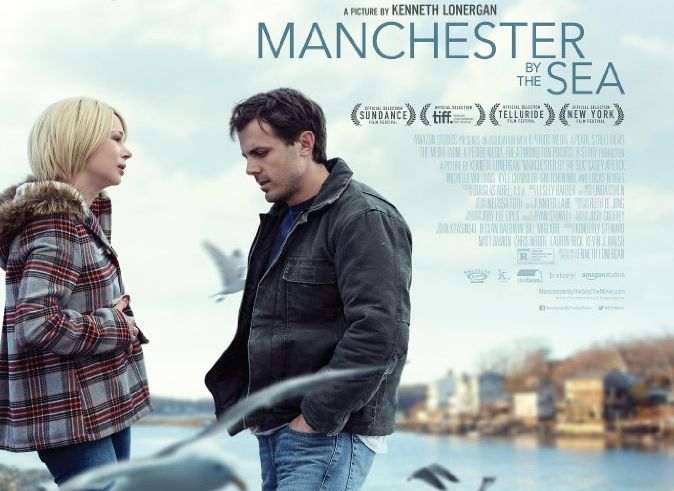
Patrick and his uncle Lee. The reserved and traumatized Lee
is forced out of the protective shell that he's created for
himself by his wiseass nephew. Their interactions are an
amazing blend of dry humor and stirring emotion.
In terms of narrative, the movie is masterful. Using occasional flashbacks, we get to see Lee as he was several years before the current story, and the difference is drastic. This initially sets up the question of what caused such an obvious shift in demeanor, and it leads us right into Lee's current conflict with himself, his hometown, and the family members and former friends who live there. Non-linear narratives can often become mere novelty tricks, but this movie uses it to enhance its' tale immensely.

As of my writing this, I've only seen four out of the nine Oscar Best Picture nominees. But Manchester by the Sea is my current leader in the clubhouse for the best. Whether it wins or not is another story, but this movie is outstanding drama, all around.


La La Land (2016)

Director: Damien Chazelle

A good movie, though one that I think is a bit overhyped, given its record-tying 14 Oscar nominations and virtually unanimous, insanely positive critical reception.

Using the now-rarely seen genre of the musical film, La La Land tells the story of two aspiring artists - jazz musician Sebastian and actress Mia - who are trying to make it in Los Angeles. After a rocky first couple of interactions, the two fall in love. However, trouble emerges when Sebastian compromises his own strict artistic integrity and takes a lucrative job as a pianist for a pop jazz band, putting pressure on his relationship with Mia.

Full disclosure: I don't like musicals. I've seen many of the classics and even a handful of modern ones considered the best in the genre, but I quite simply am not a fan of the approach. For the most part, I've always found musicals a bit too saccharine and superficial, in terms of the plots and characters. While I can appreciate the talent and effort that goes into making a good musical, I've always preferred a more straightforward style of narrative. With all of that in mind, I'll say that La La Land does a nice job of what it sets out to do, and it adds a bit more modern sophistication and humor to the proceedings in terms of acting and the non-musical dialogue.

But it is still a musical. Though director Damien Chazelle does a commendable job weaving the song and dance numbers into the story more smoothly than many musicals, they are still a distraction. Fortunately, there are some dazzling visuals sprinkled into the carefully-constructed sets, scenes, and costume layouts, making for a film that is as easy on the eyes as they come. The issue is, though, that I found almost none of the songs partcicularly memorable or catchy, in terms of either the lyrics or the tunes. And while Ryan Gosling and Emma Stone are excellent actors with great comic chops (just see them together in Crazy, Stupid Love), they aren't top-rate singers or dancers. They're fine. In Stone's case, even good. But they aren't going to rank among the best song-and-dance duos in movie history any time soon. And this is what I need from such movies. One of the few musicals I like is the classic Swing Time, with Fred Astaire and Ginger Rogers, because those two were world-class dancers who could hypnotize us with their supremely elegant moves on the dance floor. Gosling and Stone simply aren't anywhere near that class, so their "musical" skills are not a particular reason to see the movie.

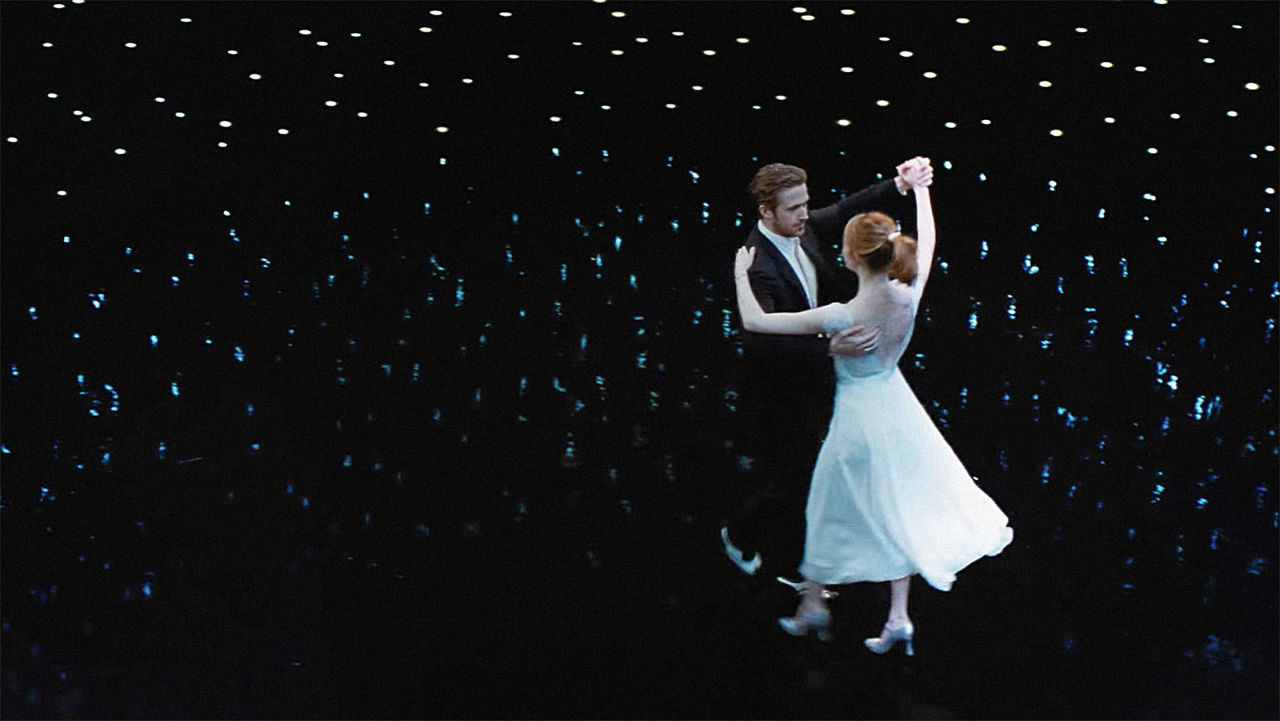
Stone and Gosling do fine with the song and dance numbers,
but they don't even come close to the level of the best singers
or dancers in the history of the musical genre.
I did enjoy the comedy in the film, thanks to Gosling and Stone's abilities to deliver humor even when the script may not have been particularly sharp. And the ending of the movie is truly creative and moving. Ultimately, though, this was not a musical that won over a person like me - one who can count on one hand the number of musicals that they enjoy.

This leads me to wonder about why the film has received a record-tying number of Oscar nominations. My personal theory is that movie critics and industry insiders, even more than movie aficionados, have a massive bias towards the legacy of movies (almost as much as movies about movies). The musical is a nearly extinct form of film, and I suspect that the Academy and other film award organization were just thrilled to see any form of well-done musical (only Les Miserable from 2013 had been nominated in the last 14 years. Before that, it was Chicago in 2002). Whatever the case, I think that the other three Best Picture nominees which I've seen - Arrival, Hell or High Water, and Manchester by the Sea - are all superior to La La Land

Wednesday, June 1, 2016

New Release! The Nice Guys

Director: Shane Black

One of the best times I've had at the movies in recent years. It might not be perfect or blindingly original in all facets, but The Nice Guys is a hilarious entry into the oft-botched genre of R-rated buddy flicks.

The movie follows Holland March (Ryan Gosling), a private investigator who is put on the case of finding a missing young woman, Amelia, in the drug-fueled Sodom and Gomorrah that was 1977 Hollywood, California. The case itself bears several odd elements, made all the more challenging by the fact that March is not only an alcoholic but also oddly inept at his job. Fortunately for him, he is joined by the sober and much more capable muscle-for-hire Jackson Healy (Russell Crowe). The two find themselves trying to navigate the winding, bizarre trail that Amelia leaves through the Hollywood porn industry, justice department, and even the U.S. automotive industry.

Writers Shane Black and Anthony Bagarozzi fully embraced the neo-noir style and did it tremendous justice, while at the same time turning plenty of its familiar cliches on their ears. There are more than a few sequences which begin in very familiar fashion to crime movie lovers, but which take sly little comic turns. In a move gleefully similar to The Big Lebowski, making the "hero" detective a booze-addled goof creates plenty of opportunity for humor, and the movie capitalizes.  And the characters only enhance the gags. While March does have reasons for being so down on his luck, it doesn't lessen the hilarity of his missteps and posturing. He's the perfect pairing to the grizzled, no-nonsense Healy, and their dynamic is a blast to watch. Peppered throughout all of this are several great little sight gags which are among some of the best I've seen in some time.

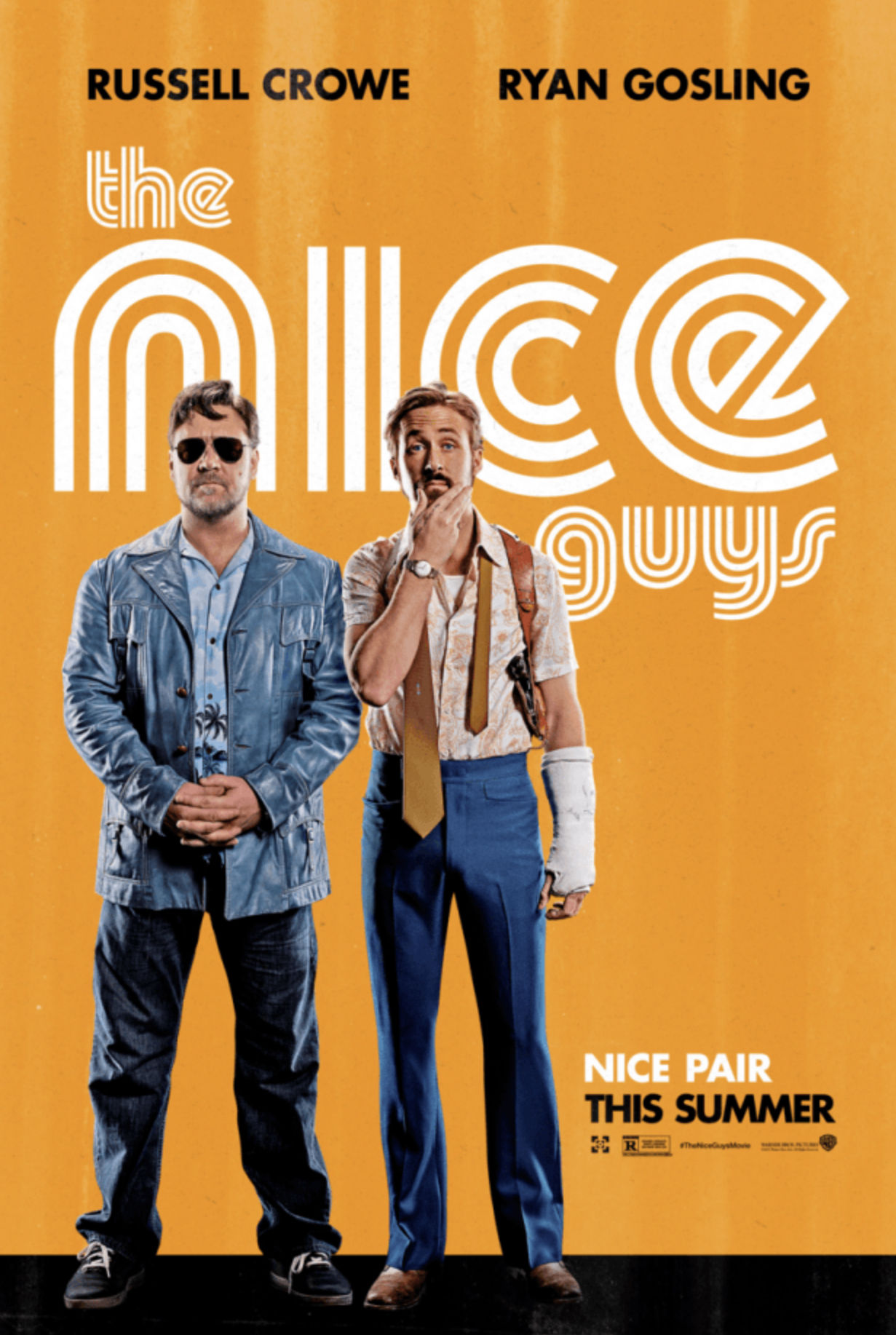
Gosling and Crowe make the blend of tough and hilarious
look deceptively smooth and easy. They enhance Black's
already-great script to another level.
It is difficult to imagine better casting for March and Healy than Ryan Gosling and Russell Crowe. They play their characters to a tee, and left me with the same feeling that any successful buddy movie should leave - the desire to see more of them. There are a few minor characters that may not have completely fit the bill, but these were the few exceptions among the mostly-strong supporting cast.

As I write this review, the movie has been out for about two weeks and hasn't done exceptionally well at the box office. I do hope that it picks up, as I feel that this type of quality, R-rated comedy is a bit of a dying breed in movies.