Showing posts with label Ethan Hawke. Show all posts

Tuesday, October 2, 2018

New Release! Juliet, Naked (2018) [No spoilers]

No Spoilers! Read Away!!

Director: Jesse Peretz

Another well-done and more unique rom-com based on a novel by British writer Nick Hornby.

Juliet, Naked focuses on Annie Platt (Rose Byrne), a semi-reluctant museum curator in a small town on the coast of England. Annie's longtime boyfriend Duncan (Chris O'Dowd) is an local college professor who has a strong obsession with obscure 1990s rock musician Tucker Crowe. Crowe had one particularly critical hit album 25 years prior but vanished into obscurity for unknown reasons. Duncan is part of a small group of obsessive fans who pore over the minutiae of Tucker's life and rather small body of musical work with almost every spare moment. After a previously-unheard demo copy of Tucker's hit album mysteriously appears, Rose accidentally finds herself in contact with Crowe himself (Ethan Hawke). This forces her to begin rethinking her own life, from her relationship with Duncan to her job and continuing to live in her sleepy hometown.

I'm not a particular fan of romantic comedies, but I can enjoy ones that don't fall into the sappier tropes of the genre. Fortunately, Juliet, Naked avoids nearly all of them. There are certainly a few familiar elements to fans of rom-coms: a woman dissatisfied with her love life. A connection with a new man that forces her to reexamine her own life. Cute and humorously awkward moments. This movie contains all of those. Where it exceeds most of its brethren is in the execution, which is pleasantly organic and genuinely funny most of the time. I truly knew nothing about the plot going into this movie, so I can't speak to how someone might feel if they've read Nick Hornby's novel first, but the movie went in a few directions which I honestly didn't see coming. Though it didn't take any massive risks with the ending, it also avoided many of the tropes and familiar beats popularized by earlier romantic comedies.

A big reason the movie rises above other rom-coms is that it does focus on slightly older people. Crazy Rich Asians, as different as it was in many ways, still focused on a woman in her late-twenties/early thirties and just on the cusp of taking the first big step of getting engaged. Juliet, Naked looks at a woman and peers who are further along in life. Annie is much closer to forty and has been in a relationship so settled that she's barely noticed how stale it's become. The "new man" in her life, Tucker, is not some dashing knight in shining armor but rather a faded musician who clearly has serious problems with relationships, and not just with women. He also has multiple children from multiple mothers, each of whom he has complicated histories with. And for most of the movie, it's not even clear if Annie looks at Tucker as a potential love interest, but perhaps simply as an unexpected sympathetic ear - the stranger to whom she feels comfortable airing her discontent with her life. It all makes for a story that is a bit tougher to predict.
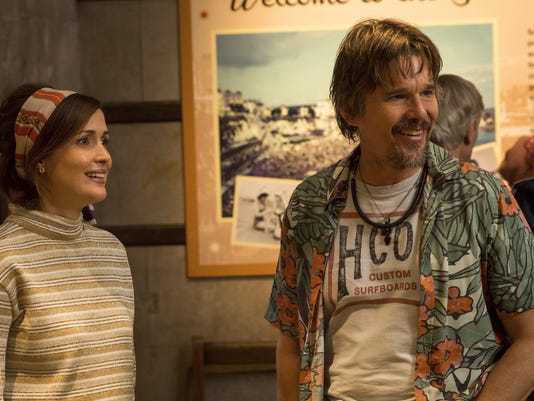
In quite a turn from his role in the hard-hitting First Reformed,
Ethan Hawke expertly plays the overly laid back, messy former
star musician Tucker Crowe. His emergence into Annie's (left)
life sends them both into reexamining their lives.
The movie also uses as one of its themes a topic that Hornby has always incorporated well in many of his stories - the topic of obsessions. Whether obsessions with music in High Fidelity, with a sports team in Fever Pitch, and now with a particular musician in Juliet, Naked, it is a subject that has stronger and stronger resonance in a time when the pool of information at our disposal deepens and creates the potential to drown in our own recreational hobbies. This movie runs with the amusing question, "What if the object of one's unhealthy obsession quite literally shows up on their doorstep?"

The cast helps things immensely. The three main actors, Byrne, O'Dowd, and Hawke, couldn't have been cast more perfectly. All three - especially Byrne and O'Dowd - have serious comedic chops to go along with their solid acting skills, which the script demands. They feel very much as authentic as such characters can, and the little seaside town is a perfectly quaint setting for such a tale.

My wife and I saw this movie only a few days after this summer's monster rom-com hit Crazy Rich Asians. I certainly enjoyed that movie, but I honestly thought Juliet, Naked to be an overall more touching and consistently strong film. This is likely because its characters are much closer to my own age in my early forties, versus the relative freshness and youth of Crazy Rich Asians. For anyone who likes the genre but wasn't aware of this under-the-radar gem, I highly recommend it. 

Friday, June 22, 2018

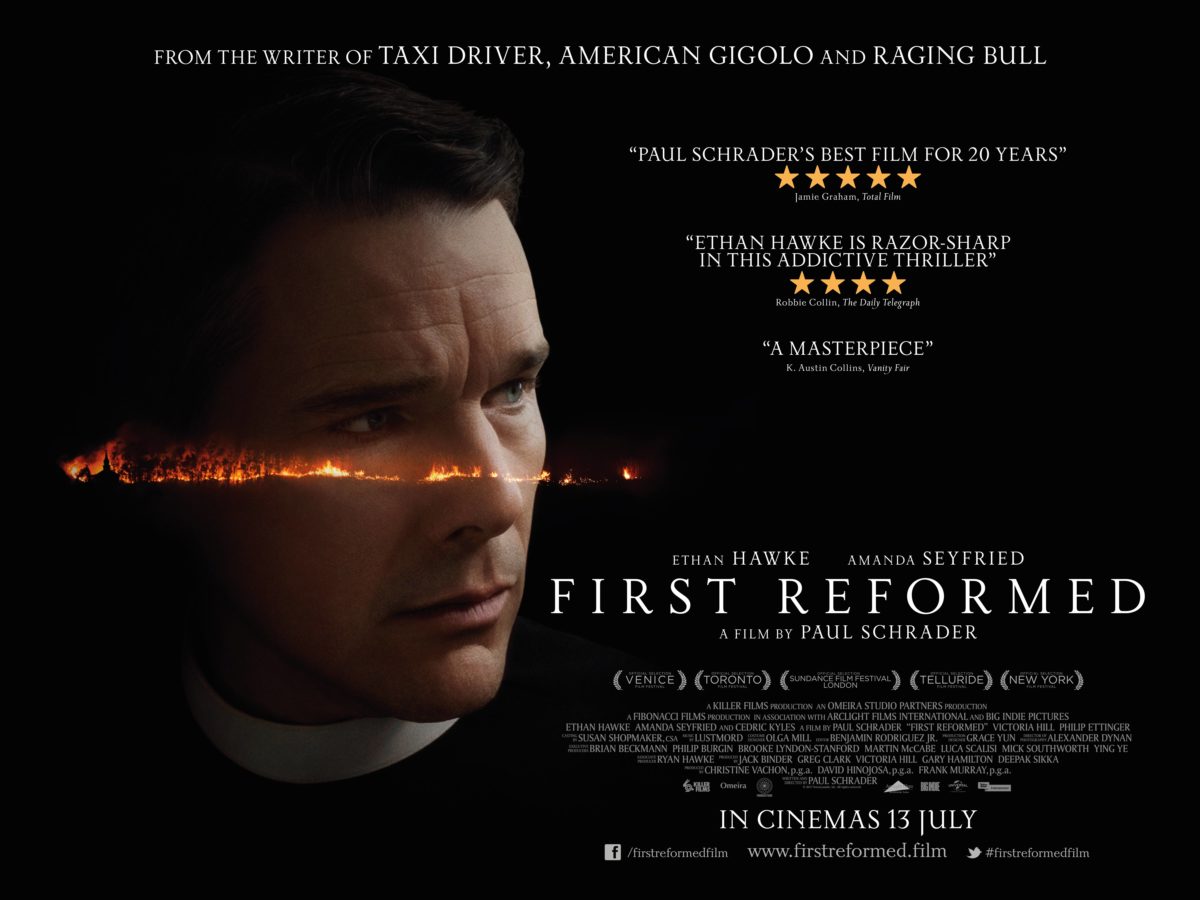
New Release! First Reformed (2018) [Spoiler-Free Review]

No Spoilers! Read Away!!

Director: Paul Schrader

An intense, disturbing gaze into a very troubled soul, but one that is mesmerizing much of the time.

First Reformed was written and directed by Paul Schrader, best known for writing Taxi Driver and co-writing Raging Bull. With his latest film, Schrader calls upon a primary theme of that earlier film - that of a deeply troubled and mentally fractured man whose anger at the world around him drives him into psychological crisis that may become a serious threat to those around him.

The story focuses on Reverend Toller (Ethan Hawke), a former military chaplain who is now the pastor of a tiny parish in upstate New York. Although his congregation consists of only a handful of people, the church building itself is of historical significance, being one of the oldest churches in the First Reformed denomination of Christianity. Due to its miniscule congregation, however, the church has recently been bought out by a nearby megachurch. One day, Reverend Toller is asked by a young parishioner, Mary (Amanda Seyfried), to speak to her husband. Her husband, Michael, is an ex-con and militant environmentalist whose rage at polluting energy companies seems on the verge of boiling over into violent action. Toller attempts to calm Michael, but the passionate young man seems to open up still-unhealed wounds within the Reverend, who himself is grappling with his own losses and guilt. As the tale unfolds, Toller grows angrier and more desperate for answers as to what is happening around him, and whether he should do something about it. And the nature of what that "something" is grows into its own frightening question.

This movie is often powerfully magnetic, with its very relevant themes of environmental destruction and humankind's blame and responsibility for its lasting effects. It is also a thought-provoking look at how a haunted person can latch onto very legitimate causes and use them to rationalize extremely frightening and even violent behavior. Some aspects of this movie feel oversimplified, such as the bombastic and bullying energy company CEO Edward Balq or the snarky Islamophibic teen at a discussion group. But most of the really important characters and interactions are highly nuanced and defy simple analysis. The despair-stricken Michael is obviously on the brink of a psychotic break, but much of his reasoning is sound. The megachurch pastor (Cedric "The Entertainer" Kyles) exhibits some of the unsavory characteristics of celebrity ministers, but he also lays out some sound observations and advice for the tormented Toller. The protagonist himself, Toller, is the most complicated of them all - being a man desperate to do the right thing, but a man who is steadily degenerating in several ways, raising questions with few easy answers.

The ending of the movie has stuck with me quite a lot, even a solid week after seeing the film. My initial reactions were those of bafflement and a bit of disappointment. After some time to ruminate on it, though, I realize that it is open to a bit of interpretation, and one of my own interpretations in much more satisfying than what is literally depicted on the screen.

Among the many pale and austere settings depicted in the film,
Rev. Toller's lined, anguished face reflects a soul attempting
to break out of a malaise of despair.
This movie has drawn many comparisons to Schrader's 1976 masterpiece, Taxi Driver, with good reason. Reverend Toller is a version of Travis Bickle, although one who is different in several important ways. Still, the most important traits of being tortured and desperate are obvious in both men, and Schrader's telling of their stories is as gripping as it is disturbing.

The visuals of the film are notable, shot in cold, often pale settings of winter in upstate New York. Done with slow precision, we get exteriors and interiors that often have a rather chilly, blank feeling, at times reflective and other times in contrast to the state of Reverend Toller's troubled soul. There is often something hypnotic about the slow pans and the stationary camera as it offers us tense conversations between Toller and others. It all creates a coherent look and tone to the entire movie, much to the film's benefit.

As with most movies of such dark subject matter, this isn't one that I will likely watch again any time soon. But it was enthralling to see it, and I suspect it will long stand as a great movie among those dealing with environmentalism and questions about religious and spiritual duty.