Billi (middle) and her family. To a person, the nearly all- Chinese cast is brilliant.
Director: Lulu Wang
An excellent dramedy that takes a look at something that nearly every family has had to deal with but is almost never given time on the silver screen.
Comedian Awkwafina plays Billi, a Chinese-American whose family immigrated to New York City when she was a young girl but who still have many relatives back in China. When Billi learns that her grandmother, "Nai Nai," has been diagnosed with terminal lung cancer, she is deeply saddened but infinitely more shocked by her family's decision not to inform Nai Nai about her fatal condition - something that is rather common in East Asian cultures. Billi chases her parents over to China in order to see her Nai Nai one last time, but must wrestle with the choice of whether to maintain the charade that her family is keeping in place or to let the cat out of the bag and tell her beloved Nai Nai that she has a very limited time to live.
The Farewell is an outstanding example of a movie that blends comedy and drama while it subtly reveals something very genuine about the human condition and how different cultures have adapted to it. On its surface, the premise seems very obvious: a granddaughter loves her grandma and is sad to know that she is dying. Fairly standard, run-of-the-mill drama stuff, right? Maybe, but there is so much that The Farewell does right with this basic notion that it has an impact that can almost blindside you.
Firstly, the relationship between Billi and Nai Nai just becomes more and more endearing as the movie progresses. From the opening moments, it's clear that they're both quite amicable and that they have a meaningful bond with each other. But as the movie goes along and we get to see them interact with each other, this bond becomes ever more clearly organic, charming, and touching. As we see Nai Nai interact with Billie and the rest of her family, we can see why she is so beloved. There is an easy humor about her that combines the best characteristics of a traditional grandparent and a charming, quirky friend. This makes is far easier to understand why Billie struggles so hard to go along with her family's wishes not to tell Nai Nai of her impending death.
Nai Nai and Billi. It doesn't take long to see why the relation- ship means so much to each of them, despite their being separated by half the world for over two decades.
When a movie isn't relying on big-budget set pieces, spectacular CGI, or elaborate costumes or choreography, it needs to find its strength in story and acting. The acting in The Farewell is as good as it gets. Yes, there is a nice amount of humor and levity throughout, but this movie is still primarily a drama, and the cast - nearly all Chinese - is amazing. Like most in the U.S., I was only familiar with Awkwafina and only familiar with her as a comedian. Well, her turn as Billi proves that she's a more than capable dramatic actor as well. Those who play her family, especially Shuzhen Zhao as Nai Nai and Tzi Ma as Billi's father, are all outstanding. They bring their characters and Wang's script to all of its fleshed-out, three-dimensional life with the subtleties and ranges of their performances. It was no surprise when I later learned from an interview with Wang that the actors were surprisingly costly to hire, contrary to her previous belief. They were worth it, though.
There were so many ways that this movie could have gone broader, going for cheaper, simpler, one- or two-dimensional characters in order to get cheap laughs. Writer and director Lulu Wang avoids every one of such pitfalls that matters, giving us a warm-but-challenging tale that does a rare thing for movies these days - it uses its drama to reveal a new perspective on a nearly universal situation. At least, it's new to us in the West. This is what the very best independent films can do - go out on a bit of a limb, take a risk, and bring new stories to audiences who haven't seen their like before.
In the small town of Big Whiskey,
Montana, in 1881, a cowhand
becomes enraged at a prostitute named Delilah over a minor insult and slashes
her face. Despite calls from Delilah’s fellow prostitutes that the cowhand and
his companion be hanged, the sheriff, “Little Bill” (Gene Hackman) merely
demands that the two boys pay the proprietor of the saloon/cathouse in the form
of horses. The furious prostitutes then secretly pool their money and start
spreading word of a bounty for anyone who kills the two cowboys.
To the south, in Kansas, a brash young man calling himself
“The Schofield Kid” finds the middle-aged farmer William Munny and asks him to
partner up to kill the cowboys for the bounty. The Kid has heard from that
Munny was once a fearless and vicious killer who would make a perfect partner
for such a dark deed. Munny, now a widower who has forsworn his previously
murderous life and with two young children to support, at first refuses The
Kid. With his farm failing, though, he changes his mind. He convinces one of
his old partners, Ned (Morgan Freeman), to join him on this final killing in
order to have a new start for his children.
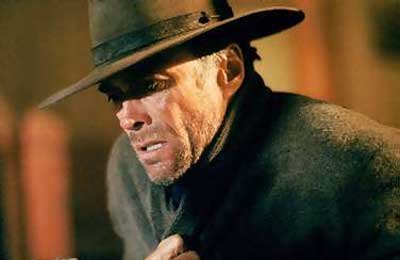
Will Munny, a brutal killer in the past, now struggles on his farm with his two your children.
Back in Big Whiskey, Little Bill has now heard of the bounty
put out and brutally beats and casts out the first bounty hunter who drifts
into town to inquire after it – the noted gunman “English” Bob (Richard
Harris). When the Kid, Will, and Ned come into town some days after, Will is
himself beaten by Little Bill, while Ned and The Kid escape. The three rally
themselves and set out after the first of the two cowboys, undeterred by Little
Bill’s edict against assassins. When they find the cowboy, however, Ned is
unable to bring himself to kill him. Will instead takes Ned’s rifle and shoots
the cowboy dead. Ned, realizing that he no longer has what it takes to kill a
man, parts ways with Will and The Kid, with Will promising to bring Ned his
share of the bounty after the job is finished.
Will and The Kid then find the second cowboy, who actually
cut up Delilah, holed up at the ranch he works on. The Kid kills the cowboy and
the two make a narrow escape. When Will and The Kid return to just outside of Big
Whiskey to collect the bounty, however, they discover that Ned has been
captured, tortured, and killed. Suddenly overcome by a dark cloud of vengeance,
Will plies himself with alcohol and rides into town alone. Calmly walking into
the saloon where Ned’s corpse is prominently displayed outside, Will coldly
kills six men, including the saloon owner, four deputies, and Little Bill
himself. Though plenty of the townspeople are still alive to stop Will from
leaving, they are all too terrified of the killer to even make the attempt.
Will, in Skinny's saloon as he slays all those he feels are responsible for Ned's death. During these moments, all traces of the quiet, tortured farmer have been burned away.
We are told in the end that Will returned to his farm and used
his bounty money to move himself and his children away, possible to California
where he “prospered in dry goods.”
My Take on the Film (Done after this most recent viewing):
Unforgiven is, in my mind, the greatest Western film. There
are others that are more exciting and entertaining, but this one has by far the
most depth and arguably the greatest acting.
Clint Eastwood’s masterpiece probably couldn’t have been
made much earlier than it was. Being a deconstruction of the mythical West and
Western stories, it required all of the popular lore that preceded it, both in
literature and film. Eastwood set out tell a story that took a dark and
realistic look into the souls of truly dangerous men in the old West, and he
did it with expert precision.
At the heart of the film are all of the popular notions of
the “Wild West” gunslinger. The mythology around that time and place has been
the inspiration for countless tales of adventure for well over a century. The
archetypal “deadly guman” has long been one of the most attractive characters
in U.S.
narrative. Unforgiven gives voice to this attraction through the character
Beauchamp, a bumbling fiction writer who at first is following around English
Bob as his biographer. His stories of Bob cast him as a noble warrior whose
skills with a pistol make him a modern-day knight. Once Bob is thrashed and
imprisoned by Little Bill, however, the myth starts to fall apart.
English Bob, left, and his biographer, Beauchamp. It is initially through these two characters that the myths of honorable gunfighters are taken apart.
It is during the scenes between Little Bill and Beauchamp,
with English Bob watching from his cell, that we start to get at the reality of
killers. With his first-hand knowledge of Bob, Little Bill tears apart
Beauchamp’s notions of his idol. We soon see that Bob, though a truly dangerous
gunman, is actually a vicious murderer unworthy of any admiration.
But the deconstruction of English Bob is only a prelude. It
is with the tale of Will Munny that the truly disturbing truths about
gunfighters emerge. With incredible pacing, Munny’s regression from penitent
farmer back to unrepentant killer is as captivating as it is terrifying. For
most of the film, Munny’s murderous past is merely hinted at, through stories
told by other characters such as The Schofield Kid and even Will’s riding
partner, Ned. As each bloody story is revealed, Munny tries to assure Ned and
himself that he, “ain’t like that no more.” Watching him cling to the new self into
which his dead wife molded him is like watching a time bomb trying to diffuse
itself.
During his arrival at Bog Whiskey, Munny is still tortured and ill. It's almost as if his modern, peaceful self is slowly coming apart under the burden of trying to keep his homicidal nature at bay.
Any doubt about Munny is removed about halfway through the
film, upon the death of the first cowboy. When Ned is unable to pull the
trigger, Munny reverts to form. Without blinking, he takes the rifle from Ned’s
uncertain hands, takes aim, and kills the young man. It is now clear that,
while Ned truly has left his homicidal past behind him, Munny still possesses
a true murderer's instinct. As if the contrast between Ned and Munny isn’t
enough, is becomes all the more clear when Munny allow The Kid, eager for a
kill, to execute the second cowboy later. After the deed is done, The Kid
shakily admits that, contrary to his prior boasting, it was his first kill. The
Kid is all too aware of the difference between himself and Munny, stating, “I
ain’t like you Will.” Will’s response is right at the heart of the film – “It’s
a hell of a thing, killin’ a man. You take away everything he’s got and
everything he’s ever gonna have.” The Kid then swears off guns and killing for
the rest of his life.
It is then, in the final ten minutes of the movie, that we
see the true horror of William Munny. After he is told of Ned’s death, a
terrifying transformation takes place. For most of the story, Will has been the
picture of anguished restraint. He has refused to take a drop of alcohol and
has only killed the two cowboys condemned by the bounty. However, when he
learns that his friend has been tortured, killed, and put on display, his
previous decade of temperance thoroughly vanishes. A cold fire alights in his
eyes, his teeth clench, and he grabs a whiskey bottle and methodically starts to drink. By
the time he enters the saloon at nightfall, he is Vengeance personified. In
front of the group of puzzled and uncertain deputies and other town residents,
he brutally shoots the saloon owner, Skinny. Even then, the deputies are
clearly too frightened to try and bring down Munny. Even when they do gather
their wits and try to square off against him, Munny is too calm under fire to
be brought down. By doing little more than keeping his composure, he proceeds
to shoot the five men remaining with weapons in their hands. The writer
Beauchamp, who has been cowering in a corner and witnesses everything, then
tries to question Munny on his “strategy.” Munny debunks any notion of skill or
strategy by simple saying, “I was lucky…I’ve always been lucky when it comes to
killin’ folks.” With this line, there is nothing left to be lauded in Munny’s
actions, not even any kind of “skill.” Like English Bob, he is a mass murderer, though an uncommonly effective one.
Munny's execution of Little Bill. It may be one of the coldest, most haunting killings in all of film.
Following the rapid departure of Beauchamp, Munny then steps
up to Little Bill, who has been wounded but is not dead. Little Bill looks up
at Will Munny, and instead of begging or pleading, simply says, “I don’t
deserve to die like this.” Munny stares him in the face and delivers perhaps
the most haunting line of the film when he proclaims, “Deserve’s got nothin’ to
do with it.” At this moment, Munny is no longer even a spirit of vengeance. He
is death itself. Unfeeling. Unthinking. Uncaring of right or wrong.
Those final lines, and others like them in the film, are
what set Unforgiven apart. The only other Western I know of that even came
close to taking such a hard look at the makeup of the Western gunfighter was
The Searchers, with John Wayne. However, The Searchers still had a solid dose
of romantic hokum blended into it, and it’s not nearly as even in execution as
Unforgiven. Clint Eastwood directed this movie as well as anything he’s ever
done, encompassing all of the things that make Western films great, while
adding unprecedented philosophical depth.
The story and characters are undoubtedly what make the movie
great, but I’d be remiss if I didn’t at least briefly mention its other merits.
The cinematography is incredible, with all of the gorgeous wide-angle shots
that you could hope for in a sweeping Western. Even more is the acting. Clint
Eastwood does a fine enough job, and it helped that the character Will Munny
didn’t call for any spectacular range of emotions (not Eastwood’s forte). The
standout performances are Morgan Freeman and Gene Hackman, the latter of whom justifiably raked in a ton of awards for his turn as Little Bill. But even the smaller
roles are all played perfectly, from Richard Harris as English Bob right down
to the lowly prostitutes and townspeople.
Little Bill, in front of the townspeople of Big Whiskey. Just as important to the tone of the movie, the smaller roles all convey very realistic reactions to violence and death - rage, frustration, and fear.
When I think about Unforgiven as a whole, one thing I often
come back to is the notion of freedom. For fans of Western tales, it is often
the sense of freedom that is most appealing. The wide-open spaces of the old
West have always been thought of as places where a person is free from the
restrictions and expectations of “civilized” society. We often assume that this
is essentially a positive thing, as it allows a person to be whoever they want
to be or discover who they really are. This is a beautiful idea, if you assume
that the person you really are is one to be loved and admired. But what if who
you really are is someone as terrifying as William Munny? What if, in spite of
your every effort to escape it in the quiet, isolated, wind-swept plains of Kansas,
you are something that frightens yourself to your very soul? I don’t know if
this is one of the intended themes of the film, but it is one that stays with
me.
Additional Note: I came across the news that there is currently under production a remake of Unforgiven, set in feudal Japan and starring Ken Watanabe as the "Will Munny" character. Normally, I would be disgusted at the thought of a remake of Unforgiven; however, I can see the potential for a samurai setting to be very successful. I hope they can pull it off.
That’s a wrap. 91 shows down, 14 to go.
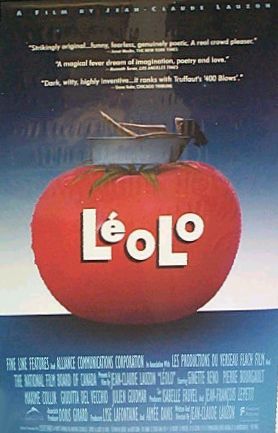
Coming Soon: Leolo (1992)
Don’t know anything about this one, but I’m guessing it
doesn’t involve Clint Eastwood, ruminations on murder, or and Englishman
getting his ass whipped. You never know, though…
Please be sure to pick up all empties on the way out.
Fogies visit kids The children are too busy Mama keels over
Uncut Summary (a full plot synopsis)
In 1950s Japan, retired Shukishi and Tomi Hirayama leave their home village in the south of Japan to visit their children in Tokyo. The elder Hirayamas are nearing their 70s and haven't seen their busy children in some time.
When they arrive in Tokyo, however, they are not afforded the pleasure of truly spending any quality time with any of their natural children. Their sons and daughters are all too busy with their work lives to make time or space for their parents. The Hirayama children even send their parents off to a nearby pricey spa, ostensibly for them to “relax,” but in truth merely to alleviate the nuisance of having to accommodate them.
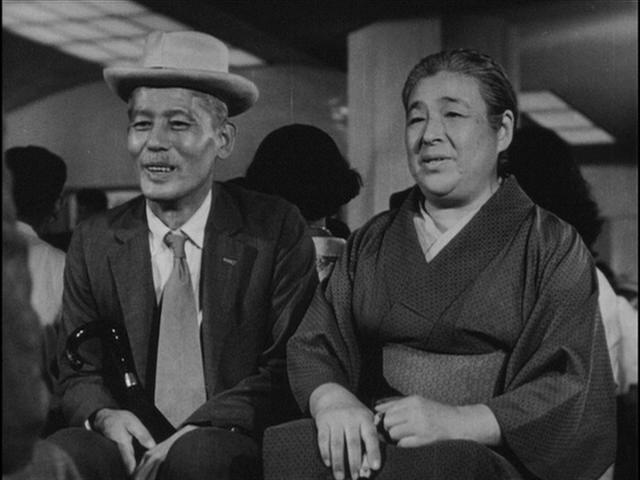
Shukishi and Tomi Hirayama's pleasant demeanors mask deep disappointment.
The only one who shows any form of true welcome is their widowed daughter-in-law, Noriko. Through the Hirayama's interactions with her and a few of their older friends, we see that the old couple is coming to grips with the reality that they are no longer a part of their children's lives. After several days of being shuffled between houses, the parents decide to cut their trip a bit short and head back to their hometown.
On the train back, however, Tomi takes ill. By the time she and her husband reach home, she is in a coma. The children finally break away from their daily hustles to be with their mother on her death bed. After she passes away, three of the five callously rush to get back to their lives in Tokyo. The two who remain with their father, the widow Noriko and the bachelorette Kyoko, share a sad moment realizing that they both may likely become just as detached from their father as their siblings have, should they start their own families some day.
The surviving Hirayamas make their final farewells & realizations
Take 1: My Gut Reaction (done after this most recent viewing, before any research)
Oof. Good thing I watched this on a grey, rainy day.
Tokyo Story is about as melancholy as they come, made all the more sad by the sheer reality and fatalism of it, as well as the skill with which the story themes are conveyed.
In the same vein as Umberto D., director Yasujiro Ozu turns his gaze toward a younger generation's attitude towards its forebears. It certainly seems that the Hirayama family is meant to represent the larger Japanese society, one in which the modernizing world has no place for maintaining deep, steady ties with anything or anyone, including one's parents.
The thing is, whereas Umberto D. had a quicker pace, a few lively characters, and a cute dog as some comic relief, Tokyo Story gives it to you raw and is much further-reaching. The former Italian film was really about an isolated loner, but Tokyo Story is about a very average family, making it far easier to feel empathy towards the characters. The dialogue and acting is so naturalistic that it almost feels like a film ethnography. In fact, of all the 40 films I've seen so far, this one has the most naturalistic acting. This is what gives it its power, especially to one as myself – a person whose parents are still alive and nearing the age of the Hirayamas. It was impossible for me to not get reflective about so many of the things the elder couple brings to light: their mild disappointment in their children, their sense of loss at their detachment from them, and their sad acceptance that nothing is to be done about it.
Here's a great moment in which Shukishi is at his most unguarded about his children. This is also a scene that reminds me an awful lot of my own time in Japan. A little too much sake in the system, coming down over a steaming bowl of ramen. Start it at time 4:40:
The pace of this movie is something quite novel, relative to the other films from the list that I've watched thus far. I'm sure some people would have a hard time sitting through the measured, quiet moments depicting everyday life. As far as I was concerned, it did get a bit tedious, but I completely understand that this is necessary and intentional. Actually, by the end I found Shukishi and Tomi's slow, almost catatonic speech soothing and very much in keeping with what they were meant to represent: a more carefully, cautiously paced generation that was being left behind in the rapidly booming 1950s.
Part of my interest in this film certainly comes from the fact that I lived and worked in Japan for two years. Very much in evidence is the famed Japanese formality and ostensible kindness, which is a theme that Ozu later explored with his film Good Morning. Most Westerners may find alien the almost mannequin-like smiles that Shukishi and Tomi wear throughout nearly the entire film, despite their growing sadness. This is what makes the few moments that they break the formality all the more potent, if not very dramatic. Were anyone I know to ask what Japanese culture is like, I could show nearly any 10-minute clip from this 57-year old movie and feel confident that it stands as a solid representative of Japanese behavior and culture. One of the several very “Japanese” moments that stood out was an exchange between Noriko and Kyoko, when the latter says, “Isn't life disappointing?” to which a calmly smiling Noriko replies, “Yes.”
As alluded to, the technical merits of the film are beyond reproach, in my opinion. It may not have been the most challenging movie to film, or the most taxing on its actors, but everything is done to perfection. Long shots convey isolation, interior shots give the sense of relative claustrophobia inside the family houses, and it's not hard to buy into the Hirayama family as thoroughly authentic.
All of these accolades aside, this is another movie that I very likely will not see again, and would only recommend with several caveats. A person must be ready for a 2-hour, 15-minute gaze into the very real but very subtle generational tensions of a Japanese family. If this doesn't sound overly entertaining, it's because it isn't. Watching this movie is an exercise of a different sort. It's one that is probably worth making at least once, but not one that's guaranteed to touch everyone.
Take 2: Why Film Geeks Love This Movie (done after further research)
One doesn't have to do much research to confirm just why Tokyo Story has a place in film history: it's that rare and classic thing that does so much in reality while seemingly doing very little. All that's needed is the viewer's careful attention and patience.
In more detail and with more erudition than I could muster, David Bordwell's analysis carefully points out just how subtle Ozu is with his lack of camera motion and his refusal to cut away from a character while they speak. Roger Ebert covers the same ground, perhaps more thoroughly in this review. What both men point to is both just how Japanese the story is, while being equally accessible to any viewer with a marginally open mind.
In reading the essays echoing the theme of a slower, older generation (aren't all younger generations “faster” these days?), I almost can't help but wonder if Tokyo Story is the very thing that it speaks of. In an age when generation gaps and attention spans seem to be shrinking astronomically, will a slow and careful look at such gaps, which is what Tokyo Story truly is, eventually be dismissed and pushed to the side?
Here's a thoughtful clip of the very end of the movie, with the new widower, Shukishi, slowly absorbing his isolation with the same measured calm as everything else. Being at time 8:20:
That's a wrap. 40 shows down. 65 to go.
Coming Soon: On the Waterfront (1954)
“I could'a been somebody! I could'a been a contendah!!” One of the few films on the list that I've already seen and absolutely love. I can't wait to watch old Terry Malloy do his thing on the docks again. Come on back and see how I feel about my latest viewing of an irrefutable classic.
Please be sure to pick up all empties on the way out.