Showing posts with label Roger Ebert. Show all posts

Saturday, December 4, 2010

Film #40: Tokyo Story (1953)


Director: Yasujiro Ozu

Initial Release Country: Japan

Times Previously Seen: once (about 10 years ago)

Teaser Summary in Haiku:

Fogies visit kids
The children are too busy
Mama keels over

Uncut Summary (a full plot synopsis)

In 1950s Japan, retired Shukishi and Tomi Hirayama leave their home village in the south of Japan to visit their children in Tokyo. The elder Hirayamas are nearing their 70s and haven't seen their busy children in some time.

When they arrive in Tokyo, however, they are not afforded the pleasure of truly spending any quality time with any of their natural children. Their sons and daughters are all too busy with their work lives to make time or space for their parents. The Hirayama children even send their parents off to a nearby pricey spa, ostensibly for them to “relax,” but in truth merely to alleviate the nuisance of having to accommodate them.
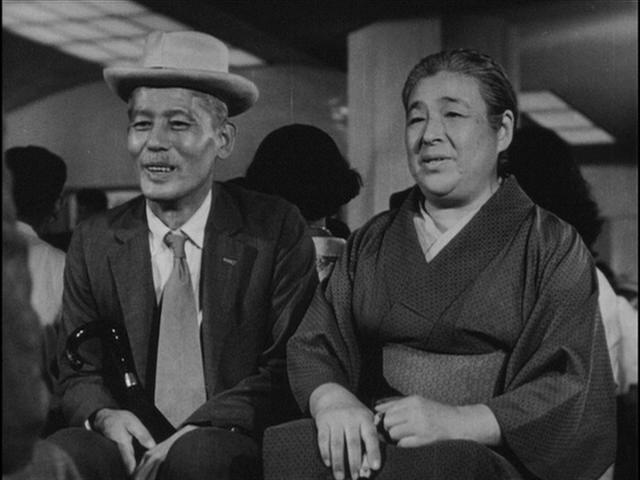

Shukishi and Tomi Hirayama's pleasant demeanors mask deep disappointment.

The only one who shows any form of true welcome is their widowed daughter-in-law, Noriko. Through the Hirayama's interactions with her and a few of their older friends, we see that the old couple is coming to grips with the reality that they are no longer a part of their children's lives. After several days of being shuffled between houses, the parents decide to cut their trip a bit short and head back to their hometown.

On the train back, however, Tomi takes ill. By the time she and her husband reach home, she is in a coma. The children finally break away from their daily hustles to be with their mother on her death bed. After she passes away, three of the five callously rush to get back to their lives in Tokyo. The two who remain with their father, the widow Noriko and the bachelorette Kyoko, share a sad moment realizing that they both may likely become just as detached from their father as their siblings have, should they start their own families some day.


The surviving Hirayamas make their final farewells & realizations

Take 1: My Gut Reaction (done after this most recent viewing, before any research)

Oof. Good thing I watched this on a grey, rainy day.

Tokyo Story is about as melancholy as they come, made all the more sad by the sheer reality and fatalism of it, as well as the skill with which the story themes are conveyed.

In the same vein as Umberto D., director Yasujiro Ozu turns his gaze toward a younger generation's attitude towards its forebears. It certainly seems that the Hirayama family is meant to represent the larger Japanese society, one in which the modernizing world has no place for maintaining deep, steady ties with anything or anyone, including one's parents.

The thing is, whereas Umberto D. had a quicker pace, a few lively characters, and a cute dog as some comic relief, Tokyo Story gives it to you raw and is much further-reaching. The former Italian film was really about an isolated loner, but Tokyo Story is about a very average family, making it far easier to feel empathy towards the characters. The dialogue and acting is so naturalistic that it almost feels like a film ethnography. In fact, of all the 40 films I've seen so far, this one has the most naturalistic acting. This is what gives it its power, especially to one as myself – a person whose parents are still alive and nearing the age of the Hirayamas. It was impossible for me to not get reflective about so many of the things the elder couple brings to light: their mild disappointment in their children, their sense of loss at their detachment from them, and their sad acceptance that nothing is to be done about it.

Here's a great moment in which Shukishi is at his most unguarded about his children. This is also a scene that reminds me an awful lot of my own time in Japan. A little too much sake in the system, coming down over a steaming bowl of ramen. Start it at time 4:40:


The pace of this movie is something quite novel, relative to the other films from the list that I've watched thus far. I'm sure some people would have a hard time sitting through the measured, quiet moments depicting everyday life. As far as I was concerned, it did get a bit tedious, but I completely understand that this is necessary and intentional. Actually, by the end I found Shukishi and Tomi's slow, almost catatonic speech soothing and very much in keeping with what they were meant to represent: a more carefully, cautiously paced generation that was being left behind in the rapidly booming 1950s.

Part of my interest in this film certainly comes from the fact that I lived and worked in Japan for two years. Very much in evidence is the famed Japanese formality and ostensible kindness, which is a theme that Ozu later explored with his film Good Morning. Most Westerners may find alien the almost mannequin-like smiles that Shukishi and Tomi wear throughout nearly the entire film, despite their growing sadness. This is what makes the few moments that they break the formality all the more potent, if not very dramatic. Were anyone I know to ask what Japanese culture is like, I could show nearly any 10-minute clip from this 57-year old movie and feel confident that it stands as a solid representative of Japanese behavior and culture. One of the several very “Japanese” moments that stood out was an exchange between Noriko and Kyoko, when the latter says, “Isn't life disappointing?” to which a calmly smiling Noriko replies, “Yes.”

As alluded to, the technical merits of the film are beyond reproach, in my opinion. It may not have been the most challenging movie to film, or the most taxing on its actors, but everything is done to perfection. Long shots convey isolation, interior shots give the sense of relative claustrophobia inside the family houses, and it's not hard to buy into the Hirayama family as thoroughly authentic.

All of these accolades aside, this is another movie that I very likely will not see again, and would only recommend with several caveats. A person must be ready for a 2-hour, 15-minute gaze into the very real but very subtle generational tensions of a Japanese family. If this doesn't sound overly entertaining, it's because it isn't. Watching this movie is an exercise of a different sort. It's one that is probably worth making at least once, but not one that's guaranteed to touch everyone.

Take 2: Why Film Geeks Love This Movie (done after further research)

One doesn't have to do much research to confirm just why Tokyo Story has a place in film history: it's that rare and classic thing that does so much in reality while seemingly doing very little. All that's needed is the viewer's careful attention and patience.

In more detail and with more erudition than I could muster, David Bordwell's analysis carefully points out just how subtle Ozu is with his lack of camera motion and his refusal to cut away from a character while they speak. Roger Ebert covers the same ground, perhaps more thoroughly in this review. What both men point to is both just how Japanese the story is, while being equally accessible to any viewer with a marginally open mind.

In reading the essays echoing the theme of a slower, older generation (aren't all younger generations “faster” these days?), I almost can't help but wonder if Tokyo Story is the very thing that it speaks of. In an age when generation gaps and attention spans seem to be shrinking astronomically, will a slow and careful look at such gaps, which is what Tokyo Story truly is, eventually be dismissed and pushed to the side?

Here's a thoughtful clip of the very end of the movie, with the new widower, Shukishi, slowly absorbing his isolation with the same measured calm as everything else. Being at time 8:20:


That's a wrap. 40 shows down. 65 to go.

Coming Soon: On the Waterfront (1954)


“I could'a been somebody! I could'a been a contendah!!” One of the few films on the list that I've already seen and absolutely love. I can't wait to watch old Terry Malloy do his thing on the docks again. Come on back and see how I feel about my latest viewing of an irrefutable classic.

Please be sure to pick up all empties on the way out.

Tuesday, June 8, 2010

Film #30: It's a Wonderful Life (1947)


Director: Frank Capra

Initial Release Country: United States

Times Previously Seen: none (though I'd seen the last 30 minutes about 4 times)

20-Words-or-Fewer Summary (no spoilers):

All-American, self-sacrificing nice guy gets in a serious jam, contemplates offing himself, then gets help from an angel.

Uncut Summary (a full blow-by-blow, spoilers included. Fair warning.):

In the quaint American town of Bedford Falls, George Bailey grows up. From childhood, he proves to be exceptionally kind and selfless. At age 12, George saves his little brother, Harry, from drowning in a frozen pond. At age 15, he prevents his pharmacist boss from making a fatal error with his drug mixing. These actions, while wonderfully admirable, are the easiest of George's altruistic feats.

Here's George at 20, showing just how far he's going to be from sanity in one hour, movie time.

At 20, just as he prepares to travel the world before going to college, George (Jimmy Stewart) is called upon to take over his uncle and father's savings and loan business. There's really no money in it, and it stymies George's life-long dream of exploring the globe; however, he feels obligated to keep the local Scrooge, Mr. Potter, from getting his greedy fingers on the business. George sucks it up and takes the position, agreeing to hold down the fort until his younger brother returns from college in four years' time.

Four years later, a newly-married Harry returns from college. Surprisingly (or not), Harry has an opportunity to take a promising job with his father-in-law's company. The ever-generous George gives his brother a pass and decides to stick with the job. On the plus side, he realizes his love for beautiful girl-next-door, Mary (Donna Reed). Just after they get married, the town forces Harry to make another sacrifice. There's a serious bank run and the newlyweds have to use their travel money to support the savings and loan's depositors.

Over the course of the next fifteen years or so, the Great Depression comes and goes, as does World War II. Many of George's friends and his brother have seen the world and made plenty of money. In the meantime, George has remained in Bedford Falls with Mary. They have very little money, but they have four children and a lovely house that Mary has slowly renovated over the years.

And then, on Christmas Eve, disaster strikes. As a government loan officer shows up to see the books at Bailey Savings and Loan, Uncle Billy misplaces $8,000, which falls into the hands of the still-stodgy Mr. Potter. When the disappearance is revealed to George, he soon grows desperate. Desperation eventually turns to panic, and panic to mania. After pleading with an unsympathetic Potter for a loan, George decides to kill himself, hoping that his life insurance policy will pay for the missing cash. He staggers to the town bridge...

Watching from, literally, on high the entire time have been the heavenly host. The angels have heard the prayers of George's concerned friends and family and decide to help. They send Angel, Second Class Clarence Oddbody (Henry Travers). Clarence keeps George from ending himself and even grants him his transitory dark wish: that he'd never been born.

Initially writing off Clarence as some random kook, George returns to town to face the music. Little does he realize that Clarence has not been joking. As he traverses Bedford Falls, George confronts the reality of the town had he never existed: Potter has turned it into a commercialized den of iniquity, loaded with bars, cabarets, and desperate people. Most the George's friends and family are either in dire straits or dead. George refuses to accept this warped reality and slowly loses his mind, only barely grasping the positive influence that he has had on the many lives in the town. Mentally and emotionally shattered, he returns to the bridge.
While a devastated George nearly hits bottom, the angel Clarence returns reality right-side-up. George soon realizes that his friends and family are back to those he always knew. Despite the still-present financial trouble, he is overjoyed to return to this familiar reality and sprints through the town, filled with Christmas cheer.

George returns to his home to find his four children, but also the local police, who are waiting to arrest him for the absent $8,000. While George is far less concerned about this than before, it soon ceases to be a problem: Mary returns with all of George's friends in the town, all of whom have decided to pitch in a help George out of his fix. George is redeemed, the Savings and Loan in saved, and everyone has a merry Christmas.

Hip-Hip...Hooray!!

Take 1: My Gut Reaction (done after one viewing, before any further research):

I might just be a very sick and disturbed person. The things I like about this film may classify me as some kind of psychotic.

By nearly any account, It's a Wonderful Life is an American Christmas classic. It clearly follows in the tradition of Dickens's A Christmas Carol, and has been referenced and imitated endless times in the decades since the 1940s. We all know how many times it gets shown during the holiday season, and this speaks to its enduring place in our U.S. culture. It's a 20th century fable that has stood the test of time remarkably well.

I really don't like most of it. Most of it, mind you.

I chalk the things I don't like up the temporal context. It's a Wonderful Life was released on December 20th, 1946. World War II had ended, optimism was high the United States, and the entertainment machine was just starting to tap into the nascent "American Dream" that would mold popular film and TV culture for roughly the next thirty years. It's a Wonderful Life was one of the first films to get the formula down correctly: the all-American town; the idyllic, romantic home; the beautiful, dutiful wife; the four adorable kids; and the hard-working, self-sacrificing husband. Movies and TV shows would keep churning out this cookie-cutter again and again.

This is mainly what I don't like about this movie. While the film is not devoid of some characters with true depth, most of the Bedford Fallsians are very one-dimensional. Mr. Potter as the local Mammon is greed and evil incarnate. Uncle Billy is a bumbling boob. Martini is an almost offensive caricature of Italian Americans, complete with a gaggle of kids, an outrageous accent, and an affable dimness. In fact, nearly all of the town reminded me of the Saint Louis portrayed in Meet Me in St. Louis - a lot of hokey lines and flashy stereotypes, very little substance.

Here's the first 10 minutes or so from the film. Just pick any random 2 minutes from it and you'll see just how far off of the "Gee-Shucks"-o-Meter this first half or so of this film is:


This leads me to the moments I like in the film, and I can sum it up in one idea: when George Bailey starts to go batshit. The viewer can sense it building throughout the film's first hour-and-a-half (the much more familiar Christmas scenes only make up the last 30 minutes of the movie) - after every sacrifice made as an adult, you can see some small piece of George get crushed into a little ball and tossed into some dark corner of his soul. Well, after the money gets lost and George is facing jail time, he loses it, and he steadily devolves into a near-madman. And I all but revelled in every moment of it.

Hear me out. It should be obvious that I disliked the setting of Bedford Falls. The cheese factor is off the charts, and my feelings about the characters should be clear. The only grounding force is George Bailey (and, before he dies, George's father). As I saw George's dreams get suppressed by the stiflingly simple-minded townies and the cartoonishly evil Mr. Potter, I totally empathized with George, though I think my feelings different than those that Frank Capra intended. While I think he meant for the viewer to pull for George to snap out of his doldrums and realize the gifts around him, I was actually rooting for George to crack some skulls. It was how I would have felt had someone dropped me into the set of Meet Me in St. Louis - that I was stuck in some twisted, nightmarishly Disneyfied version of the American dream.

And so, as George began to rant, rave and rage against the trappings of Bedford Falls, I wanted him to succeed. Or at least to escape. He obviously feels the same at the darkest moment of the film - when he stands on the bridge and contemplates jumping. I certainly wasn't hoping for that, but I surely understood it.

Here's a great moment after the money disappears and George's frenzy begins. It's exactly the way any real human would act if he found himself amongst a gaggle of half-baked, fictional goobers. Probably most disturbing is from time 2:00 to about 5:00:


Somebody get that man a case of Southern Comfort, fer chissakes!

The latter 30 minutes were odd to see again. The truth is, I always thought that I had seen this film. I came to learn, though, that I had really only seen the last 30 of this 132-minute long tale. The well-known ending is really just adapted (ripped off?) from A Christmas Carol - instead of visiting past, present, and future realities as Ebenezer Scrooge does, though, George gets to see a world in which he never existed. Once this final portion of the film is set up in its initial 5 minutes, the remaining 25 belabor the point. I must concede, however, that this is from the perspective of 34-year-old who has grown up with science fiction, alternate reality, and time-jumping tales having already gone far beyond novel.

Despite my thinking that It's A Wonderful Life is overlong and devoid of any real teeth, there are some things to like. Jimmy Stewart is very good, though he is at his Jimmy Stewartest - clever, goofy, lovable, and gosh-darn-it, just a heckuva fella! While his performance as George Bailey has a dark element, I prefer his turns in The Shop Around the Corner, Rope and Vertigo. Donna Reed is also quite good, though her character is not totally fleshed out. She's certainly more vivid than almost everyone else in Bedford Falls, but there's still something a bit lacking.

And now, my greatest shame.

I truly did get choked up at the end. Not at the stupid "Every time a bell rings...." blah-blah-blah quote (by the way - that kid was teeth-grittingly annoying). No, the throat actually tightened when George finds that he has been left Clarence the angel's copy of Tom Sawyer, in which is inscribed "Remember that no man is a failure who has friends." That one got me. It's the same way I felt at the end of City Lights. Now, Frank Capra can join Charlie Chaplin on the short list of filmmakers of sappy movies that still squeezed a few tears from me.

Jerks.

Take 2: Why Film Geeks Love This Movie (done after further research):

It's a Wonderful Life is such a quintessentially American film that I could spend months researching critics' raves and gushing praise. Instead of all that, I picked the titan of the industry: Roger Ebert. I really like a lot of Ebert's reviews since he judges films based on what they were trying to do, not necessarily on how they stack up to other films.

Roger loves this old Frank Capra classic for reasons that I think most fans like it: the simple charm of a moral tale told in a cozy town, featuring affable characters. I have to disagree with Roger on a few points, though. While he finds the admittedly slapstick humor in the earlier segments of the movie charming (falling into a swimming pool, George Bailey talking to a naked Mary hiding in a bush), I found them tedious. Ebert even uses the word "corny" to describe a few of the scenes, but he does so with acceptance and warmth. Not me.

Ebert's synopsis is worth reading for the little history lesson it gives, as well. It's a Wonderful Life, while considered a very good film upon it's release (here's TIME's glowing review back in 1946), it shortly after went to sleep. It went to sleep for about three decades and was all but forgotten.

Then, it became public domain. This meant that any television station that could get its hands on the film could show it without cost. And so, guess what got shown over and over and over during Christmas time? You got it. Hence, a Christmas movie tradition was born, though I feel like it's lost some steam in recent decades, most notably to A Christmas Story.

Richard Corliss actually puts it all very succinctly here. He's absolutely right that this film is hard to see with fresh eyes, and I agree that everyone should try it if they haven't in a while. While I may not rush back to see this film again, I have to say that it's certainly not bad, and I never felt like it was wasting my time. Once the next snow falls for you, give this one a try - I all but guarantee that you won't hate it, and I suspect many of you will actually like it more than you expect.

That's a Christmas wrap (yuk yuk). 30 shows down, 75 to go.

Coming (Very!) Soon: Out of the Past (1947):


Shady dames, quiet tough guys, and lots and lots of shadows. Yup! It's more noir!! That's what I'm talkin' about, ya mug.

Please be sure to pick up all empties on the way out.