Showing posts with label Gary Oldman. Show all posts

Tuesday, February 13, 2018

New Release! Darkest Hour (2017)

Director: Joe Wright

A very solid dramatization of a key two weeks in the history of Britain and the world, although one that I found a bit slow and perhaps geared more towards Anglophiles.

The movie covers the historically important two-week period in early 1940 when England is on the brink of being defeated by the Nazis. Back on its heels, the English Parliament has booted Prime Minister Neville Chamberlain out of office and elected controversial figure Winston Churchill (Gary Oldman) to the position. With the fate of his country in the balance, the pugnacious and oft-divisive Churchill is forced to marshal enough support from the quixotic Parliament to enact his plans. The real crux comes with the Dunkirk dilemma, when the entire British ground army of 300,000 men is stranded on the Belgian beach with no obvious escape from the rapidly-approaching German forces. Churchill must decide whether to surrender to the Nazis and prevent potentially further loss of life or to refuse and resist Hitler's demands at the possible cost of hundreds of thousands of soldiers' lives.

I found this movie similar to other well-made historical dramas. High quality work, though one that simply made me more interested in a well-done documentary or even book on the same subject. I am far from an expert of that time period in British history, but I knew enough about Churchill in general and the state of World War II at the time to know the basic outcome of the story. I also knew enough to not see anything overly revelatory about Churchill, the British Parliament, and even the British people. And this is the one thing that I wish to gain from any piece of history, be is dramatization or documentary - the revelation of new facts and overlooked, important pieces to the overall puzzle. I honestly can't say that Darkest Hour gave me enough of these things to feel completely satisfying.

That said, the movie is done exceptionally well. Unsurprisingly, Gary Oldman is phenomenal as Winston Churchill, and the rest of the cast is as first-rate as one would expect from such an accomplished group of professional British actors. I was particularly impressed with Australian genius Ben Mendelsohn's turn as King George VI. Beyond the acting, the other technical aspects of the movie are top-notch, with the costumes and set designs offering a cohesively dark and shadowy version of 1940 London. There is also some creative cinematography, including a few well-placed "bird's eye" shots, looking down on the denizens below and panning down or up, depending on the scene's requirements. These offered some welcome visual dynamism in what is often a very literally dark film, filled with shadows and the blacks, browns, and grey tweeds associated with London's buildings and its people's fashions.

The meant-to-be-rousing, climactic "subway scene." This is
when a doubtful Churchill finds support among the commoners
through uplifting exchanges. It never really happened.
This was easily one of the most "British" movies I've seen in some time. Obviously, the subject matter makes it such, but it goes a bit beyond simply taking place in England and focusing on one of that country's most famous people of the last 100 years. Darkest Hour is also packed with figures who embody some of the most "English" mannerisms, with plenty of stuffy aristocrats and royalty hemming and hawing about, hands openly clutching their jacket lapels as a show of displeasure at the rather uncouth Winston Churchill (though his brand of "uncouth" is rather tame by most modern standards). And nearly all the women in the picture are rather typically prim and proper types, sporting stiff backs and polished accents.

Then there's the climactic "subway ride" scene towards the end, which a bit of research has told me was completely fictional. In this scene, a tortured Churchill condescends to ride the subway and do an informal poll of "real" Londoners about the possibility of surrender. As one can imagine, the entire car responds in the universal and rousing negative, which the films presents as the final push that Churchill needs to refuse the Nazis demands that he and Britain surrender. This is clearly meant to be this movie's William Wallace, Braveheart "Freedom!" moment. In other words, crowd-pleasing propaganda which makes up an entire sequence and is suggesting that it might be factual. Such sneakiness bothers me, especially when it is as heavy-handed as the subway scene was here.

This movie is likely to end up in the same place as 2010's The King's Speech - a well-made, well-acted British historical drama that garners plenty of well-earned praise in its year of release, but ultimately one which will be relatively forgotten within a few years. Worth seeing, but not necessarily one which will be repeatedly studied or enjoyed upon multiple viewings.

In terms of its chances at Best Picture, I would be absolutely stunned if it won. Several other contenders were more daring, if not as refined as Darkest Hour. 

Sunday, April 9, 2017

The Harry Potter Series, Part 1: Sorcerer's Stone through Goblet of Fire

A few weeks ago, having fallen ill for about four days straight, I felt the urge to watch something that was entertaining, comforting, and didn't strain my foggy brain. Upon realizing that I had actually never seen the final film in the Harry Potter series, and I had my answer. I had seen all of the first seven movies, but not since they had originally been released in theaters.

I'm not going to go into the minutiae of the various plot points that run through the 7-novel/8-movie tale. I'll keep things rather short, assuming that most people already know the basics or would rather just watch the movies for themselves. Here's how I found them upon this rewatch:

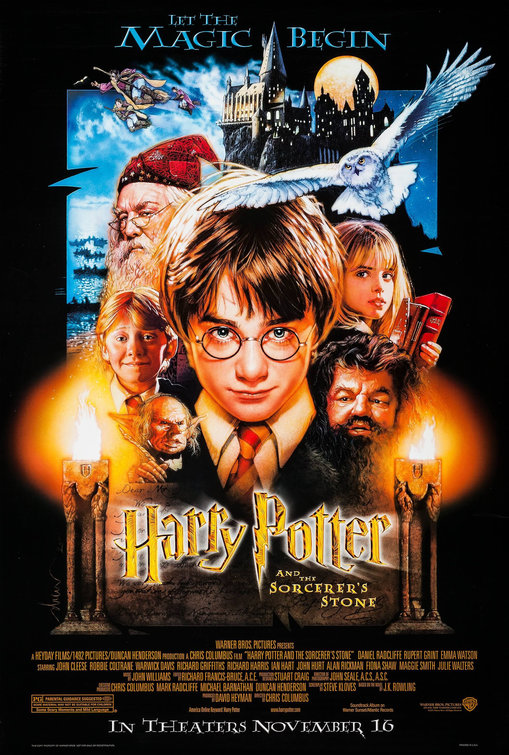
Harry Potter and the Sorcerer's Stone (2001)

Director: Christopher Columbus

In this first movie, we meet Harry Potter, a mistreated orphan boy who is informed that not only is there a secret world of magic and wizards, but that he is a rather special young man who is destined for great things within this wondrous landscape. He is brought to Hogwart's School of Wizardry, where he befriends Hermione Granger and Ronald Weasley. The three eventually foil a plot by one of the school's teachers to help revive Voldemort, the presumed-dead evil wizard who killed Harry's parents 12 years prior.

Still an entertaining and faithful-to-a-fault adaptation that hasn't aged particularly well, The Sorcerer's Stone introduced all who hadn't read the books to the world of Harry Potter and the witches, wizards, and other dazzling elements around it. There are certainly clumsy elements to the story, and the three primary child actors had not really found their footing as performers. The special effects also haven't held up very well, with the CGI now looking rather garish and clunky. Director Christopher Columbus goes for fairly broad dialogue and comedy, as he's done in his other movies, which doesn't serve us older viewers terribly well.

All the same, the world that author J.K. Rowling created is still a lot of fun, and it provides enough wonder as it is revealed to us, even if the pacing is overly brisk. The plot also features enough amusing turns to keep things lively, and the adult actors are all absolutely perfect, as it's difficult to go wrong with actors the caliber of Maggie Smith, Alan Rickman, and the like. The movie isn't flawless, but it is a solid enough beginning to this movie franchise juggernaut. 


Harry Potter and the Chamber of Secrets (2002)

Director: Christopher Columbus

Chapter two of the Potter series sees Harry return to Hogwarts and become embroiled in another mystery - this one involving various students turning up literally petrified around the campus. As Harry digs deeper, he learns a little more about his own history as well as the history of Voldemort, with whom he seems to be inexplicably linked.

Although still containing a few of the weaknesses of the first film, this second entry made some marked improvements. Main child actors Watson, Radcliffe, and Grint show a little more comfort with their roles and acting chops, even if they're not completely natural yet. Also helping matters is that the already-considerable adult cast is assisted by the inclusion of other top-notch actors like Kenneth Brannagh and Jason Isaacs. The effects are noticeably better, although the Quidditch match CGI still looks too artificially glossy and awkward.

As with the source novels, the tone and sophistication increases ever-so-slightly. This second volume features higher stakes, involving a bit more menace and some intriguing insight into the still-mysterious arch-villain Voldemort. The little plot turns reveal more clever updates of familiar myths and fairy tale elements. 

Harry Potter and the Prisoner of Azkaban (2003)

Director: Alfonso Cuaron

This film sees a 13-year-old Harry in his third year at Hogwart's dealing with the presence of the ghastly Dementors as they hover around the school on the lookout for an escaped wizard convict. The convict, Sirius Black, has some sort of tie to Harry's dead parents, and strange and dangerous events start to unfold around the school.

I always remember this third film in the series as the strongest one, and this repeat viewing didn't diminish that opinion. Directed by highly accomplished director Alfonso Cuaron, Azkaban almost immediately offers a darker look and tone, quickly introducing the horrific Dementors, grim reaper-like beings which siphon the happiness away from those unfortunate enough to go to near. These terrible creatures are a serious part of a grimmer chapter in the Potter series, one which sees the inclusion of great British actors like Gary Oldman, Emma Thompson, and a few others. 

Other improvements over the previous chapters include dialogue which is less clumsy and an overall reduction of sentimentality. The plot, still highly faithful to Rowling's novel, also shows a bit more care with its details. Of course, a savvy and mature fan of science fiction and fantasy tales can pick many details apart, but if one keeps in mind that this is a family movie, then it clearly stands superior to its passable predecessors.

Harry Potter and the Goblet of Fire (2005)

Director: Mike Newell

The fourth movie in the series gets into the action more quickly than the previous installments, soon getting to the titular and lethal "Goblet of Fire" tournament in which Harry unwillingly becomes a competitor. Now 14 years old, Harry is dealing with not only the stresses of the tournament but also questions about romance and friendship. These latter life elements eventually take a back seat, though, as Harry ultimately comes face-to-face with Voldemort himself. 

Goblet of Fire is something of a blend of the strengths and weaknesses of the previous three movies. It generally overcomes some sappier elements in its first two acts with some deadly serious consequences and repercussions in its third act. While some of the first two-third of the movie is given over to teenage angst, the final act makes it clear that play time is over. Over in a way that includes a full-on murder right in front of Harry's face. Not exactly the stuff of kiddie movies, which is quite welcome to any of us viewers past puberty. 

The three primary characters of Harry, Ron, and Hermione are now acting as moody as nearly all 14 year-olds. The interpersonal drama can be a bit tedious at times, but it does create a deeper sense of character. Even if the sappier parts of the drama become a tad thick, they are dispatched in the final part of the movie, when the long-teased nemesis Voldemort finally makes his first true, full appearance. He brings with him the sense of terror that's been building through the previous three films, to be sure, and it sets up the rest of the series extremely well.

So the first half of this eight-film series was solid enough, although the earliest movies haven't aged as well. Fortunately, the general trend was that the quality improved, which boded well as I headed into movies five through eight (review coming in a couple of days).

Sunday, April 10, 2016

Retro Trio: Bridget Jones's Diary (2001); Kung Fu Panda 2 (2011); First Blood (1982)

Bridget Jones's Diary (2001)

Director: Sharon MaGuire

One of the stronger, more accessible rom coms that I've seen, if not exactly a movie that I'll put on my all-time favorites list.

The title character (Renee Zellweger) is a hard-drinking, chain-smoking, unlucky-in-love, 30-something bachelorette who works at a publishing company. She makes a resolution to cut down on her vices and make every effort to find a decent man. Unfortunately, she soon falls for Daniel Cleaver (Hugh Grant), a handsome, funny, womanizing rogue who is a manager at her company. Bridget engages in a fun, sexually satisfying affair with Cleaver, though she does remain curious about another man on the periphery of her life, Marc Darcy (Colin Firth). Darcy is a much dryer, serious lawyer whom Bridget knows through family friends. Bridget's feelings become even more confused when more details emerge about Cleaver's past friendship with Darcy, and the former's unwillingness to fully commit to Bridget.

This is a more singular rom com, as its protagonist is unusually degenerative. Jones's loneliness is fairly standard fare for the rom com genre, but her humorously chronic attempts to drown her sadness with booze and cigarettes make her much more accessible than similar, more poised and innocent protagonists. She is a nervous type who has "diarrhea of the mouth," which results in her embarrassing herself more than any other person possibly could. It all makes for solid comedy.

The two most appealing aspects of the movie are the acting and the adult nature of it. I can appreciate the foul-mouthed exchanges, mostly between Bridget and Cleaver, which make the characters more enjoyably earthy. The actors are all perfect in their roles, with Hugh Grant especially standing out as the attractively hedonistic and sleazy Cleaver. Colin Firth plays the stuffy Darcy masterfully, and these two polar opposites offer plenty of opportunity for Renee Zellweger to show off her comedy acting chops.

My viewing partner for this one was my wife, who has seen the movie more times that she can count. It was nice to be informed that the movie, just as the source novel, drew from Jane Austen's classic Pride and Prejudice (I suppose Colin Firth playing a character named Darcy should have given it away). I can appreciate such updates, and it gives the tale some welcome intelligence and literary heft.

While the Bridget Jones character may come off as an incompetant clown a little more than her creator, author Helen Fielding, might have liked (my wife assures me that this is the case), it hardly spoils anything in a light-hearted film like this one. This is never going to be a movie that I'll go out of my way to watch, but I'll be happy to put it into the holiday rotation to see every year or two.


Don't lie - you know you enjoy the cuteness.
Kung Fu Panda 2 (2011)

Director: Jennifer Yuh

A fun enough sequel, though not as enjoyable as the original (which I reviewed here).

The tale picks up some time after the first movie. Po (voiced by Jack Black) is now a legitimate kung-fu master, working with the Furious Five, defending locals from evil-doers. Not far away, the exiled son of a powerful family - Shen (Gary Oldman) - plots to return and overthrow the country. Shen also has an obsession with avoiding a prophecy which states that a black and white warrior will utterly defeat him. This is about all there is to the main story, which is far less interesting than the story of Tai Lien in the first movie.

The other story elements include learning much more about Po's past, and it also follows Po's quest to further master kung fu by "embracing inner peace," as his master Shifu puts it. These parts to the story are fine, but the tale isn't quite as engaging as the previous movie. This is the general theme of every aspect of this sequel: decent enough, but a weaker version of the original.

From the dialogue to the visual action, all aspect of this movie are slightly less clever or entertaining versions of the themes and gags set up in the first movie. Plenty of the lines are funny, but not quite as funny. Some of the action is a visual treat, but not as much of a treat as the original, as this movie relies more on overly long fighting sequences. You get the picture.

Unlike the first movie, which was a complete story in and of itself, this second movie clearly had an eye on an assumed third film. Panda 2 plants seeds the for a plot which will obviously bear fruit in the next film (released earlier this year, in fact). This is fine, but it leaves more dangling plot threads by its end, which can make for a slightly less satisfying narrative.

This is still a good series, and I'll check out the third film. I do hope, though, that it can be a little more like the original.


First Blood (1982)

Director: Ted Kotcheff

Somehow, some way, I had never watched First Blood at any point in my meat-eating, suburban-living, red-blooded, all-American Gen-X'er male life. I finally decided to fill in this glaring blank on my dance card of '80s tough guy movies, and it was well worth it.

Based on a short novel of the same name, First Blood follows several brutal days in the post-war life of Vietnam veteran John Rambo. Rambo is a drifter of sorts, and he wanders into a small town in Michigan after finding out that one of his platoon buddies had died from complications of exposure to Agent Orange. In the town, the local police officers try to bully the somewhat ragged-looking Rambo out of town. The quiet veteran, however, civilly refuses. He is then promptly put in jail.

In the jail, while being physically abused, Rambo suffers a severe PTSD flashback and lashes out, badly beating several police officers and escaping into the nearby woods. Over the next few days, the police refuse to back down, hounding Rambo to the point that he accidentally kills one of them in self-defense. The situation escalates to the point that more troops arrive, along with Rambo's former commanding officer, Colonel Troutman. It becomes clear that Rambo was not only a war hero but also one of the fiercest and most capable soldiers he had ever trained. What unfolds is a showdown between an ignorant local law enforcement team and a man who has been trained into a lethal killer but who also suffers from untreated psychological trauma.

It's easy to see why this movie obtained such respected status. Yes, it is a survival story and a case of one-versus-many, which both have a certain macho appeal. On these fronts, the movie still hits its marks. Beyond this, though, the movie taps into some very dark psychological territory that standard action movies were rarely exploring in the early 1980s. Rambo is presented as a tragic figure, rather than simply as the "wrong man to mess with" which so many imitation characters tried to emulate.

Some of of the scenes and sequences are a bit overlong, and a few points are belabored a bit much. Still, this was a really good movie that I wish I had seen long ago. It does further beg the question, too, of what if Sylvester Stallone had managed to keep his narcissism and ego in better check? The guy was in some outstanding movies early in his career, with First Blood being of particular note. If he had aspired a little more towards artistic integrity over fame and cash, he probably could have many, many more excellent movies on his resume, and far fewer movies like Rambo III, Cobra, and Rocky 5.

Monday, January 4, 2016

Gangster Flick 3-Pack: Let Him Have It (1991); Layer Cake (2004); State of Grace (1990)

Let Him Have It (1991)

Director: Peter Medak

A harrowing drama about one of the most personal tragedies in criminal and judicial history.

Let Him Have It is a documdrama about the life of Derek Bentley, a mentally inferior young man who, in London of 1953, falls in with the wrong people and pays the ultimate price. Derek is a young, impressionable 19-year-old who is lured into a small gang of wanna-be criminals made up of boys still in secondary school. The leader is Chris Craig, an especially loud-mouthed lad who works hard to look and sound like the crooks glamorized in Hollywood gangster movies. He and three of his cohorts walk around town dressed in dark trenchcoats and black fedoras, trying as hard as possible to imitate Chris's authentically criminal older brother. Derek, an otherwise gentle soul, is taken in by the strong attitude and image of Chris's gang, and he begins to sneak away from his parents' home to hang out with them.

On the most fateful of nights, Derek finds himself on a warehouse rooftop with Chris, both of them playfully looking for a way to break in. The police arrive, however, and when one of them apprehends Derek, Chris pulls a gun. As the police officer demands that Chris turn over the weapon, a frightened Derek calls out "Let him have it, Chris," which Chris misunderstands as a prompt to shoot the officer. A firefight and standoff ensue, ending with Chris injured from a long fall, one officer wounded, and another dead by Chris's hand. The real tragedy begins when Derek and Chris are brought to court, where the penalty for their crimes is execution.

The movie is a strong one, and the tragedy of the situation is palpable. Thanks to very strong acting and pacing, what could have been a depressing slog is actually a sad but compelling account. Very much in the vein of Kieslowski's 1990 film Decalogue Five: Thou Shalt Not Kill and the 1995 movie Dead Man Walking, with their the juxtaposition of illegal murder with legal execution, Let Him Have It forces viewers to think long and hard about capital punishment.

As with any film which depicts a tragedy which happened in reality, the dramatization offers a buffer which a documentary would not. However, for cases which happened longer in past, such as this one, I feel that a well-crafted and respectful docudrama is the closest we can get to truly feeling the loss the the Bentley family did at the end of this affair. Let Him Have It is not a movie which needs to be seen more than once, but once is all but mandatory.

Layer Cake (2004)

Director: Matthew Vaughn

An entertaining British gangster flick, adding depth to the Guy Ritchie brand of films which preceded and obviously influenced it.

Layer Cake tells the story of a highly intelligent, never-named drug dealer (Daniel Craig) who is on the cusp of sealing a final "big deal" in London which will allow him to retire from the sordid, dangerous world of crime. As such stories go, though, things get extremely complicated, extremely quickly.

Up to the point of the tale's beginning, "Mr. X" has been expert at keeping his head down and remaining under the radar of more powerful or more volatile criminals in his industry. However, once the wrinkles start to pop up, X must navigate lethally treacherous waters infested with British gang lords, headstrong power-grabbers, and his own conscience. Following the actions and reactions of X certainly makes for a sometimes fun, sometimes harrowing, and often violent tale.

The style and construction of the movie is quite familiar to any who have watched 1998's Lock, Stock, and Two Smoking Barrels or 2000's Snatch, the two seminal modern British gangster movies by Guy Ritchie. There's a dizzying array of shadowy, vicious characters, and more than a little gallows humor sprinkled throughout. Compared to those earlier movies, though, Layer Cake ratchets down the insanity and overt comedy in favor of taut suspense. This is carried through with great performances all around by the brilliant cast, spearheaded by a pre-James Bond Daniel Craig.

One could criticize the movie for borrowing too heavily from Ritchie's hyperspeed style of storytelling (director Matthew Vaughn was, in fact, a producer of Ritchie's films), but this was easy for me to forgive. While there is nothing of great ingenuity here in terms of subject matter or methodology, Layer Cake feels enough like its own movie not to be overly harsh with any critique. It goes deeper into the protagonist's psyche than any Ritchie film ever dared, which prevents it from being a mere clone.

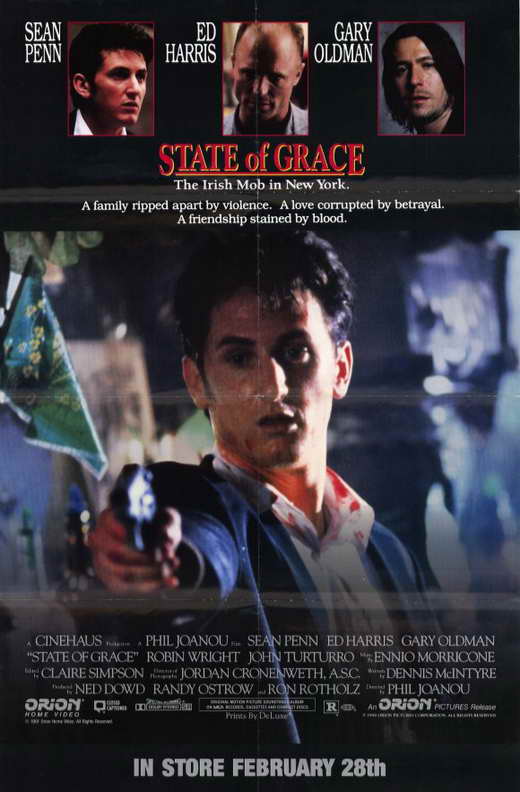
State of Grace (1990)

Director: Phil Joanou

If timing is everything, then State of Grace had nothing going for it from the jump. This is a shame, as it is a great gangster movie.

I had never even heard of this movie before I came across it on a "best gangster films" list. When I saw the cast list, I was further amazed that it was never on my radar. The movie follows young undercover police officer Terry Noonan (Sean Penn), who has returned to his old neighborhood in the Irish section of New York's Hell's Kitchen. Under the guise of a drifter looking to get back into the criminal lifestyle, he reunites with old friend Mickey Flannery (Gary Oldman), and the two soon begin cracking jokes and skulls, alike. Terry's ultimate plan is to obtain incriminating evidence on Mickey's older brother, Frankie (Ed Harris), who has become the boss of the local Irish mob. However, doing the right thing as a cop becomes far more difficult for Terry as he becomes further entrenched in his old environment.

The characters, plot, acting, and general direction of State of Grace are excellent. The drama between Noonan and the Flannerys is organic and tense, with a palpable emotional depth. The story unfolds and intensifies as well as the very best crime dramas. In addition to the great actors mentioned above, several supporting roles are played expertly by great talents like Robin Wright, John C. Reilly, and John Turturro.

At this point, you many be wondering how a high-quality movie, with such an outstanding cast, is not better-known. I wondered the same thing until I discovered that State of Grace was released on September 14, 1990. For those without a photographic memory for film release dates, this is the exact same day that Goodfellas was released. Yikes. When forced to go head-to-head against one of the absolute greatest gangster movies in the history of cinema, anything less than The Godfather would pale in comparison. Such was the fate of State of Grace. It could not have helped that, by this time, Martin Scorsese was well-established as a brilliant director, so that his return to New York crime tales was bound to drown out even an outstanding effort by a relative newcomer like State of Grace director Phil Joanou. No, Joanou's movie is not as great as Goodfellas, but it is one of the best of its kind.

The commercial and historical fate of State of Grace is rather sad. However, I highly recommend the movie to anyone who loves the gangster genre.