Showing posts with label Goodfellas. Show all posts

Tuesday, March 1, 2016

Gangster Flick 3-Pack: Salvatore Giuliano (1960); Things Change (1988); Bugsy (1991)

Salvatore Giuliano (1962)

Director: Francesco Rosi

An interesting but dizzying tale based on real events and told with skill and some creativity.

The titular historical figure is presented as an enigma. Between roughly 1940 and 1950, Giuliano was an outlaw who fought for and against various factions, and often for himself, within a fractured Sicily. Between Italian nationalists, Sicilian separatists, aspiring communists, and the Mafia, Giuliano managed to either placate or keep all potential adversaries at bay. Through kidnapping, murder, effective guerrilla fighting tactics, and a juggling of connections, he evaded capture for an entire decade. In 1950, however, he finally met his fate.

The figure of Giuliano is curious enough, but this movie takes a very interesting approach to telling the story. Instead of presenting a sort of biopic with its infamous subject at its center, director Francesco Rosi keeps the outlaw at the periphery. In fact, aside from a few shots of Giuliano's dead body, we never see his living, breathing face in the movie. Instead, the bandit is used to probe into the social and political forces swirling around the Sicilian countryside, and how they both create, sustain, and ultimately wipe out a person of Giuliano's singular nature. It's an engaging approach which had me constantly trying to piece the puzzle together, with mostly satisfying results.

Admittedly, there are some details that I simply could not keep up with. Rosi seems to have made this movie assuming that many of its viewers would be familiar with Giuliano's story, given his infamy and the fact that his life played out only twelve years before the movie's release. Perhaps to an Italian, European, or even a some American viewers in the 1960s, the endless stream of names and factions was easier to keep straight, but such was not the case for me. This chaotic narrative structure was frustrating at times, but never so much that I lost the general thread of the tale.

The cast was apparently mostly stocked with Sicilian locals, which is always a double-edged sword. You get plenty of characters who are the genuine article, in terms of appearance, but they are often lacking in acting skills. This can be a bit distracting.

Salvatore Giuliano is a well-made film with some commendable artistry to it. It's certainly worth seeing for fans of Italian cinema and mafia movies. It makes for an interesting compliment and even prequel film to more modern, realistic takes on the subjects such as Gomorrah. I'm not likely to watch it again, though.


Things Change (1988)

Director: David Mamet

Though noticeably lighter than Mamet's other movies, Things Change is yet another of his that I find competent but far from mind-blowing.

The movie centers on two very different New Yorkers: Gino (Don Ameche) and Jerry (Joe Mantegna). Gino is an elderly shoe-shiner who hails from Italy. One day, two mafiosi approach him with a deal: take the rap and spend three years in jail for one of their associates who bears an uncanny resemblance to him, and in return their bosses will pay him handsomely. Gino accepts, and he is given over to the care of Jerry, a mafia soldier who is in the doghouse with his bosses. Jerry, seeing that the kindly and genteel Gino will be spending his next few years in prison, decides to buck his bosses' orders and fly Gino to Lake Tahoe for a good time. Once in Tahoe, however, Gino and Jerry get mixed up with local mafia members and have to dance around being discovered.

The movie is fairly light-hearted, in the way that few mafia or David Mamet movies are. There are plenty of attempts at charming humor, but I found most of them uninteresting, despite sometimes being unexpected. The bond between Gino and Jerry is a bit touching, but it does smack a bit of sentimentality and a lack of natural progression.

I've now seen about a half dozen David Mamet movies, and I am simply not much of a fan. His plots are fine, and he has a keen eye for visuals. However, his dialogue is very often overthought and has a herky-jerky feel that can feel artificial at times. And for whatever reasons, every Mamet-directed movie I've watched features at least one oddly stiff performance by actors. Things Change is no exception.

This movie wasn't a chore to watch, but it's not hard for me to see why it is currently out of print and it is never really mentioned among the best gangster movies of all time, despite solid performances by great actors like Ameche and Mantegna. Hardly a must-see for mafia movie buffs.


Bugsy (1991)

Director: Barry Levinson

A movie that has several impressive things going for it, but ultimately fails to live up to its potential.

Bugsy tells the story of infamous gangster Benjamin "Bugsy" Siegel's final decade of life from 1937 to 1947. The film has three things going for it: some fascinating history of mobsters and Las Vegas, brilliant visuals, and a lot of strong acting. Without these things, the movie would be borderline awful. With them, it all rounds out to be a glamorous but highly messy film.

By all historical accounts, Siegel was a volatile mixture of charm, good looks, and unpredictable violence. Caring less about money than about grand schemes and respect, he thought and lived large. Warren Beatty does a fine job as the iconic gangster, simply oozing confidence and a hair-trigger temper. However, he is often severely let down by an uneven script, which has numerous and odd shifts in tone. Siegel's erratic mood swings rarely feel organic, just as the reactions by those around him are sometimes peculiar if not downright ridiculous. There are also several scenes which perhaps seemed like good ideas on paper but fail in the execution. Having Siegel running around his house in a goofy chef's hat while trying to juggle a child's birthday party and defend himself against his murderous mafia partners is apparently meant to be humorous. Instead, it comes off as odd and a bit tiresome, as do several other scenes. On top of this is that the pacing of the film never seems quite right, with whole months or years zipping by, often with  overly subtle or no time cues to indicate the passage. This plays havoc with the personal relationships, which are a key element to much of the movie's drama.

Despite all of these problems I had with the film, I was fascinated to keep learning a little more about how Siegel was involved in the earliest roots of turning Las Vegas into the Mecca of hedonism and wanton spending that it is today. From the moment we see him and a few friends drive out and see a lone, sad "casino" spark Siegel's ultimate vision, I had to see the movie through to the end. It didn't hurt that the movie is a pleasure to look at, in all respects.

What I had forgotten was just how much praise this movie received back in 1991. It was nominated for ten Oscars, in fact (it only won 2, for Art/Set-Direction and Costume Design). These days, though, it is not even mentioned as being in the same league as all-time great gangster movies, let alone great all-around movies. I am honestly surprised that it received all of that original acclaim, given that it came out a whole year after Goodfellas, which raised the bar so very high for such movies. Bugsy clearly has its merits, but they are equaled by its glaring faults.

Monday, January 4, 2016

Gangster Flick 3-Pack: Let Him Have It (1991); Layer Cake (2004); State of Grace (1990)

Let Him Have It (1991)

Director: Peter Medak

A harrowing drama about one of the most personal tragedies in criminal and judicial history.

Let Him Have It is a documdrama about the life of Derek Bentley, a mentally inferior young man who, in London of 1953, falls in with the wrong people and pays the ultimate price. Derek is a young, impressionable 19-year-old who is lured into a small gang of wanna-be criminals made up of boys still in secondary school. The leader is Chris Craig, an especially loud-mouthed lad who works hard to look and sound like the crooks glamorized in Hollywood gangster movies. He and three of his cohorts walk around town dressed in dark trenchcoats and black fedoras, trying as hard as possible to imitate Chris's authentically criminal older brother. Derek, an otherwise gentle soul, is taken in by the strong attitude and image of Chris's gang, and he begins to sneak away from his parents' home to hang out with them.

On the most fateful of nights, Derek finds himself on a warehouse rooftop with Chris, both of them playfully looking for a way to break in. The police arrive, however, and when one of them apprehends Derek, Chris pulls a gun. As the police officer demands that Chris turn over the weapon, a frightened Derek calls out "Let him have it, Chris," which Chris misunderstands as a prompt to shoot the officer. A firefight and standoff ensue, ending with Chris injured from a long fall, one officer wounded, and another dead by Chris's hand. The real tragedy begins when Derek and Chris are brought to court, where the penalty for their crimes is execution.

The movie is a strong one, and the tragedy of the situation is palpable. Thanks to very strong acting and pacing, what could have been a depressing slog is actually a sad but compelling account. Very much in the vein of Kieslowski's 1990 film Decalogue Five: Thou Shalt Not Kill and the 1995 movie Dead Man Walking, with their the juxtaposition of illegal murder with legal execution, Let Him Have It forces viewers to think long and hard about capital punishment.

As with any film which depicts a tragedy which happened in reality, the dramatization offers a buffer which a documentary would not. However, for cases which happened longer in past, such as this one, I feel that a well-crafted and respectful docudrama is the closest we can get to truly feeling the loss the the Bentley family did at the end of this affair. Let Him Have It is not a movie which needs to be seen more than once, but once is all but mandatory.

Layer Cake (2004)

Director: Matthew Vaughn

An entertaining British gangster flick, adding depth to the Guy Ritchie brand of films which preceded and obviously influenced it.

Layer Cake tells the story of a highly intelligent, never-named drug dealer (Daniel Craig) who is on the cusp of sealing a final "big deal" in London which will allow him to retire from the sordid, dangerous world of crime. As such stories go, though, things get extremely complicated, extremely quickly.

Up to the point of the tale's beginning, "Mr. X" has been expert at keeping his head down and remaining under the radar of more powerful or more volatile criminals in his industry. However, once the wrinkles start to pop up, X must navigate lethally treacherous waters infested with British gang lords, headstrong power-grabbers, and his own conscience. Following the actions and reactions of X certainly makes for a sometimes fun, sometimes harrowing, and often violent tale.

The style and construction of the movie is quite familiar to any who have watched 1998's Lock, Stock, and Two Smoking Barrels or 2000's Snatch, the two seminal modern British gangster movies by Guy Ritchie. There's a dizzying array of shadowy, vicious characters, and more than a little gallows humor sprinkled throughout. Compared to those earlier movies, though, Layer Cake ratchets down the insanity and overt comedy in favor of taut suspense. This is carried through with great performances all around by the brilliant cast, spearheaded by a pre-James Bond Daniel Craig.

One could criticize the movie for borrowing too heavily from Ritchie's hyperspeed style of storytelling (director Matthew Vaughn was, in fact, a producer of Ritchie's films), but this was easy for me to forgive. While there is nothing of great ingenuity here in terms of subject matter or methodology, Layer Cake feels enough like its own movie not to be overly harsh with any critique. It goes deeper into the protagonist's psyche than any Ritchie film ever dared, which prevents it from being a mere clone.

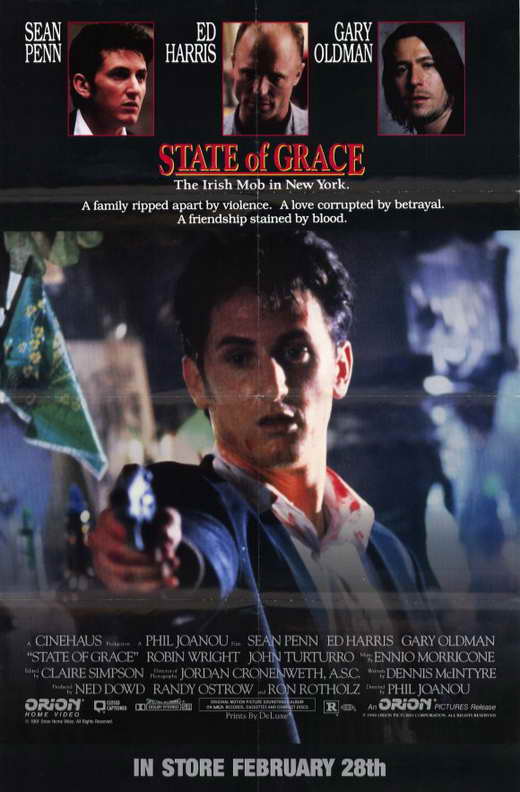
State of Grace (1990)

Director: Phil Joanou

If timing is everything, then State of Grace had nothing going for it from the jump. This is a shame, as it is a great gangster movie.

I had never even heard of this movie before I came across it on a "best gangster films" list. When I saw the cast list, I was further amazed that it was never on my radar. The movie follows young undercover police officer Terry Noonan (Sean Penn), who has returned to his old neighborhood in the Irish section of New York's Hell's Kitchen. Under the guise of a drifter looking to get back into the criminal lifestyle, he reunites with old friend Mickey Flannery (Gary Oldman), and the two soon begin cracking jokes and skulls, alike. Terry's ultimate plan is to obtain incriminating evidence on Mickey's older brother, Frankie (Ed Harris), who has become the boss of the local Irish mob. However, doing the right thing as a cop becomes far more difficult for Terry as he becomes further entrenched in his old environment.

The characters, plot, acting, and general direction of State of Grace are excellent. The drama between Noonan and the Flannerys is organic and tense, with a palpable emotional depth. The story unfolds and intensifies as well as the very best crime dramas. In addition to the great actors mentioned above, several supporting roles are played expertly by great talents like Robin Wright, John C. Reilly, and John Turturro.

At this point, you many be wondering how a high-quality movie, with such an outstanding cast, is not better-known. I wondered the same thing until I discovered that State of Grace was released on September 14, 1990. For those without a photographic memory for film release dates, this is the exact same day that Goodfellas was released. Yikes. When forced to go head-to-head against one of the absolute greatest gangster movies in the history of cinema, anything less than The Godfather would pale in comparison. Such was the fate of State of Grace. It could not have helped that, by this time, Martin Scorsese was well-established as a brilliant director, so that his return to New York crime tales was bound to drown out even an outstanding effort by a relative newcomer like State of Grace director Phil Joanou. No, Joanou's movie is not as great as Goodfellas, but it is one of the best of its kind.

The commercial and historical fate of State of Grace is rather sad. However, I highly recommend the movie to anyone who loves the gangster genre. 

Friday, November 23, 2012

Film #90: Goodfellas (1990)


Director: Martin Scorsese

Initial Release Country: United States

Timed Previously Seen: probably around eight or nine. Maybe more. 

Rapid-Fire Summary

Goodfellas is a rather epic movie, spanning several centuries. I’ll keep my summary short, but if you want many more of the details, you can check out the synopsis here at imdb’s website. Here’s my version:

In the late 1950s in Queens, New York, young teenager Henry Hill has big dreams. He dreams of becoming a gangster, like the fellows that he sees regularly on the streets of his neighborhood. Though his parents completely disapprove, Henry gets more and more involved with the crime circuit in the area – starting with simple errand-running for book-makers, progressing to orchestrated property destruction, and advancing to the sale of stolen goods. The more he gets entrenched in the life of a criminal, the more he feels welcomed by his fellow criminals, and the more normal it all becomes for him.

This normalized life of larceny follows Henry into adult life (played by Ray Liotta), when he regularly partners with two other noted crooks – the thief and hitman, Irishman Jimmy Conway (Robert De Niro) and the volatile yet charismatic Sicilian mobster Tommy DeVito (Joe Pesci). These three, along with many other local hoods, spend the next few decades of their adult lives robbing, and occasionally killing, their way to lives of luxury for themselves, their wives, children, and mistresses. Though their methods of attaining wealth are highly illegal, all of them keep up the appearances of being responsible family men who are “providers” for their friends and families. This is all in keeping with the Italian mafia tenets of organized crime, to which all of these three men pay homage.

Tommy, Henry, and Jimmy taking a look at on of their many stashes of ill-gotten money.

Eventually, however, things start to crumble. Starting in the later 1970s and into the early 1980s, Henry starts to get involved in selling cocaine. Despite clear warnings from the mafia father-figure, Paulie Cicero (Paul Sorvino), Henry continues to sell the highly illegal substance. His mistakes catch up to him, and he is caught by the police. Now facing the very likely prospect that he will be killed by any one of his criminal associates, in order to prevent him from informing on them, Henry and his wife Karen (Lorraine Bracco) decide that their only recourse is to join the witness protection program. Henry testifies against all of his former friends and criminal associates, thus escaping jail time. However, he lives out the rest of his days in a sterilized suburban neighborhood, far removed from the action, money, and excitement of his former life of crime.

My Take on the Film (Done after this most recent viewing)

Goodfellas is an absolute classic, and it may be the only English-language mafia movie that can hold a candle to The Godfather, in terms of scope, technique, and revolutionizing the genre.

I first saw this movie in the theater when my mother brought me to see it. I was only fourteen or fifteen at the time, and I remember the language blowing me away. The characters drop the f-bomb like most people blink, and violence is as normal as getting a haircut. About an hour into the movie, my mother, who grew up in Queens right at the time that this movie’s events were taking place, leans over to me and says “I think I grew up with these guys.” Now, she didn’t mean that she literally grew up with Henry Hill and the gang; she just meant that she grew up with guys eerily like them. She always said that the dialogue and attitudes depicted in Goodfellas were spot-on, in terms of how the guys from those neighborhoods spoke and acted.

This authenticity has been a hallmark of Scorsece’s New York pictures right from the very beginning. While he’s certainly done other excellent movies that are not based in New York (The Departed, Kundun, et al), his street-level stories have always been his signature ones. The verbal exchanges in Goodfellas, like Raging Bull and Taxi Driver, feel completely organic. Despite being so deeply rooted in a particular region, even people who have never been within a thousand miles of Long Island can sense and be hypnotized and amused by it.

Just another night of booze and poker. This is one of the many scenes in which the dialog and interactions between the New York tough guys are at their most realistic. 

But the dialogue is simply one of several triumphs of this movie. If The Godfather was the ultimate American criminal take on a classical Greek tragedy, Goodfellas is the ultimate deconstruction of the gangster myth. Based on the real story of Henry Hill, the movie depicts the ground-level thugs who made the mob go. There are no honorable Vito Corleones here. Henry Hill and his cohorts were unapologetic thieves and murderers who reveled in their power over others. One line that sums them up fairly well is when Henry Hill is describing Jimmy: “The one thing Jimmy loved to do was to steal. I mean, he actually liked it. Jimmy was the kind of guy who rooted for the bad guys in the movies.” These guys knew they were bad, embraced it, and pummeled anyone who had a problem with it.

Tied to this is probably the element that truly sets the movie apart from other classic gangster movies. Through Henry Hill’s life story, we see the complete and utter sham that the “honor” of the mafia is. All of the seeming friendships that Henry makes are only authentic as long as they don’t threaten any of his fellow thieves’ illicit livelihoods. The moment any one of the crew is suspected of threatening others’ freedom and fortunes, that crew member is not long for this world. The camaraderie is revealed as shallow in the face of real adversity, as evidenced by the protagonist himself. After decades of thinking of his criminal associates as family, he turns on them to protect himself and sends them all to prison. Goodfellas may have been the first film to so carefully and stylishly deconstruct the myth of honor among mobster thieves.

Normally, much of the above would make for thoroughly repugnant, unwatchable characters. Yet herein lies one of the most brilliant part of this movie – at times, you forget what they are and get completely caught up with who they are. Whether it’s Tommy cracking up his fellow mobsters with hilarious stories, Jimmy railing against the stupidity of his partners in crime, or Henry trying to juggle his passionately crazy wife and mistresses, it’s simply fun to watch. Most of the time, you laugh at them, but some of the time you actually laugh with them. There are even times when you feel a twinge of sympathy, as when Henry learns that Karen has flushed their bags of cocaine, their only remaining source of revenue, down the toilet, effectively flushing his entire life down the toilet. His desperation and fear are so palpable that you might be tempted to forget, just for a few seconds, that it’s all his selfish own doing.

Karen visits Henry while he serves time. At this point, it almost seems as normal for us the viewers as it does for the troubled couple and their kids.

All of these moments come through in large part due to the acting. While De Niro rightfully got top billing for this movie and did an outstanding job as Jimmy, it was Pesci, Liotta, and the entire ensemble crew that fully rounds out the picture and makes it come to life. By using that rare combination of world-class actors with lesser known, fully capable New York regionals, not one moment of Goodfellas rings untrue. For the full two-and-a-half hours, they pull you right into a completely different world.

It goes without saying that Scorsese was arguably at his finest with this movie. The cinematography, editing, and music are all blended into a fast-paced story that hums along without missing a single beat. Of his great films (of which there are many), this one is arguably his very best, and one would be hard-pressed to find much fault with it. At this point, anyone who is into crime movies has seen and loves this film. If, by chance, you haven’t seen it, do yourself a favor. As long as you are not put off by rough language and graphic violence (none of which is gratuitous, by the way – we need to see how visceral these thugs can be, lest we start to glamorize them), you need to watch this true modern masterpiece.

Henry takes one last look at us from his quaint little house, courtesy of the Witness Protection Program. While he survives, he would hardly call it a "life," as he came to know it on the streets of New York.

A side-note: Any fan of Goodfellas should watch Casino. It’s sometimes called “Goodfellas 2” with good reason. It’s certainly not a sequel, but so much of the tone and feel of it is the same, that one might feel like they’re watching the companion piece to the earlier film. Casino is a bit more sprawling, and some say bloated (I disagree), but it’s another excellent film in the same vein.

That’s a wrap. 90 shows down. 15 to go.

Coming Soon: Unforgiven (1992)


From the movie that deconstructed mafia gangsterism to the movie that deconstructed the American Western film. This is another of my absolute, hands-down, all-time favorites. I’m looking forward to watching it again and writing out my thoughts on the dark tale of Will Munny.